Documenting buffer zone compliance in spray application logs

TL;DR
- A pesticide label is a legal document, and its buffer distances are enforceable law.
- Your spray log must capture the buffer distance the label requires, the actual distance you maintained, wind speed and direction at application time, and the applicator's certification number.
- Missing any one of those fields is the most common reason vineyards fail state compliance audits.
Why does buffer zone documentation matter legally?
Buffer zones on pesticide labels aren't suggestions. Under the Federal Insecticide, Fungicide, and Rodenticide Act (FIFRA), the label is the law [1]. The buffer distance printed on a product label carries the same legal weight as a statute, and applying inside it without documented justification is a federal violation. State departments of agriculture can levy fines, suspend your applicator license, or report the violation to EPA.
The EPA Worker Protection Standard (WPS) adds another layer. Any pesticide with a restricted-entry interval (REI) also carries an Application Exclusion Zone (AEZ) that keeps unprotected workers out of a zone extending 100 feet (for most ground equipment) from the point of application during spraying [2]. If a state inspector asks whether anyone was inside that zone, your log is the only contemporaneous evidence you have. A memory, or a phone call you think you remember, will not hold up.
Vineyards near homes, schools, or waterways get the sharpest scrutiny. California's Department of Pesticide Regulation, for example, has notice and buffer requirements for certain organophosphates and fumigants applied near schools and daycares that go beyond the federal label [3]. Washington State University Extension reports that buffer zone violations rank among the top five reasons growers receive formal notices of noncompliance in the Pacific Northwest [4].
The short version: your log is your alibi. Build it right.
What fields must a spray log include to document buffer zones?
FIFRA requires commercial applicators to keep records for two years covering the product name, EPA registration number, total amount applied, date, location, and crop [1]. That's the floor. Buffer zone compliance needs more.
Here is what auditors from state departments of agriculture look for, drawn from EPA's WPS recordkeeping guidance and extension material from UC Davis and Cornell:
| Field | Why it matters for buffer compliance |
|---|---|
| Product name and EPA Reg. No. | Ties the record to the specific label version with the buffer language |
| Label buffer zone distance | The required standoff, copied directly from the label |
| Actual measured distance maintained | Proves you met or exceeded the requirement |
| Adjacent land use (water, residence, school) | Shows you identified what the buffer protects |
| Wind speed at application (mph) | Many labels void reduced buffers above certain wind speeds |
| Wind direction at application | Documents drift direction away from sensitive areas |
| Application equipment type | Ground vs. aerial changes the AEZ radius under WPS |
| Applicator name and cert. number | WPS requires the certified applicator be identified [2] |
| Start and end time | Establishes when the AEZ was active |
| Field ID / GPS block reference | Locates the application precisely |
Three fields go missing most often in real logs: the actual distance maintained, the adjacent land use designation, and the wind speed. Those are the same three an inspector checks first.
Wind speed carries a specific threshold. Many labels (particularly fungicides applied by airblast sprayer in California) require you to stop when winds top 10 mph, and several newer labels tie reduced-buffer options directly to the wind speed at time of application [3]. If you don't record it, you can't prove you qualified for a reduced buffer.
How do pesticide label buffer zones actually work?
A single pesticide label may list several different buffer distances depending on application method, equipment type, and what the buffer protects. Water buffers (streams, wetlands, and drainage channels) are usually listed separately from residential or bystander buffers. Read the entire "Directions for Use" and "Environmental Hazards" sections to find all of them.
EPA's label review process requires registrants to specify buffers one of two ways: a fixed numeric distance (for example, "do not apply within 50 feet of water") or a spray drift reduction credit system that lets you shrink the buffer if you use a nozzle certified to cut drift by a stated percentage [5]. That second system is where logs get complicated. Claim a reduced buffer because you ran low-drift nozzles, and your log has to document the nozzle type, the certified drift reduction percentage, and the resulting adjusted buffer. Skip those details and an inspector has no way to verify you were entitled to the shorter distance.
Some California-registered products carry additional no-spray zones under county agricultural commissioner permits that run stricter than the EPA label. Check both. The Pesticide Information Center Online (PICOL) database from WSU is a good cross-reference for label language in the Pacific Northwest [8].
For organophosphate products on EPA's Endangered Species Protection Program list, county-level buffer maps set extra restricted areas you must consult before application. Spray an OP near a mapped critical habitat and your log should note that you checked the county bulletin and stayed outside the restricted area [9].
What is the EPA Application Exclusion Zone and how do you log it?
The Application Exclusion Zone (AEZ) took effect under the 2015 revision to the EPA Worker Protection Standard, with full enforcement starting in 2018 [2]. It's not a label buffer. The AEZ protects workers and bystanders from exposure during an active application, you can't waive it, and it applies even when the label says nothing about it.
For ground-based equipment (which covers nearly all vineyard airblast spraying), the AEZ runs 100 feet in every direction from the equipment while it's running. For sprayers that throw a fine mist, or where wind can carry drift, the label itself can extend that zone.
EPA's guidance states: "The agricultural employer must not apply a pesticide in a manner that allows the pesticide to contact, directly or through drift, anyone other than appropriately trained and equipped handlers" [2]. Your log has to show that no unprotected person was inside the AEZ during application. In practice that means recording a pre-application field check, the time the field was cleared, and confirmation that no workers re-entered before the REI began.
A clean AEZ entry reads like this: field cleared at 6:05 AM, sprayer running 6:10 to 7:40 AM, no non-handler entry observed, REI of 4 hours expired at 11:40 AM. Simple. Auditors like simple and specific.
How do you measure and verify buffer distances in the field?
Eyeballing a buffer doesn't hold up. You need a documented measurement method.
GPS is the most defensible approach. Most vineyard blocks are already mapped with coordinates. If you have a GPS shapefile of your blocks, you can measure the distance from the nearest spray pass to the property line, waterway, or sensitive area in a GIS application and print or export that measurement. Record the coordinate system you used and the date you measured.
For smaller operations, a measuring wheel or laser rangefinder reading taken once per season usually does the job, as long as you document it and reference it in every later log entry for that block ("buffer distance 85 ft to ditch, measured 4/15/2025 via laser rangefinder, see seasonal setup record"). No re-measuring every application.
For aerial work, the FAA-required GPS flight logs can document the boundary of spray coverage, but you still note the buffer distance to adjacent sensitive areas separately in your pesticide log.
Cornell's pest management guidelines suggest walking the buffer boundary at the start of each season and photographing it with a timestamped image linked to your field records [6]. Good advice, easy to do with a smartphone. A photograph with GPS metadata is harder to dispute than a handwritten note.
Some California operations must notify county agricultural commissioners of application locations in advance for certain restricted materials, and the permit spells out buffer requirements by field. Keep copies of those permits with your spray logs for the same two-year minimum FIFRA sets [1].
What does a compliant spray log entry actually look like?
A concrete example beats abstract rules. Here's a complete, buffer-compliant entry for a typical vineyard airblast application:
Date: 2025-06-14
Applicator: Jane Smith, Cert. No. CA-12345, expires 2027
Field/Block: North Block 3 (Block ID: NB3, GPS centroid 38.1234N, 122.5678W)
Product: [Product name], EPA Reg. No. 62719-XXX
Rate: 2.5 fl oz / acre
Total applied: 6.25 fl oz (2.5 acres)
Equipment: Airblast sprayer, 100-gallon tank, 40-inch low-drift nozzles, 100 PSI
Label buffer (water): 50 ft standard; reduced to 25 ft using low-drift nozzle credit (>50% drift reduction certified nozzles, per label Table A)
Adjacent land use: Seasonal irrigation ditch, north edge of block
Actual distance maintained: 30 ft to ditch edge (measured laser rangefinder, 4/20/2025, see Block Setup Record)
Wind speed: 4 mph at start, 6 mph at end (Kestrel pocket anemometer)
Wind direction: SW, blowing away from ditch
Application window: 6:15 AM to 7:30 AM
Field cleared: 6:00 AM, no workers observed during application
AEZ (100 ft ground): No unprotected persons observed within zone during application
REI: 4 hours, re-entry no earlier than 11:15 AM
Every line earns its place. The low-drift nozzle credit is stated outright, so the reduced buffer can be validated. The wind data shows the applicator qualified for the credit (under 10 mph) and that drift blew away from the sensitive area. The GPS centroid links the paper record to a map. An auditor who picks up that log has no reason to dig further.
How long do you need to keep spray records for buffer zone compliance?
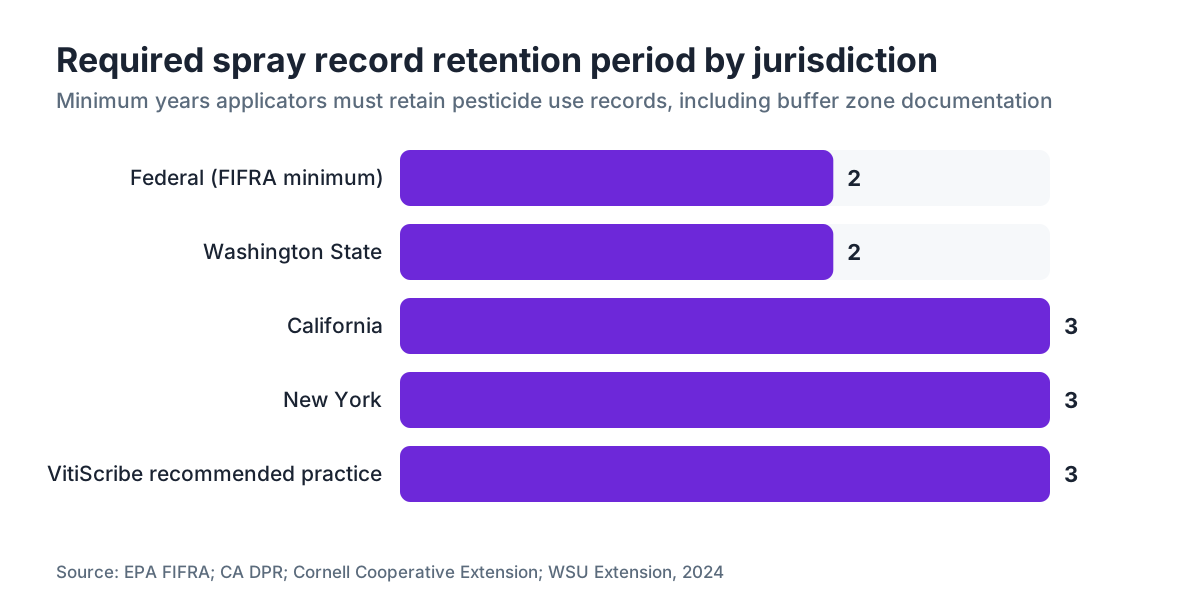
FIFRA requires commercial pesticide applicators to keep records for two years from the date of application [1]. That's the federal floor. Several states want longer.
California requires pesticide use reports submitted monthly to the county agricultural commissioner and records held for three years [3]. New York requires private applicators to keep records for three years [6]. Washington sets a two-year minimum for commercial applicators but its extension advisors recommend three [4].
My advice: keep everything for three years, minimum. Buffer disputes with neighbors or regulators can take a year or two to surface, and you want records that predate the complaint.
Store records so you can produce them fast. An inspector who shows up with a notice of investigation usually gives you 24 to 48 hours to hand over records. If your logs sit in a shoebox sorted by product name instead of date and field, that's a painful afternoon. Digital records in a cloud-based vineyard operations platform (VitiScribe, for instance, was built to organize spray records by block, date, and product with searchable buffer fields) let you pull a full application history for a specific field in under two minutes.
For records with GPS attachments or photographs, make sure your backup preserves the metadata. A JPEG with its EXIF data stripped is much weaker as evidence than the original file.
What are the most common buffer zone documentation mistakes vineyards make?
Reviewing guidance from UC Davis Integrated Pest Management, Cornell's agriculture and pesticide compliance resources, and Washington State University's pesticide safety program, a few failure modes come up again and again.
Not copying the buffer from the current label. Labels get revised, sometimes mid-season. If you downloaded the label in January and the manufacturer issued a version with a longer buffer in March, you're on the hook for the current version. EPA's Pesticide Product Label System is the official source [5]. Verify which version you're using and note the label date in your log.
Logging the required buffer but not the actual distance. Writing "50 ft buffer required" is not compliance documentation. "50 ft required, 65 ft maintained" is.
Missing wind data for products where wind speed triggers reduced-buffer eligibility. Claim a drift-reduction credit with no wind speed recorded, and the credit is unverifiable.
Not separating AEZ compliance from label buffer compliance. They're different rules. Your log addresses both.
Failing to note adjacent land use. If an inspector can't tell from your log what the buffer protects, they'll assume the worst-case sensitive area and check whether your distance covered it.
Mixing up REI and buffer re-entry. The REI governs when workers can re-enter the treated area. The buffer governs where the pesticide can be applied. Separate things. A worker can re-enter a treated block after the REI without touching the buffer, but if anyone was inside the buffer during application, that's an AEZ violation regardless of REI.
How do state auditors actually review buffer zone records?
Most vineyard pesticide audits in California, Washington, and New York run the same way. The inspector arrives (sometimes unannounced, sometimes scheduled), asks for pesticide use records for a set date range, and cross-references your spray logs against three things: the product labels (they pull the current version themselves), any county permits, and any adjacent sensitive-area maps.
California county agricultural commissioners must inspect growers holding restricted-materials permits at least once per permit year [3]. The inspection focuses on whether the application matched the permit conditions, which include buffer requirements. If your log shows an application right up to a property line and the adjacent parcel is a school, expect questions.
Washington's WSDA Pesticide Management Division leans on a complaint-driven model more than scheduled inspections, but the record review is the same [4]. Oregon Department of Agriculture follows similar protocols.
Inspectors aren't assuming guilt. They're matching your records against the label. If your records are complete and internally consistent, most inspectors move on fast. The ones who get fined are usually the ones whose logs skip fields, carry round numbers that look estimated ("wind: light"), or don't exist at all for the application in question.
UC Davis IPM recommends keeping a photocopy or digital photo of the specific label version used for each application, attached to the matching log entry [7]. That one step kills the most common dispute about which buffer language was in effect.
Are there digital tools that help with buffer zone log compliance?
Yes, and they're worth using. Paper logs are legal and fine, but they have two steady problems: fields get skipped when operators are tired or rushed, and they're slow to search when you need records under pressure.
A purpose-built vineyard record-keeping platform solves both. It prompts for required fields at entry time (you can't submit without a wind speed) and indexes everything by date, block, and product, so you produce a full application history in seconds. VitiScribe was designed for vineyard spray record compliance and includes buffer zone fields, AEZ documentation prompts, and label version tracking.
That said, any systematic approach works. A well-built Excel template with required fields and drop-down validation beats a free-form notebook every time. Cornell's Agricultural Workforce Development program publishes a free spray record template with buffer fields through Cooperative Extension [10].
GPS mapping adds real value for buffer verification. Map your blocks and mark your sensitive areas (ditches, property lines, residences) as polygons in the same system, and you can generate a distance report automatically. Some precision viticulture platforms fold this into spray records. Even if yours doesn't, exporting the distance from a GIS layer and attaching it to your log meets the documented-measurement standard auditors want.
The one thing digital tools don't replace: you still record wind speed yourself. No commercially available spray log system pulls real-time weather from a certified on-site sensor by default. Buy a pocket anemometer (a Kestrel 1000 or similar runs about $30 to $50), keep it in the sprayer cab, and record readings at the start and end of each application. That $40 is the cheapest compliance insurance you can buy.
What records should you keep beyond the spray log itself?
The spray log is the core document, but a complete buffer zone file has several supporting records that make the log defensible.
Seasonal setup records. One document per field, per season, capturing the GPS coordinates or measured distances from each block boundary to adjacent sensitive areas. Reference it in every log entry for that block. Update it when the adjacent land use changes (a vacant lot that becomes a daycare changes your buffer requirements immediately).
Label copies. Keep a PDF of every label version you use, stamped with the download date. EPA label changes are infrequent, but they happen, and the label in effect at application time governs.
Permit copies. Any state or county restricted-materials permit that specifies buffer conditions belongs in the same file as your logs for that product.
Equipment calibration and nozzle records. A drift-reduction credit that shrinks your required buffer is tied to specific nozzle types. Keep nozzle purchase receipts or inventory records showing what's installed on the sprayer, and date your nozzle changes. If a $500 fine lands because you claimed a 50% drift-reduction credit with standard flat-fan nozzles, that's an expensive lesson.
Weather station records or anemometer readings. If a Mesonet station or CIMIS station sits nearby, you can cross-reference their published hourly wind data against your log as a second check. Optional, but useful if a dispute over conditions comes up.
For California operations near sensitive sites, notice records. Some counties require written notice to adjacent property owners before certain restricted-material applications. Keep copies of the notices and any confirmation of receipt.
Frequently asked questions
What is the minimum spray log information required by federal law for pesticide buffer compliance?
FIFRA requires commercial applicators to record the product name, EPA registration number, total amount applied, application date, location, and the crop or site treated. That's the federal minimum, but it doesn't capture buffer-specific data. To demonstrate buffer compliance, you also need the label-required buffer distance, the actual distance maintained, wind speed and direction, and adjacent land use. State requirements often add to this list.
Do I need to log buffer zones for every pesticide application or only restricted materials?
Document buffer compliance for every application where the label specifies a buffer distance, regardless of whether the product is a restricted material. General-use pesticides can and do carry water or residential buffer requirements. Restricted materials typically have stricter buffers and county permit conditions on top, but the label is the trigger, not the restriction category. If it's on the label, it's enforceable.
What is the EPA Application Exclusion Zone and is it the same as a label buffer?
They're different. The EPA's Application Exclusion Zone (AEZ), established under the 2015 Worker Protection Standard revision, prohibits unprotected people from being within 100 feet of operating ground application equipment during spraying. It's a people-protection rule. A label buffer is a geographic standoff from sensitive areas (water, residences) that restricts where you can apply. Both apply at the same time. Your log should address them separately.
How do low-drift nozzles affect required buffer distances and what do I need to log?
Some EPA-registered pesticide labels allow a reduced buffer distance if you use nozzles certified to cut spray drift by a stated percentage (often 50% or 90%). Claim that credit and your log must record the nozzle model, the certified drift reduction percentage, the wind speed at application (most labels void the credit above 10 mph), and the resulting adjusted buffer. Without those details, you can't prove you were entitled to the shorter buffer.
How long do I need to keep spray records that document buffer zone compliance?
FIFRA sets a two-year minimum for commercial applicators. California requires three years plus monthly county reporting. New York requires three years for private applicators. Washington requires two years but extension advisors recommend three. The practical answer: keep everything for three years in a format you can search quickly, because buffer zone complaints often surface a year or more after the application in question.
What happens if a state inspector finds my buffer zone log is incomplete?
Outcomes range from a written warning for first-time missing fields to civil penalties for repeated or serious violations. Under FIFRA, violations can carry substantial civil penalties per violation. Loss of a restricted-materials permit is a more immediate operational problem than the fine itself. An incomplete log doesn't automatically mean you violated the buffer, but it removes your ability to prove you didn't, which is usually how the case gets decided.
Can GPS coordinates substitute for physically measuring a buffer distance?
Yes, and in most cases GPS is more defensible than a measuring wheel because it's verifiable and tied to a specific time. If you have GPS shapefiles of your blocks and can document the distance from the nearest spray pass to the sensitive area using GIS software, that output is strong compliance evidence. Record the coordinate system, the date of measurement, and the tool or software used. Attach the output file or screenshot to your seasonal setup record.
What adjacent land uses trigger the strictest buffer requirements on pesticide labels?
Water bodies (streams, ponds, wetlands, and storm drains that connect to waterways) consistently trigger the strictest buffers, sometimes 300 feet or more for aerial applications of certain insecticides. Schools and daycares trigger specific state-level requirements in California beyond the federal label. Residences and adjacent property lines typically trigger bystander buffers separate from water buffers. Check the label for each category separately.
Do I need to document buffer compliance for cover crop herbicide applications between rows?
If the herbicide label specifies a buffer distance to water or adjacent land uses, yes. In-row or inter-row vineyard herbicide applications are still subject to label buffer requirements even though they aren't full-canopy spray events. The rate is usually lower and drift risk is minimal with ground equipment, but the legal requirement is tied to the label, not the application method. Check the label. If it lists a buffer, log it.
What wind speed should I log and how often during an application?
Log wind speed at the start of the application and at the end, at minimum. For long spray sessions (over two hours) or on days with variable conditions, record it mid-application too. Use a calibrated anemometer at application height, not an estimate. Some labels specify the measurement must be taken at boom height or nozzle height. A Kestrel pocket anemometer is the standard field tool and costs roughly $30 to $50.
What should I do if wind picks up mid-application and I can no longer maintain the required buffer?
Stop spraying. Document the time you stopped, the wind speed at that point, and the reason. Then document when you resumed if conditions improved. Continuing to spray when wind voids your buffer eligibility (or exceeds label limits) is a violation even if you were compliant at the start. A log that shows a mid-application stop because of wind is evidence of good-faith compliance behavior, not a red flag.
Does the buffer zone log requirement apply to organic or biological pesticides?
Yes, with the same basic framework. Even OMRI-listed organic pesticides registered with the EPA carry an EPA registration number and a label. If the label specifies a buffer (some copper fungicides, for example, carry water buffers), that buffer is legally enforceable and should be logged. The recordkeeping requirements under FIFRA apply based on the product's registration, not its organic status.
Is there a standardized spray log template I can use that already includes buffer zone fields?
Cornell Cooperative Extension and UC Davis IPM both publish sample spray log templates that include many of the required fields. Neither template was designed around buffer zone compliance as its main focus, so you may need to add fields for actual buffer distance, adjacent land use, and nozzle type for drift-reduction credits. Washington State University's pesticide safety program also has logging resources. Review any template against your state's specific requirements before relying on it.
How do I document buffer zone compliance for a block that borders multiple different sensitive areas?
Log each sensitive area separately in the same record. List the adjacent land use type (seasonal ditch, residential property, school), the buffer required by the label or permit for that specific land use, and the actual distance maintained to each one. If one side of the block borders water at 40 feet and another side borders a residence at 200 feet, both measurements belong in the log. Auditors check the most restrictive boundary first.
Sources
- EPA, Pesticide Registration and FIFRA recordkeeping requirements: Under FIFRA, the pesticide label is a legal document; commercial applicators must retain use records for two years including product name, EPA registration number, amount applied, date, location, and crop.
- EPA, Agricultural Worker Protection Standard (WPS): The 2015 WPS revision established the Application Exclusion Zone requiring that no unprotected person be within 100 feet of operating ground application equipment during pesticide application; the standard states 'The agricultural employer must not apply a pesticide in a manner that allows the pesticide to contact, directly or through drift, anyone other than appropriately trained and equipped handlers.'
- California Department of Pesticide Regulation, Pesticide Use Reporting and enforcement: California requires pesticide use reports to be submitted monthly to the county agricultural commissioner and records retained for three years; county agricultural commissioners must inspect growers with restricted-materials permits at least once per permit year.
- Washington State University, Urban IPM and Pesticide Safety Education Program: WSU Extension notes buffer zone violations are among the top five reasons growers receive formal notices of noncompliance in the Pacific Northwest; Washington requires commercial applicators to retain records for two years.
- EPA, Pesticide Product Label System (PPLS) database: EPA's current label registration system requires registrants to specify buffer zones using either fixed numeric distances or a drift reduction credit system tied to certified nozzle types; the label version in effect at the time of application governs legal compliance.
- Cornell Cooperative Extension, pesticide recordkeeping for New York certified applicators: New York requires private applicators to retain pesticide use records for three years; Cornell's pest management guidelines recommend photographing buffer boundary conditions with timestamped images linked to field records at the start of each season.
- University of California Statewide Integrated Pest Management Program: UC Davis IPM recommends keeping a photocopy or digital photo of the specific label version used for each application attached to the corresponding log entry to eliminate disputes about which buffer language was in effect.
- WSU PICOL (Pesticide Information Center Online) Label Database: PICOL is maintained by Washington State University and provides cross-reference access to pesticide label language, including buffer zone provisions, for registered products in the Pacific Northwest.
- EPA, Endangered Species Protection Program and Bulletins Live! Two: For organophosphate products on the EPA Endangered Species Protection Program list, county-level buffer maps specify additional restricted areas near mapped critical habitat that applicators must consult and document before application.
- Cornell Cooperative Extension, Agricultural Workforce Development spray record and WPS resources: Cornell's Agricultural Workforce Development program has published spray record templates including buffer zone fields as part of WPS compliance training materials available through Cooperative Extension.
Last updated 2026-07-11