Recording water volume per acre for different vineyard canopy densities

TL;DR
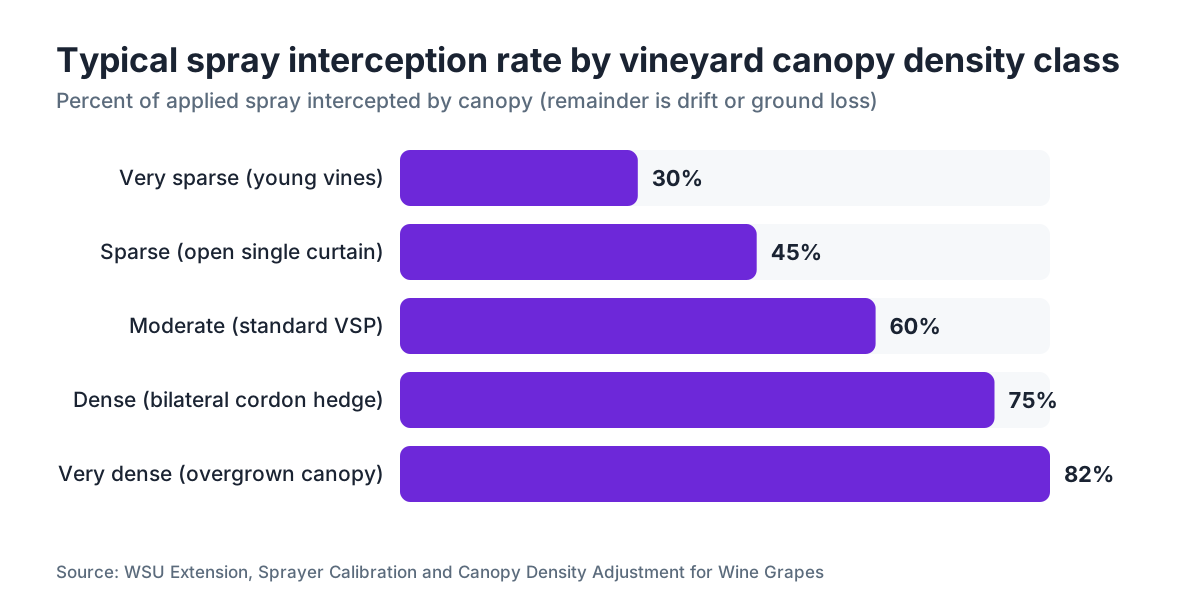
- Water volume records per acre have to account for canopy density, because a sparse open-canopy block can intercept as little as 30% of applied spray while a dense canopy catches over 80%.
- Accurate per-acre recording means measuring canopy volume or leaf wall area, adjusting the rate, and logging the calibrated output.
- EPA's Worker Protection Standard and most state ag departments require those records be kept at least two years.
Why does canopy density change how you record water volume per acre?
A flat per-acre rate on a spray record tells the inspector one number. It tells you almost nothing about whether you actually put the pesticide where the biology is. Canopy density is the variable that connects those two things.
Vine canopies vary enormously, even inside one estate. A second-leaf Syrah block on a minimal trellis has almost no interception surface. A mature, shoot-positioned Chardonnay hedged to a 4-foot wall is a completely different target. Apply 100 gallons per acre to both and write the same number on both records, and you've made a record that's technically complete and practically misleading.
The compliance angle goes past accuracy. The EPA Worker Protection Standard requires application records to include the amount of pesticide applied, and state programs (California's DPR, the Washington State Department of Agriculture, New York's DEC) increasingly expect that "amount applied" to be defensible, meaning calibrated to the real target [1]. When an inspector asks how you got your gallons-per-acre figure for a block whose canopy barely filled the trellis, "that's what the label said" is a weak answer.
Canopy density sets deposition efficiency. WSU extension work on airblast output found interception in wine grape canopies ran from roughly 30% in open, minimally trained systems to over 80% in dense bilateral cordon hedges, with the rest lost to ground and air [2]. That spread is wide enough to matter for water use, active-ingredient load math, and re-entry timing. Recording water volume without noting canopy density is like recording fuel burn without noting whether the tank was full.
What canopy measurement methods give you defensible data for your records?
Three approaches show up in practice, from quick field estimates to instrumented readings. Each fits a different level of precision.
Leaf Wall Area (LWA). This is the field method most growers use. You measure canopy wall height and length per block, then figure square feet per acre. Cornell Cooperative Extension and UC Davis both publish LWA-based spray calibration guides that turn the measurement into a target volume adjustment factor [3][4]. The math is simple. If your reference canopy (the one you calibrated the sprayer on) has an LWA of 10,000 sq ft per acre and your block has 6,000, you cut water volume by about 40%.
Tree Row Volume (TRV). Built first for tree fruit, TRV also fits high-canopy trellis systems like Smart-Dyson or high VSP. Multiply canopy height by canopy width by row spacing to get cubic feet per acre. WSU extension uses TRV tables to recommend gallon-per-acre rates tied to specific canopy volumes [2]. TRV captures both height and depth, which LWA misses when canopies are layered or unusually deep.
Percent canopy cover from photo analysis. Smartphone apps and drone imagery estimate percent cover by reading light interception. Less standardized, but gaining ground. UC Davis has published work using hemispherical photography to estimate canopy gap fraction [4]. The record-keeping catch: a cover percentage still needs a conversion factor to become a gallon-per-acre recommendation, and that factor shifts with row orientation, trellis height, and sprayer type.
For most small to mid-size operations, LWA is the right call. It takes about 10 minutes a block, needs a tape measure, and produces numbers that plug straight into published calibration tables. Do it once at veraison when the canopy is near maximum density, write the measurement into your block file, and reference it every time you log a water volume for that block.
How do you actually calculate adjusted water volume per acre once you have canopy data?
Start from a calibrated base rate. Most airblast sprayers are set to deliver a specific gallon-per-acre output at a given speed and nozzle setup. That base rate assumes a reference canopy, usually the average-density block the operator happened to calibrate in. Your job is to scale that base rate up or down for every other block.
LWA gives you a ratio. Say your base calibration block has an LWA of 11,000 sq ft per acre and your sparse young-vine block measures 5,500. The ratio is 0.5. If your base rate is 80 gallons per acre, your adjusted rate for the sparse block is 40 gallons per acre. That 40 gal/ac is what you record. Not 80.
TRV works the same way. WSU's canopy density adjustment table (available through WSU extension) maps TRV ranges to recommended concentrate-spray volumes. A canopy under 50,000 cubic feet per acre might call for 15 to 25 GPA, while one over 200,000 cubic feet per acre might call for 60 to 80 GPA [2].
A quick-reference table for the season:
| Canopy Density Class | LWA (sq ft/acre) | Approx. TRV (cu ft/acre) | Typical Adjusted GPA Range |
|---|---|---|---|
| Very sparse (young vines, minimal shoot growth) | < 5,000 | < 50,000 | 15-30 |
| Sparse (open canopy, single curtain) | 5,000-8,000 | 50,000-100,000 | 30-50 |
| Moderate (standard VSP, well-managed hedge) | 8,000-12,000 | 100,000-160,000 | 50-75 |
| Dense (bilateral cordon, poor shoot positioning) | 12,000-16,000 | 160,000-220,000 | 75-100 |
| Very dense (neglected, overgrown) | > 16,000 | > 220,000 | 100-125+ |
These ranges come from Cornell and WSU extension guidelines and assume a conventional airblast sprayer [2][3]. Tunnel sprayers and precision air-induction rigs have different efficiency curves and need their own calibration data.
The number you write on the spray record is the adjusted rate, the one that reflects what the sprayer actually put on that specific block. Keep the LWA or TRV measurement that produced it in the same record or a block file you can pull in seconds.
What information must a water volume record legally contain?
Federal baseline requirements for pesticide application records come from the EPA Worker Protection Standard (WPS) at 40 CFR Part 170 and the FIFRA record-keeping rule at 40 CFR Part 171 [1][5]. For agricultural applications, the WPS requires records that include the product name and EPA registration number, the active ingredient, the application location, the date, and the amount applied per acre. Records have to be kept at least two years and made available to authorized inspectors.
Notice the WPS phrase: "amount applied per acre." The rule doesn't say you must record canopy density, but it does require the rate to be accurate. If your record says 80 GPA and the sprayer delivered 40 because you adjusted for a sparse canopy and never documented the adjustment, you've built a discrepancy an inspector can and will question.
State requirements stack on top of the federal floor. California's Department of Pesticide Regulation requires a Pesticide Use Report (PUR) for every restricted material application, and the reported rate has to match the label and the actual delivery [6]. New York requires commercial applicator spray records to show the equipment used and how the rate was set for any pesticide applied in a restricted manner [11]. Washington requires licensed commercial applicators to keep records matching WPS minimums, plus site-specific fields on certain materials [10].
So the practical record is this: the actual delivered rate, the method you used to get it (LWA ratio, TRV table, or other), the block ID and acreage, the date, and the equipment settings. That combination makes the record defensible and reproducible. If you ever get audited, you want to show not only what you applied but why that rate fit that specific canopy.
How long do you have to keep spray records and who can inspect them?
Two years is the federal floor under FIFRA and the WPS [1][5]. Several states go longer. California requires PUR records be kept three years, and the DPR or county agricultural commissioner can request them any time [6]. New York's DEC requires commercial applicator records for three years as well [11]. Always check your state's current rule, because these get updated.
Who can inspect them? Under the WPS, EPA inspectors, state ag department officials, and county commissioners all have access. The 2015 WPS revision strengthened enforcement authority, including the right to require records from the farm operator, the certified applicator, or both [9]. Under FIFRA Section 8, the Administrator can require any record tied to the production, distribution, or use of a registered pesticide.
This is where a structured system pays off. A binder of handwritten spray tickets is technically compliant, but pulling the exact block, rate, and canopy data for an inspector on short notice is far faster when records are organized by block and date. Tools like VitiScribe are built for this, letting you attach LWA measurements and calibration notes to each spray event so the supporting data rides with the record.
One thing that surprises growers: records for restricted-use pesticides may need to be available beyond regulators, reaching neighboring residents under some state right-to-know rules. California's right-to-know provisions let residents near treated fields request spray use records through the county commissioner's office [6].
Does canopy density affect re-entry intervals or worker safety records?
Yes, but in a narrow way. The re-entry interval (REI) printed on a label is fixed. It doesn't move with canopy density. The REI clock starts at application completion, and whether workers were properly kept out during a dense-canopy application with higher drift can become a compliance question if the record doesn't clearly show timing and boundaries.
The more direct link is the WPS requirement that handler records (the people applying the pesticide) reflect actual conditions. If a dense canopy needed multiple passes at reduced forward speed, raising total application time and possible handler exposure, that belongs in the application record. WPS handler training and decontamination requirements don't change by canopy type, but exposure duration does.
For re-entry, dense canopies dry slower. A contact fungicide laid onto a dense, poorly ventilated canopy may still have residue on leaf surfaces past the standard REI drying assumption. Cornell extension guidance notes that workers should not re-enter until sprays are dry, and that dense canopy conditions can extend effective drying time [3]. That isn't a record-keeping requirement by itself, but the on-site information (the WPS-required safety data sheet and application record posted at the field) should reflect the real application conditions.
Short version: REIs don't change by canopy density, but your records should capture any unusual conditions (dense canopy, slow application, delayed drying) that could change how a supervisor reads the re-entry window.
How do irrigation water volume records differ from spray records for canopy density purposes?
This is a different compliance world, but canopy density matters here too, for a different reason.
For spray records, canopy density drives the rate calculation and the defensibility of your recorded GPA. For irrigation, canopy density is a proxy for crop evapotranspiration (ETc), which drives how much water you actually need per acre. The two record types often live in separate systems, but they should point to the same canopy data.
California's Sustainable Groundwater Management Act (SGMA) and its reporting requirements ask irrigators in adjudicated basins to report applied water in acre-feet per acre [7]. Getting that number right means knowing your ETc, which UC Cooperative Extension and the California Irrigation Management Information System (CIMIS) publish as reference ET adjusted by crop coefficients for grapevines at different canopy stages [8]. A block at 30% canopy cover has a much lower crop coefficient (Kc) than one at 80%, and the reported irrigation volume should show that gap.
For water districts that require use reporting, the record needs the block ID, acreage, water source, date and duration, and the method used to figure the applied amount (meter reading, pump output curve, or other). Canopy density tells you whether your applied amount makes agronomic sense. An auditor reviewing irrigation records for a young-vine block with sparse canopy will raise a flag if the applied volume matches a mature, dense-canopy reference without explanation.
Practical advice: keep your canopy density measurements in one block file that both your spray records and your irrigation records can reference. Both are justified by the same field measurement.
What's the best field workflow for recording these measurements during the growing season?
The error-prone move is measuring at spray time, tank pressurized, crew standing around. Don't do that.
Measure LWA or estimate canopy density class once during shoot growth, around the 10 to 14 inch shoot stage, and again at veraison when the canopy is near maximum density. Write both measurements into a permanent block record. Those two figures drive your calibration for the whole season.
Here's a workflow that holds up:
- Walk each block in mid-June (or the equivalent for your region). Measure canopy height and the length of one representative row. Calculate LWA with: LWA (sq ft/acre) = canopy height (ft) x vine row length per acre (ft). Row length per acre = 43,560 / row spacing (ft).
- Assign each block a density class (use the table above). Note any blocks that changed class since last year, which happens as young vines fill in or after a block needs severe canopy correction.
- Calibrate or verify sprayer output in GPA at the speed and nozzle setup you'll run, using a catch-and-measure procedure. WSU extension's sprayer calibration guide has a clear protocol [2].
- Calculate the density adjustment ratio for each block and write it on the block card or in your record-keeping system.
- At each spray event, pull the block's adjusted rate, confirm conditions haven't shifted (heavy shoot growth after a wet spring can bump a block up a class), and record the adjusted GPA as the actual delivered rate.
This runs maybe 2 hours at the start of the season for a 50-acre vineyard with 8 to 10 blocks. Worth every minute when an inspector asks you to justify a rate that looks low for a product's efficacy recommendation.
How do electronic record-keeping systems handle canopy density adjustments?
Most vineyard record-keeping software, including purpose-built tools like VitiScribe, stores block-level attributes including canopy measurements and density class. The good ones let you attach those attributes to each spray event so the record is self-contained. The weak ones make you keep canopy data in a separate spreadsheet and reconcile it by hand, which is exactly where errors slip in.
Minimum you want from any digital system: a block record that stores LWA or TRV with the date measured, a spray event form that references the block record and pre-fills the density-adjusted GPA range, and an export format that satisfies state PUR or equivalent reporting.
Paper still works. A well-built spray ticket with a dedicated field for "canopy density class" and "LWA or TRV measured value" alongside the standard pesticide, rate, and date fields is fully compliant. The problems with paper are search time during an audit and the risk of losing records to a barn fire or a flood. The EPA doesn't dictate record format, only content and retention, so the choice between paper and digital is yours, based on your operation's size and record volume.
For growers filing California PURs, the county commissioner's office has specific electronic filing requirements for operations above certain thresholds. Check with your county for the current filing method, because it varies by county and shifts as DPR upgrades its systems [6].
What mistakes do growers commonly make in per-acre water volume records?
Most common: recording the label's maximum rate or the sprayer's base-calibrated rate for every block regardless of actual canopy. That inflates applied volume on sparse blocks and builds a record that doesn't match what got delivered.
Second most common: recording total tank volume instead of gallons per acre. "I used 500 gallons in block 7" isn't a per-acre record unless you also note the block acreage and do the math. The record needs the per-acre figure. Always.
Third: not updating canopy data year to year. A block at 7,000 sq ft LWA in its third leaf might hit 11,000 in its sixth. A stale LWA creates the same problem as never measuring.
Fourth: recording the planned rate instead of the actual delivered rate. If weather stopped you halfway through a block, or a nozzle clogged and you didn't catch it until two rows in, the delivered rate is different from the plan. Record what the sprayer actually did, with a note on the partial application.
Fifth: skipping the re-read check. Before you close a spray event record, re-read the block acreage, the delivered GPA, and back-calculate to total gallons. If total gallons doesn't match your tank fill log, one of the numbers is wrong. Find out which one before the record gets filed.
Are there specific university or extension resources for canopy-adjusted spray calibration?
Yes, and they're free.
WSU extension's publication on airblast sprayer calibration and canopy density adjustment is the most practical field guide out there for wine grape operations in the Pacific Northwest [2]. It has TRV tables, speed and nozzle charts, and worked examples. Download it, print it, drop it in the spray equipment binder.
Cornell Cooperative Extension's IPM program has published LWA-based calibration guides for northeastern grape production, including how to adjust rates for open-lyre and Geneva Double Curtain training systems that WSU's Pacific Northwest material doesn't always cover [3]. Their spray application technology pages live on Cornell's NYSAES campus site.
UC Davis and UC Cooperative Extension publish canopy management and spray application guidance through their Viticulture and Enology department and the UC IPM program [4]. UC's material leans toward drip-irrigated systems and the link between irrigation-driven vine vigor and canopy density, which hits home in California's Central Valley and coastal valleys.
The EPA's Worker Protection Standard resources at epa.gov explain the federal record-keeping requirements and include plain-language guides for small farms [1]. Reading the actual regulation text (40 CFR Part 170) is useful once, even if you don't enjoy regulatory prose, because it clarifies exactly what "amount applied" requires and what supporting documentation the agency expects.
For calibration equipment, the Sprayer Calibration app from University of Nebraska Extension walks the catch-and-measure procedure, though it isn't wine-grape-specific. The core math holds regardless of crop.
Frequently asked questions
Do I have to record canopy density measurements on every spray record?
No federal rule specifically requires canopy density on a spray record. FIFRA and the WPS require the recorded gallons-per-acre figure to be accurate and defensible. Keeping canopy measurements in a block file you reference when setting rates, rather than copying them onto every ticket, is fully compliant as long as the link between the measurement and the rate is clear and retrievable.
What is leaf wall area and how do I measure it in the vineyard?
Leaf wall area (LWA) is the surface area of the canopy wall in square feet per acre. Measure average canopy height with a tape at several representative vine locations in a block. Calculate row length per acre by dividing 43,560 by your row spacing in feet. Multiply height by row length for LWA in square feet per acre. Cornell and WSU extension both publish tables that convert this figure to a recommended spray volume range.
How often should I re-measure canopy density during the season?
For most operations, two measurements per season are enough: one at the 10 to 14 inch shoot stage in late May or early June, and one near veraison when the canopy peaks. If your vineyard had a very wet spring and pushed heavy growth, or you ran a heavy green thinning program, re-check any blocks that might have shifted density class before your mid-season spray events.
Does water volume per acre change with row spacing, or just canopy density?
Both matter. Wider row spacing cuts total canopy surface per acre regardless of how dense any single vine is. Tree Row Volume (TRV) captures this because it multiplies canopy dimensions by row spacing. A dense canopy in 12-foot rows has far less total canopy per acre than the same density in 7-foot rows. Your per-acre water volume should reflect the TRV or LWA from your actual row spacing, not a generic industry average.
Can I use drone-based canopy mapping for my spray records?
Drone canopy mapping can give defensible canopy cover estimates if the methodology is documented and reproducible. The hurdle is converting a percent cover figure to a gallons-per-acre recommendation, which needs a conversion protocol tied to published research or your own calibration data. As of now, no state PUR system specifically accepts drone canopy data as a primary calibration source, but it can back up a traditional LWA or TRV calculation.
How does canopy density affect the accuracy of my pesticide use reports?
If you report a rate calibrated for a denser block and apply it uniformly across less dense blocks, your reported total pounds of active ingredient will be overstated. California's DPR PUR data feeds environmental load modeling, so systematic overreporting has regulatory effects beyond your own operation. Accurate density-adjusted rates produce PUR reports that reflect what you actually put in the field, which matters for your records and for industry-wide data integrity.
What's the minimum record a small vineyard owner needs for a spray event?
Under the WPS and FIFRA, a compliant spray record includes product name, EPA registration number, active ingredient, application site (block ID and acreage), date, and amount applied per acre. For PUR states like California, add application method, equipment, start and end times, and the certified applicator's name. Canopy density isn't a mandatory field, but the GPA figure must be defensible, which means keeping the measurement that justifies it in your files.
How do I handle a block with highly variable canopy density across rows or sections?
Split the block into sub-blocks by density class and record each one separately with its own LWA measurement and adjusted GPA. That's more paperwork, but it's the accurate route. Alternatively, apply at the rate for the densest section and note that the rate was set conservatively to the maximum observed density. The first approach is more precise. The second is simpler but wastes material and water on sparse sections.
Does the EPA Worker Protection Standard require me to post water volume records at the field?
The WPS requires posting an application-specific information sheet at the establishment's central location before workers or handlers enter a treated area. That sheet must show the product name, active ingredient, REI, and the location of the treated area. It does not specifically require water volume or GPA on the posted notice, but records with that data must be available for inspection. The full requirement is in 40 CFR Part 170.
Is tree row volume or leaf wall area better for wine grape spray calibration?
For most VSP and hedged canopy systems, LWA is simpler and adequate. TRV adds value when canopy depth varies a lot across blocks, such as bilateral cordon systems with wide shoot walls, or high-trellis systems like Smart-Dyson. WSU extension uses TRV as its primary calibration framework for Pacific Northwest wine grapes, while Cornell and UC Davis lean toward LWA. Use the method that matches your dominant training system and the reference tables available for your region.
How do I record a water volume adjustment if I stopped a spray partway through a block?
Record the actual acreage treated, not the block's full acreage. Note the delivered GPA for the portion treated and add a field note explaining why it was incomplete: equipment failure, weather, or a crew stop. This partial record matters because the REI and re-entry restrictions apply to the treated portion regardless of whether the full block was covered. Regulators expect records to reflect reality, not plans.
Do irrigation water volume records have the same retention requirements as spray records?
Not under the WPS, which only covers pesticide applications. Irrigation record requirements depend on your state and, increasingly, on your groundwater management plan under programs like California's SGMA. California irrigators in adjudicated basins subject to SGMA reporting may need to keep water use records for periods set in their local Groundwater Sustainability Agency's plan, which commonly runs two to five years. Check with your local water district or GSA for the current requirement in your basin.
Can the same per-acre water volume work for both a fungicide and an insecticide application in the same block?
Only if both products are calibrated for the same canopy density and need the same coverage standard. Some fungicides targeting downy or powdery mildew need thorough coverage of all leaf surfaces, which demands more volume than a systemic insecticide that only needs to contact part of the canopy for uptake. Read each label's coverage requirements on their own. Water is the carrier. The biology of coverage decides whether the rate is right, and that should show in your records.
Sources
- EPA, Worker Protection Standard (40 CFR Part 170): WPS requires pesticide application records including amount applied per acre, retained for two years, accessible to inspectors
- WSU Extension, Sprayer Calibration and Canopy Density Adjustment for Wine Grapes: WSU research found airblast sprayer interception rates in wine grape canopies range from roughly 30% in open systems to over 80% in dense hedges; TRV tables map canopy volume to recommended GPA ranges
- Cornell Cooperative Extension, New York State Integrated Pest Management Program: Cornell publishes LWA-based spray calibration guides for northeastern grape production, including open-lyre and Geneva Double Curtain adjustments, and notes workers should not re-enter until sprays are dry
- UC Davis Viticulture and Enology / UC IPM Program: UC Davis and UC IPM publish canopy management and spray application guidance; UC IPM uses hemispherical photography to estimate canopy gap fraction and crop coefficients at different canopy development stages
- EPA, FIFRA Pesticide Recordkeeping (40 CFR Part 171): FIFRA record-keeping rule sets a two-year retention floor for agricultural pesticide application records
- California Department of Pesticide Regulation, Pesticide Use Reporting: California DPR requires a Pesticide Use Report for every restricted material application; reported rate must match label and actual delivery; records kept for three years; county agricultural commissioner has access, and right-to-know provisions allow residents to request records
- California Department of Water Resources, Sustainable Groundwater Management Act: SGMA and associated reporting requirements ask irrigators in adjudicated basins to report applied water in acre-feet per acre; retention periods vary by local Groundwater Sustainability Agency plan
- UC Cooperative Extension / CIMIS, Reference Evapotranspiration and Crop Coefficients for Grapevines: CIMIS publishes reference ET adjusted by crop coefficients for grapevines at different canopy development stages; a block at 30% canopy cover has a substantially lower Kc than one at 80%
- EPA, 2015 Revised Worker Protection Standard Federal Register: The 2015 WPS revision strengthened enforcement authority including the right to require records from the farm operator, the certified applicator, or both
- Washington State Department of Agriculture, Pesticide Management Division: Washington State requires licensed commercial applicators to keep records matching WPS minimums with additional fields for site-specific conditions on certain restricted materials
- New York State DEC, Pesticide Applicator Certification and Record-Keeping Requirements: New York State requires commercial applicator spray records for three years; records must include equipment used and how the rate was determined for restricted pesticides
Last updated 2026-07-10