Vineyard crop insurance documentation requirements for USDA programs

TL;DR
- USDA's Risk Management Agency insures wine grapes under the Actual Production History (APH) plan and the Whole-Farm Revenue Protection plan.
- To qualify and file a valid claim, you need signed acreage reports by the reporting deadline (July 15 in most western states), up to ten years of production records, spray and cultural practice logs, and a loss notice filed within 72 hours of damage.
- Miss one and the claim can void.
What USDA crop insurance programs actually cover vineyards?
Two programs cover wine and table grapes under USDA's Risk Management Agency (RMA): Actual Production History (APH) crop insurance and Whole-Farm Revenue Protection (WFRP). A third, the Noninsured Crop Disaster Assistance Program (NAP), kicks in when no private APH policy exists for your county. Each has its own paperwork rules. Picking the wrong one for your operation is a mistake plenty of small vineyards make.
APH is the workhorse for dedicated grape operations. It covers yield losses from insurable causes (frost, hail, drought, disease when it's not caused by poor practices) and pays based on your established average yield multiplied by the price election you choose at sign-up. The 2024 price election for wine grapes varies by variety and state. RMA publishes an actuarial data tool where you look up your county's specific numbers before the sales closing date [8].
WFRP works differently. It insures your whole farm's revenue, grapes and everything else, and it earns its keep if you grow multiple crops or pull real income from several commodities. The coverage cap is $8.5 million in insured revenue for the 2024 program year [2]. For a small estate vineyard that also sells olives or cut flowers, WFRP can beat juggling separate commodity policies.
NAP is the fallback. If your county has no APH plan for your grape type, you buy NAP coverage through your local USDA Farm Service Agency (FSA) office. Service fees run up to $325 per crop per county, capped at $825 per producer per county and $1,950 nationally [3]. NAP documentation mirrors APH in most respects, but FSA administers it, not RMA. That difference matters when you file paperwork.
What production records do you need to establish your APH yield?
RMA uses up to ten consecutive crop years of production records to build your Approved Yield (the APH yield). Fewer years are allowed if you're a new producer or the records don't exist, but RMA plugs the gaps with a Transitional Yield (T-yield) that's almost always lower than what a well-run vineyard actually produces. Low T-yields mean low APH yields and smaller indemnities the year you need them most. Keep every year you can.
Acceptable records fall on a defined list. RMA accepts sales receipts from wineries or brokers, settlement sheets (the crush tickets most wineries issue), warehouse receipts, processor records, or your own production records when independent verification backs them up [9]. A handwritten spreadsheet by itself won't cut it. The record needs corroboration, and that's exactly where spray logs, picking records, and load tickets pull their weight.
Here's what the RMA loss adjuster wants to see in a claim year. Records that tie the acres you reported to the production you delivered. Your vineyard block map has to match the acreage on your APH report, which has to match your FSA farm record (the 156 Farm Record). When those three numbers disagree, expect delays. Cornell's viticulture program has documented that acreage discrepancies rank among the top reasons New York grape claims get partially denied [4].
For each crop year in your database, keep the dated winery settlement sheets or crush tickets, your picking log with harvest dates and weights by block, any crop appraisal records from a prior adjuster visit, and filed copies of the signed APH Report of Production. Scan everything. Paper fades.
What goes on the acreage report and when is it due?
The acreage report (Report of Acreage, RMA Form 15) is the founding document for any APH grape policy. You file it after planting or after coverage attaches, then update it every year. The reporting deadline for wine grapes is July 15 in most western states and late July in eastern ones, but verify your county's exact date in the actuarial data or with your agent, because it moves [1].
On the report you declare each insured unit (usually by section, township, and range, or by FSA farm number), the grape variety, the planting year, the count of bearing and non-bearing acres, the practice (irrigated or non-irrigated), and the share you own or rent. Every field you want covered has to be listed. Acreage you forget to report is uninsured acreage. Full stop.
One trap for newer growers: non-bearing acreage (vines under three years old in most policies, though it varies by variety and policy type) usually can't be insured for production loss, but you still report those acres so the adjuster can account for them during a loss inspection. Skip that step and the adjuster can miscalculate your bearing acres.
Washington State University Extension breaks down how practice types (trellis system, irrigation method) get coded for the Pacific Northwest, and coding errors are a real source of premium problems [5]. Recheck your practice code with your agent every year, especially if you've flipped blocks from drip to overhead or changed your training system.
What spray records and cultural practice logs does USDA crop insurance require?
This is where vineyard managers underestimate the paperwork. The APH policy itself doesn't list spray records as a required enrollment document. Two things make them essential anyway.
First, if you file a loss claim, the adjuster has to decide whether the loss came from an insurable cause or from poor farming practices. RMA policy language says coverage does not apply to losses "due to the insured's failure to follow good farming practices" [1]. Your defense against that finding is a complete spray and cultural practice log showing you scouted on a schedule, applied registered materials on time, and stayed ahead of disease and pest pressure. UC Davis Cooperative Extension recommends every application record include, at minimum, the date, target pest or disease, product name and EPA registration number, application rate, acres treated, applicator name, and weather at the time of application [6]. Those are the same records EPA's Worker Protection Standard (WPS) demands under 40 CFR Part 170, so one log clears two obligations [7].
Second, if you're in USDA's Environmental Quality Incentives Program (EQIP) or drawing conservation practice payments alongside your insurance, FSA and NRCS cross-reference your practice certifications. A gap in spray records can spark inconsistencies that trigger audits across both programs.
Practical minimum: keep spray records at least five years past the policy year they cover. Some states require three years under pesticide law. USDA loss adjustment can reach further back on a disputed claim. Five years is the honest hedge.
If you already file a WPS-compliant spray log (mandatory for any vineyard with workers or handlers), that log captures most of what RMA adjusters want. The formats aren't identical, but they overlap enough that one well-built log serves both. A tool like VitiScribe keeps a single spray record that exports in a format useful for WPS compliance and insurance loss documentation both.
How do you file a loss notice and what's the deadline?
File a notice of loss the moment you know there's damage. The standard APH policy requires you to notify your agent within 72 hours of discovering damage, or within 72 hours of the final harvest date if you find it at harvest [1]. Blowing that window is one of the most common and most avoidable reasons claims die.
The notice doesn't have to be a formal document. A phone call or email to your agent, backed by written confirmation, does the job. What matters is the timestamp. Your agent notifies the insurance company, which assigns a loss adjuster.
After you give notice, leave the damaged vines or fruit in place. Don't push over frost-killed material, disk under unharvested fruit, or pull damaged wood before the adjuster finishes the inspection, unless leaving it risks further crop loss. If you have to act in an emergency (say, stripping mold-infected clusters to save the rest), document it with dated photographs and write down the circumstances before you touch anything.
The adjuster writes an appraisal comparing your APH established yield against appraised production in the loss year, using actual harvested production plus any appraised unharvested production. Your picking records and winery settlement sheets from that year are the primary evidence. That's the whole reason those documents need to exist and be accurate before the loss year, not reconstructed after it.
For frost, UC Davis has documented that adjusters may use degree-day calculations and bloom records to estimate the percentage lost before visible damage shows [6]. If you keep phenology notes (bud break, bloom, set dates), those records support your loss calculation when a late frost lands after fruit has already set.
What records are needed for the Whole-Farm Revenue Protection plan?
WFRP carries a heavier paperwork load than APH because it insures total farm revenue, not one crop's yield. The core enrollment document is five years of complete Schedule F tax returns (the farm income and expense schedule filed with your 1040) [2]. If you don't have five years of Schedule F history, you can use as few as one, but RMA applies a revenue history adjustment that cuts your coverage level.
Beyond Schedule F, WFRP wants a farm operation report listing every commodity you sell, expected revenue by commodity, and documentation of any revenue that skips the normal market (direct-to-consumer sales, estate winery revenue from wine, agritourism). This is where small estate wineries get tangled: if your grape sales go to your own bonded winery and you report grape revenue as winery grape purchases, RMA wants proof that the internal transfer price is at arm's length or tied to a published market price [2].
Wine-on-hand inventory (if you're a grower-producer) complicates revenue timing. Talk to your agent before your first WFRP enrollment if you hold significant wine inventory, because how you report it on Schedule F sets your insured revenue baseline.
What are the key deadlines you cannot miss?
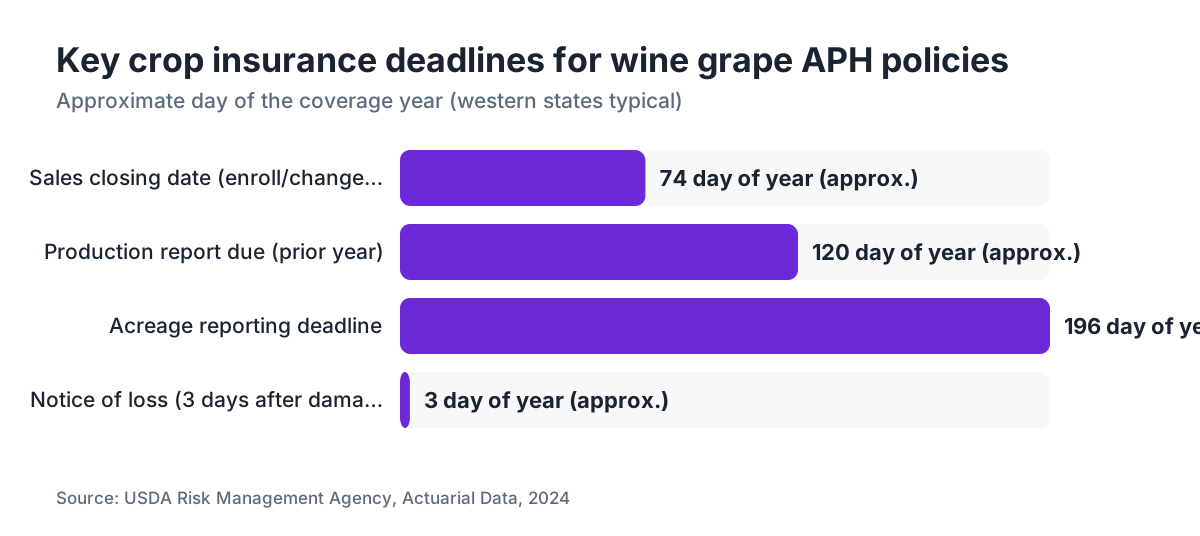
Miss a crop insurance deadline and there's no extension. You get denied, or uninsured for the year. Here are the dates that matter most for grape APH policies, with the standing caveat that your county's actuarial documents control and these are the common dates RMA sets for western wine grape states [1].
| Deadline | Typical Date (West) | Typical Date (East) | Consequence of Missing |
|---|---|---|---|
| Sales closing date (enrollment/change deadline) | March 15 | March 15 | Cannot buy or modify coverage for that crop year |
| Acreage reporting deadline | July 15 | Late July | Uninsured acreage; possible late fee or void policy |
| Notice of loss | Within 72 hrs of damage discovery | Same | Claim denial |
| Production report due date | By April 30 of the following year (approx.) | Similar | APH yield frozen or reduced |
| NAP application deadline | Before planting or 30 days after published deadline | Varies | Cannot participate that year |
The sales closing date catches growers off guard the most. March 15 comes before bud break in most California and Washington vineyards, which means you're deciding on coverage before the season tips its hand. That's by design. You can't buy insurance once you can see the frost coming.
Mark the production report due date too. After harvest you file a Report of Production with your agent so RMA can update your APH database. Plenty of growers hand this off and assume it's handled. Call your agent in November or December to confirm the report went in with accurate numbers.
How does FSA farm record data connect to your insurance policy?
Your RMA crop insurance policy and your FSA farm records are linked. The FSA farm number, tract number, and field numbers on your 156 Farm Record are the geographic anchors for your insurable units. Errors in those records flow straight into your acreage report, and your claim settlement gets messy.
Verify your FSA farm records every year, even when nothing changed. FSA updates common land unit (CLU) data through the National Agriculture Imagery Program, and acreage calculations shift slightly when new aerial imagery lands. A block recorded as 4.2 acres in 2019 might read 4.0 acres in the current CLU, and that gap moves your premium and your indemnity cap [3].
Replanted a block, converted ground to another use, or renegotiated a lease? Update FSA records first, then your acreage report. Do it the other way around and you build a paper trail that doesn't match, which hands adjusters a reason to slow your claim.
Small vineyards often go years without setting foot in their local FSA office. An annual visit, or at least an annual phone review of your farm records, protects your insurance position more than almost any other administrative move you can make.
What documentation is specific to organic or sustainable grape programs?
If your vineyard holds USDA organic certification, RMA offers an organic price election that beats the conventional election for most grape varieties. To use it, hand your current organic certificate (from your USDA-accredited certifying agent) to your crop insurance agent before the sales closing date [1]. The certificate has to cover the specific acres you're insuring under the organic election.
For transitional acres (year two or three of conversion, where you're farming organic but can't yet be certified), RMA allows a transitional practice price election in some counties. Documentation there means your organic system plan and a letter from your certifier confirming you're in transition.
If you run USDA conservation programs alongside your insurance (EQIP payments for cover crop establishment, hedgerow planting, or irrigation efficiency), keep those practice certifications separate and organized. FSA and NRCS can ask for proof that your conservation practices are being maintained, and current farm bill programs tie conservation compliance to eligibility for crop insurance premium subsidies [3]. Fail a conservation compliance review and you can lose your insurance subsidy, which stings more than losing the conservation payment.
WSU Extension publishes guidance for Washington wine grape growers on documenting organic practices for certification and insurance. It's worth reading even if you farm in California or Oregon, because the RMA documentation logic applies nationally [5].
What records should you keep permanently versus for a set number of years?
Not everything belongs in the permanent file. Some things do. Here's a framework you can actually run.
Keep permanently: signed APH reports of production for every year (these build your yield database), acreage reports for every year, loss appraisal documents from any claim, your original insurance policy and every endorsement, and the FSA farm record printouts matched to each policy year.
Keep at least seven years: Schedule F tax returns (the IRS statute of limitations runs three years on a standard return, six for substantial understatement; seven gives you a buffer), winery settlement sheets and crush tickets, picking logs, and any correspondence with your adjuster or agent about a loss.
Keep at least five years: spray and pesticide application records (EPA WPS requires two years under 40 CFR 170.311, but insurance disputes can reach further, so five is safer), scouting records, phenology notes, and irrigation logs [7].
Digital copies work for most of these. The IRS accepts electronic records under Revenue Procedure 98-25 [10]. RMA adjusters routinely work from scans. What matters is that the files are dated, unaltered, and backed up somewhere you can actually reach five years from now. A folder on a laptop you replace every three years is not a records system.
How can vineyard management software help with documentation compliance?
The documentation load for USDA crop insurance is real, and it never stops. Growers who file clean, fast-settled claims are the ones who baked record-keeping into the daily workflow instead of scrambling to rebuild records after a loss.
Software that ties spray logging, harvest tracking, and block mapping together cuts the odds that your acreage report fights your block map or your production report fights your crush tickets. Your spray logs get timestamped as you go, not rebuilt from memory. VitiScribe is built for vineyard compliance and field operations, and its spray and harvest records export in formats that match what RMA adjusters and FSA offices usually request.
Still, software doesn't file your acreage report. It doesn't call your agent within 72 hours of a frost. The calendar decisions need a human who knows the deadlines and acts on them. Treat digital records as the evidence and calendar discipline as the strategy.
For growers running multiple vineyard locations under one policy or across several insurable units, the payoff is bigger. Keeping separate, clearly labeled records by block and policy unit from day one heads off the acreage reconciliation problems that stall claims.
What are common documentation mistakes that get vineyard claims denied or reduced?
Loss adjusters see the same failures over and over. These are the ones that cost growers money.
Mismatched acreage. If the acres on your acreage report don't match the CLU acres in your FSA farm record, the adjuster uses the smaller number or flags it for review. One trip to your FSA office fixes this before a loss year ever arrives.
No contemporaneous production records. Rebuilding a production history from memory or scraps after a loss is a red flag. Adjusters can accept reconstructed records in narrow cases, but they carry less weight than records kept in real time.
Missed notice of loss. Seventy-two hours passes fast after a hailstorm, especially while you're managing the damage. Put your agent's cell number in your phone under 'Loss Notice' so you know who to call and why.
Poor farming practice findings. If you had a disease loss and your spray records show four skipped applications in a row during a high-pressure stretch, the adjuster has grounds to cut or deny the claim under the good farming practices clause. This is one of the most disputed areas in grape claims, and the burden sits on you to show your records.
Expired organic certificate. Claim the organic price election with a certificate that lapsed or went unrenewed before the sales closing date, and RMA drops you to conventional pricing. The gap can be large depending on variety and loss year.
Incorrect share reporting. Farm leased ground and report 100% share when your lease gives you 60%, and the claim gets prorated. Match the share on your acreage report to what's in the lease.
Frequently asked questions
What is the acreage reporting deadline for wine grape crop insurance?
For most western wine grape states including California, Washington, and Oregon, the acreage reporting deadline is July 15. Eastern states tend to run a week or two later, into late July. RMA's actuarial documents set the date for your specific county, so confirm your exact date with your agent before the season starts. A missed acreage report leaves those acres uninsured.
How many years of production records does USDA require for APH grape insurance?
RMA uses up to ten consecutive crop years to build your Approved Yield. With fewer years, RMA substitutes a Transitional Yield (T-yield) for the missing ones. T-yields are set by county and usually run lower than a productive vineyard achieves. File a production report every year without fail so your APH database stays as accurate, and as high, as it honestly can.
Do spray records affect whether a crop insurance claim gets approved?
Yes, indirectly but meaningfully. APH policies exclude losses from poor farming practices. File a disease or pest loss claim and the adjuster looks for evidence you managed the crop right. Spray logs showing timely, properly documented applications are your defense against a poor farming practices finding. UC Davis Extension recommends logs include date, product, rate, acres treated, and applicator name for every application.
What happens if I miss the 72-hour notice of loss deadline?
Missing the notice deadline gives the insurance company grounds to deny the claim. Some companies will accept a late notice if the damage wasn't immediately apparent and you called as soon as you found it, but that's discretionary and often disputed. The safe path is to call your agent the same day you find damage. A quick phone call backed by an email establishes the notice date.
Can I use Schedule F tax returns as production records for USDA crop insurance?
Schedule F returns are required for Whole-Farm Revenue Protection enrollment (WFRP wants five years of Schedule F history). For APH grape insurance, winery settlement sheets, crush tickets, and processor records are the primary production documentation. Schedule F can corroborate those records but isn't itself a production record for APH yield purposes. Keep both regardless.
Does USDA crop insurance cover frost damage to wine grapes?
Frost is a named insurable cause under most APH grape policies, so yes, it can be covered. File the loss notice within 72 hours of discovering frost damage, preserve damaged material for the adjuster, and keep your phenology and production records in order. For spring frost that kills buds before fruit sets, the adjuster may use appraisal methods tied to your area's published T-yields and historical production.
What is the NAP program and when does it apply to vineyards?
The Noninsured Crop Disaster Assistance Program (NAP), run by USDA FSA, covers crops with no private federal crop insurance plan in your county. If your county has no RMA APH plan for your grape type, NAP is your option. Service fees are capped at $325 per crop per county. Documentation mirrors APH: acreage reports, production records, and timely loss notices filed with your local FSA office.
How do organic vineyards document their practices for USDA crop insurance?
Organic vineyards give their current USDA-accredited organic certificate to their crop insurance agent before the sales closing date (typically March 15) to qualify for the organic price election. The certificate must cover the specific insured acres. Transitional acres need an organic system plan and a certifier letter. If the certificate lapses or goes unupdated before the sales closing date, RMA defaults the policy to conventional pricing that year.
What FSA records do I need to verify before filing a crop insurance acreage report?
Check your FSA 156 Farm Record to confirm the farm number, tract number, field numbers, and current acreage for each block you plan to insure. CLU acreage can shift when FSA updates aerial imagery. Discrepancies between your acreage report and FSA records are a common source of claim delays and partial denials. An annual visit to your FSA office to confirm current records is time well spent.
How long do I need to keep vineyard crop insurance records?
Keep signed APH production reports and acreage reports permanently. Keep Schedule F tax returns and production documentation (crush tickets, picking logs) at least seven years. Keep spray and pesticide records at least five years, which covers EPA WPS requirements and leaves buffer for insurance disputes. Digital copies with dated, unaltered files are acceptable to both RMA and the IRS.
What is the sales closing date for grape crop insurance and why does it matter?
The sales closing date is the last day you can buy or modify an APH grape policy for that crop year. For most wine grape states it's March 15. After that date you cannot raise coverage levels, add acres, or enroll new units, no matter what the season looks like. That date falls before bud break in most regions, so coverage decisions get made without knowing what the season brings.
Can a grower-winery operation use Whole-Farm Revenue Protection instead of APH?
Yes, and for some estate operations it fits better. WFRP insures total farm revenue up to $8.5 million and suits multi-commodity farms or operations with diverse income. The enrollment paperwork is heavier: five years of Schedule F tax returns, a farm operation report listing all commodities, and documentation of any non-market revenue. Estate wineries have to be careful how internal grape transfers get priced and reported to keep revenue calculations consistent.
What should I do if I discover frost damage after the 72-hour window has passed?
Notify your agent immediately regardless. Document when and how you found the damage. If you can show visible damage wasn't apparent within 72 hours (plausible with subtle freeze injury that shows up weeks later as fruit fails to develop), some companies will accept the notice. Dated photographs taken the moment you found the damage, plus weather station records from the frost event, are your best evidence in a disputed late-notice case.
Does USDA crop insurance require me to keep irrigation records for vineyards?
Irrigation records aren't explicitly required for enrollment or routine APH filing. But in a drought-related loss claim, an adjuster may ask for them to confirm the loss wasn't worsened by weak irrigation management in irrigated-practice blocks. If your policy codes your acres as irrigated, seasonal irrigation logs strengthen your case that a water-related loss came from a genuine shortage, not a practice failure.
Sources
- USDA Risk Management Agency, Crop Insurance Policies and Procedures: APH acreage reporting deadline of July 15 for most western wine grape states, 72-hour notice of loss requirement, and exclusion of losses due to failure to follow good farming practices
- USDA RMA, Whole-Farm Revenue Protection Fact Sheet: WFRP coverage cap of $8.5 million in insured revenue and requirement for five years of Schedule F tax returns for enrollment
- USDA Farm Service Agency, Noninsured Crop Disaster Assistance Program: NAP service fees up to $325 per crop per county, capped at $825 per producer per county and $1,950 nationally; FSA administers farm records and common land units
- Cornell University, Statewide Viticulture Extension Program: Acreage discrepancies rank among the top reasons New York grape insurance claims get partially denied
- Washington State University Extension, Viticulture and Enology: Practice type coding errors on acreage reports cause premium calculation problems; WSU publishes guidance on documenting organic practices for both certification and insurance
- University of California Agriculture and Natural Resources (UC Cooperative Extension), Viticulture: Spray records should include date, target pest, product name and EPA registration number, application rate, acres treated, applicator name, and weather conditions; phenology records support frost loss calculations
- U.S. EPA, Agricultural Worker Protection Standard, 40 CFR Part 170: The Worker Protection Standard requires pesticide application and hazard records, retained for two years
- USDA RMA, Actuarial Information Browser (Actuarial Data): RMA publishes county-level actuarial data including price elections and T-yields for wine grapes by variety and state
- USDA RMA, Actual Production History (APH) Insurance Plan: APH uses up to ten consecutive crop years of production records; T-yields are substituted for missing years; acceptable records include settlement sheets, warehouse and processor records, and verifiable grower records
- IRS, Recordkeeping guidance (Revenue Procedure 98-25 on electronic records): IRS accepts electronic records as acceptable documentation; standard statute of limitations runs three years, six years for substantial understatement
Last updated 2026-07-10