Steinernema carpocapsae application records for vine mealybug management

TL;DR
- Steinernema carpocapsae (Sc) is an insect-parasitic nematode used against vine mealybug crawlers in California and other wine regions.
- Federal and state law require you to keep pesticide application records for at least two years.
- Because Sc is a living organism with narrow application windows, your records need more detail than a standard chemical spray log to be both compliant and useful.
What is Steinernema carpocapsae and why does it matter for vine mealybug?
Vine mealybug (Planococcus ficus) is one of the most damaging pests in California wine grapes, and it's spreading in Arizona, Washington, and parts of the South. It carries Grapevine leafroll-associated viruses. It drips honeydew that feeds sooty mold. It hides under bark and in the soil, out of reach of contact insecticides. Conventional chemistry struggles to touch the crawler stage.
Steinernema carpocapsae is an insect-parasitic nematode, a microscopic roundworm sold as infective juveniles (IJs) suspended in gel or water. The juveniles hunt down a host, enter through natural openings, and release a symbiotic bacterium (Xenorhabdus nematophila) that kills the insect within 24 to 48 hours. UC Cooperative Extension has documented Sc working against first-instar vine mealybug crawlers in soil and near the soil surface, where mealybugs overwinter and re-emerge each spring [1].
The word 'pesticide' catches people off guard here. Sc is registered by EPA as a microbial pesticide under FIFRA Section 3, with its own label and registration number. Every application is a pesticide application under the law, with all the recordkeeping that follows. You can't treat it like releasing ladybugs.
Does applying Steinernema carpocapsae legally require a pesticide record?
Yes. EPA registers Sc products as biopesticides under FIFRA, and any registered pesticide application triggers federal and state recordkeeping requirements [2]. In California, the Department of Pesticide Regulation (CDPR) requires growers to keep written records of every pesticide application, and county agricultural commissioners can inspect those records on request [3].
Other states run on their own statutes, but most mirror the two-year retention floor set in the Federal Insecticide, Fungicide, and Rodenticide Act (FIFRA Section 8). Washington's agricultural pesticide use record rules under WAC 16-228 match that scope [4].
One practical note: Sc products carry an EPA establishment number and a registration number printed on the label, same as any synthetic pesticide. That number goes on your record. If you bought a product with no EPA registration, you should not be putting it on a commercial crop. Legitimate Sc formulations sold for agricultural use are all registered.
What specific information do you need to record for each Sc application?
Federal law under FIFRA Section 8 sets the minimum fields for certified applicator records, and California DPR expands those for all agricultural use. Here is what your record needs to capture for an Sc application:
| Field | What to record | Notes |
|---|---|---|
| Date of application | Exact date (not week or range) | Required federally and by all states |
| Product name | Full label name, e.g. "Nemasys G" or "Capsanem" | Match the label exactly |
| EPA Reg. No. | From the product label | Required by FIFRA |
| Active ingredient | Steinernema carpocapsae | Note strain if listed on label |
| Amount applied | IJ count per acre OR oz/acre of formulation | Record both if label gives both |
| Water volume | Gallons per acre | Affects viability; good practice even if not mandated |
| Site/field ID | Block name, APN, or GPS coordinates | County may require legal location |
| Total acres treated | Actual acres, not block size | |
| Application method | Drip injection, soil drench, handgun, airblast | Sc is almost always soil-directed |
| Applicator name and license | Name + PCA/QAL number if applicable | Required in CA for restricted materials |
| Pest targeted | Vine mealybug (Planococcus ficus) | Helps with efficacy review later |
| Environmental conditions | Soil temp (°F), air temp, humidity, soil moisture | Not legally required but operationally essential |
| Product lot number | From packaging | Traceability if efficacy fails |
| Expiration date of product | From packaging | IJ viability is time-sensitive |
That last pair, lot number and expiration date, sits on almost no spray record template. With chemical pesticides, slightly old product just underperforms. With live nematodes, an expired or heat-damaged product is dead. Recording these fields protects you when a county agent asks why you had a crop problem in a treated block.
California's DPR Pesticide Use Report (PUR) requires the site location to the section, township, and range, or an alternate legal description [3]. Most county ag commissioners want the Township/Range fields filled in even for biocontrol products.
What environmental conditions should you log, and why do they change the record?
Sc infective juveniles are alive. They die above roughly 86°F soil temperature and go sluggish below 50°F. UC Cooperative Extension recommends applying Sc when soil temperatures at four inches deep sit between 52°F and 86°F, with enough soil moisture for IJs to move through the pore spaces [1].
Apply on a marginal day and the treatment fails, and your environmental log is the only proof you followed label guidance. That matters for any cost-share or crop insurance claim. It's also the only way to tell product failure from applicator error when you review the records next season.
The environmental fields worth logging: soil temperature at 2 to 4 inches (taken at time of application), air temperature, percent soil moisture or recent irrigation history, time of day (midday sun stresses IJs even during a soil drench), and whether the block was irrigated right before and right after (as most Sc labels require).
Nobody has perfectly standardized field data on exactly how much a soil-temperature swing cuts efficacy. The closest controlled work found that Sc IJ mobility dropped sharply below 50°F and above 95°F [5]. So "we applied at correct temperatures" turns into a concrete, defensible statement once you have an actual soil-temp reading attached to the record.
How do Sc application records differ from a standard chemical spray log?
A chemical spray log tracks what you put out and where. An Sc record has to capture whether the product had a realistic chance of working, because biological products fail differently than chemistry does.
A synthetic insecticide's active ingredient is stable. Sc is a living organism whose viability can drop from 95% to under 10% on a 20-degree temperature swing or a week of bad refrigeration. Regulators don't require you to log IJ viability at time of application. Any grower serious about actually controlling vine mealybug should be tracking it anyway.
Here's what a good Sc record adds on top of a conventional spray log:
- Product storage temperature before use (Sc needs refrigeration between 35°F and 50°F per most labels)
- Time from product reconstitution to application (most labels say apply within a few hours of mixing)
- Agitation notes (IJs settle; continuous agitation is required)
- Post-application irrigation timing (most Sc labels require irrigation to wash IJs into the soil within 30 minutes)
These fields protect your money. A $150 to $300 per acre input in nematodes is wasted if the post-application irrigation never happened because the drip system was down and nobody wrote it down.
Running multiple blocks and multiple biological inputs on a paper log gets ugly fast. Tools like VitiScribe let you build custom application record templates that carry the environmental and product-viability fields a standard spray log skips, while still generating the county-formatted PUR reports you need for compliance.
When is the right timing to apply Sc for vine mealybug, and how does that affect your record schedule?
Vine mealybug runs two to four generations a year in California's San Joaquin Valley. The crawler stage, first instars, is when Sc hits hardest, because crawlers are exposed and mobile near the soil surface. In the Central Valley, the first crawler flush usually shows up from late March through May, depending on heat accumulation [6].
Timing around crawler emergence means your records need to document what phenological trigger you used. A degree-day model? A visual sweep? A trapping threshold? UC IPM uses a 50°F base temperature degree-day model to predict crawler emergence, and the first crawlers typically appear near 300 to 400 degree-days from January 1 [6]. That entry turns a record from a legal checkbox into a working operational document.
Most Sc programs for vine mealybug target soil applications in late winter to early spring (February to April in California) to hit overwintering mealybugs before they climb the vine. A second application against the summer crawler flush in June or July is common in high-pressure vineyards [1]. Note which generation you were targeting, because efficacy review at season's end depends on knowing it.
In the Paso Robles wineries region, where vine mealybug pressure is high and degree-days pile up fast, the spring application window can be narrow. Make the record the same day you apply, not at the end of the week. That's how you capture accurate conditions.
What are the EPA Worker Protection Standard requirements for Sc applications?
The EPA Worker Protection Standard (WPS), revised in 2015 and codified at 40 CFR Part 170, applies to all pesticide applications in agricultural settings, including biological pesticides like Sc [7]. The practical burden for Sc is usually lighter than for conventional chemistry, because most Sc products carry a Caution signal word (the lowest hazard tier) and short or zero restricted-entry intervals (REI). You still have WPS obligations.
Required under WPS for any Sc application:
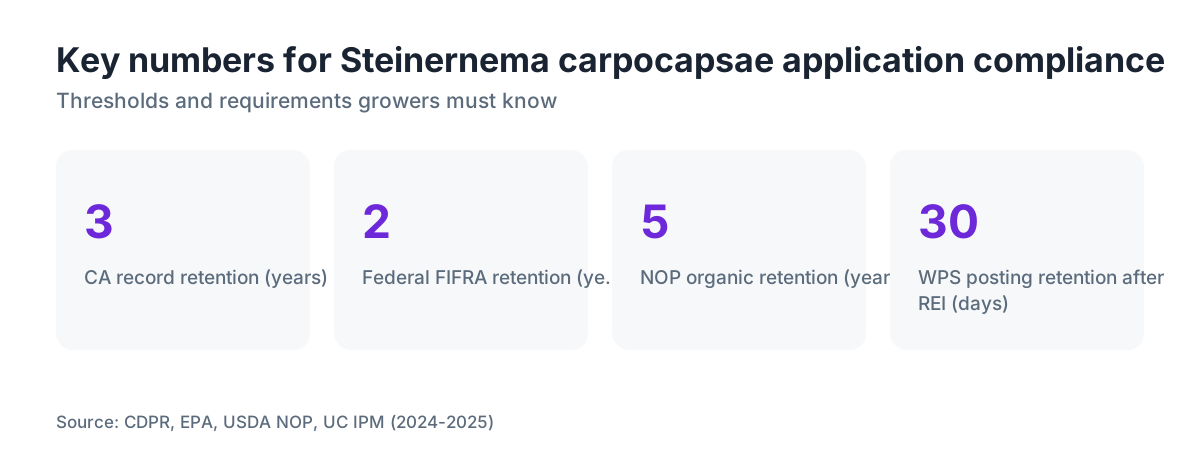
- Central posting of pesticide application information (product name, EPA Reg. No., active ingredient, location treated, date and time of application, REI, and any PPE required for early entry) at a location workers can reach, held for 30 days after the REI expires [7]
- Oral warning to workers about treated areas if they could be in or near those areas during the REI
- Providing the label and SDS on request
- Handler PPE as specified on the label (typically long sleeves, gloves, and closed-toe shoes for Sc; read your specific label)
Growers miss the WPS posting requirement on biological products all the time, assuming low toxicity means no paperwork. EPA draws no such line. The 2015 WPS rule states: "All pesticides used in the production of agricultural plants are covered by the WPS, including pesticides with low toxicity." [7]
Your application record should note that WPS posting was done, and you should keep the central display card or a copy of it in your records. If you use a digital system, a timestamped photo of the posted card works.
How long do you need to keep Sc application records?
Federal law under FIFRA requires certified applicators to keep records of restricted-use pesticide applications for two years. California goes further: DPR requires all agricultural pesticide application records to be kept for three years, available for inspection within 72 hours of a request from the county agricultural commissioner [3].
Sc products are generally general-use pesticides, not restricted-use, at the federal level. California's requirements apply regardless of use classification. So in California: three years, full stop.
Washington requires two years under WAC 16-228 [4]. Oregon requires two years too. Check your state's department of agriculture for the exact number, and keep records for the longer of your state requirement or three years if you operate across state lines or sell fruit under contracts that specify record retention.
One more thing: if you're certified organic, your organic system plan and your certifier likely require product records (Sc applications included) for five years to keep the certification audit trail intact. The National Organic Program (NOP) at 7 CFR Part 205 requires records that "fully disclose all activities and transactions" and retention for five years [8].
Is Steinernema carpocapsae allowed in certified organic vineyards?
Yes. Sc is an allowed material under USDA National Organic Program regulations. The NOP's National List of Allowed and Prohibited Substances (7 CFR 205.601) permits nonsynthetic biological pest controls, and insect-parasitic nematodes qualify [8]. OMRI (the Organic Materials Review Institute) lists several commercial Sc products as suitable for organic use.
What that means for records: your organic system plan has to include Sc as an approved intervention, and your application records must match your OSP exactly. Same product name, same supplier, same application sites. Switch Sc brands or formulations mid-season and you update your OSP with your certifier and note the change in your records. Auditors flag mismatches between the OSP and actual applications.
Not every commercial Sc product is OMRI-listed. Formulation matters: some carriers or adjuvants in non-OMRI products aren't allowed. Check your specific product's OMRI status before applying in a certified organic block, and record the OMRI listing number next to the EPA registration number.
What does a complete Sc application record actually look like for a vine mealybug program?
Here's what a filled-out Sc application record should contain. This is not a template from a specific source; it's built to reflect the fields California DPR requires plus the biological-specific fields good practice demands.
Date: April 14, 2025
Time: 6:30 AM
Farm/Vineyard name: [Your name here]
Block ID: Block 7, Cabernet Sauvignon, 8.4 acres
Legal location: T15N R22E Section 12 (or APN)
Pest targeted: Vine mealybug (Planococcus ficus), overwintering generation and first crawlers
Phenological trigger: 380 degree-days base 50°F from Jan 1; first crawler visual confirmation April 10
Product name: [Registered Sc product]
EPA Reg. No.: [From label]
Active ingredient: Steinernema carpocapsae
Lot number: [From packaging]
Expiration date: June 2025
Amount applied: 1 billion IJs per acre
Formulation rate: [Per label]
Water volume: 150 gal/acre
Application method: Drip injection system, soil-directed to root zone
Total acres treated: 8.4
Product storage temp before use: 40°F (verified refrigerator log)
Time from mixing to application: 45 minutes
Agitation: Continuous during application
Soil temperature at 4 inches: 58°F
Air temperature: 62°F
Soil moisture: Irrigated to field capacity 24 hours prior
Post-application irrigation: 0.5 inch applied immediately after via drip
REI: 4 hours (per label)
WPS posting completed: Yes, central location board updated 6:45 AM
Applicator: [Name], CA QAL License [Number]
PCA Recommendation: [Name], License [Number], dated April 12, 2025
Notes: Product received from supplier April 10, kept refrigerated. Visual mealybug crawler count in block: 3 crawlers per cluster on sampled vines.
That level of detail looks like a lot. In practice, with a pre-built form or a digital system, filling it in takes about five minutes at the truck before you drive off the block. VitiScribe and similar platforms let you set up a block-specific template so the fixed fields pre-populate and you only enter the day's variables.
This record ties your Sc purchase invoice, your product lot, your environmental conditions, and your WPS compliance together in one place. When county shows up or your certifier audits, you pull one document.
What should you do if an Sc application fails to control vine mealybug?
First, don't blame the product before you read the record. The usual reasons Sc fails in vine mealybug programs: soil temperatures outside the effective range at time of application, product heat-damaged in transit or storage, thin post-application irrigation, or timing that missed the crawler window.
Your application record is the diagnostic tool. Walk it field by field:
- Was soil temp in range? Record shows 88°F and the label caps at 86°F, and you have your answer.
- Did post-application irrigation happen within 30 minutes? If the drip log shows it ran two hours later, IJ mortality in the surface soil was probably high.
- What was the lot expiration date relative to application date? Expired product is the simplest failure mode there is.
If conditions were right and the product was fresh and stored properly, the failure record becomes evidence for the supplier. Most reputable Sc suppliers ask for exactly these records before they'll talk replacement or credit. Without them, you have no case.
WSU Extension notes that efficacy data for Sc against vine mealybug in field conditions is variable, and that soil type, irrigation system type, and application rate all interact with the outcome [9]. Clay-heavy soils limit IJ movement; sandy soils dry out faster after application. These belong in your notes even though they're not on the mandatory fields list.
At high-pressure sites, like coastal California or warm inland valleys where vine mealybug is endemic, a single Sc application rarely gets the job done. Your recordkeeping needs to track efficacy across multiple applications and seasons to see whether the program works at all.
How do you record Sc applications when combining with other vine mealybug controls?
Vine mealybug programs often pair Sc with other tactics: mating disruption pheromones, conventional insecticides against aerial crawlers, parasitoid releases (Anagyrus pseudococci), and kaolin clay barriers. Each is a separate record.
The hard part is attribution. Apply Sc in March, spirotetramat in May, and mealybug counts drop by July, and your records have to be detailed enough to say which intervention did what. That means:
- Separate records for each product on each date, even applied the same day
- Pre- and post-treatment monitoring data attached to or referenced in the records
- Notes on which blocks got which combination, so you can compare programs
Where you combine Sc with a conventional insecticide on the same day, check compatibility. Some adjuvants and tank-mix partners kill IJ viability. Record what you mixed, in what order, and whether you ran separate applications or a single tank. This is a label compliance question too: most Sc labels prohibit tank mixing with chlorine-based sanitizers or copper-based fungicides, and some prohibit any tank mixing at all. Mix against the label and that's a violation, and it's probably why your nematodes didn't work.
Frequently asked questions
Is Steinernema carpocapsae classified as a pesticide for recordkeeping purposes?
Yes. EPA registers Sc as a microbial biopesticide under FIFRA, so every application is a pesticide application and triggers the same recordkeeping requirements as a conventional insecticide. California's DPR and county agricultural commissioners treat it exactly the same way. The fact that it's a living organism doesn't change the legal classification.
How long do I need to keep Steinernema carpocapsae application records?
California requires three years. Federal FIFRA requires two years for certified applicators handling restricted-use pesticides, but California's standard applies to all agricultural pesticide use regardless of classification. Certified organic growers must keep records for five years under USDA NOP rules. Keep records for the longest period that applies if you operate under multiple frameworks.
What fields does a vine mealybug Sc application record need beyond a standard spray log?
Beyond the standard fields (date, product, EPA Reg. No., rate, acres, applicator), an Sc record should include soil temperature at 4 inches, product lot number and expiration date, storage temperature before use, time from product mixing to application, agitation method, and post-application irrigation timing. These fields are not legally mandated, but they're the only way to diagnose a failed application.
Can I apply Steinernema carpocapsae in a certified organic vineyard?
Yes. The USDA NOP National List at 7 CFR 205.601 allows insect-parasitic nematodes as nonsynthetic biological controls in organic production. Not all commercial Sc products are OMRI-listed, though. Check your specific product before applying in an organic block, and record the OMRI listing number next to the EPA registration number in your application record.
Does the EPA Worker Protection Standard apply to Sc nematode applications?
Yes. The 2015 revised WPS at 40 CFR Part 170 covers all pesticide applications to agricultural crops, including biological pesticides. For Sc, you post application information at a central location, give oral warnings to workers about treated areas during the REI, and supply the label and SDS on request. Most Sc products carry a short REI (often 4 hours), but the posting requirement is the same.
What soil temperature range makes Sc effective against vine mealybug crawlers?
UC Cooperative Extension recommends applying Sc when soil temperatures at four inches deep sit between 52°F and 86°F. Mobility of infective juveniles drops sharply outside that range. Record soil temperature at time of application on every Sc application, both for compliance evidence and to diagnose efficacy failures after the fact.
How do I record an Sc application that failed to control vine mealybug?
Keep the record exactly as completed, with every environmental condition noted. A complete record is your diagnostic tool: review soil temperature, post-application irrigation timing, product lot expiration, and application-to-field time. If conditions were correct, the record is your evidence when you contact the supplier about product quality. Never modify a record after the fact to explain a failure.
Does a Pest Control Adviser recommendation cover Sc applications in California?
A licensed PCA recommendation is required in California before you apply any pesticide to an agricultural crop if you use a pest control business or licensed adviser. For growers applying their own registered pesticides, a PCA recommendation isn't legally required in every case, but many county commissioners expect it for any pesticide use on commercial crops. Check your county's specific requirements.
How often should Sc be applied in a vine mealybug program?
Most UC Cooperative Extension programs for vine mealybug suggest two Sc applications per season in high-pressure vineyards: one in late winter to early spring against overwintering mealybugs (February to April in California) and a second in early summer against the first crawler flush. Each application requires a separate application record.
Can I tank-mix Steinernema carpocapsae with fungicides or other pesticides?
Most Sc labels prohibit or restrict tank mixing. Copper-based fungicides and chlorine sanitizers are toxic to IJs. Some labels allow specific adjuvants only. Read your product label before mixing anything with Sc. If you apply Sc separately from other products, note in your records that applications were sequential rather than combined, which also simplifies the efficacy audit later.
What pest monitoring data should go into my Sc application record?
Note the pre-application mealybug count or threshold that triggered the application: crawlers per cluster, crawlers per sticky trap, or degree-day model reading. Post-application counts 2 to 4 weeks later should be filed with or referenced in the record. This before-and-after data is what lets you evaluate whether Sc is working in your specific blocks and soil conditions.
Who can inspect my Sc application records in California?
The county agricultural commissioner (CAC) can inspect pesticide application records on request and must receive them within 72 hours under California Food and Agricultural Code Section 12980. The California Department of Pesticide Regulation also has inspection authority. Records must be available at the farm or business address shown on the records.
Are there any restrictions on where or when I can apply Sc near water bodies?
Sc is generally low risk for aquatic environments compared to synthetic insecticides, but some product labels include buffer zone language near surface water. Always read the specific label for your product. Your application record should note proximity to water bodies and any buffer distances maintained, particularly in California where water quality enforcement near agricultural areas is active.
Sources
- UC Cooperative Extension, Vine Mealybug Management in California Vineyards: Sc efficacy against first-instar vine mealybug crawlers in soil; recommended soil temperature range of 52°F to 86°F at 4 inches; two-application seasonal program
- U.S. EPA, Pesticide Registration Overview: Sc registered as a microbial biopesticide under FIFRA Section 3; all FIFRA-registered products trigger federal application recordkeeping requirements
- California Department of Pesticide Regulation, Pesticide Use Reporting: California requires agricultural pesticide application records retained for three years, available to county agricultural commissioner within 72 hours of request; Township/Range location required on PUR
- Washington State Department of Agriculture, Pesticide Recordkeeping (WAC 16-228): Washington requires agricultural pesticide use records retained for two years under WAC 16-228, matching the FIFRA scope
- Journal of Nematology, Temperature effects on Steinernema carpocapsae infective juvenile mobility: Sc infective juvenile mobility dropped sharply below 50°F and above 95°F in controlled conditions
- UC IPM, Vine Mealybug Pest Management Guidelines: Degree-day model base 50°F; first vine mealybug crawlers typically appear at 300 to 400 degree-days from January 1 in California's Central Valley; two to four generations per year
- U.S. EPA, Worker Protection Standard 40 CFR Part 170: WPS revised 2015 covers all pesticide applications to agricultural crops including biological pesticides; requires central posting of application information; 30-day posting retention after REI expires
- USDA Agricultural Marketing Service, National Organic Program 7 CFR Part 205: NOP National List 7 CFR 205.601 permits nonsynthetic biological pest controls including insect-parasitic nematodes in certified organic production; records must be retained five years
- Washington State University Extension, Biological Control of Mealybugs in Vineyards: Efficacy of Sc against vine mealybug in field conditions is variable; soil type and irrigation system type interact with outcomes; clay soils limit IJ movement
- UC Davis Department of Entomology and Nematology, Entomopathogenic Nematode Research: Steinernema carpocapsae releases Xenorhabdus nematophila bacteria that kill insect hosts within 24 to 48 hours; sold as infective juveniles in gel or water suspension
- California Department of Food and Agriculture, Food and Agricultural Code Section 12980: County agricultural commissioner has authority to inspect pesticide application records; grower must provide records within 72 hours of request
- OMRI (Organic Materials Review Institute), Listed Products: Multiple commercial Sc products listed as suitable for use in certified organic production; formulation carrier and adjuvants determine OMRI eligibility
Last updated 2026-07-10