Trunk injection pesticide application records for trunk disease management

TL;DR
- Trunk injection is a pesticide application under federal law, so it needs the same records as any other method: product name, EPA registration number, date, location, rate, and applicator credentials.
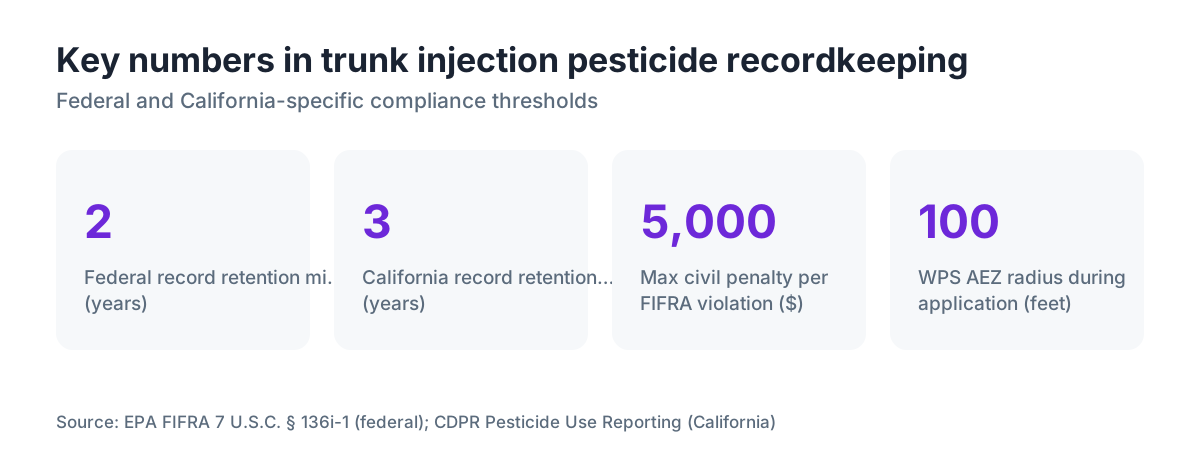
- Federal Worker Protection Standard records must be kept two years.
- California requires three.
- Missing records can trigger fines up to $5,000 per violation.
Why do trunk injection applications require pesticide records at all?
Trunk injection puts a pesticide solution straight into the vascular system of a vine. No drift. No airblast. No buffer zones to worry about. Growers sometimes assume those differences mean less paperwork. They're wrong.
A pesticide application is defined by the EPA as any activity that delivers a registered pesticide to a target site, no matter how it gets there. Trunk injection meets that definition completely [1]. The Federal Insecticide, Fungicide, and Rodenticide Act (FIFRA), codified at 7 U.S.C. § 136 et seq., requires that every pesticide application follow label directions and that records exist to prove compliance [2]. The delivery method doesn't change the obligation.
For trunk disease work specifically, the fungicides registered for injection (products containing thiabendazole, for one) carry EPA registration numbers, label directions, and re-entry intervals just like any foliar material. If your state runs a restricted-use pesticide (RUP) program, your certified applicator records apply too. Skipping the paperwork because the application looks low-profile is how growers back into real compliance trouble.
What federal law says you must record for every pesticide application
The core federal recordkeeping rule for commercial agricultural pesticide use lives in FIFRA and the regulations at 40 C.F.R. Part 170 (the Worker Protection Standard, or WPS) and 40 C.F.R. Part 171. For certified applicators using restricted-use pesticides, 7 U.S.C. § 136i-1 and the regulations at 40 C.F.R. § 171.31 require records that include [3]:
- Product name and EPA registration number
- Crop or site treated
- Location (field or block identifier)
- Date of application
- Quantity applied
- Size of area treated
- Applicator's name and certification number
Keep those records for two years and make them available to EPA or an authorized state agency on request. The statute sets a floor of "not less than 2 years" [3].
The WPS, revised in 2015 and effective January 2017, adds an Application Exclusion Zone (AEZ) requirement and mandates that application information be posted where workers can reach it [4]. For trunk injection, the AEZ runs 100 feet in all directions while the application is happening, same as any other closed pesticide system. You still post the information.
Using a non-restricted product for injection? FIFRA still governs it, but the specific certified applicator recordkeeping rule under 7 U.S.C. § 136i-1 covers RUPs only. Plenty of states have filled that gap with their own rules, so check your state agricultural department regardless.
What information belongs in a trunk injection spray record, field by field
A compliant trunk injection record looks a lot like a conventional spray record, with a few extra fields tied to the method. Here's what to capture.
Standard required fields (federal minimum for RUPs):
| Field | What to write | Why it matters |
|---|---|---|
| Product name | Full label name, e.g. "Arbotect 20-S" | Identifies the label that governs the application |
| EPA Reg. No. | Found on the label, e.g. "100-1005" | Ties to the registered label in EPA's system |
| Active ingredient | e.g. thiabendazole 20% | Helps with residue queries and resistance tracking |
| Application date | MM/DD/YYYY | Legal record and re-entry timing |
| Field/block ID | Your internal block name or GPS coords | Traceable to the treated vines |
| Acres or vine count treated | Number | Required for rate compliance |
| Application rate | Amount of product per vine or per acre | Label compliance |
| Method | "Trunk injection, drill-and-fill" or "pressurized injection" | Distinguishes from foliar; affects AEZ posting |
| Applicator name | Full name | Accountability |
| Applicator certification # | From your state license | Required for RUPs |
| REI | Hours from label | Must be posted under WPS |
Trunk-injection-specific fields worth adding:
- Injection tool make and model (Arborjet, Mauget, Bite, etc.) and whether it's pressurized or passive
- Injection port depth and number of ports per vine
- Volume injected per vine (in mL or fl oz)
- Wound treatment applied after injection, if any (some labels or best-practice guides specify this)
- Vine condition notes: infection rating and wood symptoms observed before treatment
- Weather at time of application (temperature, relative humidity, wind speed)
The vine condition notes and weather data aren't legally mandatory at the federal level. They're the documentation that defends you if a label dispute or a crop insurance claim comes up later. WSU Extension's trunk disease research recommends recording vine health status before treatment, because you can't measure efficacy without a baseline [5].
Which trunk disease fungicides are registered for injection and what do their labels require?
Not every fungicide you'd reach for against Eutypa, Botryosphaeria, or Esca is registered for trunk injection. Injecting a product whose label doesn't list that method is a federal label violation under FIFRA Section 12(a)(2)(G). Full stop [2].
As of the most recent EPA label reviews, the main fungicide registered specifically for grapevine trunk injection in the U.S. is thiabendazole, sold under several trade names. Tebuconazole and some other triazoles carry registrations for wound protectant use (cut-surface application), which is a related but legally separate method. Before you inject anything, read the "Application Methods" section of the label and confirm injection is listed.
UC Davis Cooperative Extension, which has produced some of the most cited field research on trunk disease in U.S. viticulture, treats label compliance as the first gate in any treatment program [6]. Their published protocols say to record the product label version (revision date) in use at the time of application, because labels change between seasons.
Operating under a California county agricultural commissioner (CAC) permit? Put the permit number and county in your record. The California Department of Pesticide Regulation (CDPR) has recordkeeping rules that track federal ones but add fields like the permit number and precise GPS coordinates for the treated block [7].
How do state pesticide recordkeeping rules differ from federal rules?
Federal law sets the floor. States set the ceiling for their own growers, and several wine grape states go well beyond what FIFRA and WPS require.
California: CDPR requires licensed pest control operators and growers using RUPs to file a pesticide use report (PUR) with their county agricultural commissioner within 30 days of application. The PUR needs GPS-based location data, the commodity, the target pest, and an application method code. There is a specific method code for injection/implant applications [7]. California also requires three-year record retention, not two.
Washington: The Washington State Department of Agriculture (WSDA) requires certified applicator records for any RUP application and recommends, though doesn't always mandate, the same data fields as the federal rule. WSU Extension's pesticide management guides line up with these requirements and work well as a checklist template [8].
New York: Cornell Cooperative Extension and the New York State Department of Environmental Conservation (NYSDEC) both publish recordkeeping guidance. New York requires two-year retention for RUPs under state law, mirroring the federal standard, with county-level pesticide reporting in some situations [9].
Oregon: The Oregon Department of Agriculture (ODA) follows federal RUP recordkeeping requirements and adds a rule that records stay accessible for inspection at the farm rather than only in offsite storage.
For states not listed here, go straight to your state department of agriculture's pesticide program page and search for the recordkeeping rule. Don't guess based on what your neighbor does.
What records do you need under the EPA Worker Protection Standard for trunk injection?
The 2015 revised Worker Protection Standard at 40 C.F.R. Part 170 requires employers to give workers specific application information before they enter a treated area [4]. For trunk injection, that breaks down three ways:
- The treated area must be identified clearly so workers can avoid it during the Application Exclusion Zone period.
- Application information must be posted at a central location (the designated pesticide application and hazard information area) and stay posted until the REI expires.
- After the REI expires, the information must stay available to workers or their representatives for 30 days.
The posted information includes the product name, the active ingredient, the REI, the location and description of the treated area, and the date and time the application started and is expected to end.
EPA's WPS guidance states directly: "The pesticide application and hazard information must be kept for 2 years from the date of the application" [4]. That two-year clock covers your posted records along with your formal spray logs.
Here's a practical wrinkle. Trunk injection is often done by a crew moving vine to vine through a block, which can stretch across several hours or even multiple days on a large block. Your record should carry the start date and the end date, not a single date, and your AEZ posting has to show the application is ongoing.
How should you document trunk injection records for Eutypa, Esca, and Botryosphaeria specifically?
Trunk diseases move slow and show up over years. A treatment you apply in year one of a remediation program can matter to a crop history review five years later, especially if you're selling grapes under a long-term contract with pesticide residue warranties. Good records from day one protect you in that scenario.
For disease-specific documentation, go past the legal minimum and add:
- Target pathogen: Write it down. "Eutypa lata" or "Botryosphaeriaceae spp." is more defensible than "trunk disease."
- Symptom assessment date and severity rating: UC Davis has published assessment protocols for each trunk disease class [6]. A consistent scale (even 0 to 3 per vine) lets you track efficacy over seasons.
- Treatment rationale: Which vines got injected, and why? Were they symptomatic, or is this prophylactic after pruning? Document the decision.
- Previous treatment history: If you've treated these vines before, cross-reference the prior record. Resistance monitoring, re-treatment intervals, and label limits on cumulative rates can all depend on history.
- Post-treatment photos: Not required by law. Still worth taking. A dated photo of a freshly injected vine with visible wound care takes thirty seconds and has settled disputes for growers before.
WSU's viticulture extension program notes that record systems linked across seasons are the only way to judge whether a trunk disease program is actually working at the block level [5].
What are the penalties for missing or incomplete trunk injection records?
FIFRA penalties for recordkeeping violations are real and tiered. Under 7 U.S.C. § 136l, civil penalties for RUP recordkeeping violations can reach $5,000 per violation for commercial agricultural producers [2]. Each application missing required documentation can count as a separate violation. An EPA inspector reviewing three seasons of missing RUP records from a certified applicator is staring at potential liability around $15,000 before any negotiation.
States stack their own penalties on top. CDPR can issue civil penalties up to $5,000 per day per violation for failure to file pesticide use reports, and chronic non-filers can lose their license [7].
Fines aside, incomplete records cause trouble in other places:
- Crop insurance claims for disease losses are harder to support without a documented treatment history.
- Grape purchase contracts sometimes carry pesticide residue warranties and give the buyer the right to inspect your spray records. An audit with gaps becomes a contract problem.
- Worker injury claims: if a worker is exposed during or after an injection and you can't produce WPS-compliant records, your defense is materially weaker.
Nobody audits every vineyard every year. The selective-enforcement reality doesn't lower your exposure one bit.
What's the best system for keeping trunk injection records in the vineyard?
Paper binders still work legally. They also have an obvious failure mode: they get wet, they get lost, and they're brutal to search when a buyer's compliance team calls asking what you put on block 14 in May 2023.
The practical minimum for a small operation is a dedicated field notebook or a printable spray log template in a weatherproof sleeve, transferred to a master file within 24 hours of each application. Several land-grant extension programs publish free printable templates. Cornell's spray record template [9] and UC Davis's pesticide recordkeeping guidance [6] are both solid starting points.
For operations running multiple blocks or multi-season remediation programs, digital records win. A platform like VitiScribe lets you log trunk injection applications by block, tag the target pathogen, attach photos, and export records in the format your county agricultural commissioner or crop insurance adjuster wants. The time-stamp trail matters in a regulatory review. Whatever system you pick, the record has to exist within 24 hours of the application, not at the end of the season when you're squinting to remember what happened in the back block in April.
One rule holds regardless of your system: keep a backup. Cloud sync, a quarterly printout, a copy emailed to your office. Records that live in exactly one place have a way of vanishing exactly when you need them.
Do you need a licensed pesticide applicator to do trunk injection, and does that change the records?
It depends on the product and the state. If the fungicide you're injecting is a restricted-use pesticide, then yes, a certified applicator has to either do the application or directly supervise it. That person's certification number goes in the record, and they carry legal responsibility for the record being complete.
For non-restricted products registered for trunk injection, the rules get more variable. Some states require any commercial pesticide application to be done by or under the supervision of a certified applicator regardless of RUP status. Others let uncertified workers apply non-RUPs under general supervision. Check your state's applicator certification program.
Here's what changes in the record when a certified applicator is involved: the certification number becomes a required field, not an optional one. EPA's certified applicator recordkeeping rule at 40 C.F.R. § 171.31 is specific about that [3]. If you're a self-certified grower-applicator doing your own injection, your own certification number goes in. If you hire a PCA or licensed applicator, their credentials go in and they keep a copy of the record too.
A private applicator (a farmer certified to apply RUPs only on their own land) has the same two-year recordkeeping obligation as a commercial applicator under the federal rule. The private/commercial distinction affects where you can apply, not whether you record it.
How do pre-harvest intervals and re-entry intervals apply to trunk injection?
Re-entry intervals (REIs) and pre-harvest intervals (PHIs) apply to trunk injection products the same way they apply to any other pesticide application. The label governs. Read the specific label for whatever you're injecting and record both numbers.
For thiabendazole-based trunk injection products, the REI is typically 4 hours (check the specific product label; this can vary). The PHI depends on the formulation and label specifics. Don't rely on memory or on what worked last season. Labels get revised.
For your records, write down the REI in hours, the calculated earliest re-entry date and time (application end date/time plus REI), and the PHI in days with the calculated earliest harvest date. Put the calculation in the record, more than the abstract number from the label. When your harvest crew supervisor asks in August whether block 7 is clear, you want the answer already calculated and sitting in the file, not something you reconstruct from a log entry under pressure.
Under the WPS, the REI must also be posted at the central posting location. That posting is part of your compliance record, so note when you put it up and when you took it down after the REI expired.
How does VitiScribe or similar software help manage trunk injection records across seasons?
The compliance value of any record system jumps when you can search across seasons, aggregate by block or pathogen, and pull records on short notice without digging through a filing cabinet.
VitiScribe is built for this kind of field-operation record, trunk injection logs included. You can assign each application to a specific block or even a specific vine row, tag the target trunk disease, attach the label version in use, and export a compliant report as PDF or CSV for regulatory submissions. The time-stamp on each entry creates the audit trail that carries weight in a WPS or CDPR review.
The broader category here is any system that forces field entry instead of office reconstruction. Research on agricultural record accuracy (the closest published data comes from USDA ERS agricultural management surveys) consistently finds that records completed at the time of application beat records compiled later for accuracy [11]. No surprise there. It's just worth building your system around.
The alternative, waiting until the end of the month to catch up on spray logs, is the single most common reason records fail a compliance review. Not because the applications went wrong, but because the reconstructed record can't prove they went right.
Frequently asked questions
Do trunk injection pesticide applications have to be reported to my county agricultural commissioner?
In California, yes. CDPR requires all restricted-use pesticide applications, including trunk injection, to be reported via a pesticide use report to the county agricultural commissioner within 30 days of application. Washington, Oregon, and New York have similar reporting systems for RUPs, but fewer states mandate county-level filing for non-RUP products. Check your state ag department's pesticide program for the specific rule.
How long do I have to keep trunk injection spray records?
Federal law requires certified applicators to keep RUP records at least two years from the date of application under 7 U.S.C. § 136i-1. California extends that to three years. Some crop insurance programs and grape purchase contracts suggest keeping records longer, up to five years. The safest default is five years, stored in a searchable format.
Can I use the same spray log template for trunk injection that I use for foliar applications?
The core required fields are the same, so yes, a standard spray log covers the federal minimum. But trunk injection has method-specific details worth adding: injection tool type, volume per vine, number of ports, and vine health assessment. Most standard templates don't have those fields. Build a modified version or use vineyard software that supports custom fields.
What EPA registration number should I record for trunk injection fungicides?
Record the EPA registration number exactly as it appears on the label of the specific product you used, for example "100-1005" for a thiabendazole product. Verify the number and the current label through EPA's pesticide registration system at https://www.epa.gov/pesticide-registration. If you're using a product whose label doesn't list trunk injection as an approved method, stop and find one that does.
Does the Worker Protection Standard apply to trunk injection in a vineyard with no employees?
If you have no workers and no handler employees, many WPS requirements don't apply because there's nobody to protect. But the moment you have any worker who could enter a treated area, including harvest labor from a contractor, WPS compliance kicks in fully. Most vineyards with any hired labor need to follow WPS, which means the application information posting and the two-year record retention rule apply.
Is there a standard form for pesticide application records, or can I make my own?
There's no single federal mandatory form. EPA and USDA specify required data elements, not a specific form. You can design your own, use a university extension template (Cornell and UC Davis both publish free ones), or use agricultural software. What matters is that every required field gets captured. A custom form with all required fields is fully compliant.
What's the difference between a restricted-use pesticide record and a general-use pesticide record for trunk injection?
For restricted-use pesticides, federal law under 7 U.S.C. § 136i-1 requires a certified applicator's name and certification number in the record, kept two years and available to EPA or state inspectors. General-use pesticide records carry fewer federal mandates, but state law, your insurance policy, and your grape buyer's contract may still require full documentation.
Can I record trunk injection applications on my phone, or does it have to be on paper?
Federal and state recordkeeping rules specify required information, not the medium. Digital records are fully acceptable as long as they're legible, retrievable, and producible during an inspection. If you use an app or software, make sure you can export records in a readable format (PDF or CSV) and that records are backed up. A phone dropped in a tank row ends a paper-free system fast.
Do I need to record the specific vines treated during a trunk injection program, or is block-level adequate?
Federal minimum requirements specify the treated area, not individual plant IDs, so block-level records satisfy the law. For trunk disease management, vine-level records are better practice because remediation programs often target symptomatic vines selectively, and you need to track which vines were treated to judge efficacy in future seasons. UC Davis trunk disease protocols recommend vine-level tracking.
What records do I need if I hire a licensed pest control operator to do trunk injection for me?
The PCO is responsible for their own applicator records under their license. You should still keep a copy of the application record they provide, confirm the EPA registration number matches the product actually used, and verify they've given you what you need for your WPS posting. Ask for a written record within 24 hours of each application. Having their record in your file doesn't take you off the hook for your own WPS compliance.
How do I calculate and record the re-entry interval for a trunk injection application that spans multiple days?
Record the application start date and time and the end date and time. The REI clock starts at the end of the application, not the beginning. If your crew injects vines across two days, the REI for the whole block starts when the last vine is finished. Calculate and write the earliest re-entry date and time in your record, and update your WPS posting to reflect the end date of the application.
Are there any trunk disease label restrictions I should record beyond the REI and PHI?
Yes. Some trunk injection labels specify a maximum number of applications per season, minimum intervals between repeat treatments, restrictions on treated vines being used for propagation material, and specific wound closure requirements after injection. Record any label-specified restrictions that apply to you. If the label says don't inject within 30 days of harvest, write that date in your record. Verifying compliance later is much easier when the constraint is in the file.
Sources
- EPA, Pesticide Registration (FIFRA definitions and application): EPA defines a pesticide application as any activity that delivers a registered pesticide to a target site, including trunk injection methods.
- U.S. Congress, Federal Insecticide, Fungicide, and Rodenticide Act (FIFRA), 7 U.S.C. § 136 et seq.: FIFRA Section 12(a)(2)(G) prohibits pesticide application in a manner inconsistent with the label; Section 136l sets civil penalties up to $5,000 per violation for commercial producers.
- EPA, Certification of Pesticide Applicators, 40 C.F.R. Part 171 and 7 U.S.C. § 136i-1: Federal law requires certified applicators using RUPs to record product name, EPA registration number, site, location, date, quantity, area treated, and applicator name and certification number, kept not less than two years.
- EPA, Worker Protection Standard (WPS), 40 C.F.R. Part 170 (2015 revision, effective January 2017): WPS requires application information to be posted at a central location, the AEZ to be maintained during application, and application records to be kept for two years.
- Washington State University Extension, Grapevine Trunk Disease Management: WSU Extension recommends coordinated multi-season record systems to evaluate trunk disease intervention efficacy and documents vine health status before treatment as baseline.
- UC Davis Cooperative Extension, Trunk Disease Management in Grapevines: UC Davis trunk disease protocols specify recording the product label version in use and recommend vine-level symptom assessment using a consistent rating scale before and after injection treatment.
- California Department of Pesticide Regulation (CDPR), Pesticide Use Reporting: California requires pesticide use reports filed with county agricultural commissioners within 30 days of application, three-year record retention, GPS block location data, and a specific method code for injection/implant applications; penalties up to $5,000 per day per violation.
- Washington State Department of Agriculture (WSDA), Pesticide Management: WSDA requires certified applicator records for RUP applications; WSU Extension pesticide management guides align with state recordkeeping requirements and serve as a checklist template.
- Cornell Cooperative Extension, Pesticide Recordkeeping and Spray Log Templates: Cornell publishes free printable pesticide spray log templates that meet federal and New York state recordkeeping requirements; New York requires two-year retention for RUPs mirroring the federal standard.
- EPA, Pesticide Registration (label lookup by EPA registration number): EPA's pesticide label system allows verification of EPA registration numbers and current approved label language, including application methods listed as approved.
- USDA Economic Research Service, Agricultural Resource Management Survey (ARMS): USDA ERS agricultural management surveys document that records completed at time of application are consistently more accurate than those reconstructed later.
Last updated 2026-07-10