Vine count records and missing vine tracking for yield and insurance

TL;DR
- Accurate vine count records tell you your planted capacity, feed yield estimates, and satisfy USDA Risk Management Agency crop insurance requirements.
- Missing vine tracking matters because RMA and most state programs tie indemnity payments to actual bearing vines, not planted acreage.
- A difference of even 5-10% in vine count can shift your reported yield per vine enough to affect coverage levels and trigger audits.
Why do vine count records matter for yield and insurance?
Your vine count is the denominator of every yield calculation you make. Tons per acre is a useful shorthand, but crop insurance programs, bank lenders, and grape contracts increasingly want tons per vine, or at minimum a reported vine count that reconciles with your acreage. If you can't produce that number from a documented source, you're guessing, and your insurer knows it.
USDA's Risk Management Agency requires that growers enrolled in the Nursery, Whole Farm Revenue Protection, or Actual Production History (APH) plans maintain records that support the yields they certify [1]. For wine grapes specifically, APH databases are built from actual harvested production divided by the reported unit, which for most policies is the acre. Bear density matters because RMA adjusters who question a dramatically low yield will ask whether the block was fully stocked. A block with 30% missing vines that was not disclosed will almost certainly get flagged during a loss adjustment.
Yield integrity is the other reason. Track tons per vine over several seasons and you catch blocks that are quietly declining before a collapse shows up on the crush ticket. A block running 8 pounds per vine two years ago and 5 pounds per vine this year is telling you something, whether it's leafroll, trunk disease, or water stress. You can't see that trend without good vine counts backing the harvest data.
What should a complete vine count record include?
At minimum, a usable vine count record needs: the block identifier (matching your vineyard map), the variety and rootstock, the planting year, the row count, the average vine spacing within rows, and the actual planted vine count from a physical tally or reliable initial install record. That last point trips people up. Most growers know their spacing from the planting plan but never formally counted what went in the ground. A planting plan that says 6x10 spacing on a 2.3-acre block implies roughly 1,677 vines, but disease losses, replants, and end-row adjustments mean the real number is usually different.
Beyond the baseline count, you need a running log of removals and replacements. Every time a vine comes out, note it: the date, the row and position if you're tracking at that level, the reason (trunk disease, mechanical damage, deer, drought stress), and whether it was replanted. If you replanted, record the new variety and rootstock if different from the original, and the date. Young replacement vines are non-bearing for at least two to three seasons, which matters for yield calculations.
Extension resources from UC Davis and Washington State University both recommend tying block-level vine counts to GPS-mapped vineyard records, because a number without a spatial anchor gets lost over staff turnover [2][3]. A simple spreadsheet works. A field notebook works. The format matters less than consistency and the ability to reconstruct the record during an audit several years later.
| Record element | Why it matters | Minimum frequency |
|---|---|---|
| Total planted vine count | Insurance unit baseline, yield denominator | At planting, then after any replant event |
| Missing/dead vine tally | Bearing vine adjustment for APH | Annually, before harvest |
| Replant log (date, variety, rootstock) | Non-bearing period tracking | Per event |
| Row and spacing dimensions | Independent cross-check on count | At planting; update if trellising changes |
| Block map with vine positions | Spatial audit trail | At planting; update annually |
How do you count missing vines accurately in a large vineyard?
There's no universal standard for how granular the count needs to be. RMA loss adjusters typically work from a sample, not a vine-by-vine census, but your own records should be better than a sample. The real question is how to make that practical across 20 or 50 or 200 acres.
The most reliable low-tech method is a two-person walk: one person calls row numbers and missing positions, the other records on a tally sheet. If your rows average 50 vines, a 20-row block takes maybe 40 minutes to walk thoroughly. Most operations can finish an annual missing vine audit on all blocks in two to three field days. That's a reasonable investment given what's at stake.
For larger operations, canopy sensors and drone imaging have gotten good enough to flag empty vine positions reliably, though you'll still want a ground-truth walk on anything the image analysis marks as suspicious. Cornell's Lake Erie Regional Grape Program has published on remote sensing for vineyard gap detection, noting that high-resolution RGB imagery (around 1-2 cm/pixel from drone altitude under 50 meters) can identify missing vines with reasonable accuracy, but mid-canopy images taken during peak shoot growth work better than dormant-season captures [4]. Nobody has agreed-upon accuracy benchmarks yet for insurance purposes, so pair any remote sensing method with enough manual verification to stand behind the numbers.
Record missing vines in a way that separates missing-and-not-replanted from missing-and-replanted-but-non-bearing. Both are gaps in your bearing vine count, but they have different trajectories. A replanted vine typically enters full bearing by year three or four depending on variety and training system. A missing vine that's never replanted is a permanent bearing loss in that position.
How does USDA RMA use vine counts in crop insurance?
RMA's Actual Production History plan for wine grapes calculates your APH yield as average production per acre over the production history period, typically the most recent 10 years, with minimum year requirements [1]. You certify your planted acreage, and RMA stores your production records. Missing vines don't directly enter the APH formula, but they're relevant in two ways.
During a loss adjustment, the adjuster calculates the appraised yield for the damaged unit. If the block is significantly understocked, the adjuster can apply a vine count factor that reduces the theoretical maximum yield, which changes how a partial loss gets calculated. RMA's loss adjustment standards for grapes specify that the adjuster must record the number of vines per acre as part of the claim documentation [5]. A grower who can hand over a current vine count log looks very different from one who says "I think there are about 400 vines per acre in that block."
The second use is cross-checking. Whole Farm Revenue Protection (WFRP) and some specialty crop policies use planted vine counts to check the plausibility of reported production. If your reported yield implies 25 pounds per vine in a block where the variety averages 12 to 15 pounds per vine at full stocking, that inconsistency gets scrutiny. The most defensible position is one where your vine count record, your harvest weight, and your crush ticket all point to the same number.
RMA's Summary of Business data shows wine grape APH policies are concentrated in California, Washington, and Oregon, with smaller programs in New York and Michigan [5]. State-level requirements vary in what supporting documentation agents and adjusters expect to see, so talk to your crop insurance agent before you design your record-keeping system.
What is the bearing vine adjustment and how do you calculate it?
A bearing vine adjustment is the ratio of currently bearing vines to the total planted capacity of a block. Plant 800 vines, lose 80 to death or recent replanting, and your bearing vine percentage is 90%. That percentage doesn't automatically reduce your insurance coverage, but it's the right number for calculating yield per bearing vine in your internal records and any block-level yield reporting.
Here's the calculation spelled out:
- Count total planted positions in the block (from your original planting plan, cross-checked by row count times average vine count per row).
- Count missing positions (dead and not replanted).
- Count non-bearing positions (replanted but not yet in full production, typically years 1-3).
- Bearing vines = planted positions minus missing minus non-bearing.
- Bearing vine percentage = bearing vines divided by planted positions, times 100.
Then for yield: harvest weight from the crush ticket (or your own bin records) divided by bearing vine count equals pounds per bearing vine. Divide by 2,000 for tons per bearing vine.
WSU Extension's viticulture resources suggest tracking yield per vine as a block health metric alongside standard tons-per-acre reporting, because it isolates vine performance from stocking rate changes [3]. Replant heavily in a block and your tons per acre drop. That's not necessarily a yield problem. It may just be diluted by the non-bearing replacement vines. Tons per bearing vine would stay flat or improve.
How should you document vine removals and replants over time?
A vine removal event is exactly the kind of thing that looks obvious now and turns completely mysterious three years from now, when a new farm manager inherits the block. Write it down at the time.
A removal record should capture: the date, the block and row identifier, the approximate number of vines removed, the reason (be specific: "Eutypa dieback" beats "trunk disease," "mechanical damage from harvester" beats "equipment"), and who made the decision. If you're pulling a significant number of vines and the block is insured, notify your crop insurance agent before you do it. Some policies have provisions that affect coverage if you alter a unit significantly without disclosure.
For replanting: date of planting, count of new vines, variety (note if different from original), rootstock, and the expected year of first commercial crop. Most extension programs count year of planting as year 0; year 3 is typically the first light commercial harvest for vinifera varieties on standard rootstocks, though this varies by variety and training system. UC Davis Cooperative Extension notes that Cabernet Sauvignon on vigorous rootstocks like 110R may reach commercial yields by year 4-5 under good conditions [2].
Keep the removal and replant records attached to, or cross-referenced with, the annual vine count snapshot. The annual snapshot tells you where you are. The event log tells you how you got there.
How do vine count records affect your block yield estimates before harvest?
Pre-harvest yield estimation is one of the most useful applications of good vine count records, and it's where a lot of growers find the investment pays off immediately in operations, more than in compliance.
The standard pre-harvest method works like this: around veraison or shortly after, you sample clusters per vine and average cluster weight across representative vines in a block. Clusters per vine times average cluster weight times bearing vine count gives you the block's estimated yield. The bearing vine count is the number you get from your records after your annual missing vine audit.
If your vine count is wrong by 10%, your yield estimate is wrong by 10%. On a 5-acre block producing 4 tons per acre, that's 2 tons of estimation error. That matters for scheduling picking crews, ordering bins and tanks, and for contract compliance if you have a tonnage obligation.
Cornell Cooperative Extension's viticulture team publishes a pre-harvest estimation guide built on exactly this structure: vines per block, clusters per vine, and average cluster weight as the three inputs [4]. Their recommended sample size is at least 10 vines per block for small blocks, scaling up with block size, selected to represent the range of vigor in the block.
For operations tracking multiple blocks, a tool like VitiScribe can store the vine count baseline alongside seasonal cluster counts, which keeps the estimation math connected to the underlying record rather than done on a scratch sheet that disappears at harvest.
For vineyard operations in high-value appellations, a small improvement in pre-harvest accuracy has real financial consequences. Getting within 5% of actual yield lets you commit to winery contracts with more confidence and reduces the chance of delivering significantly over or under your agreed tonnage.
What records do state programs and lenders want to see?
Beyond federal crop insurance, vine count records matter for state programs and agricultural lending. California's Specialty Crop Block Grant program, for example, requires participating growers to document planted acreage and vine counts as part of project baseline reporting. Most state agricultural lenders and Farm Credit System lenders underwriting an expansion or replant project will ask for block-level vine inventories because they're calculating collateral value.
Bank appraisers valuing a vineyard as a going concern rely on planted vine count by variety and age class to estimate productive capacity. A vineyard with complete, current vine count records that match a clear map appraises more straightforwardly than one where the count has to be estimated from aerial imagery. The difference in appraised value isn't the point. The risk of a lower appraisal delaying or complicating your financing is.
State pesticide and worker protection compliance is a different angle but still tied to your block map and vine count. The EPA Worker Protection Standard requires training, posting, and restricted-entry interval compliance for agricultural workers, and the block map that supports your vine count records is also the document that defines where treated areas sit [6]. One well-maintained field map that serves compliance records, vine inventory, and yield tracking beats maintaining separate documents that inevitably drift apart.
New York's Agriculture and Markets program and Washington State's Department of Agriculture both run cost-share and support programs for specialty crop record-keeping that a farm manager should know about. Eligibility sometimes requires baseline inventory documentation, which is another argument for getting vine counts in order.
What is the right format for a vine count record that will survive an audit?
An auditable record has three qualities: it's dated, it can be cross-checked against an independent source, and it has a clear chain of custody (you know who made it and when).
Dated means every count, update, or revision carries a calendar date. Not "spring 2023" but "April 14, 2023." This matters because insurance loss periods, tax year records, and compliance program cycles all run on specific dates.
Cross-checkable means the record contains enough information that someone else could verify it independently. A row count times average vine spacing times row spacing should produce a number close to your planted count. If those don't reconcile within a few percent, you need to explain why. Photos tied to a date and block number are excellent supporting documentation, even if they're just from your phone.
Chain of custody means the record carries the name of the person who made the count, and any software or system used to generate it. A printout from a farm management platform with a farm name, date, and block list is more audit-ready than a handwritten notebook that's ridden in a truck for three seasons. Neither is inherently better as evidence, but the cleaner format reduces friction during a loss adjustment or program audit.
Store records for at least seven years. Federal crop insurance regulations require you to keep production records for the longest of seven years or the length of your policy's production history period [1]. Some state programs run longer. Seven years is a safe floor for everything.
How do missing vine percentages affect your APH yield and what thresholds trigger attention?
RMA does not publish a single threshold percentage of missing vines that automatically flags a claim for review. But loss adjusters use professional judgment, and a block showing 25% or more missing vines will prompt questions about whether that stocking rate was disclosed on the original policy application and whether it represents a recent loss event or a long-standing condition.
For your own planning, model the impact at different missing vine percentages. If your APH yield was built on a block running 450 vines per acre and that count has eroded to 360 vines per acre (a 20% decline), your theoretical maximum production on that block has dropped proportionally. If actual production stayed flat because remaining vines compensated with larger clusters, your reported yield per acre may not have changed, but your yield per vine tells a different story that could complicate a future loss adjustment.
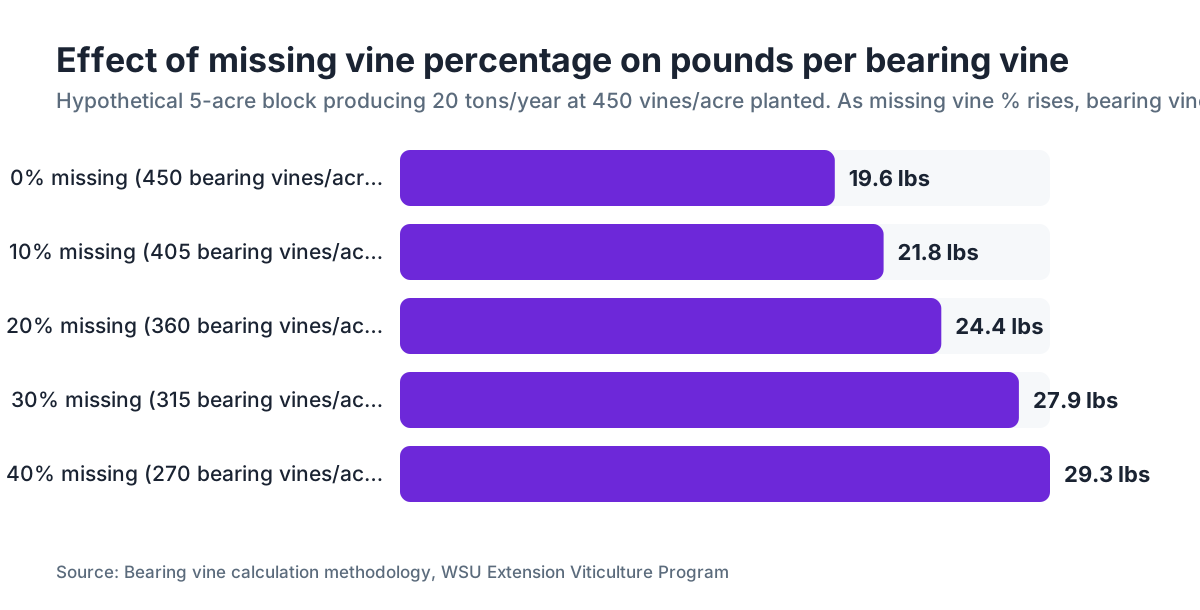
The table below shows how bearing vine count changes the yield-per-vine calculation at different stocking levels, using a hypothetical 5-acre block producing 20 tons per year.
| Planted vines/acre | Missing vine % | Bearing vines/acre | Tons/acre | Lbs/bearing vine |
|---|---|---|---|---|
| 450 | 0% | 450 | 4.0 | 19.6 |
| 450 | 10% | 405 | 4.0 | 21.8 |
| 450 | 20% | 360 | 4.0 | 24.4 |
| 450 | 30% | 315 | 4.0 | 27.9 |
| 450 | 40% | 270 | 3.6 | 29.3 |
At 30% missing vines, the remaining bearing vines are carrying nearly 28 pounds each to hold the block's total yield. That's a reasonable load for some varieties in high-vigor conditions, but for others it signals the block is compensating hard and is one stress year away from a big yield drop. A good vine count record is what makes that analysis possible.
When should you notify your crop insurance agent about vine count changes?
The honest answer is sooner than most growers do.
RMA-approved policies typically require you to report any change that affects your insured unit, including changes in acreage and significant changes in vine stocking, by the applicable reporting deadline for your policy year [1]. Those deadlines vary by policy type and state, but they generally fall in the winter months before the production year begins. For wine grapes in California, many reporting deadlines land in January or February.
Practically, call your agent any time you remove more than a few rows of vines, you have a significant disease event (a trunk disease outbreak that takes out 15%+ of a block), you replant a block with a different variety, or you add a new block to your operation. Agents can usually process a mid-term unit change if you call early enough. Waiting until after a loss event to disclose that a block had significant vine gaps is not a strategy that ends well.
Keep the agent contact in writing, even if it's just an email confirmation after a phone call. A date-stamped email that says "Per our call today, I'm reporting a 12% vine loss in Block 4 due to red blotch virus pulls, completed November 2024" is worth more than a memory of having mentioned it.
Frequently asked questions
How often should I physically count missing vines in each block?
Once per year is the minimum, and the best time is late dormancy or early spring before shoot growth makes walking rows difficult. Some operations do a quick pass post-harvest in fall as well. Annual counts tied to a specific calendar window give you a consistent baseline for year-over-year comparisons, which matters more than the raw count in any single year.
Can I use drone imagery for vine count records that satisfy insurance requirements?
Not as a standalone record in most cases. RMA loss adjusters may use remote sensing tools internally, but for your own records, drone or satellite imagery works best as a supplement to ground-truth counts rather than a replacement. Print the annotated image with a date stamp, note the resolution and flight parameters, and pair it with a manual verification walk of any flagged areas. That combination is defensible.
What happens if my vine count was wrong when I originally took out crop insurance?
Contact your crop insurance agent and request a correction before any claim occurs. RMA allows corrections to APH records when a grower can show the original reporting was a good-faith error and can provide documentation for the correct number. Correcting the record proactively is very different from having it discovered during a loss adjustment, which can trigger a misrepresentation review.
Do non-bearing replacement vines count against my insured yield?
Non-bearing vines don't produce yield, so they reduce your effective block capacity. Whether that reduction affects your insurance depends on how your policy unit is defined and whether you disclosed the replanting. For APH purposes, if your actual production stays up despite non-bearing vines, your APH builds normally. If production drops during a heavy replant period, you may be able to document the cause to avoid a low yield dragging down your APH average.
How do I calculate vines per acre if I don't have the original planting plan?
Measure the within-row vine spacing (average of several intervals in the middle of the row, away from any end gaps) and the between-row spacing. Divide 43,560 by the product of those two spacings in feet. For example, 8-foot by 10-foot spacing gives 43,560 divided by 80, or 545 vines per acre theoretical density. Then walk the block and count actual gaps to get a real bearing vine number.
What records does USDA RMA actually require me to keep for wine grape APH policies?
RMA requires production records (typically crush tickets, winery receipts, or weigh tags) that support each year's certified yield. The records must be kept for the longest of seven years or the current production history period. Vine counts aren't separately enumerated, but any record that an adjuster uses to verify a loss, including vine stocking, becomes part of the required documentation set for that claim year.
If a block has 20% missing vines, should I replant or remove the whole block?
That depends on vine age, variety value, and the cause of the gaps. If the block is under 15 years old and the losses are random (mechanical, isolated disease), filling with the same variety and rootstock usually makes sense. If the losses are systemic (trunk disease across the block, nematode pressure), replanting without addressing the cause just restarts the clock on the same problem. WSU and UC Davis extension both publish block-renewal decision frameworks worth consulting before committing.
Can vine count records help with grape purchase contract compliance?
Yes. Many grape purchase contracts specify a minimum tonnage commitment per acre or per block. Your bearing vine count, combined with a realistic yield-per-vine estimate from prior years, is the best tool for projecting whether you'll meet that obligation. If your bearing vine count has dropped 15% since the contract was signed, that's information your buyer should have before harvest, not a surprise at delivery.
How should I handle vine count records when I buy a vineyard that has no prior documentation?
Do a full physical count within your first growing season and document it as the established baseline. Hire a farm consultant or walk every row yourself. GPS-map the block boundaries and note variety and apparent vine age. That baseline, dated to your ownership period, is what your records stand on going forward. For insurance purposes, notify your agent of the lack of prior APH records; you'll likely enroll with a minimum guarantee or transitional yield until your own production history builds.
Is there a standard vine count form or template I should be using?
No single federal or state standard form exists. RMA doesn't prescribe a format, only that the records support the certified production and are available for review. UC Davis and WSU extension have published sample vineyard record templates that include vine count fields. Any format you use consistently, date, and can export as a readable document works for compliance purposes.
Does a missing vine at the end of a row count differently than one in the middle?
For yield and insurance purposes, no. A missing vine position is a missing vine position regardless of where it sits in the row. End-of-row vines sometimes show more vigor because of lower competition, so their loss may actually affect total block yield slightly more than interior positions, but insurance calculations don't apply that granularity. Count them the same way.
How do vine count records connect to worker protection and pesticide compliance?
Your vineyard block map, which is the spatial backbone of your vine count records, is also the document that defines treated area boundaries under the EPA Worker Protection Standard. That standard requires clear notification of pesticide-treated areas to agricultural workers. A block map that's current and accurate for vine records is also a current and accurate record of where sprays were applied, which matters for WPS compliance and for pesticide application records required by most state departments of agriculture.
Sources
- USDA Risk Management Agency, Actual Production History (APH) policy information: RMA APH plans require growers to maintain production records for seven years or the length of the policy's production history period, whichever is longer, and records must support certified yields.
- University of California Agriculture and Natural Resources (UC ANR): UC Davis Cooperative Extension recommends tying block-level vine counts to GPS-mapped records and notes that Cabernet Sauvignon on vigorous rootstocks may reach commercial yields by years 4-5 under good conditions.
- Washington State University Extension: WSU Extension recommends tracking yield per vine as a block health metric alongside standard tons-per-acre reporting, because it isolates vine performance from stocking rate changes.
- Cornell Cooperative Extension, Lake Erie Regional Grape Program: Cornell's Lake Erie Regional Grape Program has published on remote sensing for vineyard gap detection and recommends a pre-harvest yield estimation methodology using vines per block, clusters per vine, and average cluster weight as three inputs, with a minimum of 10 vines sampled per block.
- USDA Risk Management Agency, Loss Adjustment Manual Standards Handbook: RMA loss adjustment standards for grapes specify that the adjuster must record the number of vines per acre as part of claim documentation; RMA Summary of Business data shows wine grape APH policies are concentrated in California, Washington, and Oregon.
- EPA Worker Protection Standard for Agricultural Pesticides: The EPA Worker Protection Standard requires that treated area boundaries be clearly defined and that agricultural workers receive notification of pesticide-treated areas, making an accurate block map a compliance document.
- USDA National Agricultural Statistics Service, California field office: California NASS grape acreage reports track planted acreage and non-bearing acreage by variety, illustrating how statewide vine inventory tracking is structured at the program level.
- USDA Risk Management Agency, Whole Farm Revenue Protection Handbook: WFRP and specialty crop policies use planted vine counts to cross-check the plausibility of reported production.
- Washington State University Extension, Viticulture and Enology: WSU and UC Davis extension publish block-renewal decision frameworks for assessing whether gap-filling or full replanting is warranted when missing vine percentage exceeds certain thresholds.
- University of California Agriculture and Natural Resources (UC ANR): UC Davis and WSU extension have published sample vineyard record templates that include vine count fields as part of recommended record-keeping practice for compliance and yield management.
Last updated 2026-07-10