Stem water potential target ranges for Cabernet Sauvignon mid-season
TL;DR
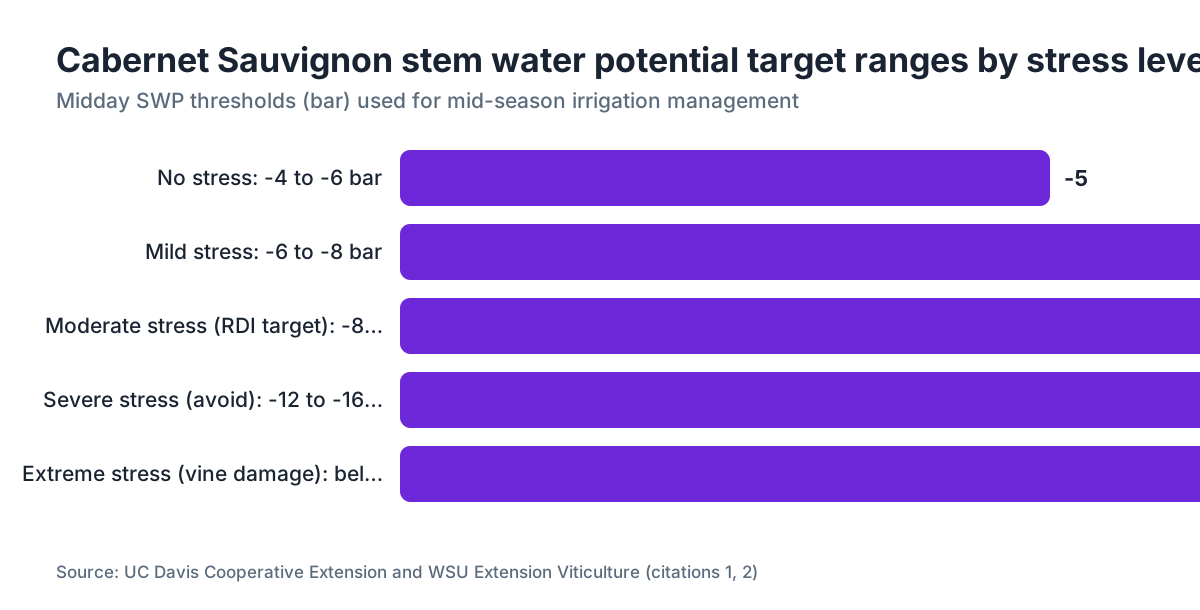
- For Cabernet Sauvignon measured at midday in mid-season (berry development through veraison), stem water potential targets run -6 to -8 bar for well-watered vines, -8 to -12 bar for moderate regulated deficit irrigation, and below -14 bar signals severe stress to avoid.
- UC Davis and WSU extension both use these thresholds as field benchmarks.
What is stem water potential and why does it matter for Cabernet Sauvignon?
Stem water potential (SWP) measures how hard a vine is working to pull water through its tissues. You express it in bars or megapascals (1 MPa = 10 bar), and the number is always negative. A reading of -8 bar means the vine is under moderate tension. A reading of -18 bar means you're watching the vine shut down.
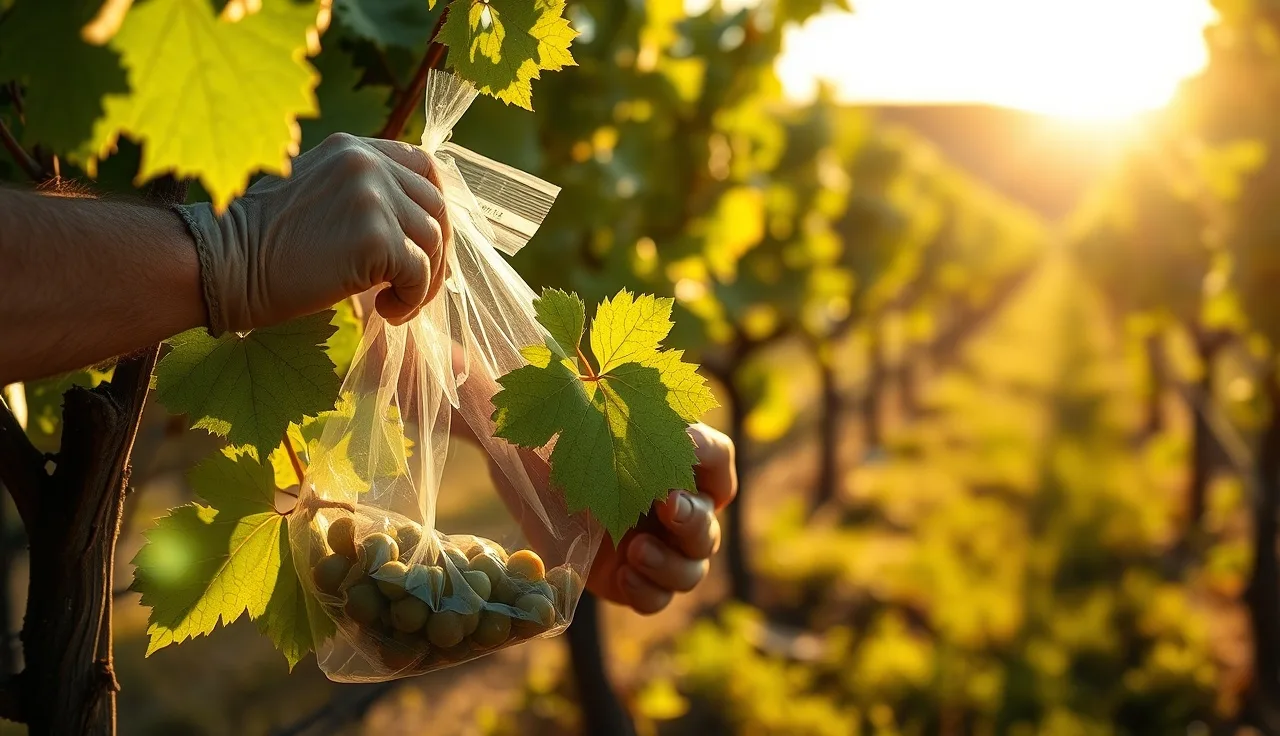
Why measure the stem rather than the leaf? Leaf water potential responds to everything: air temperature, wind, time of day, even cloud cover. Stem water potential, measured with a pressure chamber on a bagged, shaded leaf, integrates the whole plant's water status. It's far less noisy and much more repeatable across technicians and vineyards. UC Davis Cooperative Extension calls stem water potential "the most reliable midday measurement for scheduling irrigation" in their practical guide for California winegrape growers [1].
Cabernet Sauvignon does well under deficit irrigation during berry development and ripening. The variety is vigorous, more drought-tolerant than Pinot noir, and makes better wine under moderate to mild stress than at full hydration. That's not an opinion. It's documented across California trial datasets going back to the 1990s.
The real question is what 'moderate stress' actually means in bar readings at specific growth stages. That's what this article answers.
What are the recommended stem water potential targets for Cab Sauv from fruit set to veraison?
From fruit set through veraison (roughly May through late July in most California regions, later in Washington and Oregon), your irrigation decisions carry the most weight on berry size, cluster architecture, and eventual wine quality. Get this window right and the vine follows.
Here are the benchmark ranges used by UC Davis and WSU extension [1][2]:
| Stress Level | Midday SWP (bar) | Vine Condition | Typical RDI Goal |
|---|---|---|---|
| No stress | -4 to -6 | Full canopy function, maximum shoot growth | Cover crops, cool sites |
| Mild stress | -6 to -8 | Moderate growth, good photosynthesis | Early post-fruit set |
| Moderate stress | -8 to -12 | Reduced berry size, anthocyanin accumulation begins | Berry development to veraison |
| Severe stress | -12 to -16 | Stomata closed, photosynthesis impaired, risk of sunburn | Avoid sustained exposure |
| Extreme stress | Below -16 | Leaf drop, cane damage, yield loss next year | Never intentional |
The practical target most California Cabernet Sauvignon growers aim for between fruit set and veraison is -8 to -12 bar. That range promotes natural berry size reduction (smaller berries mean higher skin-to-juice ratios), keeps shoot growth in check, and starts building the terpene and phenolic precursors that matter in red wine. You're not trying to torture the vine. You're keeping it comfortably uncomfortable. [1][3]
WSU Extension's recommendations for Washington state Cabernet Sauvignon run a touch less severe, suggesting -7 to -10 bar during this window, partly because Washington growing seasons are shorter and growers have less time to recover from severe mid-season events [2].
One caveat you can't skip: these numbers assume you're measuring at solar noon (11 AM to 1 PM local time) on a bagged, shaded leaf. Measure at 9 AM and every threshold shifts by 3 to 5 bar toward less negative values. The time of day matters as much as the reading itself.
What are the stem water potential targets from veraison through harvest?
After veraison, the math changes. Berry cell division is done. You're building sugar, phenolics, and aromatics now, and you can push more stress without hurting berry count. Most Cabernet Sauvignon programs shift toward -10 to -14 bar post-veraison.
The UC Davis viticulture group's work in the San Joaquin Valley and North Coast found that Cabernet Sauvignon held at -10 to -12 bar from veraison to harvest consistently produced higher Brix, better color density, and improved tannin structure compared to well-watered controls [3]. The trade-off is always yield. Stressed vines make less juice per berry.
Going below -14 bar post-veraison is a mistake even when the wine quality data look tempting at very high stress. The risk of irreversible phloem damage and reduced return bloom is real. A few studies from Australia and the Napa Valley suggest -16 bar may be recoverable once, but hitting that mark season after season shortens the vine's productive life.
Paso Robles and other hot inland sites run a different problem. Ambient heat pushes vine stress higher than soil moisture alone would predict, so growers there manage the upper end of these ranges rather than the lower. The vine is already stressed by the heat load. At those sites, irrigation strategy is less about imposing deficit and more about holding the target range without overshooting. The paso robles wineries region runs some of the most disciplined SWP programs in California precisely because summer heat forces active monitoring to keep readings from crashing below -14 bar by accident.
How do you actually measure stem water potential in the field?
You need a pressure chamber (often called a pressure bomb), a bagging kit, and roughly 15 to 20 minutes per block to get a reliable reading. The hardware runs $700 to $1,500 for a professional instrument. PMS Instruments and Soil Moisture Equipment Corp are the two main suppliers in North America. Skip the cheap knockoffs. The pressure seals fail and you get garbage readings.
The protocol:
- At least 30 minutes before measuring, put small foil or black plastic bags over the leaves you plan to sample. The bag stops transpiration and lets leaf water potential equilibrate with stem water potential. Skip this step and you're measuring leaf potential, which is noisier.
- At solar noon, cut the bagged leaf at the petiole, keeping it in the bag.
- Seat the petiole through the pressure chamber's rubber seal, bag pressed against the outside.
- Slowly pressurize with nitrogen gas while watching for the first bead of xylem sap at the cut end of the petiole.
- Record the pressure at that moment. That's your SWP reading.
Sample at least 4 to 6 vines per block, from similar positions in the canopy (a mid-cordon leaf exposed to sun is standard). Throw out readings that sit 3 or more bar away from the cluster. Average the rest. One reading from one vine tells you almost nothing. [1][4]
The University of California has a practical video walkthrough on this technique, and their Drought Toolbox for winegrapes covers equipment calibration and common errors [4]. Watch it before you train a new field crew member.
How often should you measure SWP on Cabernet Sauvignon mid-season?
Weekly measurements are the standard during berry development and the run-up to veraison. That gives you enough data to catch a drift from your target range before the vine has been stressed for 10 or 14 days at the wrong level.
In hotter stretches or on sandier soils that drain fast, twice a week is better. Sandy loam and volcanic soils in Sonoma, or the alluvial fans around the Yakima Valley, can move a vine from -8 to -14 bar in three to four days of no irrigation and 100 degree heat. Weekly monitoring would miss that entirely.
Once you have 2 or 3 seasons of data for a specific block, you'll build intuition about how fast your soils cycle and how your irrigation intervals map to SWP readings. That knowledge is worth writing down. Tools like VitiScribe exist to capture that kind of time-series field data alongside your irrigation logs, so you can see the relationship between valve-open hours and pressure chamber readings across multiple seasons without rebuilding a spreadsheet from scratch every year.
Measure more during heat waves. Measure after any big irrigation event to confirm the vine responded the way you expected. Skip measurement when it's cloudy or when temperatures sit below about 85°F, because the vine hasn't reached full stress expression and your readings will underestimate the true soil water deficit.
What happens to berry size and wine quality if you let SWP drop too low?
Below -14 bar sustained over more than a week, stomata close and photosynthesis drops sharply. Sugar accumulation slows. Brix can look high because you're concentrating existing sugar into smaller berry volume, but you're not actually making more sugar. Total soluble solids per vine go down, not up.
Acids spike. Malic acid degrades faster at high temperatures, so pH tends to rise faster than you want. Color can look excellent on the surface, but tannin quality suffers at extreme stress because biosynthesis of late-season phenolics needs photosynthate the stressed vine isn't making.
A 2002 study by Dry, Loveys, McCarthy, and Stoll in the Australian Journal of Grape and Wine Research found that regulated deficit irrigation improving wine quality was mostly explained by berry size reduction during the cell division phase, not by late-season stress per se. Timing matters as much as magnitude. [5]
For berry size specifically: cells divide from fruit set to about 40 days post-set in Cabernet Sauvignon. Apply stress during that window (-8 to -12 bar) and you reduce final cell number, producing permanently smaller berries. Apply the same stress after cell division ends and you mainly shrink existing cells through dehydration. The first approach is structural and holds through ripening. The second is temporary and can reverse with irrigation. Most premium Cabernet Sauvignon programs target the cell division phase for moderate stress for exactly this reason.
How does stem water potential relate to other irrigation scheduling tools like soil moisture sensors?
Soil moisture sensors (capacitance probes, neutron probes, tensiometers) measure what's in the soil. Pressure chambers measure what the vine is actually experiencing. Those two things are related but not identical. Soil hydraulic conductivity, root depth and distribution, vine age, and rootstock all mediate how the vine gets at available soil water.
The most common setup in well-managed California vineyards uses soil moisture sensors as the continuous monitoring tool and pressure chamber readings as the weekly calibration check. If your neutron probe says you have adequate water at 12 inches but your pressure chamber reads -14 bar at noon, the vine is either root-limited, the soil is drying at a depth your probe doesn't capture, or your probe is miscalibrated. The pressure chamber is the ground truth.
ETc-based scheduling (evapotranspiration calculations using weather station data and crop coefficients) is another common framework. UC Davis and the California Department of Water Resources publish daily reference ET values through the CIMIS network, and Cabernet Sauvignon Kc values by growth stage are well-documented [6]. ETc scheduling tells you how much water to apply. SWP measurements tell you whether the vine agrees.
None of these tools replace each other. Experienced growers run all three and build a mental model for their specific site. The Cabernet Sauvignon blocks at a well-run vineyard usually carry the most mature irrigation scheduling programs on the property, because Cab's tolerance for stress makes the precision pay off.
Do SWP targets differ by rootstock, soil type, or climate region?
Yes, and this is where the textbook numbers can mislead you.
Rootstock matters a lot. 110R and 140Ru are drought-adapted rootstocks that suppress SWP somewhat under the same soil moisture conditions as a shallower-rooted stock like 3309C. A vine on 110R at -10 bar may be less stressed in absolute terms than a vine on 3309C at the same reading, because 110R is reaching deeper water and holding turgor through mechanisms the shallower rootstock can't. Comparing SWP targets across rootstocks without accounting for this is one of the most common errors in irrigation management. [7]
Soil type sets how fast the vine moves through the target range once you stop irrigating. Heavy clay soils buffer the change. Shallow rocky soils in Napa mountain appellations can crash from -8 to -16 bar in 48 hours during a heat event. You can't manage those blocks on the same irrigation interval you'd use on deep alluvial soils in the valley floor.
Climate region changes baseline vapor pressure deficit (VPD), which drives how hard the vine must transpire even when soil moisture is adequate. High VPD environments like the Columbia Basin in Washington or the Central Valley in California push SWP more negative even at similar soil moisture contents compared to coastal California or the Willamette Valley. WSU Extension notes this in their Cabernet franc and Cabernet Sauvignon irrigation recommendations for Eastern Washington [2].
The practical answer: treat published target ranges as a starting framework, not a prescription. Calibrate to your site over 2 or 3 seasons and build your own target table. The ranges here sit at the center of the research literature, but your blocks are specific.
What are the recordkeeping and worker safety requirements tied to vineyard irrigation and monitoring programs?
Irrigation scheduling and SWP monitoring don't carry standalone regulatory requirements in most states. The broader context of vineyard operations absolutely does.
If you're applying pesticides as part of canopy management alongside irrigation decisions, the EPA Worker Protection Standard (WPS) requires that pesticide application records be kept for at least two years, accessible to workers and their representatives, and that restricted-entry intervals be tracked and communicated [8]. California's DPR piles on additional requirements, including monthly production reports for restricted-materials licenses [9].
For water management specifically, California growers operating under State Water Board water rights permits have reporting obligations tied to use volumes that often require maintaining irrigation logs with dates, amounts, and method [10]. These aren't SWP logs, but they live in the same recordkeeping system.
A practical note: even where there's no legal mandate to log SWP readings, doing so creates audit trail value. If you're pursuing Certified California Sustainable Winegrowing (CCSW) or Lodi Rules certification, documented irrigation decisions tied to vine stress data are exactly the practice those programs want to see. SWP logs also protect you in crop insurance disputes, where showing you managed irrigation to a documented standard can support a claim that a loss was weather-driven rather than management-related.
Visit VitiScribe if you want to see how a field operations platform handles time-series SWP log entry alongside spray records and irrigation events in one place.
How do you handle heat waves without letting SWP crash below your targets?
Heat waves are the single biggest threat to your SWP management program. A week of temperatures above 100°F can move a well-managed vine from -9 bar to -17 bar faster than any irrigation system can compensate if you're not watching.
A few things that actually work:
Pre-irrigate before a forecast heat event. Get soil moisture up to field capacity 24 to 48 hours before the heat arrives. The vine can't absorb water fast enough during a heat event to compensate, but going in with full soil moisture gives the root zone a buffer. UC Cooperative Extension recommends this practice for North Coast vineyards [1].
Measure SWP every two days during the event, not weekly. The data you need is real-time.
Know your soil's hydraulic conductivity well enough to estimate whether the water you apply today will reach roots by tomorrow. On coarse soils, applied water takes 12 to 24 hours to move into the active root zone. On heavy clay, it might be three days. A big irrigation pulse at 4 PM during a 108°F day does essentially nothing to protect the vine that afternoon.
Evaporative cooling through overhead irrigation (where the system exists) is a legitimate tool for preventing sunburn and reducing canopy temperature during extreme events. It doesn't substitute for root zone irrigation, but it can buy you hours. The NRCS and UC Cooperative Extension have both addressed this in California drought and heat management guides [4][6].
How do you explain SWP targets to a new field crew or farm labor contractor?
The pressure chamber intimidates people the first time they see it. It looks like something from a chemistry lab, not a vineyard. A few things that make the handoff easier:
Use an analogy. Tell your crew a garden hose with no water pressure is like a vine at -18 bar. No pressure, nothing moves. A hose at normal house pressure is like a vine at -6 bar. The reading tells you how hard the vine is working to hold itself together.
Make a simple reference card (laminated, pocket-sized) with your block-specific target ranges and the action thresholds: below what reading do they call you immediately, above what reading do they hold off on scheduling an irrigation event. Three numbers per block. Nothing more complicated than that.
Bagging technique takes practice. Have your most experienced person run the first round with any new crew member and physically walk through the 30-minute bag time, the cut technique, and how to seat the petiole in the chamber seal. A torn seal or an unbagged leaf ruins the measurement and wastes everyone's time.
Document who measured, which block, which vines (row and vine number), time of day, and the reading. If you're using paper logs, a simple table works. If you're in a digital system, timestamp and GPS tagging take the ambiguity out entirely and let you compare vine-specific stress history across seasons.
Frequently asked questions
What is a normal midday stem water potential for Cabernet Sauvignon in summer?
During mid-season berry development, a Cabernet Sauvignon vine managed for moderate regulated deficit irrigation typically reads -8 to -12 bar at midday. Well-watered vines run -4 to -7 bar. Below -14 bar signals stress that warrants immediate attention. These benchmarks come from UC Davis and WSU Extension field research and are measured at solar noon on a bagged, shaded leaf.
What units are stem water potential readings reported in, bars or MPa?
Both. The conversion is straightforward: 1 MPa equals 10 bar. UC Davis extension materials often use bar; academic literature often uses MPa. A reading of -1.0 MPa is the same as -10 bar. When comparing your readings to published targets, confirm which unit the source is using before deciding whether your vine is in range.
At what stem water potential does Cabernet Sauvignon show visible stress symptoms?
Visible wilting in Cabernet Sauvignon typically starts around -14 to -16 bar. Leaf curl and interveinal chlorosis can appear at -12 to -14 bar under sustained exposure. These visual cues lag behind the actual physiological stress by days, which is why pressure chamber readings are valuable: they catch problems before you can see them in the canopy.
Does stem water potential target differ for young Cabernet Sauvignon vines versus mature vines?
Yes. Young vines (first and second leaf) should not be deficit-irrigated at all. Their root systems are shallow and their canopy is too small to withstand the stress mature vines handle easily. The -8 to -12 bar mid-season targets apply to established vines, generally third leaf and beyond. Young vines should be managed at -4 to -7 bar maximum.
How long does it take a Cabernet Sauvignon vine to recover from a stem water potential below -14 bar?
Recovery depends on how long the vine was below threshold and soil conditions. With a well-timed irrigation event, most mature Cabernet Sauvignon vines recover to above -10 bar within 24 to 48 hours on loam soils. Coarser soils respond faster. However, if the vine was below -14 bar for more than a week, some photosynthetic capacity may not return until the following season.
Can you use a leaf pressure bomb for stem water potential or do you need a different instrument?
The same instrument works for both, with a technique difference. For stem water potential, you bag the leaf 30 minutes before sampling to stop transpiration and equilibrate the leaf with internal stem pressure. For leaf water potential, you measure an unbagged, sun-exposed leaf. Both use a pressure chamber; the distinction is in sample preparation. Stem water potential is the recommended method for irrigation scheduling decisions.
How do you calibrate or verify a pressure chamber is reading correctly?
There's no universal calibration standard for field pressure chambers, but you can run a verification check by measuring 4 to 6 vines in a well-watered, non-stressed block on a cool morning and confirming you get readings in the -3 to -5 bar range. If your instrument reads below -8 bar on vines you know received full irrigation the prior evening, your seal is leaking or your pressure gauge needs service.
What is regulated deficit irrigation and how does it relate to stem water potential targets?
Regulated deficit irrigation (RDI) is an irrigation strategy where water is intentionally withheld below full evapotranspiration replacement during specific growth stages to improve fruit quality. Stem water potential targets are the feedback mechanism: you define an acceptable range (for Cabernet Sauvignon, typically -8 to -12 bar during berry development) and irrigate only enough to stay within that window. SWP measurement is what makes RDI a managed system rather than guesswork.
Do cover crops or tillage between rows affect stem water potential readings?
Cover crops compete for soil moisture and can push vine SWP more negative than a clean-cultivated floor, especially on drier sites. If your cover crop is still active in June on a water-limited site, your vines may hit -12 bar sooner than expected. Terminating or mowing the cover crop reduces competition and shifts soil moisture toward vine roots. This is a meaningful variable to track alongside your SWP log.
What time of day should you measure stem water potential for accurate results?
Measure at solar noon, which is 11 AM to 1 PM local standard time (noon to 2 PM daylight saving time). That window captures peak daily vine stress. Measurements taken outside that window, especially before 10 AM, significantly underestimate midday stress and will make your irrigation program too conservative. Time-stamp every reading and discard any taken outside the noon window when comparing to published targets.
What is the relationship between stem water potential and ETc-based irrigation scheduling?
ETc scheduling uses weather data and crop coefficients to calculate how much water to replace. SWP measurement checks whether the vine agrees with that calculation. Use ETc to determine irrigation volume and timing intervals, and SWP to validate those calculations against actual vine response. When ETc and SWP diverge, trust the pressure chamber: it accounts for site-specific factors like rooting depth and soil variability that ETc models cannot capture directly.
How many vines per block do you need to sample for a reliable SWP reading?
Four to six vines per block is the standard recommendation from UC Davis and WSU Extension for production monitoring. For research or troubleshooting purposes, 8 to 12 vines gives better statistical confidence. Always pull samples from the same representative position in each vine (a mid-cordon leaf in a sun-exposed position). Average the readings and flag any outlier more than 3 bar from the median for investigation.
Are there any free tools or apps to help track stem water potential readings over the season?
There's no dedicated free app built specifically for SWP tracking as of 2025, but many growers use spreadsheet templates. University extension programs including UC ANR and WSU have published downloadable irrigation log templates. Paid vineyard management platforms including VitiScribe allow time-series SWP entry alongside irrigation and spray records, which makes cross-season comparison practical. CIMIS, the California Irrigation Management Information System, provides the weather reference data that feeds ETc calculations alongside your SWP field logs.
Does stem water potential differ significantly between drip-irrigated and dry-farmed Cabernet Sauvignon at the same reading?
The reading itself means the same thing physiologically regardless of irrigation method. Dry-farmed Cabernet Sauvignon often runs -10 to -14 bar mid-season on coastal California sites without showing the yield or quality damage you'd expect at those levels under drip irrigation. The difference is that dry-farmed vines adapt over years with deeper roots and osmotic adjustment. Compare dry-farmed and drip-irrigated vines only with that context in mind.
Sources
- UC Agriculture and Natural Resources, 'Drought Tips: Measuring Plant Water Status': Stem water potential is the most reliable midday measurement for scheduling irrigation in winegrapes; target ranges -6 to -12 bar mid-season for Cabernet Sauvignon
- Washington State University Extension, Viticulture and Enology Program: WSU recommends -7 to -10 bar SWP during berry development for Cabernet Sauvignon in Washington state; notes high VPD in Eastern Washington pushes readings more negative
- UC ANR Drought Toolbox for Winegrapes: Practical guidance on pressure chamber technique, leaf bagging protocol, equipment calibration, and pre-irrigation before heat events for North Coast vineyards
- Dry, Loveys, McCarthy, and Stoll, Australian Journal of Grape and Wine Research, 2002, 'Principles and practices for wine grape production with controlled water deficits': Regulated deficit irrigation improving wine quality is mostly explained by berry size reduction during the cell division phase, not late-season stress per se
- California Department of Water Resources, CIMIS (California Irrigation Management Information System): Daily reference ET values by station and Cabernet Sauvignon Kc values by growth stage for ETc-based irrigation scheduling
- UC Davis Cooperative Extension, 'Rootstock Effects on Vine Water Relations and Irrigation Management': Drought-adapted rootstocks like 110R and 140Ru suppress SWP expression relative to shallower rootstocks at the same soil moisture content; comparing SWP targets across rootstocks requires this context
- US EPA Worker Protection Standard (WPS), 40 CFR Part 170: Pesticide application records must be kept for at least two years and be accessible to workers and their representatives; restricted-entry intervals must be tracked and communicated
- California Department of Pesticide Regulation, Pesticide Use Reporting: California DPR requires monthly production reports for restricted-materials licenses and ongoing pesticide use reporting by licensed applicators
- California State Water Resources Control Board, Water Rights Reporting: California growers under State Water Board water rights permits have reporting obligations tied to irrigation use volumes requiring date, amount, and method documentation
- Cornell Cooperative Extension, Viticulture Program, New York State IPM: Pressure chamber protocols and vine water status monitoring recommendations for eastern US viticulture contexts
Last updated 2026-07-11