How to record and interpret midday leaf water potential in vineyard logs

TL;DR
- Midday leaf water potential (LWP) measures vine water stress in megapascals (MPa) using a pressure chamber.
- Readings between -1.0 and -1.4 MPa signal mild to moderate stress; below -1.6 MPa means severe stress requiring irrigation review.
- Log the reading, exact time, vine ID, growth stage, and weather.
- UC and WSU extension both publish crop-stage thresholds you can map straight to your log fields.
What is midday leaf water potential and why does it matter for vineyard records?
Leaf water potential is the energy status of water inside leaf tissue, expressed in megapascals (MPa). A reading of 0.0 MPa is pure, unstressed water. Vineyard leaves always read negative because the vine pulls water upward against gravity and through resistance, so you'll see numbers like -0.8, -1.2, or -1.6 MPa. The more negative the number, the more stressed the vine.
Midday readings matter because that's when atmospheric demand peaks and vine stress is loudest. A pre-dawn reading tells you about soil water supply. A midday reading tells you how the vine is coping with soil water, root uptake, and evaporative demand from the canopy all at once. For irrigation scheduling and deficit programs, midday LWP is the number most growers and researchers watch [1].
For your records, midday LWP is a decision-support data point. One reading is a snapshot. A season of readings is a pattern you can use to calibrate irrigation timing, compare blocks, and defend your water decisions in a regulatory audit or crop insurance review. The log is worth more than any single measurement.
What equipment do you need to measure midday leaf water potential?
The standard tool is the Scholander pressure chamber, sometimes called a pressure bomb. You clip a leaf petiole, seal the leaf inside the chamber with the cut end exposed, and slowly apply nitrogen gas pressure until sap appears at the cut surface. The pressure at that moment equals the tension the leaf was under, which is the water potential [2].
A bench-top pressure chamber from a supplier like PMS Instrument costs roughly $2,000 to $4,000 depending on model and accessories. You also need a compressed nitrogen tank, a hand lens to see the sap endpoint, a stopwatch, and a good pair of scissors or a razor blade. The chamber body is tough. The gauge is not, so transport it carefully.
Thermocouple psychrometers exist but require lab conditions and long equilibration times, so they aren't practical for field screening. Pressure chambers are what production vineyards actually use. Some researchers have tested pressure-probe methods or remote sensing proxies for stress, but none have replaced the pressure chamber as a field standard for daily operations [1][3].
Calibration matters. Check your gauge against a known standard at the start of each season. A gauge that reads 0.1 MPa off at mid-range gives you a whole season of skewed data. Replace gauges that show nonlinear drift.
What is the correct protocol for taking a midday leaf water potential reading?
Timing is the most common source of error. Midday means solar noon, which in most wine regions lands between 1:00 p.m. and 2:00 p.m. local time depending on your longitude within the time zone. WSU Extension recommends taking readings within a 90-minute window centered on solar noon and logging the exact clock time for every measurement [3].
Leaf selection matters just as much. You want a sun-exposed, fully expanded leaf from the mid-canopy, ideally the fourth or fifth leaf back from a shoot tip. The leaf should be shaded only by itself, not tucked behind a canopy wall. UC Cooperative Extension guidance says to pick leaves that have been fully sun-exposed for at least 30 minutes before sampling [1]. Shaded leaves equilibrate toward shoot water potential, which reads a different and lower-stress number.
Here's the step-by-step field protocol:
- Select the target leaf. Do not bag it first for midday (bagging is for stem water potential, a different measurement).
- Cut the petiole cleanly with a sharp blade as close to the leaf as possible. Work fast, within 30 seconds is the common benchmark.
- Insert the petiole through the chamber lid gasket so the cut end sits outside the chamber, leaf inside.
- Pressurize slowly, at roughly 0.02 to 0.05 MPa per second.
- Watch the cut surface with a hand lens. Stop the moment you see a glistening bead of sap.
- Record the gauge reading immediately, in MPa.
- Log air temperature and relative humidity from a nearby weather station or handheld meter. These give the reading context.
- Repeat on at least 3 to 5 vines per block per date for a block-level estimate.
Safety note: you're working with compressed gas. The EPA Worker Protection Standard doesn't govern pressure chamber use, but your farm safety program should train crews on compressed gas cylinders, including keeping tanks away from heat and secured upright during transport [4].
What stress thresholds should you use to interpret midday leaf water potential readings?
Raw MPa numbers mean nothing without a reference framework. UC Davis and UC Cooperative Extension publish threshold ranges used across California wine regions [1]. WSU Extension publishes similar guidance calibrated to Pacific Northwest conditions [3]. The ranges shift a little by cultivar and region, but the broad shape holds.
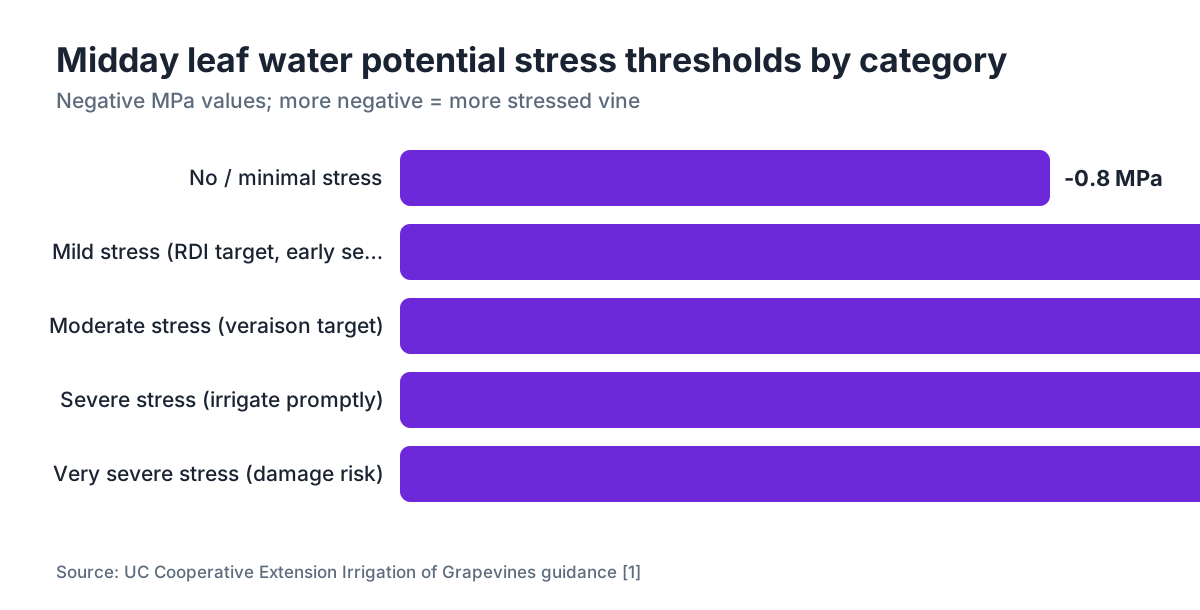
| Stress Category | Midday LWP Range (MPa) | Practical Meaning |
|---|---|---|
| No stress / minimal stress | -0.6 to -0.9 | Vine fully hydrated; typical of well-irrigated or post-rain vines |
| Mild stress | -1.0 to -1.2 | Common target for regulated deficit irrigation early in the season |
| Moderate stress | -1.3 to -1.5 | Acceptable for berry sizing; review irrigation timing |
| Severe stress | -1.6 to -1.9 | Shoot growth stops; berry shrinkage risk; irrigate promptly |
| Very severe stress | Below -2.0 | Leaf damage, premature defoliation risk; urgent action needed |
Thresholds shift by growth stage. During bloom and fruit set, keep the vine above -1.2 MPa because berry cell division is sensitive to stress. During veraison and ripening, many premium programs push -1.3 to -1.6 MPa on purpose for regulated deficit irrigation (RDI) to concentrate flavor. Post-harvest, let the vine rehydrate before pushing it back into stress [1][5].
Cultivar sensitivity varies a lot. Pinot Noir shows stress symptoms at less negative values than Cabernet Sauvignon. Zinfandel is notably more drought-tolerant. Nobody has published a clean cultivar-by-cultivar threshold table for commercial use, though UC Davis viticulture research keeps working on it. Use the general framework as a starting point and track your own vines over seasons.
The UC Cooperative Extension publication on grapevine irrigation describes midday leaf water potential monitoring as "one of the most reliable methods available for determining vine water status" and scheduling irrigation in California vineyards [1]. That's the clearest statement you'll find from a primary source.
How should you structure your vineyard log entries for midday leaf water potential?
A useful LWP entry has six fields at minimum: date, time of measurement, block or vine ID, growth stage (using a recognized scale like modified Eichhorn-Lorenz or BBCH), the MPa reading, and environmental context like air temperature plus a note on recent irrigation or rainfall.
Here's what a clean entry looks like in a spreadsheet row:
2025-07-14 | 13:15 | Block 4-B, Row 12, Vine 3 | E-L 35 (Berry pea-size) | -1.3 MPa | 96°F air temp, no rain in 7 days, last irrigated 2025-07-11
The growth stage note gets skipped constantly, and it shouldn't. A -1.3 MPa reading at fruit set is a red flag. The same reading at veraison might be exactly where you want to be. Strip out the stage and the number becomes hard to read months later or across seasons.
When you sample multiple vines for a block, log each vine reading plus the block mean. Don't collapse to the mean in the field. The range across vines tells you about within-block variability, which matters if you're weighing variable-rate irrigation.
On paper, a field notebook with a pre-printed header row works fine. Digitally, a spreadsheet with locked column headers and a dropdown for growth stage cuts transcription errors. Tools like VitiScribe let you attach LWP entries to block records with timestamp and GPS, which speeds end-of-season reporting and cross-season comparison.
Keep raw data. Never overwrite original readings when you calculate block averages. Audits and crop insurance claims sometimes want the raw field records, not the summaries.
How do midday and stem (predawn) water potential differ, and which should you log?
These are different measurements that answer different questions. Pre-dawn leaf water potential (taken before sunrise, when leaf and soil water potential have equilibrated overnight) estimates soil water in the root zone. Midday LWP measures the vine's real-time stress under maximum atmospheric demand.
Stem water potential is a third variant, sometimes called shoot water potential. You take a fully shaded, bagged leaf (bagged 20 to 30 minutes before sampling to stop transpiration and let the leaf equilibrate to shoot xylem pressure), then measure it the same way with a pressure chamber. Stem WP is generally more stable and replicable than midday leaf WP because it's less sensitive to leaf-to-leaf differences in sun exposure [5].
For practical logging, the honest answer is: pick one method and stick with it. Mixing midday leaf WP and stem WP in the same log column is a data quality problem. The numbers look similar but aren't comparable. Label your method clearly in the log header or record template.
Most small and mid-size operations use midday leaf WP because it needs no bagging and moves faster in the field. Larger research-oriented estates and some irrigation consultants prefer stem WP for its lower variability. Cornell's viticulture program has published guidance on both methods for New York conditions [6].
How many vines per block should you sample for a reliable midday LWP average?
Sample size decides how much you can trust the block average. A single vine reading is nearly useless as a management tool because vine-to-vine variability within a block can run 0.2 to 0.4 MPa on any given day, depending on soil variability, canopy architecture, and distance from drip emitters.
UC Davis researchers have found that sampling 5 to 10 vines per block gives a mean stable enough for irrigation scheduling [1]. For large blocks with known within-block soil variability (different soil series, say), stratify your sample: 3 to 4 vines from each distinct zone instead of random selection across the whole block.
For research-quality data, the standard error of the mean for midday LWP in a uniform block usually falls below 0.05 MPa with 8 to 10 replicate leaves. That's more precision than irrigation scheduling needs, but worth knowing if you're comparing two irrigation treatments or tracking year-over-year trends.
Log each vine's reading separately, then calculate the block mean. Note the outliers. A single vine reading 0.5 MPa more stressed than the rest often flags a local problem: a clogged emitter, a gopher-chewed root system, or a vine fighting disease pressure.
What environmental factors do you need to record alongside each LWP measurement?
A number without context is hard to read when you look back at it later. Record at minimum: air temperature at the time of measurement (from a nearby weather station or CIMIS/AgWeatherNet station, not a car thermometer), relative humidity, days since the last significant rainfall, and days since the last irrigation event with volume or duration applied.
Vapor pressure deficit (VPD) is worth logging alongside LWP because it folds temperature and humidity into one metric that strongly predicts atmospheric demand. A vine reading -1.3 MPa on a 95°F day with VPD of 4.5 kPa is under far more atmospheric stress than the same vine reading -1.3 MPa on a 75°F day with VPD of 1.5 kPa. Same number, very different context.
CIMIS (California Irrigation Management Information System) provides free hourly ETo, temperature, humidity, and VPD data for station locations across California wine regions. AgWeatherNet serves Washington and Oregon. Both run through state agencies with USDA cooperation [7][8]. Logging the nearest station ID and pulling its midday weather data as a companion to your LWP record takes about two minutes and makes the record far more useful.
Soil moisture sensor readings, if you have them, round out the picture. A vine at -1.4 MPa midday with a full soil profile is reacting to atmospheric demand and may not need water. The same vine at -1.4 MPa with a depleted profile is running out of water and probably does.
How do you use historical midday LWP logs to make better irrigation decisions over multiple seasons?
One season of LWP data is useful. Two or three seasons is where the real value shows up. You start to see block-specific baselines: this block reads 0.2 MPa more stressed than the block next door at the same irrigation volume because the soil is shallower. That vine row in the upper corner spikes to -1.8 MPa by mid-August before the rest of the block moves.
Multi-season logs let you compare irrigation programs directly. If you ran a regulated deficit trial in 2024 holding Block 6 at -1.4 to -1.6 MPa from berry sizing through veraison, you can compare wine quality outcomes (Brix at harvest, berry weight, pH) against seasons where you held that block at -1.0 to -1.2 MPa. The logs are the base of that comparison.
For yield and quality reporting to a winery buyer, a documented LWP record with matching irrigation volumes and harvest data is increasingly expected at premium price points. Some California wineries building sustainability certifications (California Sustainable Winegrowing Alliance certification, for example) ask for water use records that LWP logs support directly [9].
Review your logs at the end of each season, before you put the irrigation gear away. Ask which blocks needed the most reactive decisions. Ask where readings drifted past your target before you caught them. Ask what lead time you actually had from first detection to the irrigation event. That retrospective, logged as a seasonal note in the same binder or database, is worth the 30 minutes it takes.
What are the most common recording errors that make midday LWP logs unreliable?
The most common problem is inconsistent timing. People measure at 11 a.m. on cool days and 2 p.m. on hot days, then average those readings as if they're the same thing. They aren't. Midday stress peaks at different clock times on different days depending on cloud cover and VPD. Standardize your window and log the exact time every single time.
Mixed leaf types are the next frequent issue. Sampling a shaded leaf instead of a sun-exposed one gives a reading 0.2 to 0.5 MPa less negative than a properly selected leaf from the same shoot. Sample a bagged leaf without logging it as stem WP and you've mixed methods.
Equipment drift slips by because most people don't re-zero or calibrate mid-season. A stuck gauge or slow nitrogen leak can push readings positive over time, falsely suggesting the vines are getting less stressed as the season runs. Verify your gauge against a second chamber or a certified calibration check at least twice per season.
Pressurization speed errors change the result. Too fast (above 0.05 MPa per second) overshoots the endpoint. Too slow lets water evaporate from the cut petiole, giving a falsely high reading. Practice matters. New crew members should take 10 to 20 practice readings alongside an experienced operator before working solo.
Transcription errors are underrated. A reading of -1.4 logged as -14 or -0.14 corrupts the dataset. Digital entry with a numeric validation rule (forcing entries between -0.1 and -3.0 MPa) catches most of these. On paper logs, have a second person review field sheets before data entry.
What do regulations or compliance programs require for vineyard water potential records?
No federal regulation currently mandates LWP logging. The EPA Worker Protection Standard (WPS) [4] governs pesticide safety and record-keeping but says nothing about irrigation or water stress monitoring. California's Irrigated Lands Regulatory Program requires growers in some watersheds to document water use and management practices, but it generally doesn't prescribe specific sensor or measurement formats [10].
What does create a documentation expectation is participation in voluntary programs. The California Sustainable Winegrowing Alliance (CSWA) certification process asks for evidence of water use monitoring and irrigation management decisions [9]. The Lodi Rules for Sustainable Winegrowing includes water management practices as a scored category [11]. In those programs, a clean LWP log with dates, readings, and irrigation responses is your evidence.
For federal cost-share programs through USDA NRCS, particularly EQIP (Environmental Quality Incentives Program) irrigation efficiency practices, detailed water management records can be required to demonstrate implementation and trigger payments [12]. LWP records alongside soil moisture and irrigation volume logs satisfy those requirements.
If you sell fruit under a grower contract that specifies irrigation protocols, your LWP records are the documentation that you followed them. That matters if there's ever a quality dispute. Keep records for at least three years; some contracts specify five.
For a tool that structures these records so they're retrievable for any of those purposes, VitiScribe organizes block-level data, including water potential logs, in formats you can export for compliance submissions.
How do you handle midday LWP measurement in dry-farmed vineyards?
Dry-farmed vines routinely reach midday LWP values that would trigger irrigation in an irrigated program. That's the point. Many dry-farmed Zinfandel and Cabernet blocks in Paso Robles or the Sierra Foothills hit -1.8 to -2.2 MPa by July and August with no water applied, and those vines keep functioning [5].
For a dry-farmed log, the interpretation shifts. You're not asking "do I need to irrigate?" You're asking "is this vine within its historical stress range for this date and growth stage, and is this year's trajectory better or worse than prior years?" That's where multi-season logging earns its keep. A dry-farmed block that usually sits at -1.6 MPa in the second week of July and this year reads -2.0 MPa on July 1 is telling you this is an unusually dry year and you need to watch canopy health closely.
Log the same fields regardless of irrigation status. Note dry-farmed status clearly in the block header so readings aren't misread out of context. If you share data with a winery or consultant, make that designation obvious. A -2.0 MPa reading from a dry-farmed old-vine Zinfandel is a data point of interest. From an irrigated block, it's an emergency.
Frequently asked questions
What time of day should I take midday leaf water potential readings?
Take readings within a 90-minute window centered on solar noon, typically 12:30 to 2:00 p.m. local time depending on your position within the time zone. WSU Extension recommends logging the exact clock time for every measurement. Readings taken at 11 a.m. versus 1:30 p.m. can differ by 0.3 MPa or more on high-demand days, which makes them incomparable if you're tracking trends.
What MPa value should trigger an irrigation event?
It depends on growth stage. During bloom and fruit set, most programs aim to keep midday LWP above -1.2 MPa. During veraison and ripening, a regulated deficit target of -1.3 to -1.6 MPa is common in premium programs. Below -1.6 MPa at any stage in an irrigated block warrants immediate irrigation review. Below -2.0 MPa means vine damage risk is real. UC Davis extension publishes the most commonly referenced threshold table.
How is midday leaf water potential different from stem water potential?
Midday leaf water potential uses a sun-exposed leaf with no preparation. Stem water potential uses a leaf that's been bagged for 20 to 30 minutes before sampling to stop transpiration and let the leaf equilibrate to shoot xylem pressure. Stem WP is generally less variable between leaves and considered more stable. Don't mix the two in the same log column; they read differently even from the same vine at the same time.
How many leaves or vines per block do I need to sample?
UC Davis recommends 5 to 10 vines per block as a practical minimum for irrigation scheduling. Sample each vine with one leaf for midday LWP. For blocks with obvious within-block variability in soil type or canopy architecture, stratify your sample across zones. Log each individual reading, then calculate the block mean. A single vine reading is too noisy to act on reliably.
Does the cultivar affect what LWP reading is considered stressed?
Yes, though the published thresholds are general rather than cultivar-specific. Pinot Noir tends to show stress symptoms at less negative values (around -1.2 MPa) than Cabernet Sauvignon or Zinfandel. Zinfandel is notably more drought-tolerant and can function at values approaching -2.0 MPa that would damage Pinot. Track your own cultivar's response over seasons and adjust your threshold reference accordingly.
Can I use leaf water potential data for crop insurance or USDA program documentation?
Yes. USDA NRCS EQIP irrigation efficiency practices may require documented water management records to demonstrate implementation and trigger cost-share payments. A LWP log with dates, readings, growth stages, and corresponding irrigation events satisfies that documentation need. Keep records for at least three years; some programs or contracts require five. Always verify current requirements with your local NRCS office.
How do weather conditions affect how I should interpret a midday LWP reading?
High vapor pressure deficit (VPD) days amplify stress readings independent of soil water status. A vine reading -1.4 MPa on a 100°F day with high VPD is under less physiological crisis than the same reading suggests on a 75°F day, because atmospheric demand is doing most of the work. Always log air temperature and humidity alongside LWP readings. VPD data from CIMIS or AgWeatherNet stations is free and worth including.
What fields should every midday LWP log entry include?
At minimum: date, exact time of measurement, block and vine ID, growth stage (using E-L or BBCH scale), the MPa reading for each vine sampled, block mean, air temperature and relative humidity at time of measurement, days since last rainfall, and days since last irrigation with volume or duration noted. Logging all of these takes an extra two to three minutes per block but makes the record interpretable months or seasons later.
How do I calibrate a pressure chamber gauge to make sure my readings are accurate?
Check your gauge against a known calibrated reference at the start of each season and at least once mid-season. PMS Instrument and other manufacturers sell calibration adapters for this purpose. Look for zero-point drift and non-linearity across the measurement range. A gauge that's 0.1 MPa off at mid-range produces a season of skewed data. Replace gauges showing nonlinear drift rather than correcting for offset mathematically.
Are there regulations that require me to keep vineyard water potential records?
No federal regulation currently mandates LWP logging. The EPA Worker Protection Standard covers pesticide records, not irrigation data. California's Irrigated Lands Regulatory Program requires some water management documentation in regulated watersheds but doesn't specify measurement methods. Voluntary programs like California Sustainable Winegrowing Alliance certification and Lodi Rules do ask for water monitoring evidence, and grower contracts at premium wineries increasingly expect it.
How should I log midday LWP readings for a dry-farmed vineyard block?
Use the same fields as irrigated blocks, but label the block clearly as dry-farmed in your header. Interpret readings relative to your own historical baseline for that block, not against irrigated thresholds. Dry-farmed vines routinely reach -1.8 to -2.2 MPa in summer without irrigation being an option. The useful question is whether this season's stress trajectory is better or worse than prior years at the same date and growth stage.
What's the main reason midday LWP measurements are inconsistent between crew members?
Pressurization speed is the biggest operator-dependent variable. Applying pressure too fast overshoots the sap endpoint; too slow lets the cut petiole dry and gives a falsely high reading. Leaf selection errors (sampling a shaded or partially shaded leaf instead of a fully sun-exposed one) are the second most common issue. New crew members should take 10 to 20 supervised readings alongside an experienced operator before measuring independently.
Can I use smartphone apps or remote sensing to replace pressure chamber measurements?
Not reliably yet. Remote sensing indices (NDVI, canopy temperature from thermal cameras) can flag blocks that are more stressed than others, but they don't produce values calibrated to the MPa scale that pressure chambers give you. Some NDWI and crop water stress index approaches show promise in research settings, but no commercial tool currently replaces the pressure chamber as a direct vine water status measurement for management decisions.
How far in advance does a worsening LWP reading give me to irrigate before damage occurs?
This varies by how fast conditions deteriorate, but in hot, dry weather midday LWP can drop 0.2 to 0.4 MPa in 24 to 48 hours. Weekly measurement may not catch a rapid stress event in time during peak summer demand. During critical stages like fruit set and veraison, many experienced managers measure every two to three days. Pair LWP measurements with daily ETo tracking from CIMIS or AgWeatherNet to extend your lead time.
Sources
- UC Cooperative Extension, 'Irrigation of Grapevines' (Fidelibus et al.): 5-10 vines per block recommended for reliable block mean; midday LWP stress thresholds by growth stage; statement that consistent LWP monitoring is 'one of the most reliable methods available' for vine water status
- UC Davis Department of Viticulture and Enology, pressure chamber methodology guidance: Scholander pressure chamber protocol: pressurize until sap appears at cut petiole surface; reading equals tension the leaf was under
- Washington State University Extension, 'Irrigation Scheduling for Wine Grapes': WSU Extension recommends 90-minute measurement window centered on solar noon; log exact clock time for every reading
- US EPA, Agricultural Worker Protection Standard: EPA Worker Protection Standard governs pesticide safety and record-keeping but does not address irrigation or water stress monitoring or pressure chamber use
- Williams, L.E. & Araujo, F.J. (2002), 'Correlations Among Predawn Leaf, Midday Leaf, and Midday Stem Water Potential and Their Correlations with Other Measures of Soil and Plant Water Status in Vitis vinifera', Journal of the American Society for Horticultural Science 127(3): 448-454: Stem water potential from bagged leaves is more stable and less variable than midday leaf water potential; dry-farmed vines can reach -2.0 MPa and beyond while continuing to function
- Cornell University Cooperative Extension, New York State viticulture irrigation management guidance: Cornell publishes guidance on both midday leaf and stem water potential measurement methods for New York wine grape conditions
- California Irrigation Management Information System (CIMIS), California Department of Water Resources: CIMIS provides free hourly ETo, temperature, humidity, and VPD data for station locations across California wine regions
- AgWeatherNet, Washington State University: AgWeatherNet provides weather and evapotranspiration data for Washington and Oregon agricultural operations
- California Sustainable Winegrowing Alliance (CSWA), Certification Program: CSWA certification process includes water use monitoring and irrigation management documentation as required or scored categories
- California State Water Resources Control Board, Irrigated Lands Regulatory Program: California's ILRP requires water use and management documentation in regulated watersheds but does not prescribe specific measurement methods like pressure chamber readings
- Lodi Winegrape Commission, Lodi Rules for Sustainable Winegrowing: Lodi Rules includes water management practices as a scored certification category; water monitoring records support certification scores
Last updated 2026-07-11