Sulfur application temperature restrictions and how to log weather data
TL;DR
- Elemental sulfur can burn vine tissue when applied at or above 90°F, or within 24 hours of a forecast that crosses that threshold.
- Most labels also block application within 14 days of an oil spray.
- You need a dated weather log, a thermometer at or near the block, and a record that ties each application to the conditions at spray time.
Why does sulfur burn vines at high temperatures?
Sulfur burns vines because it volatilizes. As air temperatures approach 90°F, elemental sulfur shifts from a solid or wettable-powder particle into sulfur dioxide gas fast enough that the gas concentration around leaf tissue causes oxidative cell damage before the residue can do its fungicidal work. You get bleached, bronzed, or papery patches on young tissue, and in bad cases, shot-hole on berries. The vines most at risk are the ones in lush vegetative growth, because their stomates are wide open.
This is old knowledge. UC Davis and UC Cooperative Extension have published field guidance on sulfur phytotoxicity for decades. The UC IPM guidelines state that sulfur should not be applied when temperatures are expected to reach or exceed 90°F on the day of application or within 24 hours after [1]. That 24-hour window matters as much as the temperature at the moment you pull the trigger on the sprayer.
Heat also speeds sulfur breakdown and cuts residual efficacy. So you take on more risk for less protection. There's no agronomic reason to push a sulfur pass into a hot afternoon.
What are the exact temperature cutoffs on sulfur labels?
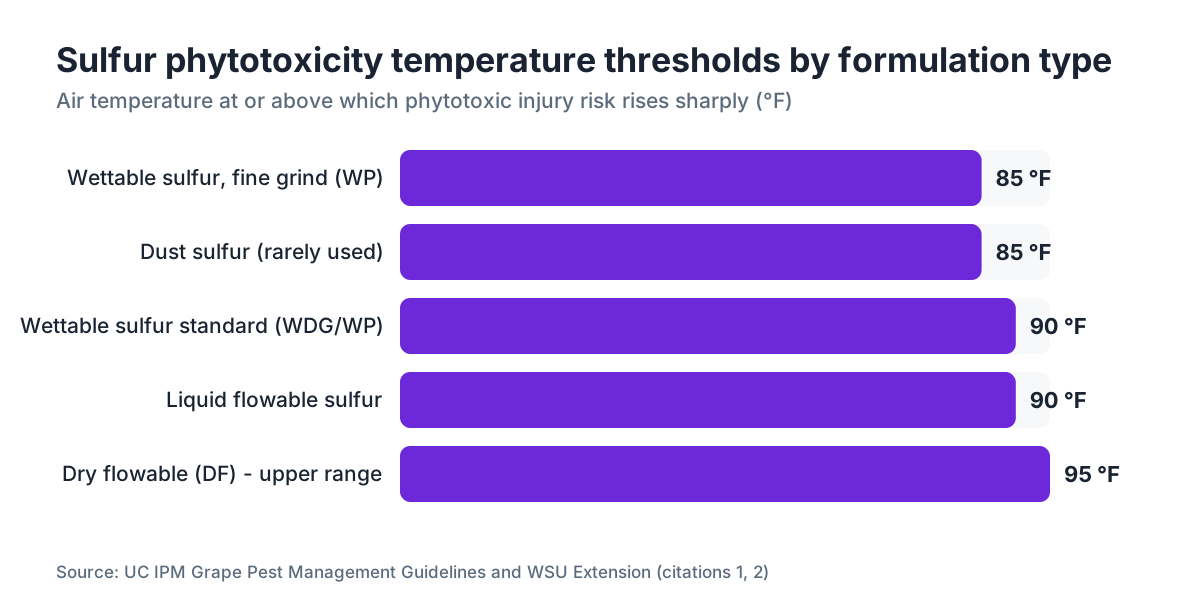
The near-universal cutoff on registered sulfur fungicide labels in the United States is 90°F. Some products drop to 85°F, usually finely ground wettable formulations. A few dry flowable products give themselves room and say 95°F, though those are less common in wine grape programs. Labels vary by product, and the label is the law under FIFRA, so you read the one in your hand.
Washington State University Extension's wine grape pest management guide puts the field rule plainly: avoid sulfur applications when temperatures exceed 90°F or when they're expected to exceed 90°F within 24 hours of application [2]. Cornell's viticulture team uses the same cutoff in its Northeast fungicide program guidance [3].
A few label conditions are easy to miss:
- Do not apply within 2 weeks (14 days) of any oil-based product. The oil-plus-sulfur interaction is its own phytotoxicity risk, separate from temperature.
- Night applications don't get you off the hook if the next day's high is predicted above the threshold.
- Some labels restrict application within a window before predicted rainfall. That affects efficacy, not phytotoxicity, so treat it separately.
| Sulfur formulation | Typical phytotoxicity threshold | Notes |
|---|---|---|
| Wettable sulfur (WP/WDG) | 90°F | Most common label language |
| Wettable sulfur, fine grind | 85°F | More volatile at lower temps |
| Dry flowable (DF) | 90-95°F | Check specific label |
| Liquid flowable | 90°F | Often stricter than DF |
| Dust (rarely used now) | 85-90°F | High surface area increases risk |
The table is a generalization. Confirm against the registered label every time.
Does the time of day matter for sulfur applications?
Time of day matters as much as the number on the thermometer. This is where a lot of growers get burned, sometimes literally.
The threshold applies to the temperature during the application window and to the forecast for the next 24 hours. Start spraying at 7:00 AM when it's 72°F, but know the forecast says 92°F by 2:00 PM, and you're already in a gray zone. Some labels would say you shouldn't be applying at all.
Most farm advisors give a simpler rule: finish all sulfur applications before 8:00 or 9:00 AM on days where afternoon highs are projected above 85°F. That buys residue drying time and puts the sulfur into a more stable state before canopy temperatures climb. Canopy temperature runs 5 to 15°F above ambient air temperature in direct sun with low wind, so your weather station reading already undercounts what the leaf surface feels.
Evening applications work if nighttime temperatures stay low and the next day's forecast is safe. But a fast-warming morning after puts you right back in the same trouble.
This is why logging the time of application, more than the date, matters. A spray applied at 6:30 AM in 68°F conditions tells a very different compliance story than one applied at 11:00 AM in 84°F conditions.
What weather data do you need to record for each sulfur application?
The EPA Worker Protection Standard and most state pesticide rules require a pesticide application record with, at minimum, date, time, specific location, product name and EPA registration number, rate applied, and applicator name [4]. Temperature and wind speed aren't universally required on the record itself, but they matter for two reasons.
First, if a phytotoxicity complaint lands or an inspector questions whether you broke a label condition, your weather log is the only objective evidence you have. Second, some state rules (California DPR recordkeeping under FAC Section 12981, for example) require growers to document that applications complied with label directions, and that includes temperature restrictions [5].
Here's what a defensible weather log entry looks like for a sulfur application:
- Date of application
- Start time and end time
- Block or zone identifier
- Air temperature at start, midpoint, and end of application (from a calibrated thermometer or on-site station)
- Forecast high for that day (screenshot from a named weather service, or a station printout)
- Forecast high for the following 24-hour period
- Wind speed and direction at time of application
- Relative humidity (useful for efficacy, increasingly required by some labels)
- Source of weather data (station name, GPS coordinates, or service provider)
You don't need a research-grade station on every block. You do need something defensible. A printed or PDF forecast from NOAA or a commercial service tied to your zip code, or the nearest CIMIS station in California, is a reasonable supplement to on-site readings [6].
What's the best way to set up weather monitoring in a vineyard?
The honest answer is that it depends on your acreage and budget, and nobody has clean data on an exact cost-benefit crossover. Here's what actually gets used in the field.
Small operations, under 20 acres or so, can get by with a simple digital min-max thermometer at canopy height in the block you spray most, plus daily forecast screenshots from NOAA saved to a folder by date. That's genuinely enough for compliance. Total cost is under $50.
Mid-size operations, 20 to 100-plus acres, get real value from an on-site station that logs temperature, humidity, wind speed, and direction automatically. The main options growers use:
- Davis Instruments Vantage Vue or Vantage Pro 2, roughly $400 to $700 for the station, plus a data logger or WeatherLink subscription to pull records [7]. These are the stations you see most often at vineyard offices.
- Onset HOBO data loggers, simpler and cheaper (sometimes under $200), built for data export to spreadsheets. Good for temperature and RH logging in a single block.
- Commercial services like Pessl Instruments (iMetos) or Sencrop that bundle hardware with cloud logging and integrate with spray scheduling tools.
The CIMIS network (California Irrigation Management Information System) runs over 145 stations across California wine country and gives free public access to hourly data. If you're in California and there's a CIMIS station within a few miles, that data is a fully defensible supplement to on-site readings [6].
WSU runs a similar network called AgWeatherNet with real-time data for Washington [2]. The Northeast has the New York State Mesonet and NEWA (Network for Environment and Weather Applications), which includes disease models built for vineyard use [3].
Whatever you pick, the point is that the data is dated, timestamped, and retrievable. A handwritten notebook can work. A system that logs and stores automatically is far harder to dispute.
How do you create a spray record that satisfies label and regulatory requirements?
A spray record that holds up to the label, your state pesticide authority, and a possible WPS audit needs these fields at minimum [4][5]:
- Date of application
- Start and end time
- Applicator name and, if your state requires it, their license number
- Specific location (block ID, GPS coordinates, or a block map reference)
- Crop and growth stage
- Pest target
- Product name, EPA registration number, and formulation
- Amount of product applied and total water volume (gallons per acre is standard)
- Application method (airblast, handheld, drone, etc.)
- Weather conditions at time of application: temperature, wind speed, wind direction
- Weather forecast for the 24-hour period following application
- Data source for weather information
Fields 10, 11, and 12 are the ones most growers skip, and they're exactly the ones that decide the outcome if you spray sulfur and something goes wrong.
A paper spray log is legal in most states. But paper logs get wet, fade, and are hard to search. A simple spreadsheet you fill in after each application, backed up to a cloud folder, is far better. Tools like VitiScribe let you log application conditions alongside your spray records and keep everything in one searchable place, which helps when you're preparing for an audit or trying to remember why you skipped a block three weeks ago.
Keep records for at least 2 years. California and Washington both require records be kept for a minimum of 2 years from the date of application [5]. Some operations keep them longer for liability reasons, especially where organic certification records are tangled in.
How should you handle the 14-day oil buffer around sulfur applications?
This comes up constantly and gets ignored just as often. The restriction bans sulfur within 14 days (some labels say 10, some say 21, so check yours) of an oil product, including dormant oil, horticultural mineral oil, and some adjuvants. The reason is that the combination causes severe, sometimes irreversible phytotoxicity regardless of temperature.
The mechanism differs from heat damage. Oil residue on the leaf surface reacts with sulfur to produce phytotoxic compounds that attack the waxy cuticle. Injury shows within 48 to 72 hours and looks like sunburn, scorching, or heavy bleaching, often worse than heat damage alone.
Your spray log is your protection here too. With a clear dated record of every oil application by block, you can calculate whether you're inside or outside the buffer before you mix a tank. Without it, you're guessing. Guess wrong on a hot May week and you can lose a lot of leaf area.
Log oil applications with the same rigor as pesticide applications. Most growers keep both in the same record system. That's the right call.
What does 'application within 24 hours of forecast' mean in practice?
It means the forecast counts as much as the thermometer reading right now. The UC IPM language is direct: do not apply if temperatures are expected to reach 90°F within 24 hours of application [1].
In practice, you're making a judgment call about forecast reliability. NOAA's 24-hour forecasts are reasonably accurate for most agricultural areas, but vineyard microclimates diverge from official station readings. If the NOAA forecast for your nearest city says 88°F but your block sits on a south-facing slope in a sun trap, treat it as a 90°F-plus day.
The habit that protects you is simple: save the forecast. Screenshot the NOAA hourly forecast for your location before you spray. Name the file with the date and block. That becomes the contemporaneous record showing you relied on a reasonable source and that the forecast sat below threshold when you made the call.
If you use a commercial service that gives block-level or vineyard-level forecasts, print or save the summary tied to that date. The specificity of your source matters when you're defending a label compliance question.
Are there any exceptions to the 90°F sulfur rule for organic vineyards?
No. Organic certification creates no exception to label language, and elemental sulfur is toxic to plant tissue the same way whether you're certified or not. OMRI-listed sulfur products, allowed under National Organic Program rules, carry the same phytotoxicity warnings and temperature restrictions as their conventional equivalents [8].
Some organic growers assume that because sulfur is a natural material, the restrictions are softer. They aren't. The USDA NOP requires materials be applied according to the label, and applying above 90°F is a compliance problem for your certifier just as it is for a conventional grower.
The practical consequence for organic vineyards is narrower spray windows. Organic programs lean harder on sulfur for powdery mildew control than conventional ones, so you spray more passes, and each pass has to land in a compliant window. That makes good weather logging more important for organic operations, not less.
How do you log weather data without expensive equipment?
You don't need expensive gear to keep defensible records. Here's a realistic minimum setup that costs almost nothing.
A digital min-max thermometer (under $20 at any hardware store) placed in the canopy zone of your most spray-heavy block. Reset it each morning. Before each application, record the current temperature, yesterday's high, and yesterday's low in a spray log notebook or a phone note.
For the forecast, go to forecast.weather.gov, enter your zip code or nearest city, and read the hourly forecast for the spray day and the following day [9]. Screenshot it or write down the projected high. Takes 90 seconds.
For wind, a handheld anemometer (under $30) gives you a reading at the moment of application. A smartphone weather app showing current conditions from a nearby station is acceptable documentation if you note the source.
Data you write down, or type into your phone, at the moment of application beats data filled in after the fact. Log before you start the tractor, not after you get back to the office.
Growers who want to formalize this without buying station hardware can use the NEWA system, which gives free hourly weather data from the nearest network station for northeastern states. Similar public networks exist in most major wine regions [3]. Pull the data, save the page, tie it to your spray record date.
What happens if you spray sulfur in conditions that violate the label?
Several things can go wrong at once.
The agronomic damage comes first. Phytotoxic sulfur injury usually shows up 24 to 72 hours after a hot-day application. Depending on growth stage and how far over the threshold you went, you might see light stippling, or you might lose real canopy and set the block back weeks. Young shoots and berries at fruit set are the most sensitive. A 95°F application during bloom is genuinely risky to yield.
The regulatory exposure comes second. Applying a pesticide inconsistent with label directions violates FIFRA Section 12(a)(2)(G), which prohibits use inconsistent with the label. The EPA or your state department of agriculture can cite you. Penalties under state pesticide regulations vary widely but can reach thousands of dollars per violation [10]. California's DPR has fined growers for label violations where exceeded temperature restrictions were documented.
Third, if you carry crop insurance and take phytotoxicity injury, a credible claim depends on records showing what actually happened. Without documentation that you tried to comply and still got hit by an unusual weather event, the claim gets complicated.
None of this means you live under constant existential risk. Regulators rarely audit spray timing on their own. But if a neighbor, a farm worker, or an inspector raises a question and you have no records, you're in a much weaker position.
Keep the records. They take less than 5 minutes per application.
How do you integrate weather logging into your existing spray record workflow?
Add weather fields directly to whatever spray record form you already use. On paper, add three lines at the top of each entry: temp at spray time, forecast high for the day, forecast high for the following day. Give the data source its own line too.
On a spreadsheet, add columns. Temperature at start, temperature at end, forecast high, forecast source, wind speed, wind direction. None of this takes more than 60 seconds to fill in if the data is in front of you when you spray.
Operations that want a more integrated approach can use software like VitiScribe, which lets you attach weather conditions directly to spray records in the field from your phone. Everything stays in one place, and audit prep gets straightforward. The point is that weather data lives with the application record, not in a separate notebook you may not be able to find two years later.
The bigger habit to build is checking the forecast before you mix. Make it part of your morning pre-spray routine: check conditions, document what you see, then make the go or no-go call. If you go, the documentation is already done. If you wait, note that decision and its reasoning too. An auditor who sees you occasionally delayed applications over temperature reads your compliance posture very differently than one who sees no evidence you ever thought about it.
Frequently asked questions
At exactly what temperature should I stop applying sulfur?
Most sulfur labels set the phytotoxicity threshold at 90°F. Some finely ground wettable sulfur products use 85°F. A few dry flowable formulations allow up to 95°F. Always read the label on the specific product, because the label is the legal standard. The UC IPM guidelines also recommend against applying if temperatures are forecast to exceed 90°F within the following 24 hours.
Can I apply sulfur early in the morning to avoid high afternoon temperatures?
Yes, with a condition: the forecast for the rest of that day and the following 24 hours must also stay below the label threshold. If morning temperatures are 70°F but the afternoon will hit 92°F, many labels still consider that a violation. Finish applications early and confirm the day's forecast before you start. Most experienced growers stop sulfur applications by 8 or 9 AM on potentially hot days.
How long after an oil application can I spray sulfur?
Most sulfur labels require a minimum of 14 days between an oil application and a sulfur application, in either direction. Some labels use 10 or 21 days. The oil-plus-sulfur combination causes phytotoxic injury independent of temperature. Check the specific label. Log all oil applications by date and block so you can calculate the buffer accurately before mixing a sulfur tank.
Is a digital thermometer enough for compliance, or do I need a weather station?
A calibrated digital thermometer placed at canopy height in the spray block, plus a dated weather forecast screenshot from NOAA or a similar service, is sufficient for compliance in most states. A dedicated weather station is better for large operations or disease modeling, but it isn't legally required. What matters is that your data is contemporaneous, dated, and pulled from a named, reasonable source.
What weather data fields do I legally have to record on a spray record?
Federal WPS rules require date, time, location, product name, EPA registration number, rate, and applicator name. Temperature and wind speed aren't universally mandated on the record itself, but California's DPR and other state agencies require documentation of compliance with label conditions, which include temperature restrictions. Recording weather conditions is the only practical way to prove that compliance after the fact.
Does canopy temperature differ from air temperature, and does it matter for sulfur?
Yes, significantly. Canopy temperature in direct sun with low wind commonly runs 5 to 15°F above ambient air temperature. Your weather station reads ambient air in the shade. If you make the go or no-go call on an air temperature of 85°F on a clear, still afternoon, the leaf surface your sulfur lands on may already be above 90°F. This is one reason most advisors say to err conservatively on the threshold.
How long do I have to keep spray records?
Federal law (FIFRA) and most state regulations require pesticide application records be kept for a minimum of 2 years. California and Washington both use the 2-year minimum. Organic certifiers often want records going back further, and some liability situations argue for keeping them even longer. Storing records digitally with backups makes long-term retention trivial compared to paper.
Are there free weather data sources I can use for my vineyard spray log?
Yes. NOAA's hourly forecast at forecast.weather.gov is free and covers the entire US. California has the CIMIS network with 145-plus stations and free public data. Washington has AgWeatherNet through WSU. The Northeast has NEWA through Cornell. All of these provide historical hourly data you can retrieve after the fact, which helps if you forgot to log a forecast before spraying.
Does the 90°F rule apply to dust sulfur the same way it does to wettable sulfur?
Dust sulfur formulations tend to carry a lower threshold, sometimes 85°F, because the smaller particle size increases volatilization. Dust formulations are also harder to target accurately and are less common in modern wine grape programs. If you still use dust, check the specific label and assume the threshold may be more conservative than for wettable or dry flowable forms.
What do I do if I accidentally spray sulfur in conditions that exceed the label threshold?
Document what happened, including the conditions at the time of application and when you realized the error. Watch the block closely for injury symptoms over the next 48 to 72 hours. If symptoms appear, photograph them and note the date and growth stage. Depending on your state, self-reporting a label violation to your pesticide authority may reduce penalties. Consult your pest control adviser or farm attorney if you're uncertain.
Does organic certification change the temperature rules for sulfur?
No. OMRI-listed elemental sulfur carries the same phytotoxicity warnings and temperature restrictions as conventional sulfur products. Organic certification doesn't override label language. The USDA National Organic Program requires materials be applied according to their labels. Organic vineyards typically rely more heavily on sulfur for powdery mildew control, which makes compliant spray timing and thorough weather logging more critical, not less.
Can I use a nearby weather station instead of one in my vineyard?
Yes, with documentation. Name the station, record its location relative to your block, and note the reading. A CIMIS, AgWeatherNet, or NOAA ASOS station within a few miles is a reasonable and defensible source. The further the station, especially if topography differs, the weaker the data for your microclimate. For most flat or gently rolling sites, a nearby network station is completely acceptable.
What's the best time of year to audit my spray record system?
Before the season starts, ideally in late winter. Review last year's records for gaps, check that temperature and forecast data were captured consistently, and update your forms or spreadsheet if fields were missing. Fixing your logging system in February is far easier than reconstructing missing weather data from a spray day in June. A brief pre-season audit also helps you spot records that need correcting before the 2-year retention clock matters.
Sources
- UC IPM - Grape Pest Management Guidelines, Powdery Mildew: Sulfur should not be applied when temperatures are expected to reach or exceed 90°F on the day of application or within 24 hours after application
- Washington State University - AgWeatherNet and wine grape pest management guide: WSU Extension advises avoiding sulfur applications when temperatures exceed 90°F or are expected to exceed 90°F within 24 hours; AgWeatherNet provides real-time weather data for Washington
- Cornell Cooperative Extension - Viticulture and Enology Program and NEWA: Cornell's viticulture team uses the 90°F cutoff in its fungicide program guidelines; NEWA provides free hourly weather data and disease modeling for northeastern vineyard use
- EPA - Worker Protection Standard for Agricultural Pesticides: WPS and pesticide regulations require application records including date, time, location, product name, EPA registration number, rate applied, and applicator name
- California Department of Pesticide Regulation - Pesticide Application Records: California FAC Section 12981 requires growers to document that applications were made in compliance with label directions; records must be maintained for a minimum of 2 years
- CIMIS - California Irrigation Management Information System: CIMIS operates over 145 stations across California wine country and provides free public access to hourly data including temperature, humidity, and wind speed
- Davis Instruments - Vantage Vue and Vantage Pro 2 weather stations: Davis Instruments Vantage Vue and Vantage Pro 2 stations cost roughly $400 to $700 and are among the most commonly deployed on-site weather stations in vineyard operations
- OMRI - Organic Materials Review Institute, elemental sulfur listing: OMRI-listed elemental sulfur products are allowed under the National Organic Program but carry the same phytotoxicity warnings and temperature restrictions as conventional sulfur formulations
- NOAA - National Weather Service hourly forecast: NOAA provides free public access to hourly weather forecasts by zip code or city, usable as a documented forecast source for pesticide application records
- EPA - Federal Insecticide, Fungicide, and Rodenticide Act (FIFRA): FIFRA Section 12(a)(2)(G) prohibits use of a pesticide in a manner inconsistent with its labeling; violations can result in enforcement action and penalties
Last updated 2026-07-09