How to document a pesticide application interrupted by weather

TL;DR
- When weather stops a spray mid-block, document the interruption inside the same application record: start time, stop time, cause, acres actually covered, and any re-application details.
- Most states want records within 7 days, some within 24 hours.
- Report actual use, never intended use.
- A single day's record covers a same-day pause; a two-day split needs two linked records.
Why does an interrupted application create a compliance problem?
A spray record is supposed to describe what happened in the field, not what you planned. When rain rolls in halfway through a block, or the wind climbs past your label's maximum, the field now holds a two-event story. A single entry that only captures the intended pass tells that story wrong.
The EPA's Worker Protection Standard (WPS) at 40 CFR Part 170 requires employers to keep accurate pesticide application records that workers and handlers can reach in an emergency [1]. Say your record claims you sprayed a contact fungicide across 12 acres of Chardonnay on Tuesday. You actually covered 6 before a thunderstorm shut you down. That record is now wrong in ways that bite. Re-entry intervals depend on what got sprayed where. A worker walking into the uncovered half the next morning has no REI issue. A worker walking into the sprayed half does, and your record just told them the whole block was treated.
State rules pile on a second layer. California's DPR requires pesticide use reports (PURs) within 7 days after the end of the month the application happened in, and those reports must reflect actual use, not intended use [2]. Washington requires records within 7 days of the application [3]. New York runs on a 7-day rule too under DEC recordkeeping requirements. The deadline shifts by state. The principle never does: the record documents reality.
The real risk is simple. An auditor who spots a gap between your spray record and your weather station log, your tank-mix invoices, or a re-application entry three days later starts pulling threads. Inconsistent records are the fastest route to a violation finding, even when the spray itself was done right.
What information do you need to capture at the moment the interruption happens?
Stop and write it down before you touch anything else. Sounds obvious. The instinct is to deal with the tractor, rinse the boom, or squint at the radar. Fight it. The second you stop is when the details are sharpest in your head.
At the point of interruption, capture these:
Time the application stopped. Not an estimate. Look at your watch or phone. A GPS-equipped sprayer logs that timestamp anyway, but write it down separately in case the file gets overwritten or corrupted.
Location in the block where you stopped. Row number, vine number, a GPS coordinate if you have it, or at minimum something anyone else could find: "stopped at the north end of Row 14, roughly 200 feet from the vineyard road."
The cause. Be specific. "Wind" tells an auditor nothing. "Sustained wind exceeded 15 mph, label maximum is 10 mph" tells them you read the label and made a call based on it. "Rain" is weak. "Rain began, product label prohibits application within 24 hours of rain" is strong. Specificity protects you.
Acres actually covered. This is the number that flows into your PUR or state equivalent. Sprayed 6 of 12 planned acres? The record says 6, not 12. Gallons follow from there. If you mixed for 12 acres and used half the tank, note the ending tank level.
Wind speed and direction, temperature, relative humidity at the moment you stopped. Your on-site station is best. A nearby CIMIS or AgWeatherNet station works. Screenshot it or write the numbers down. This is your defense if anyone later questions whether the interruption was legitimate.
Running a paper spray log? Keep a blank column or a dedicated "interruption notes" field. Running digital records? A decent platform lets you log a mid-application event without closing the record.
How do you structure the written record for a split or partial application?
The cleanest approach is one application record with two date-time entries, start and stop, plus a clearly labeled interruption section. Don't create two separate records for the same tank mix, same block, same day unless your state's form forces it. Two records read like two separate applications, and that raises dosage questions you don't want.
Here's a sample record structure:
| Field | Entry |
|---|---|
| Pesticide / EPA Reg. No. | Pristine WG, EPA Reg. 7969-138 |
| Target pest | Botrytis cinerea |
| Application date | 2024-08-14 |
| Application start time | 06:45 |
| Application stop time | 08:10 |
| Reason for stop | Wind 18 mph, label max 10 mph |
| Block / APN | Estate North Block, APN 000-000-000 |
| Acres intended | 12.0 |
| Acres actually covered | 6.2 |
| Rate applied | 8.2 oz/acre per label |
| Carrier volume | 50 gal/acre |
| Application method | Airblast sprayer, 540 PTO |
| Tank volume remaining at stop | ~155 gal of 310 gal mixed |
| Weather at stop | Temp 72°F, RH 55%, wind 18 mph W |
| Weather source | CIMIS Station 80, Oakville |
| Re-entry interval posted? | Yes, REI signs posted at block entries |
| Operator / license no. | J. Torres, QAL CA-12345 |
| Supervisor signature |
If your state's official PUR form has a fixed structure with no room for a notes field, attach a signed addendum. California DPR recognizes the addendum approach for unusual application circumstances [2].
Make sure the acreage you report matches what you charged to your pesticide inventory. Your records show you pulled 310 gallons of tank mix, and your PUR accounts for 6.2 acres at 50 gal/acre, which is 310 gallons. The math ties out. When it doesn't, an auditor notices.
What are the label requirements you must check before re-applying?
This is where operators get burned. The interruption itself is manageable. The re-application is where label violations happen.
Nearly every fungicide and insecticide label in vineyard use sets a minimum interval between applications, usually written as "do not reapply within X days" or "maximum of X applications per season." When you interrupted the first pass, you may have only partly spent one of your seasonal applications. The question is whether re-spraying the uncovered half counts as a new application for interval math.
The general rule: yes, it counts. EPA treats each separate entry into the field with product as a new application event for recordkeeping [8]. So if your label says "minimum 7 days between applications," and you stopped Tuesday and want to resume Friday, you may be over the interval even though you never finished the first pass.
Check three things on the label before you re-apply:
- Minimum interval between applications
- Maximum seasonal applications or maximum seasonal rate per acre
- Pre-harvest interval (PHI), since crop stage may have shifted if the delay ran more than a day or two
Cornell's Pest Management Guidelines for Grapes are a good secondary reference for common vineyard intervals, but they don't override the label, which is a legal document [4]. WSU's viticulture extension team publishes similar guidance for Pacific Northwest conditions [12]. UC Davis Cooperative Extension covers PHI questions in its integrated pest management materials for wine grapes [6].
Can't finish inside the label's allowable interval? Your options are thin: apply a different product with a separate mode of action, or accept that some acreage goes uncovered this timing. Neither is fun. Both beat going over-interval, which hurts you on resistance management and on the legal side.
How do you document the re-application on the remaining acreage?
The re-application gets its own record. Full stop. It's a separate application event, on a separate date, covering the acres you missed.
On that new record, point back to the original interrupted application by date and record number. Something like: "This application covers the 5.8 acres of Estate North Block not covered on 8/14/2024 due to wind interruption (see Record #2024-147)." That cross-reference is the thread that ties the two records together and explains why the acreage across both adds up to 12 rather than either one showing the full 12.
Your re-application record needs every field a normal record has: date, time, product, rate, acres, weather, operator, license number, REI posting confirmation. Don't shortcut it because "it's just finishing what I started." It isn't, not legally. It's a new application.
The REI on the first-day acreage started ticking when you stopped that morning. The REI on the newly covered acreage starts fresh at the re-application. If you have workers who might enter any part of the block, you need clear field maps or row-by-row records of which rows carry which REI expiration. This is one of the more annoying realities of interrupted applications, and it's where paper systems fall apart. A digital platform that logs GPS-stamped spray events by row makes REI tracking for partial blocks a lot less painful.
VitiScribe, for one, lets you log a mid-block interruption as a separate event tied to the parent application record, so the REI clock runs correctly for the covered rows only. Row-level tracking isn't required by federal law. It's the kind of documentation that makes a WPS inspection boring, which is exactly what you want.
What weather thresholds actually appear on pesticide labels?
Label language on weather is less standardized than most people expect. Some products hand you a hard number. Others give vague language and leave the judgment to you.
Common threshold language on vineyard pesticide labels:
| Condition | Typical label language | Common numeric threshold |
|---|---|---|
| Wind speed | "Do not apply when wind speed exceeds X mph" | 10-15 mph, varies by product |
| Rain | "Do not apply if rain is expected within X hours" | 1-24 hours, product-specific |
| Temperature | "Do not apply when temperatures exceed X°F" | Usually 85-90°F for some herbicides |
| Relative humidity | Rarely specified explicitly | Not typically given |
| Inversion conditions | "Avoid applications during temperature inversions" | No number, judgment call |
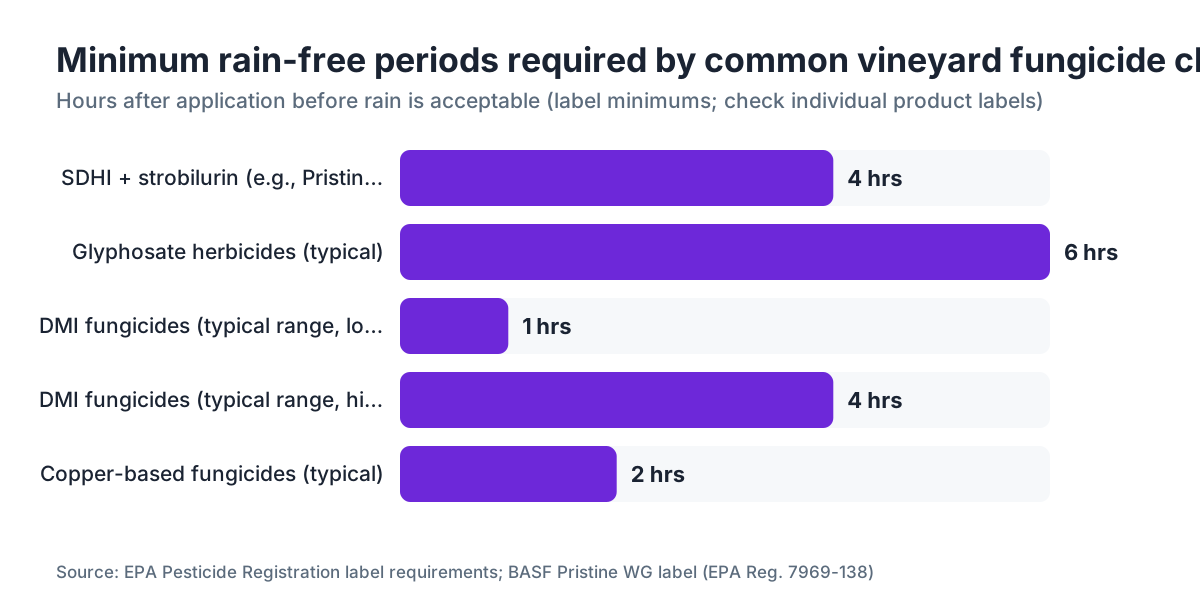
For DMI-class fungicides (tebuconazole, myclobutanil, and the like), rain-free periods of 1 to 4 hours are typical. SDHI fungicides like boscalid, the active in Pristine, generally need about 4 hours rain-free [7]. Copper products vary widely, and some tolerate rain better because rain helps move copper into plant tissue.
Herbicides on the vineyard floor raise the stakes. Glyphosate labels usually require a 4 to 6 hour rain-free window, and some specify 24 hours. An interrupted herbicide application is more than a paperwork problem. It's an efficacy problem, a possible off-target movement problem, and a possible phytotoxicity problem if drift reaches your vines.
When you write down the reason for the interruption, quote the label's exact words, then note the actual conditions. "Label states 'do not apply when wind speeds exceed 10 mph.' Measured wind at application site: 18 mph sustained per CIMIS Station 80." That's a record that holds up.
What do REI postings look like for a partially sprayed block?
The EPA WPS at 40 CFR 170.409 requires warning signs at all entrances to treated areas at or before the time of application, and they stay up until the REI expires [1]. A partially treated block creates a headache: the whole block shares one set of entrances, but only part of it has an active REI.
The safest reading, and the one most state lead agencies expect, is to treat the entire block as restricted during the treated portion's REI unless you can physically separate the treated and untreated areas. If your rows run north-south and you stopped halfway, you'd need a physical barrier and separate entrance markings to manage it row by row. Most vineyards can't pull that off.
So here's what most managers actually do: post the full block as restricted for the treated portion's REI, re-enter only the untreated rows for the re-application once the interval question is settled, then re-post for the new REI on those rows.
Write your posting decisions into the application record. Note when signs went up, which entrances got posted, and when they came down. It's tedious. It also resolves WPS complaints fast. A complaint that goes to investigation with no posting records is a long slog. One where you can show exactly what was posted, and when, closes quickly.
The EPA's Agricultural Worker Protection Standard page has a plain-language summary of posting requirements [1]. UC Davis IPM's WPS compliance resources for California are worth bookmarking too [6].
How does a rain event mid-application affect your state pesticide use report?
Your pesticide use report, in states that require one (California, Washington, Oregon, New York, and others), must reflect actual use. Actual use means the product that left the nozzle and contacted, or was aimed at, the crop, soil, or target pest.
California's DPR PUR system requires growers and PCAs to report total pounds of active ingredient applied per site, per product, per day of application [2]. Applied to 6.2 of 12 planned acres? You report 6.2 acres and the matching amount of active ingredient. Come back and finish the other 5.8 acres three days later, and that goes on a separate PUR entry for the later date.
Washington's WSDA record requirements at WAC 16-228-1250 also require records of the actual area treated [3]. Oregon's ODA runs comparable requirements under OAR 603-057-0400 [10].
One honest snag: if you applied half a tank and can't say exactly how many acres that covered because you were running a headland and partial rows, estimate and label it an estimate. "Approximately 6 acres based on GPS track log" is a fair entry. "Unknown" is not acceptable. Do your best with the data you have, document how you got there, and move on.
Never round acreage up to make the math work with your product withdrawal. Auditors compare inventory withdrawals against PUR acreage totals. Show more product used than your reported acreage justifies, more than once, and you'll get a visit.
What's the easiest system to set up before the season starts?
The operators who handle interrupted applications with the least pain built their recordkeeping to expect uncertainty before they ever fired up a sprayer.
A few things that cost almost nothing to set up:
Keep a waterproof notepad on the sprayer. Not your phone (low battery, notifications, distraction). A dedicated pad that lives in the cab and never leaves the vineyard until spray season ends. Write interruption notes the moment you stop. Transfer to your formal record that evening.
Save your weather station data daily. Using CIMIS, AgWeatherNet, or a personal station? Export or screenshot the hourly data for every spray day. Store it with your spray records, paper folder or a digital folder named by date. An auditor asking about conditions on August 14th is a lot easier to answer when you pull the data up in 20 seconds.
Make a block map with row numbers marked. A hand-drawn or GIS-printed map with permanent row numbers lets you record exactly where you stopped. "Row 14, vine 23 from the north end" is auditable. "About halfway" is not.
Build a spray record template with the interruption section already printed. Make it feel like a normal part of the form, not an exception. If the field is there, operators fill it in. If they have to add it themselves, plenty won't.
Managing more than a few hundred acres, or multiple blocks with overlapping spray programs? A digital platform that logs GPS-tracked applications by row makes all of this automatic. The record captures where the sprayer was, when it was there, and what product was loaded. You still log the reason for the interruption. The acreage and location questions answer themselves.
Can you use a single record for an application that spans two days due to weather?
Sometimes yes, sometimes no. It hangs on how your state defines an "application" for recordkeeping.
California DPR treats each day of application as a separate PUR entry. Start spraying Tuesday, finish the rest Wednesday, and those are two separate PUR entries, even for the same block, same product, same tank mix [2]. This trips people up constantly.
Washington and most other states follow the same convention: the record maps to a specific date. When an application spans two calendar days, you create two records linked by cross-reference.
The exception is a stop inside a single operating day. Stop at 10 AM, wait for the wind to calm, resume at 1 PM, and many states and most practitioners treat that as one continuous application event with one record, noting the interruption window inside it. Ask your county agricultural commissioner or state lead agency if you're unsure how your state reads this.
What you never do is backdate a record or lump two separate calendar-day events into one date. That's falsification. Same product and same intent don't save you. If an auditor pulls your weather data, sees rain at 9 AM Tuesday, and reads your record as an uninterrupted 8-hour Tuesday application, you have a problem.
For most vineyard operations, keeping spray records as close to real-time as you can, instead of reconstructing them at week's end, is the single most effective way to stay out of compliance trouble. The 24-hour rule some states apply to private applicators isn't arbitrary. It reflects how fast memory of specific field details fades.
What should you do if you forgot to document the interruption at the time?
Be honest and correct the record. Don't alter the original entry to hide that it was a later fix. Write a dated correction note and attach it to the original record.
A correction note reads like this: "Correction added 8/17/2024 by J. Torres, QAL CA-12345. Application on 8/14/2024 was interrupted at 08:10 due to wind. Original record did not capture stop time or acreage covered. Corrected acreage: 6.2 acres. Weather data for 08:10 on 8/14/2024 from CIMIS Station 80 attached."
If you can rebuild the details from tank-fill records, GPS data, CIMIS history, or a field worker's note made at the time, document those sources. The goal is an honest record, not a perfect one.
Never change the original record's date, acreage, or time to make it look like the interruption never happened. Altered records are a far more serious violation than an incomplete one, and document forensics (ink dating, metadata timestamps, GPS data) catch alterations that looked undetectable.
If the discrepancy is material, say the wrong acreage on a PUR you already submitted, contact your county agricultural commissioner or state lead agency. Most agencies have an amendment process for PUR corrections, and voluntary disclosure of an error gets handled very differently from a violation someone else discovers.
Frequently asked questions
How long do I have to complete and file a spray record after an interrupted application?
It depends on your state. California requires PURs within 7 days of the end of the application month. Washington requires records within 7 days of the application date. Some states require records within 24 hours for commercial applicators. Check your state lead agency. As a rule of thumb, complete the record the same day, while details are fresh, even if the filing window is longer.
Does an interrupted application count as one of my maximum seasonal applications under the label?
Yes, in almost all cases. EPA and most state lead agencies treat each application event as a separate use for label counting, regardless of whether it covered the full intended acreage. The re-application on uncovered acreage counts as a second application. Check your label's maximum seasonal application limit before re-applying. You may be closer to the ceiling than you think.
What wind speed triggers the requirement to stop spraying?
Your specific product label controls, not a universal rule. Most vineyard pesticide labels set 10 to 15 mph as the maximum allowable wind speed. Some use language like "avoid conditions that promote drift" with no hard number. California's DPR recommends against applying above 10 mph as a practical guideline. Always record the actual measured wind speed at the interruption, not that it was "too windy."
If rain washes off part of my application, do I need to re-spray and document that separately?
Whether you re-spray is an agronomic and label decision, not a recordkeeping one. If the label sets a rain-free period and rain fell inside that window, the first application may have lost efficacy. If you re-spray, that re-application gets its own complete record linked to the first. The washed-off application still gets recorded as applied, because the product was released, even if it didn't perform.
Can I post REI signs for part of a block and leave the other part open?
Technically yes, but you need a physical barrier or clear demarcation that keeps workers from confusing the restricted and open areas. The EPA WPS at 40 CFR 170.409 requires signs at all entrances to the treated area. In practice, most vineyards restrict the whole block and re-enter the untreated portion only under a re-application protocol. Document your posting approach in the application record.
What happens if my GPS sprayer data and my paper record don't match on acreage?
You have a discrepancy, and you resolve it before filing anything. GPS data is generally more reliable for acreage than manual estimates. Use the GPS data as the basis and note that acreage came from the GPS track log, not a manual calculation. If the paper record was already filed and the GPS data disagrees, file an amendment with your county agricultural commissioner and explain the source of the discrepancy.
Do I need to record the interruption if I stopped to refill my tank rather than due to weather?
A refill stop is different from a weather interruption. Most states don't require documentation of routine mid-block refills as long as the same product and rate keep flowing and the application continues the same day. Weather stops are different because they may force you to reconsider whether re-application is even allowed under the label. Any stop that changes what you applied, where, or how much always belongs in the record.
What weather data sources are acceptable for documenting conditions at the time of interruption?
Your own on-site weather station is the most defensible. State networks like California's CIMIS (cimis.water.ca.gov), Washington's AgWeatherNet, and Oregon's AgriMet are widely accepted by auditors because they hold timestamped public records that can't be altered after the fact. Commercial weather services work if you screenshot the data at the time. A personal note with no external source is the weakest option, though still better than nothing.
What's the difference between a pesticide application record and a pesticide use report?
A pesticide application record is the detailed field-level document you keep at the farm: product, rate, acreage, weather, operator, REI posting. A pesticide use report (PUR) is the summary you submit to a state or county agency, often monthly. Both are required in California and several other states. Your PUR should match your application records. Discrepancies between the two are a common audit finding.
Can a licensed PCA file the interruption notes, or does the operator have to sign them?
Requirements vary by state. In California, the Pest Control Adviser (PCA) is responsible for the recommendation, but the grower or their licensed supervisor is responsible for the application record. Either can add a dated correction note, but the applicator of record should sign any amendment to the original application entry. When in doubt, have both the PCA and the qualified applicator sign any post-application correction.
If I sprayed only part of the block, do I calculate my pre-harvest interval from the date of the partial application or the re-application?
The PHI clock runs separately for each area treated, starting on the date that area was actually sprayed. Rows covered August 14 have their PHI from August 14. Rows covered August 17 have their PHI from August 17. This matters near harvest: the later-sprayed rows may not clear PHI in time. Map which rows got product on which date and check each area's clearance date before sending in crews.
Is an interrupted application something I need to report to my state's department of agriculture?
Not automatically. An interruption is a normal field event and doesn't trigger a special report on its own. What you do need is to reflect it accurately in your standard application records and any required state use reports. If the interruption caused product to drift off-target, or there was equipment failure with product release, that may trigger separate reporting under your state's spill or environmental incident rules.
What records should I keep on hand during the application in case an inspector shows up?
Under the EPA WPS, you must provide on request the product's Safety Data Sheet (SDS), the pesticide label, the specific application information for the current spray, and evidence that REI postings are current. For an in-progress application, keep the label and SDS in the cab or immediately reachable, and be ready to show the inspector the block being treated and your posting records. The formal application record doesn't have to be finalized on the spot, but supporting notes should exist.
Sources
- U.S. EPA, Agricultural Worker Protection Standard (40 CFR Part 170): EPA WPS requires accurate pesticide application records accessible to workers and handlers; requires REI warning signs at all entrances to treated areas at or before time of application (40 CFR 170.409).
- California Department of Pesticide Regulation, Pesticide Use Reporting (PUR) program: California requires pesticide use reports within 7 days of the end of the month of application and that records reflect actual, not intended, use; addenda are recognized for unusual application circumstances.
- Washington State Department of Agriculture, Pesticide Recordkeeping (WAC 16-228-1250): Washington requires pesticide application records within 7 days of application and requires records of the actual area treated.
- Cornell Cooperative Extension, Pest Management Guidelines for Grapes: Cornell's Pest Management Guidelines for Grapes provide secondary reference for common vineyard pesticide application intervals but do not supersede individual product labels.
- UC Davis Integrated Pest Management, Wine Grape Pest Management: UC Davis IPM covers PHI considerations and WPS compliance resources for California wine grape operations.
- BASF, Pristine WG Fungicide Label (EPA Reg. No. 7969-138): Pristine WG (boscalid + pyraclostrobin) label requires approximately 4 hours rain-free period after application for adequate efficacy and residue retention.
- U.S. EPA, Pesticide Registration and Label Requirements: EPA considers the pesticide label a legal document; each separate entry into a field with product constitutes a new application event for recordkeeping purposes.
- California Department of Water Resources, CIMIS Weather Station Network: CIMIS provides timestamped public hourly weather data used as an accepted external documentation source for pesticide application weather conditions in California.
- Oregon Department of Agriculture, Pesticide Recordkeeping Requirements (OAR 603-057-0400): Oregon OAR 603-057-0400 requires pesticide application records to reflect actual area treated, consistent with other state lead agency requirements.
- U.S. EPA, Label Review Manual: EPA Label Review Manual documents how maximum seasonal application numbers and minimum retreatment intervals are applied per separate application event.
- Washington State University, AgWeatherNet: WSU AgWeatherNet provides timestamped public weather station data accepted as documentation for pesticide application conditions in Washington State.
Last updated 2026-07-09