Sulfur spray program timing for powdery mildew prevention in vineyards

TL;DR
- Start sulfur at 0.5-inch shoot growth (roughly budbreak) and spray every 7 days during high-risk periods, stretching to 14 days when pressure drops.
- Stop at veraison.
- Wettable sulfur at 3-6 lbs/acre per application is the standard rate.
- Above 95°F, skip sulfur to avoid leaf burn.
- UC Davis and WSU extension research backs this framework.
Why does powdery mildew timing matter more than product choice?
Powdery mildew (Erysiphe necator) spreads fast and hits fruit harder than almost any other common vineyard disease. Miss one spray window during the three to five weeks after budbreak, and the fungus colonizes young tissue that stays infected the rest of the season. No amount of later spraying undoes that.
Most product failures are timing failures in disguise. The grower picked a fine material and then applied it too late, too rarely, or in conditions that killed its effect. UC Davis plant pathologist Doug Gubler's risk model, published through UC Cooperative Extension, was built around exactly this point: for early-season control, application interval matters more than which fungicide class you reach for. [1]
Sulfur is still the backbone of most organic and many conventional programs. It's cheap, it works at the right intervals, and E. necator has no known resistance to it. Its limits are physical, not biological. Coverage, temperature, and humidity all decide how well it performs. Get those right and you have one of the most reliable materials on the shelf.
When exactly should you start your first sulfur application?
Apply your first sulfur when shoots reach 0.5 to 1 inch (about 1-2 cm) of growth. That's the standard call from UC Davis and WSU extension. In most California coastal regions that's late March to mid-April. Washington's Columbia Valley runs to late April. The Finger Lakes usually hits early to mid-May. [2]
Don't wait for symptoms. Powdery mildew infects tissue before you can see anything. The lag between infection and visible signs is typically 7 to 14 days depending on temperature, so by the time you spot white fuzz on a shoot, you're already behind. A sulfur program is protectant coverage before infection, not cleanup after.
A common mistake: skipping early sprays after a dry, cold April and betting the season stays quiet. It doesn't work that way. The overwintering structures (chasmothecia) survive on bark and release ascospores with warm rains even in dry years. One wet morning in the right temperature window can start an epidemic on unprotected tissue. Assume the risk is live at budbreak and plan for it.
If you track degree days, the Gubler-Thomas Powdery Mildew Risk Index uses three consecutive days averaging above 70°F as the trigger for high-risk status and a 7-day spray interval. Below that, a 14-day interval is fine. [1]
What spray intervals should you use through the season?
The season breaks into three phases.
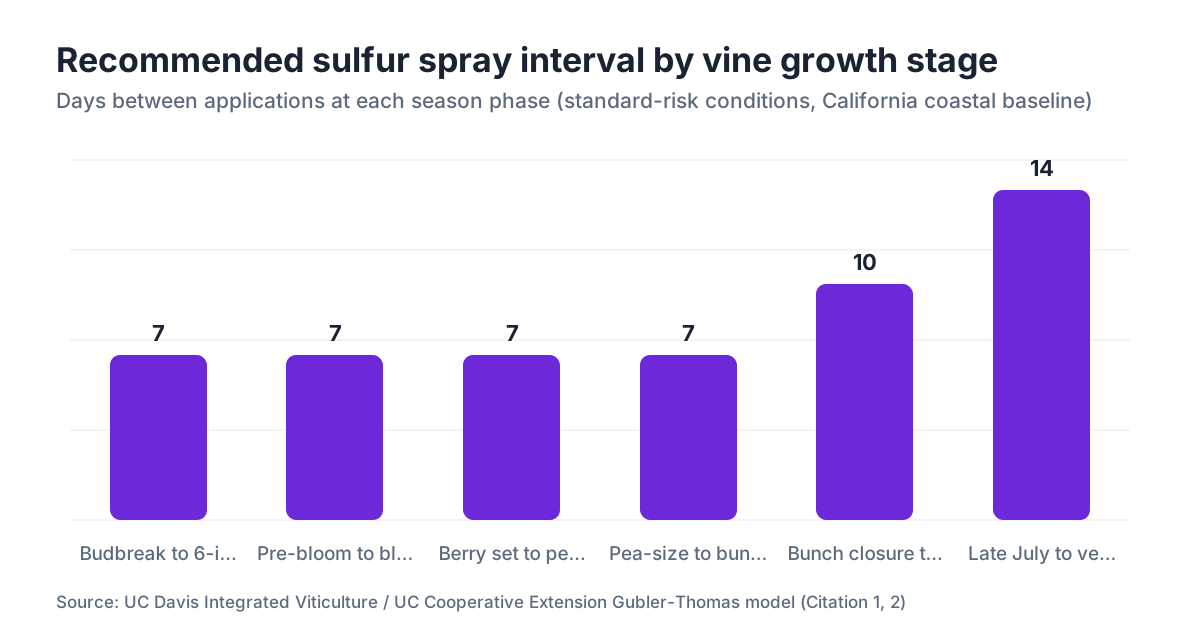
Early season (budbreak through bloom, roughly 0.5-inch shoot to berry set): your highest-risk window. Young, fast-growing tissue is at peak susceptibility. Run a 7-day interval, or tighten to 5 days if the Gubler-Thomas index stays high and your region had heavy pressure last year. Never stretch to 14 days during this phase. [1]
Mid-season (berry set through bunch closure, roughly 4 to 8 weeks post-bloom): risk stays elevated until berries reach about 8-12 mm in diameter. After that the skin toughens and resists new infection. Hold 7-day intervals through bunch closure, then stretch to 10-14 days if the weather cooperates (dry, moderate temperatures). [2]
Late season (bunch closure through veraison): berries are largely hardened and new leaf infections matter less for fruit quality. A 14-day interval is standard. Most extension programs let you stop at veraison, defined as the onset of color change or berry softening, because fruit is no longer susceptible to new infection at that point. [3]
After veraison, more sulfur adds cost and residue for almost no protective gain. Stop there. The one exception: if your canopy management left you with dense, shaded clusters that never dried out mid-season, keep a closer eye on things.
What are the correct sulfur rates and formulations for mildew control?
Wettable sulfur (WS) is the most common formulation and the one most extension programs use for rate math. Typical use rates run 3 to 6 pounds of product per acre per application, depending on disease pressure and interval. Most programs land at 4-5 lbs per acre during high-risk periods. [2]
Liquid sulfur (flowable or suspension concentrate) works at similar sulfur-equivalent rates, mixes more easily, and can cover a touch better through a hydraulic sprayer. Dust sulfur still shows up in some regions but delivers uneven deposition and is hard to apply accurately with modern equipment.
For organic programs, sulfur is an allowed material under the USDA National Organic Program and appears on the OMRI list. No exemptions or special approvals are needed, though your certifier may want to see the specific product's ingredient list. [4]
Don't exceed label rates. Once you've hit adequate coverage, higher sulfur doesn't buy you more efficacy, and it raises phytotoxicity risk, especially on sensitive varieties like Concord, Grenache, and some Zinfandel clones. The label is a legal document under FIFRA. Read it and follow it.
What temperatures make sulfur unsafe to apply?
This is the single biggest operational limit on a sulfur program. Sulfur volatilizes rapidly above 90°F (32°C) and can cause visible phytotoxicity (leaf burn, berry russeting) above 95°F (35°C). Most labels and extension guidance say to skip applications when temperatures hit 90°F or above during or within a few hours of the spray window. [2]
WSU extension is specific: don't apply sulfur when temperatures will exceed 90°F within 24 hours of application, or when plants are heat-stressed from prolonged dry conditions. [3]
That rule creates a real problem during heat spikes in California's Central Valley, Southern Oregon, and Washington's Yakima Valley, where summer temperatures can sit above 100°F for days. Your options during those windows: switch to a synthetic fungicide (EBDC, DMI, or SDHI class), apply oil-based materials at cooler evening temperatures, or accept the gap and tighten intervals once things cool off. Plenty of experienced managers keep a small reserve of a DMI fungicide (tebuconazole or trifloxystrobin) just for heat-wave gaps in an otherwise sulfur-based program.
Apply sulfur early morning or evening, when temperatures sit below 85°F. Early morning also gets you dew that helps the material stick, though you want leaves to dry reasonably quickly so you're not creating a fungal-friendly wet period yourself.
How do you adjust timing for your specific region and climate?
Powdery mildew risk isn't uniform, so your program should track local conditions instead of a generic calendar. The Gubler-Thomas index came mostly from California data. WSU has its own degree-day models tuned for the Pacific Northwest. Cornell has published adapted guidelines for the Northeast's cooler, wetter seasons. [5]
In the Willamette Valley, you're dealing with cool springs and frequent rain, which delays the high-risk temperature window but hands you ideal humidity for ascospore release. Oregon State University extension recommends starting sprays at budbreak regardless of temperature, because early infections set up canopy problems for the whole year. [6]
In Napa and Sonoma, the high-risk window runs roughly late March through July, peaking in May and June when temperatures sit in the optimal germination range (65-77°F, 18-25°C) and days are long. The Gubler model is widely used here and has been validated across many seasons.
In the Finger Lakes and other northeastern regions, the season starts later, but compressed heat events in July can spike risk in a hurry. Cornell recommends a 7-day interval from budbreak through veraison with no exceptions during bloom. [5]
Starting a new property or working an unfamiliar region? The honest answer is to default to 7-day intervals from budbreak through bunch closure and adjust tighter or looser based on observed disease incidence and local extension guidance. Don't try to optimize early. Get a few clean seasons under you first.
Good spray records by block and date make regional calibration possible over time. Tools like VitiScribe let you log spray events, note weather, and build a season-by-season picture of which intervals actually held in your microclimate.
Does rain or irrigation timing affect when you should spray sulfur?
Rain washes wettable sulfur off foliage, so a heavy rainfall (generally over 0.5 inch, about 12 mm) warrants a reapplication even if you're mid-interval. Most extension programs recommend reapplying within 24 to 48 hours after rain that crosses that threshold during the high-risk period. [2]
Irrigation timing matters less for spray-off than for disease risk generally. Overhead irrigation creates prolonged leaf wetness, which is exactly what E. necator needs to germinate. If you run overhead, run it early morning so tissue dries by midday. Drip-irrigated blocks hold lower canopy humidity and often tolerate slightly longer intervals mid-season.
Dew is the factor people underestimate. Heavy morning dew keeps relative humidity above 90% long enough for spores to germinate even without rain. Sites with frequent morning fog, coastal influence, or dead air are higher-risk and usually need tighter intervals.
One practical rule: if your spray record shows a gap longer than your planned interval and real rain fell in it, don't just note it and move on. Tighten the next two intervals by two or three days as insurance.
What worker protection and record-keeping rules apply to sulfur applications?
Sulfur is a pesticide under FIFRA and triggers EPA Worker Protection Standard (WPS) requirements. [7] The WPS, codified at 40 CFR Part 170, requires that all agricultural workers and handlers who may be exposed during sulfur applications receive WPS training before they enter treated areas during a restricted entry interval (REI). For most wettable sulfur products, the REI is 24 hours. Check your specific product label; some dust sulfur formulations carry shorter REIs.
Under WPS, you must post treated areas with application information (product name, date, REI) or provide equivalent notification to workers. You also must keep application records that include the product name and EPA registration number, the active ingredient, the amount applied, the date and time, the location, and the applicator's name. Federal law requires two-year retention, and some states go longer. California requires three years under the California Department of Pesticide Regulation (CDPR). [8]
Your pesticide dealer or PCA (Pest Control Adviser) should hand you a safety data sheet (SDS) for any sulfur product you buy. Keep it on file and accessible during applications, per Hazard Communication standards.
Certified organic operations need documentation that the sulfur product meets the NOP standard (no prohibited adjuvants, OMRI-listed or equivalent verification) as part of the annual certification file. Keep purchase receipts and product labels for each lot. [4]
Record-keeping sounds like paperwork for its own sake, but a clean spray log is your legal protection if a worker exposure complaint or a neighbor's drift claim lands. VitiScribe is built to handle these spray records, REI tracking, and audit-ready documentation for vineyard operations.
Should you rotate sulfur with other fungicides, or is sulfur alone enough?
Sulfur has no documented resistance issues with E. necator, which is unusual and part of why it stays the default. But leaning on sulfur alone has real limits: temperature restrictions knock it out during heat events, coverage gaps stack up in dense canopies, and rain-off is a fact of life.
Most extension programs recommend a mixed program: sulfur as the backbone, with rotation to or addition of other mode-of-action classes at high-risk intervals. The main rotation classes:
DMI fungicides (demethylation inhibitors, FRAC group 3): tebuconazole, myclobutanil, trifloxystrobin. These are systemic, so they move into plant tissue and can stop an infection that's already started. That's a big advantage over sulfur, which is contact-only. Resistance management still matters. Rotate within the class and hold to no more than two or three applications per season from a single FRAC group. [9]
SDHI fungicides (FRAC group 7): fluopyram, fluxapyroxad. Newer systemic materials with good efficacy. Resistance is a concern industry-wide, and SDHI resistance has been documented in some powdery mildew populations. Rotate with caution. [9]
Kaolin clay: a physical barrier, useful for late-season applications on organic programs where pressure is low. It's no substitute for early-season sulfur.
A typical conventional program looks like this: sulfur every 7 days from budbreak to bloom, one or two DMI applications at bloom and two weeks post-bloom (when infection risk peaks and systemic backup earns its keep), then back to sulfur at 10-14 day intervals through veraison. That gives you sulfur's economics (roughly $8-20 per acre per application at standard rates) while covering the stretch where systemic activity pays off.
Nobody has great industry-wide data on the perfect rotation sequence. The best local guidance usually comes from your county farm advisor or extension viticulture specialist, who track regional isolate sensitivities.
What does a complete sulfur spray schedule look like from budbreak to veraison?
Here's a working template. Adjust dates to your region's calendar.
| Growth Stage | Approximate Timing (CA Coast) | Interval | Notes |
|---|---|---|---|
| 0.5-inch shoot (budbreak) | Late March | First app | Start here regardless of weather |
| 2-4 inch shoot | Early April | 7 days | Tighten if Gubler index high |
| 6-inch shoot | Mid-April | 7 days | High susceptibility, no skipping |
| Pre-bloom (clusters visible) | Late April | 7 days | Consider DMI rotation here |
| Bloom (50% cap fall) | Early May | 7 days | Highest-risk window; no gaps |
| Berry set | Mid-May | 7 days | Continue through berry set |
| Pea-sized berry | Late May | 7 days | Tighten to 5 days if wet |
| Bunch closure | Mid-June | 10 days | Berries hardening, risk drops |
| Post-closure to veraison | Late June-July | 14 days | Stop at veraison |
That's roughly 12 to 15 sulfur applications per season for a California coastal vineyard, which is normal. Drier interior regions often get by with 8 to 12. Wet northeastern and Pacific Northwest regions may need 14 to 18. [5]
The cost math: at $15 per acre per application (mid-range wettable sulfur rate), a 15-application season runs $225 per acre in material alone. Add labor, equipment time, and water, and you're likely at $350 to $600 per acre for the full program. That's still cheap next to a serious mildew loss, which on premium wine grapes can mean rejected fruit or a 20-40% yield cut. [10]
What are the signs your spray program is failing and what should you do?
The first symptom you'll usually catch is white powdery sporulation on young leaves, shoot tips, or rachises. On fruit, the early sign is often a circular, pale lesion that later turns russet. See this before veraison and you have an active epidemic. Respond fast.
Immediate steps:
Switch to a systemic fungicide (DMI or SDHI) at label rate for one to two applications. These can stop an active infection; sulfur can't. Then return to sulfur once you've broken the cycle.
Review your spray log. Did you run a gap longer than 10 days during the high-risk period? Did rain events cause runoff you didn't cover for? Did a heat event force a skip without a substitute material?
Open up the canopy in the affected blocks. Dense canopies trap humidity and block spray penetration. Leaf removal in the cluster zone, positioned shoots, and honest shoot thinning all cut mildew pressure mechanically. None of that replaces sprays, but it reduces the load your spray program has to carry.
Seeing mildew despite tight, consistent sulfur intervals? Look at whether you have a resistance issue with a material you're rotating in, or whether your sprayer needs recalibration. Coverage is the first thing to check before you blame the product. A well-calibrated sprayer counts as much as timing.
Frequently asked questions
How early in the season do you need to start spraying sulfur for powdery mildew?
Start at 0.5-inch shoot growth, which marks budbreak. That's typically late March to mid-April in California, late April in Washington, and early to mid-May in New York. Don't wait for visible symptoms, because powdery mildew infects tissue 7-14 days before you can see it. Starting late is the most common reason programs fail early in the season.
What temperature is too hot to spray sulfur on grapevines?
Avoid sulfur when temperatures during the application window will reach 90°F (32°C) or above. Above 95°F, phytotoxicity risk is high enough that most labels prohibit it outright. WSU extension recommends no applications when temperatures will exceed 90°F within 24 hours. During heat events, switch to a synthetic systemic fungicide rather than leaving the canopy unprotected.
How many days between sulfur sprays gives good powdery mildew protection?
Seven days during high-risk periods (budbreak through bunch closure), 10-14 days when pressure is lower or after bunch closure. The Gubler-Thomas Risk Index, developed at UC Davis, ties interval to a three-day average temperature: above 70°F triggers the 7-day schedule. Rain over 0.5 inch requires reapplication within 24-48 hours regardless of where you are in the interval.
When should you stop spraying sulfur in the vineyard?
Stop at veraison, the point when berries begin to change color and soften. Berry tissue is no longer susceptible to new E. necator infections after this stage, so continued applications add cost without protection. Leaf infections after veraison don't meaningfully affect fruit quality. Stopping at veraison also reduces sulfur residues on fruit going to crush.
What sulfur rate per acre works for powdery mildew in grapes?
Wettable sulfur at 3 to 6 pounds per acre per application is the standard range, with most programs landing at 4-5 lbs per acre during high-risk periods. Higher rates don't reliably improve control once you've hit adequate coverage, and they raise phytotoxicity risk on sensitive varieties. Always follow the specific product label rate, which is a legal requirement under FIFRA.
Is sulfur approved for organic vineyard programs?
Yes. Sulfur is an allowed material under the USDA National Organic Program (7 CFR Part 205) and appears on the OMRI list. No special approval is needed, but your certifier may require that your specific product contains no prohibited adjuvants. Keep purchase receipts and labels for each lot as part of your organic system records. Confirm your specific sulfur product is OMRI-listed or equivalent.
Should you rotate sulfur with other fungicides during the season?
Rotating makes practical sense even though sulfur has no resistance issues. Heat events can force sulfur gaps; a systemic DMI (like myclobutanil or tebuconazole) covers those periods and adds curative activity sulfur can't provide. Most extension programs recommend one to two DMI applications around bloom, then a return to sulfur. Limit any single FRAC group to two to three applications per season to manage resistance.
What records do you legally need to keep for sulfur applications in a vineyard?
Under EPA WPS and FIFRA, application records must include: product name, EPA registration number, active ingredient, amount applied, date and time, application location, and applicator name. Federal law requires two-year retention; California CDPR requires three years. Organic programs need extra documentation showing the product meets NOP standards. Post REI information on treated areas as required by WPS (40 CFR Part 170).
Does rain wash sulfur off vines and when should you reapply?
Yes. Rainfall over roughly 0.5 inch (12 mm) effectively removes wettable sulfur from foliage. Reapply within 24-48 hours of significant rain during high-risk periods, even if you're not at your next scheduled interval. In consistently wet seasons, you may end up doing unplanned applications nearly every week. Track rain events in your spray log alongside application dates.
Which grape varieties are most sensitive to sulfur phytotoxicity?
Concord and other Labrusca varieties are notably sensitive. Among Vinifera varieties, Grenache, some Zinfandel clones, and Chardonnay grown in hot conditions show higher sensitivity. Symptoms are leaf burn, shot berries, or russeting on fruit. On a sensitive variety, stay at the low end of the rate range, apply in early morning when it's cool, and never spray close to a forecast hot day.
How does the Gubler-Thomas powdery mildew risk index work for spray timing?
The Gubler-Thomas index, developed at UC Davis, assigns a daily risk score based on temperature. Three consecutive days averaging above 70°F (21°C) and below 95°F (35°C) push the index to 'high risk,' calling for a 7-day spray interval. Cooler periods drop to 'low risk,' allowing 14-day intervals. The model came from California data and has been adapted by other extension programs for regional conditions.
What are the worker safety rules for applying sulfur in a vineyard?
Sulfur applications trigger EPA WPS requirements (40 CFR Part 170). Workers must receive WPS safety training before entering treated areas during the REI, which is typically 24 hours for wettable sulfur. Post treated areas with application information. Handlers applying sulfur must use required personal protective equipment per the product label. Keep the product SDS on file and accessible at the application site during use.
Can you spray sulfur the day before or during bloom without causing problems?
Sulfur during bloom is generally safe at standard rates and timing, but be careful with very high rates or application during hot afternoons. Some programs target bloom as a DMI rotation point to get systemic protection rather than relying on contact sulfur alone, since bloom is the single highest-risk stage. Using sulfur at bloom? Apply early morning, stay at mid-range rates, and confirm no heat event is forecast.
Sources
- UC Cooperative Extension, Gubler-Thomas Powdery Mildew Risk Index description: The Gubler-Thomas index uses three consecutive days averaging above 70°F to trigger high-risk status and a 7-day spray interval for powdery mildew management in vineyards.
- UC Statewide Integrated Pest Management Program, Grape Powdery Mildew Pest Notes: UC IPM recommends first sulfur applications at 0.5 to 1 inch shoot growth, wettable sulfur rates of 3 to 6 lbs per acre, and reapplication after significant rain during high-risk periods.
- Washington State University Extension, Grape Powdery Mildew management: WSU extension states do not apply sulfur when temperatures will exceed 90°F within 24 hours of application, and recommends stopping applications at veraison.
- USDA Agricultural Marketing Service, National Organic Program 7 CFR Part 205: Sulfur is listed as an allowed material for organic crop production under USDA NOP regulations with no exemptions or special approvals required beyond certifier review.
- Cornell University College of Agriculture and Life Sciences, New York and Pennsylvania Pest Management Guidelines for Grapes: Cornell recommends a 7-day interval from budbreak through veraison in the Finger Lakes with no exceptions during bloom, and northeastern programs may require 14 to 18 applications per season.
- Oregon State University Extension, Willamette Valley Grape Pest Management Guide: OSU extension recommends starting sprays at budbreak regardless of temperature in the Willamette Valley due to high humidity and early ascospore release conditions.
- EPA Worker Protection Standard, 40 CFR Part 170: The EPA WPS at 40 CFR Part 170 requires that all agricultural workers and handlers who may be exposed during pesticide applications receive WPS training and that treated areas be posted with application information including REI.
- California Department of Pesticide Regulation, Pesticide Use Reporting requirements: California CDPR requires pesticide application records be kept for three years, longer than the two-year federal FIFRA minimum.
- Fungicide Resistance Action Committee (FRAC), FRAC Code List and Resistance Management recommendations: FRAC guidance recommends limiting any single FRAC group to two to three applications per season to manage resistance risk in powdery mildew populations, and documents SDHI resistance development in some regions.
- UC Agriculture and Natural Resources, Economic impact of powdery mildew in California wine grapes: Severe powdery mildew infections can reduce yield by 20-40% and lead to fruit rejection in premium wine grape programs; estimated per-acre spray program costs for sulfur-based programs range from approximately $350-600 per acre per season including materials and labor.
Last updated 2026-07-11