Sustainable viticulture: what it actually takes in the vineyard
TL;DR
- Sustainable viticulture means running a vineyard so soil, water, beneficial insects, and workers can keep supporting it for decades.
- It sits between conventional and certified organic, and the real programs are third-party audited.
- Certification runs a few hundred to a few thousand dollars a year depending on acreage.
- The payoffs are lower input costs over time, market access, and less regulatory risk.
What does sustainable viticulture actually mean?
Sustainable viticulture has no single legal definition. That's the first thing that trips people up. The phrase covers a family of practices and programs with one shared goal: farm the vineyard so you don't wreck the resources it runs on. Soil, water, beneficial insects, and the people doing the work all count.
It is not the same as organic, though the two overlap. Organic certification under the USDA National Organic Program (NOP) bans most synthetic pesticides and fertilizers and carries federal legal weight [1]. Sustainable programs are mostly state or industry run. They allow some synthetic inputs under specific conditions and judge you on whole-farm outcomes instead of a single banned-inputs list. Some growers hold both certifications. Most hold one.
It is also not greenwashing by default, though that risk is real. The line between a marketing slogan and a verified program comes down to one question: does a third party audit your records? SIP Certified (Sustainability in Practice), California Certified Sustainable Winegrowing (CCSW), and LIVE (Low Input Viticulture and Enology) in the Pacific Northwest all require on-site audits and written documentation [2][3].
"Sustainable" means something rigorous when it's verified and something vague when it isn't. Your buyers already know the difference.
What are the main sustainable viticulture certification programs in the U.S.?
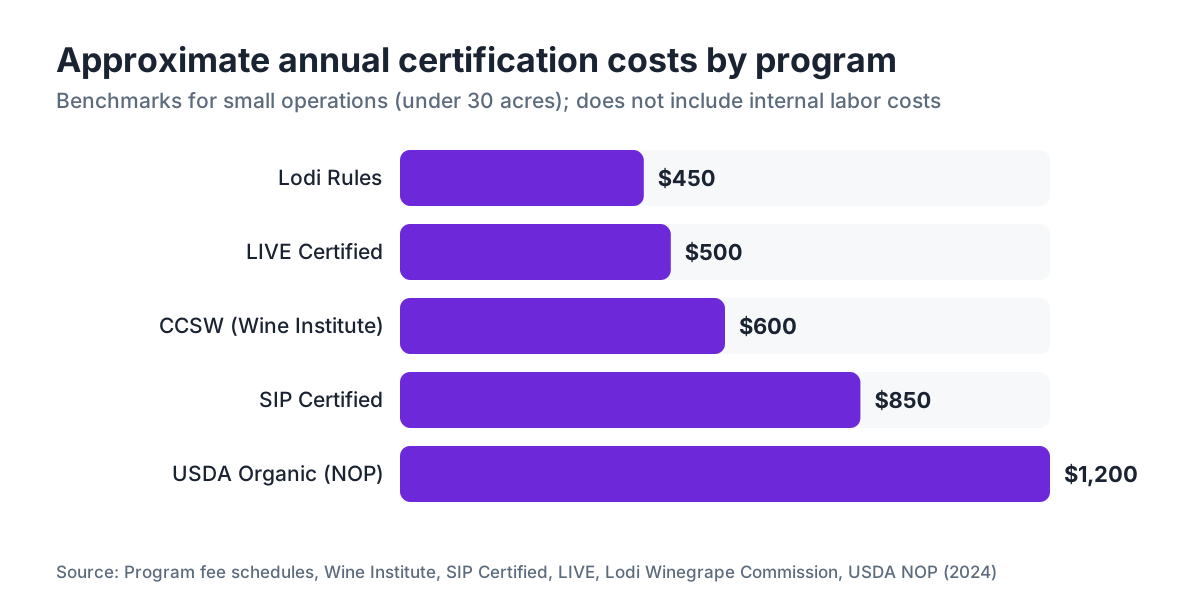
Programs split by region, cost, and what they actually audit. Here's a practical comparison:
| Program | Region | Third-party audit? | Synthetic inputs allowed? | Approx. annual cost |
|---|---|---|---|---|
| CCSW (Wine Institute) | California | Yes | Limited, documented | ~$400-$800 for small operations [2] |
| SIP Certified | California / expanding | Yes | Yes, with restrictions | ~$500-$1,200 depending on acreage [3] |
| LIVE | Pacific Northwest | Yes | Very limited | ~$300-$700 [4] |
| Lodi Rules | Lodi, CA | Yes | Yes, documented | ~$300-$600 [5] |
| USDA Organic (NOP) | National | Yes (USDA accredited certifier) | No synthetics | $400-$2,000+ varies widely [1] |
| Certified Sustainable (CSWA) | California supply chain | Self-assessment + third party | Yes | Included in Wine Institute membership [2] |
Those cost figures are rough benchmarks from published fee schedules. They don't include the internal labor of building your documentation, which is usually the bigger cost in year one.
Lodi Rules is worth calling out. It's one of the longest-running grower programs in the country, started in 1992, and its workbook covers 102 individual practices across six categories [5]. New to structured sustainability work and farming California's Central Valley? Lodi is a smart starting point. The certified grower community is large and the extension support runs deep.
For growers in Oregon and Washington, LIVE has strong retailer recognition and lines up with what many Pacific Northwest buyers ask for on supply chain questionnaires [4].
What does integrated pest management look like in a sustainable vineyard?
Integrated pest management (IPM) is the operational spine of every serious sustainable program. The EPA defines IPM as "an effective and environmentally sensitive approach to pest management that relies on a combination of common-sense practices," including biological control, habitat manipulation, and resistant varieties, with pesticides used only when monitoring shows they're needed and only in ways that minimize risk [6].
On the ground, that means scouting weekly through the growing season, writing down what you find, and making spray calls off economic thresholds instead of the calendar. For grape berry moth in the East, Cornell extension publishes degree-day models that time sprays to cumulative heat units rather than fixed dates. Done right, that cuts applications without letting damage climb [7].
Cover crops between rows do real work. They raise beneficial insect populations, improve water infiltration, and cut the dust that feeds mite problems on bare soil in hot climates. UC Davis research shows a diverse cover crop mix can meaningfully raise populations of predatory insects like Anagrus wasps that attack leafhopper eggs [8]. The tradeoff is water competition in dry years, so species selection hangs on your rainfall pattern.
Fungicide timing doesn't change much from conventional for a disease like powdery mildew, because the pressure is real and so is the damage. What changes is product choice. Sulfur is still the backbone in many programs. OMRI-listed biologicals like Bacillus subtilis earn a spot during low-to-moderate pressure. The trick is knowing your disease model data. If you're not running a model, you're spraying on gut feel, and gut feel costs more.
Record-keeping is non-negotiable. Every spray event needs a written record: product name, EPA registration number, rate, timing, target pest, and applicator signature. That's an EPA Worker Protection Standard requirement, and it's exactly what your certifier will audit [9].
How does sustainable viticulture handle soil health?
Soil health is where sustainable viticulture pulls away from conventional farming over a long horizon. Conventional programs often treat soil as a container for the nutrients you add. Sustainable programs treat it as a living system with its own biology to manage.
Your certifier will ask about three things: organic matter percentage, compaction (often read with a penetrometer), and biological activity. Soil organic matter above 2 to 3% in most vineyard soils tracks with better water-holding capacity, lower erosion, and less fertilizer need. Plenty of California vineyard soils sit below 1% after decades of tillage and bare midrows.
Building organic matter takes years. A study in the American Journal of Enology and Viticulture found permanent cover crops raised soil organic carbon over a 10-year period compared to tilled controls, with the effect strongest in the top 15 cm of soil [8]. Encouraging, but it means the numbers move slowly.
Compost helps, and the math matters. A typical 2 to 3 tons per acre per year adds roughly 0.01 to 0.03% organic matter annually in well-drained soils. That's a decade of steady applications to move the needle. Cheap, low-analysis compost is a waste of money. Get an analysis and know the C:N ratio.
Tillage calls are genuinely hard. Some growers in rocky, compacted ground need periodic deep ripping. Others move toward no-till or strip-till to protect fungal networks. Washington State University's Center for Sustaining Agriculture and Natural Resources has solid regional guidance on soil biology in dryland and irrigated wine grape systems [10].
What water management practices do sustainable programs require?
Water creates more regulatory pressure on vineyards than any other resource, especially in California, Oregon, and Washington, where groundwater and surface water rights are contested and monitored.
Sustainable programs generally require a written irrigation plan, tracking of applied water by block, and some form of plant water status monitoring instead of a fixed schedule. The common tools are pressure bombs (stem water potential), soil moisture sensors, and ET-based scheduling through services like CIMIS in California [2].
Midday stem water potential is the most direct read on vine stress. For most wine grape varieties, the target during ripening lands roughly between negative 8 and negative 14 bars, depending on style and variety. UC Davis extension publishes variety-specific guidelines that are genuinely useful and free online [8].
Drip is the norm in most certified sustainable vineyards in the West. The efficiency edge over overhead or furrow is real: well-managed drip applies water at 85 to 90% efficiency versus 60 to 70% for overhead. That gap matters for your water budget and for disease, since wet canopies favor Botrytis and powdery mildew.
In the East and Pacific Northwest, where rainfall is higher, the work shifts to drainage, canopy management to drop humidity, and cover crop selection to manage soil moisture. Different problems, same documentation rule: keep records of what you observed and what you did about it.
What does the EPA Worker Protection Standard require in a sustainable vineyard?
The EPA's Agricultural Worker Protection Standard (WPS), revised in 2015 and enforced through state lead agencies, applies to any farm that uses pesticides and has agricultural workers or pesticide handlers [9]. It is not optional and it is not a sustainability requirement. It's federal law.
The WPS requires pesticide safety training before workers enter treated areas, a central posting site with current application information, decontamination facilities with water, soap, and clean towels, and access to pesticide labeling and safety data sheets for workers and handlers.
The 2015 revision added application exclusion zones (AEZs) around applications still in progress, expanded early-entry restricted activity exclusions, and switched handler and worker training from every five years to annual [9].
In a sustainable vineyard, WPS compliance is the floor. Most certification programs stack more on top: restricted-use pesticide records kept at least two years (WPS requires three years for handler training records), spray records posted in a central location, and proof workers were actually trained rather than handed a brochure.
The gap I see most often is decontamination. The rule requires a decontamination site within a quarter mile of where workers are working, with enough water for routine washing plus emergency eye flushing. A bucket in the back of a truck doesn't meet it. This is exactly the kind of detail that becomes evidence in a complaint investigation.
Does sustainable viticulture actually improve wine quality?
The data here is mixed, and nobody should pretend otherwise.
The argument for a quality link goes like this. Healthier soils with more biology and organic matter support better nutrient cycling and more balanced vine growth. Lower chemical inputs cut residues that might drag on fermentation. And the observation and record discipline that sustainable management demands tends to produce more attentive viticulture overall. There's logic to all of it.
The direct experimental evidence is thinner than the marketing implies. A review in Frontiers in Plant Science compared organic and biodynamic against conventional trials and found fruit composition differences were inconsistent across regions and varieties, with soil health metrics improving far more reliably than any sensory measure of wine quality [12]. The honest summary from that literature: sustainable practices reliably improve soil and ecosystem health, sometimes improve vine balance, and show no consistent effect on wine sensory scores.
What certification does reliably is signal to buyers. In markets where provenance and environmental practice matter, it works as a quality shorthand. Many retailers and restaurants now write sustainability into their sourcing criteria. Whether that turns into a price premium depends on the buyer, the region, and the vintage. In Paso Robles and Lodi, where certification density is high, it's table stakes more than a premium. In less-developed markets, it can still set you apart.
How do you keep spray records and documentation for a sustainability audit?
Documentation is where these programs live or die. An auditor looks at two years of records minimum, and the questions stay consistent across programs: what did you apply, when, at what rate, to which blocks, and what was the basis for the decision?
A compliant spray record needs, at minimum: date, block or location, crop stage, product name, EPA registration number, active ingredient, rate per acre, total acres treated, total product used, target pest or disease, REI (re-entry interval), PHI (pre-harvest interval), applicator name, and weather at application. Those fields aren't optional. They're specified in the WPS and in most state pesticide record-keeping laws [9].
The common failure is recording what you sprayed without recording why. Auditors for SIP Certified and Lodi Rules look for evidence you scouted before deciding to spray and that you wrote down the threshold that triggered it. A spray logged on June 15 with no matching scouting note is a finding.
Digital records cut transcription error and make audit prep far faster. VitiScribe was built for this workflow: field crews log spray events on mobile devices, blocks are geo-referenced, and reports come out in the formats certification auditors ask for. The point isn't the software. The point is having a system your crew actually uses in the field instead of reconstructing records from memory in October.
Back up your records. Paper or digital, losing everything the week before your audit is not a theoretical risk. Keep copies off-site or in the cloud.
What does sustainable viticulture cost versus conventional farming?
The cost comparison is genuinely complicated, because the timeframe changes the answer.
In year one, costs go up. You're paying certification fees, building training and documentation systems you didn't have, maybe buying soil tests and cover crop seed, and probably paying a consultant or attending extension workshops to fill gaps. A realistic first-year number for a 20-acre certified operation runs $3,000 to $8,000 above what you were already spending, depending on how far your current practices sit from the program's requirements.
Over five to ten years, the picture flips. IPM programs that cut spray applications cut pesticide costs. UC Davis research on California wine grape IPM has documented spray savings of 15 to 40% against calendar-based conventional programs in moderate-pressure years [8]. Cover crops trim erosion control and sometimes fertilizer spending. Better soil health lowers irrigation water per ton of fruit.
Nobody has clean, large-sample data on the full cost difference over a vineyard rotation, and you should be skeptical of anyone claiming exact numbers. The closest thing to honest accounting I've seen is the Lodi Winegrape Commission's annual grower survey, which tracks input costs among certified and non-certified growers and generally shows lower herbicide and insecticide spending among Lodi Rules participants, with higher cover crop and compost costs partly offsetting the savings [5].
The honest read: sustainable viticulture costs more upfront and in staff time. It can cost less over a decade if you run it well. Don't join expecting immediate savings. Join because you think the system holds up longer and you want the market access.
What role do cover crops and biodiversity play in sustainable vineyard systems?
Cover crops are probably the single most effective tool in the sustainable viticulture kit, and the most mismanaged. The mistake most growers make is planting them without thinking through species selection, termination timing, and water competition.
A well-designed cover crop mix does several jobs at once. It fixes nitrogen (with legumes), adds organic matter when terminated, feeds beneficial insects, cuts erosion, and improves soil structure. UC Davis viticulture extension recommends mixing legumes like bell beans or hairy vetch with grasses and brassicas to balance nitrogen, biomass, and pest habitat value [8].
Biodiversity beyond the midrow matters too. Hedgerows along vineyard borders shelter beneficial insects and birds, and several California programs, Lodi Rules among them, set specific standards for hedgerow establishment and maintenance [5]. A hedgerow doesn't need to be ornamental. Native bunch grasses and shrubs work fine and usually drink less than introduced plantings.
Raptor habitat is showing up more in Pacific Northwest program requirements. The logic is direct: hawks and owls knock down gopher and vole pressure that would otherwise mean rodenticide. LIVE in Oregon has guidelines for raptor box installation and monitoring [4].
Starting from scratch on biodiversity? The most realistic first move is dropping bare-soil management in every block where water competition is manageable. That alone shifts the biological baseline faster than most inputs.
How does sustainable viticulture connect to climate resilience and carbon sequestration?
This is where the science moves fast and the claims sometimes outrun the evidence.
The carbon sequestration case for regenerative and sustainable vineyard management rests on building soil organic matter and cutting tillage. The California Air Resources Board and Wine Institute have both published roadmaps linking sustainable farming to the state's carbon neutrality goals, and vineyard soils get named as a sequestration opportunity [2].
The numbers in the literature are real but modest. A well-managed cover crop and reduced-tillage system in a wine grape vineyard might sequester 0.2 to 0.5 metric tons of CO2-equivalent per acre per year, based on California and European studies. Meaningful at scale, but not the offset marketing sometimes implies. USDA's Natural Resources Conservation Service (NRCS) runs cost-share through EQIP (Environmental Quality Incentives Program) that pays growers to put in practices like cover cropping and irrigation efficiency [11].
Climate resilience is the more concrete near-term argument. Vineyards with higher soil organic matter hold water longer between rains, which matters as summer drought stretches out in the West. Diverse canopy and floor systems show lower temperature extremes at the vine than bare-soil monocultures, which matters as heat events get more frequent. These aren't abstract future benefits. They're shaping decisions in Paso Robles and the Sierra Foothills right now.
Farm-scale carbon credits through voluntary markets are an option some growers explore, but the transaction costs run high against the revenue for small operations, and the permanence rules lock you into specific management for 10 to 20 years. Walk that path carefully and get independent legal review of any carbon contract before you sign.
Where do you start if you want to transition your vineyard to a certified sustainable program?
The first step is an honest gap analysis, not paperwork. Walk your operation against the workbook of the program you're eyeing and write down every practice that doesn't comply today. Most programs publish their standards publicly and free [2][3][4][5]. Spend a day on that before you spend a dollar.
Step two is deciding between a certification partner and a consultant. For larger operations (50-plus acres), hiring a certified crop adviser (CCA) or viticulture consultant with real experience in your target program usually pays off, because they know what auditors flag. For small operations, the extension programs at UC Davis, Cornell, and WSU all have self-directed resources and sometimes on-farm support worth knowing about [7][8][10].
Documentation setup is step three. You need a system for spray records, scouting logs, water use tracking, and worker training records before you apply, not after. Building it from scratch? VitiScribe's field records module handles the specific data fields California and Pacific Northwest certifiers require, and the trial is free to evaluate.
Timeline: most programs want one to two full growing seasons of documented records before they'll certify you. Plan for that. Start your documentation in January and apply in fall, and some programs will certify you for the following season. Others make you finish the full calendar year first. Check your target program's rules directly.
The growers who win at this treat it as a farming system change, not a paperwork chore. The records matter because the practices matter. That order is the right order.
Frequently asked questions
Is certified sustainable wine different from organic wine?
Yes. Organic wine certification under the USDA NOP prohibits all synthetic pesticides and most synthetic fertilizers and has federal legal standing. Sustainable certifications like SIP Certified or Lodi Rules are state or industry programs that allow some synthetic inputs under documented conditions. Many growers hold both, but they're separate programs with separate audits and fee structures.
How much does sustainable vineyard certification cost per year?
Program fees alone typically run $300 to $1,200 per year for small operations depending on acreage and the certifying body. USDA Organic certification costs $400 to $2,000 or more. Those figures exclude the labor cost of documentation and record-keeping, which in year one can exceed the certification fee itself for operations without existing systems.
What records do I need to keep for a sustainability audit?
At minimum: spray records with product name, EPA registration number, rate, acres treated, target pest, REI, PHI, applicator, and weather conditions; scouting logs showing what triggered each spray decision; water use by block; cover crop seeding and termination dates; worker training records; and compost or amendment purchase and application records. Auditors look for records that connect observation to action.
Does sustainable viticulture require eliminating all synthetic pesticides?
No, not in most programs. Sustainable certifications like SIP, CCSW, and Lodi Rules allow synthetic pesticides when documented monitoring shows they're needed, when no effective alternative exists, and when the product meets the program's toxicity and environmental criteria. The focus is on documented decision-making and minimizing unnecessary applications, not on a blanket prohibited list.
What is the EPA Worker Protection Standard and does it apply to small vineyards?
The WPS applies to any agricultural establishment that uses pesticides and employs agricultural workers or pesticide handlers, including family farms with non-family labor. There is no size exemption for most provisions. Requirements include annual training, central information posting, decontamination facilities, and emergency assistance provisions. The 2015 revision strengthened several of these requirements and is the current enforceable standard.
How long does it take to see soil health improvements from sustainable practices?
Measurable improvements in soil organic matter typically take five to ten years of consistent cover cropping, reduced tillage, and compost application. Biological indicators like earthworm counts and fungal biomass can show change faster, sometimes within two to three seasons. A single season of cover crops will not move your soil organic matter number on a test report.
Are there federal funding programs that help pay for sustainable viticulture transitions?
Yes. USDA NRCS offers cost-share through EQIP for practices like cover cropping, drip irrigation conversion, and hedgerow establishment. The Organic Initiative within EQIP provides additional support for growers transitioning to organic certification. Availability and payment rates vary by state and fiscal year. Contact your local NRCS office for current signup periods.
What is Lodi Rules and who is it for?
Lodi Rules is a grower-developed sustainable winegrape program from the Lodi Winegrape Commission in California's Central Valley, started in 1992. It covers 102 practices across soil, water, pest management, human resources, and air quality. It's designed for warm-climate California winegrape growers and has one of the largest certified grower communities in the state. The workbook is publicly available.
Can I self-certify as sustainable without a third-party audit?
You can make sustainability claims without third-party certification, but those claims carry no independent verification and are increasingly scrutinized by buyers, retailers, and regulators. Several states have consumer protection statutes that can apply to unsubstantiated environmental marketing claims. Third-party verification is what separates a marketing phrase from a defensible program credential.
Does sustainable viticulture help with wildfire smoke exposure and air quality compliance?
Indirectly. Sustainable programs that reduce burning, limit dust from tillage, and maintain cover crops reduce particulate emissions from vineyard operations. Some programs, including Lodi Rules, have an air quality category. Smoke taint from external wildfires is a separate problem and sustainable certification provides no protection against it, though healthy vine canopy management may affect smoke absorption at harvest.
What university extension programs are the most useful resources for sustainable viticulture?
UC Davis Viticulture and Enology extension has the deepest library of California-specific research on IPM, cover crops, water management, and variety trials. Cornell's viticulture extension covers Eastern U.S. disease and pest models, particularly for humid climates. Washington State University's Center for Sustaining Agriculture and Natural Resources covers Pacific Northwest dryland and irrigated systems. All three publish freely online.
Is biodynamic farming the same as sustainable viticulture?
No. Biodynamic farming, certified by Demeter USA, is a distinct system based on Rudolf Steiner's agricultural philosophy. It includes a lunar planting calendar, specific preparations made from fermented plant and animal materials, and a closed-farm-system philosophy. It typically exceeds organic requirements for synthetic input prohibitions. Some biodynamic growers also hold sustainable certifications; many don't, because the programs have different foundations.
How do sustainable vineyards handle grapevine disease pressure without conventional fungicides?
Most sustainable programs allow fungicide use but prioritize sulfur, copper, and OMRI-listed biologicals as first-line tools, reserving synthetic fungicides for high-pressure situations when alternatives aren't effective. Disease modeling tools, like the UC Davis powdery mildew model, help time applications to the highest-risk periods, reducing total spray frequency without accepting higher disease risk.
What's the difference between LIVE certification and SIP Certified?
LIVE (Low Input Viticulture and Enology) is a Pacific Northwest program based in Oregon with strong recognition among Northwest retailers and emphasizes very low synthetic input use. SIP Certified started in California's Central Coast and has expanded; it allows a broader range of synthetic inputs under documented conditions. Both require third-party audits. Your choice should depend on your region and your buyers' expectations.
Sources
- USDA National Organic Program: USDA NOP prohibits synthetic pesticides and fertilizers in certified organic production and requires third-party certification
- Wine Institute, California Sustainable Winegrowing Alliance: CCSW certification requirements, audit structure, and approximate cost benchmarks for California sustainable winegrowing
- SIP Certified, Sustainability in Practice program standards: SIP Certified program structure, third-party audit requirements, and annual certification fee ranges
- LIVE Certified, Low Input Viticulture and Enology: LIVE program requirements including raptor habitat guidelines and annual certification cost ranges for Pacific Northwest growers
- Lodi Winegrape Commission, Lodi Rules program: Lodi Rules started in 1992, covers 102 practices across six categories, and the annual grower survey tracks input costs among certified and non-certified growers
- U.S. EPA, Integrated Pest Management: EPA definition of IPM as an effective and environmentally sensitive approach relying on biological control, habitat manipulation, and resistant varieties with pesticides used only when monitoring shows they are needed
- Cornell University Cooperative Extension, New York State IPM Program: Cornell extension degree-day models for grape berry moth timing that reduce spray applications compared to calendar-based schedules
- UC Davis Department of Viticulture and Enology: UC Davis research on cover crops, beneficial insect populations, stem water potential guidelines, soil organic carbon, and California wine grape IPM spray savings
- U.S. EPA, Agricultural Worker Protection Standard: WPS 2015 revision requirements including annual training, application exclusion zones, central posting, decontamination facilities, and three-year handler training record retention
- Washington State University, Center for Sustaining Agriculture and Natural Resources: WSU CSANR guidance on soil biology management in dryland and irrigated wine grape systems in the Pacific Northwest
- Frontiers in Plant Science, review of organic and biodynamic viticulture effects on fruit and wine quality (2018): Review found soil health metrics improved more reliably than sensory wine quality measures across organic and biodynamic versus conventional viticulture trials
Last updated 2026-07-09