AI and precision viticulture in Australia: what actually works
TL;DR
- Australian vineyards run machine learning, multispectral imaging, and sensor networks to cut water use, sharpen spray timing, and shrink yield guesswork.
- Documented water savings hit 30 to 50% in some irrigated regions.
- Tools range from free NDVI apps to six-figure robotics.
- Most small operators earn the best return from satellite NDVI subscriptions and soil sensor arrays, not full autonomy.
What is AI precision viticulture and how is it being used in Australia?
Precision viticulture means collecting spatially variable data from your vineyard, then acting on that variability rather than managing every block as a uniform unit. The 'AI' layer sits on top: machine learning models that find patterns in your sensor data, satellite imagery, and historical records to predict disease risk, estimate yield, or flag irrigation stress before you can see it with your eyes.
In Australia, the two biggest drivers of adoption have been water scarcity and labor cost. Irrigated regions like Riverland, Riverina, and the Murray-Darling Basin pay real money for every megalitre, so even a modest improvement in irrigation scheduling pays back quickly. Vineyard labor here is expensive and hard to find, which makes autonomous scouting and monitoring tools attractive in a way they aren't everywhere.
The technology stack most Australian operators are working with in 2024 breaks into four layers. First, remote sensing: satellite imagery (Sentinel-2 is free, commercial services like Maxar cost more) and drone-mounted multispectral or thermal cameras. Second, in-field sensors: soil moisture probes, weather stations, dendrometers that measure vine trunk diameter changes as a water stress proxy. Third, the analytics platform: software that takes all that data and gives you a map, a dashboard, or an alert. Fourth, actuators: variable-rate spreaders, precision irrigation controllers, and eventually autonomous robots.
Most small-to-medium Australian wineries sit somewhere in layers one and two. The full stack, robotics included, is mostly in large corporate vineyards and research trials.
What satellite and drone imaging tools do Australian vignerons actually use?
The most widely used remote sensing tool in Australian viticulture is NDVI (Normalized Difference Vegetation Index) derived from satellite imagery. NDVI measures chlorophyll activity using near-infrared reflectance. High NDVI means vigorous canopy; low NDVI means stress, disease, or poor nutrition. A single NDVI map tells you where your block is variable before you've walked a row.
Sentinel-2, operated by the European Space Agency, delivers 10-meter resolution imagery every 5 days for free [2]. For most blocks, that's enough resolution to find zones that need closer attention. Commercial services like Viti Vision, VitiVantage, and AgriSat use higher-resolution imagery and add analytics layers. Prices vary widely, but expect to pay roughly AUD $500, $2,500 per season for a commercial NDVI subscription covering a small estate.
Drones give you finer resolution and timing flexibility, which matters around veraison when you want weekly images, not five-day satellite passes. A decent viticulture-capable drone setup (DJI Agras or a senseFly eBee fixed-wing with a Parrot Sequoia multispectral camera) runs AUD $15,000, $50,000 to own outright. Many operators hire drone contractors for AUD $800, $2,500 per flight, which is often smarter if you only want three or four flights a year.
Thermal imaging from drones adds water stress detection. A vine under moisture stress transpires less and its canopy temperature rises. Research from the University of Adelaide showed canopy temperature differences of 2 to 4°C between stressed and unstressed vines visible by midday on warm days, enough signal to drive deficit irrigation decisions [3]. That work was done in McLaren Vale and Coonawarra conditions, so it translates well to South Australian operations.
What the images alone won't tell you: why a zone is different. Low NDVI could be Phylloxera, nematodes, waterlogging, salinity, or just a lighter soil. The image flags the problem. You still have to walk it.
How do AI disease and pest prediction models work in vineyards?
Disease forecasting models use temperature, leaf wetness, and relative humidity as inputs, then apply infection risk algorithms built from decades of pathogen biology research. The well-known ones, Botrytis risk models, Powdery mildew infection models, Downy mildew (Plasmopara viticola) models, have been around since the 1980s. What AI adds is the integration: pulling weather data automatically from your on-site station, running the model continuously, and sending an alert when infection risk crosses a threshold.
In Australian conditions, Downy mildew is the dominant fungal threat in wetter regions (Yarra Valley, Mornington Peninsula, Margaret River), and Powdery mildew is the dominant issue in warm dry regions where high temperatures create long susceptible windows. A well-configured disease model tells you when a spray is genuinely necessary versus when you're spraying on a calendar with no real pressure. Studies from the GRDC and Plant & Food Research found disease model-guided programs cut fungicide applications by 20 to 40% in low-to-moderate pressure seasons without meaningful yield loss [4].
More recent AI applications use convolutional neural networks (CNNs) trained on image datasets to identify disease symptoms directly from photos. Tools like Plantix and purpose-built vineyard apps let you photograph a leaf and get a tentative disease ID. These are useful triage tools, not diagnostic certainties. The training datasets for Australian vine diseases are thinner than for broadacre crops, so accuracy can be inconsistent, particularly for unusual presentations or multiple co-infections.
Phylloxera detection is a specific research frontier. Because Phylloxera damage appears as canopy decline that looks similar to several other problems, researchers at the University of Melbourne and Agriculture Victoria have been testing whether hyperspectral drone imagery can distinguish Phylloxera-induced chlorosis from other causes early enough to matter [5]. Early results are promising but not yet commercial. Nobody should rely on remote sensing alone for Phylloxera detection right now.
What are the real water savings from AI-guided irrigation in Australian vineyards?
Water is the number one economic case for precision viticulture in Australia. The Murray-Darling Basin produces roughly 50% of Australian wine grapes by volume [6], and water allocation prices in that system have reached AUD $700, $900 per megalitre in tight years. At those prices, anything that improves scheduling discipline pays back fast.
Soil moisture sensors (capacitance probes like EnviroSCAN or Sentek, neutron probes, or the newer cheaper TDT-based sensors) give you a direct read of what's in the root zone. Pair that with a weather-based evapotranspiration model and you have the basis for deficit irrigation management. The 'AI' component, in commercially deployed Australian systems like Aquasys and Irrimax, automates the scheduling decisions, adjusting irrigation based on real-time sensor reads rather than a fixed calendar.
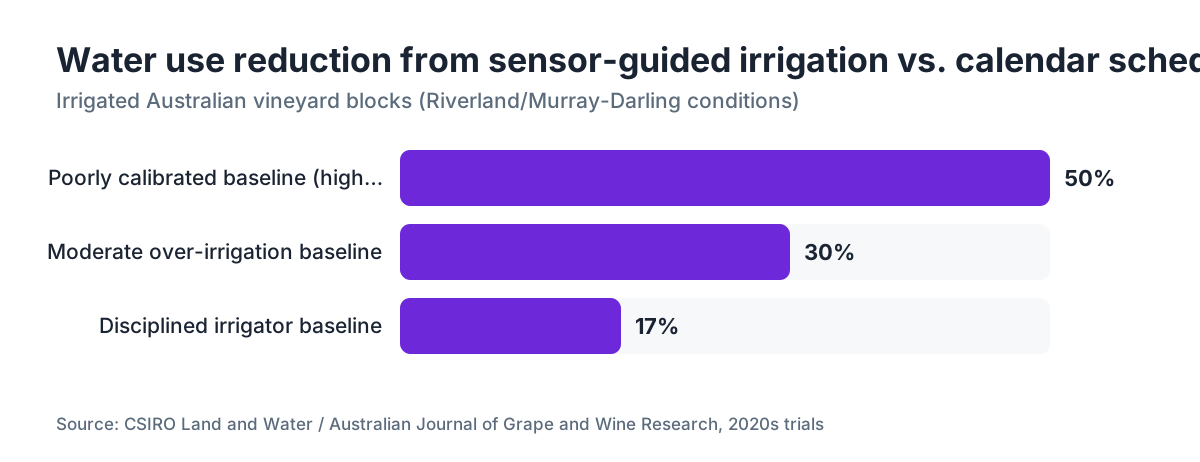
Documented water savings from sensor-plus-model systems in Australian irrigated vineyards range from 15% to 50% compared to unguided calendar scheduling, depending on how poorly calibrated the baseline was [7]. The honest caveat: if you're already a disciplined irrigator using tensiometers and ET data, the marginal gain from a full AI platform is smaller. The big wins go to operations that were previously over-irrigating or guessing.
Regulated Deficit Irrigation (RDI) and Partial Rootzone Drying (PRD) are the two main deliberate stress strategies Australian viticulturalists use to improve wine quality and cut water use at the same time. Both need fairly precise soil moisture monitoring to execute correctly. Getting RDI wrong, stressing vines at the wrong phenological stage, can hurt berry set or slow ripening. The sensor and analytics tools reduce that risk by giving you data at the moments the timing decisions actually matter.
Some context. A well-irrigated Riverland Shiraz block might use 5 to 8 megalitres per hectare per season under unguided management. Precision-guided RDI can bring that to 3 to 5 ML/ha while holding or improving yield and fruit quality, according to CSIRO Land and Water research published in the Australian Journal of Grape and Wine Research [7].
What does AI-driven yield estimation look like and how accurate is it?
Yield forecasting is one of the most commercially valuable problems in viticulture, and historically one of the hardest to do well. Wineries need harvest logistics, tank space, and grape purchasing decisions months before vintage. Growers need to price their fruit and plan labor. Traditional bunch counting and weight sampling give you a number, but it's labor-intensive and statistically noisy.
Machine learning approaches to yield estimation fall into two main categories. The first uses image analysis: cameras (handheld, on-vehicle, or drone-mounted) photograph bunches or individual berries, and a trained object-detection model counts them and estimates berry size. CSIRO's yield estimation research using this approach has shown prediction errors of 10 to 20% at the block level under good conditions [8], meaningfully better than the 25 to 35% error typical of manual sampling.
The second approach uses canopy reflectance proxies. NDVI and other vegetation indices correlate with yield because vigorous canopy generally means more fruit (up to a point). Calibrated against historical yield data from the same blocks, NDVI-based models give useful early-season forecasts. The catch is that the relationship shifts by variety, rootstock, and climate, so a model calibrated on Cabernet Sauvignon in Coonawarra may not transfer directly to Shiraz in the Barossa.
The Australian wine industry's vintage reporting program, coordinated by Wine Australia, tracks national and regional production, but block-level yield data shared across the industry is thin, which limits model training data [9]. That's a real constraint on how fast these models improve.
For small estate operators: hand-held bunch scanning apps using your phone camera run AUD $0, $500 per season, and they're worth trying if yield forecasting has cost you money in the past. For large operations running multiple blocks across varieties, a professionally calibrated machine-vision system or a consulting arrangement with one of the CSIRO spinouts makes more sense.
How much does AI precision viticulture technology cost in Australia?
Cost is where most conversations about precision viticulture go sideways, because vendors have every incentive to quote the ROI case and not the realistic all-in cost. Here's an honest breakdown.
| Technology | Typical cost (AUD) | Notes |
|---|---|---|
| Sentinel-2 NDVI (DIY) | Free | Requires time to process; tools like SNAP or EO Browser |
| Commercial satellite NDVI subscription | $500, $2,500/season | Varies by block count and provider |
| Basic soil moisture sensor setup (2 to 3 probes, 1 logger) | $3,000, $8,000 | Installation extra; ongoing subscription may apply |
| Full soil moisture network (5+ probes, telemetry, dashboard) | $15,000, $40,000 | Per block or per ~20ha zone |
| Drone with multispectral camera (entry level) | $15,000, $25,000 | DJI Mavic 3 Multispectral equivalent |
| Professional drone setup (fixed-wing, full analytics) | $40,000, $80,000+ | Typically contractor hire makes more sense |
| Disease decision support software | $500, $3,000/season | E.g., VitiMeteo, Greencast, local equivalents |
| Full AI platform (sensors + imaging + yield + irrigation AI) | $30,000, $150,000+ | Large corporate vineyards only; implementation costs additional |
The honest mid-range answer for a 20 to 50 hectare family winery: budget AUD $10,000, $25,000 for a meaningful precision viticulture setup covering NDVI subscriptions, 6 to 10 soil probes with telemetry, and a disease forecasting tool. That covers the decisions that actually save money. You don't need the robot.
Recurring costs get underestimated. Sensor calibration, data subscriptions, and the staff time to interpret and act on the data are real ongoing expenses. A platform nobody looks at because it's too complicated is money wasted.
What does Australia's research community say about AI viticulture outcomes?
Australia has one of the stronger applied viticulture research programs in the world, largely through Wine Australia's R&D levy system, CSIRO, the University of Adelaide's Waite campus, and a network of state department of agriculture bodies [9].
CSIRO's Data61 and Agriculture arms have been the main movers on machine learning in Australian viticulture. Their work on automated bunch detection and yield estimation using deep learning (published in the journal Computers and Electronics in Agriculture) is among the most cited in the field globally [8]. The work is honest about constraints: models trained on one variety and one region do not automatically generalize.
The University of Adelaide's viticulture group has published extensively on remote sensing for water stress and precision irrigation, with field trials across South Australian regions [3]. Their conclusion, roughly: sensor-based RDI is agronomically sound and economically justified in water-limited environments. The 'AI' optimization layer adds value but isn't strictly necessary. Good agronomic judgment with sensor data beats no data at all.
Wine Australia's research investment in digital viticulture appears in their R&D investment reports, and the broad finding is that adoption lags development by a significant margin [9]. Most growers know the tools exist but stay uncertain about implementation, ROI, and data ownership. That last one matters. Several growers have raised concerns about sharing block-level data with platforms run by input suppliers who might use it commercially.
For comparison, UC Davis's viticulture and enology program and Washington State University's extension have published parallel work on precision viticulture in California and Washington [10][11]. Their findings on NDVI accuracy, disease model performance, and sensor ROI broadly match Australian results, though water pricing and labor economics differ enough that the business case shifts by a wide margin.
What are the compliance and record-keeping implications of AI viticulture data?
This is the piece most precision viticulture vendors don't talk about, but it matters.
When your AI platform is making or recommending spray decisions, the compliance obligation stays with you. Under Australia's National Registration Scheme for Agricultural and Veterinary Chemicals, administered by APVMA, using a registered pesticide off-label or at a rate outside label directions is a legal violation regardless of what your software told you [12]. If an AI disease model says 'spray today' and you do, you're still responsible for using the right product, at the right rate, in the right conditions.
Spray records in Australia are required under state-level legislation and the SQF/HARPC food safety codes that most commercial grape supply agreements require. Some AI platforms generate automatic spray records from planned applications. That's convenient, but only accurate if the operator confirms the planned application actually happened as logged. Platforms that assume completion rather than confirm it create audit problems.
Under the EPA Worker Protection Standard (WPS) framework in the US, which is the reference standard UC Davis and Cornell extension programs use for comparison in export market compliance discussions, records must document restricted-entry intervals (REIs), personal protective equipment requirements, and decontamination provisions [13]. Australian equivalents under the model Work Health and Safety Regulations require equivalent documentation. Any AI spray advisory tool that doesn't output WPS/WHS-compliant record fields creates a manual reconciliation burden.
This is where a field operations platform matters in practice. VitiScribe, for example, is built around the compliance record as the output, not an afterthought, so AI-assisted spray recommendations log directly into audit-ready records. That's the kind of integration that makes precision tools usable in a compliance context, more than interesting in a research context.
Data ownership clauses in platform contracts are worth reading before you sign. Several major precision agriculture platforms have clauses that allow anonymized or aggregated use of your block data. That may be fine for you. Or it may not be, particularly if your data covers a small distinct appellation where block-level information is commercially sensitive.
What are the barriers to AI adoption for small Australian vineyard operators?
The technology works well enough. The adoption problem is real, and it's not primarily technical.
Connectivity is the first barrier. A lot of Australian wine country has poor mobile coverage and no reliable broadband. Sensors that require cellular data upload run into dead spots. Satellite connectivity (Starlink is now available in most rural Australian regions at AUD $599 installation + $139/month) has changed this a lot, but it's another cost and complexity layer.
Skill and interpretation are the second barrier. An NDVI map shows you zones. Working out what to do about them takes agronomic judgment, the part that can't be automated away. Growers who lack confidence reading the data often end up ignoring it, which makes the investment worthless. Cornell's extension viticulture program makes this point directly in its precision viticulture guidance: the data is only as useful as the person interpreting it [11].
Cost and fragmentation are the third barrier. Sensors from one vendor often don't talk to platforms from another. A grower with a Sentek probe, a Davis weather station, an NDVI subscription from a satellite service, and a disease tool from their agrochemical supplier ends up with four dashboards and no single picture. The industry has been promising interoperability for a decade, and progress has been slow.
Then there's scale. The economics of precision viticulture favor large blocks. Dividing a 100ha property into management zones based on NDVI and applying variable-rate inputs is straightforward. Applying the same logic to a 5ha boutique estate in the Yarra Valley is harder to justify, because the cost of the tools approaches the value of the variable management. Small operators often get better ROI from one really well-placed soil sensor and a disease advisory tool than from trying to buy the full precision agriculture stack.
Which Australian regions are leading in AI viticulture adoption?
Adoption varies more by economic structure than by geography.
The Riverland (SA), Riverina (NSW), and Murray Darling regions lead on irrigation technology, because the economics of water cost and large block size make the return obvious. You'll find dense soil moisture monitoring networks, ET-based scheduling platforms, and some variable-rate drip systems in commercial operations here.
Barossa Valley and McLaren Vale have seen heavy drone and NDVI adoption, driven partly by premium wine positioning (where small quality improvements matter more per tonne) and partly by the concentration of large corporate producers like Treasury Wine Estates and Pernod Ricard who carry internal innovation budgets.
Margaret River in Western Australia has been active in disease forecasting tools given its wetter, higher-pressure disease environment. The Western Australian Department of Primary Industries and Regional Development has extension resources on precision viticulture for the region.
Cooler climate regions, including the Yarra Valley, Mornington Peninsula, and Tasmania, are smaller in scale and more fragmented in ownership, which slows adoption. But they carry high labor costs and complex disease management needs, so the disease model tools have found traction with serious operators there.
For comparison, Australian adoption rates broadly track New Zealand and sit somewhat ahead of most South American producers, but behind the most tech-intensive regions of California's Central Coast. Researchers at WSU's Center for Precision and Automated Agricultural Systems have published comparison work on technology adoption rates across wine regions that gives useful context [10].
What should a vineyard manager actually do first with AI precision viticulture?
Start with a problem that costs you money, not with a technology looking for a problem.
If water cost is your main concern: install two or three soil moisture probes in your most variable irrigation block. Use them for one full season. Track whether your current scheduling was over- or under-irrigating based on actual sensor reads. That single season of data tells you more than any vendor pitch about whether expanded sensor coverage is worth it.
If disease management cost or spray failures are your main concern: sign up for a disease risk advisory service or configure a local weather station to run a published mildew or Botrytis model. VitiMeteo, Greencast, and several state DPI tools are available at low or no cost. Use one for a season alongside your existing spray program. Track where the model disagreed with your timing and whether those disagreements lined up with disease outcomes.
If yield forecasting accuracy is costing you logistics money: photograph 50 to 100 bunches per block at bunch closure using a smartphone, count them, and extrapolate. Do it consistently over two or three seasons. That's a manual precision viticulture practice that costs nothing and gives you baseline data against which to judge whether a $5,000 yield estimation app adds anything.
For vineyard record-keeping and compliance, keeping your AI-assisted field observations in the same system as your spray and irrigation records matters more than the specific sensor or imaging tool you choose. A platform like VitiScribe that ties together field scouting, spray records, and compliance outputs means your AI-generated observations are already in the right place when auditors or certifiers ask for them.
The growers who get burned on precision viticulture are the ones who buy the hardware first and figure out the workflow second. Do it the other way around.
Frequently asked questions
Is AI precision viticulture worth it for small Australian wineries under 20 hectares?
For most operations under 20ha, the full AI stack isn't justified. The highest-return investments at that scale are one or two soil moisture probes per irrigation zone (AUD $1,500, $4,000 total) and a disease advisory tool (often free or under $500/season). These give you actionable data without the complexity or cost of a full platform. ROI is fastest if you're currently over-irrigating or spraying on a fixed calendar regardless of actual disease pressure.
What is NDVI and why do Australian grape growers use it?
NDVI stands for Normalized Difference Vegetation Index, a measure of canopy health calculated from near-infrared and red light reflectance. Australian vignerons use it to spot spatial variability within blocks without walking every row. Low NDVI zones flag stress, nutrient deficiency, or pest damage early. Sentinel-2 satellite data provides free NDVI maps every 5 days at 10-meter resolution, enough for most block-level management decisions.
How accurate are AI yield estimation tools for wine grapes?
The best published systems using machine-vision bunch counting hit prediction errors of 10 to 20% at the block level, according to CSIRO research published in Computers and Electronics in Agriculture. Traditional manual bunch sampling typically runs 25 to 35% error. Accuracy drops in dense canopies where bunches hide, and models trained on one variety don't automatically transfer to another. Calibrate against your own historical yield data for best results.
Can AI replace the agronomist or viticulture consultant in Australia?
No, and it's not close. AI tools automate data collection and pattern recognition, but diagnosing why a zone is underperforming still takes physical scouting, soil knowledge, and regional experience. Low NDVI can mean Phylloxera, waterlogging, nematodes, or salinity, and the management response differs completely for each. The tools make a good consultant more efficient. They don't replace the judgment call.
What Australian government or research bodies fund AI viticulture research?
Wine Australia administers R&D investment through a grower levy co-funded by the Australian Government, and has directly funded digital viticulture and precision monitoring projects. CSIRO runs applied machine learning research in agricultural systems including viticulture. State departments (SA PIRSA, Agriculture Victoria, NSW DPI, DPIRD Western Australia) all run precision agriculture extension programs, though vineyard-specific coverage varies by state.
What connectivity do I need in my vineyard to run sensor and AI tools?
Most sensor telemetry systems need either a 3G/4G mobile signal or a local radio network (LoRaWAN is common for multi-probe setups). In areas with poor mobile coverage, Starlink satellite internet now covers most rural Australian vineyard regions at around AUD $139/month after a $599 setup cost. Some sensors log locally and upload when you bring a device within range, which works fine if you're on-site daily.
Are there spray record compliance implications when using AI spray advisories?
Yes. The compliance obligation stays with you regardless of what the AI platform recommends. Under APVMA's National Registration Scheme, you must still use registered products at label rates and document applications correctly. AI-generated spray recommendations need to be recorded as actual completed events with product, rate, REI, and operator details. If your platform doesn't generate audit-ready records automatically, you need a manual reconciliation step.
What is the difference between precision viticulture and AI viticulture?
Precision viticulture is the broader practice of managing spatial and temporal variability within vineyards using data. AI viticulture specifically refers to using machine learning or neural network models to find patterns, make predictions, or automate decisions from that data. You can do precision viticulture without AI (using sensor data and human judgment), and the two are not the same thing, though vendors often swap the terms.
How does drone multispectral imaging compare to satellite imagery for Australian vineyards?
Drones give you sub-centimeter resolution and fly on your schedule, which matters for time-sensitive growth stages. Satellites offer 10-meter resolution free (Sentinel-2) or higher resolution for a fee, with fixed revisit times. Drones win for detailed canopy architecture work, thermal stress mapping, and early-season scouting. Satellites are more practical for season-long monitoring across large blocks. Most serious operations use both, with satellites for routine monitoring and drones for targeted investigation.
What water savings can Australian irrigated vineyards realistically expect from AI irrigation tools?
Documented savings from sensor-guided irrigation in Australian vineyards range from 15% to 50% versus unguided calendar scheduling, according to CSIRO Land and Water research in the Australian Journal of Grape and Wine Research. The higher end applies to operations that were previously over-irrigating significantly. If you're already disciplined about irrigation timing, expect savings closer to 15 to 20%. At Murray-Darling water prices of $700, $900/ML in tight years, even 15% savings on a 200ha block is substantial.
Can AI tools detect Phylloxera in Australian vineyards from imagery?
Research from the University of Melbourne and Agriculture Victoria has tested hyperspectral drone imagery for early Phylloxera detection. Results are promising but not yet reliable enough for commercial deployment. Phylloxera-induced canopy symptoms overlap heavily with other stress responses, making confident automated identification difficult. No operator should rely on remote sensing alone for Phylloxera surveillance. Ground inspection and soil sampling remain the standard detection methods.
What do university extension programs say about implementing precision viticulture?
Cornell's viticulture extension emphasizes that data is only useful if the operator can interpret and act on it; technology without agronomic knowledge creates expensive noise. UC Davis research on precision viticulture points to spatial variability mapping as the highest-value starting point before investing in automation. WSU's precision agriculture center recommends starting with a single variable (soil moisture or NDVI) and building operational competence before expanding the sensor network.
Who owns the data collected by AI precision viticulture platforms?
Data ownership varies by platform and lives in the contract terms of service, not in your assumptions. Several major precision agriculture platforms include clauses allowing aggregated or anonymized use of your block data. For most large-scale operations, this is a minor concern. For small estate producers in a distinct appellation where block-level performance data has commercial sensitivity, read the contract carefully and negotiate data ownership or export clauses before signing.
Sources
- European Space Agency, Sentinel-2 mission overview: Sentinel-2 delivers 10-meter resolution imagery every 5 days at no cost
- University of Adelaide, Waite Research Institute, viticulture water stress research: Canopy temperature differences of 2 to 4°C between stressed and unstressed vines are detectable by midday thermal imaging in McLaren Vale and Coonawarra conditions
- Plant & Food Research / GRDC, disease model-guided spray program trials: Disease model-guided programs reduce fungicide applications by 20 to 40% in low-to-moderate pressure seasons without meaningful yield loss
- Agriculture Victoria, Phylloxera and Grape Industry Board research: Researchers have been testing whether hyperspectral drone imagery can distinguish Phylloxera-induced chlorosis from other causes of canopy decline
- Murray-Darling Basin Authority, water use in agriculture overview: The Murray-Darling Basin produces roughly 50% of Australian wine grapes by volume
- CSIRO Land and Water / Australian Journal of Grape and Wine Research, deficit irrigation research: Sensor-based RDI can reduce water use from 5 to 8 ML/ha to 3 to 5 ML/ha while maintaining or improving yield and fruit quality in Riverland conditions
- CSIRO, Computers and Electronics in Agriculture, automated yield estimation study: Machine-vision bunch counting yields prediction errors of 10 to 20% at the block level, compared to 25 to 35% for traditional manual sampling
- Wine Australia, R&D investment and digital viticulture programs: Wine Australia administers R&D investment via grower levy and has funded digital viticulture and precision monitoring projects; adoption lags development across the sector
- Washington State University, Center for Precision and Automated Agricultural Systems: WSU researchers have published comparison work on precision agriculture technology adoption rates across wine regions globally
- Cornell University, College of Agriculture and Life Sciences, viticulture extension resources: Cornell extension guidance states that data is only as useful as the person interpreting it, and technology without agronomic knowledge creates expensive noise
Last updated 2026-07-09