Advanced viticulture: techniques, tools, and field decisions that actually move the needle
TL;DR
- Advanced viticulture combines precision canopy management, soil health science, deficit irrigation strategy, targeted pest scouting, and digital record-keeping to improve fruit quality and cut input costs.
- The biggest gains come from vine balance work and smarter water decisions, not expensive sensors.
- Extension programs at UC Davis, Cornell, and WSU publish the best free technical guidance available.
What does 'advanced viticulture' actually mean in practice?
Ask ten vineyard managers what advanced viticulture means and you'll get ten different answers. That's not a dodge. The term genuinely covers a wide spectrum, from basic deficit irrigation scheduling all the way to canopy microclimate modeling and petiole analysis timed to growth stage. The common thread is this: you're managing the vine as a system rather than reacting block-by-block to whatever problem shows up that week.
At its core, advanced viticulture is about vine balance. That means matching vigor to your site, your variety, and your target fruit quality. Louis Ravaz's concept of the Ravaz Index, the ratio of fruit weight to pruning weight, is still one of the most useful single metrics in the industry. A balanced vine typically produces a Ravaz Index between 5 and 10, depending on variety and style goal [1]. Push a vine much above 10 and you're likely sacrificing color, tannin structure, and berry concentration. Drop it much below 5 and you're over-cropping the canopy's photosynthetic capacity.
The 'advanced' part isn't about technology for its own sake. A grower who hand-counts shoots per meter of cordon and prunes to a target crop load is doing advanced viticulture. A grower who buys a $40,000 multispectral drone but doesn't adjust any management decision based on its output is not. The distinction is whether the information actually changes what you do.
How do you manage vine canopy for better fruit quality?
Canopy management is where most of the real gains in vineyard quality work hide. The foundational goal is light interception: you want roughly 50-90% of the canopy surface to intercept direct sunlight at key times of day, while keeping interior leaves at less than 10% shade [2]. Richard Smart's work through the 1980s and 1990s established the practical protocols that most of the industry still uses, and UC Davis Viticulture and Enology extends those into California-specific guidance.
Shoot positioning is the first tool. Orienting shoots vertically in a VSP (vertical shoot positioning) system maximizes light exposure without requiring hedging that removes leaf area. In warmer inland regions like Paso Robles, some growers deliberately leave the canopy slightly more closed on the afternoon-sun side to protect fruit from sunburn. That's a real trade-off: less heat damage versus more disease pressure from reduced air circulation.
Leaf removal in the fruit zone, typically timed to shortly after fruit set, consistently improves berry color, reduces botrytis susceptibility, and tightens skin-to-pulp ratios. A WSU study found that early leaf removal (at the 5-10 berry stage) reduced gray mold incidence by 30-50% in Concord-family and vinifera varieties compared to untreated controls [3]. That's a meaningful number. But timing matters: overly aggressive early removal in hot climates causes sunburn and bleaching that no amount of canopy adjustment later will fix.
Hedging and topping should be a last resort, not a standard calendar operation. Every time you hedge, you stimulate lateral shoot growth that re-shades the cluster zone within two to three weeks. If you're hedging repeatedly through a season, the right answer is probably a different trellis system or lower base bud count at dormant pruning, not more frequent hedging passes.
What is deficit irrigation and how should vineyard managers use it?
Regulated deficit irrigation (RDI) is the practice of intentionally withholding water at specific growth stages to control vine vigor and improve fruit quality. This is one of the best-studied topics in viticulture, and the evidence is clear: moderate water stress during the period from fruit set through veraison reduces berry size, concentrates sugars and color, and slows excessive shoot growth [4]. The key word is 'moderate.'
The standard metric for measuring vine water status is stem water potential, measured with a pressure bomb (Scholander bomb) at solar noon on shaded leaves. For most red varieties, maintaining stem water potential between -8 and -12 bars from fruit set to veraison is a practical deficit target. Below -16 bars, you start seeing photosynthesis shut down and berry shriveling that can concentrate harsh tannins rather than ripe ones. UC Cooperative Extension publishes variety-specific stem water potential benchmarks, and their Irrigation Management publication is worth having in paper form in the truck [4].
California growers added about 30% less irrigation water per acre per year in recent drought years partly because RDI protocols gave them scientific cover to confirm what stress they could tolerate. That matters for water rights compliance too. The EPA Worker Protection Standard doesn't directly regulate irrigation decisions, but if you're running fertigation lines with restricted pesticides, the restricted-entry interval rules still apply to any entry into treated areas for any reason, irrigation included [5].
The tools for irrigation scheduling range from free (visual observation of shoot tip angle, leaf color, and tendrils) to expensive (continuous dendrometers and sap flow sensors). Honestly, a good pressure bomb and a disciplined twice-weekly measurement schedule beat most sensor systems in reliability and accuracy for under $1,500.
How does soil health connect to vine performance in advanced programs?
Soil biology is the most underrated variable in vineyard management. A living, biologically active soil with good organic matter (even 2-3% in most wine regions is considered healthy) improves water-holding capacity, nutrient cycling, and root architecture in ways that synthetic fertilization alone can't replicate.
Cover cropping is the most practical tool for building soil health in vineyards. The choice of cover crop species matters more than most growers realize. Cereal rye and vetch mixes add nitrogen and biomass but can harbor leafhoppers. Native grasses and low-growing clovers reduce tillage needs and improve beneficial insect habitat with less pest risk. Research from UC Davis found that vineyards with permanent cover crops in alternate rows had significantly higher earthworm populations and better aggregate stability than tilled controls [6].
Soil testing frequency in an advanced program should be annual for standard nutrient panels (macro and micro) and every three to five years for a full physical and biological assessment. Petiole sampling at bloom (15-20% flowering) and at veraison gives you the plant's own read on what it's actually absorbing from whatever the soil test says is available. The two numbers don't always match, and that gap tells you something important about pH, compaction, or drainage.
Compaction is the silent killer in high-traffic vineyards. A penetrometer reading above 300 psi in the top 18 inches is a common threshold cited by NRCS for restricting root growth [7]. If you're seeing weak vine growth in row middles and strong growth near posts, check for wheel-traffic compaction before you change your fertilization program.
What precision viticulture tools are worth the investment?
The precision viticulture market has exploded, and a lot of what's being sold is genuinely more useful to a vendor's balance sheet than to yours. So let's sort it.
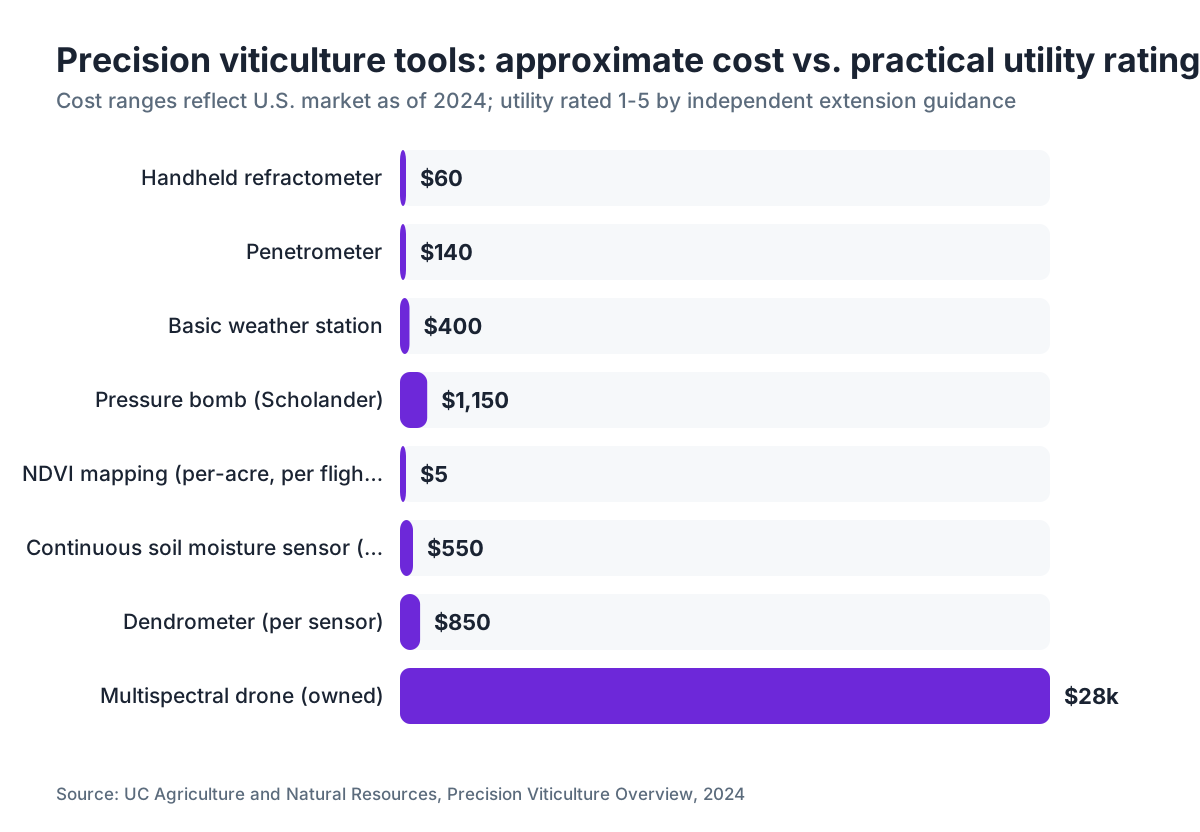
High value, relatively low cost: a good handheld refractometer ($40-80) for Brix field checks, a pressure bomb for stem water potential ($800-1,500), a basic weather station with degree-day accumulation ($200-600), and a penetrometer for soil compaction ($80-200). These tools, used consistently, answer most of your in-season management questions.
High value, higher cost: normalized difference vegetation index (NDVI) mapping from aircraft or drone, done once or twice per season. This tells you where vigor variability exists across your blocks, which lets you target canopy work, soil sampling, and irrigation sector adjustments more efficiently. One good NDVI map at veraison can stratify a 50-acre block into three management zones in a way that saves you thousands in misapplied inputs. Commercial services run roughly $2-8 per acre per flight [8].
Lower value than marketed: continuous soil moisture sensors without trained staff to interpret and act on the data. I've seen too many operations buy six soil moisture probes, look at the dashboard for two weeks, and then stop checking. The data is only as good as your willingness to change irrigation scheduling based on it.
For record-keeping across all these data streams, this is exactly where a platform like VitiScribe earns its keep: pulling spray records, irrigation logs, scouting notes, and weather data into one place so your compliance paperwork and your agronomic decision record are the same document, not two separate systems that drift apart by August.
Table: Precision viticulture tool cost vs. practical utility
| Tool | Approximate cost | Primary use | Worth it? |
|---|---|---|---|
| Pressure bomb (Scholander) | $800-1,500 | Stem water potential | Yes, for irrigated vineyards |
| Handheld refractometer | $40-80 | Brix field check | Yes |
| Basic weather station | $200-600 | Degree-day accumulation | Yes |
| Penetrometer | $80-200 | Soil compaction | Yes |
| NDVI drone/aircraft mapping | $2-8/acre/flight | Vigor mapping | Yes, if you act on it |
| Continuous soil moisture sensors | $300-800/probe | Irrigation scheduling | Only with staff to use data |
| Dendrometer (trunk diameter sensor) | $500-1,200/sensor | Continuous vine water status | For research blocks, mostly |
| Multispectral drone (owned) | $15,000-40,000+ | Canopy analysis | Rarely justified unless large acreage |
How do you design an integrated pest management program for a vineyard?
Integrated pest management (IPM) in viticulture isn't just a philosophy. It's a documented, decision-based approach that regulators increasingly expect to see in your records. California's Pesticide Use Reporting system requires licensed applicators to log every pesticide application, and CDFA audits do look for evidence of scouting-based decision making [9].
The four pillars of a vineyard IPM program are: monitoring and scouting (weekly during the growing season at minimum), economic or aesthetic thresholds for the pests you're managing, action choices (biological, cultural, chemical, in that preference order), and record keeping of what you did and why. The 'why' part is what separates a real IPM program from a spray calendar with IPM written on the cover.
For grape leafhopper, UC IPM guidelines recommend a threshold of roughly 15-20 nymphs per leaf for Erythroneura elegantula (western grape leafhopper) in wine grapes before intervening, because populations below that level rarely cause yield or quality loss that justifies treatment cost [9]. For powdery mildew, the decision is more about degree-day accumulation and infection period models (the Gubler-Thomas model is the standard in California) than visible symptom counts, because by the time you see symptoms, the infection event that caused them happened 7-14 days ago.
Worker protection under the EPA WPS applies to any application of a registered pesticide, regardless of what your IPM label says. The WPS requires a minimum 25-foot buffer from workers for outdoor applications, posting of treated areas when REIs apply, and access to safety data sheets at the central display location in your operation [5]. If you're in California, you have state-level requirements on top of federal WPS that are generally stricter.
Biological controls in vineyards are real and underused. Anagrus spp. parasitic wasps attack leafhopper eggs and are preserved by the same cover crops that benefit soil health. Predatory mites (Galendromus occidentalis) provide excellent spider mite control when you haven't hammered the population with broad-spectrum organophosphates. The key is that once you go broad-spectrum in a block, you typically reset the biological control community and own that pest problem for the rest of the season.
How do you read and use petiole and leaf tissue analysis in viticulture?
Petiole analysis is one of the most cost-effective diagnostic tools in the viticulture toolkit, and it's consistently underused outside of large commercial operations. The principle is simple: the petiole (leaf stem) reflects what the vine has actually taken up, which tells you more about nutritional status than a soil test alone.
There are two standard sampling times. At bloom (roughly 50% capfall), petiole nitrate-N is the primary diagnostic for nitrogen status. At veraison, you switch to whole petiole mineral analysis to assess potassium, phosphorus, magnesium, calcium, boron, and zinc. UC Davis Viticulture and Enology publishes specific sufficiency ranges by variety and timing, and those are the benchmarks most California labs calibrate against [1].
Sampling protocol matters as much as the lab analysis. You want 60-100 petioles per sample, taken from the same leaf position (opposite the basal cluster) across the sampling area, from visually uniform vines, at the same time of day. Don't mix blocks, varieties, or rootstocks in a single sample. If you're seeing a problem in one area of a block, sample that area separately from the apparently healthy vines.
Potassium is a common issue in California wine grape production. High K uptake drives up juice pH and can flatten acidity in finished wines. Some soils with plenty of plant-available K still produce vines with marginal K status because root architecture or antagonism with magnesium limits uptake. Petiole analysis at veraison will tell you which situation you're in, and it tells you before harvest, when you can still have a conversation with your winemaker about acid additions.
What advanced pruning and training strategies improve long-term vine health?
Pruning is the single annual decision that has the most consequence for vine longevity, and it's the area where a lot of California vineyards have taken on decades of trunk disease damage that's now compressing economic life spans.
Trunk diseases, particularly Eutypa latidia, Botryosphaeria, and the esca complex, enter almost exclusively through pruning wounds. The research is unambiguous: wounds are most susceptible in the first few hours after cutting, and wet weather dramatically increases infection risk [10]. Cornell Extension and UC Davis both recommend applying wound protectants (registered fungicides or sealants) to cuts larger than roughly 1 cm diameter when pruning in wet conditions or when trunk disease pressure is known.
Delay pruning until the coldest part of the dormant season when fungal spore load in the air is lowest. In California's North Coast, that's typically January through mid-February. In warmer interior valleys, some growers double-prune: cut long canes in December to prevent early budbreak, then return in February to final positions. This costs an extra pass but reduces early-season vigor and improves bud fruitfulness through better nutrient partitioning.
The Guyot and cane-pruned systems preserve a shorter connection between the permanent wood and the fruiting zone, which limits the path length for trunk disease spread and keeps the sap flow architecture cleaner. For high-vigor sites, minimal pruning or mechanical hedging with hand-finishing at selected positions can reduce labor cost while maintaining acceptable vine architecture. This is legitimately controversial and the right answer depends heavily on your variety, site, and labor availability.
For vineyards with established trunk disease, surgical removal of infected wood combined with retraining from suckers or low shoots (called 'rehab pruning') can extend a vine's productive life by 10-20 years in cases where the crown is still clean. Nobody has great data on exact recovery rates because the trials vary so much by cultivar and disease species, but the closest systematic review from UC Davis Cooperative Extension found that early intervention in mildly infected vines produced meaningful canopy recovery within 2-3 seasons [10].
How do cover crops and soil amendments fit into an advanced viticulture system?
A cover crop program is not one decision. It's a series of annual decisions about species mix, seeding timing, termination method, and residue management, each with trade-offs that vary by region and vine growth stage.
In dryland and low-rainfall systems (under roughly 12-14 inches per year), permanent cover crops compete with vines for soil moisture and often can't be sustained without supplemental irrigation of the midrows. In these situations, disk or mow and let native vegetation manage itself in alternate midrows. In higher-rainfall regions, permanent swards of low-growing fescues or clovers in every midrow are standard.
Seeding timing for winter annual cover crops (cereal rye, vetch, bell beans) should target the first fall rains, typically October-November in California. Spring termination timing matters: if you roll or mow too early, you lose nitrogen fixation from the legumes; if you wait too long in a wet year, you're driving tractors over saturated soil and undoing the compaction work the cover crop roots were doing. Terminate when the biomass is at peak and soil conditions allow a dry pass.
Compost applications of 1-2 tons per acre per year (dry weight) consistently improve soil organic matter in established vineyards, though the soil type matters. Sandy loams show faster improvement than heavy clays. The USDA NRCS EQIP program provides cost-sharing for soil health practices including cover cropping and composting in many wine-producing counties [7]. If you're not checking what EQIP cost-share is available in your county each year, you're leaving money on the table.
For vineyards exploring regenerative practices alongside traditional management, the most honest answer is that the science is still catching up to the marketing. Cover crops, reduced tillage, and compost inputs have good evidence behind them. More exotic biological amendments and biostimulants have far less peer-reviewed data, and the studies that do exist are often funded by the companies selling the products.
What does grape harvest timing really depend on in advanced viticulture programs?
Harvest timing is where every season's agronomic decisions either pay off or don't. And yet a surprising amount of picking still runs off winery intake schedules rather than actual fruit chemistry.
The standard metrics are Brix (total soluble solids, dominated by sugars), titratable acidity, and pH. An advanced program adds berry sensory assessment for skin and seed tannin maturity, and often includes yeast-assimilable nitrogen (YAN) testing to inform winemaking decisions. For red wines, a seed that snaps cleanly and has a woody-brown color rather than green is one useful indicator of phenolic maturity. But the correlation between seed color and actual tannin extractability is imperfect enough that you shouldn't let it override the full chemistry picture.
Acid management begins in the vineyard, not at the winery. Potassium uptake through the berry skin during ripening displaces malic acid from the vacuole, which is one reason late-season irrigation and high-K soils both tend to produce juice with elevated pH and flabby acid structure. If your juice pH is consistently running above 3.6 at harvest, the conversation needs to start with your viticulture program, not your tartaric addition budget.
The question of when to pick gets genuinely complicated in smoke-affected vintages. Smoke taint precursors (guaiacol and 4-methylguaiacol glycosides) are not detectable by taste at harvest and can be present at concerning levels even in berries that look and smell normal. If you're in a smoke-exposed region, lab testing for bound smoke taint compounds before making final harvest decisions is worth the $150-300 per sample cost.
For growers managing multiple blocks across a larger vineyard operation, harvest scheduling software that integrates field Brix readings with weather forecasts and winery scheduling slots reduces the decision chaos significantly. VitiScribe's field log functions can capture rolling Brix and pH records by block so you're not reconstructing the harvest decision rationale from memory in February.
How do compliance and record-keeping work in a professional viticulture operation?
Compliance paperwork in a vineyard is not optional, and in many states it's actively audited. California requires Pesticide Use Reporting for all licensed applicators, with records submitted monthly to the county agricultural commissioner [9]. The record for each application must include the pest targeted, product name and EPA registration number, rate applied, total area treated, and start and end times. Missing or incomplete records result in fines that start around $500 per violation and can escalate quickly.
Federal EPA Worker Protection Standard requirements apply to any agricultural operation using registered pesticides. The WPS, as summarized by the EPA, states that "agricultural employers must provide workers with pesticide safety training, information about pesticides used on the establishment, access to pesticide application and hazard information, and personal protective equipment" [5]. Practically, this means a central display location with current safety data sheets, annual WPS safety training documentation for all workers, and REI compliance for every application.
Water use records are increasingly important as western states tighten groundwater regulation. If your operation is in a Sustainable Groundwater Management Agency (SGMA) basin in California, you may already be required to report extractions. Even outside SGMA basins, keeping seasonal irrigation logs by block gives you data to defend against curtailment claims and to refine your water use efficiency over time.
The practical answer for most small and medium operations is that one organized paper system beats three half-implemented digital systems. Whatever format you use, the records that matter most are: spray application logs (pesticide, rate, area, date, target pest), irrigation logs (volume or run time by zone, weather-based adjustments), scouting records (what you found, where, decision made), and harvest records (Brix, pH, TA, yield per block). Cornell Cooperative Extension and WSU Extension both publish free record-keeping templates that meet most state requirements [11][12].
What are the most common mistakes in advanced viticulture programs?
The biggest mistake is confusing data collection with management. You can have perfect spray records, weekly scouting notes, and a pressure bomb reading every Tuesday and still make poor decisions if you're not pausing to ask what the data is telling you and changing your behavior accordingly.
The second most common mistake is managing for average conditions in a block that has meaningful variability. If you have a 20-acre block with a clay lens in one corner and rocky loam in the other three-quarters, managing it as one unit means you're always under-irrigating one part and over-irrigating another. NDVI mapping or even systematic soil probing will identify this, but only if you're willing to act on it with separate irrigation zones or separate harvest decisions.
Shooting for very low yields without understanding the vine's carbohydrate reserve implications is another pitfall. Severely crop-thinning a vine doesn't automatically make better wine; it depends entirely on whether the vine was over-cropped relative to its leaf area to begin with. A vine with a Ravaz Index of 6 that you thin to get a Ravaz Index of 3 is now directing a larger proportion of its carbohydrate production into roots, trunk, and cane reserves rather than fruit. That's good for vine longevity. Whether it's good for fruit quality depends on variety, site, and target style.
Underestimating the cumulative effect of small decisions on vine health is a real issue too. Trunk disease, compaction, and root health problems build over years before they show up as reduced vine performance. An advanced viticulture program thinks in 10-year arcs, more than about what you're going to harvest this October.
For operations at destinations like Gervasi Vineyard or Ponte Winery that also host visitors, the compliance discipline matters even more, because the public-facing operation creates additional record-keeping obligations that overlap with viticulture documentation.
Frequently asked questions
What is the Ravaz Index and what should it be for wine grapes?
The Ravaz Index is the ratio of fruit weight to pruning weight, measured at dormant pruning. For most wine grape varieties, a value between 5 and 10 indicates vine balance, where the canopy can fully ripen the crop it's carrying. Values above 10 suggest over-cropping; values below 5 suggest excessive vigor or severe under-cropping. The ideal range varies by variety, rootstock, and target wine style.
How often should I do petiole analysis in my vineyard?
Sample at two growth stages each season: at 50% bloom for nitrogen (nitrate-N in petioles) and at veraison for a full mineral panel including potassium, phosphorus, magnesium, calcium, boron, and zinc. Collect 60-100 petioles per sample from uniform vines, same leaf position, same time of day. Compare results to UC Davis or university extension sufficiency ranges for your variety, not generic crop tables.
What stem water potential should I target during deficit irrigation?
For most red wine varieties, maintaining stem water potential between -8 and -12 bars from fruit set through veraison produces the concentration and berry size reduction that improves quality without shutting down photosynthesis. Below -16 bars you risk permanent stress and harsh tannin concentration. Measure with a pressure bomb on shaded leaves at solar noon. UC Cooperative Extension publishes variety-specific benchmarks.
Does the EPA Worker Protection Standard apply to small vineyards?
Yes. The federal EPA Worker Protection Standard applies to any agricultural employer who uses registered pesticides and employs workers. Requirements include annual pesticide safety training, a central display location with current safety data sheets and application records, and compliance with restricted-entry intervals after every application. Farm size does not exempt you; the threshold is whether you employ agricultural workers and use registered pesticides.
How do I know if my vineyard has trunk disease problems?
Look for wedge-shaped or sector-shaped wood discoloration when you make pruning cuts, delayed or weak budbreak in specific vine sections, and dead spurs that don't produce growth. In advanced cases you'll see external symptoms like dead arms or tiger-stripe leaf patterns (esca). Cross-section cuts through the cordons or trunk at dormant pruning are the most reliable early diagnostic tool. Infected wood has a brown to gray stain that healthy wood lacks.
What is the Gubler-Thomas powdery mildew model and how do I use it?
The Gubler-Thomas model predicts powdery mildew infection risk based on daily temperature accumulation. If average daily temperatures stay between 70 and 85°F for three or more consecutive days during the growing season, infection risk is high. The model uses a numeric index that rises with warm nights and sustained moderate temperatures. UC IPM publishes the index formula and risk thresholds, and many regional weather networks calculate it automatically.
What is NDVI mapping and is it worth the cost for small vineyards?
NDVI (Normalized Difference Vegetation Index) mapping uses aerial or satellite imagery to measure canopy reflectance differences that correlate with vine vigor. Commercial services run roughly $2-8 per acre per flight. For small uniform vineyards under 10 acres, a single map rarely justifies the cost unless you suspect significant block variability. For larger or more variable blocks, one NDVI map at veraison can identify management zones that save thousands in misapplied inputs.
What records does California's Pesticide Use Reporting system require from vineyard operators?
California requires licensed pesticide applicators to submit monthly Pesticide Use Reports to the county agricultural commissioner. Each application record must include the pesticide product name and EPA registration number, the pest targeted, the application rate, total area treated, and start and end times. Records must be submitted within one month of the application. Incomplete records can trigger fines starting around $500 per violation.
How does cover cropping affect vine water use in dry climates?
In regions receiving less than roughly 12-14 inches of annual rainfall, permanent cover crops can compete significantly with vines for soil moisture, especially in spring before irrigation begins. Most dry-climate growers use cover crops in alternate midrows only, or terminate early with a roller or disk before significant soil moisture is depleted. In higher-rainfall regions, permanent low-growing swards add organic matter and biological activity without meaningful competition.
What is the best resource for advanced viticulture training for vineyard managers?
UC Davis Viticulture and Enology offers short courses, online modules, and publications covering canopy management, irrigation, pest management, and soil health at varying levels of depth. Cornell Cooperative Extension and Washington State University Extension both publish free technical guides calibrated to their respective regions. For professional certification, the Society of Wine Educators and CCA (Certified Crop Adviser) programs both include viticulture content applicable to field managers.
Can biological control replace fungicide sprays for powdery mildew?
Not reliably in commercial wine grape production under significant disease pressure. Biological fungicides (Bacillus subtilis, potassium bicarbonate, sulfur alternatives) can reduce mildew incidence in low-pressure seasons and are useful in organic programs, but head-to-head trials consistently show conventional fungicides outperforming them in moderate to high disease pressure environments. The best approach uses biologicals in low-pressure windows to reduce selection pressure for fungicide resistance.
How do I test for smoke taint in grapes before harvest?
Smoke taint precursors are measured as bound forms of guaiacol and 4-methylguaiacol (and related phenols) by specialized labs using liquid chromatography mass spectrometry. Free volatile forms are also measured but bound glycoconjugates are the more important indicator for wine-making risk since they're released during fermentation. Labs like ETS Laboratories and Enartis Vinquiry offer this testing. Cost runs roughly $150-300 per sample and results typically return within 3-5 business days.
What is double pruning and why do some growers use it?
Double pruning involves an early dormant pass in late fall to cut canes back to long stubs (4-6 buds), followed by a final detailed pruning pass in late winter to the intended bud count. The first pass delays budbreak by reducing the hormonal signals from bud scales, which reduces frost risk in cold-spring regions. The second pass is done at lower disease-pressure times. Labor cost is higher, but the frost protection and vine health benefits often justify it in risk-prone sites.
Sources
- UC Davis Viticulture and Enology, Vine Balance and Fruit Composition: Ravaz Index between 5 and 10 indicates vine balance; UC Davis publishes petiole sufficiency ranges by variety and growth stage
- University of California Agriculture and Natural Resources, Canopy Management: 50-90% of canopy surface intercepting direct sunlight with less than 10% interior shade is the practical target for wine grape canopy management
- Washington State University Extension, Grape Canopy and Disease Management: Early leaf removal at the 5-10 berry stage reduced gray mold incidence by 30-50% compared to untreated controls in WSU trials
- UC Cooperative Extension, Irrigation Management for Vineyards: Stem water potential between -8 and -12 bars from fruit set to veraison is the standard RDI target for most red wine varieties; UC CE publishes variety-specific benchmarks
- US EPA, Worker Protection Standard for Agricultural Pesticides: EPA WPS requires agricultural employers to provide workers with pesticide safety training, information about pesticides used, access to hazard information, and personal protective equipment
- UC Davis Department of Viticulture and Enology, Cover Crops and Soil Biology: Vineyards with permanent cover crops in alternate rows had significantly higher earthworm populations and better aggregate stability than tilled controls
- UC Agriculture and Natural Resources, Precision Viticulture Overview: Commercial NDVI mapping services for vineyards run approximately $2-8 per acre per flight depending on provider and resolution
- California Department of Pesticide Regulation, Pesticide Use Reporting: California requires monthly Pesticide Use Reports with product name, EPA registration number, target pest, rate, area treated, and application times; fines start at approximately $500 per violation
- UC Davis Cooperative Extension, Trunk Disease Management in Vineyards: Trunk disease wounds are most susceptible in the first hours after cutting; early intervention in mildly infected vines produced meaningful canopy recovery within 2-3 seasons
- Cornell Cooperative Extension, Vineyard Record Keeping Templates: Cornell Cooperative Extension publishes free vineyard record-keeping templates that meet most state pesticide and worker safety reporting requirements
- Washington State University Extension, Vineyard and Winery Compliance Resources: WSU Extension publishes free record-keeping templates for spray applications, scouting, and harvest data meeting most regulatory requirements
Last updated 2026-07-09