Agriculture and viticulture: how grape growing actually works
TL;DR
- Viticulture is the branch of agriculture focused on growing grapevines for wine, table grapes, raisins, and juice.
- It covers site selection, vine training, canopy and water management, pest control, and regulatory compliance.
- U.S.
- grape acreage sits near 1 million acres.
- Get any one discipline wrong and you pay in yield, quality, or both.
What is viticulture and how does it fit within agriculture?
Viticulture is the science and practice of growing grapevines. It sits inside horticulture, which sits inside agriculture, but it carries enough specialized physiology, climate sensitivity, and regulatory weight that most universities treat it as its own discipline. UC Davis runs one of the most cited viticulture programs in the world. Cornell and Washington State University both maintain research stations built specifically for cool-climate and Pacific Northwest wine grape production [1][2][3].
The word comes from the Latin vitis (grapevine) and cultura (cultivation). That etymology has a practical edge. Grapevines are perennial woody crops that live 30 to 100 years on the same site, which is nothing like an annual row crop. Your choices about rootstock, trellis, and row orientation compound across decades, not one season.
In the U.S., commercial viticulture concentrates in California (roughly 80% of wine grape production), Washington, Oregon, New York, and Michigan. Viable vineyards now exist in nearly every state [4]. Worldwide, the FAO estimates about 7.4 million hectares of vineyard in production as of the early 2020s, with Spain, France, and China leading by area.
What are the main branches of viticulture?
Most practitioners split the field into three areas that overlap constantly.
General viticulture is the foundation. It covers vine physiology, soil science, climate matching, and production systems. This is what you learn in a classroom before you ever pick up a pruning saw.
Enological viticulture, sometimes called wine grape growing, ties every vineyard decision to how the fruit will ferment and age. Canopy work, irrigation cutoffs, harvest timing: all of it gets filtered through what the winemaker wants in the cellar.
Then there's precision viticulture, the youngest branch. It uses remote sensing, soil mapping, yield monitors, and weather data to manage variability inside a single block instead of treating that block as uniform. Nobody has clean data on how much precision viticulture improves net returns at small-farm scale. The closest published work from UC Davis suggests site-specific management can cut input costs 10-25% in blocks with high internal variability [1].
A fourth dimension rarely makes the textbooks. Spray records, water-use reporting, worker protection, pesticide licensing: these are legally required parts of running a vineyard. Ignore them and you're not farming. You're accumulating liability.
How does the grapevine growth cycle affect vineyard operations?
The annual growth cycle, called phenology, sets the calendar for every task on the farm. It has eight recognized stages, and the timing of each one drives your scouting, spraying, pruning, and harvest calls [1].
Budbreak happens when temperatures reliably climb past about 50°F (10°C). It's the most frost-vulnerable moment of the year. One frost event at budbreak can wipe out 40-80% of a crop. That's not hyperbole. It's why growers in frost-prone areas buy wind machines, overhead sprinklers, or smudge pots.
From budbreak through bloom (roughly May to June in the Northern Hemisphere), the vine builds shoot and leaf area. Canopy management starts here. Powdery mildew pressure peaks here. And your spray program carries the most weight on final fruit quality right here.
Veraison, the color change in reds and softening in whites, marks the switch from vegetative growth to ripening. After veraison, irrigation strategy flips: now you're managing vine stress to concentrate sugars and phenolics instead of keeping leaves at maximum function.
Harvest timing is where art and agronomy collide. Brix, pH, titratable acidity, and a walk through the rows tasting berries all feed the pick date. No single number decides it. Most experienced growers say they read their blocks over years in a way a Brix meter can't.
After harvest, the vine slides into senescence and dormancy. Pruning happens in dormancy, usually December through February in the Northern Hemisphere. Those pruning cuts set next year's crop load before next year's season even starts.
What soil and climate factors determine where grapes grow well?
The French idea of terroir says place shapes wine character. For the agronomist the question is sharper: what physical and chemical conditions keep a grapevine healthy and its fruit consistent?
Soil drainage matters more than soil fertility, and it's not close. Vines shrug off low-nutrient soils but hate wet feet. Phylloxera, nematodes, and crown gall all set up shop faster in stressed, poorly drained vines. Most extension guides call for at least 3 to 4 feet of well-drained rooting depth [2].
pH controls nutrient availability. The target range for vineyard soils runs 6.0 to 7.0. Step outside it and iron, manganese, or boron deficiencies show up no matter what you spread on the surface.
Climate matching comes down to heat, measured in growing degree days (GDD) above 50°F from April 1 through October 31. UC Davis researcher A.J. Winkler built the GDD classification still used today: Region I sits under 2,500 GDD (best for Pinot Noir and Chardonnay), Region V runs above 4,000 GDD (Thompson Seedless and table grapes). Matching variety to region is the single highest-leverage decision a new grower makes [1].
Frost risk, winter lows, and humidity all stack on top of heat totals. A site can hit the right GDD number and still be too humid for Botrytis-sensitive varieties. That's why WSU's extension work pushes site-specific climate analysis before anyone picks a variety [3].
What are the main vine training systems and why does it matter?
The training system is the physical shape you build the vine into with trellis, wires, and pruning. It sets sun exposure, air circulation, mechanization access, and labor cost. Pick the wrong one for your site and variety and you'll fight it every season.
Vertical shoot positioning (VSP) is the most common system in premium wine grape production. Shoots are trained upright between paired foliage wires, making a flat vertical canopy. It works well in moderate-vigor sites and takes to mechanical harvest if the rows are spaced right.
Scott Henry and Smart-Dyson systems split the canopy into upward and downward zones. That roughly doubles the leaf area exposed to light without widening the rows. You see them in high-vigor sites where VSP gets so dense that disease pressure jumps.
Gobelet (head training) and Guyot are traditional European systems, still common in old-vine plantings. They use no trellis or very little. Hand-pruning labor runs high, but fruit off old head-trained vines often earns price premiums that pay for it.
Split canopy systems like Geneva Double Curtain (GDC) and Lyre were built for high-yield table grape and raisin production in warm climates. You rarely see them in premium wine grape blocks.
Here's the honest part. No system is universally correct. The right choice depends on vine vigor, row orientation, hand versus machine harvest, your labor costs, and the variety's growth habit. Cornell's viticulture team has published deep comparison data for cool-climate systems, and it's worth reading before you commit to a trellis you'll live with for 30 years [2].
How do growers manage pests and diseases in the vineyard?
Vineyard pest and disease work runs on integrated pest management (IPM). You scout first, set thresholds before you spray, and pick materials based on efficacy, resistance management, and re-entry interval compliance [5].
Powdery mildew (Erysiphe necator) is the single most damaging disease across most U.S. wine regions. It's obligate, meaning it only infects living tissue, and it moves fastest between 70-85°F in dry conditions. The practical takeaway: you can't wait for visible symptoms. By the time you see white powder, you're two to three infection cycles behind. UC Davis IPM guidance says start a mildew program at 1-inch shoot growth and hold coverage through 4 to 6 weeks past bloom [1].
Botrytis cinerea (gray mold) is the mirror image. It loves cool, wet conditions and dense canopies. Canopy management, not fungicide alone, is your first line. Pulling leaves in the fruit zone at pea-size berry opens up the air movement Botrytis can't stand.
Phylloxera (Daktulosphaira vitifoliae) is the root louse that gutted Europe's vineyards in the late 1800s. The control is planting on resistant rootstock. Own-rooted Vitis vinifera in phylloxera-present soil is a ticking clock.
Leafhopper, mealybug, and spider mite pressure shift by region. Pierce's Disease, caused by the bacterium Xylella fastidiosa and spread by sharpshooter leafhoppers, is an existential threat in California's Central Valley and parts of the South. There's no cure for an infected vine.
Every application needs a written record: product name and EPA registration number, rate applied, target pest, date, applicator's name, and the pre-harvest interval (PHI) for anything sprayed near harvest [6]. Those records must be kept at least two years under federal law, and some states demand longer.
What does EPA Worker Protection Standard compliance require in vineyards?
The EPA's Worker Protection Standard (WPS) is the federal rule governing pesticide safety for farmworkers and handlers, vineyards included [6]. If you employ anyone who enters treated areas, the WPS applies to you. No exceptions for small farms.
The WPS requires you to post pesticide application information at a central location so workers can read it before they enter a treated field. You must train workers before their first entry into any treated area, and that training has to cover the specific hazards of the pesticides they might contact. EPA-approved WPS training materials come in multiple languages.
Re-entry intervals (REI) are the mandatory wait times after an application before workers can enter without full personal protective equipment. REIs run from 4 hours for some fungicides to 48 hours or more for certain insecticides. Blowing past an REI isn't a paperwork problem. It's a direct safety failure and a federal enforcement risk.
The 2015 revised WPS, effective for most provisions by 2017, added anti-retaliation protections, designated representative access to pesticide records, and a minimum age of 18 for pesticide handlers [6]. Plenty of small vineyards got caught flat-footed by those changes.
If you use hired labor during spray season, do three things. Post your application records the same day you spray. Keep a dated log. Walk your supervisors through REI rules at the start of every season. State ag departments run compliance inspections, and they do show up.
How do irrigation and water management work in wine grape production?
Grapevines have a drought-tolerant reputation, but that reputation belongs to mature, deep-rooted vines in the right soils. Young vines in their first two or three years need reliable water to build a root system. After that, deliberate water stress at the right growth stages actually improves wine grape quality.
Regulated deficit irrigation (RDI) is the standard in most western U.S. wine regions. You hold mild to moderate plant water stress from fruit set through veraison, then cut or stop irrigation after veraison to concentrate sugars and build skin tannins. Research from WSU's Irrigated Agriculture Research and Extension Center at Prosser has shown deficit irrigation from veraison to harvest can raise phenolic content in Cabernet Sauvignon without dropping yield below economically damaging thresholds [3].
Soil water monitoring tools give you data instead of guesswork: tensiometers, capacitance probes, and pressure bomb readings on leaves. Pressure chamber measurements of midday stem water potential are the most direct read on vine water status. A midday stem water potential of -1.2 to -1.4 MPa during ripening is a common target for mild stress, though it shifts by variety and target style.
In the West, water rights are a separate legal beast from irrigation agronomy. California, Washington, Oregon, and other western states run on prior appropriation doctrine. Know your water right's priority date and volume before you design a single irrigation line.
What records does a vineyard legally have to keep?
Record-keeping in viticulture isn't optional. It's mandated at federal and state levels, and it's also your best defense when something goes sideways: a worker illness, a drift complaint, a pre-harvest interval question the morning of harvest.
At the federal level, the WPS requires pesticide application records accessible to workers and their designated representatives [6]. USDA commodity programs, if you're enrolled, carry their own requirements. If you hold organic certification, the National Organic Program (NOP) requires a complete audit trail of every input and practice for five years [7].
State rules vary a lot. California's Department of Pesticide Regulation requires that all pesticide applications by licensed applicators, or under their supervision, be reported to the county agricultural commissioner within 30 days of application [8]. The Washington State Department of Agriculture runs similar commercial pesticide reporting [9].
A complete vineyard record system captures block-level pesticide logs (product, rate, REI, PHI, applicator, date), irrigation logs, scouting records (pest counts, disease notes), weather data for spray timing, yield by block, and soil or tissue test results.
This is where vineyard management software earns its keep. Paper binders technically work, right up until a state inspector asks for two years of spray records for Block 3 and you're flipping pages in a truck cab. Tools like VitiScribe are built around this compliance workflow, pulling spray records, REI tracking, and field notes into one place you can actually find.
Keep paper backups anyway. Every software company can go dark.
What does it cost to plant and operate a vineyard?
The honest answer: establishment costs swing hard by region, labor market, trellis system, and land price. Anyone handing you one number without context is oversimplifying.
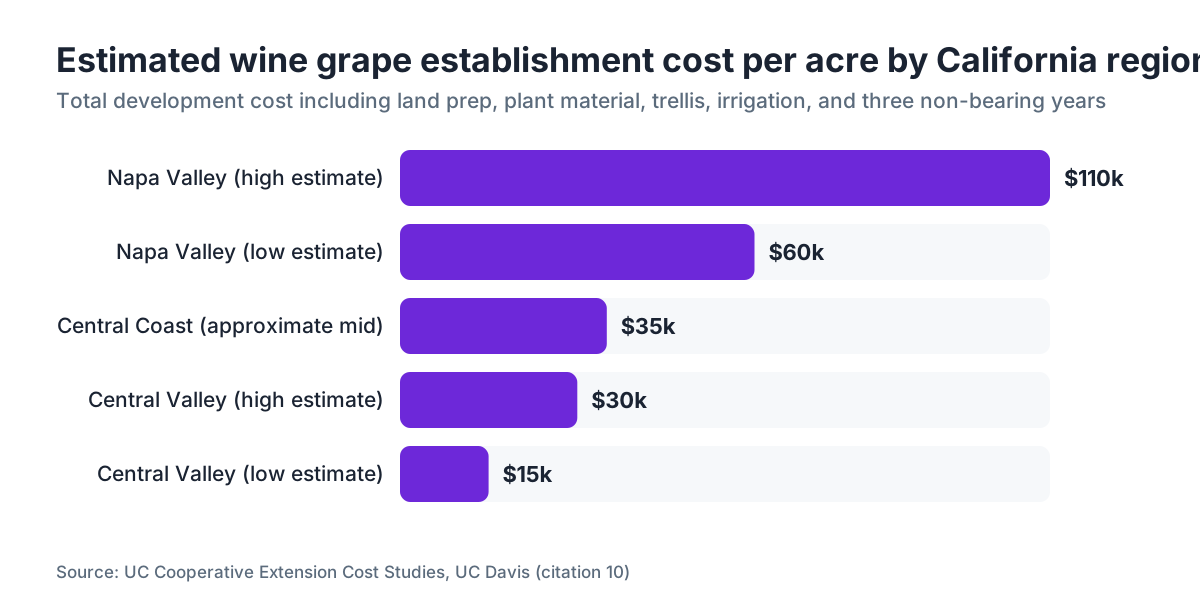
UC Cooperative Extension farm budgets for California wine grape production are the best public baseline we have. Their recent Napa Valley establishment budgets put total development costs (land prep, plant material, trellis, irrigation, and the first three non-bearing years) in the range of $60,000 to $110,000 per acre for premium regions. Central Valley wine grape establishment runs lower, roughly $15,000 to $30,000 per acre [10].
Annual operating costs for a mature California wine grape vineyard run about $3,000 to $8,000 per acre, depending on region, labor intensity, and irrigation type. Washington State University publishes comparable enterprise budgets for Washington wine grape production [3].
Returns ride almost entirely on the contract or market you've lined up. Bulk wine grape prices for common varieties can fall below $200 per ton in oversupply years. Napa Cabernet Sauvignon contracts regularly clear $5,000 to $8,000 per ton. Know your market before you plant, not after the vines are in the ground.
For small estate wineries, the growing-versus-buying math comes down to scale and quality control. Below about 20 to 30 acres, contract farming often pencils out better than owning vineyard equipment. Above that, owning your fruit supply starts to make strategic sense.
Regions like Paso Robles and the South Coast are interesting case studies in mid-market viticulture economics: land costs run below Napa, but quality ceilings stay high.
How does viticulture differ in cool climates versus warm climates?
The core problem in cool climates is getting enough heat to ripen fruit before autumn rains and frost show up. The core problem in warm climates is holding acidity and dodging overripe flavors at harvest. Everything else flows from those two facts.
Cool-climate viticulture, the kind you find in the Finger Lakes, the Willamette Valley, and much of Germany and Burgundy, leans on site selection for south-facing slopes, reflective bodies of water that soften temperature swings, and early-ripening varieties. Cornell's extension work covers disease-resistant hybrids like Marquette, Frontenac, and Traminette, bred for cold-climate survival, and they matter enormously for growers in states with hard winters [2].
Warm-climate viticulture faces the opposite squeeze. Growers in the San Joaquin Valley, parts of Australia, and southern Spain pick earlier to keep acidity, use canopy management to shade clusters and cut heat load, and sometimes spray kaolin clay to reflect radiation. Irrigation management runs more active because evapotranspiration is higher.
There's no universal best climate for grapes. Terroir advocates are right that distinctive wines come from marginal sites where the vine struggles. Agronomists are just as right that marginal sites carry more risk. The balance depends on what you grow, for whom, and at what price point.
The mountain winery context makes the tradeoff clear. Elevation adds diurnal temperature swing and often lowers disease pressure, but it also limits mechanization and stretches the growing season in ways that force careful variety matching.
What is the difference between viticulture and enology?
Viticulture is everything that happens in the vineyard, from soil prep through harvest. Enology (oenology in the European spelling) is the science of winemaking: fermentation chemistry, yeast selection, barrel aging, blending, and stabilization.
The two are deeply linked and genuinely separate professions. A viticulturist who doesn't understand what a winemaker needs from the fruit makes vineyard decisions that turn into cellar problems. A winemaker who doesn't understand canopy management or irrigation timing blames fermentation for flaws that actually started in the field.
At large wineries these are separate job titles with separate training. UC Davis runs distinct viticulture and enology degree tracks [1]. At small estate operations one person often does both, which is why that person's reading load is brutal.
The cleanest way to think about it: viticulture sets the ceiling on wine quality, and enology works within that ceiling. You cannot vinify your way to great wine from mediocre fruit. You can absolutely wreck good fruit with poor winemaking.
For small producers weighing estate winemaking, the vineyard side almost always needs attention first. Get the fruit right, then sort out the cellar.
How is precision viticulture changing field operations?
Precision viticulture uses spatial data to manage a block as a set of zones instead of one uniform unit. The tools include aerial and satellite NDVI (normalized difference vegetation index) imagery to map vigor, soil EC (electrical conductivity) mapping to find soil texture differences, yield monitors on mechanical harvesters, and block-level weather stations.
The payoff is that you stop managing to an average that exists nowhere in your vineyard. A block with high internal vigor variability has zones that are consistently over-cropped and zones that are consistently under-cropped when you treat the whole block the same. Differential management (variable-rate irrigation, zone-specific pruning, or segregated picking) starts to pay once you have the spatial data to steer it.
The limit is cost and interpretation. NDVI imagery is cheap now, available through services like Planet Labs or as government data from USDA NAIP flights [4]. Turning that imagery into real management zones takes either agronomic skill or software built for it. Getting the data is the easy part. Knowing what to do with it is the hard part.
For vineyards keeping spray records and field notes digitally, layering spatial data onto those records builds a far more useful compliance and management archive. That's where tools built for field operations, like VitiScribe, add value past basic record-keeping.
Honest read on adoption: precision viticulture is well-established in research, increasingly common in large commercial operations, and still spotty at the 20-to-100-acre estate scale. If you're a small grower, your highest-return precision tool is probably a block-level weather station and a pressure bomb. Those run a few hundred to a few thousand dollars and give you data you'll actually use.
Frequently asked questions
What degree or certification do you need to work in viticulture?
No single credential is legally required to grow grapes. A B.S. in Viticulture and Enology from UC Davis or Cornell, or a viticulture certificate from a community college, gives you the agronomic and regulatory grounding to manage vineyards professionally. Pesticide applicator licensing is legally required in most states if you're the person buying and applying restricted-use pesticides. That's a state exam, not a degree.
How many acres of vineyards are there in the United States?
USDA NASS data puts total U.S. bearing grape acreage around 900,000 to 1 million acres depending on the survey year. California holds roughly 80-85% of wine grape bearing acreage. Washington runs second with about 60,000 acres of wine grapes. Oregon, New York, and Michigan account for much of the rest, though commercial viticulture now exists in nearly every state.
What is the Winkler scale and why do viticulturists use it?
The Winkler scale, developed by A.J. Winkler at UC Davis, classifies wine grape regions by cumulative growing degree days (GDD) above 50°F from April through October. Region I sits under 2,500 GDD (Pinot Noir, Chardonnay), climbing to Region V above 4,000 GDD (table grapes, high-yield varieties). It's still the most widely used single-variable climate system for matching variety to site.
What is phylloxera and why does it still matter today?
Phylloxera is a root-feeding louse (Daktulosphaira vitifoliae) that kills Vitis vinifera vines by destroying root tissue. It devastated European vineyards in the 1860s-1880s. The fix was grafting vinifera varieties onto resistant American rootstocks. It still matters because any own-rooted vinifera vine in phylloxera-present soil will eventually decline. Parts of California had to replant extensively in the 1990s after the AxR1 rootstock proved susceptible.
How long does it take a vineyard to become economically productive?
Most vineyards produce a first harvestable crop in year three, though yields run just 20-40% of mature production. Full production usually arrives by years five to seven. That means three to four years of establishment costs with little to no revenue, which is why understanding financing and cashflow before planting matters as much as the agronomy. UC Cooperative Extension establishment budgets model this non-bearing period explicitly.
What is regulated deficit irrigation and should I use it?
Regulated deficit irrigation (RDI) intentionally holds mild to moderate vine water stress during specific growth stages, typically from fruit set through post-veraison, to concentrate fruit and limit excess vegetative growth. WSU and UC Davis research supports it for wine grape quality in irrigated regions. Whether to use it depends on your soil's water-holding capacity, your variety, and whether your target style benefits from higher phenolic concentration.
What pesticide records are legally required in a vineyard?
Federal WPS requires pesticide application information to be posted and accessible to workers. State rules add commercial use reporting: California requires monthly reporting to the county agricultural commissioner for all licensed commercial applications, and Washington runs similar requirements. At minimum, every spray record needs the product name, EPA registration number, application rate, target pest, date, block treated, applicator name, and the REI and PHI for each product.
What is powdery mildew and how do you control it in vineyards?
Powdery mildew (Erysiphe necator) is the most economically damaging fungal disease in most U.S. wine grape regions. It spreads in dry, warm conditions (70-85°F) and needs no free moisture to infect. Control requires a preventive spray program starting at 1-inch shoot growth. UC Davis IPM guidance recommends rotating sulfur, DMI, and SDHI fungicides to manage resistance. Canopy management improves air circulation and lowers pressure but doesn't replace a spray program.
Can you grow wine grapes organically and what does certification require?
Yes. Organic viticulture bans synthetic pesticides, herbicides, and fertilizers, relying on sulfur and copper-based fungicides, beneficial insect habitat, and compost. USDA National Organic Program (NOP) certification requires a 3-year transition from last prohibited substance use, a documented Organic System Plan, and annual inspection by an accredited certifier. It also requires complete input records for five years. Pierce's Disease pressure and humid climates make organic viticulture much harder in some regions.
What is the difference between a viticulturist and a vineyard manager?
A viticulturist focuses on the science: vine physiology, disease identification, variety selection, and data analysis. A vineyard manager focuses on operations: scheduling crews, running equipment, executing spray programs, keeping compliance records, and hitting harvest dates. In practice the roles overlap heavily at small operations. Large estates and farming companies sometimes separate them, with the viticulturist acting as technical consultant and the manager handling daily execution.
How do cover crops affect viticulture?
Cover crops between vine rows do several things: they cut erosion, build soil organic matter, compete with vines for water and nitrogen (handy in high-vigor sites), and support beneficial insects. In dry climates, permanent cover crops can noticeably raise vineyard water demand, which matters for your water budget. Most California wine regions run a mix of permanent and mowed cover in alternating rows, keeping some rows bare to conserve moisture.
What rootstocks are most commonly used in U.S. viticulture?
The most widely planted rootstocks in California include 110R (drought-tolerant, moderate-high vigor), 101-14 (low-moderate vigor, suited to moist soils), and 3309C (low-moderate vigor, good for cool climates), with Chambourcin-based selections common in the East. Rootstock choice should be driven by soil type, phylloxera and nematode risk, target vine vigor, and drought tolerance. UC Davis Foundation Plant Services maintains rootstock trial data and is the most reliable current source.
Sources
- Cornell University, College of Agriculture and Life Sciences, Viticulture and Enology Extension: Cornell viticulture research for cool climates, cold-hardy hybrid varieties (Marquette, Frontenac, Traminette), training system comparison data, minimum 3-4 feet well-drained rooting depth guidance
- Washington State University, Viticulture and Enology Extension: WSU extension work on deficit irrigation improving phenolic content from veraison to harvest in Cabernet Sauvignon, Washington wine grape enterprise budgets, site-specific climate analysis guidance
- USDA National Agricultural Statistics Service, Grape Acreage Report: U.S. bearing grape acreage approximately 900,000 to 1 million acres; California accounts for roughly 80-85% of wine grape bearing acreage; Washington approximately 60,000 acres; USDA NAIP imagery availability
- UC Statewide IPM Program, Grapes: IPM framework for vineyards: scout first, establish thresholds, select materials based on efficacy and resistance management; powdery mildew program timing and fungicide rotation guidance
- U.S. EPA, Agricultural Worker Protection Standard (WPS): WPS requires posting pesticide application information, worker training before field entry, re-entry intervals (4 hours to 48+ hours), minimum age 18 for pesticide handlers (2015 revision effective 2017), pesticide records accessible to workers, minimum two-year record retention
- USDA Agricultural Marketing Service, National Organic Program: NOP requires 3-year transition period, documented Organic System Plan, annual inspection, and complete input records for five years
- California Department of Pesticide Regulation, Pesticide Use Reporting: California requires all pesticide applications by licensed applicators to be reported to the county agricultural commissioner within 30 days of application
- Washington State Department of Agriculture, Pesticide Management: Washington State requires commercial pesticide use reporting similar to California's county reporting system
- UC Cooperative Extension, Sample Costs to Establish a Vineyard and Produce Wine Grapes, Napa County: Napa Valley wine grape establishment costs range from $60,000 to $110,000 per acre total; Central Valley establishment runs $15,000 to $30,000 per acre; annual operating costs $3,000 to $8,000 per acre for mature California vineyards
- UC Davis Foundation Plant Services, Rootstock Information: Most commonly planted rootstocks in California include 110R, 101-14, 3309C; rootstock choice driven by soil type, phylloxera and nematode risk, vigor, drought tolerance
Last updated 2026-07-09