Rinsate disposal documentation requirements for vineyard spray equipment
TL;DR
- Federal law requires you to keep pesticide application and disposal records for at least two years under FIFRA Section 8.
- Rinsate from spray equipment counts as pesticide waste unless diluted below label thresholds.
- Your record must capture the product name, EPA registration number, disposal method, date, and quantity.
- State rules often add more, and California adds a lot.
What is rinsate and why does it need its own documentation?
Rinsate is the liquid left over after you rinse a pesticide container or spray tank. It still carries pesticide residue. That means the law treats it as pesticide waste in most places, not plain wastewater, and it can't just drain onto the ground or into a drain unless it meets specific conditions. [1]
The EPA's definition matters here. Under FIFRA, pesticide waste includes any pesticide that can no longer be used for its intended purpose and has to be thrown out, and rinsate you don't re-use in the spray mix usually lands in that bucket. [1] Most product labels carry the force of law under FIFRA Section 12, and they spell out how rinse water has to be handled. If the label says add the first rinse back to the spray tank, that's a legal direction, not a suggestion.
For vineyard managers, the documentation gets messy fast. You run several products through the same rig in a single day, moving from fungicides to herbicides to insecticides sometimes within hours. Each product may have a different label rule for rinsate. Your record has to reflect what you actually did with each one.
Paper or digital, the question an inspector asks is simple. Can you show what residue was in that rinse water, how much, when you got rid of it, and where? Miss one of those four and you're exposed.
What federal records do you have to keep for rinsate disposal?
FIFRA Section 8(a) requires certified applicators to keep records of restricted-use pesticide (RUP) applications for two years. [2] The EPA's pesticide recordkeeping requirements under 40 CFR Part 171 spell out what those records must include: the product name, EPA registration number, total amount applied, location and size of the treated area, and the date. [2]
Rinsate disposal has no standalone federal form. It gets folded into two existing frameworks. If you re-use the rinsate in the spray mix (triple-rinse, for example), that re-use is part of the application record and belongs there. If you dispose of the rinsate separately, you need records linking the disposal back to the original application so an inspector can trace the chain. [1]
The EPA also treats pesticide waste disposed of on-site (say, applying diluted rinsate to the treated field at or below label rates) as exempt from hazardous waste rules under RCRA Section 3001(f), but only when it's done in compliance with FIFRA. [4] Your label compliance and your disposal records are the same legal shield. One protects the other.
For general-use pesticides, federal law doesn't require written records. States often do. And practically, if you ever face a complaint, an audit, or a worker exposure incident, no records is far worse than imperfect ones.
What specific information belongs in a rinsate disposal record?
A defensible rinsate disposal record has eight fields. Miss any of them and the record loses value under enforcement.
| Field | Why it matters |
|---|---|
| Date and time of disposal | Establishes timeline relative to application |
| Product name and EPA Reg. No. | Ties disposal to the specific pesticide label |
| Formulation concentration in rinsate (estimated) | Helps confirm disposal met label dilution thresholds |
| Volume of rinsate generated | Material accounting, needed if a spill occurs |
| Disposal method (field application, evaporation pit, licensed hauler) | The core compliance question |
| Location of disposal | Coordinates or block/row reference |
| Applicator name and license number | Who was responsible |
| Equipment rinsed | Sprayer ID, tank size |
UC Cooperative Extension recommends growers also note weather at the time of disposal (wind speed, temperature, whether rain was coming) when applying rinsate to fields, because those conditions change runoff and drift risk. [5] That's not a federal requirement. It's good practice, and it documents good judgment.
WSU Extension's pesticide safety program points out that the volume calculation matters because it's what you use to prove you stayed at or below one percent of the labeled use rate. That one percent figure is the common threshold for treating rinsate as non-waste when you re-apply it to the treated area. [6]
How long do you have to keep these records?
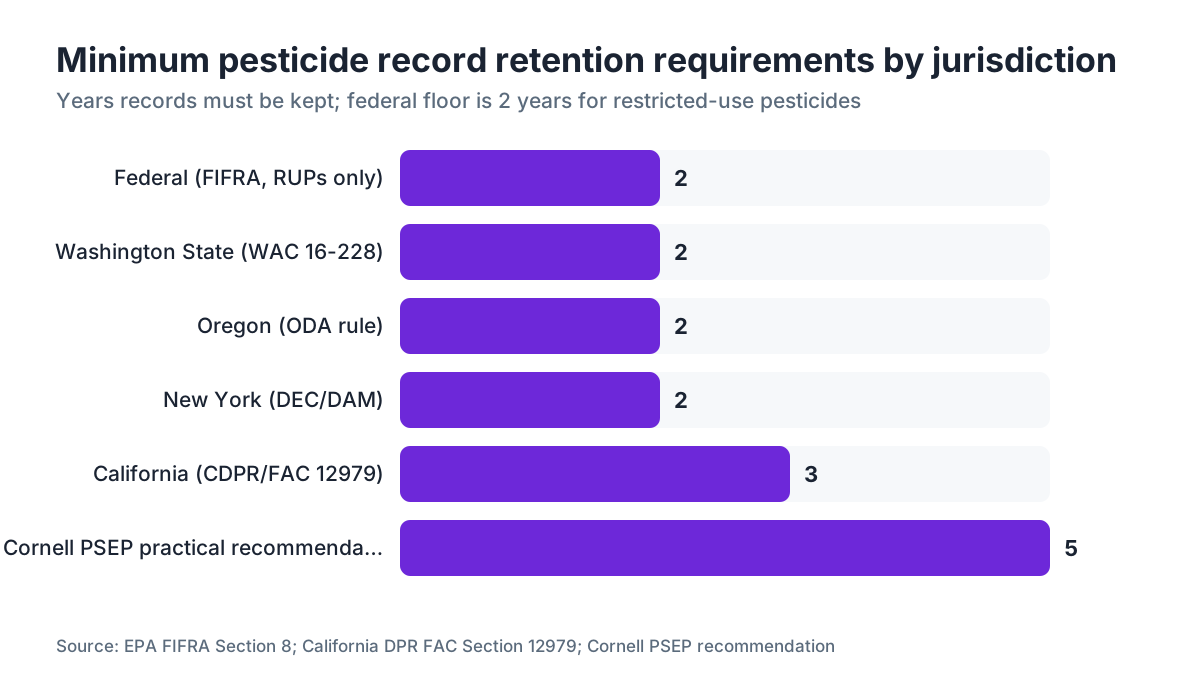
Two years minimum under FIFRA Section 8(a) for restricted-use pesticides. [2] Keep them longer if your state says so.
California requires pesticide use records be kept for three years and reported monthly to the county agricultural commissioner under California Food and Agricultural Code Section 12979. [7] Washington requires two years but adds a reporting window for commercial applicators under WAC 16-228. Oregon holds at two years but requires records be available for inspection within 24 hours of a request.
New York follows the federal two-year baseline, though the Department of Environmental Conservation can require records within a few business days. Cornell Cooperative Extension's pesticide safety program suggests keeping records five years as a practical hedge, because a crop-damage or water-contamination complaint can surface well after the federal window closes. [8]
If your state has annual pesticide use reporting, the disposal record feeds that report too. Get the primary record right and the annual summary almost writes itself.
What are the legal disposal methods for vineyard rinsate?
There are four widely accepted methods, and each one changes what you document. [1][6]
Re-use in the spray mix is the cleanest option. Triple-rinse the tank, add each rinse back, and apply at normal rates. The record is the application record itself, with a note that triple-rinse rinsate went into the mix. No separate disposal record needed.
Field application of diluted rinsate is allowed by most labels if the rinsate concentration stays at or below one percent of the labeled application rate, applied to the same crop and field where the product was used. Document the estimated dilution, the field location, and the date. Don't apply rinsate to field borders, ditches, or non-target areas.
Evaporation pits or containment pads on-site are common in larger operations. If you hold rinsate to evaporate or degrade, document what went in, when, and how much. Some states require permits for evaporation pits, and California's pesticide contamination prevention program addresses on-farm containment. [7]
Licensed hazardous waste hauler removal is required for concentrated rinsate, for products whose labels prohibit field application of rinsate, or when you've blown past on-site management thresholds. Keep the manifest from the hauler. That manifest is your disposal record. [4]
One method that's legal nowhere: dumping rinsate into a storm drain, irrigation ditch, or surface water. FIFRA Section 12 prohibits it, and Clean Water Act Section 402 can pile on NPDES permit violations. Prove you know this by keeping a written SOP. [11]
Do state regulations add requirements beyond federal law?
Yes, often by a lot. This is where growers in different regions split apart, and where a one-size-fits-all checklist breaks down.
California is the strictest. The Department of Pesticide Regulation (CDPR) requires pesticide use records to include disposal information, and county agricultural commissioners can inspect records and equipment. CDPR's Pesticide Use Reporting (PUR) system requires monthly electronic submission of use data, and that data has to match your field records. [7] Rinsate disposal that doesn't line up with application records is a red flag in a CDPR audit.
Washington's Department of Agriculture (WSDA) requires commercial applicators to keep records and make them available within a set window of a request. WSU Extension notes that Washington's water quality rules add limits on where rinsate can go relative to surface water, with buffer distances that vary by product. [6]
New York growers face DEC oversight that overlaps with the Department of Agriculture and Markets. Cornell's Pesticide Safety Education Program gives the practical advice: keep records in one place, format them the same way every time, and put the disposal method in the same entry as the application record. [8]
Run across multiple counties in California or across state lines, and you check every jurisdiction. Rules on evaporation pit permits and on-site containment sizing vary by county and watershed more than they vary by state.
What does the EPA worker protection standard say about rinsate and records?
The EPA's Worker Protection Standard (WPS), revised in 2015 and codified at 40 CFR Part 170, focuses on exposure risk to agricultural workers and handlers. [3] It doesn't create a standalone rinsate disposal log, but it connects to rinsate documentation through one thing: equipment cleaning.
Under the WPS, handlers who clean pesticide application equipment get specific protections, including the right to know what residues they're handling. The person cleaning your sprayer needs access to the label and safety data sheet for every product that was in the tank. The cleaning event, and who did it, counts as part of the handler activity record.
The WPS also requires owners and operators to keep records of pesticide applications, including location, and make that information available to handlers and workers for 30 days after the restricted-entry interval (REI) expires. [3] Because rinsate handling happens at the tail end of an application, the person cleaning the sprayer sits squarely inside WPS protections.
"Each agricultural employer must provide handlers with the pesticide labeling for the pesticide being applied," states 40 CFR 170.309. That reaches cleaning operations. Your rinsate disposal record, when it carries the product and applicator information, doubles as proof that you tracked who handled residue and when.
What does a compliant rinsate disposal log actually look like?
You don't need proprietary software or a special form. A compliant log is a structured document, paper or digital, that captures the eight fields listed earlier in a consistent format. The National Pesticide Information Center and most state extension programs publish sample forms you can copy. [9]
For a small vineyard, a single-page paper log kept in the spray shed works fine if you use it every time. The trouble with paper is retrieval. If an inspector shows up and you're digging through field notebooks from 18 months ago, that's a bad look even when the records are technically complete.
This is where a field records platform helps. VitiScribe is built for vineyard compliance work, including linking spray event records to disposal notes so the two-year retention requirement is easy to meet and easy to prove. Dedicated software, a spreadsheet, or a spiral notebook, it doesn't matter which, as long as the record is findable within a day or two. That's the real test.
One formatting tip extension advisors give over and over: keep the disposal record in the same entry as the application it matches. Separate disposal logs that have to be cross-checked against application logs double your audit risk, because the two can drift out of sync.
What happens if your rinsate disposal records are incomplete or missing?
Federal penalties under FIFRA for recordkeeping violations can reach around $5,500 per violation for private applicators, and roughly $19,000 per violation for commercial applicators, based on EPA's adjusted civil penalty figures. [2] Those are the statutory caps. Actual fines for first offenses in agricultural enforcement usually run lower, but they stack if an inspector finds several violations at once.
California penalties from CDPR and county agricultural commissioners add to your federal exposure. California FAC Section 12999 allows fines up to $5,000 per day for willful violations of pesticide use reporting requirements. [7]
Beyond fines, missing records complicate insurance claims, water quality enforcement, and neighbor complaints about drift or runoff. If a rinsate spill reaches surface water and you have no records showing your handling procedures, EPA regional offices can pursue corrective action under FIFRA Section 13. That's a different level of scrutiny than a routine inspection.
Here's the part that catches people. The growers who get in the most trouble usually aren't the ones who handled rinsate carelessly. They're the ones who handled it right but can't prove it, because nobody wrote it down.
How do you handle rinsate when you use multiple products in the same spray event?
Tank mixes are the norm in vineyard spraying. A fungicide plus a spreader-sticker plus maybe an insecticide, and after the pass you're rinsing a tank that held all three. The documentation problem is that each product's label governs how its own rinsate has to be handled.
The conservative move: find the most restrictive label rule among all products in the mix and apply that standard to the whole rinsate volume. If one product prohibits field application of rinsate and demands licensed disposal, that governs the entire tank rinse. Document the tank mix (all products and EPA registration numbers), the combined rinsate volume, and the disposal method that met the strictest rule.
WSU Extension's pesticide safety guidance addresses tank mix rinsate directly and recommends the most-restrictive-label approach when labels conflict. [6] UC Cooperative Extension materials echo this for California growers, especially for organophosphate and carbamate combinations where individual rinsate thresholds differ. [5]
One field shortcut that creates problems: rinsing a sprayer between products without recording what came out when. Flush the tank between a fungicide and an herbicide pass and you now have two separate rinsate events with different disposal rules. Record them separately. Treating them as one event because it's simpler puts you out of compliance with at least one label.
Are there any exemptions for small vineyards or non-commercial operations?
The FIFRA recordkeeping mandate under Section 8(a) applies specifically to certified applicators handling restricted-use pesticides. [2] If a small vineyard uses only general-use pesticides and the applicator isn't certified, there's no federal written recordkeeping requirement for RUPs. The label is still law, though, and the disposal rules still apply even without a formal logging requirement.
The practical reality is that most vineyards, even small ones, use at least some restricted-use pesticides. Certain copper compounds at commercial concentrations, some organophosphate insecticides, and several pre-emergent herbicides are RUPs. Pull those products and you're in the recordkeeping requirement whether you want to be or not.
The EPA's Small Business Environmental Assistance Program exists in every state to help small operations understand their obligations without an immediate enforcement threat. [10] These programs are genuinely useful and genuinely underused. If you're unsure whether your operation triggers a specific requirement, call your state's program or your county agricultural commissioner's office before an inspector does it for you.
Some states exempt pesticide use on properties below a certain acreage from monthly reporting, but not from record retention. California exempts home and garden use but not any commercial agricultural production, no matter the size. [7]
What's the best way to set up a rinsate documentation system from scratch?
Start with your product list. Pull every pesticide label you use and note the rinsate handling language. Most labels read some variation of "rinse equipment three times, adding each rinse to spray tank" or "do not apply rinsate to non-target areas." Sort products by the disposal method each one allows. Now you have a disposal protocol for every product before the spray event ever happens.
Next, pick a record format and stick to it. Paper forms work if your operation is small and you have a physical filing system. A shared spreadsheet works if several people need access. Purpose-built compliance software works if you want automatic retention tracking and audit-ready exports. The format matters less than the consistency.
Then train everyone who touches the sprayer. The applicator filling the tank needs to know that day's disposal rules. The worker cleaning the rig at day's end needs to know what was in the tank and how the rinse water has to be handled. The WPS requires that training anyway. [3]
Once a month, reconcile disposal records against application records. Every application should have a matching disposal note. Gaps are easier to fix one month later than two years later when an inspector asks.
For operations running several vineyards or doing contract spray work, VitiScribe offers a spray records module that links application data to equipment cleaning and rinsate disposal notes, with built-in two-year retention and state-specific reporting formats. That linkage is hard to reproduce in a general-purpose spreadsheet without real setup.
For growers who want a solid start without software, the vineyard operations templates published by UC Cooperative Extension are free and field-tested. [5]
Frequently asked questions
Do I need to document rinsate disposal if I only use general-use pesticides?
Federal law under FIFRA Section 8(a) only mandates written records for restricted-use pesticides applied by certified applicators. For general-use products, there's no federal recordkeeping mandate, but the label still governs disposal. Many states add their own requirements regardless of product classification. California requires reporting for all commercial agricultural pesticide use, general or restricted.
Can I pour vineyard sprayer rinsate into an irrigation ditch or drainage channel?
No. FIFRA Section 12 prohibits disposal of pesticide waste in any manner inconsistent with the label. Most labels explicitly prohibit disposal into surface water, drainage systems, or storm drains. Clean Water Act Section 402 adds NPDES permit exposure. The fine risk and environmental liability from a single rinsate discharge into a drainage channel far outweigh any convenience of skipping proper disposal.
What is the triple-rinse method and does it change my documentation requirements?
Triple rinsing means filling the empty spray tank about 25 percent full with water, agitating, draining through the boom, and repeating three times, adding each rinse back to the spray mix before application. It's the most common way to avoid generating rinsate as waste. Triple-rinse correctly and the rinse water is incorporated into the application, so your application record covers it. No separate disposal record is needed.
How do I calculate whether my rinsate is dilute enough to apply back to the field?
The standard threshold is one percent of the labeled application rate. Divide your rinsate volume by the total spray volume for the application, then confirm that concentration stays at or below one percent of the label rate. WSU Extension recommends documenting the calculation, more than the conclusion. If you can't confirm you're below the threshold, treat the rinsate as pesticide waste and dispose accordingly.
Does the EPA worker protection standard require me to keep records of who cleaned my sprayer?
The WPS at 40 CFR Part 170 requires agricultural employers to document handler activities, including equipment cleaning, and to give handlers pesticide label information for any product they're working with. There's no standalone WPS cleaning log requirement, but the handler exposure records you already have to keep should reflect who performed cleaning tasks and when.
What records does a licensed hazardous waste hauler provide, and do I need to keep them?
A licensed hazardous waste hauler provides a manifest, sometimes called a uniform hazardous waste manifest, that documents what was transported, in what quantity, from where, and to which disposal facility. Keep that manifest as your rinsate disposal record. It's the most legally complete documentation you can have. Retain it at least two years federally, longer if your state requires more.
What do California's rinsate documentation requirements add beyond federal rules?
California requires monthly electronic reporting of all commercial agricultural pesticide use to the county agricultural commissioner under the Department of Pesticide Regulation's Pesticide Use Reporting system. Records must be kept three years, not two. County agricultural commissioners can inspect records and equipment without advance notice. Disposal information that conflicts with application records is a specific audit trigger in CDPR enforcement.
Can I keep rinsate records digitally, or do they have to be on paper?
Federal regulations under FIFRA don't specify paper versus digital. Electronic records are fine as long as they're accessible and printable within the required response window, usually 24 to 48 hours depending on state rules. The real requirement is that records are legible, complete, and retrievable. Cloud-based systems with automatic backups are generally more reliable than local spreadsheets for long-term retention.
What's the penalty for failing to keep pesticide disposal records in California?
California Food and Agricultural Code Section 12999 allows fines up to $5,000 per day for willful violations of pesticide use reporting requirements. First-time violations for incomplete records usually draw warning notices or lower fines from county agricultural commissioners, but repeat violations or records showing deliberate falsification carry much higher penalties and possible license suspension.
How should I handle rinsate documentation when I contract out my spraying?
The licensed commercial applicator you hire keeps their own RUP application records. But as the property owner, you can still be held responsible for what happens on your land. Get a copy of the applicator's spray record for every application, confirm it includes the rinsate disposal method, and file those copies with your own field records. Don't assume the applicator's records cover you completely.
Do rinsate records need to be separate from my regular spray records?
No, and most extension programs recommend against separating them. Cornell and UC Cooperative Extension both advise keeping disposal documentation in the same record as the application event it matches. Separate logs create cross-referencing problems during audits and raise the chance that an application ends up missing its disposal entry. One record, one event, all fields complete.
What extension resources can I use to build a rinsate compliance system?
UC Cooperative Extension's Integrated Pest Management program, Cornell Cooperative Extension's Pesticide Safety Education Program, and WSU Extension's Pesticide Safety program all publish free templates and guidance for pesticide records including rinsate. The National Pesticide Information Center, a cooperative effort of Oregon State University and the EPA, provides label interpretation support for disposal questions.
Sources
- EPA, Managing Pesticide Wastes (Hazardous Waste section): Pesticide rinsate is treated as pesticide waste under FIFRA when not re-used in the spray mix; on-site disposal in compliance with FIFRA is exempt from RCRA hazardous waste rules
- EPA, Pesticide Worker Safety and Recordkeeping (FIFRA Section 8): Certified applicators must maintain RUP records for two years; statutory civil penalties reach roughly $5,500 per violation for private applicators and about $19,000 per violation for commercial applicators
- EPA, Agricultural Worker Protection Standard (WPS), 40 CFR Part 170: WPS requires agricultural employers to provide pesticide labeling to handlers performing equipment cleaning; 40 CFR 170.309 states each agricultural employer must provide handlers with the pesticide labeling for the pesticide being applied
- EPA, Resource Conservation and Recovery Act (RCRA) Overview: Pesticide waste disposed of on-site in compliance with FIFRA is exempt from RCRA hazardous waste requirements
- UC Statewide Integrated Pest Management Program (UC ANR): UC Cooperative Extension recommends documenting weather conditions at time of rinsate disposal and notes label compliance governs on-site rinsate field application thresholds
- WSU Pesticide Education Program: WSU Extension recommends applying the most-restrictive-label rule for tank mix rinsate disposal and documenting the volume calculation verifying dilution at or below one percent of labeled rate
- California Department of Pesticide Regulation, Pesticide Use Reporting: California requires monthly reporting of all commercial agricultural pesticide use to county agricultural commissioners; records must be retained three years under California FAC Section 12979; fines up to $5,000 per day for willful violations under FAC Section 12999
- Cornell Pesticide Safety Education Program: Cornell's Pesticide Safety Education Program recommends retaining pesticide records for five years to cover civil liability exposure beyond the two-year federal retention window
- National Pesticide Information Center (Oregon State University and EPA): NPIC provides label interpretation support and recordkeeping guidance resources for pesticide disposal questions
- EPA, Small Business Environmental Assistance: EPA's Small Business Environmental Assistance Programs operate in every state to help small agricultural operations understand pesticide compliance requirements without immediate enforcement threat
- EPA, Federal Insecticide, Fungicide, and Rodenticide Act (FIFRA): FIFRA Section 12 prohibits disposal of pesticide waste in any manner inconsistent with the label, including discharge to surface water or drainage systems
Last updated 2026-07-09