Vineyard trellis systems: a complete guide for growers
TL;DR
- A vineyard trellis system trains vines onto posts and wire to control canopy position, sunlight, airflow, and yield.
- The main types are VSP, Scott Henry, Geneva Double Curtain, Smart-Dyson, lyre, and pergola.
- The right choice depends on vine vigor, variety, climate, and whether you pick by hand or machine.
- Installed cost runs roughly $3,000 to $14,000 per acre.
What is a vineyard trellis system and why does it matter?
A trellis system is the scaffolding a vineyard runs on. Posts driven into the ground at regular intervals, wires strung between them, and trained vines that grow along those wires in a defined shape. That shape controls almost everything downstream. Where the leaves sit decides how much light reaches the clusters. How open the canopy is decides airflow, and airflow decides disease pressure. Canopy shape even changes how well your spray rig wets the zone where botrytis or powdery mildew wants to move in.
Canopy management is one of the cheapest tools you have for cutting fungal disease pressure before a single spray goes on, according to the UC Statewide Integrated Pest Management Program's grape guidelines [1]. That's not a small claim when a season of fungicide runs $200 to $600 per acre.
For a small winery owner growing your own fruit, the trellis decision is effectively permanent. You live with it for 20 to 30 years. Most people spend more time picking a spray rig than picking a trellis, which is backwards.
What are the main types of vineyard trellis systems?
There's no universal system, and anyone who tells you one is always best is selling something. Here are the ones you'll actually meet in the field.
Vertical Shoot Positioning (VSP)
The most common system in premium wine regions worldwide. Shoots grow straight up and tuck between pairs of foliage wires, making a narrow vertical curtain. The cluster zone sits at a steady height, which keeps hand harvesting and spray coverage predictable. VSP works well for low-to-moderate vigor varieties in moderate climates. It falls apart when vigor is high: dense canopy, shading, poor fruit quality.
Scott Henry
A split-canopy system developed in Oregon's Umpqua Valley by grower Scott Henry. Half the shoots train up, half train down. That doubles the leaf wall surface area over VSP without changing row spacing, a real gain on high-vigor sites. Mechanization gets trickier and establishment takes extra labor, but it's one of the best options for productive, vigorous varieties like Zinfandel or Riesling on fertile soils [2].
Geneva Double Curtain (GDC)
Developed at Cornell's Geneva station by Nelson Shaulis in the 1960s. Two parallel canopies hang down from a wide crossarm at the top of the trellis. Excellent for high-vigor varieties and warm climates where you want maximum leaf area and yield. It suits mechanical harvesting well because the clusters hang below an open canopy. It needs a wide row (10 to 12 feet minimum), so plant density drops [3].
Smart-Dyson (SD)
A modification of Scott Henry, refined by viticulturist Richard Smart with his collaborator John Dyson. Like Scott Henry, half the shoots go up and half go down. The difference is that the downward shoots sit beneath the fruiting zone, which can improve cluster sun exposure. Less common than Scott Henry in the U.S., more popular in New Zealand and Australia.
Lyre (U or open lyre)
Two arms spread apart in a U shape, making two angled canopy walls that face outward. High surface area, strong light interception, good air movement. The catch is cost: more hardware, more labor, and it mechanizes badly. Mostly seen in high-value Chardonnay or Pinot Noir blocks where hand management pays for itself.
Pergola (Tendone)
Shoots train overhead on a flat horizontal framework. It's traditional in parts of Italy, in Portugal's Vinho Verde region (the Ramada style), and on some hotter California sites. Good shade for fruit in extreme heat. Low on most growers' lists here because mechanization is nearly impossible and labor costs are brutal.
High Cordon / Single High Wire
Common for Zinfandel in old-vine California blocks. A single wire at chest-to-shoulder height carries a permanent cordon, and shoots hang down on their own (a style people call head-trained when there's no wire at all). Low labor once established. Hand picking is hard, but mechanized pruning works fine.
How do you choose the right trellis system for your site?
Four things drive the choice, in roughly this order: vine vigor, variety, climate, and harvest method.
Vigor first. Soil depth, water-holding capacity, and rootstock together decide how hard your vines want to grow. A high-vigor site under VSP almost always turns into a problem. Dense canopy, slow dry-down, more fungal disease, shaded clusters, lower quality. If your vines are going to push hard, you need a system that soaks up that energy, which means a split or divided canopy. Cornell's viticulture extension points to Scott Henry or GDC for sites where VSP canopies keep running past 12 shoots per foot of cordon length [3].
Variety second. Varieties differ in natural vigor and in what the clusters need. Pinot Noir wants more light at the cluster zone than Cabernet Sauvignon does. Grenache on a warm, fertile site can bury a VSP. Cooler-climate Riesling often does beautifully on VSP because shoot growth stays moderate.
Climate third. In hot, dry regions (the Central Valley, inland Paso Robles, parts of eastern Washington), some canopy shading over the clusters actually helps hold acid and blocks sunburn. A system that flings the canopy wide open may not be what you want. In cool, wet regions (Willamette Valley, Finger Lakes, coastal Sonoma), open canopies and good airflow are non-negotiable for disease control.
Harvest method last, but not minor. If you're set on a mechanical harvester now or later, that rules out pergola and lyre and puts real limits on how high your fruiting wire sits. Most mechanical harvesters shake vines best when the fruiting zone sits between 36 and 48 inches off the ground. Check your harvester's specs before you set post heights.
WSU Extension's viticulture team published a guide to trellis and training system selection that walks through choices by region and variety. Read it before you finalize anything [4].
What does a vineyard trellis system cost to install?
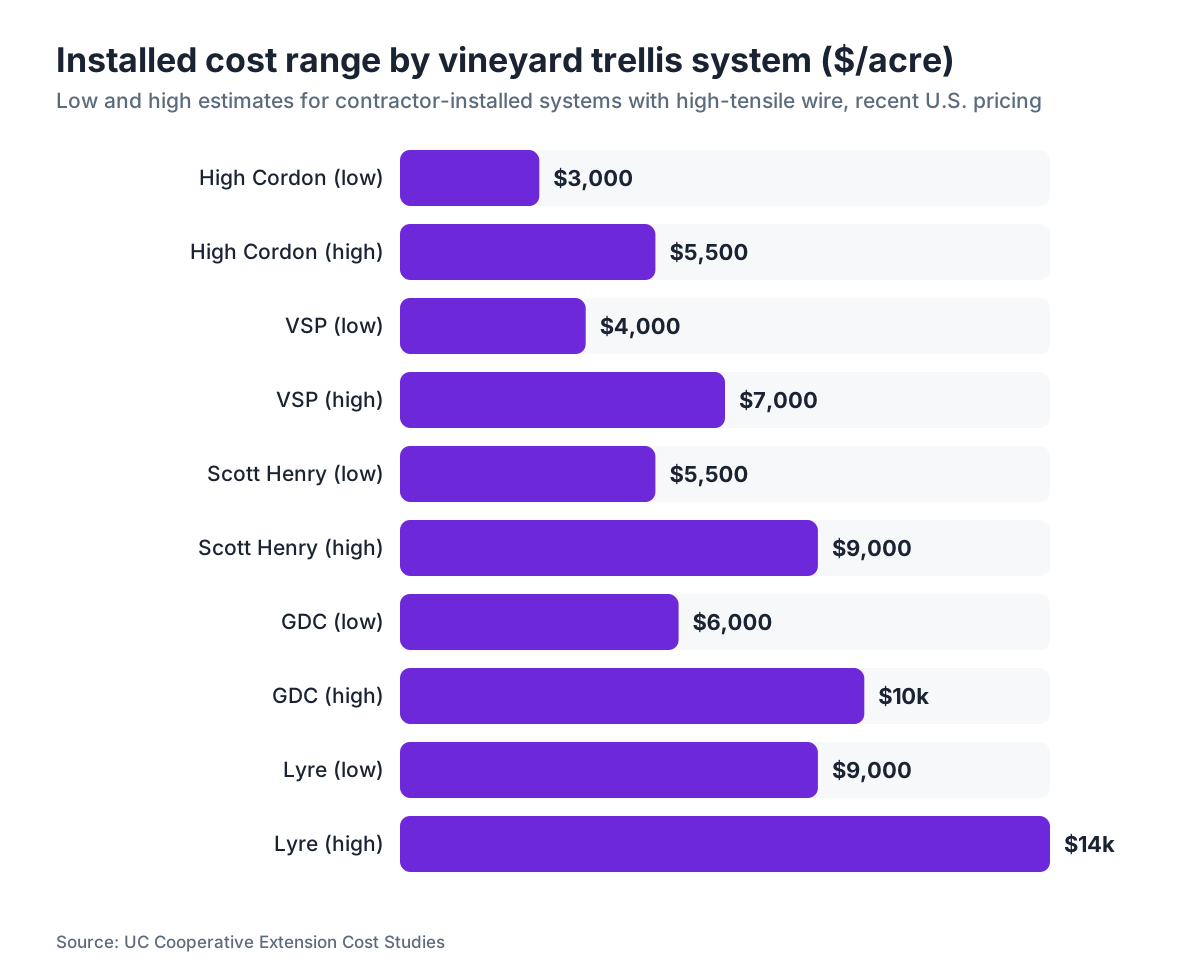
Costs swing more than almost any other topic in viticulture, and a lot of the numbers floating around online are stale. Here's an honest estimate based on recent material and labor pricing in U.S. wine regions.
| System | Posts per acre (approx.) | Wire tiers | Installed cost range ($/acre) |
|---|---|---|---|
| VSP | 220-260 | 4-5 | $4,000 - $7,000 |
| Scott Henry | 220-260 | 5-6 | $5,500 - $9,000 |
| GDC | 140-180 | 3-4 | $6,000 - $10,000 |
| Lyre | 180-220 | 5-7 | $9,000 - $14,000 |
| High Cordon | 200-240 | 1-2 | $3,000 - $5,500 |
These ranges assume steel T-posts or treated wood posts, galvanized high-tensile wire (12.5 gauge is standard), and contractor installation. The big variable is end posts. Anchor assemblies, deadman anchors, and corner hardware run $80 to $200 per end assembly, and a 10-acre block has a lot of row ends.
Steep slopes add 30 to 50 percent to installation because post-driving equipment can't get in. If you're on a hillside driving posts by hand, budget for it honestly.
Wire quality matters more than most people realize. Cheap imported wire with an inconsistent gauge or low tensile strength sags within three to five years under vine weight, worst in high-yield systems like GDC. High-tensile wire rated to 170,000 to 200,000 psi, tensioned properly with ratchet assemblies, is the difference between a trellis that lasts 25 years and one you're refastening every other season.
UC Cooperative Extension publishes sample cost studies for wine grape production that break out trellis establishment by year. They're some of the most honest cost documents a California grower can find [1].
How does trellis type affect spray coverage and pesticide record-keeping?
This is where trellis choice meets compliance, and most growers don't think about it until they're already locked into a system.
A dense canopy, like a high-vigor VSP block that never got hedged right, means your sprayer physically cannot push product into the interior. The EPA Worker Protection Standard requires handlers to apply pesticides consistent with label directions, and most fungicide labels call for thorough coverage of all green tissue [5]. If your canopy is so thick that the inner shoots and cluster zone never get wet, you have poor disease control, and you may also have a paperwork problem if your records claim applications were made per label.
Open-canopy systems (GDC, lyre, Scott Henry) improve spray penetration in a way you can measure. Split-canopy systems can cut the number of fungicide applications needed to hit the same disease control as a dense VSP, according to WSU Extension training-system work [4]. That's a direct cost saving, more than a quality story.
Keeping timestamped spray records tied to canopy type, row, and block is exactly the field-level detail VitiScribe tracks, with records that satisfy state department of agriculture requirements and EPA WPS documentation.
Rule of thumb: if you're hedging more than twice a season to open up a VSP canopy, the trellis is working against you. Your spacing is wrong, your rootstock is too vigorous for the site, or you need a split system.
What posts and wires work best for a vineyard trellis?
Post material is the first call. Steel T-posts are cheap, easy to drive, and last 20-plus years. They're the default for interior line posts in most American vineyards. Treated wood posts (usually Douglas fir or pine with a copper-based preservative) hold up better as end posts because they take the lateral load of tensioned wire better than a T-post. Concrete end posts are common in Europe and showing up more in California, but they're expensive and heavy to haul to remote blocks.
Post spacing runs 18 to 24 feet for interior line posts in most VSP and Scott Henry systems. Wider spacing (20 to 24 feet) cuts material cost and works fine when wire tension is high enough to stop sagging between posts. GDC systems carry a heavier load from two canopies, so they often need tighter spacing, around 16 to 20 feet.
Post height above ground depends on the system. For VSP, the top foliage wire usually sits at 60 to 66 inches, so posts run 7 to 8 feet with 2.5 to 3 feet buried. For GDC, the crossarm sits at 5 to 6 feet, so post heights are similar with crossarm hardware added on top.
Wire gauge: 12.5-gauge high-tensile is the standard for load-bearing wires (fruiting wire, top wire). Foliage catch wires in VSP can drop to 14-gauge because they carry less weight. Avoid soft wire. It stretches, sags, and passes mechanical-harvest vibration along in ways that loosen staples and clips.
Tensioning gear (gripples, ratchet strainers, tightening rods) is not an optional extra. It's how you hold tension as the wire expands and contracts with the seasons. A wire tensioned right in winter will hang loose in summer if you ignore thermal expansion.
How do different trellis systems affect vine training and labor?
Trellis system and training system aren't the same thing, though people swap the terms. The trellis is the physical structure. The training system is how the vine's permanent wood (trunk, cordon, or head) is arranged on that structure. The same trellis hardware can carry either cordon training or cane training, and that choice moves your pruning labor a lot.
Cordon-trained vines (permanent horizontal arms off the trunk) prune faster once established because the spurs sit in predictable spots. Cane-trained vines (you select new canes each dormant season) need more skilled labor but often do better for varieties where spur pruning leaves dead spur positions over time. Pinot Noir on VSP is usually cane-trained for exactly that reason.
Pruning a cordon-trained VSP block runs roughly $300 to $600 per acre in California, depending on region and crew skill. Cane training runs $500 to $900 per acre because selecting, cutting, and tying new canes eats time.
Scott Henry adds work: the downward shoot tier needs positioning in spring, which is extra labor. Budget another 3 to 5 hours per acre for shoot positioning in a Scott Henry block over a VSP. Some growers decide it's worth it because they skip hedging costs and get better fruit. Others find the math doesn't pencil out on lower-margin fruit.
GDC is fairly low-labor once established, because the hanging canopy mostly sorts itself out. That's one reason GDC stays popular for commodity fruit, where labor efficiency beats premium positioning.
How does trellis system choice affect fruit quality and wine style?
Canopy shape drives berry temperature, light exposure, and cluster microclimate, and those feed straight into flavor compound development, sugar accumulation rate, and phenolic ripeness.
Research from UC Davis and the Australian Wine Research Institute has confirmed the pattern again and again: exposed clusters build more anthocyanins, develop more concentrated tannins, and reach phenolic ripeness faster than shaded clusters [8]. Shaded fruit also carries higher methoxypyrazine levels, the compounds behind vegetal or green-pepper aromas in Cabernet Sauvignon and Sauvignon Blanc. That's why growers on the Napa Valley hillsides or in Walla Walla spend real money on leaf pulling and canopy work to open up the cluster zone [8].
Now the flip side. In very hot climates (Madera County in California's Central Valley, or some blocks in eastern Paso Robles), direct sun can scald clusters and spike sugar at the expense of acid. A system that gives the cluster zone afternoon western shade, like a VSP row oriented north-south with clusters on the east side of the curtain, can hold acid better.
Row orientation works together with the trellis system. East-west rows pull in the most total solar radiation on a VSP canopy. North-south rows spread morning and afternoon sun more evenly across both sides. Cornell extension has published light-interception modeling on row orientation that's worth reading while you're still planning [3].
For Paso Robles wineries and similar warm inland appellations, the practical advice is simple: don't assume what works in Napa or the Willamette Valley works here. Talk to your farm advisor about your block's heat accumulation and sunburn history before you commit to an open-canopy system.
Can you convert an existing vineyard to a different trellis system?
Yes, and it happens more than people expect, usually when a block went in on VSP and the site turned out more vigorous than anyone planned for.
Converting VSP to Scott Henry is the most common retrofit. The existing fruiting wire stays put. You add a lower wire tier below the fruiting wire for the downward-trained shoots, and a higher tier above the existing top wire. Half the shoots from each spur or cane go down in the first conversion season. It takes some vine adjustment time and careful choice of which shoots go which way, but most blocks convert cleanly over two seasons.
Converting to GDC is more involved. You have to establish two parallel cordons at an elevated height (4.5 to 5 feet), and the existing trunk positions may not line up. Some growers retrain from the existing vine base, which takes three to four seasons and delays production.
The math on conversion: hardware and labor for a VSP-to-Scott-Henry retrofit typically runs $800 to $1,800 per acre, depending on how much new wire and how many posts you add. That's not nothing, but it's a fraction of replanting cost. A block struggling with disease and poor quality from canopy density can pay back the conversion within two or three seasons through lower spray costs and better fruit contracts.
Do conversions during dormancy, ideally before bud swell, so the vine's first-season growth pushes into the new system from the start.
What are the trellis-related compliance and record-keeping requirements growers should know?
Trellis systems don't carry direct regulatory requirements in the U.S., but several compliance areas touch on trellis and canopy decisions.
The EPA Worker Protection Standard requires agricultural employers to keep workers out of treated areas during restricted entry intervals and to apply pesticides according to label directions [5]. A dense canopy that blocks adequate spray coverage becomes a label compliance issue, as noted above. The WPS also requires training for pesticide handlers, retention of application records, and posting of treated-area notifications. None of that is specific to trellis type, but open-canopy systems cut the number of applications, which trims your records too.
State rules vary. California's Department of Pesticide Regulation requires Pesticide Use Reports for all agricultural pesticide applications. Those reports need the site (block or field ID), acres treated, application method, and product information [6]. If your canopy shape changes your treatment approach, your records should reflect it.
Certified organic operations carry extra documentation around materials used and canopy practices. The USDA National Organic Program doesn't dictate trellis type, but it does require documented pest management justification, and canopy records (hedging dates, shoot positioning dates, leaf pulling) can help demonstrate an integrated approach before synthetic inputs come into play [7].
Maintaining records by block, in a way that ties canopy observations to spray decisions, is where a field operations platform like VitiScribe saves hours at year-end. The trellis system in each block is exactly the kind of metadata that makes a spray record or an organic inspection trail actually hold together.
What do vineyard managers wish they'd known before choosing a trellis system?
A few honest observations drawn from the viticulture literature and extension guidance, since I won't fabricate individual grower quotes.
Post depth is almost always underestimated. Extension guidance from UC and WSU points to a minimum burial depth of 24 inches for line posts and 36 inches for end posts in most soils [1][10]. Growers who go shallow to save time watch posts start leaning within five years, worst in the first few seasons when vines are light and give no counterbalance.
Row spacing and trellis type have to be decided together, before planting. Planting at 8x6 (8 feet between rows, 6 feet between vines) and then trying to install GDC makes no sense. GDC needs 10 to 12 foot rows minimum. It sounds obvious, and yet people plant vines and then ask about trellis type when it should run the other way.
Mechanical harvest compatibility belongs on your checklist even if you're hand-harvesting today. Your situation can change in 10 years, and retrofitting a lyre or pergola for a machine harvester is basically off the table. If there's any chance you'll mechanize, design for it now.
And wire is not where you save money. Posts, hardware, and installation are fixed costs. The wire runs continuously through the block and lasts decades. Skimping on wire quality is one of the most consistently regretted calls in vineyard establishment.
If you're looking at a vineyard property to buy, the trellis already in the ground is a real factor in your due diligence. Ask about post age, wire gauge, tensioning method, and any conversion history before you close.
Frequently asked questions
What is the most common trellis system used in vineyards?
Vertical Shoot Positioning (VSP) is the most widely used trellis system in premium wine regions across North America and Europe. Shoots train upward between pairs of foliage wires, making a narrow vertical canopy. It works best for low-to-moderate vigor varieties in cool to moderate climates. It suits high-vigor sites poorly, where split canopy systems like Scott Henry or Geneva Double Curtain produce better results.
How much does it cost to install a vineyard trellis system per acre?
Installed costs range from about $3,000 per acre for a simple high-cordon system to $14,000 per acre for a lyre. VSP typically runs $4,000 to $7,000 per acre, and Scott Henry or GDC runs $5,500 to $10,000 per acre. These figures assume contractor installation with steel T-posts, treated wood end posts, and 12.5-gauge high-tensile wire. Slopes add 30 to 50 percent.
What is the difference between VSP and Scott Henry trellis systems?
VSP trains all shoots straight up between foliage wires, making one vertical curtain. Scott Henry splits the shoots: half train up, half train down, doubling the leaf wall surface area without changing row spacing. Scott Henry handles high-vigor sites much better than VSP and can improve both fruit quality and disease control. It needs more management labor, especially spring shoot positioning, but often reduces hedging frequency.
Which trellis system is best for machine harvesting?
Geneva Double Curtain and high cordon systems suit mechanical harvesting best. In GDC the fruit zone hangs below an open canopy, and the harvester head engages it cleanly. VSP is also mechanizable when the fruiting wire sits at the right height, typically 36 to 48 inches off the ground. Lyre and pergola systems are very hard or impossible to harvest by machine.
How many posts do you need per acre for a vineyard trellis?
For VSP and Scott Henry with standard 8-to-9-foot row spacing and 18-to-24-foot post spacing, plan for roughly 220 to 260 line posts per acre. GDC with wider rows (10 to 12 feet) needs about 140 to 180. End posts and anchor assemblies add to that. A 10-acre block might carry 2,200 to 2,600 interior line posts plus 100 or more end post assemblies.
What wire gauge should I use for a vineyard trellis?
Use 12.5-gauge high-tensile galvanized wire for fruiting wires and top wires. High-tensile wire rated at 170,000 to 200,000 psi resists stretching and holds tension through seasonal temperature swings. Foliage catch wires in VSP can drop to 14-gauge because they carry less load. Avoid soft wire: it sags, passes harvester vibration poorly, and needs constant re-tensioning. Proper tensioning hardware (gripples or ratchet strainers) is required.
Can I convert my VSP vineyard to Scott Henry without replanting?
Yes. VSP-to-Scott-Henry conversion is the most practical trellis retrofit. The existing fruiting wire stays in place; you add a lower wire for downward shoots and a higher wire above. Half the shoots from each spur or cane train downward in the conversion season. The process takes two seasons to fully establish and typically costs $800 to $1,800 per acre in hardware and labor, far less than replanting.
How does trellis system affect fungal disease pressure in vineyards?
Canopy density drives drying time after rain and dew, which sets botrytis and powdery mildew risk. The UC Statewide IPM Program calls canopy management one of the cheapest tools for cutting fungal disease before you spray. Open-canopy systems like Scott Henry and GDC improve air movement and spray penetration, which can reduce the number of fungicide applications needed per season compared to a dense VSP canopy.
What row spacing do I need for each trellis system?
VSP and Scott Henry typically work with 8-to-9-foot row spacing. GDC needs 10-to-12-foot rows to fit two parallel canopy curtains hanging from a crossarm. Lyre systems need at least 9-to-10-foot rows for the U-shaped arms to open. Pergola systems need wide spacing and overhead clearance. Set row spacing before you plant: retrofitting a different system into the wrong spacing is expensive or impossible.
Does trellis orientation (north-south vs. east-west) affect fruit quality?
Yes. East-west rows pull in the most total solar radiation on a VSP canopy but can hammer the west-facing leaf wall with afternoon sun in hot climates. North-south rows spread morning and afternoon sun more evenly across both sides. Cornell University extension has published light-interception modeling showing north-south rows generally improve cluster sun exposure uniformity in VSP systems in the northeastern U.S.
What records do I need to keep related to canopy management and spray applications?
California requires Pesticide Use Reports for all agricultural pesticide applications, including block ID, acres treated, and application method. The EPA Worker Protection Standard requires pesticide application records be retained. For organic certification, the USDA National Organic Program expects documentation of canopy management practices as part of pest management justification. Tying canopy observation dates (hedging, leaf pulling, shoot positioning) to spray decisions strengthens both state compliance and organic audit trails.
How do I know if my site has too much vigor for VSP?
Cornell extension offers a practical field test: if your VSP canopy consistently runs more than 12 shoots per foot of cordon length, shoot tips keep growing past the top wire through the season, and interior leaves sit heavily shaded, your vigor is too high for VSP. Other signs include slow canopy dry-down after rain, disease breakouts inside the curtain, and shaded-fruit aromas (vegetal notes, green tannins) in finished wine despite good spray programs.
What is a Geneva Double Curtain (GDC) trellis system?
GDC was developed by Nelson Shaulis at Cornell's Geneva research station in the 1960s. Two parallel canopies hang downward from a wide crossarm mounted at the top of the trellis, typically at 5-to-6 feet. The system handles high-vigor varieties well and suits mechanical harvesting because clusters hang below an open canopy. It requires 10-to-12-foot row spacing and costs roughly $6,000 to $10,000 per acre installed.
Is a pergola trellis system practical for small U.S. vineyards?
Rarely. Pergola systems work in specific traditional settings (Vinho Verde in Portugal, some Italian regions) where labor economics and local tradition support them. In most U.S. wine regions the overhead structure is expensive to build, mechanical harvesting is essentially impossible, and spray coverage of the cluster zone is difficult. Extreme heat mitigation is the one case where a pergola may make agronomic sense, but most growers in hot climates find other solutions.
Sources
- UC Statewide Integrated Pest Management Program and UC Cooperative Extension Cost Studies (Grape Pest Management guidelines; wine grape sample cost studies): Canopy management as a cost-effective disease control tool, and UC Cooperative Extension farm budget data on trellis establishment costs and post burial depth in California wine grape production
- Oregon State University Extension, Viticulture (training and trellising guidance): Scott Henry system development in Oregon's Umpqua Valley and its advantages for high-vigor varieties
- Cornell University, Grapes and Wine (Viticulture and Enology extension): Cornell recommendation of Scott Henry or GDC for high-vigor sites exceeding 12 shoots per foot of cordon, and row orientation light interception modeling
- Washington State University Extension, Grape Training Systems for Pacific Northwest Vineyards: WSU trellis and training system selection guidance by region and variety, and evidence that split-canopy systems reduce fungicide application frequency
- U.S. EPA, Agricultural Worker Protection Standard: EPA WPS requirements for pesticide application records, restricted entry intervals, and label-compliant application coverage of all green tissue
- California Department of Pesticide Regulation, Pesticide Use Reporting: California CDPR requirement for Pesticide Use Reports including block/field ID, acres treated, and application method for all agricultural pesticide applications
- USDA Agricultural Marketing Service, National Organic Program: NOP documentation requirements for pest management justification and canopy management records in certified organic vineyard operations
- UC Davis Department of Viticulture and Enology: Research confirming that exposed clusters accumulate more anthocyanins and reach phenolic ripeness faster than shaded clusters, and that shaded fruit has elevated methoxypyrazine levels
- Cornell University, Grapes and Wine (Geneva Double Curtain history and design): GDC development by Nelson Shaulis at Cornell's Geneva station in the 1960s, and its compatibility with mechanical harvesting
- Washington State University Extension (vineyard establishment and trellis materials): Minimum burial depth recommendations of 24 inches for line posts and 36 inches for end posts in standard vineyard soils
Last updated 2026-07-09