Grape trellis systems: every major design explained
TL;DR
- The best grape trellis system depends on your variety, vigor, and mechanization needs.
- VSP (Vertical Shoot Positioning) works for most wine grapes in moderate climates.
- High-wire cordon suits table grapes and high-vigor sites.
- Scott Henry and GDC handle heavy canopies.
- Post spacing runs 18-24 feet.
- End post anchoring is where most DIY builds fail.
What are the main grape trellis systems and how do they differ?
A trellis does two jobs. It holds the permanent vine structure (trunk and cordon or canes), and it manages the shoot canopy through the growing season. Every system makes a different tradeoff between canopy exposure, labor, yield, and how well it plays with machinery.
Here's a working comparison of the systems most widely planted in North America:
| System | Canopy type | Shoot orientation | Mechanization | Best for |
|---|---|---|---|---|
| VSP (Vertical Shoot Positioning) | Narrow, vertical | Upward | High | Vinifera wine grapes, moderate vigor |
| High-Wire Cordon (HWC) | Pendulous | Downward | High | Table grapes, Concord, high-vigor sites |
| Geneva Double Curtain (GDC) | Two curtains | Downward | Moderate | Very high vigor, Concord-type |
| Scott Henry | Split, two zones | Up and down | Moderate | High-vigor vinifera |
| Lyre (U-system) | Open, two walls | Upward | Low | Very high vigor, research blocks |
| Smart-Dyson | Split vertical | Up and down | Moderate | High-vigor, narrow rows |
| Single Guyot | Narrow, vertical | Upward | High | Cool-climate vinifera, hand-harvest |
The Geneva Double Curtain came out of Cornell's Geneva Experiment Station to handle Concord vineyards that were too vigorous for a single curtain. The Scott Henry system came from an Oregon grower in the 1980s and caught on because it doubled canopy surface area without touching row spacing. [1][2]
VSP is the workhorse. Walk into almost any commercial vinifera block in California, Washington, or Oregon and that's what you'll see. Shoots train upward between foliage wires, which keeps the canopy thin enough for spray to reach the fruit and air to move through. It fits standard under-vine equipment and mechanical harvesters. Starting a new planting with no extreme vigor and no unusual training goal? Start with VSP.
How do I choose the best grape trellis system for my site?
Vine vigor drives the decision more than anything else. A low-to-moderate vigor site (think rocky, well-drained vinifera ground) almost always does fine on VSP. High vigor, meaning shoots pushing past 1.2 meters by midsummer and a canopy so dense you lose airflow, calls for a divided canopy: GDC, Scott Henry, or Lyre.
Four questions to answer before you spec anything:
- What's your row spacing? VSP wants 7-10 feet between rows for most wine grapes. GDC and Lyre need 11-12 feet minimum to give both curtains room. If the rows are already in the ground, your canopy options shrink fast.
- Are you mechanizing harvest? Mechanical harvesters run clean on VSP and HWC. GDC is mechanizable with the right header. Lyre is very hard to harvest by machine.
- What's your variety's inherent vigor? UC Davis extension notes that Cabernet Sauvignon and Syrah sit at moderate vigor in most coastal California soils, while Chardonnay and Sauvignon Blanc can run hot on rich flats. [3]
- What's your climate? Hot, dry regions do better with a higher cordon or downward-shoot system that shades the fruit. Cool, wet climates want the opposite: maximum exposure to move air and cut disease pressure.
WSU's viticulture extension offers a useful rule of thumb. If your pruning weight runs above about 0.5 kg per meter of row, you probably need a canopy division system. Below that, VSP handles it. [4]
Budget belongs in the decision too. A single-wire HWC build costs less per post than VSP because it needs one fruiting wire and few foliage wires. Divided canopy systems like GDC cost more in hardware and a lot more in trellis labor, since you're building two trellis planes instead of one.
How to construct a grape vine trellis: step-by-step
This walks through a standard VSP build, which is the most common starting point. Other systems follow the same structural logic with different wire heights and layouts.
Step 1: Lay out the row stakes.
Mark end posts first, then intermediate post locations. Post spacing in the row runs 18-24 feet for most modern commercial plantings. Closer spacing (18 feet) gives better wire support and slightly better vine anchoring. Wider spacing (24 feet) cuts material costs. Most WSU and UC Davis recommendations land at 20-24 feet for VSP. [3][4]
Step 2: Set end posts (anchor posts).
This is where most DIY builds fail. End posts carry the entire tension load of every wire in the row. Use 4-6 inch diameter treated posts or steel H-posts, set at least 3-3.5 feet deep (deeper in sand, shallower in rock). Brace each end post with a diagonal brace post and brace wire, or use a dead-man anchor buried at 45 degrees. Skimp here and your whole row sags within two seasons.
Step 3: Set line posts.
Line posts can be lighter: 2.5-3.5 inch round treated wood, T-posts, or steel. Set them 24-30 inches deep on firm soil. Keep them plumb. An auger turns this into a one-day job for a crew of two on a 5-acre block.
Step 4: Run the fruiting wire.
For VSP, the fruiting wire sits 30-36 inches above the ground, where the cordon or cane trains. Use 9-gauge high-tensile galvanized wire (class 3 galvanizing lasts 20-plus years; class 1 starts rusting inside a decade in wet climates). Tension the wire to roughly 150-200 lbs with a wire strainer, not by hand-twisting.
Step 5: Run foliage (catch) wires.
VSP needs two pairs of moveable foliage wires to position shoots as they grow. The first pair sits about 12-16 inches above the fruiting wire; the second pair another 12-16 inches higher. These are typically 12.5-gauge smooth wire. You move the top pair outward as shoots grow, trapping them against the lower pair. Some operations run a single fixed foliage wire and hand-tuck. That's more labor but fine on small blocks.
Step 6: Install staples or clips.
Attach wires to line posts with double-head staples or wire clips. Don't drive staples tight against wooden posts. Leave slight movement, or the wire works against the wood and snaps during freeze-thaw cycles.
Step 7: Mark vine positions.
If the vines aren't planted yet, mark vine spacing within the row before you pull the post layout stakes. In-row vine spacing usually runs 4-8 feet depending on variety and rootstock.
The Cornell Cooperative Extension viticulture materials walk through post sizing tables and anchor specs with soil-type adjustments. [1]
What materials and dimensions do I need for a VSP trellis?
Here's a realistic materials list for 1 acre of VSP, assuming 7-foot row spacing (about 89 rows per acre, each roughly 200 feet long in a square-acre block; actual row length varies by site geometry).
Treat this as approximate. Your terrain, soil, and post-spacing choice will shift the numbers.
| Item | Spec | Quantity per acre (approx.) |
|---|---|---|
| End/anchor posts | 4-6" treated wood, 8 ft | 6-10 per row |
| Line posts | 2.5-3.5" treated or T-post, 7 ft | ~8 per row |
| Dead-man anchors or brace assemblies | Steel or treated wood | 2 per row end |
| Fruiting wire | 9-ga high-tensile galvanized (class 3) | ~200 ft per row |
| Foliage wire | 12.5-ga high-tensile | ~800 ft per row (2 pairs) |
| Wire clips/staples | Double-head or clip | 4-5 per post |
| Wire tensioners/strainers | 1 per wire per row end | ~3 per row end |
Posts run $2-6 each for T-posts and $8-20 each for treated round wood (prices swing with region and the lumber market as of 2024-2025). High-tensile wire runs roughly $0.03-0.05 per foot in bulk. Total installed trellis cost for a commercial VSP planting, labor included, runs $3,000-7,000 per acre depending on region, post type, and how much of the labor you do yourself. Cornell's cost-of-production budgets for New York vinifera put trellis establishment at around $4,000-5,500 per acre in recent years. [1][10]
For a backyard or hobby block (10-30 vines), swap in T-posts or 4x4 cedar posts every 8-10 feet, run two or three wires at 30", 48", and 60", and tension by hand with gripples or wire tensioners. The scale is smaller. The principle is the same.
How to trellis grape vines in year one vs. subsequent years
Year one is simple because there's almost nothing to do. Plant the vine, drive a bamboo or fiberglass stake next to it, and tie the single developing shoot loosely to that stake. Your goal is one strong shoot reaching the fruiting wire height by season's end, or close to it. Don't run the vine out on the cordon wire yet. Let it build root mass.
At the end of year one, prune back to 1-3 buds if the shoot fell short of wire height. If it made the wire, you have two options depending on your training method:
- Cordon training (spur pruning): Pick the strongest shoot as the trunk. Head it just above the fruiting wire, and in year two let the two strongest laterals run along the cordon wire in both directions. Spur these back to 2 buds at the end of year two. By year three you should have a working bilateral cordon.
- Cane training (replacement cane): Pick the strongest shoot as the trunk. In year two, select 1-2 canes for the fruiting position and one renewal spur. This takes more skill at pruning time but suits varieties prone to basal bud failure (Pinot Noir, some Riesling).
Year two and three trellis work means training cordons or tying canes to the fruiting wire, tucking shoots into foliage wires as they grow in spring, and hedging the canopy in early summer. The wire structure should already be finished before the vine goes in the ground. Retrofitting trellis around growing vines is a headache.
Washington State University's viticulture extension publishes year-by-year training guides for VSP cordon and cane systems that are worth reading before you start. [4]
What post spacing and wire gauges actually work?
This comes up constantly, and the honest answer is that both depend on soil type and how hard you tension the wire.
Post spacing. Most commercial VSP guidelines in the U.S. land at 18-24 feet between line posts. Tighter spacing costs more in posts but holds tension better over time, especially on hilly ground where frost heave is a factor. Wider spacing saves money and is fine on flat ground with firm soil. WSU research blocks typically run 20-foot spacing. [4]
End post sizing. End posts need to be much stronger than line posts. A common commercial spec is a 6-inch round treated post set 3.5 feet deep, braced with a diagonal compression post and a buried anchor or a floating anchor plate. Some growers use H-brace configurations instead. In an H-brace, the brace wire runs from the top of the end post to the bottom of the brace post, not the other way around.
Wire gauge. 9-gauge high-tensile steel is the industry standard for fruiting wires in North America. It carries roughly 1,300-1,800 lbs of breaking strength, and when tensioned to 150-200 lbs it holds steady through temperature-driven expansion and contraction. Don't use 12.5-gauge as a fruiting wire. It's fine for foliage catch wires, but it stretches and sags under a heavy crop. Class 3 galvanized wire has roughly three times the zinc coating of class 1. That's the difference between 20-plus years of service and 5-10 years in wet climates. [1][3]
What does a GDC or divided canopy trellis look like and when is it worth it?
Geneva Double Curtain mounts a T-bar crossarm on top of each post, with two fruiting wires running parallel down the row about 4 feet apart. Shoots hang downward from two cordon arms trained along those wires, so end-on you see two separate curtains of foliage.
Cornell developed GDC at Geneva, NY starting in the 1960s. The reasoning: on high-vigor vineyards, especially Concord and other labrusca varieties on fertile New York and Ontario soils, single-curtain training left so much shade that fruit quality and set suffered. Split the canopy and you roughly double the exposed leaf area without touching row spacing. [2]
The T-bar crossarm typically runs 4 feet wide and mounts so the fruiting wire sits 5-5.5 feet above the ground. Posts have to be sturdier to take the lateral load from the crossarm, and end post anchoring matters even more than usual.
Is GDC worth the extra hardware? On a moderate-vigor site, no. VSP with a bit more aggressive summer hedging does the same job for less money. On a Concord or hybrid block in a fertile, high-rainfall region where the canopy won't stay manageable, GDC can genuinely improve brix, color, and disease pressure. The University of Wisconsin Extension publishes GDC trellis guidelines for Midwest conditions that include soil-vigor assessment before you commit to the build. [5]
Scott Henry is the lighter-hardware alternative for high-vigor vinifera. It uses a standard VSP wire setup but trains alternate canes or cordons upward and downward, splitting the shoot population between two zones. It costs less than GDC because there's no crossarm, but it demands more training skill and more labor per vine to run right.
How do trellis choices affect spray coverage and worker safety?
This gets ignored until something goes wrong. Canopy architecture directly changes pesticide deposition, and deposition is the basis of both efficacy and regulatory compliance under the EPA Worker Protection Standard. [6]
A dense VSP canopy, especially with foliage wires that nobody moves, blocks spray from reaching interior leaves and fruit clusters. UC IPM guidelines note that interior leaf layer count and shoot density change how well spray penetrates a vineyard block. [9] A divided canopy or a well-managed VSP block lets spray reach its target, which means lower application rates can hit the same coverage, which cuts both cost and residue.
The EPA Worker Protection Standard (40 CFR Part 170) sets requirements for restricted-entry intervals, worker notification, and decontamination supplies that apply no matter your trellis design. But if your canopy blocks spray from reaching target surfaces, you're likely applying more product than you need, with direct cost and compliance fallout on your spray records. [6]
If you're tracking spray applications, canopy scores, and vine growth stage, those records have to hold together across the season. VitiScribe is built for exactly that kind of field-to-compliance record keeping, linking spray applications to growth stage and canopy condition in a format state ag inspectors accept.
Post and wire materials matter for spray too. Wooden posts absorb pesticides over time. That's not a regulatory problem on its own, but it affects how long your materials last. Galvanized steel posts are essentially inert.
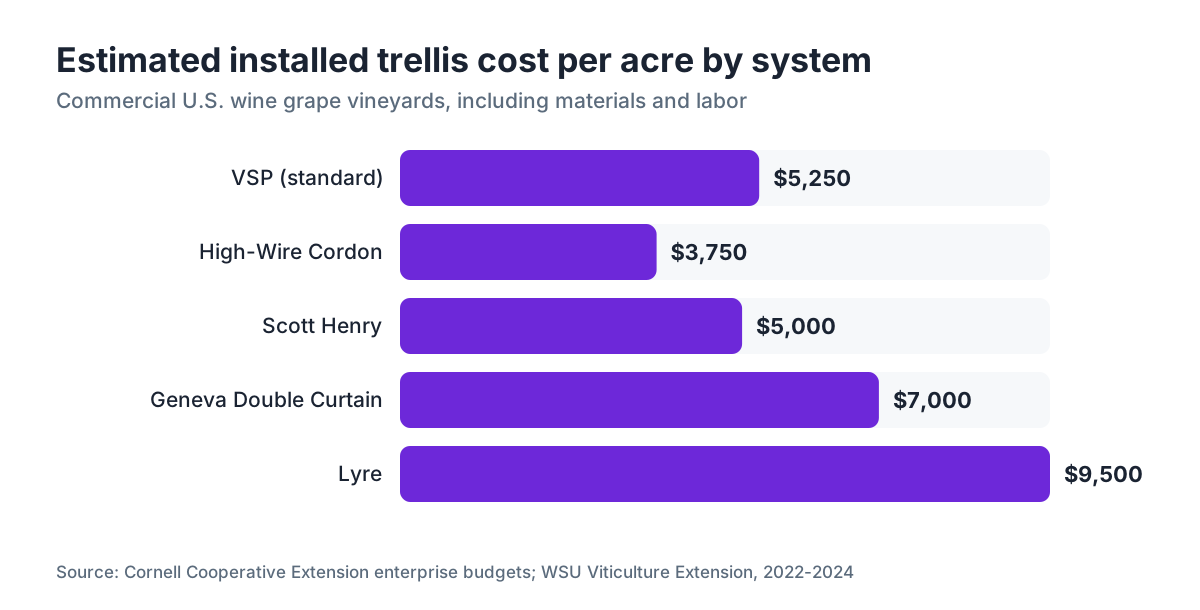
What are the real costs of different vine trellis systems?
The numbers below come from Cornell enterprise budgets for New York and WSU budgets for Washington State, both published as part of their extension cost-of-production series. Real costs move with region, labor market, and how much you DIY.
| System | Est. installed cost per acre | Labor intensity | Notes |
|---|---|---|---|
| VSP (standard) | $3,500-$7,000 | Moderate | Most widely costed in extension budgets |
| High-Wire Cordon | $2,500-$5,000 | Low-Moderate | Fewer wires; same post structure |
| Geneva Double Curtain | $5,000-$9,000 | Moderate-High | Crossarm hardware adds real cost |
| Scott Henry | $3,500-$6,500 | High (training labor) | Hardware similar to VSP; more pruning labor |
| Lyre | $7,000-$12,000+ | Very high | Wide rows, complex wire geometry |
These are establishment costs only. Annual maintenance (wire retensioning, post replacement, clip and staple replacement) typically runs $150-400 per acre per year on a well-built VSP trellis. Cornell's New York vinifera enterprise budgets from 2022-2023 put trellis repair at roughly $200-300 per acre per year. [10]
Here's where people consistently lowball the cost: end post assemblies and anchoring. Cut corners to save $50-100 per row end and you're usually resetting or rebuilding within 5 years. The anchor post and brace system on each row end runs $80-200 in materials alone if you build it right. Don't skip it.
How do I maintain and repair a trellis over time?
Wire tension is the first thing to check every spring before bud break. Walk the rows and push down on each fruiting wire. It should feel firm. Real sag means the wire has stretched, a staple or clip has failed, or an end post has shifted. Fix it before shoot growth starts. Pushing through loose wires to retension them after foliage fills in is miserable work.
Post replacement runs on a rough 15-25 year cycle for treated wood, depending on climate and drainage. Wet, clay-heavy soils speed up rot at the soil line. Steel T-posts outlast treated wood in most conditions, though they're less rigid under heavy tension loads.
Wire breaks usually happen at crimps, staples, or tensioner connections, not mid-span. Keep a roll of repair wire and a set of gripples or wire joins in the tractor kit. A broken fruiting wire during shoot growth lets the cordon sag and tears shoot attachments. Fix it the same day.
At the end of each season, drop the foliage catch wires to their lowest position before you start pruning. That gives you room to work and cuts the odds of slicing a foliage wire with your shears. Some growers pull the top foliage wire entirely for winter to dodge snow-load problems in northern regions.
Keep records of post replacement, wire retensioning, and anchor work. This is part of your vineyard capital asset record, and you'll want it when you compute depreciation on trellis establishment costs. VitiScribe's block records section handles this alongside your spray logs and vine health notes, which helps at tax time and during any lender or buyer due diligence.
For the wider operational picture, the vineyard overview on VitiScribe shows how trellis management fits into the full production calendar.
Are there trellis systems better suited for specific grape varieties?
Yes, though variety is rarely the only factor. Vigor, climate, and row orientation all interact with the variety-driven call.
Pinot Noir goes on VSP almost universally in Oregon and Burgundy-type climates. Cane training beats cordon here because Pinot's basal buds are often less fruitful, and cane training lets you pick wood with good fruitful bud positions each year. Tight row spacing (7-8 feet) and high vine density (1,200-2,000 vines per acre) are the Oregon norm. [8]
Cabernet Sauvignon and Merlot run on VSP cordon spur pruning across Napa, Sonoma, and Walla Walla. High-density VSP (3x6 or 4x6 foot spacing) is common in premium blocks. Where vigor runs high, like Napa Valley floor alluvial soils, Scott Henry sometimes steps in to reduce shading.
Chardonnay and Sauvignon Blanc both run vigorous on rich soils. You'll find GDC on some high-vigor Chardonnay blocks in the Finger Lakes and parts of Washington's Columbia Valley. Smart-Dyson is another option there.
Concord and American hybrids lean on GDC and high-wire cordon, for the vigor reasons above. Concord on HWC is a standard sight in the Lake Erie grape belt. Cornell's GDC work used Concord as the main test variety. [2]
Table grapes (Thompson Seedless, Flame, and others) run on overhead pergola and T-trellis systems, common in California's San Joaquin Valley. Those are distinct from wine grape trellises and out of scope here, but WSU's table grape program in the Yakima Valley has extension materials on T-trellis construction for fresh-market varieties. [4]
For how regional wine styles connect to these training choices, the paso robles wineries piece covers how Central Coast producers manage their blocks, many of them running cordon-trained VSP on bench soils.
What are the most common grape trellis construction mistakes?
Underpowered end posts top the list. The end post assembly gets treated as an afterthought instead of the most load-bearing element in the system. Anchor an end post poorly and all wire tension relaxes within a season or two, and now you're hand-tensioning wires every spring instead of doing productive work.
Wrong wire gauge is second. Growers reach for 12.5-gauge or 14-gauge soft wire on the fruiting position to save money. It works in year one. By year three, under a heavy Zinfandel or Barbera crop load, it sags noticeably and the cordon drops below intended height. Use 9-gauge high-tensile on the fruiting wire.
Class 1 galvanized wire in high-rainfall regions is another reliable way to spend money twice. The cost bump from class 1 to class 3 is small per foot. The service life difference (10-plus years versus 20-plus years) is not.
Over-driving staples into wooden posts, crushing the wire into the wood, is a subtler one. The wire needs to slide slightly when you retension it. Pinch it into a compressed groove and retensioning pulls the staple out instead of moving tension along the span.
And the classic: planting vines before the trellis is built. It happens every year on eager new operations. Vines planted into an open field with no stakes grow fast in a direction you don't control, and by the time you're running post holes you're working around established root balls and wandering shoots. Trellis first. Then plant.
Frequently asked questions
How far apart should grape trellis posts be?
Line post spacing in commercial vineyards runs 18-24 feet for most VSP and high-wire cordon builds. Twenty feet is a common compromise between wire support and material cost. End (anchor) posts sit at the row ends and need larger diameter, deeper setting, and a bracing assembly. WSU and Cornell extension budgets both reflect 20-foot line post spacing as a baseline.
What wire gauge should I use for a grape trellis?
Use 9-gauge high-tensile galvanized wire for the fruiting wire, tensioned to 150-200 lbs. Class 3 galvanizing earns its small price premium over class 1 in any wet climate, adding 10-plus years of service life. Foliage catch wires can be 12.5-gauge since they carry shoot weight, not crop weight. Never use soft, low-carbon wire on a fruiting position. It stretches and sags under crop load within a few seasons.
How deep should grape trellis posts be set?
Line posts typically go 24-30 inches deep in firm soil. End posts go deeper, 36-42 inches, because they take the full wire tension load. In sandy or loose soil, go deeper on both. The general rule is one-third of post length in the ground. In frost-heave country, depth matters even more, since posts can slowly migrate upward over winter freeze-thaw cycles.
What is VSP training and why is it the most common system?
VSP (Vertical Shoot Positioning) trains grape shoots upward between pairs of foliage wires, building a narrow, vertical canopy wall. It dominates commercial vinifera plantings because it fits mechanical harvesters and under-vine equipment, allows good spray penetration, and produces well-exposed fruit in moderate-vigor situations. UC Davis and WSU both recommend it as the starting point for most new vinifera plantings.
Can I build a grape trellis myself or do I need a contractor?
You can absolutely build it yourself on a small block with basic farm tools and a post driver or auger. The skills are modest: setting posts plumb, tensioning wire with a strainer, and building a proper end-post brace. That brace assembly trips up most first-timers. For blocks over 5 acres, a trellis contractor usually delivers faster, straighter rows and better end-post work than a first-time DIY crew.
How much does it cost to trellis one acre of grapes?
Installed VSP trellis runs roughly $3,500-$7,000 per acre including materials and labor in most U.S. wine regions, based on Cornell and WSU enterprise budgets. GDC costs more, typically $5,000-$9,000 per acre, due to crossarm hardware. Material costs alone (posts and wire) for a basic VSP build run closer to $1,500-$2,500 per acre. Labor usually accounts for 40-60% of the total.
What is Geneva Double Curtain (GDC) and when should I use it?
GDC mounts a horizontal T-bar crossarm on each post, running two fruiting wires about 4 feet apart so shoots hang downward from two separate cordon arms. Cornell developed it for high-vigor Concord vineyards where dense single-curtain canopies caused poor fruit quality and disease pressure. Use GDC when vigor runs so high that VSP can't keep the interior leaf layer count below 2-3 even with aggressive hedging.
How do I trellis grape vines in the first year after planting?
In year one, your only job is to get one strong shoot growing vertically toward the fruiting wire. Set a bamboo or fiberglass stake next to each vine and tie the shoot loosely as it climbs. Don't run anything on the trellis wires yet. At the end of year one, if the shoot reached fruiting wire height, head it there and begin training. If not, prune back to 1-3 buds and try again in year two.
Does trellis design affect disease pressure and spray coverage?
Yes, directly. A dense, poorly managed canopy blocks pesticide from reaching interior leaves and fruit clusters. UC IPM guidelines note that interior leaf layer count and shoot density change how well spray penetrates a block. Divided canopy systems like GDC and Scott Henry improve air movement and spray penetration on high-vigor sites, which lets lower application rates hit the same coverage.
How to construct a grape vine trellis on a slope or hillside?
Sloped terrain makes post-setting harder because you're working uphill, and the frost-heave and drainage dynamics shift. Run rows up-and-down slope rather than across it when you can, for better equipment access and drainage. End posts need extra-deep setting and strong dead-man anchors, since downslope tension pulls on the end post differently than flat-ground tension. Wire length calculations must account for slope-length versus map-length on each row.
What's the difference between spur pruning and cane pruning on a trellis?
Spur pruning cuts each cane back to 2-3 buds every winter, leaving a permanent cordon along the fruiting wire. Cane pruning replaces the fruiting wood entirely each year, selecting one or two long canes near the trunk head. Cane pruning takes more labor but suits varieties with poor basal bud fruitfulness, like Pinot Noir. Spur pruning fits mechanical harvesting better and is faster at pruning time.
How long do grape trellis posts and wires last?
Treated round wood posts last 15-25 years depending on soil moisture and climate. Steel T-posts often outlast wooden posts in wet soils. Class 3 galvanized wire lasts 20-plus years in most climates; class 1 galvanized wire runs 5-10 years in high-rainfall regions before surface rust weakens it. Annual inspection and retensioning extends wire life. End-post anchor hardware is the most likely early failure point if undersized.
Is a high-wire cordon system easier to build than VSP?
Somewhat, yes. High-wire cordon needs fewer wires than VSP because shoots hang down naturally without foliage catch wires to contain them. The main wire sits 5-5.5 feet high instead of 3 feet, meaning slightly taller posts but the same setting process. The lower wire count cuts material cost. Where it gets harder is mechanically harvesting some downward-shoot varieties, which may need a specific harvester head.
What permits or regulations apply to building a vineyard trellis?
Trellis construction in an agricultural zone usually needs no building permit, but check your county ag zoning rules if the site sits near wetlands, easements, or any conservation easement restrictions. Pesticide applications near the trellis fall under EPA's Worker Protection Standard (40 CFR Part 170), which governs restricted-entry intervals and worker notification regardless of trellis type. Keep spray records that reference growth stage and canopy condition for compliance.
Sources
- Cornell Cooperative Extension, Viticulture Program: VSP trellis installed cost for New York vinifera runs approximately $4,000-$5,500/acre; post spacing and anchor specifications for commercial builds.
- Cornell University, Geneva Experiment Station, GDC development history: Geneva Double Curtain was developed at Cornell's Geneva, NY station starting in the 1960s to address high-vigor Concord vineyards where single-curtain training caused yield and quality problems.
- UC Davis Viticulture and Enology Extension: VSP is recommended as the standard system for moderate-vigor vinifera in California; Cabernet Sauvignon and Syrah run moderate vigor in most coastal soils while Chardonnay and Sauvignon Blanc can run high on rich flats.
- Washington State University Viticulture and Enology Extension: Pruning weight above about 0.5 kg per meter of row indicates need for canopy division; WSU research blocks use 20-foot line post spacing; year-by-year VSP training guides.
- University of Wisconsin Extension, Fruit Program: GDC trellis guidelines for Midwest conditions including soil-vigor assessment methods before committing to divided canopy construction.
- U.S. EPA, Worker Protection Standard, 40 CFR Part 170: EPA Worker Protection Standard sets requirements for restricted-entry intervals, worker notification, and decontamination supplies for pesticide applications in agricultural settings including vineyards.
- USDA National Agricultural Library: General reference for grape production practices and regional trellis system adoption in North American viticulture.
- Oregon State University Extension, Viticulture Program: VSP cane training is preferred for Pinot Noir in Oregon due to poor basal bud fruitfulness; typical row spacing of 7-8 feet and vine density of 1,200-2,000 vines per acre.
- University of California Agriculture and Natural Resources, UC IPM Pest Management Guidelines: Canopy management practices affect pesticide deposition and efficacy; interior leaf layer count and shoot density influence spray penetration in vineyard blocks.
- Cornell University, New York Vinifera Grape Enterprise Budgets, 2022-2023: Trellis establishment cost around $4,000-$5,500/acre and annual trellis repair at roughly $200-$300/acre/year for New York vinifera VSP systems.
Last updated 2026-07-09