Wine grape trellis systems: which one actually fits your vineyard
TL;DR
- Five trellis systems cover most wine grape vineyards: VSP (vertical shoot positioning), Scott Henry, Geneva Double Curtain (GDC), high-wire cordon, and Smart-Dyson.
- VSP fits cool climates and low-vigor varieties.
- High-vigor sites and warm regions do better under GDC or Scott Henry.
- Installed post-and-wire costs run $4,000 to $8,500 per acre depending on materials, system, and post spacing.
What is a trellis system for wine grapes and why does it matter?
A trellis is the framework of posts, wires, and hardware that holds a grapevine's canopy off the ground and organizes its shoots through the growing season. That single choice shapes almost every decision after it: how you train young vines, which pruning system you run, whether you can harvest by machine, how well spray penetrates the canopy, and what the fruit tastes like at crush.
Get it wrong and you fight the vine for decades. Cram a high-vigor Zinfandel block into a single-plane VSP (vertical shoot positioning) trellis and you get shade, dead air, and disease pressure every July. Plant a low-vigor Pinot Noir on a double-curtain system and you've paid for infrastructure the vine will never fill. Matching site to system wrong is one of the most common and most expensive mistakes in new vineyard establishment [1].
The engineering here isn't a mystery. A handful of tested systems covers nearly every commercial situation, and the published work from Cornell, UC Davis, and Washington State University tells you how to match system to site before you pound a single post.
What are the main types of wine grape trellis systems?
Five systems cover almost all commercial wine grape production in North America. Each has a distinct canopy shape and a different cost.
| System | Canopy type | Fruit zone height | Mechanical harvest compatible | Best for |
|---|---|---|---|---|
| VSP (vertical shoot positioning) | Single plane, upright | 2.5 to 4 ft | Yes, with over-the-row harvesters | Low-to-moderate vigor, cool climates |
| Scott Henry | Divided, upright + downward | 2.5 to 4 ft | Yes | Moderate-to-high vigor, cool climates |
| Geneva Double Curtain (GDC) | Divided, two downward curtains | 4 to 5 ft | Yes | High-vigor, warm regions |
| High-wire cordon (Lenz Moser) | Single plane, sprawling or minimal training | 4 to 5 ft | Yes | High-vigor, mechanized operations |
| Smart-Dyson (bilateral) | Divided, upright + downward pairs | 3 to 4 ft | Limited | Moderate-high vigor, hand-tended blocks |
VSP is the default across most of the world's premium wine regions, from Napa Valley to Burgundy. Shoots grow upward between two or more pairs of catch wires, the fruit zone sits in a clean band, and canopy work is straightforward [2]. It performs well with Cabernet Sauvignon, Chardonnay, and Pinot Noir on sites where vigor stays in check.
Scott Henry came out of Oregon's Umpqua Valley in the 1980s [3]. It takes a VSP framework and splits each vine's shoots into two tiers: half go up, half train down. That split roughly doubles the exposed leaf area without widening the row. That's exactly what a moderate-vigor site needs when a plain VSP keeps shading out.
GDC came out of Cornell's Geneva station in the 1960s, developed by Nelson Shaulis [4]. The cordon sits on a T-bar at the top of a tall post, and two curtains of shoots hang down from either side. It handles very high-vigor vines better than any other system and suits machine cultivation and harvest. You see it across high-production Concord and table grape country, and in warm wine regions with deep, fertile soils.
High-wire cordon (sometimes called Lenz Moser after the Austrian viticulturist who promoted it) runs a single cordon wire at 4 to 5 feet with few or no catch wires above it. Shoots sprawl. Labor costs drop hard, but canopy control is coarse, so it suits mechanized, larger operations planted to vigorous, well-adapted varieties.
Smart-Dyson is a bilateral version of Scott Henry, developed by Richard Smart and Peter Dyson at Lincoln University in New Zealand [3]. Each vine carries four cordon arms: two upper, two lower. Leaf-to-fruit ratios improve, but the system is fussy to build and manage, so you mostly find it in research plots and boutique blocks.
How much does it cost to install a wine grape trellis system?
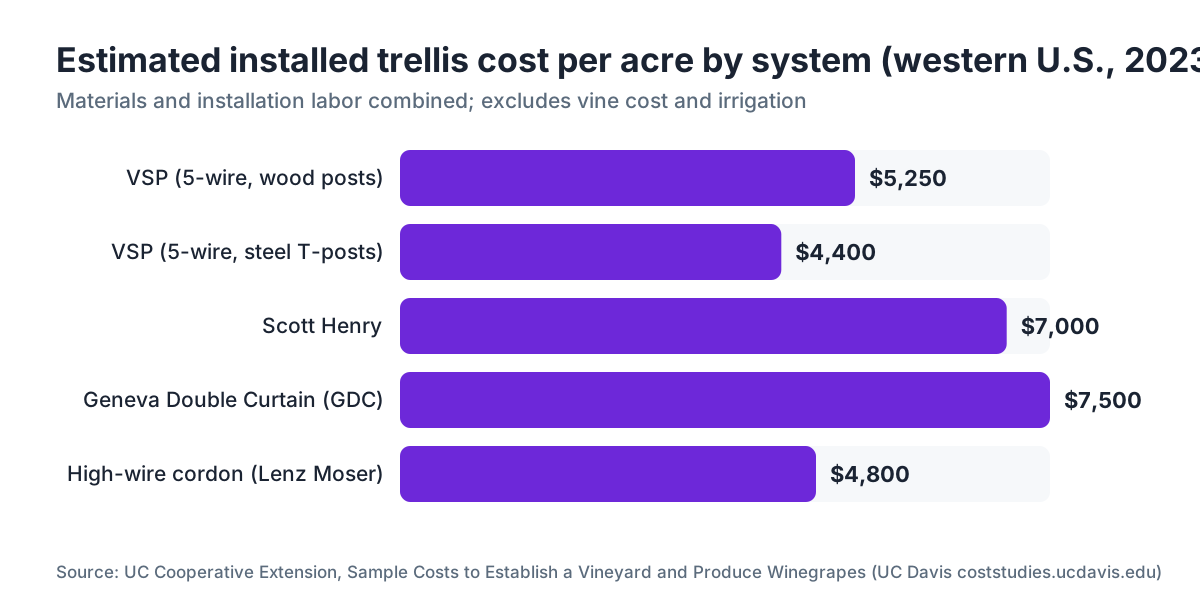
Installed cost runs $4,000 to $8,500 per acre in the western U.S., and any single number is misleading without the details behind it. The published ranges from University of California Cooperative Extension are the most-cited benchmarks in the West [5].
A standard VSP trellis in California, built with treated wood end posts, line posts every 20 to 24 feet, and four to five wires, runs roughly $4,000 to $6,500 per acre for materials and installation labor combined. Switch to steel T-posts for the line posts (common in Washington) and you can shave $500 to $1,000 per acre, though you trade some longevity for it. GDC and Scott Henry cost more because they use taller posts and more wire. Figure $6,000 to $8,500 per acre in Pacific Coast markets across 2023 and 2024.
Region matters more than most people expect. Labor rates in Napa Valley run roughly double those in the Columbia Valley or Texas Hill Country. Shipping steel posts to remote sites can add $300 to $600 per acre. Do the work yourself and you can cut per-acre cost by 30 to 40 percent by supplying your own labor. This is where the DIY route actually earns its keep. Just be honest about how long post driving and wire tensioning take on rough ground.
Post spacing is the biggest lever on material cost. Going from 20-foot to 24-foot line post spacing cuts post count by roughly 17 percent per acre. Cornell's work on post spacing and wire tension says that tradeoff is fine for most wine grape varieties, as long as the end-post anchoring holds [6].
Anchor cost is the number people forget. Every end post needs a deadman anchor or a driven anchor rod to hold wire tension across decades of canopy load. A proper anchor assembly runs $40 to $90 per end post in materials alone.
Which trellis system works best for high-vigor sites?
For genuinely high-vigor sites, GDC or Scott Henry are the honest first choices, because both divide the canopy and expose more leaf area to sunlight. High vigor is the most common reason a trellis choice goes wrong. When roots reach deep, fertile soil or get heavy irrigation, the vine throws more shoot growth than a single-plane trellis can display without shading itself out. Shaded clusters give you less color, less tannin, higher pH, and more green flavor. That's the straight line from trellis mismatch to a wine problem.
Dividing the canopy raises photosynthetic capacity and puts more light into the fruit zone at the same time. Research from Smart and Robinson in "Sunlight into Wine" (a manual both WSU and Cornell extension cite) found divided canopy systems can lift yield by 30 to 100 percent on high-vigor sites while holding or improving fruit quality against non-divided systems [3].
Before you commit to hardware, find out where the vigor comes from. If it's excess irrigation, fix the irrigation. If it's rootstock (a 3309 or SO4 on deep loam will run hard), that's much harder to undo after planting. If it's soil depth and fertility, you're managing high vigor for the life of the vineyard, so build the trellis for it from day one.
Scott Henry usually beats GDC in cooler regions because the downward-trained shoots still ripen well in a shorter season. GDC's fully pendant shoots can struggle to ripen where you get less than 2,500 growing degree days (base 50 degrees F).
Can you build a DIY wine grape trellis system that will last?
Yes, and small growers do it all the time. A DIY trellis works fine for plantings under five acres. The failures repeat themselves: undersized end posts, weak anchoring, and slack wire because a hand come-along can't reach proper tension.
Here's what the university extension programs actually specify [6][2].
End posts should be 4-inch-diameter pressure-treated wood or equivalent, 8 feet long, set at least 3 feet deep (3.5 feet in sandy soils). Line posts can be smaller: 3-inch treated wood or steel T-posts, 7 to 7.5 feet long, set 2 feet deep. Use high-tensile wire, 12.5 gauge, Class 3 galvanized. Plain galvanized or Class 1 wire rusts through in 10 to 15 years in humid climates.
Anchoring is where DIY projects cut the wrong corner. Each end-post assembly has to hold thousands of pounds of tension across years of canopy load and freeze-thaw. A deadman anchor (a buried post driven perpendicular to the wire pull, tied in with a tension rod) is the standard fix. A screw anchor driven 4 to 5 feet at a 45-degree angle also works in most soils and costs about $15 to $25 per unit plus a day's rental on a power driver.
Wire tension is the other miss. Target the catch wires at roughly 150 to 200 pounds of pull. A mechanical wire tensioner or ratchet strainer hits that; a hand come-along on a 500-foot run usually doesn't. Penn State and Cornell extension both publish wire tension specs by row length [6].
For a backyard or micro-vineyard under a quarter acre, simplify freely: closer post spacing cuts the tension demand, and wood stakes hold up on very short runs. At commercial scale, every shortcut on these specs comes back as re-work and lost vine years.
How do different trellis systems affect spray coverage and worker safety?
Canopy shape decides how well a sprayer reaches the fruit zone, which drives disease control, spray efficacy, and compliance under the EPA's Worker Protection Standard (WPS). A tight, open canopy sprays well. A dense one doesn't, and no label rate fixes that.
In a well-managed VSP with a narrow vertical canopy, air-blast sprayers get good two-sided coverage in one pass at moderate air volume. The fruit zone is defined and reachable. In a dense, unmanaged VSP canopy (the most common real-world case), coverage collapses in the interior and you burn more product chasing the same biological result.
Divided systems like GDC and Scott Henry expose more leaf surface and keep more open interior, so they tend to cover better per gallon applied, according to work at Cornell's viticulture program [4]. The catch is that GDC's two curtains may need a different sprayer setup or a second pass to hit both sides of the divided zone.
Under the Worker Protection Standard, re-entry intervals (REIs) apply the same regardless of trellis type, but taller canopies (high-wire cordon, GDC) can push more drift toward ground-level workers in adjacent rows. The WPS requires that handlers get notified of applications and that REI postings stay current and visible at field entry points [7]. Canopy shape also touches the "thorough coverage" wording on many fungicide labels: if your VSP block is shaded out, product isn't reaching target tissue, and that's both wasted money and a compliance gap.
Spray records tied to canopy conditions aren't just good practice. Most states require pesticide recordkeeping by law. Tools like VitiScribe let you log application rates, canopy notes, and REI windows in one place, which makes a state inspection far less painful.
What trellis spacing and row orientation should you choose?
Standard commercial VSP row spacing in the western U.S. runs 8 to 10 feet, with north-south rows the usual default. Row spacing and orientation tie into trellis design in ways that are hard to pull apart. Tight rows (6 feet) show up in high-density European-style plantings, but they need narrow tractors or hand cultivation. Wide rows (12 feet) suit mechanized, high-vigor sites but drop vine density and can cut per-acre production.
Orientation is a real decision. North-south rows push more afternoon sun onto the west face of the canopy in the northern hemisphere, which helps most reds that need heat. East-west rows earn their place on steep slopes where you plant across the fall line for erosion control, but east-west on flat ground often shades one face and darkens the whole canopy.
WSU extension viticulture publications report that north-south orientation gives more uniform ripening across the vine and better fruit zone temperature moderation than east-west under Pacific Northwest conditions [8]. The effect is real but modest. Site topography usually overrides orientation.
In-row vine spacing (the gap between plants along the wire) runs 4 to 8 feet for wine grapes. Tighter spacing at 4 to 5 feet raises vine density, fills the trellis faster, and improves wine complexity in some research, but it costs more to establish and may be pointless if you're managing to low-to-moderate vigor anyway. Most California coastal vineyards target 600 to 1,200 vines per acre depending on site and style [5].
How do you train young vines on a new trellis system?
Training is the multi-year job of building the permanent vine structure (trunk and cordon or canes) onto the trellis. Patience pays. Rushing training to grab an early crop is the most common mistake in young vineyard management, and it leaves you with crooked, weak trunks that cause trouble for 20 years.
Year one: don't crop the vine at all. All the energy goes to roots and to growing one straight shoot that becomes the trunk. Tie it loosely to a bamboo stake or the first wire with soft ties. At season's end, cut it back to two or three buds if it didn't reach the cordon wire, or to just below the cordon wire if it did.
Year two: if the vine hit cordon height in year one, pick two laterals at the cordon wire and train them in opposite directions along the wire to form bilateral cordons. If it fell short, repeat the single-shoot training. Some vigorous varieties reach the cordon in their first full season. Slow-establishing varieties can take three years in cool climates.
Year three and beyond: spur positions develop along the cordon, and the count of spurs and buds per spur sets your crop load. UC Davis recommends no more than two to four shoots per foot of cordon in VSP training during establishment, so you don't overload vines before the root systems fill out [2].
Scott Henry and Smart-Dyson take longer, because you're building four cordon arms instead of two. Budget an extra full season before either system fills and runs at target capacity.
How do VSP and Scott Henry differ in practice at harvest?
Both VSP and Scott Henry work with over-the-row mechanical harvesters, which is a real advantage over some hand-tended systems. The difference shows up in how harvest goes on the ground.
In VSP, the fruit zone is a narrow, defined band at 2.5 to 4 feet. Harvesters calibrate right to it, and hand-pickers know exactly where to look. The system rewards steady pruning and canopy work, because clusters that stray outside the band either miss the harvester or need hand cleanup.
Scott Henry complicates harvest a little. The downward-trained shoots hang clusters below the mid-point of the fruiting wire. Harvesters need slightly wider jaw aperture settings, and if the lower shoots get too dense, the machine misses fruit. Hand crews need more time to work both the upper and lower fruiting zones.
On balance, if you run mechanical harvest on moderate-to-high-vigor blocks, Scott Henry earns its extra training and harvest complexity through the fruit quality gains. If you hand-harvest everything and labor isn't a binding constraint, the quality case for Scott Henry over a well-managed VSP gets murkier. Nobody has clean, replicated data comparing fruit chemistry between the two systems across multiple seasons in the same variety at the same site. The closest published work is Smart and Robinson's 1991 study, where canopy-divided vines consistently beat non-divided ones under warm Australian conditions [3].
What trellis materials hold up longest and which are a waste of money?
Treated wood end posts are the workhorse of the industry and the best value for most operations. Rated properly for ground contact (UC2B or UC4B), they last 25 to 40 years across most western U.S. climates. Concrete posts cost more upfront and last essentially forever, and they're common in some European regions, but they're heavy to handle and overkill for most U.S. commercial work.
Steel T-posts for line posts are cheap and fast to install with a driver. The tradeoff: they handle frost heave worse than wood in northern climates, they rust at ground level after 15 to 25 years depending on soil chemistry, and they're a pain to fix once they bend. Wood line posts split the difference: more durable than T-posts, slower to install, roughly 40 to 60 percent more per unit.
High-tensile galvanized wire (Class 3, 12.5 gauge) is the standard for a reason. It carries roughly three times the zinc coating of Class 1 wire, which buys roughly three times the corrosion life. Stainless wire shows up in some premium installs and lasts essentially forever, but it costs two to four times as much as Class 3 galvanized. For a short-run boutique block under 200 feet, stainless can pencil out. For a 20-acre planting, the premium is hard to justify.
Fiberglass posts get marketed as a wood alternative, mostly for organic operations worried about treated-wood leachate. They're light, they don't rot, and their tensile strength is fine, but they're brittle under lateral impact (equipment strikes happen in any working vineyard), they cost more than steel T-posts, and no major production region has made them the standard. Draw your own conclusion.
Clips and staples are where people consistently under-buy. Cheap galvanized clips corrode faster than the wire they hold and turn into a maintenance headache within five to ten years in humid climates. Class 3 galvanized or stainless clips add almost nothing to total project cost.
How does trellis design affect wine quality and fruit composition?
The mechanism is settled: fruit zone sunlight drives anthocyanin concentration, flavonoid buildup, tannin development, and titratable acidity in wine grapes. Shaded clusters give you fruit with less color, higher pH, and more malic acid still hanging around at harvest. Open, well-exposed clusters run warmer through the day, ripen evenly, and pack in more phenolics.
Work by Smart and colleagues in the American Journal of Enology and Viticulture through the 1980s and 1990s tied canopy light exposure to fruit and wine quality, and set the framework most trellis design has followed since [9]. The practical read: any system that keeps the fruit zone open and the canopy interior lit will beat a shaded canopy of the same variety on the same site.
VSP does this well for low-to-moderate vigor vines when it's shoot-thinned and positioned right. GDC and Scott Henry do it by dividing the canopy structurally. The failure mode across every system isn't the trellis, it's the management. A well-designed VSP block that never gets shoot-thinned turns into a dense, shaded mess that underperforms a high-wire cordon on the same site.
Canopy temperature cuts both ways. Fruit hit by afternoon sun in very warm climates can show heat damage: sunburn, dehydration, and sugar racing ahead of phenolic maturity. In those spots, a slightly more shaded orientation may be the right call on purpose. That's a live management tradeoff in the San Joaquin Valley and other hot regions, and cool-climate trellis thinking doesn't always account for it.
What resources and extension programs give the most practical trellis guidance?
Three university extension programs put out the most reliable, practical trellis guidance for North American wine grape growers: Cornell, UC Davis, and Washington State University.
Cornell Cooperative Extension's viticulture program, based at the New York State Agricultural Experiment Station in Geneva, published the foundational GDC research and stays the go-to for humid eastern U.S. viticulture [4][6]. Their extension publications on trellis design, wire tensioning, and canopy management are free and searchable through Cornell's site.
UC Davis's viticulture and enology department covers the widest span of California climates and variety-rootstock combinations. Their cost-of-production studies are the most-cited benchmark for California trellis installation costs, updated periodically through UC Agriculture and Natural Resources [5]. UC Cooperative Extension farm advisors in each county also publish region-specific trellis guides.
Washington State University's viticulture and enology extension program covers Columbia Valley and Pacific Northwest conditions in depth, including cold-climate adaptations like trunk protection and training systems built for freeze risk [8]. WSU's publications come through its wine grape research program.
Outside those regions, Virginia Cooperative Extension, the University of Missouri's grape and wine institute, and the Texas A&M AgriLife viticulture team all publish trellis guides fit to their local conditions.
Beyond extension, Richard Smart and Mike Robinson's 1991 manual "Sunlight into Wine" is still the most complete single-volume reference on canopy management and trellis design, even though it's dated on specific cultivar picks [3]. Most university viticulture programs still assign it.
Where trellis decisions connect to ongoing compliance, spray records, and canopy logs, keeping field notes in one system saves real time. VitiScribe's field operations platform links trellis block records to spray applications, canopy assessment scores, and harvest data, which helps a lot when you manage multiple blocks running different systems.
Frequently asked questions
What is the most common trellis system used in wine grape vineyards?
VSP (vertical shoot positioning) is the dominant trellis system in most premium wine regions worldwide. Shoots grow upward between catch wires, the fruit zone sits in a defined band at 2.5 to 4 feet, and the system handles low-to-moderate-vigor vines well. It works with mechanical harvesting and is the default for Pinot Noir, Chardonnay, Cabernet Sauvignon, and most major wine varieties in cool to moderate climates.
How deep should trellis posts be set for wine grapes?
End posts need at least 3 feet of depth (3.5 feet in sandy or loose soils) because they carry the full tension of every wire in the row. Line posts can go 2 feet deep. Cornell and UC Davis extension specs both call for 8-foot end posts and 7 to 7.5-foot line posts to reach standard wire heights after setting. Setting posts too shallow is the single most common structural failure in DIY trellis projects.
Can you use a VSP trellis system for Zinfandel or other high-vigor varieties?
You can, but you'll fight the vine every season. Zinfandel on a fertile site in VSP throws excessive shoot growth, shades the fruit zone, and invites botrytis and powdery mildew. Scott Henry or GDC handles high-vigor varieties much better. If you're already planted in VSP, aggressive shoot thinning, leaf removal, and canopy work partly compensate, but it adds labor and rarely fully solves the shading.
How long does it take for a new wine grape trellis to be fully established?
You can install the physical trellis before planting or in year one. The vines take two to four years to fill a standard VSP or bilateral cordon system, depending on vigor, climate, and rootstock. Divided systems like Scott Henry and Smart-Dyson need an extra full season to fill because they require more cordon arms. First commercial crops usually come in years three to four after planting.
What wire gauge should I use for a wine grape trellis?
12.5-gauge high-tensile wire with Class 3 galvanized coating is the industry standard. It combines enough tensile strength (around 200,000 psi) with corrosion resistance that pushes service life past 25 years in most climates. Heavier 11-gauge wire gets used for the main load-bearing cordon wire in some designs. Skip Class 1 galvanized wire; it corrodes too fast in humid conditions and needs replacing far sooner.
Is Geneva Double Curtain (GDC) suitable for small vineyards?
GDC works at any scale technically, but it's built around high-vigor vines and mechanized operations, so it's overkill for a small, hand-tended block with moderate vigor. The taller posts, T-bar hardware, and double-curtain wire cost more to install than VSP or Scott Henry. If you have a high-vigor small block and can't mechanize, Scott Henry gives similar canopy division with simpler infrastructure.
How do trellis systems affect pesticide application and re-entry intervals?
Canopy density and height directly affect spray penetration and worker exposure. A well-managed open VSP canopy lets air-blast sprayers cover thoroughly in one pass. Dense or divided canopies may need adjusted sprayer settings or a second pass. Under the EPA Worker Protection Standard, re-entry intervals apply uniformly by pesticide label regardless of trellis type, but taller canopies can raise drift exposure for workers in adjacent rows during application.
What's the difference between a bilateral cordon and a unilateral cordon trellis?
A bilateral cordon has two permanent cordon arms running in opposite directions from the trunk along the wire, one to each side. That's the standard for VSP, GDC, and Scott Henry. A unilateral cordon has one arm running in a single direction, used on end-of-row vines and in some head-trained systems. Bilateral cordons fill the wire more efficiently and suit mechanized pruning and harvest better.
Can wine grape trellis systems be converted after the vineyard is established?
Conversion is possible but expensive and disruptive. Moving from VSP to Scott Henry means adding taller posts or post extensions, adding lower fruiting wire positions, and retraining vines over two to three seasons. Converting single-plane to GDC means replacing the entire post and wire framework. Most growers convert only when quality and yield problems are bad enough to justify $2,000 to $5,000 per acre for hardware and labor, which is a high bar.
How do I choose between Scott Henry and Smart-Dyson for a moderate-vigor site?
For most commercial operations, Scott Henry is the practical pick. It divides the canopy with two cordon arms per vine instead of four, which means faster establishment, simpler management, and easier mechanical pruning. Smart-Dyson's four-arm system can give slightly better leaf exposure ratios in research settings, but the added training and management complexity is hard to justify unless you're running a research plot or a very high-end small block.
What is the best trellis system for a cool, short-season climate?
VSP is the standard for most cool, short-season regions like the Finger Lakes, Willamette Valley, and Lake Erie. The upright canopy soaks up heat and keeps fruit in a warm, well-exposed zone. On very cold sites with freeze risk, some growers run a low-wire, head-trained system or a bilateral cordon that can be mounded with soil for winter trunk protection. WSU extension covers these cold-climate modifications in detail.
What does it cost to build a DIY wine grape trellis system per acre?
Supplying your own labor, material costs for a standard VSP trellis (treated posts, high-tensile wire, clips, anchors) run $2,500 to $4,000 per acre depending on post spacing, local prices, and wire configuration. That's 30 to 40 percent below a professionally installed system. The savings are real, but budget the time honestly: driving and setting posts and tensioning wire on one acre usually takes two to three people three to five days.
Do organic vineyards need different trellis systems?
The trellis system itself doesn't change for organic certification, but materials can. Some organic growers prefer fiberglass or cedar posts over pressure-treated wood over concerns about copper-based preservatives leaching into soil. The National Organic Program (NOP) doesn't specifically prohibit commonly used treated lumber, but UC4B copper-treated posts sit in a gray area under some certifiers' reading. Check with your certifier before buying materials if you plan to certify.
How many posts and how much wire do I need per acre for a VSP trellis?
At standard 10-foot row spacing and 20-foot line post spacing on one acre (about 4,840 square feet), you'll need roughly 50 to 60 line posts and 8 to 12 end posts, depending on row count and length. Wire runs depend on wire count per system: a five-wire VSP (one cordon, two fixed catch wires, two movable catch wires) uses roughly 3,500 to 4,500 linear feet per acre. Add 10 to 15 percent for waste and tensioning overlaps.
Sources
- UC Davis Viticulture and Enology, Department overview: Mismatch between site vigor and trellis system is a leading cause of performance problems in established vineyards, per UC Davis viticulture faculty guidance.
- UC Agriculture and Natural Resources, Grape Pest Management: VSP is described as the standard training system for California wine grapes, with shoot counts and canopy management specifications for establishment.
- Smart, R. and Robinson, M. (1991). Sunlight into Wine: A Handbook for Winegrape Canopy Management. Winetitles, Adelaide.: Divided canopy systems (Scott Henry, GDC, Smart-Dyson) can increase yield 30 to 100 percent on high-vigor sites while maintaining fruit quality versus non-divided systems; Scott Henry was developed in Oregon's Umpqua Valley.
- Cornell Cooperative Extension, New York State Agricultural Experiment Station, Viticulture Program: Geneva Double Curtain was developed at Cornell's Geneva station by Nelson Shaulis in the 1960s; Cornell extension publishes foundational trellis and canopy management guidance for humid eastern viticulture.
- UC Cooperative Extension, Sample Costs to Establish a Vineyard and Produce Winegrapes: VSP trellis installation in California runs roughly $4,000 to $6,500 per acre; vine density in California coastal regions typically targets 600 to 1,200 vines per acre.
- Cornell Cooperative Extension, Trellis and Training Systems for Grapes: End posts should be 4-inch-diameter, 8 feet long, set at least 3 feet deep; Class 3 galvanized 12.5-gauge high-tensile wire is specified; target catch wire tension is 150 to 200 pounds.
- U.S. EPA, Worker Protection Standard for Agricultural Pesticides: EPA Worker Protection Standard requires re-entry interval postings at field entry points and handler notification prior to pesticide application; the standard applies regardless of canopy or trellis architecture.
- Washington State University Extension, Wine Grape Varieties and Viticulture: North-south row orientation produces more uniform ripening and better fruit zone temperature moderation than east-west in Pacific Northwest conditions; WSU covers cold-climate trellis adaptations including trunk protection strategies.
- American Journal of Enology and Viticulture: Sunlight exposure of the fruit zone directly influences anthocyanin concentration, flavonoid accumulation, tannin development, and titratable acidity in wine grapes; shaded clusters produce less color and higher pH.
- UC Davis, Wine Grape Varieties in California (publication series): UC Davis recommends leaving no more than two to four shoots per foot of cordon during establishment to avoid overloading vines before root systems are fully developed.
- Virginia Cooperative Extension, Grape Production Guide: Regional extension viticulture guides for eastern U.S. trellis design, including humid-climate wire and post specifications.
- USDA National Organic Program, Allowed and Prohibited Substances: National Organic Program regulations govern materials used in certified organic vineyards; treated lumber in ground contact is a certifier-specific determination.
Last updated 2026-07-09