Wine grape varieties: the complete grower's field guide
TL;DR
- More than 10,000 named grape varieties exist worldwide, but roughly 33 cover half the world's planted vineyard area.
- Picking the right one for your site comes down to climate, rootstock fit, market demand, and your spray calendar.
- This guide walks through the major red and white varieties, the Italian grapes, and what you actually need to know before a vine goes in the ground.
How many wine grape varieties are there, and why does it matter for growers?
There are more than 10,000 named grape varieties. The most careful count comes from the Vitis International Variety Catalogue (VIVC) at Geisenheim University, which lists over 10,000 distinct Vitis vinifera cultivars and interspecific hybrids [1]. That total includes ancient landrace selections most growers will never touch. The OIV (International Organisation of Vine and Wine) estimates that roughly 33 varieties account for about 50 percent of the world's planted vineyard area [2].
The raw count matters less than the practical categories. Is a variety early, mid, or late ripening? Is it thick-skinned enough for a wet climate? Does it have powdery mildew susceptibility that will drive your spray program all season? Does your AVA or appellation restrict what you can plant? Those four questions cut 10,000 names down to maybe a dozen candidates for any given site.
Variety selection is a compliance decision, more than an agronomic one. Once you plant, you lock in a pesticide label universe, a set of USDA NASS reporting classes, and possibly a federal or state marketing order that governs how you sell. Getting it right before the vine goes in costs a lot less than fixing it after five years of growth.
What are the most widely planted red wine grape varieties in the world?
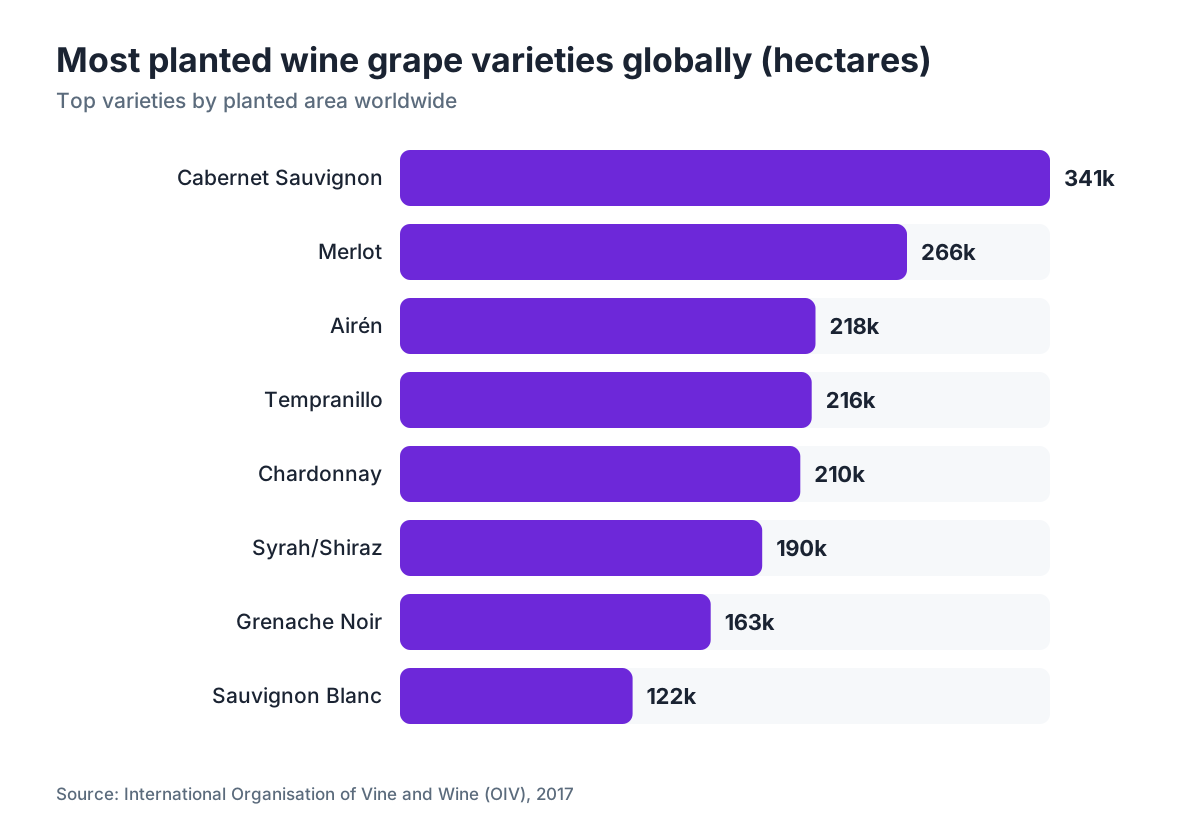
Cabernet Sauvignon is the most planted wine grape on the planet, at roughly 341,000 hectares according to the OIV's 2017 world vitiviniculture report [2]. That number has grown since. It dominates in Napa Valley, Bordeaux, Chile, Australia, and increasingly in warmer Italian DOC zones.
Here are the major reds growers actually work with:
| Variety | Primary regions | Ripening | Key management notes |
|---|---|---|---|
| Cabernet Sauvignon | Napa, Bordeaux, Chile | Late | Thick skin, powdery mildew susceptible |
| Merlot | Bordeaux, Washington, Napa | Mid | Prone to over-cropping, watch botrytis |
| Pinot Noir | Burgundy, Oregon, Sonoma | Early | Thin skin, high labor, tight cluster rot risk |
| Syrah/Shiraz | Rhône, Australia, WA state | Mid-late | Needs good drainage, can sunburn |
| Zinfandel | California | Mid-late | Uneven ripening, requires multiple passes |
| Grenache | Spain, Southern Rhône | Late | Drought tolerant, high sugar accumulation |
| Tempranillo | Spain, Portugal | Mid | Moderate vigor, good in warm continental climates |
| Sangiovese | Italy | Mid-late | High acid, cluster thinning critical |
| Malbec | Argentina, Cahors | Mid | Benefits from good sun exposure |
| Nebbiolo | Piedmont, Italy | Late | Very late, needs long seasons, high tannin |
Washington State University's extension research on variety adaptation is genuinely useful here. WSU has published heat unit requirements and phenology data for varieties grown in the Columbia Valley and Yakima AVAs, and it translates well to other semi-arid inland regions [3].
Thin-skinned reds drive your spray program. Pinot Noir, Gamay, and Nebbiolo take more fungicide applications because botrytis pushes through the berry skin more easily. That means more label compliance events, more PPE documentation under the EPA Worker Protection Standard [4], and a higher cost per ton before the fruit ever reaches the crush pad.
What are the main white wine grape varieties and how do they differ to grow?
White varieties bring a different set of headaches than reds. With no skin-contact color to hide behind, blemish, sunburn, and early rot show up in the finished wine directly. Cluster architecture matters a lot. Tight-clustered whites like Muscat Blanc and Riesling are botrytis magnets in humid climates.
| Variety | Primary regions | Ripening | Key management notes |
|---|---|---|---|
| Chardonnay | Burgundy, Napa, Oregon | Mid | Highly site-expressive, powdery mildew risk |
| Sauvignon Blanc | Loire, New Zealand, Napa | Early-mid | Vigorous, needs shoot positioning |
| Riesling | Germany, Alsace, Finger Lakes | Late | Tight clusters, botrytis watch, cold hardy |
| Pinot Gris/Grigio | Alsace, Oregon, Italy | Mid | Pink-skinned mutation, sunburn sensitive |
| Gewürztraminer | Alsace, Alto Adige | Early | Low vigor, precise timing at harvest |
| Viognier | Rhône, California | Mid | Inconsistent fruit set, needs warm sites |
| Chenin Blanc | Loire, South Africa | Mid-late | Versatile, high acid, long hang time possible |
| Muscat Blanc | Worldwide | Early | Aromatic, prone to powdery mildew |
| Albariño | Galicia, Portugal | Mid | High acid, needs good air circulation |
| Grüner Veltliner | Austria, California | Mid-late | Peppery, does well in moderate climates |
Chardonnay is the most planted white variety in the world, at roughly 210,000 hectares in the OIV's 2017 data [2]. That figure keeps climbing, driven by demand across still and sparkling production.
Cornell University's viticulture extension has published variety trial data for cool-climate sites in New York, with winter hardiness ratings and disease pressure profiles for whites including Riesling, Gewürztraminer, and Vidal Blanc [5]. If you farm in the Northeast or Great Lakes region, that's the first place to look before you finalize a planting decision.
Which Italian wine grape varieties should growers and winemakers know?
Italy has the deepest documented native variety diversity of any wine country. The National Registry of Vine Varieties maintained by the Italian Ministry of Agricultural Policy lists over 500 officially registered varieties [6]. Include the unregistered regional ecotypes and the real number climbs much higher.
A smaller set dominates Italian red production.
Sangiovese is Italy's most planted red by a wide margin. It's the backbone of Chianti Classico, Brunello di Montalcino (where it goes by Brunello), Morellino di Scansano, and dozens of other DOC and DOCG wines. Ripening runs mid to late, acid stays high, and crop load management is the single biggest lever for quality. Under-thinned Sangiovese makes thin, weedy wine no matter how good the site is.
Nebbiolo is the grape behind Barolo and Barbaresco, and it's brutally site-specific. It buds early, which raises frost risk, then ripens very late, which demands a long warm season. Planting Nebbiolo in a marginal climate is a losing bet.
Barbera gives you high acid and low tannin naturally. It's forgiving in the vineyard, handles moderate climates, and has caught on in California's Amador County alongside its Piedmont home.
Montepulciano (not the Tuscan town) is native to the Adriatic coast and makes deeply colored, round wines. It's vigorous and needs steady canopy management.
Primitivo is genetically identical to Zinfandel, confirmed through DNA profiling with UC Davis at the center of the research [7]. That matters for rootstock and clone selection: California's Zinfandel research base applies directly.
Italian whites are just as regional.
Pinot Grigio (Pinot Gris) dominates in Friuli and Trentino-Alto Adige. In American plantings it's often picked early for the light, crisp style the market wants, which keeps pH low and acid high.
Garganega is the primary grape in Soave. It's thick-skinned, late-ripening, and makes excellent wine at moderate yields.
Vermentino does well in Sardinia and coastal Tuscany. It handles heat and drought reasonably and has picked up a small but growing footprint in California.
Fiano and Greco di Tufo are Southern Italian whites having a revival both at home and among American growers hunting for heat-tolerant alternatives to Chardonnay.
If you're sourcing Italian variety clones in the U.S., Foundation Plant Services at UC Davis keeps a Clean Plant Network repository of certified, virus-tested scion and rootstock for many of these varieties [8].
How do you match grape varieties to your vineyard site and climate?
Climate matching is the thing growers get wrong most often. Degree days (the Winkler scale) give you a starting point: Region I sits below 2,500 degree days Fahrenheit, Region V above 4,000 [9]. Pinot Noir wants Regions I to II. Cabernet Sauvignon can ripen well through Region III. Grenache and Zinfandel need Region III or warmer to reach phenolic ripeness before the rains arrive.
Degree days alone miss half the story. Diurnal temperature swing drives acid retention. Fog influence, the way it works in coastal Sonoma, creates cool pockets where cool-climate varieties thrive even on a map that reads warm. Frost dates box in early-budding varieties like Chardonnay and Pinot Noir in the Finger Lakes or the high Sierra Foothills.
Soil affects variety performance in ways that are harder to measure but just as real. Nebbiolo has historically done best on calcareous clay in Piedmont. Cabernet Sauvignon on deep, well-drained gravelly loam builds more structure than the same variety on heavy clay. Riesling is one of the few varieties that seems nearly indifferent to soil type as long as drainage is good.
Rootstock interacts with variety in ways growers underweight. Own-rooted vines still work in some sandy soils (phylloxera doesn't move well in sand), but most American sites need grafted vines. The rootstock sets vine vigor, drought tolerance, and nutrient uptake. UC Davis's viticulture and enology program publishes rootstock-variety compatibility guidance that's free and genuinely detailed [8].
If you're tracking records across multiple blocks with different varieties, rootstocks, and spray histories, keeping that organized is where a tool like VitiScribe earns its keep. Each block's variety, clone, rootstock, and spray record stays linked instead of scattered across paper binders.
Go walk an established vineyard in your target region before you finalize a planting plan. Watching how a variety behaves in your climate neighbor's dirt beats any data table.
What role does variety choice play in your spray program and compliance records?
This is the part of variety selection that gets almost no attention in popular viticulture writing, and it's where growers pay real money later.
Every pesticide label spells out the crops it can legally treat. Some materials are registered for "grapes, wine" broadly. Others restrict to specific variety types or growth stages. If you add a variety that falls outside your current label language, verify registration before your first spray event, not after.
The EPA Worker Protection Standard (WPS), revised heavily in 2015 and enforced under 40 CFR Part 170, requires that all agricultural workers and handlers get training, that restricted-entry intervals be posted, and that pesticide application records be kept [4]. Those records have to identify the crop and site. As your variety mix grows, the record-keeping surface grows with it.
Botrytis-susceptible, thin-skinned, and tight-clustered varieties usually take more fungicide passes. More passes means more PPE documentation, more re-entry interval management, and more chances for a WPS compliance gap. Powdery mildew pressure swings by variety too. Chardonnay and Riesling run highly susceptible. Muscadine hybrids and disease-resistant varieties like Marquette or Frontenac have partial resistance built in.
Some states, California and Oregon among them, require pesticide application records be kept at least two years and made available to agricultural commissioners on request [10]. Your spray records need to name the variety, the block, the applicator, the product, the rate, and the REI. Filing by variety and block instead of just by date is both a compliance requirement and a practical tool when you're chasing an efficacy problem or prepping for a third-party audit.
What are hybrid and disease-resistant grape varieties, and are they worth planting?
Hybrid varieties cross Vitis vinifera with American species like Vitis labrusca, Vitis riparia, or Vitis rotundifolia. The aim is usually vinifera wine quality with the cold hardiness or disease resistance of the American parent. Results vary widely.
Older hybrids like Seyval Blanc, Vidal Blanc, and Chambourcin have long track records in the Midwest and Northeast. They make commercially viable wine and cut fungicide applications sharply. Cornell's viticulture program, which has done more cold-climate hybrid research than probably any other U.S. institution, reports that varieties like Marquette can produce wine that competes with Pinot Noir in blind tastings under the right conditions [5].
Newer PIWI varieties (from the German term for fungus-tolerant interspecific crosses) out of Germany, France, and Switzerland, like Cabernet Blanc, Souvignier Gris, and Regent, have found footholds in European organic production and are starting to show up in American trial plots. These can reduce fungicide applications by 50 to 80 percent against susceptible vinifera, which has real weight for labor cost and WPS compliance.
The honest tradeoff: most hybrid wines still don't command the prices top vinifera does. If you sell through a direct-to-consumer tasting room, that gap matters less. If you sell bulk grapes to a winery chasing recognized variety names, a hybrid's market value is capped by what the buyer can put on the label.
WSU's extension program has published variety trial data for disease-resistant varieties suited to the Pacific Northwest, which fills a real gap in the research for that region [3].
How are Italian wine regions organized around grape variety designations?
Italy's DOC and DOCG system ties directly to variety in a way that affects growers who supply those wines. Barolo DOCG must be 100 percent Nebbiolo. Chianti Classico DOCG must be at least 80 percent Sangiovese. These aren't suggestions. They're legal production requirements enforced by the consorzio and audited by the Italian government [6].
For American growers making wines in the Italian style or using Italian variety names, the Federal TTB (Alcohol and Tobacco Tax and Trade Bureau) regulates what can appear on a U.S. label. A wine labeled "Sangiovese" here must contain at least 75 percent of that variety under TTB rules [11]. That threshold sits well below what Italy's own DOC rules demand, but it's the minimum that governs your label compliance in the States.
Some California AVAs have organized around Italian varieties on purpose. Paso Robles carries a meaningful Nebbiolo and Sangiovese presence, and the Paso Robles wineries scene has experimented more broadly with Italian grapes than most California regions. Amador County in the Sierra Foothills has Barbera plantings going back several decades.
The compliance point for any grower producing under a variety-designated label: your vineyard records have to support the varietal percentage claim. If a TTB auditor asks how you know your Chianti-style blend holds at least 75 percent Sangiovese, your block maps, harvest records, and crush logs need to tell that story without gaps.
What should small winery owners know about sourcing grapes by variety?
Buying grapes instead of growing them brings its own variety questions. You're relying on the grower's block records, their spray history, and their variety identification. Misidentified varieties happen more than the industry likes to admit, especially in old vineyards with mixed blocks.
DNA ampelography can identify a variety definitively from a leaf or berry sample. UC Davis Foundation Plant Services offers variety identification services [8]. If you're buying from an old block where the identity is uncertain, spending a few hundred dollars on DNA testing before you commit to a multi-year purchase contract is money well spent.
When you buy grapes, your supplier's pesticide application records become your records for food safety and label compliance. Under California's food safety rules and FSMA requirements, if residues turn up on a finished wine, the question of what got applied in the vineyard and when lands on both parties. Get the spray records in writing as part of the purchase agreement.
For winery operations with tasting rooms and events, variety mix drives more than the wine. Visitors arrive with variety preferences shaped by what they order at restaurants. Cabernet Sauvignon and Chardonnay still pull a disproportionate share of tasting room sales at most American wineries. That's a marketing reality worth weighing in your sourcing plan even if your own winemaking interest runs toward Grüner Veltliner.
Operations like Ponte Winery and South Coast Winery in Southern California have built tasting room programs around Southern Rhône and Spanish varieties that suit their warm climate. That kind of regional alignment, where the grapes match the climate and the story matches the visitor experience, is a model worth studying.
How do you keep accurate variety and block records for compliance and audits?
The minimum you need in writing for every block: variety name, clone number if known, rootstock, year planted, block acreage, and a GPS boundary or map reference. That's what a USDA census reporter, a TTB auditor, or a lender doing a vineyard appraisal asks for first.
Spray records filed by block and variety let you pull the full pesticide history for a specific lot of grapes in minutes. That matters when a buyer asks for residue information, when you're applying for organic certification, or when you're disputing a grape rejection at the crush pad.
Most small operations fall down on keeping the block map current as they replant, graft over, or add new plantings. A block that was half Merlot and half Cabernet Franc in 2015 might be all Cabernet Franc by 2023 after a phased topwork. If your records still read half and half, your varietal percentage math is wrong and your label compliance is at risk.
Digital tools make this easier. A spreadsheet works. A dedicated platform like VitiScribe that links block maps to spray logs and harvest records works. A GIS system works. The point is that every spray event, every harvest note, and every replanting gets tied to a specific variety-block combination and dated. Paper binders work too, but they're miserable to search when an auditor gives you 24 hours to produce three years of records.
For growers who supply multiple wineries, clean records also protect you legally. If one winery claims the grapes were misrepresented, your records are your defense.
What university extension resources cover variety selection and performance data?
Three university programs do the most directly useful work for American grape growers and winemakers.
UC Davis's viticulture and enology program is the oldest and best resourced. It covers variety trials, rootstock compatibility, canopy management research, and the Clean Plant Network for certified planting material [8]. Its extension publications are free and span the full range of vinifera varieties grown in California and beyond.
Cornell University's viticulture extension, based at the New York State Agricultural Experiment Station in Geneva, leads on cold-climate varieties, hybrid research, and integrated pest management for humid northeastern conditions [5]. If you farm in New York, Pennsylvania, Michigan, or the Great Lakes region, Cornell's data beats UC Davis's for variety performance in cold and wet conditions.
Washington State University extension covers the Pacific Northwest with detailed work on Columbia Valley AVA conditions, heat accumulation by site, and variety adaptation for reds and whites [3]. WSU also publishes irrigation and nutrition guidelines by variety, which is especially useful in the semi-arid inland Northwest.
Beyond those three, Virginia Tech has done meaningful work on varieties suited to mid-Atlantic conditions, and the University of Minnesota has driven much of the cold-hardy hybrid development (Marquette, Frontenac, La Crescent) reshaping what's possible in the upper Midwest.
All three major programs publish free online resources. Read one of their regional variety trial reports before you select a new block variety and you'll learn more than any nursery sales pitch will tell you.
Frequently asked questions
What is the most widely planted wine grape variety in the world?
Cabernet Sauvignon holds the top spot globally at roughly 341,000 hectares as of the OIV's 2017 count, and that figure has grown since. It's followed by Merlot, Airén (Spain's dominant but largely anonymous white), Tempranillo, and Chardonnay. For red production specifically, Cabernet Sauvignon and Merlot together cover more planted area than any other two varieties combined.
How many grape varieties are used in winemaking commercially?
The VIVC catalogs over 10,000 named varieties, but commercial production concentrates in roughly 30 to 50 of them. The OIV estimates 33 varieties cover about half the world's vineyard area. In any given American wine region, a list of 10 to 15 varieties accounts for the bulk of planted acreage and nearly all labeled varietal wines sold through retail channels.
What are the best red wine grape varieties for hot climates?
Grenache, Zinfandel, Mourvèdre, Tempranillo, and Primitivo all handle heat well. Grenache in particular is drought-tolerant and holds sugar without dropping too much acid in warm conditions. Montepulciano and Nero d'Avola from southern Italy are worth a look too. Skip late-ripening thin-skinned varieties like Pinot Noir in sustained high heat: the skin can't shield the pulp long enough to reach phenolic ripeness before sugars run away.
What are the key Italian red wine grape varieties a grower should know?
Sangiovese, Nebbiolo, Barbera, Montepulciano, Primitivo, Dolcetto, Nero d'Avola, and Aglianico cover the major ones. Sangiovese is Italy's most planted red by far and the base of Chianti Classico and Brunello di Montalcino. Nebbiolo makes Barolo and Barbaresco but is extremely site-specific and late-ripening. Primitivo is genetically identical to Zinfandel, confirmed through DNA research centered at UC Davis.
What Italian white wine grape varieties are gaining traction in U.S. vineyards?
Vermentino, Fiano, Greco di Tufo, Pinot Grigio, and Garganega draw the most American interest. Vermentino and Fiano handle heat better than Chardonnay and hold good natural acidity. Pinot Grigio has strong market recognition. Garganega is less known but makes compelling wine at moderate yields. Foundation Plant Services at UC Davis keeps certified planting material for several of these.
How does grape variety affect my pesticide program and compliance records?
Variety sets disease susceptibility, which drives your fungicide frequency. Thin-skinned varieties like Pinot Noir and Riesling need more botrytis protection. More applications mean more EPA Worker Protection Standard documentation: REI postings, handler training records, and application logs by block. California and Oregon require spray records be kept at least two years and available to agricultural commissioners on request. Variety identification on every spray record is both a legal requirement and a practical audit tool.
What are disease-resistant grape varieties and are they worth using?
Disease-resistant varieties (PIWI crosses and cold-climate hybrids like Marquette, Frontenac, and Regent) can cut fungicide applications by 50 to 80 percent against susceptible vinifera. Cornell University's research shows some hybrids produce wine that competes with vinifera in blind tastings. The tradeoff is market recognition: most buyers and direct consumers still prefer labeled vinifera names. For organic or low-input goals, the case for disease-resistant varieties is strong.
What is the TTB minimum percentage for a varietal-labeled wine in the U.S.?
Under TTB regulations, a wine labeled with a single variety name in the U.S. must contain at least 75 percent of that variety. That's lower than most European appellations require: Italian DOC rules often mandate 80 to 100 percent of the named variety. Your vineyard block records, harvest logs, and crush data need to support whatever varietal percentage appears on the label if you're ever audited.
What university extension programs have the best grape variety trial data?
UC Davis covers the broadest range of vinifera varieties and manages the Clean Plant Network for certified scion and rootstock. Cornell University leads on cold-climate and hybrid research for the Northeast. Washington State University extension has the best data for Pacific Northwest variety adaptation in semi-arid conditions. All three publish free online resources that beat most commercial nursery recommendations for objectivity.
How do I verify the variety identity of an old vineyard block?
DNA-based ampelography is the definitive method. UC Davis Foundation Plant Services offers variety identification using leaf or berry tissue. Old mixed blocks, especially California plantings from before the 1970s, often carry field blends with misidentified or mislabeled vines. If you're buying a property or entering a long-term grape purchase contract for a labeled varietal wine, DNA verification on any questionable block is worth the cost before you commit.
How does the Winkler heat summation system help with variety selection?
The Winkler scale sums degree days (Fahrenheit) above 50°F from April through October. Region I sites below 2,500 degree days suit Pinot Noir, Chardonnay, and Riesling. Region III (3,000 to 3,500 degree days) works for Cabernet Sauvignon, Merlot, and Sangiovese. Regions IV and V favor Grenache, Zinfandel, and late-ripening Italian and Spanish varieties. UC Davis developed the system, and it's still the standard first-pass climate screen for California and comparable climates worldwide.
What records do I need to keep by grape variety for compliance purposes?
At minimum: a block map with variety, clone, and rootstock; planting year; acreage; all pesticide applications with product, rate, REI, and applicator; harvest date and yield; and any topwork or replanting events. These records support TTB varietal label compliance, state agricultural commissioner inspections, organic certification, FSMA traceability, and any grape purchase contract dispute. Filing by block-variety combination rather than just by date makes retrieval far faster during an audit.
Is Primitivo the same grape as Zinfandel?
Yes. DNA profiling confirmed they are genetically identical, and the research tracing the relationship through Croatian Tribidrag was led largely by scientists at UC Davis and the University of Zagreb. Both Primitivo (an Italian name from Puglia) and Zinfandel (the American market name) are the same Vitis vinifera cultivar. Growers can apply California Zinfandel research on physiology, rootstock, and clonal selection directly to Primitivo plantings.
What white wine grape varieties perform best in cool climates?
Riesling, Grüner Veltliner, Albariño, Pinot Gris, and Gewürztraminer all handle cool conditions well. Riesling is probably the most cold-hardy of the classic vinifera whites and holds natural acid even in warm years. Cornell University's extension program has published cold-hardiness ratings and disease pressure profiles for whites suited to the Finger Lakes and Great Lakes regions. Vidal Blanc is a reliable hybrid option where winter damage risk to vinifera runs high.
Sources
- Vitis International Variety Catalogue (VIVC), Geisenheim University: Over 10,000 distinct Vitis vinifera cultivars and interspecific hybrids are catalogued in the VIVC database
- International Organisation of Vine and Wine (OIV), World Vitiviniculture Situation 2017: Cabernet Sauvignon is the most planted wine grape globally at approximately 341,000 hectares; Chardonnay at approximately 210,000 hectares; 33 varieties account for roughly 50 percent of global vineyard area
- Washington State University Viticulture and Enology Program: WSU extension publishes heat unit requirements, phenology data, and disease-resistant variety trial results for Columbia Valley and Yakima AVA conditions
- U.S. EPA, Worker Protection Standard, 40 CFR Part 170: The EPA Worker Protection Standard requires training, REI posting, and pesticide application records for all agricultural workers and handlers; revised significantly in 2015
- Cornell University Grapes and Wine Program, New York State Agricultural Experiment Station: Cornell extension publishes cold-hardiness ratings, disease pressure profiles, and hybrid variety trial data including Marquette, Frontenac, and La Crescent for cool-climate sites
- Italian Ministry of Agriculture, Food and Forestry (MASAF), National Registry of Vine Varieties: Italy's National Registry of Vine Varieties lists over 500 officially registered varieties; DOC and DOCG production rules specify mandatory variety percentages
- UC Davis Foundation Plant Services, Zinfandel and Primitivo DNA research: DNA profiling confirmed that Primitivo and Zinfandel are genetically identical, with the shared Croatian ancestor identified as Tribidrag
- UC Davis Foundation Plant Services, Clean Plant Network: Foundation Plant Services maintains certified, virus-tested scion and rootstock material for vinifera and Italian varieties, and offers variety identification services via DNA testing
- UC Davis, Winkler Scale and California Climate Regions: The Winkler heat summation scale defines five California wine climate regions from below 2,500 degree days (Region I) to above 4,000 degree days (Region V), used as the standard first-pass variety-to-climate screening tool
- California Department of Pesticide Regulation, Pesticide Use Reporting: California requires pesticide application records be kept for a minimum of two years and made available to county agricultural commissioners on request
- U.S. Alcohol and Tobacco Tax and Trade Bureau (TTB): Under TTB regulations, a wine labeled with a single variety name in the U.S. must contain at least 75 percent of that variety
Last updated 2026-07-09