Winery spray program approval process: documentation for grower compliance

TL;DR
- Wineries that source grapes typically require growers to submit a pre-season spray program for approval, then keep application records all season.
- Required documents usually include a pesticide use log, applicator license copies, and preharvest interval confirmations.
- Federal EPA Worker Protection Standard rules apply to any farm with hired labor, and most states add their own pesticide reporting layer on top.
What is a winery spray program approval process?
A winery spray program approval process is the system a winery uses to review, approve, and track every pesticide application in the vineyards it buys from. The winery needs to know what chemicals touched the fruit before it comes through the crush pad door. That matters for food safety, residue liability, label compliance with organic or sustainable certifications, and sometimes for import rules on wine sold overseas.
The process has two phases. Before the season starts, a grower submits a proposed spray program, usually a list of approved materials, target pests, and intended timing windows. The winery's viticulturist or compliance officer checks it against the winery's internal approved materials list (AML). Then, through the growing season, the grower documents every actual application and submits those records on whatever schedule the winery has set, weekly, monthly, or at preharvest.
Small wineries often run this on paper or email. Larger operations, and more mid-sized ones every year, use digital platforms to track submissions and flag gaps. The core documents are the same either way.
What documents does a grower need to submit for spray program approval?
The minimum document set most wineries expect breaks into three groups: pre-season submissions, in-season records, and preharvest certifications. Miss one field in any of them and you have a gap an auditor can find.
Pre-season submissions generally include:
- A proposed spray program or pesticide use plan listing every material the grower intends to apply, including product name, EPA registration number, and target pest
- Copies of current Qualified Applicator License (QAL) or Qualified Applicator Certificate (QAC) for any restricted-use pesticides, or documentation that a licensed pest control adviser (PCA) is directing applications [1]
- Any organic system plan, if the vineyard carries an organic certification
- Proof of current pest control business license if a commercial applicator will be used
In-season pesticide application records must include, at minimum:
- Date and time of application
- Product name and EPA registration number
- Target pest or disease
- Rate applied (per acre or per gallon of spray solution)
- Total acres or area treated
- Application method (airblast sprayer, backpack, helicopter, etc.)
- Name and license number of the applicator
- Adjuvants and tank-mix partners used
- Weather conditions at time of application (wind speed and direction, temperature, relative humidity) [2]
Preharvest documentation typically includes a signed preharvest interval (PHI) certification confirming that every material applied meets its labeled PHI for the expected harvest date, plus a final spray record summary for the season.
Some wineries also want the grower's PCA written recommendations. California requires those under Food and Agricultural Code section 12002 for any restricted-use pesticide application [3]. If your contract specifies it, that recommendation record belongs in your compliance file whether or not the winery asks for it at submission time.
What are the federal EPA Worker Protection Standard requirements that affect spray records?
The EPA Worker Protection Standard (WPS), revised in 2015 and fully effective January 2, 2017, applies to any agricultural establishment, including vineyards, that employs agricultural workers or pesticide handlers [4]. WPS does not govern what you spray or when the winery approves it. It governs how you protect people during and after applications, and it requires recordkeeping that overlaps with your winery compliance file.
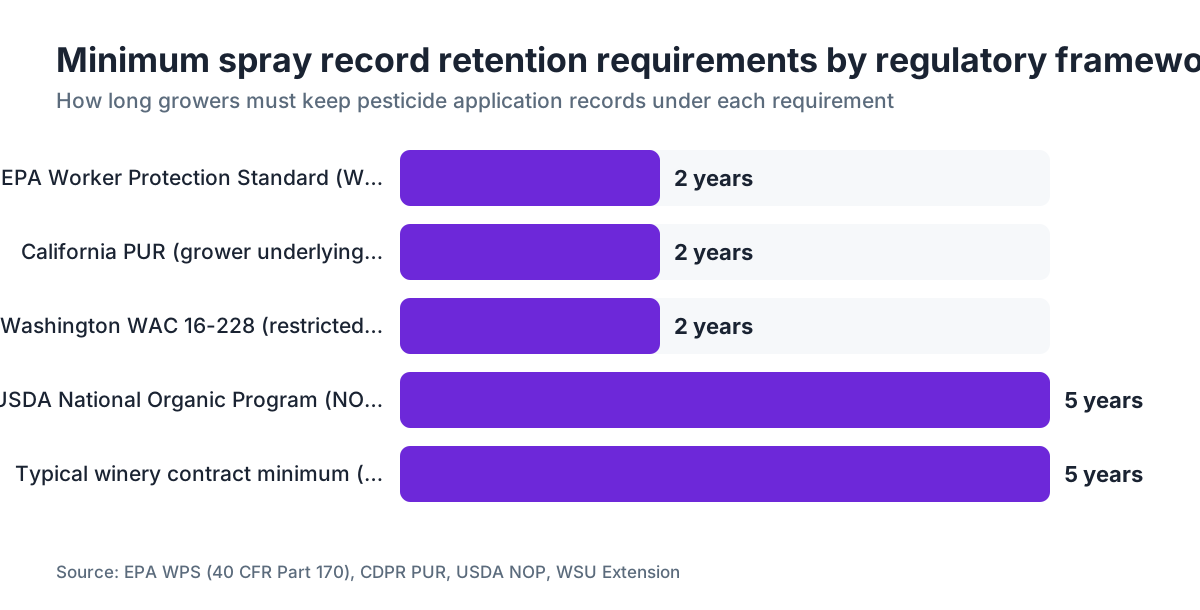
Under 40 CFR Part 170, WPS requires employers to keep records of pesticide applications for at least two years. Those records must include the product name, EPA registration number, active ingredient(s), location and description of the area treated, date(s) of application, and the restricted-entry interval (REI) for the product used [4]. EPA states directly: "Agricultural employers must keep records of all pesticide applications made to their establishment for two years" [4].
Those same records, formatted right, cover the core of what most winery contracts ask for in an in-season spray log. So WPS recordkeeping is not extra work. It is the baseline. A winery asking for your application records is asking for something you were already legally required to keep.
One thing growers miss: WPS also requires that workers and handlers get application-specific information within 24 hours of an application, including the product name, REI, and location. Central posting at the establishment's safety data center satisfies that requirement and should be documented [4].
How do state pesticide reporting requirements interact with winery approval paperwork?
Federal WPS sets the floor. States go higher. California's pesticide use reporting (PUR) system is the most extensive in the country: every pesticide application to any agricultural commodity must be reported to the county agricultural commissioner within one month of the application [5]. That report includes the grower's site ID, the product, the rate, the acreage, and the pest targeted. County data then flows to the California Department of Pesticide Regulation (CDPR) into a statewide database that anyone can search [5].
In Washington, growers using restricted-use pesticides must keep records for two years and make them available to the state Department of Agriculture on request under WAC 16-228 [6]. Oregon requires licensed applicators to keep records for two years under ORS 634 [6].
Here is why it matters for approval. In California, a winery can check your spray records against the county PUR database. If what you submitted to the winery does not match what got reported to the county, that gap will surface. Most wineries with active compliance programs in California run exactly this check before approving a grower's records each season.
Growers in other states should check with their state department of agriculture. The National Pesticide Information Center keeps a state-by-state resource for pesticide regulations [7].
What is an approved materials list (AML) and how does it drive the approval process?
An approved materials list is the winery's internal document naming which pesticides, at what rates and PHIs, are acceptable on incoming fruit. Every winery with a serious grower compliance program has one. The AML reflects the winery's liability math, its certification requirements (Napa Green, Fish Friendly Farming, CCOF, SIP Certified, Lodi Rules, etc.), and sometimes specific customer or export market requirements.
The AML is what your proposed spray program gets checked against during pre-season review. List a material that is not on the AML and one of three things happens: the winery rejects it and you revise, the winery grants a one-season exception in writing, or you use it anyway and risk a contract dispute at delivery.
Get the winery's current AML before you build your proposed spray program, not after. AMLs change year to year, especially as sustainability programs update their restricted materials lists. Lodi Rules, for example, publishes an updated pesticide risk-ranking list every year [8]. SIP Certified updates its prohibited materials list through Wine Institute and its certifier network [8].
Supply multiple wineries and you may be managing compliance against several AMLs at once. That gets complicated fast. Build one master spray program that satisfies the strictest AML you are under, then confirm it passes for the rest.
What is a typical timeline for the spray program approval process?
Timing shifts with winery size and how organized the compliance team is, but here is a realistic sequence:
| Milestone | Typical Timing |
|---|---|
| Winery distributes updated AML to growers | January to February |
| Grower submits proposed spray program | February to March |
| Winery review and approval (or revision request) | 2 to 4 weeks after submission |
| Season begins, in-season records submitted | Per winery schedule (weekly/monthly) |
| Final spray record submission | 2 to 4 weeks before harvest |
| PHI certification signed | 5 to 7 days before harvest |
| Records archived (grower obligation) | 2 years minimum (WPS and most state law) |
Miss the pre-season submission window and some wineries will still take a late program, but it creates friction. A few larger operations treat a late or missing pre-season submission as a material breach of the grower contract. Read your contract.
Preharvest is where timing gets sharp. Apply something with a 14-day PHI when you want to pick in 10, and you have a problem no paperwork fixes after the fact. That is the kind of situation that ends contracts.
How should growers organize and store spray records for compliance audits?
Organize them the way an auditor would want to find them. Chronological within each block or vineyard unit, with an index showing which records apply to which parcel. That is the whole trick.
A clean file structure for a season's spray records looks like this:
- Cover sheet: grower name, ranch name, APN or vineyard ID, winery/buyer, season year
- Pre-season documents: proposed spray program, winery approval letter or email, PCA license copies, applicator license copies
- Application records: filed by date, one record per application event, all WPS-required fields completed
- PCA written recommendations: filed with the matching application record
- In-season submissions: copies of everything sent to the winery and confirmation of receipt
- Preharvest documents: PHI certification, final spray summary, any corrective action records
Paper is fine if it stays dry and legible. Digital records in a consistent format (PDF, structured CSV, or a purpose-built platform) come out faster during an audit. The two-year retention rule under WPS means records from the 2024 season must be available through at least December 31, 2026.
For growers running multiple blocks across multiple buyers, keeping each block's records in a separate folder (physical or digital) and cross-referencing the relevant winery contract saves hours when someone calls asking for records on short notice. Tools like VitiScribe can generate formatted spray logs that already match what most winery compliance officers want, so you are not rebuilding the format every time.
WSU Extension's Viticulture and Enology program has published guidance on recordkeeping systems for Pacific Northwest growers that is worth reading even if you are nowhere near Washington [9].
What happens if a grower uses a pesticide not on the winery's approved list?
Consequences run from a warning conversation to a rejected load at harvest. Most winery contracts include language letting the winery refuse delivery of fruit if unapproved materials were used. Some contracts add residue testing at the grower's cost when a compliance concern is flagged.
The usual sequence: the grower's final spray record shows an unapproved product, the winery compliance officer flags it, there is a conversation about whether the material is actually present at detectable levels, and the winery may send a residue sample to a lab before deciding on the fruit.
Residues from some materials carry over into wine at levels European Union regulators can detect far below what EPA calls a tolerance violation. This is a real problem for wineries exporting to the EU. EU maximum residue levels (MRLs) for wine ingredients are set under Regulation (EC) No 396/2005 and are often lower than US EPA tolerances for the same compound [10]. A winery shipping to Germany or the UK has a business reason for its AML that goes past domestic compliance.
Made a genuine mistake? Document it, tell your winery contact right away, and do not wait for them to find it. The grower-winery relationship is long. Honesty about an error is survivable. A winery learning about it from a lab result you never disclosed usually is not.
How do organic and sustainability certifications change the documentation requirements?
Certified organic vineyards carry the most paperwork. USDA National Organic Program (NOP) rules require an organic system plan (OSP) that must be updated annually and approved by the certifying agent before any certified-organic product can be sold [11]. That OSP includes the field history, the allowed and prohibited materials list, and the recordkeeping plan. Every application of any substance to an organic vineyard gets logged, even if it is just sulfur or copper. Allowed materials still have cumulative limits: copper is capped at 8 pounds per acre per year under NOP rules [11].
For sustainability certifications, the added layer varies by program:
- Lodi Rules requires an annual self-assessment and pest management records using the IPM framework [8]
- Fish Friendly Farming requires documentation of pesticide application buffer distances from waterways and records of riparian area management practices
- SIP Certified includes a third-party audit every three years plus annual self-assessment submissions
- Napa Green's vineyard certification covers water, energy, and pesticide practices with record requirements in each category
If you supply a winery marketing its wine under any of these seals, your records can be audited by the certifying body, not only the winery. Your approval documents need to satisfy both sets of requirements at once. Cornell Cooperative Extension has published a useful comparison of sustainability program requirements for Northeast grape growers that translates reasonably well to western regions [12].
One honest caveat: audit frequency and rigor vary a lot between these programs. Some have strong third-party verification. Others are largely self-reported. Your winery compliance officer will know which ones they actually audit.
What should a grower-winery spray approval contract clause actually include?
Most grower contracts bury a spray compliance clause somewhere in the viticultural practices section. Many are vague in ways that create problems later. A clause worth signing spells out:
- The timeline for pre-season submission (specific date or number of weeks before bud break)
- The winery's commitment to respond within a defined review period
- Which version of the AML governs the season (include a date or version number)
- The format required for in-season records (specific fields, submission frequency)
- The preharvest documentation deadline
- The retention period required of the grower (should align with the WPS 2-year minimum at least)
- What happens if an unapproved material is used (notice obligation, testing rights, remedies)
- Whether the winery has inspection rights for the grower's spray records at the farm
- How records must be provided (paper, email, specific digital platform)
If your current contract does not spell out format requirements for spray records field by field, you and your winery contact should agree on them before the season starts, even in a short email. "Submit records by the 15th of each month" beats "records available upon request" every time.
Growers working with VitiScribe or similar vineyard record platforms can often export formatted spray logs directly in whatever structure the winery specifies, which takes most of the friction out of monthly submissions.
How do pesticide applicator license requirements affect grower submissions?
Any application of a restricted-use pesticide (RUP) needs a licensed applicator or someone working under direct supervision of one, per 7 U.S.C. 136i (FIFRA section 11) [13]. In California, you also need a PCA's written recommendation before applying any pesticide in an agricultural setting, RUP or general use, under Food and Agricultural Code section 12002 [3].
For winery compliance, the grower submission needs to document:
- The applicator's license type and number
- The state issuing the license
- The license expiration date
- For California: the supervising PCA's license number and the written recommendation
Licenses expire. This mundane problem causes real compliance headaches. If your records show a licensed applicator but their license lapsed in March and your application ran in April, you have a gap. Check expiration dates at the start of each season and document that you checked.
UC Davis Extension's viticulture programs offer training resources for PCAs and growers on pesticide recordkeeping standards that apply in California [2]. Washington State University's extension covers Washington's licensing and record requirements for grape growers in its viticulture publications [9].
What are the most common compliance failures growers make in spray documentation?
Winery compliance officers report the same handful of problems again and again. Here they are, in rough order of how often they show up.
Missing or incomplete fields. The record has the date and the product but not the rate, or not the applicator's license number. Every field matters. A record missing the applicator ID is not a compliant WPS record.
PHI violations. The grower applied a product inside its restricted preharvest interval. Sometimes it is a miscalculation. Sometimes it is a spray event that never made it into the records until someone reviewed the field. Both are serious.
License lapses. As above. The license on file from the pre-season submission expired partway through the season.
Spray program drift. The pre-season submission listed certain materials. By August, facing unexpected disease pressure, the grower used something off-program without seeking approval. The mid-season change never got documented.
Late submissions. Records land after harvest. By then any compliance issue is nearly impossible to fix.
Tank mix omissions. The record lists the primary fungicide but not the adjuvant, spreader-sticker, or acidifier added to the tank. Some adjuvants carry their own residue and label requirements.
The WSU Mt. Vernon NWREC viticulture team has published specific guidance on what triggers compliance failures in organic certification audits, and it translates well to conventional grower audits too [9].
Frequently asked questions
How far in advance does a grower need to submit a proposed spray program to a winery?
Most wineries want the proposed program in February or early March, usually four to eight weeks before bud break. The exact deadline should be written into your grower contract. If it is not, agree in writing with your winery contact before January. Missing the pre-season window does not automatically void your contract, but it removes your ability to get formal approval before you start spraying.
Does a small vineyard with no hired workers still need to comply with EPA WPS?
The EPA Worker Protection Standard applies only to agricultural establishments that employ agricultural workers or pesticide handlers. Farm with zero outside labor and WPS technically does not apply. But your winery's grower contract may require WPS-compliant records regardless. And the moment you hire anyone to work in or near treated fields, WPS applies in full. Most compliance officers recommend keeping WPS-formatted records no matter your farm size.
Can a winery require growers to use a specific digital platform for spray record submission?
Yes. Winery contracts can specify whatever submission format or platform the winery requires, provided the grower agrees to those terms. This is more common at larger operations every year. If your winery mandates a specific platform, the cost of that platform is typically a grower cost unless the contract says otherwise. Confirm before signing.
What is the difference between a pesticide use log and a WPS application record?
In practice they overlap heavily. A pesticide use log usually means the grower's internal record of every application. A WPS application record is the specific set of fields required under 40 CFR Part 170: product name, EPA registration number, active ingredient, location treated, date, and REI. A log that captures all WPS fields satisfies both. The difference matters mostly when a form only captures some fields.
How long does a grower need to keep spray records?
The EPA Worker Protection Standard requires a minimum of two years. California PUR regulations require pesticide use reports to be filed monthly, and the grower's underlying records should be kept at least as long. For organically certified vineyards, USDA NOP requires five years of records. If your contract is silent, keeping records for five years covers every federal and state requirement currently in place.
What is a preharvest interval (PHI) certification and who signs it?
A PHI certification is a signed document confirming that every pesticide applied to a given block or vineyard unit met its labeled preharvest interval before the expected harvest date. The grower or their designated representative signs it. Some wineries require the supervising PCA to co-sign. It is submitted days to weeks before harvest, depending on contract terms, and it is the winery's last formal check before fruit comes in.
Do EU export requirements change what a winery puts on its approved materials list?
Yes. EU maximum residue levels under Regulation (EC) No 396/2005 are often lower than US EPA tolerances for the same pesticide compound. A winery exporting to European markets typically reflects this in a stricter AML. If your winery sells wine in Germany, the UK, or Scandinavia, expect its AML to exclude some materials that are perfectly legal under US law. Ask your winery contact whether export markets affect the AML before you finalize your program.
What happens if a grower's spray records are audited and a gap is found?
An audit finding of a missing or incomplete record typically triggers a corrective action request from the certifying body or the winery. For organic certification, a gap can put your certification at risk for that parcel. For conventional winery compliance, a gap usually results in a warning for a first occurrence and possibly a contract remedy (testing, price adjustment, or rejected fruit) for a substantive gap like a missing PHI confirmation or an unapproved material.
Is a PCA written recommendation required in every state, or just California?
The PCA written recommendation requirement is specific to California, under Food and Agricultural Code section 12002. Other states have their own licensing and recommendation structures, but none currently have a blanket requirement for a licensed adviser's written recommendation before every agricultural pesticide application. Washington requires a licensed applicator for restricted-use pesticides under WAC 16-228 but does not require a separate adviser recommendation.
How does a grower handle mid-season changes to the approved spray program?
Contact your winery compliance contact in writing before you apply anything not in the approved program. Explain the pest or disease situation, the material you intend to use, the rate, and the PHI. Get written approval, even by email, before application. Document the request, the approval, and the application record together. Do not apply first and ask later. Mid-season approvals are common and most wineries turn them around fast, but the sequence matters for your compliance file.
Can a vineyard lose a grape purchase contract over spray compliance failures?
Yes. Most grower contracts give the winery the right to decline delivery if spray compliance obligations are not met. PHI violations and use of unapproved materials are the most common grounds. Contracts with sustainability certification requirements may add that a loss of certification is also grounds for termination. Read the termination and remedies section of your contract carefully before the season starts, not at harvest.
What spray record format works best when supplying multiple wineries with different requirements?
Build one master log that captures every field required by your most demanding buyer, usually the one with the strictest AML or an export market requirement. That master record should include every WPS-required field plus PCA recommendation reference numbers, adjuvants, and weather data. From that master log you can generate a subset for any winery that asks for less detail. It beats maintaining separate logs per buyer.
Does tank mixing two approved materials require separate approval?
Not automatically, but check. Some winery AMLs or certifications restrict certain tank mix combinations even when both individual products are approved. The label of each product must legally permit the tank mix; FIFRA requires all pesticide use to conform to the label. Document all tank mix partners, rates, and any adjuvants in your application record. If a mix is unusual, confirm with your winery contact before applying.
What university extension resources are most useful for grower spray compliance documentation?
UC Davis Cooperative Extension has detailed guidance on California PUR reporting and PCA requirements. WSU Extension's viticulture and enology program covers Pacific Northwest pesticide recordkeeping under WAC 16-228. Cornell Cooperative Extension covers New York and Great Lakes region requirements, including a useful sustainability program comparison. All three are free to access and updated more often than most commercial guides.
Sources
- California Department of Pesticide Regulation, Pest Control Adviser Requirements: California requires a licensed PCA written recommendation before any pesticide application in an agricultural setting under Food and Agricultural Code section 12002
- UC Davis Cooperative Extension, Viticulture and Enology: UC Davis Extension publishes guidance on California pesticide recordkeeping standards applicable to grape growers, including required fields for application records
- California Food and Agricultural Code Section 12002, State of California: California FAC 12002 requires a licensed pest control adviser written recommendation before any agricultural pesticide application in the state
- EPA, Worker Protection Standard for Agricultural Pesticides, 40 CFR Part 170: EPA WPS requires agricultural employers to keep records of all pesticide applications for two years, including product name, EPA registration number, active ingredient, location, date, and REI
- California Department of Pesticide Regulation, Pesticide Use Reporting: California requires every agricultural pesticide application to be reported to the county agricultural commissioner within one month of application under the statewide PUR system
- Washington State Department of Agriculture, Pesticide Management Division, WAC 16-228: Washington WAC 16-228 requires growers using restricted-use pesticides to maintain records for two years and make them available to the state on request
- National Pesticide Information Center, State Pesticide Regulations: NPIC maintains a state-by-state resource for pesticide regulations including recordkeeping requirements
- Lodi Winegrape Commission, Lodi Rules Sustainable Winegrowing: Lodi Rules publishes an updated pesticide risk-ranking list annually and requires growers to complete an annual self-assessment using the IPM framework
- Washington State University Extension, Viticulture and Enology: WSU Extension publishes guidance on Pacific Northwest pesticide recordkeeping requirements and what triggers compliance failures in organic vineyard audits
- European Commission, Regulation (EC) No 396/2005 on Maximum Residue Levels: EU MRLs for pesticide residues in wine grapes under Regulation EC 396/2005 are often lower than US EPA tolerances for the same compounds
- USDA Agricultural Marketing Service, National Organic Program: USDA NOP regulations require an annually updated organic system plan approved by the certifying agent; copper applications are limited to 8 pounds per acre per year and all substance applications must be logged
- Cornell Cooperative Extension, Viticulture and Enology Program: Cornell Extension has published a comparison of sustainability certification program requirements for grape growers applicable across wine regions
- FIFRA Section 11, 7 U.S.C. 136i, Federal Insecticide Fungicide and Rodenticide Act: FIFRA section 11 requires that any application of a restricted-use pesticide be made by or under direct supervision of a certified applicator
Last updated 2026-07-10