Vineyard spray record sharing requirements between grower and winery buyer

TL;DR
- Federal law (EPA Worker Protection Standard, 40 CFR Part 170) requires growers to keep pesticide application records for two years and make them available to workers and handlers on request.
- Winery buyers have no automatic federal right to those records, but state pesticide laws, food-safety audits, and grape purchase contracts routinely create that obligation.
- Know which layer applies to you.
What federal law actually requires growers to record and keep
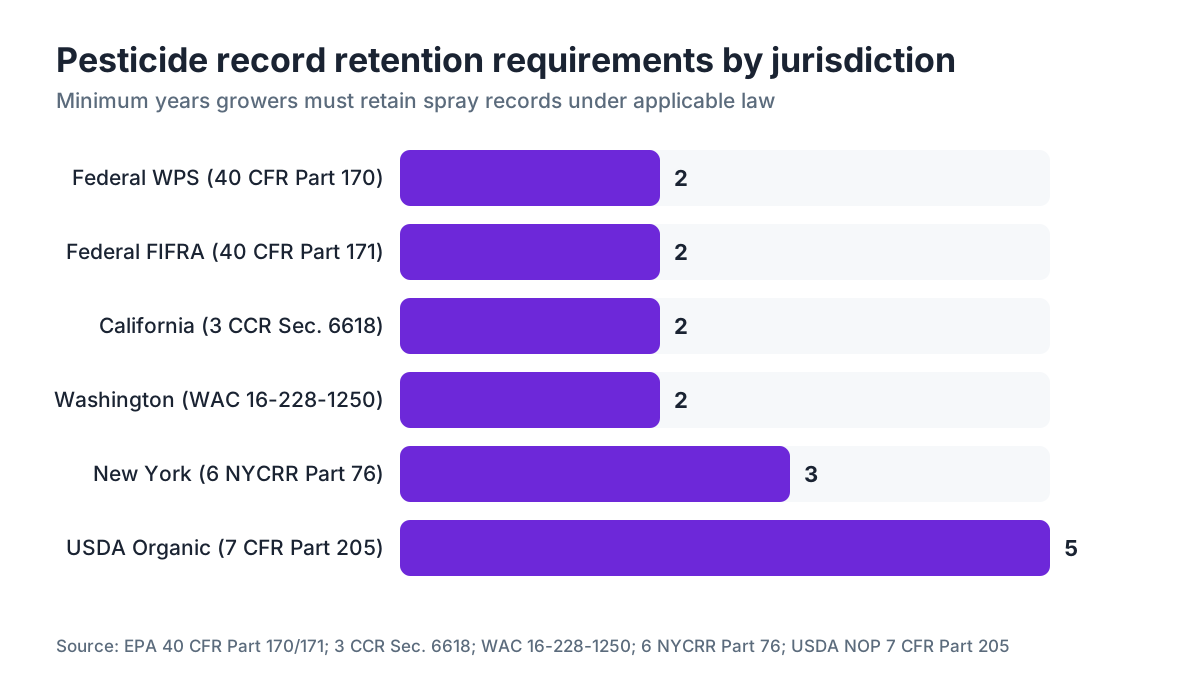
The EPA Worker Protection Standard (WPS), codified at 40 CFR Part 170, is the baseline federal rule every commercial vineyard operates under. It requires the agricultural employer to keep a record of every pesticide application for at least two years from the date of application. [1] The record must include the product name, EPA registration number, active ingredient(s), total amount applied, location and size of the treated area, date, and the name of the certified applicator.
Those records must be provided to workers or their designated representatives within fifteen minutes of a request if the request comes during normal business hours. [1] That's a worker-protection obligation, not a buyer-facing one. The WPS does not mention grape purchasers, wineries, or supply-chain partners at all.
EPA's separate FIFRA (Federal Insecticide, Fungicide, and Rodenticide Act) recordkeeping rule under 40 CFR Part 171 applies to certified applicators on restricted-use pesticides. That rule requires keeping records for two years and producing them to an authorized agent of the EPA or a state lead agency within 72 hours of a request. [2] Again, the winery buyer is not an authorized agent under FIFRA.
So from a purely federal standpoint, a grower has no statutory duty to hand spray records to a winery. The duty to share comes from somewhere else.
Which state pesticide laws add sharing or disclosure requirements?
State rules are where things get real for most buyers and sellers. California, Washington, and New York (the three largest wine-grape states by acreage) all have their own pesticide recordkeeping regulations that go past the federal floor in ways that matter.
California is the strictest. Under California Food and Agricultural Code Section 12981 and the implementing regulations at 3 CCR Section 6618, licensed pest control operators and growers who hire them must file Pesticide Use Reports (PURs) with their County Agricultural Commissioner within 30 days of application. [3] Those reports become public record. The California Department of Pesticide Regulation publishes annual summaries by county and crop. Any buyer, winery, or retailer can look up what was applied to a given commodity in a given county. Individual field-level data is accessible by county in most cases. This is not a sharing requirement between grower and buyer, exactly, but it does mean a winery can check a grower's records against the public PUR database.
Washington State requires pesticide application records under WAC 16-228-1250, with two-year retention and inspection rights by the state Department of Agriculture. [4] There's no direct grower-to-buyer sharing mandate in state statute, but Washington's food-safety programs (WSDA Good Agricultural Practices guidance) push hard for documented spray record exchange in farm-to-processor relationships.
New York requires records for certified applicators under 6 NYCRR Part 76 with a three-year retention period. [5] The state's Department of Agriculture and Markets can inspect, but the statute does not compel sharing with buyers.
Oregon, Virginia, and other significant wine states have similar structures: mandatory recordkeeping with state inspection rights, no explicit grower-to-winery sharing statute. In those states the sharing obligation is almost entirely contract-driven.
One genuine exception to watch: if a grower grows certified organic fruit, USDA National Organic Program regulations at 7 CFR Part 205 require an Organic System Plan and records that must be produced to the certifying agent and, under some certification body rules, to buyers claiming organic status on their labels. [6] That is a real disclosure obligation tied to the commodity.
How does the grape purchase contract create a legal sharing duty?
This is the practical answer for most working relationships. The grape purchase agreement is where nearly all grower-to-winery spray record sharing obligations actually live.
A well-drafted grape contract will include a clause along these lines: the grower warrants that all pesticide applications have been made in accordance with label directions, that no pre-harvest intervals (PHIs) have been violated, and that the grower will provide copies of all application records to the buyer within a specified period (often 30 days after harvest, or within 48 hours of written request). Some contracts extend that to the entire growing season on demand.
Why does the winery care? Three reasons. First, pesticide residue on incoming grapes is the winery's problem once the fruit crosses the crush pad. The TTB (Alcohol and Tobacco Tax and Trade Bureau) and FDA both have authority over adulterated wine, and certain pesticide residues that are legal on grapes can become a compliance issue in the finished wine under food adulteration statutes. Second, export markets, particularly the EU, have maximum residue limits (MRLs) for wine that are often stricter than U.S. tolerance levels. A buyer exporting to Germany or the UK needs to know what was applied. Third, retailer and restaurant audits increasingly ask wineries to document their supply chain's pesticide practices.
From a contract-drafting standpoint, if your purchase agreement doesn't have an explicit spray record provision, the winery has no enforceable claim to those records beyond what state law provides. The absence of language is a gap, not a protection.
What records does a winery buyer actually need and in what format?
The minimum useful spray record for a winery buyer includes: the commercial product name and EPA registration number, the active ingredient and signal word, the application date, the block or APN (assessor's parcel number) treated, the application rate, and confirmation that the pre-harvest interval was observed. That last point matters most.
Pre-harvest intervals for common wine-grape fungicides and insecticides range from zero days (sulfur) to 30 days or more for some systemic fungicides. Cornell's Pest Management Guidelines for Grapes list PHIs for every registered material. [7] A buyer receiving fruit 10 days after a Mancozeb application (7-day PHI) is fine. Receiving fruit 10 days after a Captan application with a 4-day PHI is also fine. But violations happen, and the only way to catch them is to have the records.
Format is usually whatever the grower has. Paper spray logs, spreadsheet exports, or digital records from field-software systems all work. Some large wineries now specify electronic submission and even require their own portal upload before the load ticket is issued. That's a buyer-side requirement enforced by contract, not by law.
A few buyers also ask for the MSDS (now called Safety Data Sheets, or SDS) for every product applied in the final 60 days before harvest. That's more than most audits require, but it's not unusual for export-focused wineries.
| Record Element | WPS Requirement | Typical Contract Requirement | EU Export Need |
|---|---|---|---|
| Product name | Yes | Yes | Yes |
| EPA reg. number | Yes | Yes | No (but helpful) |
| Active ingredient | Yes | Yes | Yes |
| Application date | Yes | Yes | Yes |
| Block/location | Yes | Yes | Yes |
| Rate applied | Yes | Yes | Yes |
| PHI confirmed | No (implied) | Often explicit | Yes |
| Applicator name | Yes | Sometimes | Rarely |
| Weather at application | No | Sometimes | No |
| SDS/label copy | No | Sometimes | No |
What are pre-harvest intervals and why do they matter for record sharing?
The pre-harvest interval is the minimum number of days that must pass between the last application of a pesticide and harvest. It's set by the EPA during registration and printed on the label. Using a product closer to harvest than the label allows is a federal violation of FIFRA, and the fruit may be considered adulterated. [2]
For the winery buyer, a PHI violation on incoming grapes is a serious food-safety and regulatory event. The fruit can't legally be sold as wine if the wine would contain residues above the established tolerance. That's the scenario wine buyers lose sleep over.
UC Davis Cooperative Extension has published vineyard pesticide guides that include PHI tables for the major wine-grape pests and diseases. [8] WSU Extension produces similar materials for Washington growers. [9] Both are worth bookmarking.
The spray record exchange solves this specifically: if the winery receives dated application records with product name and PHI, it can independently confirm that the interval was honored before accepting the load. Some wineries do this on every delivery. Others spot-check. A buyer who never asks is flying blind.
Does food-safety certification (FSMA, SQF, GlobalG.A.P.) require spray record sharing?
Yes, in practice, even if the statute doesn't use those words.
The FDA Food Safety Modernization Act's Produce Safety Rule (21 CFR Part 112) covers most fresh produce but has a specific exemption for grapes and other commodities that are rarely consumed raw in their commercial form, since wine undergoes a transformation (fermentation and processing) that is considered a kill step for pathogens. [10] So FSMA's Produce Safety Rule does not typically require growers to share spray records with wine buyers on its own terms.
The FSMA Preventive Controls for Human Food rule (21 CFR Part 117) does apply to the winery as a food facility, though. A winery's Hazard Analysis and Risk-Based Preventive Controls (HARPC) plan should identify pesticide residues as a potential chemical hazard in raw material (grapes). The standard control for that hazard is supplier verification, which practically means getting spray records. The FDA has not published a specific MRL list for wine; it defers to tolerances set under FIFRA, but the audit expectation is that you have a supplier program.
SQF (Safe Quality Food) certification and GlobalG.A.P. are third-party audit schemes that wine buyers use to satisfy retail customers. Both require documented pesticide application records and, in buyer-supplier situations, documented evidence that the buyer has reviewed them. GlobalG.A.P.'s grower module (IFA standard, version 5.4 onward) includes a specific requirement for spray records to be available for inspection. [11] If your winery buyer is SQF or GlobalG.A.P. certified, expect a contractual spray record sharing requirement regardless of what state law says.
How should a grower set up their spray records to make sharing easy?
The grower who makes sharing easy gets paid faster and gets fewer calls at harvest. That sounds obvious, but it's worth being specific about what easy actually means.
Keep records by block, not by date. A winery buyer asking about the Cabernet Sauvignon in block 7 does not want to dig through a calendar-sorted log hunting for every entry that mentions that block. Block-sorted records let the buyer pull the complete history for a single lot in minutes.
Record at application, not at the end of the week. Memory gaps cause errors. If you applied at 6 AM and wait until Friday to log it, the rate, the exact date, and the weather conditions are approximations at best.
Keep the product label with your records, or at minimum the EPA registration number and the current PHI. Labels change. An EPA registration number lets anyone look up the current label on the EPA's Pesticide Product Label System. [12] If a product's label changed mid-season and the PHI was extended, you need to know that.
Use a consistent format your buyer can read. A single-page spray log template from your county farm advisor or extension service works fine for most small operations. If you're managing more than 50 acres for multiple buyers, a digital field-records system (like VitiScribe, which exports spray logs by block in buyer-ready format) saves real time at harvest. The format matters less than the discipline of recording and organizing.
Store records in two places. Fire, flood, and a spilled coffee have all destroyed spray logs. Cloud backup or a paper copy in a separate location is not overcautious.
What should a winery buyer put in the grape purchase contract about spray records?
At minimum, a grape purchase contract should include four things on this topic.
First, a warranty clause. The grower warrants that all pesticide applications were made according to label directions, that no PHIs were violated, and that the fruit meets all applicable state and federal pesticide tolerance requirements at the time of delivery.
Second, a disclosure obligation. The grower agrees to provide copies of all pesticide application records for the vintage year within X days of written request (30 days is common; 5 business days before harvest delivery is better for operational reasons).
Third, an audit right. The buyer may inspect or audit the grower's spray records during normal business hours with reasonable advance notice. This protects the buyer if a residue issue surfaces after harvest and the buyer needs to trace it.
Fourth, a remedy clause. If a PHI violation is discovered after delivery, what happens? Some contracts provide for rejection of the load, price reduction, or indemnification of the buyer's costs for residue testing. Without this language, the buyer's remedies are limited to whatever state commercial law provides for breach of warranty, which is less predictable.
Wineries exporting to the EU should add a fifth element: an EU MRL compliance representation. The EU has distinct MRLs for wine under Regulation (EC) No 396/2005, and some materials legal in the U.S. either have no established EU tolerance or have a tolerance lower than the U.S. level. A grower who didn't know that doesn't get a pass when the shipment is rejected at Rotterdam.
What happens if a grower refuses to share spray records with a winery buyer?
If there's a contract and it requires sharing, refusal is a breach. The buyer's remedies depend on the contract language and state law, but at minimum the buyer can reject the load, withhold payment pending compliance, or sue for damages caused by the breach.
If there's no contract provision requiring sharing, the grower is under no general legal obligation to hand over records voluntarily. State law doesn't usually compel it outside of the public reporting system (California's PUR is the clearest example). The buyer's power here is commercial, not legal: the grower who won't share records is a grower who probably won't get the contract renewed.
In practice, a grower who stonewalls on spray records during a quality dispute or after a residue detection is in a very bad position. Courts have not been kind to producers who could have documented compliance and chose not to. The absence of records, or refusal to produce them, is often treated as evidence that something was wrong.
For small vineyard operations selling to a single winery, the relationship usually resolves this informally. The disputes that end up in litigation are almost always between larger operations where the commercial stakes justify the legal cost.
How do organic and sustainable certification programs change the picture?
Organic certification changes everything here. Under the USDA National Organic Program, a certified organic grower must maintain records that fully disclose all activities and transactions for five years (not two), and those records must be available to the certifying agent and to the USDA's Agricultural Marketing Service. [6] If a winery is purchasing fruit for a wine labeled as certified organic, the winery itself is part of the organic supply chain and must also be certified by a USDA-accredited certifier. In that structure, the certifying agent has explicit inspection rights over both the grower's and the winery's records. The buyer and seller are both accountable to the same third-party auditor, which creates a practical sharing requirement even if it's not framed as grower-to-buyer disclosure.
Sustainable certification programs vary a lot. California's Certified California Sustainable Winegrowing (CCSW) program, managed by the California Sustainable Winegrowing Alliance, requires participants to complete an annual self-assessment that includes pesticide use practices, but the program does not mandate sharing those records with buyers. [13] LIVE (Low Input Viticulture and Enology) certification in the Pacific Northwest has similar self-assessment structures.
Some regional sustainability programs are moving toward third-party verification, which would change this. If verification becomes the standard, expect spray record sharing to become a certification condition rather than just a best practice.
The short version: organic means mandatory and auditable. Sustainable usually means voluntary and self-reported, for now.
What's the practical workflow at harvest when records need to change hands?
Harvest is chaotic. Having a clear protocol agreed before the season starts saves grief when everyone is exhausted and fruit is coming in fast.
A reasonable pre-harvest protocol: 10 days before your earliest estimated pick date, the grower sends the buyer a complete spray log for the year to date for the contracted blocks, sorted by block. The buyer reviews for PHI compliance and any materials that might affect their export or certification status. Any questions get resolved before the load ticket is issued, not at the crush pad at midnight.
For large multi-block contracts, some wineries use a sign-off form: the grower signs a statement that the records provided are complete and accurate, the buyer signs that they've reviewed them. That document lives with the harvest contract.
If records are kept digitally, an email export to the buyer's designated contact with a read receipt covers the transfer. Paper records should be copied and the copy signed and dated by the grower. Either way, document that the exchange happened and when.
Post-harvest, the grower keeps the originals for the full retention period (two years federal, three in New York, five for organic). The winery buyer keeps their copy for their own compliance records. If the winery has a Preventive Controls plan under FSMA, their copy of the grower's spray records is part of their supplier verification documentation and has its own retention period of two years under 21 CFR Part 117. [10]
If you're managing this paperwork across multiple growers and multiple buyers, a platform like VitiScribe that timestamps record delivery and stores both parties' copies can remove a lot of the he-said-she-said from a later dispute.
Are there liability risks for a winery that doesn't request spray records?
Yes, and they're underappreciated.
A winery that accepts grapes without reviewing spray records has made no documented effort to verify that the fruit was produced in compliance with pesticide laws. If a residue issue surfaces in the finished wine, the winery's ability to defend itself (to a regulator, to a retailer, or in litigation) is compromised by the absence of supplier verification. The legal concept here is negligence: a reasonably prudent winery in your position would have requested and reviewed spray records. Failing to do so is a departure from that standard.
The FDA's Preventive Controls framework under FSMA reinforces this. A winery with a written HARPC plan that identifies pesticide residues as a supply-chain hazard but has no supplier verification records is not in compliance with its own plan. That's an FDA inspection finding.
On the commercial side, most general liability and product liability insurance policies for food and beverage producers include some version of a "reasonable care" requirement. An insurer presented with a pesticide residue claim against a winery that never asked for spray records has a reasonable argument that the insured didn't exercise reasonable care. That argument might not win, but it will slow down a claim.
The cost of requesting records is zero. The cost of not having them when you need them is not.
Frequently asked questions
Does federal law require a grower to give spray records to a winery buyer?
No federal statute requires a grower to proactively share spray records with a winery buyer. The EPA Worker Protection Standard (40 CFR Part 170) requires two-year record retention and worker access, and FIFRA requires records for certified applicators, but neither creates a grower-to-buyer disclosure duty. That obligation comes from state pesticide law, grape purchase contracts, or food-safety certification requirements.
How long must a vineyard grower keep pesticide application records?
Federal WPS rules require a minimum of two years from the date of application. FIFRA certified-applicator rules also require two years. New York state law requires three years. USDA National Organic Program requires five years. Growers selling to buyers with specific audit or certification requirements should keep records for the longest applicable period. When in doubt, keep everything for five years; storage is cheap compared to a gap in documentation.
What is a pre-harvest interval and why does it matter for record sharing?
A pre-harvest interval (PHI) is the minimum number of days between the last pesticide application and harvest, as specified on the product label. Harvesting before the PHI has elapsed is a federal FIFRA violation and can result in residues above established tolerances in the fruit. Spray record sharing lets the winery buyer verify that every application respected its PHI before accepting delivery, which is the single most important compliance check at harvest.
Does California's Pesticide Use Report system satisfy a winery buyer's need for spray records?
Partially. California's PUR system (required under Food and Agricultural Code Section 12981) creates public records of pesticide use by county and commodity, and a buyer can access county-level summaries. But PUR data is filed within 30 days of application and is aggregated at the county level for public access; it doesn't give a buyer real-time, block-level PHI verification. A direct record exchange with the grower is still necessary for harvest-level compliance checks.
What spray record language should a grape purchase contract include?
At minimum: a grower warranty of label compliance and no PHI violations, an obligation to provide complete application records within a specified period (ideally 5 to 10 business days before harvest), a buyer audit right, and a remedy clause for PHI violations discovered after delivery. Wineries selling to the EU should add a representation that no materials were applied in violation of EU MRLs under Regulation (EC) No 396/2005.
Do FSMA rules require wineries to collect spray records from grape growers?
The FSMA Produce Safety Rule generally exempts wine grapes because fermentation is considered a transformation that addresses raw-commodity safety concerns. But the FSMA Preventive Controls rule (21 CFR Part 117) applies to the winery as a food facility. If a winery's Hazard Analysis identifies pesticide residues as a supply-chain hazard, the standard control is supplier verification, which in practice means collecting and reviewing spray records. FDA auditors look for documented supplier programs.
How do EU wine export requirements affect spray record sharing between grower and winery?
The EU sets pesticide MRLs for wine under Regulation (EC) No 396/2005. Some materials legal in the U.S. have no established EU tolerance, which defaults to 0.01 mg/kg (essentially a prohibition). A winery exporting to the EU needs spray records to confirm that no prohibited or non-compliant materials were applied. This is typically enforced through the grape purchase contract rather than statute, but it's a hard commercial requirement for any export-focused operation.
What records must organic vineyard growers share with winery buyers?
Under the USDA National Organic Program (7 CFR Part 205), certified organic growers must maintain complete records for five years and make them available to their certifying agent. If the winery is also certified organic and purchasing fruit for an organic-labeled wine, both parties are subject to the same certifying agent's oversight. In practice, the certifying agent has inspection rights over both sets of records, creating an effective sharing requirement through the certification structure.
Can a grower legally refuse to share spray records with a winery buyer?
If the contract requires sharing, refusal is a breach. If the contract is silent, no general statute compels a grower to share records with a buyer (outside California's public PUR system, which is separately accessible). The practical consequence of refusal is usually commercial: a grower who won't document compliance is unlikely to keep the contract. Courts have also treated refusal to produce available records as evidence of non-compliance in pesticide-related disputes.
What format should spray records be in when shared with a winery buyer?
There's no legally required format for buyer-facing record sharing. A grower's standard spray log, whether on paper, in a spreadsheet, or exported from field-management software, is acceptable as long as it includes the product name, EPA registration number, active ingredient, application date, block treated, rate applied, and confirmation of PHI compliance. Block-sorted records (rather than calendar-sorted) are the most useful format for a buyer trying to verify a specific lot.
How does GlobalG.A.P. certification affect spray record sharing for wine grape growers?
GlobalG.A.P.'s Integrated Farm Assurance (IFA) standard requires certified growers to maintain complete pesticide application records and make them available for inspection by the certifying body. Where a winery buyer is GlobalG.A.P. certified and requires supplier compliance, the grower's records become part of the buyer's documented supplier verification program. This creates a contractual sharing obligation even in states with no explicit statutory requirement.
What's the retention period for spray records under the EPA Worker Protection Standard?
The EPA Worker Protection Standard at 40 CFR Part 170 requires a two-year retention period from the date of application. Records must be made available to workers or their designated representatives within 15 minutes of a request during normal business hours. This is a minimum; state law and contractual obligations frequently require longer retention periods, and growers should keep records for the longest applicable period.
Should a winery buyer conduct residue testing instead of relying on spray records?
Testing and record review serve different purposes. Residue testing can detect violations that records don't show (or that were falsified), but it's expensive (typically $200 to $500 per sample for a multi-residue screen), time-consuming, and can't catch every compound. Spray record review is free and catches PHI and label violations before they become residue problems. Most buyers should do both: records as the baseline check, targeted testing when something looks off or for export shipments with strict MRL requirements.
Sources
- EPA, Worker Protection Standard 40 CFR Part 170: WPS requires two-year retention of pesticide application records and production to workers within 15 minutes of request
- EPA, FIFRA Section 8 and 40 CFR Part 171 certified applicator recordkeeping: FIFRA requires certified applicators to retain restricted-use pesticide records for two years and produce them to authorized EPA or state agents within 72 hours
- California Department of Pesticide Regulation, Pesticide Use Reporting: California Food and Agricultural Code Section 12981 and 3 CCR Section 6618 require pesticide use reports filed with county agricultural commissioner within 30 days of application
- Washington State Department of Agriculture, pesticide recordkeeping under WAC 16-228-1250: Washington requires two-year retention of pesticide application records with state Department of Agriculture inspection rights
- New York State Department of Environmental Conservation, pesticide recordkeeping under 6 NYCRR Part 76: New York requires certified applicators to retain pesticide records for three years
- USDA Agricultural Marketing Service, National Organic Program 7 CFR Part 205: NOP requires certified organic operations to maintain complete records for five years and make them available to the certifying agent
- Cornell Cooperative Extension, Pest Management Guidelines for Grapes: Cornell's Pest Management Guidelines list pre-harvest intervals for all registered wine-grape pesticides
- UC Davis, UC Statewide Integrated Pest Management Program (UC IPM) grape guidelines: UC IPM publishes vineyard pesticide guides with PHI tables for major wine-grape pests and diseases
- Washington State University Extension: WSU Extension produces pesticide guidance materials for Washington grape growers
- GLOBALG.A.P., Integrated Farm Assurance Standard: GlobalG.A.P. IFA standard requires certified growers to maintain and make available pesticide application records for inspection by the certifying body
- EPA, Pesticide Product Label System (PPLS): EPA's Pesticide Product Label System allows lookup of current registered labels by EPA registration number
- California Sustainable Winegrowing Alliance, Certified California Sustainable Winegrowing program: CCSW requires annual self-assessment including pesticide practices but does not mandate direct grower-to-buyer spray record disclosure
Last updated 2026-07-09