Best backpack sprayer for vineyard use: how to choose and what to buy

TL;DR
- For most small vineyard operations, a 4-gallon battery-powered backpack sprayer with an adjustable brass nozzle handles fungicide and pesticide applications efficiently.
- Expect to spend $80-$350 depending on battery vs.
- manual, tank size, and pump quality.
- Key specs: 0.5-1.0 GPM flow rate, 40-60 PSI max pressure, and a comfortable shoulder harness for all-day use.
What makes a backpack sprayer actually work in a vineyard?
Vineyards are not lawns. Rows are narrow, canopy height changes by season, the foliage you need to penetrate is thick at bloom and thicker at veraison, and you're often on a slope. A sprayer that works fine for spot-treating weeds in an orchard can be a miserable tool in a tight Pinot Noir block.
Three things decide whether a backpack sprayer earns its keep here: reach, pressure consistency, and how heavy it is when full. A gallon of water weighs about 8.3 pounds. Fill a 4-gallon tank and you're carrying 33-plus pounds before the unit's own weight. Fill a 5-gallon and you're looking at 45-plus. That matters at hour three on a steep block.
Pressure consistency is the spec most buyers overlook. Manual piston pumps build pressure in bursts, so your spray pattern shifts between strokes. Diaphragm pumps on battery units hold a steadier PSI, which means more uniform coverage. That matters when you're applying a contact fungicide like copper and need the whole leaf surface hit. UC Davis Cooperative Extension notes that uniform droplet deposition is a key factor in efficacy for botrytis and powdery mildew programs [1].
Reach matters for trellis systems specifically. Run VSP with a high catch wire and you need a wand long enough to get under the canopy without contorting. Most commercial-grade backpack wands run 20-30 inches. Some have a curved or 90-degree tip that makes canopy penetration much easier.
Battery backpack sprayer vs. manual pump: which is better for vineyards?
This comes down to acreage and how often you spray. Managing 5 acres or less and spraying only a few times a season? A quality manual diaphragm-pump backpack does the job. Running 10-plus acres and spraying on a 7-14 day interval during disease pressure season? A battery backpack vineyard sprayer will save your arm and your back.
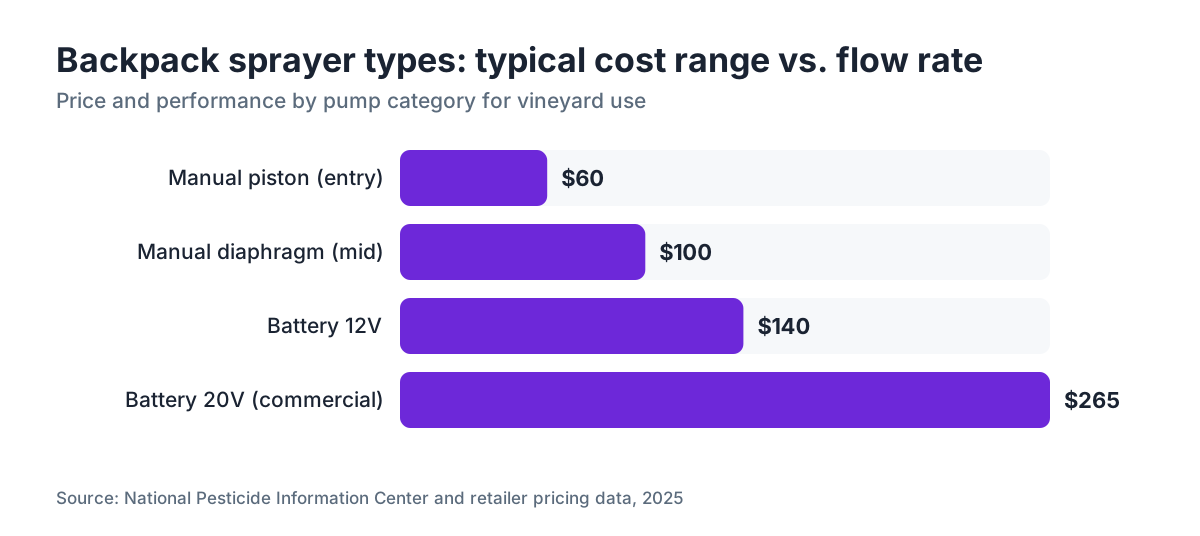
Manual units cost $40-$120 for a decent one. Battery units run $150-$350 for a vineyard-worthy model. The battery models use either a 12V or 20V lithium system. The 20V units from brands like RYOBI, ECHO, and Chapin deliver 0.5-0.8 GPM without any pump strokes, which is the main functional advantage.
Battery life is the legitimate concern. Most 20V battery sprayers cover 2-4 full tanks on a single charge, depending on pressure setting. Some users report 6-8 tanks if they run at lower PSI. Carry a spare battery if you're doing a full spray day. They're typically $40-$80 extra.
One thing people don't talk about enough: battery sprayers are quieter and take less muscle, which is why the pressure stays even the way the section above describes. They're also easier on the body under the EPA Worker Protection Standard requirements for field workers, since reduced repetitive-motion fatigue is real [2].
For a small estate owner doing their own spraying, a battery backpack in the $200-$280 range is the right call in most cases. Manual is fine for small blocks or touch-up work.
| Type | Typical Cost | Flow Rate | Best For |
|---|---|---|---|
| Manual piston | $40-$80 | Variable, 0.2-0.6 GPM | Under 3 acres, occasional use |
| Manual diaphragm | $80-$120 | More consistent, 0.3-0.5 GPM | Small blocks, budget |
| Battery 12V | $100-$180 | 0.4-0.6 GPM | Light-duty, small tanks |
| Battery 20V | $180-$350 | 0.5-0.8 GPM | 5-15 acres, regular programs |
What tank size do you need for vineyard rows?
The standard sizes are 2 gallon, 3 gallon, 4 gallon, and 5 gallon. For vineyard work, 4 gallons is the sweet spot for most people.
Here's the math. A typical Bordeaux-style fungicide program applies at 50-100 gallons per acre for a hand-sprayer setup [11]. If your rows are 100 feet long at 10-foot spacing, you have roughly 43 rows per acre. A 4-gallon backpack refilled once covers a real stretch of row before you're walking back to your mix station. Anything smaller and you're refilling constantly. Anything larger and the weight becomes the limiting factor.
Doing foliar fertilizers or a light sulfur alternative at lower volumes? A 3-gallon unit is enough and keeps the carry weight down. Running a larger operation with cover crop spraying or pre-emergent applications on top of canopy work? 5 gallons covers more ground between refills, but you'll feel it on a slope.
One practical note. You'll be bending, reaching, and crouching in the vine rows. A tank that fits your back frame at the retailer may shift awkwardly when you're pushing through a dense canopy. Look for models with a wide padded hip belt. That hip belt does more work than the shoulder straps.
Which nozzle types work best for vine canopy applications?
The nozzle matters more than the pump type. Three configurations come up most in vineyard use: flat fan, adjustable cone, and hollow cone.
Flat fan nozzles give you a wide even swath, good for pre-emergent herbicide under the vine row, but they're weak for canopy penetration. Adjustable cone nozzles let you switch between a tight stream for reaching high on the trellis and a wide cone for canopy work, which is why most vineyard operators keep them on for multipurpose spray days.
Hollow cone nozzles produce smaller droplets that penetrate dense canopies better. That matters for powdery mildew programs where you need abaxial (underside) leaf coverage. Cornell's viticulture extension research on powdery mildew management emphasizes that coverage of the underside of leaves is where the pathogen overwinters and where early infections establish [3].
Brass nozzles outlast plastic in agricultural chemical service. They handle sulfur and copper-based fungicides better over time. Plan to replace plastic nozzle tips annually if you run them through a full season. Brass tips are worth the extra $5-$15 per tip.
Tip size matters too. A TeeJet 8003 flat fan nozzle at 40 PSI delivers roughly 0.3 GPM. An 8008 at the same pressure delivers 0.6 GPM. Know your calibration before you spray. WSU Extension has a straightforward sprayer calibration worksheet that works for backpack units [4].
How do you calibrate a backpack sprayer for vineyard applications?
Calibration is the part most small growers skip, then wonder why their fungicide program isn't working or why they're running out of product. It's not complicated.
The basic method: fill the tank with clean water. Spray a measured distance of row, say 100 feet, at your normal walking pace and pump pressure. Measure how much water you used. That gives you output per 100 feet of row. Multiply by the number of rows per acre and you get gallons per acre delivered. Compare that to the label rate. Adjust nozzle size or walking speed to hit the target.
WSU Extension's calibration guide recommends doing this at the start of each season and whenever you change nozzles or spray materials [4]. Pressure changes output a lot. Dropping from 60 PSI to 40 PSI on the same nozzle can cut output by 15-20%.
For battery sprayers with a pressure dial, note the exact setting you used during calibration and keep it there. Manual pumpers need a consistent stroke rhythm, which is harder to hold, which is one more reason battery units tend to deliver more even coverage.
Record your calibration results. This is also where software like VitiScribe makes the compliance side easier, since calibration data feeds directly into your pesticide application records, which many states require you to keep for a minimum of two years [5].
What are the EPA Worker Protection Standard requirements for backpack sprayers in vineyards?
The EPA's Agricultural Worker Protection Standard (WPS), revised in 2015 and administered under 40 CFR Part 170, covers anyone who handles pesticides in agricultural settings, including small vineyard owners doing their own spraying [2].
Key requirements that apply to backpack sprayer use: you must have and use the personal protective equipment (PPE) listed on the pesticide label. For most fungicides applied by backpack in a vineyard, that means at minimum chemical-resistant gloves, long sleeves, long pants, and closed-toe shoes. Some materials, particularly organophosphates or systemic fungicides with higher toxicity ratings, require a respirator.
The WPS also requires that pesticide safety information be available to handlers and that a decontamination site (water, soap, single-use towels) be accessible within a quarter mile of where you're working. For a solo owner-operator, that often means a jug of clean water and soap in the truck at the end of the row.
The EPA WPS guidance states that handlers must be trained in pesticide safety before performing handler activities [2]. Annual training is required for all pesticide handlers, including owners who handle their own materials.
Record every application. Most states require pesticide application records for restricted-use pesticides within 24 hours of application, and general-use pesticide records within a few days. Check your state ag department for exact timelines [5].
For a fuller look at how your field operations and spray records connect, see vineyard for the broader compliance picture.
How much does a good vineyard backpack sprayer cost?
Real price ranges as of mid-2025, based on major ag supply retailers:
Entry-level manual units (brands like Solo, Chapin, Hudson): $35-$80. These work. They're not comfortable for all-day use and the seals wear faster than commercial-grade units, but for a hobbyist or someone with less than an acre of vines, they're fine.
Mid-range manual or 12V battery units: $80-$180. This is where you find the Solo 425, Chapin 63985, and similar units with better harness systems and more durable pump assemblies. Many ag supply stores carry these.
Commercial-grade battery backpack sprayers (20V, 4-5 gallon): $180-$350. ECHO PB-2520, RYOBI One+ 18V, Chapin 63924, and the Birchmeier (Swiss-made, considerably more expensive at $250-$400 just for the manual version) sit in this tier. The Birchmeier units have a reputation among professional vineyard consultants for longevity, but you're paying for that.
Replacement parts matter more than initial cost for a regular spray program. Nozzles, seals, and pressure relief valves all wear. Brands with US distributor networks (Solo, Chapin, ECHO) are easier to get parts for than imports with no local parts supply.
Don't buy the cheapest unit you find on a general merchandise site without checking whether replacement seals and nozzles are available. A $45 sprayer you can't fix after one season is worse than a $150 unit you can maintain for a decade.
What are the best backpack sprayer brands for vineyards in 2025?
A few brands come up again and again in vineyard operator discussions and ag extension recommendations. None of these are paying for the mention.
Solo (Germany): The Solo 425 is widely used in US vineyards for good reason. It has a diaphragm pump, comfortable padded straps, and parts are easy to source through ag supply chains. The 4.5-gallon version is the standard. Around $100-$130.
Chapin International: American brand, widely distributed. The Chapin 63985 battery unit (18V) and the 63924 are popular for small vineyard operations. Build quality is acceptable, and the company has real customer support. The battery models run $160-$220.
ECHO (Yamabiko group): ECHO makes some of the better battery backpack vineyard sprayers on the market right now. The PB-2520 runs on their 56V battery system, which gives longer runtime than most competitors. Around $250-$300. If you already use ECHO power equipment in the vineyard, the battery compatibility is a real advantage.
Birchmeier (Switzerland): The Rucksack RE 15 and RE 20 are manual units used by professional vineyard managers in Europe and increasingly in Napa and Sonoma. Build quality is exceptional. Price is $250-$400 for the manual version, which tells you something about who they're targeting.
For most operations under 10 acres running a standard spray program, a Solo 425 or Chapin battery unit hits the right balance of cost, parts availability, and performance. The ECHO battery units are worth the premium if you're spraying more than 15 times per season.
How do you maintain a backpack sprayer between spray days?
Maintenance is the thing that separates a sprayer that lasts eight seasons from one that dies after two.
After every use: rinse the tank three times with clean water, and spray the rinse water through the nozzle. Don't leave chemical residue sitting in the tank. Copper fungicides are especially corrosive to metal fittings if left to dry.
At the end of season: disassemble the pump, inspect the diaphragm or piston cup for cracks or hardening, and replace if there's any doubt. Seals cost $5-$15 and are the most common failure point. Lubricate O-rings lightly with a petroleum-free lubricant. Store with the tank cap loose to prevent pressure buildup and seal distortion.
For battery units: charge the battery to 40-60% before long-term storage. Lithium batteries degrade faster if stored fully charged or fully depleted. Keep the battery indoors during winter storage.
Inspect nozzle tips each season under good light. Worn tips produce larger droplets and irregular patterns. A worn nozzle is one of the most common reasons a spray program underperforms, and it can create drift problems, which carry regulatory implications under WPS [2].
Keep a spare nozzle set and a full seal kit in your spray supply box. At $10-$25 per kit, there's no reason to get caught mid-season with a blown seal.
For broader record-keeping on your spray program, including logging equipment calibration and maintenance dates, VitiScribe handles that documentation in the same system where you track your pesticide applications, which keeps audits straightforward.
Can a backpack sprayer cover enough acres for a commercial vineyard?
Honestly, a backpack sprayer is a supplemental tool for most commercial operations, not a primary one. A tractor-mounted airblast sprayer or boom sprayer covers volume a backpack can't match once you're over 5-10 acres on a regular spray schedule.
Still, backpack sprayers have real roles even in larger vineyards. Spot treatments, escape vine management, areas the tractor can't reach (end rows, narrow terraced blocks, hillside sections with access issues), and applying biological controls at lower volume rates are all legitimate backpack tasks in a 50-acre vineyard.
Cornell's farm operations resources note that hand-application equipment including backpack sprayers remains standard for small-scale and specialty crops where equipment access is limited [6]. The trick is not stretching a backpack into tasks where the volume and coverage demands exceed what you can realistically deliver on foot.
For a hobby or small estate vineyard under 3 acres, a backpack sprayer can absolutely be your primary spray equipment. Between 3 and 8 acres, think hard about whether a small ATV-mounted or UTV-mounted tank sprayer makes more sense for at least your canopy fungicide applications. Above 8 acres, airblast is almost always the right primary tool and the backpack fills in around the edges.
Nobody has great public data on the exact acreage crossover point where the economics flip decisively. Most grower discussions in extension networks put it at 5-8 acres, where the time cost of backpack applications starts to exceed the equipment investment for a simple UTV sprayer setup.
What safety gear do you need when operating a backpack sprayer in the vineyard?
The label is the law. That's not a slogan, it's the legal reality. The pesticide label specifies the minimum PPE required, and using the product without that PPE is a federal violation under FIFRA [7].
For most fungicides commonly used in vineyards (sulfur, copper, captan, myclobutanil): chemical-resistant gloves (nitrile minimum, butyl rubber preferred for systemic fungicides), long-sleeved shirt and long pants, shoes plus socks, and protective eyewear. Some labels add a dust/mist filtering respirator, particularly for sulfur dust applications.
For herbicides applied under the vine row: many common vineyard herbicides (glyphosate, oxyfluorfen, flumioxazin) require added protection. Read the specific label for each product every time. Labels change when products are re-registered.
Heat is a real issue. Chemical-resistant gloves and a full-length protective suit on a July afternoon in the Central Valley, or in a hot-summer Eastern Washington vineyard, are brutal. Many applicators work early morning to manage both the heat and the evaporation and drift risk from midday applications. UC Davis extension research on heat illness in agricultural workers is directly relevant here, since applicators in hot conditions face compounded physiological stress [8].
Never eat, drink, or smoke while applying pesticides. Wash hands and face before eating or touching your face. These sound obvious. They're also the behaviors that account for most dermal and oral exposure incidents in farm settings.
How do spray records for backpack applications work in a vineyard compliance program?
Applying a restricted-use pesticide (RUP) or a general-use material, you still need a paper trail either way. For RUPs, federal law under FIFRA requires certified applicator records kept for two years [5]. Most states require similar records for general-use pesticides applied commercially.
A compliant spray record for a backpack application needs: the date, the location (block or parcel identification), the target pest, the product name and EPA registration number, the rate applied, the total amount of product used, the application method (backpack sprayer), the applicator's name, and the weather conditions at time of application.
Weather conditions matter for two reasons. First, some labels prohibit application when wind speed exceeds a certain threshold, typically 10-15 mph, to prevent drift. Second, temperature and relative humidity affect efficacy for many fungicides, particularly sulfur, which can cause phytotoxicity above certain temperatures.
For a small vineyard doing a dozen spray events per year, a paper logbook works. For anything bigger, or any operation that's been through a compliance audit, digital records with timestamps and GPS coordinates hold up much better. The state department of agriculture can request pesticide records during an inspection, and the records need to be legible and complete.
Some county agricultural commissioners in California, Washington, and Oregon have their own reporting requirements on top of state and federal rules [9]. Know your county requirements. They vary.
Frequently asked questions
How many acres can you realistically spray with a backpack sprayer in a day?
Under typical vineyard conditions, an experienced operator with a 4-gallon backpack sprayer can cover 1-2 acres per day at a canopy fungicide rate. Speed depends heavily on row spacing, walking speed, refill distance, and application volume. At very low-volume foliar applications (10-20 gallons per acre), you might hit 3 acres. At full-coverage rates of 80-100 gallons per acre, one acre is a full day of work.
What PSI should a vineyard backpack sprayer run at?
Most vineyard applications work well between 30 and 60 PSI. Canopy penetration for dense foliage often benefits from 45-60 PSI. Lower pressure (20-30 PSI) reduces drift and suits herbicide applications under the row. Check your nozzle manufacturer's rated pressure range. Running above the nozzle's rated maximum wears the orifice faster and produces inconsistent output.
What is the best nozzle for spraying fungicides on grapevines?
For powdery mildew and botrytis programs where canopy penetration matters, an adjustable hollow cone or a 90-degree angled hollow cone nozzle in brass is the most effective. It produces smaller droplets that penetrate dense canopy and cover leaf undersides where pathogens establish. For pre-emergent herbicide applications under the vine, a flat fan nozzle with a shield is better to reduce off-target contact.
Is a battery-powered backpack sprayer worth the extra cost for a small vineyard?
For a vineyard over 3 acres spraying on a regular fungicide program, yes. The consistent pressure, reduced physical fatigue, and more uniform application coverage pay off quickly. For under 2 acres or only a few spray events per year, a quality manual diaphragm unit like the Solo 425 is genuinely sufficient and costs $70-100 less. The break-even point depends on how often you spray.
How do you prevent cross-contamination between herbicide and fungicide use in the same backpack sprayer?
The safest approach is to designate separate sprayers for herbicides and fungicides and label them clearly. If you must share equipment, triple-rinse the tank, run clean water through the pump and nozzle, then do an activated charcoal rinse (sold as a tank cleaner). Glyphosate residue in particular can damage sensitive vine tissue at concentrations far below visible contamination. Separate sprayers cost less than one herbicide drift event.
Do I need to be a certified pesticide applicator to use a backpack sprayer in my own vineyard?
For general-use pesticides (most fungicides, many herbicides), no certification is required for private applicators on their own land. For restricted-use pesticides (RUPs), you need a private applicator certificate or must work under the supervision of a certified commercial applicator. Check your state department of agriculture for specific requirements. California, Washington, and Oregon all have slightly different rules around what requires a certificate.
How long do backpack sprayer seals and diaphragms typically last?
Under regular vineyard spray program use (10-20 applications per season), most diaphragms last 2-3 seasons before showing wear. Piston cup seals may need replacement annually with heavy use. Inspect at the start and end of each season. UV exposure, chemical residues, and storage temperature all speed up deterioration. Replacement seal kits for major brands like Solo and Chapin run $8-$20 and are worth keeping on hand.
Can you use a backpack sprayer for kaolin clay applications in a vineyard?
Yes, but with caveats. Kaolin clay (sold as Surround WP for grape berry moth and heat management) is abrasive and will wear nozzle tips faster than most fungicides. Use a coarser nozzle tip for kaolin, agitate the tank continuously or shake frequently during application since kaolin settles quickly, and rinse the pump and nozzle thoroughly after each use. A dedicated wand tip for kaolin makes sense if you use it regularly.
What weather conditions make backpack spraying in a vineyard risky?
Wind above 10 mph creates drift risk, particularly for herbicides near the vine foliage. High temperature (above 90°F) increases sulfur phytotoxicity risk on grapevines. Rain within 1-4 hours of application (timing varies by product) reduces efficacy. Applying fungicides during early morning when leaves are wet from dew can spread spore-laden water if you're moving through the canopy. Check labels for specific restrictions, and check local wind forecasts before mixing.
How do I record a backpack sprayer pesticide application to stay compliant?
Each application record needs: date, time, location (block ID), target pest or disease, product name and EPA registration number, application rate (amount per acre or per gallon mixed), total volume used, equipment used (backpack sprayer), applicator name, and weather conditions including wind speed. For restricted-use pesticides, federal law requires these records for two years. Many states require general-use records as well. Your county ag commissioner may have added reporting requirements.
Is a 5-gallon backpack sprayer too heavy for extended vineyard use?
For most adults, yes. A full 5-gallon tank plus the sprayer unit weighs 48-55 pounds. On flat ground for a short sprint that's manageable. On a slope, after an hour, the weight becomes a fatigue and safety issue. Most experienced vineyard operators prefer 4-gallon tanks even if the refill stops are more frequent. Doing large-scale backpack work regularly? Look at a wheeled garden cart sprayer or ATV-mounted option instead.
What should I look for in a backpack sprayer harness for all-day vineyard use?
A padded hip belt that carries at least 40% of the load off your shoulders, wide shoulder straps with foam or gel padding, and an adjustable sternum strap to keep the load stable when you're bending and reaching in the canopy. Some users add aftermarket padding from hiking packs. The harness is where cheap units fail first. Try the unit on with a full tank before buying if you can, or check return policies carefully.
How often should I calibrate my backpack sprayer during the season?
Calibrate at the beginning of each spray season and whenever you change nozzle tips, switch to a significantly different material, or notice your product usage per acre has changed. Nozzle wear increases output over time, so a nozzle accurate in April may be 15-20% off by harvest. WSU Extension recommends recalibrating any time your output seems inconsistent with label rates or with your own prior experience.
Sources
- UC Davis Cooperative Extension, Integrated Pest Management for Grapes: Uniform droplet deposition is a key factor in efficacy for botrytis and powdery mildew spray programs in vineyards
- U.S. EPA, Agricultural Worker Protection Standard (40 CFR Part 170): Handlers must be trained in pesticide safety before performing handler activities; PPE requirements apply to all pesticide handlers including backpack sprayer operators
- Cornell University, Grapes IPM and Powdery Mildew Management: Coverage of the underside of grape leaves is where powdery mildew overwinters and where early infections establish
- Washington State University Extension, Sprayer Calibration for Small Acreage: WSU Extension recommends calibrating sprayers at the start of each season and whenever nozzles or materials are changed
- U.S. EPA, FIFRA Pesticide Application Records for Restricted-Use Pesticides: Federal law under FIFRA requires certified applicator records for restricted-use pesticides kept for a minimum of two years
- Cornell Cooperative Extension, Farm Operations and Specialty Crop Resources: Hand-application equipment including backpack sprayers remains standard for small-scale and specialty crops where equipment access is limited
- U.S. EPA, Federal Insecticide, Fungicide, and Rodenticide Act (FIFRA) Label Requirements: Using a pesticide product without the PPE specified on the label is a federal violation under FIFRA
- University of California Agriculture and Natural Resources, Heat Illness Risk in Agricultural Workers: Pesticide applicators in hot conditions face compounded physiological stress related to protective equipment requirements
- California Department of Pesticide Regulation, County Agricultural Commissioner Reporting Requirements: County agricultural commissioners in California have their own reporting requirements on top of state and federal rules for pesticide applications
- National Pesticide Information Center, Pesticide Application Equipment Overview: Diaphragm pumps provide more consistent pressure output than piston pumps in backpack sprayer applications
- UC Davis Cooperative Extension, Grape Pest Management Guidelines: Application volume targets for hand-spray equipment in California vineyards typically range from 50-100 gallons per acre depending on canopy density and material
Last updated 2026-07-09