ATV vineyard sprayer: how to choose and use one right
TL;DR
- An ATV vineyard sprayer mounts on a utility vehicle or tows behind it, applying fungicides and pesticides across rows a full-size tractor can't reach efficiently.
- Tank sizes run 15 to 100 gallons.
- A well-matched unit for 5 to 20 acres costs $1,200 to $4,500.
- The decisions that matter: airblast vs.
- wand, tank capacity, pump GPM, and nozzle type for your canopy.
What is an ATV vineyard sprayer and who actually needs one?
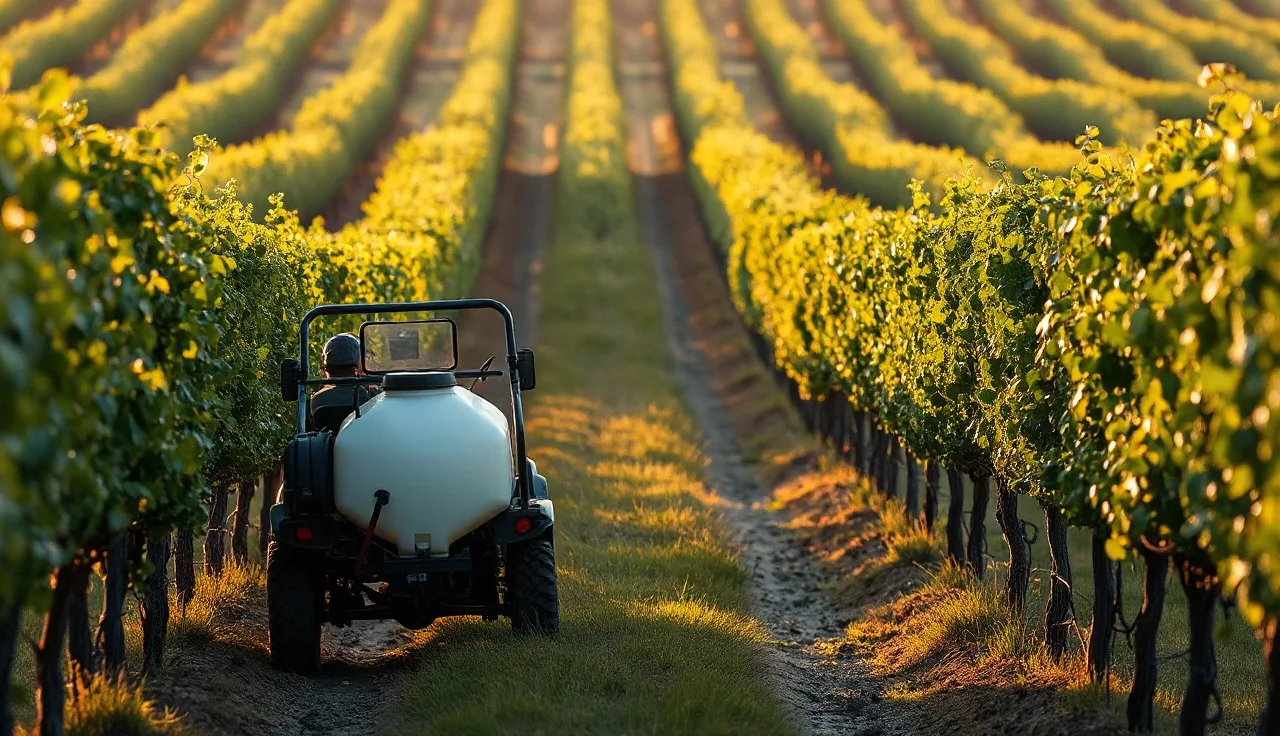
An ATV vineyard sprayer is a pump-and-tank assembly that rides on an all-terrain vehicle or tows behind it on a small trailer, delivering pesticide, fungicide, or foliar nutrition to grapevine rows. It fills the gap between a backpack sprayer (too slow past two acres) and a full tractor-mounted airblast rig (too big for narrow rows or steep ground).
Small-acreage growers get the most from this format. Call it 2 to 25 acres. If you're running a vineyard with 36-inch row spacing on a hillside, a 200-gallon tractor unit may not fit, or it compacts soil in ways you'd rather avoid. A 50-gallon ATV sprayer on a 500-pound utility vehicle handles the same block without the weight.
Backyard growers and small commercial operations on the California Central Coast or in the Pacific Northwest use these rigs to manage powdery mildew, botrytis, and mealybug, the main vector for leafroll virus. The spray interval for powdery mildew in much of California runs every 10 to 14 days from bud break through veraison, so even a small block adds up to a lot of passes [1].
Who doesn't need one? Under an acre, a 4-gallon backpack or a 15-gallon spot sprayer on a garden tractor does the job. Above 30 acres of straight, flat rows, a tractor airblast unit pays for itself faster.
What are the main types of ATV sprayers used in vineyards?
Three configurations show up in real vineyards. Each one is right for a different job.
Boom sprayer on an ATV rack. A horizontal boom with evenly spaced nozzles mounts behind the ATV and sprays a fixed swath. These work for cover crops between rows or herbicide strips under the cordon. Boom width on ATV units usually runs 4 to 8 feet [2]. The catch: booms don't push spray into the canopy, so they're rarely your primary tool for foliar fungicides.
Spot or wand sprayer. A tank (15 to 100 gallons) sits on the rack or a trailer, paired with a hose and a hand-held wand. The operator aims into the canopy while driving slowly. Simple, cheap ($800 to $2,500), and flexible. The downside is coverage that lives or dies on the operator's speed and wand angle. Drift risk climbs too, because the droplet hangs in open air longer than it does off a directed nozzle.
ATV-towed mini airblast (turbine) sprayer. This is the serious tool. A small axial fan or centrifugal blower throws an air stream that carries droplets into and through the canopy, the same principle as a full-size airblast rig, scaled down. Tanks run 25 to 100 gallons. Expect $2,500 to $6,000 or more for a build that lasts. University of California guidance favors air-assisted delivery for dense canopies because the moving air improves penetration and cuts the water volume you need per acre [1].
For most growers running 5 to 20 acres with a trained canopy (VSP, lyre, or similar), the towed mini airblast gives the best disease control per pass. The wand setup is fine for herbicide strips. Plenty of operations run both and never regret it.
What tank size do you need for your vineyard acreage?
Tank size decides how often you stop to refill, which decides how long the whole job takes. The math is simple once you know your application rate.
Most vineyard fungicide programs run 25 to 50 gallons per acre with air-assisted delivery, or 75 to 150 gallons per acre with dilute boom or wand application [1][3]. True concentrate spraying can drop that to 5 to 15 gallons per acre, but only with equipment that's calibrated and nozzled correctly.
| Tank size | Refills per acre (50 GPA) | Practical acreage per day |
|---|---|---|
| 25 gal | 1 refill per 0.5 ac | 3 to 5 acres |
| 50 gal | 1 refill per 1 ac | 6 to 10 acres |
| 75 gal | 1 refill per 1.5 ac | 10 to 15 acres |
| 100 gal | 1 refill per 2 ac | 14 to 20 acres |
The table assumes a 50 GPA rate, a 10 to 15-minute fill, and 4 to 5 hours of actual spraying per day. Row length and headland turns move the numbers.
A 10-acre block on a 10-day interval is livable with a 50-gallon tank. Push to 20 acres with rain coming, and 75 to 100 gallons buys back real refill time. Don't overbuy, though. A 100-gallon tank full of water weighs over 830 pounds, and many ATV trailers and utility vehicles cap payload at 1,000 to 1,500 pounds once you add the frame and pump [4].
How do you choose the right pump and pressure for a vineyard sprayer?
The pump is the machine. Get it wrong and you'll either starve your nozzles or blow diaphragms trying to compensate.
Diaphragm pumps are the standard pick for ATV vineyard sprayers. They handle wettable powders and suspension concentrates without the corrosion and wear that chew up centrifugal or roller pumps [2]. Flow rates on ATV units run 2 to 7 GPM. Pressure matters just as much: most nozzle makers spec their output at 20 to 40 PSI for fungicides, with some flat-fan tips running up to 60 PSI for finer atomization.
A 50-gallon tank with a wand or dual-nozzle setup runs fine on a 2 to 3 GPM pump. A mini airblast with several nozzle outlets open at once wants 5 to 7 GPM at 40 to 60 PSI. Undersizing is the mistake I see most. The operator opens the wand valve, pressure sags, and coverage falls apart.
Gas-engine pumps run independent of the ATV's electrical system and hold up better under heavy demand. 12V electric pumps are quieter, simpler, and fine for light wand work under 3 GPM, but they pull on the ATV battery and get sluggish in cold weather.
Always spec a pressure-relief bypass valve. When a nozzle clogs, the pressure has to go somewhere. A burst hose on a loaded sprayer is a mess at best and a WPS recordkeeping headache at worst.
Which nozzle type works best for grapevine canopy coverage?
Nozzle choice is where small-vineyard operators quietly give away disease control. A sprayer that's right on everything else but wears the wrong nozzle will starve the interior canopy and dump extra product on the outer leaves.
Hollow-cone nozzles have long been the default for fungicide into a VSP canopy, because their fine to medium droplets wrap around leaf surfaces. Cornell's grape and wine program notes that those smaller droplets also drift more, which raises re-entry and off-target concerns [3]. Current extension thinking leans toward air-induction (twin flat-fan) nozzles that make larger, drift-resistant droplets whenever coverage stays adequate, and reserves fine hollow-cone tips for dense-canopy, low-wind days where penetration is the whole point.
The ASABE S572 droplet-size standard runs from Very Fine (under 100 microns) to Ultra Coarse (over 665 microns). Fungicides generally target Fine (100 to 175 microns) to Medium (175 to 250 microns). Under-vine herbicide works better at Coarse to Very Coarse to keep spray off green tissue.
Washington State University published work showing that nozzle height and angle matter as much as nozzle type. Positioning nozzles at cordon height and angling up 15 to 30 degrees improved inside-cluster coverage by 20 to 40% in their trials versus flat horizontal aim [5]. That's free coverage. No equipment cost at all.
My rule for most operators: run hollow-cone or deflector nozzles for the thin spring canopy, then switch to twin flat-fan or air-induction tips as the canopy fills in by mid-season.
How do you calibrate an ATV vineyard sprayer?
Calibration isn't optional. Skip it and you either under-dose (and lose the powdery mildew fight) or over-dose (waste money and blow past the label rate, which is a federal offense under FIFRA) [6].
The catch-and-measure method works for almost any ATV setup. Here's the process:
- Fill the tank with clean water.
- Mark off 100 feet of a representative row.
- Drive that 100 feet at your normal spraying speed with the pump running and nozzles open.
- Measure how much water you used, by weight or the tank sight gauge.
- Calculate: (ounces per 100 feet x 435) / row spacing in feet = gallons per acre.
Say you spray 32 ounces over 100 feet with 8-foot rows: (32 x 435) / 8 = 1,740 ounces per acre, about 13.6 gallons per acre. If your fungicide target is 50 GPA, you need to slow down, raise pressure, or move to a higher-output nozzle.
University of California guidance says calibrate at the start of each season, after any nozzle swap, and whenever you change products or tank mix [1]. Five minutes of calibration heads off a season of guessing.
Write down the results. If you track spray applications digitally, tools like VitiScribe let you log calibration data next to your spray records, so you can pull the numbers during an audit without digging through paper. That matters when the county ag commissioner wants your pesticide use records, which California law says you keep for two years [7].
What does an ATV vineyard sprayer cost, and what should you expect at each price point?
The range is wide, and the quality jump between bottom and middle is dramatic. Here's the honest breakdown.
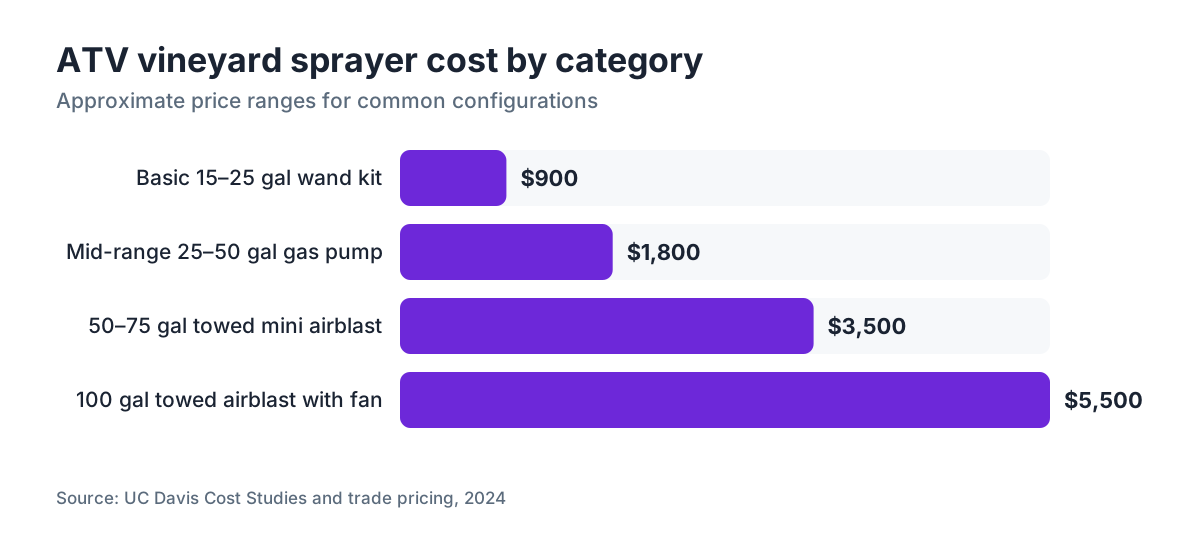
Under $1,000. 15 to 25-gallon tank-and-wand kits with 12V electric pumps. Fine for a single-acre backyard block. Flow rates run 1 to 2 GPM. These rarely last more than three to five seasons under regular use, and parts availability is spotty.
$1,000 to $2,500. Purpose-built 25 to 50-gallon units with gas-engine or better electric pumps, real pressure relief, and replaceable nozzle bodies. Fimco, Demco, and NorthStar show up at this tier. A good fit for the serious hobbyist or a small commercial grower spraying 2 to 8 acres.
$2,500 to $4,500. The towed mini airblast units start here. Rigs from Gregoire, Bertoni, or smaller Hardi units (check the current US distributor for availability) land in this band. Flow rates reach 5 to 7 GPM, you get real fan delivery, and the build supports a 10 to 15-year service life with maintenance.
Over $4,500. Custom builds, larger 75 to 100-gallon towed airblast units, or GPS flow control. Probably not the right spend unless you're farming 20-plus acres hard.
For most 5 to 15-acre growers, the sweet spot is $2,000 to $3,500. Don't cheap out on the pump. The tank is just a bucket. The pump is the part that fails [4].
What EPA Worker Protection Standard rules apply when using an ATV sprayer in a vineyard?
The EPA Worker Protection Standard (WPS), last revised in 2015 and codified at 40 CFR Part 170, covers agricultural workers who could be exposed to pesticides during and after application [8]. If you have any employees working in or near treated vineyard areas, WPS applies to you no matter how small the vineyard.
The requirements that hit ATV sprayer work directly:
The label is law. The pesticide label sets the restricted-entry interval (REI), the minimum time workers stay out of a treated area after application. For common vineyard fungicides like myclobutanil (Eagle, Rally) the REI is 24 hours. For some organophosphates still used in IPM programs, REIs reach 4 days. You post treated areas or notify workers before the REI expires [8].
Personal protective equipment. WPS requires the handler (the person running the sprayer) to wear all PPE listed on the label. For most fungicides that's chemical-resistant gloves, eye protection, and a long-sleeved shirt. Higher-toxicity restricted-use products can require a respirator. The rule states: "Handlers must wear the personal protective equipment required by the pesticide product's labeling during the entire time they are performing handler activities" [8].
Training. Workers and handlers get WPS safety training before they work in treated areas, from an EPA-approved curriculum, and you keep the training records.
Decontamination. WPS requires decontamination supplies (water, soap, towels) within a quarter mile of workers in the field [8].
Small vineyards with no employees only trigger WPS when they hire someone. Build the habits now anyway. Retrofitting compliance after you've grown is the harder road.
How do you reduce pesticide drift when spraying with an ATV in a vineyard?
Drift is a problem you prevent, not fix. Once product leaves the target zone, you've wasted money, maybe created a neighbor or waterway issue, and possibly violated the label's use restrictions, which the EPA treats as a federal offense [6].
Wind drives most of it. Nearly every label and all the good guidance says don't spray above 10 mph. California's Department of Pesticide Regulation puts the useful window at 3 to 7 mph with stable air, which usually means early morning before thermal mixing kicks in [7]. Spraying at 2 p.m. on a warm day is asking to dose the neighbor's property.
Nozzle choice. Larger droplets drift less. Switching from a hollow-cone to an air-induction nozzle at the same pressure can cut drift 50% or more while still covering a medium-density canopy, per work from Washington State University [5].
Drive speed. Faster ATV speed makes its own turbulence that lifts droplets off target. Most effective vineyard spraying happens at 2 to 4 mph. Calibrate at the speed you'll actually drive, not the speed you wish you could.
Buffer zones. Some labels, especially products with aquatic toxicity like pyrethroid insecticides, set mandatory buffer zones near water. Read the label before every application. The required buffer can change with nozzle type and application method.
Shielded sprayers for herbicide rows. A shielded or recirculating sprayer with a plastic skirt over the boom nearly stops drift onto vine green tissue. These are cheap add-ons to a standard boom setup, and the $150 to $300 is money well spent.
How do you maintain an ATV vineyard sprayer to make it last?
Neglect is expensive. A $300 pump replacement that a $5 winter flush would have prevented is a bad trade.
After every use. Flush the tank, lines, and nozzles with clean water. Used a copper product or sulfur? Flush twice. Sulfur residue corrodes diaphragm pumps faster than anything else in a standard vineyard program.
Nozzle inspection. Check nozzle output at least twice a season with a check cup and a stopwatch. A nozzle running 10% over its rated output is worn and should come out. Worn nozzles throw finer, driftier droplets and cover unevenly. A set of replacement nozzles for a 4-nozzle ATV sprayer runs $20 to $80 depending on type.
Filter screens. Clean the tank strainer and inline filters before each spray event. Wettable powders and suspension concentrates blind screens fast.
End of season. Drain all water (a frozen pump cracks). Run a pump-saver lubricant, RV antifreeze or dedicated pump storage oil, through the pump if you store it cold. Inspect hoses for cracks, especially at fittings where flex fatigue piles up.
Gasket and diaphragm replacement. Losing prime or pressure usually means the diaphragm. Kits for common ag pumps run $15 to $40 and take 20 minutes. Don't limp a weak diaphragm through the season and then wonder why coverage is inconsistent.
Store it out of the sun. Polyethylene tanks break down under prolonged UV, and hoses crack sooner. A $40 tarp over the unit through summer buys years of service life.
What records do you need to keep for ATV sprayer applications in a vineyard?
Record rules depend on your state, but the federal floor comes from FIFRA and, for restricted-use pesticides, EPA regulations that require certified-applicator records [6].
In California, every pesticide application to an agricultural crop goes to the county agricultural commissioner within 30 days on a pesticide use report (PUR): product name, EPA registration number, amount applied, acres treated, and date [7]. California growers keep those records at least two years.
Other states vary. Oregon and Washington run similar requirements through their departments of agriculture. In states with no mandatory reporting, label requirements still bind you, and many crop insurance policies and sustainable-winegrowing certifications (LIVE in the Pacific Northwest, Certified California Sustainable Winegrowing) require spray records in their audits.
A good spray record includes:
- Date and start/end time of application
- Field block ID and GPS coordinates or map reference
- Product name, EPA registration number, and lot number
- Application rate (product per acre and gallons per acre)
- Wind speed and direction at application
- Temperature and relative humidity
- Equipment used (sprayer type and nozzle configuration)
- Operator name and applicator license number if applicable
- REI and when the field can be re-entered
Digital records make audits and certification reviews far easier. VitiScribe is built for vineyard spray records and ties each application to a block map, so you're not reconstructing from memory when an auditor asks why you applied sulfur three passes running.
For organic certification, complete spray records are non-negotiable. The USDA National Organic Program requires documentation of all inputs, and your certifier will ask for records going back to the transition period [9].
How does an ATV sprayer compare to a tractor airblast unit for small vineyards?
This is the real fork for anyone farming 5 to 30 acres. Both tools work. The right answer comes down to terrain, row spacing, budget, and how many hours you're willing to spend in the field.
| Factor | ATV sprayer | Tractor airblast unit |
|---|---|---|
| Equipment cost | $800 to $6,000 | $8,000 to $60,000+ |
| Row spacing minimum | 4 feet | 6 to 8 feet (varies by tractor) |
| Tank capacity | 15 to 100 gal | 100 to 500+ gal |
| Coverage rate | 1 to 5 ac/hr | 5 to 20 ac/hr |
| Canopy penetration | Good (airblast) to fair (wand) | Excellent |
| Soil compaction | Low | Moderate to high |
| Operator training | Moderate | Higher |
| Maintenance cost | Low | Moderate to high |
On slopes over 20%, an ATV sprayer is usually safer and more practical than a tractor rig. The lower center of gravity and lighter total weight cut rollover risk on steep ground.
On flat, wide-row blocks above 25 acres, the tractor airblast unit's coverage rate wins on labor economics. The math flips somewhere around 20 to 30 acres for most operations, though nobody has published a clean breakeven study with current labor rates. The closest numbers come from the UC Davis sample cost studies, which put tractor airblast operation at roughly $18 to $30 per acre per pass for a mid-size vineyard, including equipment depreciation [10]. ATV cost per acre runs higher per pass at large scale because of slower speed, but the capital cost is so much lower that the math usually favors the ATV under 15 acres.
A lot of serious small-acreage growers run both: an ATV unit for the steep or narrow sections, and rent or hire custom application for the larger open blocks.
Frequently asked questions
Can an ATV sprayer handle powdery mildew control across a full season?
Yes, if the equipment is calibrated and the program is timed right. Powdery mildew needs fungicide coverage every 10 to 14 days from bud break through veraison in high-pressure regions. An ATV sprayer with a mini airblast head delivers adequate canopy coverage for that program on blocks up to about 20 acres. University of California guidance recommends checking coverage with water-sensitive paper early in the season to confirm nozzles are reaching interior clusters.
What is the minimum ATV size needed to pull a vineyard sprayer?
Most towed 50 to 100-gallon vineyard sprayers weigh 400 to 850 pounds full. You want an ATV or UTV with a tow capacity of at least 1,000 pounds and a hitch receiver. Side-by-sides (UTVs) rated at 1,500 to 2,000 pounds work best. A small 400cc recreational ATV towing a full 100-gallon sprayer overstresses the drivetrain and brakes, especially on slopes.
Do I need a pesticide applicator license to operate an ATV sprayer in my vineyard?
For general-use pesticides, most states don't require a license if you're the owner-operator applying to your own land. For restricted-use pesticides (RUPs), you need a certified private applicator license or supervision by a licensed applicator. Requirements vary by state, so check with your state department of agriculture. California's rules are handled by the CDPR and the county agricultural commissioner.
How often should I recalibrate my ATV vineyard sprayer?
University of California guidance says calibrate at the start of each season, after replacing any nozzle, and when you change to a product that needs a different application rate. In practice, a quick nozzle-output check with a collection cup every 4 to 6 spray events catches wear before it hurts coverage. Worn nozzles can put out 10 to 20% more volume than rated, which means over-application and label-rate violations.
Can I spray sulfur with an ATV diaphragm pump?
Yes, wettable sulfur is compatible with diaphragm pumps, but flush right after every use. Sulfur residue reacts with metal fittings and corrodes diaphragm material over time. Use EPDM-compatible diaphragms rather than natural rubber, which sulfur degrades faster. Never mix sulfur with oil-based products or apply within two weeks of a horticultural oil application. That combination causes phytotoxicity at normal summer temperatures.
What speed should I drive when spraying in a vineyard with an ATV?
Most vineyard calibration guidelines target 2 to 4 mph for ATV application. Faster than 4 mph creates wind turbulence that pushes droplets off target and cuts canopy penetration. Calibrate at the speed you actually plan to drive. Operators who calibrate at 3 mph then drive at 5 mph apply about 40% less product per acre than intended, which usually means the disease control fails.
Is an ATV sprayer suitable for organic vineyards?
Yes. The equipment is neutral; what matters is what goes in the tank. Organic-certified vineyards commonly use ATV sprayers for sulfur, copper-based fungicides, kaolin clay, and approved biological inputs. Copper is USDA NOP-approved with quantity restrictions. Sulfur has no quantity limit under organic rules. Keep complete spray records for your certifier, including product lot numbers and application rates per acre.
How do I prevent an ATV sprayer from tipping on hillside vineyard rows?
For towed units on slopes, keep the tank no more than three-quarters full when traversing across a slope rather than up and down. Low-profile trailer frames (under 18 inches to the tank bottom) and a wide wheel stance cut rollover risk. Drive up and down the hill instead of across when slopes top 15 to 20 degrees. Some towed mini airblast units have a wider base for hillside work; confirm the specs before buying for steep terrain.
What's the difference between a spot sprayer and a dedicated vineyard sprayer?
A spot sprayer is a general-purpose tank-and-wand unit with no row-specific engineering. It works on small vineyards but lacks the nozzle positioning, air-assisted delivery, and pressure regulation built around canopy geometry. A dedicated vineyard sprayer, even at ATV scale, has directed nozzle brackets, output matched to vine height, and usually better pump specs. For anything over 3 acres with regular fungicide passes, the dedicated unit earns its extra cost.
How long does it take to spray 10 acres with an ATV vineyard sprayer?
At 3 mph, 6-foot row spacing, and 100-foot rows, you cover roughly 2 to 3 acres per hour of actual spraying. Add 10 to 15 minutes per refill for a 50-gallon tank at 50 GPA. A 10-acre vineyard takes about 4 to 6 hours including refill stops, equipment checks, and headland turns. Longer rows and wider spacing improve efficiency a lot.
What's the best ATV sprayer for a 5-acre vineyard?
For 5 acres, a 50-gallon towed unit with a gas-engine diaphragm pump (3 to 5 GPM) and adjustable hollow-cone or air-induction nozzles is the practical standard. Budget $1,800 to $3,000 for a quality unit. Brands sold in the US include Fimco, NorthStar, and various Hardi or Bertoni models through ag dealers. Verify parts availability in your region before buying a less-common import brand.
Do EPA Worker Protection Standard rules apply to family members working in my vineyard?
Immediate family members of the agricultural employer are exempt from WPS under 40 CFR 170.601. Any non-family employee, even a part-time seasonal worker, triggers full WPS coverage. The exemption covers a spouse, parent, or child of the owner. State laws can add requirements beyond the federal WPS floor, so check with your state department of agriculture.
How do I clean an ATV sprayer after applying herbicides before switching to fungicides?
Triple-rinse the tank and run clean water through all lines and nozzles. Many herbicides, especially phenoxy types like 2,4-D, need an extra rinse with a 1% ammonia solution to neutralize residue that causes grape phytotoxicity at very low concentrations. Some growers keep a dedicated tank for herbicide and never cross-use it for canopy work. That's the cleanest solution if you apply herbicides regularly.
Sources
- University of California IPM, Grape Pest Management Guidelines: Air-assisted delivery improves canopy penetration and reduces water carrier volume needed per acre; fungicide intervals for powdery mildew run every 10 to 14 days from bud break through veraison in California
- University of California IPM, sprayer equipment and calibration guidance: Boom widths for ATV-mounted units typically run 4 to 8 feet; diaphragm pumps are the standard recommendation for handling wettable powders and suspension concentrates
- Cornell University Grapes and Wine program, vineyard spray equipment and techniques: Drift from hollow-cone nozzles is higher because of smaller droplet size, creating re-entry and off-target concerns; application rate guidance 75 to 150 gallons per acre for dilute wand application
- U.S. Consumer Product Safety Commission, ATV safety information: Many ATV trailers and utility vehicles have payload limits around 1,000 to 1,500 pounds; a 100-gallon tank full of water weighs over 830 pounds
- Washington State University Extension, vineyard spray application technology: Nozzles positioned at cordon height angled upward 15 to 30 degrees improved inside-cluster coverage 20 to 40% compared to horizontal positioning; air-induction nozzles can reduce drift 50% or more vs hollow-cone at same pressure
- EPA, pesticide registration and FIFRA information: Application at rates exceeding the label is a violation of FIFRA and constitutes a federal offense; restricted-use pesticide applicator record requirements are set under FIFRA
- California Department of Pesticide Regulation, pesticide use reporting: California requires all pesticide applications to agricultural crops to be reported to the county agricultural commissioner within 30 days; records must be kept for at least two years; effective spray window is 3 to 7 mph wind with stable air, typically early morning
- EPA, Agricultural Worker Protection Standard (40 CFR Part 170): WPS requires handlers to wear all PPE on the label during the entire time performing handler activities; decontamination supplies must be within a quarter mile of workers; training must be from an EPA-approved curriculum; restricted-entry intervals must be posted or workers notified
- USDA Agricultural Marketing Service, National Organic Program: The USDA NOP requires documentation of all inputs and certifiers review records going back to the transition period; copper-based fungicides are NOP-approved with quantity restrictions; sulfur has no quantity limit under organic rules
- UC Davis, Sample Costs to Establish and Produce Wine Grapes: Tractor airblast sprayer operation estimated at roughly $18 to $30 per acre per pass for a mid-size vineyard including equipment depreciation
Last updated 2026-07-09