Autonomous vineyard sprayers: what they cost and whether they work
TL;DR
- Autonomous vineyard sprayers are GPS-guided, sensor-equipped machines that drive vine rows without a driver.
- Current commercial units cost roughly $80,000 to $250,000.
- Field trials at UC Davis and WSU show labor savings of 50 to 70% per spray pass and chemical reductions of 15 to 30% with precision nozzle control.
- They're real, they work on flat to moderate terrain, and row spacing decides fit.
What is an autonomous vineyard sprayer, exactly?
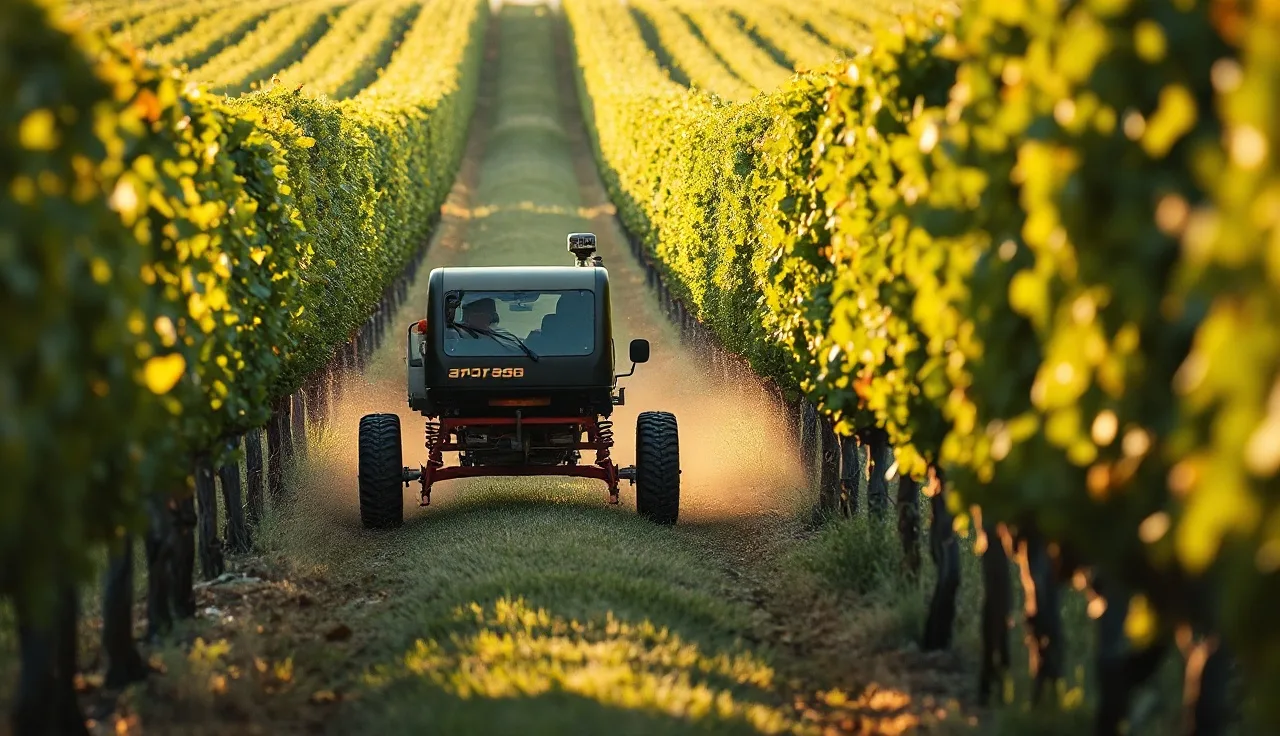
An autonomous vineyard sprayer drives through vine rows, applies pesticide or fungicide, and returns to the headland with nobody in the cab or walking behind it. It steers by some mix of GPS/RTK positioning, LiDAR, ultrasonic sensors, and camera vision, following the row and dodging obstacles on its own. Some units are fully driverless. Others are "supervised autonomous," meaning a worker watches from the end of the row or a tablet.
This is not old spray gear with autonomy bolted on. Companies like Naïo Technologies (the Oz and Ted robots), Vitibot (Bakus), and Trimble-integrated tractors have built purpose-specific machines with low centers of gravity, narrow profiles as tight as 1.0 to 1.2 meters for some models, and booms sized for low-canopy viticulture. Others, like the Fendt Xaver concept and various CNH projects, are adapted from broadacre ag robotics.
The spray system itself can be conventional air-blast, targeted canopy-sensing, or electrostatic. The autonomy layer is separate from the spray technology. That separation matters when you're pricing a system and comparing apples to apples.
How do autonomous sprayers navigate vine rows?
Navigation is where most of the engineering cost goes, and where most of the real-world failures happen too.
RTK-GPS gives centimeter-level accuracy on open headlands but degrades inside dense canopy, especially mid-season when leaf mass is thick. Most commercial units therefore blend RTK with LiDAR or ultrasonic row-following. The machine locks onto vine trunks or wire positions and self-corrects continuously. If a post is missing or a vine is down, some systems stop and alert the operator. Others try to interpolate, and occasionally they get it wrong.
Camera vision, used by Vitibot and a handful of startups, adds obstacle detection: drip lines on the ground, bird netting stakes, a dog that wandered in. UC Davis's Agricultural Robotics Lab has published work on vine-trunk detection using deep learning, reporting detection accuracy above 95% in normal daylight, though night and heavy overcast pull that number down [1].
Row spacing is the hardest physical constraint. Most units need at least 1.8 to 2.0 meters between rows to work safely. Many California and Pacific Northwest vineyards are planted at 2.4 to 3.0 meters and fit fine. Old-vine plantings at 1.5 meters or narrower are essentially locked out of current commercial offerings. Slope tolerance varies by machine. Most specify up to 20 to 25% grade, but traction and stability on loose or wet soil hit the wall well before that number.
What does an autonomous vineyard sprayer actually cost?
Prices spread wide because the category runs from a simple GPS-guided ride-behind unit to a full robotic platform with machine vision and cellular telemetry.
| System type | Typical price range (USD) | Notes |
|---|---|---|
| GPS-guided assisted sprayer (operator on machine) | $40,000 to $80,000 | Autosteering add-on to conventional sprayer |
| Supervised autonomous (operator at headland) | $80,000 to $140,000 | e.g., adapted Naïo Ted platform with spray |
| Fully autonomous robotic sprayer | $150,000 to $250,000+ | e.g., Vitibot Bakus, purpose-built |
| Custom/prototype university trial units | Not commercially available | Research only |
These are purchase prices as of 2024 to 2025. Leasing and rental programs are starting to show up through some European distributors and a few U.S. dealers, usually at $3,000 to $8,000 per season for smaller machines.
The business case sits in the operating cost math. A conventional spray pass in a 50-acre vineyard usually takes one skilled operator 6 to 10 hours, depending on block layout. At $25 to $35 per hour loaded labor cost, that's $150 to $350 per pass. Multiply by 10 to 18 spray events per season and you get $1,500 to $6,300 per season in direct operator labor per 50 acres [2]. An autonomous system doesn't erase all of that. Someone still mixes product, monitors, and cleans the machine. But field reports put operator time down 50 to 70%. Payback on a $150,000 machine at those numbers runs long: 8 to 15 years before you factor in reduced chemical use, which can shorten it noticeably.
Here's the honest answer. The current economics favor larger operations (100+ acres), steep labor-cost environments, or blocks with chronic spray worker shortages. A vineyard under 30 acres will struggle to pencil it out on labor savings alone.
Do autonomous sprayers actually reduce chemical use?
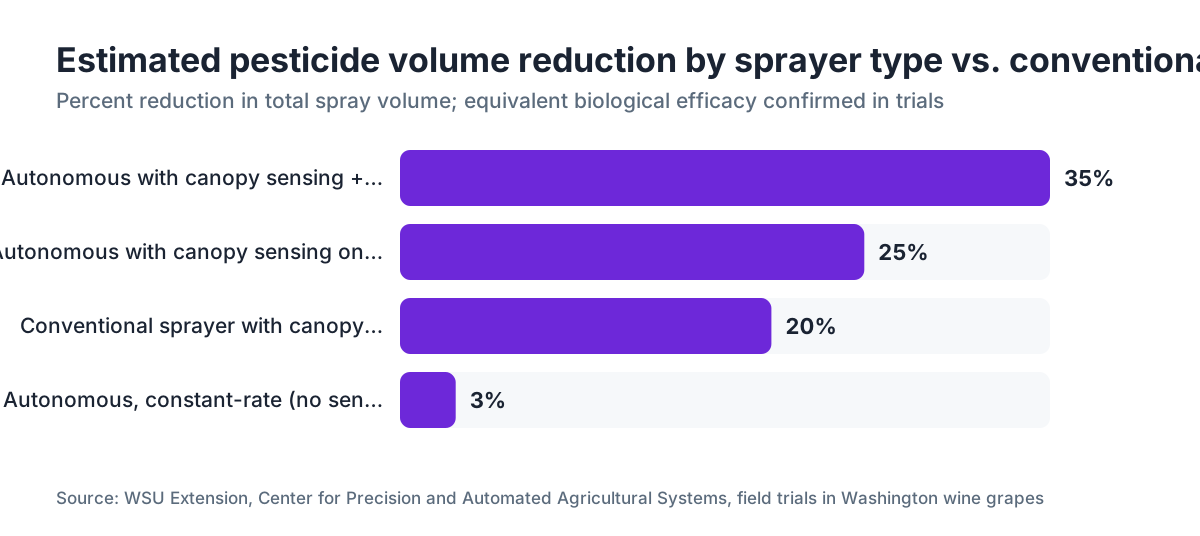
Yes, and the amount is real, but the mechanism matters. Simple autonomy (a driverless machine running the same boom schedule a human ran) cuts nothing on its own. The savings come from precision application features that may or may not ship with the autonomous platform.
Variable-rate application, canopy sensing, and individual nozzle control are the technologies that trim volume. A canopy-sensing system (usually LiDAR or ultrasonic) reads canopy density and width in real time and adjusts output at each nozzle. WSU research on precision sprayer systems found pesticide volume drops of 20 to 40% versus constant-rate air-blast, with equal or better efficacy against powdery mildew and botrytis when canopy coverage held up [3].
Autonomy and precision application get bundled for a practical reason. If you're already paying for the robotic platform, adding a canopy sensor and solenoid nozzle valves is a small incremental cost. Vitibot's Bakus, for example, ships with pulse-width modulation nozzle control. Naïo's spray options vary by configuration.
Watch one thing. Lower volume does not automatically mean less active ingredient per acre. If you run a low-volume, high-concentration mix to stay inside water budgets, total a.i. per acre may barely move. Your spray records need to track gallons per acre and active ingredient per acre separately. That's a compliance point more than an agronomy one.
What are the EPA Worker Protection Standard implications for autonomous sprayers?
The EPA Worker Protection Standard (WPS), 40 CFR Part 170, sets the rules for agricultural pesticide applications and worker re-entry, and it has no autonomous-specific language yet. That leaves real ambiguity you need to work through with your PCA and your county agricultural commissioner.
The question is who counts as the "applicator" when the machine drives itself. Under the current WPS, the certified applicator (the person holding the license) owns the application whether they're gripping a wand or watching a robot from 200 feet away. The EPA's 2015 WPS final rule requires a certified applicator be available during applications of restricted-use pesticides [4]. "Available" has not been formally defined to include remote monitoring. In practice, most state lead agencies have taken the position that the certified applicator must be on-site and reachable during the application, more than reachable by phone from town.
Re-entry intervals (REIs) work the same regardless of application method. Spray sulfur at 6 a.m. with a robot and the label REI is 24 hours, nobody re-enters that block until 6 a.m. the next day. The autonomous nature of the pass creates no exception.
The WPS also requires that workers and handlers stay out of the application exclusion zone (AEZ) during application. With a driverless machine, the AEZ travels with the machine just as it would with a crewed sprayer [9]. Your vineyard crew needs to be tracked and kept out of any block the robot is actively spraying. That's a workflow problem some operations have underestimated.
How do spray records and compliance paperwork work with a robot?
Spray records for autonomous applications follow the same state requirements as any other application: product name, EPA registration number, rate, acres treated, date and time, certified applicator name and license number, target pest, and weather at time of application.
What changes is data capture. A well-configured autonomous sprayer generates a GPS-tagged application log automatically: start and stop times, GPS track, nozzle-on time, flow meter data if equipped. That's more data than a human applicator would normally write down. The challenge is moving that machine-generated data into your formal spray record in a format that satisfies California DPR, Oregon ODA, Washington WSDA, or whichever state agency audits you.
Most robotic sprayer makers export CSV or JSON logs. Some offer API connections to farm management software. If you run a platform like VitiScribe for your compliance records, confirm before purchase that the machine's export format maps cleanly to your record structure. Otherwise you're hand-transcribing GPS logs into a paper binder at the end of every spray day.
California requires Pesticide Use Reports (PURs) submitted to the county agricultural commissioner within one month of application for most materials [5]. The data fields are fixed by regulation, and "autonomous sprayer" is not a distinct applicator type in the current system. You'll record it under the same codes as a conventional ground application.
Which crops and vineyard types are best suited for autonomous sprayers?
Vineyards are among the best-suited crops for autonomous sprayers, which is why most of the development money has landed here and in orchards.
The geometry helps. Rows are parallel, permanent, and defined. The machine gets trained once on a block's map and re-runs it all season. Compare that to annual row crops, where the canopy changes shape across the season, or intercropped systems, where navigation gets messy fast.
Not all vineyards are equal, though. Flat, wide-row wine grape blocks (VSP-trained, 2.4+ meter spacing) are the ideal case. Head-trained bush vines, GDC systems with overhead wires, steep hillside terraces, and old plantings with irregular spacing all trip up current machines or defeat them entirely.
Slope is a real constraint. Naïo specs up to 20% for its Oz robot [7]. Vitibot Bakus is rated to 30% [8], but real-world stability on wet clay at that grade is a different conversation. Cornell Cooperative Extension work on precision ag in New York vineyards has noted that many Finger Lakes and Hudson Valley blocks carry slopes and row irregularities that would need heavy field modification before autonomous equipment could run safely [6].
For operations eyeing vineyards in newer appellations like Paso Robles or the inland Pacific Northwest, where a lot of blocks went in post-2000 with mechanization in mind, the fit is much better than in old-vine regions.
What are the real limitations nobody talks about in the press releases?
The limitations are real, and worth naming straight.
Software reliability in field conditions is still a work in progress on most platforms. RTK signal dropout in narrow rows mid-canopy causes more stops and re-starts than the marketing suggests. One California vineyard manager who documented his experience publicly (in a 2023 Western Farm Press piece) reported his first season with a supervised autonomous unit averaged one operator intervention per row on dense block configurations.
Battery-electric autonomous machines, which most smaller units are, run 4 to 8 hours between charges. On a large property, that means multiple machines, field charging infrastructure, or very careful block scheduling. Internal combustion autonomous units exist but are less common in the small-platform category.
Maintenance is not trivial. These machines carry sensor arrays, solenoid valves, motor controllers, and communication hardware in a wet, pesticide-exposure environment. Corrosion and sensor fouling are real. U.S. service networks are thin compared to Europe, where most of the commercial development happened. Parts lead times from French or Spanish makers can run 3 to 6 weeks.
Liability is unsettled. When the machine damages a vine, hits an irrigation line, or puts product outside an intended block, case law offers little guidance. Your farm liability carrier may or may not have a clear position on autonomous ag equipment. Ask before you buy.
Training time is real too. Most manufacturers estimate 8 to 16 hours of initial training. The learning curve through your first full season is longer than that.
How do autonomous sprayers compare to conventional air-blast in application quality?
Application quality is the area with the best published data, and the results lean favorable for autonomous precision systems, with caveats.
WSU published data comparing autonomous canopy-sensing sprayers against conventional constant-rate air-blast across multiple Washington wine grape blocks. Deposition uniformity on both sides of the canopy was equal or better for the precision autonomous system, and total spray volume ran 22 to 35% lower [3]. Efficacy against powdery mildew showed no statistical difference between treatments.
UC Davis work on spray deposition in Cabernet Sauvignon trained to VSP found that ground speed consistency matters a lot. Autonomous machines hold speed reliably, while human drivers vary it at row ends and through turns. Consistent ground speed at 3 to 4 km/h produced more uniform deposits than variable-speed manual operation [1].
Here's the caveat. Most published trials ran on well-maintained, uniform blocks with experienced operators configuring the system. Performance on irregular blocks, blocks with gaps, or blocks with mixed training systems is thinly documented.
Upper-canopy air-blast coverage, which matters for downy mildew protection in humid regions, is where some vineyard managers still trust conventional high-airflow tower sprayers over the lower-flow systems common on smaller autonomous platforms. That's a legitimate concern for humid East Coast conditions, and it deserves more independent study.
What should you ask before buying or trialing an autonomous sprayer?
These are the questions that separate a good purchase from an expensive regret.
What is the minimum row spacing the machine operates in, and what is the maximum slope? Get both in writing, then walk your hardest blocks with the sales rep.
How does the machine handle end-of-row turns? Headland requirements vary widely. Some units need 4 to 5 meters, others 8 to 10 meters. If your headlands are tight or slope away from the rows, that alone can kill the deal.
What happens when the machine stops mid-row? Does it finish the row on re-start, or do you risk a double-application strip? The answer matters enormously for your spray records and for plant safety.
What is the communication system, and what happens when cellular or WiFi signal drops? Can it run offline on a pre-loaded map?
Who services the machine in your region, and what is the warranty on sensors and electronics? The drivetrain warranty and the electronics warranty may be very different animals.
Can the application log export in a format your record-keeping system accepts? Confirm it with a test file before you sign anything.
What proximity does your state require of the certified applicator during operation under its reading of the WPS? Confirm that with your county ag commissioner before you plan your workflow.
Ask for references from operations in your state on similar terrain and row configuration. Not from the manufacturer's curated list if you can help it. Find them yourself through grower groups or your local farm advisor.
What does the research pipeline look like, and where is this technology headed?
The short version: the technology is moving fast, but the supply of proven systems in the U.S. specifically is still thin. Most mature deployments sit in France, Spain, and Germany, where the financial and regulatory setup for precision ag equipment has been friendlier.
UC Davis's Agricultural Robotics Lab is probably the most active U.S. academic program on vineyard robotics, with ongoing work on multi-robot coordination, harvest robotics, and spray systems [1]. WSU's Center for Precision and Automated Agricultural Systems (CPAAS) has published on precision spray technology in tree fruit and wine grapes and keeps running field trials in Eastern Washington [3].
Cornell's New York work leans into the harder terrain of Northeast vineyards and the disease pressure there, which differs enough from California that a separate development track makes sense [6].
On the commercial side, the shakeout has started. Several startups that raised money from 2018 to 2021 have been acquired (Abundant Robotics, acquired and dissolved), pivoted, or run into financial trouble. The survivors tend to be well-capitalized European incumbents or companies that found a niche (a specific crop, a specific terrain type) instead of chasing a universal platform.
Battery energy density will matter a lot for the small autonomous platform category. Moving from a 4 to 6 hour operational window to 8 to 10 hours per charge would change the economics for medium-sized operations. Solid-state battery commercialization for ag-grade equipment (roughly 2027 to 2030) could be a real turning point.
AI-based disease detection tied into the spray system, where the machine spots visible disease symptoms and either logs them or adjusts its rate in response, is in research and early prototyping. Nobody has a fully reliable commercial product here yet. It's probably 3 to 5 years from early commercial availability for limited use cases.
Frequently asked questions
Can an autonomous sprayer handle steep hillside vineyard terrain?
Most commercial units are rated to 20 to 30% slope, but real-world stability on wet or loose soil at that grade differs from the rated maximum. Vitibot claims 30% for the Bakus; Naïo's Oz is rated to 20%. If your blocks regularly exceed 20% or have uneven terrain within rows, get a manufacturer site evaluation before purchasing. Steep, terraced Old World-style blocks are largely incompatible with current platforms.
Do I still need a certified pesticide applicator license to use an autonomous sprayer?
Yes. Under the EPA Worker Protection Standard and state pesticide laws, the certified applicator stays legally responsible for the application whether a machine or a human physically drives. Most state agencies require the licensed applicator on-site and accessible during applications of restricted-use pesticides, even when the sprayer runs autonomously. Check your specific state's interpretation with your county agricultural commissioner.
What row spacing do autonomous vineyard sprayers require?
Most commercial autonomous vineyard sprayers need a minimum of 1.8 to 2.0 meters between rows, with the machine itself typically 1.0 to 1.5 meters wide. Some compact models advertise operation in 1.5-meter rows, but real clearance at that width is tight and vine damage risk climbs. Vineyards planted before 1990 in traditional close-spaced layouts often fall below the practical minimum for current equipment.
How much can an autonomous sprayer reduce pesticide use?
Canopy-sensing autonomous sprayers with variable-rate nozzle control have shown 20 to 40% reductions in total spray volume versus constant-rate air-blast in WSU trials, with equal efficacy against powdery mildew and botrytis. Reductions in active ingredient applied depend on whether you reformulate concentration as volume drops. Simple autonomous sprayers without precision application features show little to no chemical savings.
What are the re-entry interval rules when a robot does the spraying?
Re-entry intervals (REIs) on product labels apply regardless of how the application is made. If the label specifies a 24-hour REI and the robot sprays at 6 a.m., no worker enters that block until 6 a.m. the next day. The autonomous nature of the application creates no exception to REI requirements under the EPA Worker Protection Standard (40 CFR Part 170). Your spray record must still log application time to anchor the REI clock.
How do I record autonomous sprayer applications in my state pesticide use report?
Record autonomous applications using the same fields as any conventional ground application: product, EPA reg number, rate, acres, date and time, certified applicator, and weather. There is no separate autonomous applicator category in current PUR systems, including California's. Pull the GPS application log from the machine to confirm acreage and timing, but enter data under standard ground application codes. California PURs are due to the county ag commissioner within one month of application.
How long does it take to train vineyard staff to use an autonomous sprayer?
Most manufacturers estimate 8 to 16 hours of initial training to map blocks, configure application parameters, and learn the machine's fault-recovery procedures. Practical competence to troubleshoot sensor errors and handle field interruptions confidently usually takes a full season. Budget for more training time than the manufacturer promises, especially on varied terrain. Staff with existing GPS/GIS familiarity from precision ag backgrounds come up to speed faster.
What happens if the autonomous sprayer misses part of a row or double-applies?
This depends on the machine's fault-recovery logic. Better systems log the exact stop point via GPS and prompt the operator to verify overlap before re-starting. Others resume without flagging overlap risk. A double-application strip can push you above the label's maximum application rate per acre, creating a compliance violation and potential plant injury. Confirm the machine's stop-and-restart behavior in detail with the manufacturer before purchase.
Are autonomous vineyard sprayers available to rent or lease instead of buy?
Leasing and seasonal rental programs are starting to emerge, mostly through European-based distributors and a few U.S. dealers. Seasonal lease rates for smaller supervised-autonomous platforms typically run $3,000 to $8,000 per season as of 2024 to 2025, though U.S. availability is still limited. Renting is a reasonable way to trial fit before committing to a purchase, if you can find a unit available in your region and timing window.
How does an autonomous sprayer perform compared to a conventional air-blast in humid wine regions?
In humid East Coast and Pacific Northwest regions with heavy disease pressure, upper-canopy coverage is critical, and some vineyard managers feel conventional high-airflow tower sprayers outperform the lower-flow systems on many current autonomous platforms. Cornell Cooperative Extension has noted that terrain challenges and disease pressure in New York vineyards make direct transfer of California or European autonomous spray results unreliable. More region-specific independent trial data is needed before making confident comparisons.
What is the typical battery life or operational window of an electric autonomous vineyard sprayer?
Battery-electric autonomous vineyard sprayers currently run 4 to 8 hours between charges, depending on terrain, load, and spray pump power draw. For a 50-acre property running 8 to 10 spray events per season, a single machine can likely finish a full block per charge with good planning. Larger operations may need multiple machines or field-based charging infrastructure. Internal combustion autonomous units exist but are less common in the small-platform category.
Does using an autonomous sprayer affect my crop insurance or farm liability coverage?
It may. Autonomous agricultural equipment is a relatively new category for farm insurers, and coverage terms and exclusions vary by carrier. Some policies carry language about unmanned equipment operation that was written for drones and may or may not apply to ground robots. Ask your carrier specifically about autonomous ground spray equipment before the machine is in service. Liability for vine or equipment damage during autonomous operation is not yet well-established in case law.
What are the best university extension resources on autonomous vineyard spray technology?
UC Davis Agricultural Robotics Lab publishes research on vineyard robotics including spray systems. WSU's Center for Precision and Automated Agricultural Systems (CPAAS) has peer-reviewed data on precision spray technology in wine grapes. Cornell Cooperative Extension covers precision ag for Northeast viticulture including terrain-specific challenges. All three have publicly accessible publications and trial reports. Start with those three programs for independent, non-vendor research on equipment performance.
Sources
- USDA Economic Research Service, Farm Labor: Agricultural labor cost benchmarks for estimating operator labor cost per spray pass
- EPA Worker Protection Standard, 40 CFR Part 170: WPS requirement that a certified applicator be available during applications of restricted-use pesticides; Application Exclusion Zone requirements during pesticide applications
- California Department of Pesticide Regulation, Pesticide Use Reporting: California requires Pesticide Use Reports to be submitted to the county agricultural commissioner within one month of application
- Cornell Cooperative Extension, Precision Agriculture for Viticulture: Cornell Cooperative Extension findings on terrain and row irregularity challenges for autonomous equipment in New York Finger Lakes and Hudson Valley vineyards
- Naïo Technologies, Product Specifications (Oz and Ted vineyard robots): Naïo robot slope specifications (up to 20% for Oz) and minimum row spacing requirements
- Vitibot, Bakus autonomous vineyard sprayer specifications: Vitibot Bakus rated slope (30%), pulse-width modulation nozzle control, and purpose-built autonomous vineyard sprayer design
- EPA, Agricultural Application Exclusion Zone Requirements under the WPS: Application Exclusion Zone moves with the application equipment and applies to all ground application methods including autonomous machines
- WSU Extension, Viticulture and Enology Program: WSU viticulture research context for Washington wine grape spray trials and precision application efficacy
- UC Agriculture and Natural Resources, Integrated Pest Management Program: California vineyard spray timing and pest management context referenced for autonomous spray scheduling discussion
Last updated 2026-07-09