Berthoud Twist'Air vineyard sprayer: full operator guide

TL;DR
- The Berthoud Twist'Air is a French-made axial-fan airblast sprayer built for tight vineyard rows.
- Its rotatable air tower redirects airflow from 0° to 50° without tools, so you match airflow to canopy height as the vines fill in.
- Tanks run 400 to 1200 L.
- The real work is calibration, drift control, and Worker Protection Standard recordkeeping.
What is the Berthoud Twist'Air and who makes it?
Berthoud is a French sprayer maker, founded in 1884, now owned by the AGCO group. The Twist'Air is their purpose-built vineyard airblast line, sold across European wine regions and exported to the United States, Australia, and South Africa. The engineering idea is simple. A single axial fan drives air through a vertical tower of adjustable deflectors, and the whole outlet rotates (the "twist" in the name) to aim coverage high into a tall trellis or low into a short cordon. No hardware swap needed. [1]
Berthoud sells the Twist'Air as a middle-tier professional machine, above basic tower sprayers and below their fully automated GPS line. That positioning sets the realistic buyer: a small-to-medium estate with 20 to 200 acres, one full-time equipment operator, and vines trained several different ways (VSP, GDC, high-wire) that all get sprayed by the same tractor and sprayer.
The line comes trailed (towed) and mounted (3-point hitch). Tank sizes in the current catalog run from 400 L (about 105 gal) on the compact mount to 1200 L (about 317 gal) on the larger trailed units. Fan diameter is either 560 mm or 620 mm depending on model. [1]
Here's the part nobody puts in the brochure. Berthoud's North American distribution runs through the AGCO network and a handful of regional dealers, and U.S. parts availability is the complaint operators raise most. Confirm your dealer stocks common wear parts (fan belts, nozzle bodies, diaphragm check valves) before you sign anything. That's not optional advice.
How does the Twist'Air rotatable tower actually work?
The tower is the whole point. It sits on a pivot above the fan housing. You loosen a locking knob, rotate the tower to your target angle, lock it back down, and you're done in under two minutes without tools. The range runs from 0° (blowing straight sideways into a low canopy) to roughly 50° upward (reaching over a tall, dense canopy). Some models add a second pivot at the deflector fins for finer vertical zoning. [1]
Inside the tower, horizontal deflectors split the airstream into bands you adjust independently. Each band covers a vertical zone of the canopy. Close off the lower deflectors early in the season when the shoot zone is thin, then open every band at peak summer canopy. This is genuinely useful, not brochure copy. Blow all deflectors wide open at a 30 cm (12 inch) shoot in May and you'll paint the soil with product you paid for.
Air output on the larger models runs around 30,000 to 40,000 m³/h, mid-range for a commercial vineyard airblast. UC Davis Cooperative Extension research on airblast sprayers found that fan output, nozzle placement, and forward speed interact to set actual canopy penetration, and fan volume alone is a weak predictor of how well the machine works. [2] So the work is calibrating the Twist'Air for your specific block, not setting a tower angle and driving off.
The hydraulic version adds tower-angle adjustment from the cab. That matters on a long 40-acre block where you shift from a VSP section to a high-wire section mid-pass. The manual version is fine for uniform blocks, and it's cheaper. Buy the hydraulic tower only if your blocks actually change under you.
What tank sizes and nozzle configurations does it come in?
The current Twist'Air range (2024 to 2025 Berthoud catalog) covers four tank sizes: 400 L, 600 L, 800 L, and 1200 L. The 400 and 600 L models are usually 3-point mounted units for tractors in the 60 to 90 HP range. The 800 and 1200 L versions are trailed and need a tractor with the right drawbar and PTO capacity, generally 80 HP minimum for the 800 and 100+ HP for the 1200. [1]
Nozzle count varies by model and tower setup. A standard tower carries 10 to 14 nozzle positions across both sides, each side mirroring the other. Berthoud ships the machine with its own flat-fan and hollow-cone nozzles, but the bodies use standard ISO fittings, so any compatible nozzle from Albuz, TeeJet, Lechler, or Greenleaf drops in without adapter plates. That flexibility matters, because tuning nozzle type to your chemistry (contact fungicide versus systemic, drift-reduction rules, water-sensitive paper results) usually means dropping the factory nozzle.
Flow at the boom is set by a pressure regulator and the computer (on equipped models) or a manual gauge. Most vineyard work runs 6 to 12 bar, though air-induction drift-reduction nozzles work better at 5 to 8 bar. WSU Extension's spray application research says check nozzle output every 25 hours of use and replace any nozzle deviating more than 10% from rated output. [3]
One honest limitation. Tower nozzle spacing is fixed by the frame. If your canopy is very different from the factory spacing (a very low-slung head-trained block, say), you'll cap some nozzles and re-aim others. Budget 2 to 3 hours the first time you set up a new block type.
| Model | Tank (L) | Tank (gal) | Fan diam. (mm) | Mount type | Min. tractor HP |
|---|---|---|---|---|---|
| Twist'Air 400 | 400 | 105 | 560 | 3-pt mounted | 60 |
| Twist'Air 600 | 600 | 158 | 560 | 3-pt mounted | 70 |
| Twist'Air 800 | 800 | 211 | 620 | Trailed | 80 |
| Twist'Air 1200 | 1200 | 317 | 620 | Trailed | 100 |
How do you calibrate the Berthoud Twist'Air for your vineyard?
Most operators calibrate once and never touch it again. That's a mistake with two edges. Rate accuracy is an agronomic problem (resistance management, coverage) and a legal one, because following the pesticide label is federal law under FIFRA. [4]
The calibration sequence for the Twist'Air is the same logic as any airblast unit. Start by picking your target application volume in gallons per acre (GPA) or liters per hectare. UC Davis Cooperative Extension's Grape Pest Management guide suggests roughly 50 to 100 GPA for dense VSP canopies and 30 to 60 GPA for more open architectures, adjusted for growth stage and density. [2] These are ranges, not rules. Water-sensitive paper cards in the canopy are the honest check.
Measure actual nozzle output next. Run the sprayer at target pressure with the engine at PTO speed and the fan running, then collect each nozzle's output for 30 seconds into a graduated container. Multiply by 2 for liters per minute. Sum every nozzle for total boom output per minute.
Then get your forward speed. Drive a measured 100 meters in your target gear and PTO setting, time it, convert to km/h or mph.
Now the formula: GPA = (total nozzle output in GPM × 5940) / (mph × row spacing in feet). Outside target? Adjust speed, pressure, or nozzle size. Cornell's integrated pest management program publishes a free airblast calibration worksheet worth printing and taping inside the cab. [5]
Recalibrate at least twice a season (pre-bloom and post-fruit set), and any time you change nozzles, switch chemistry, or move to a block with different row spacing.
What are the real-world drift and canopy penetration results?
Drift is the central environmental and regulatory worry with any airblast sprayer. The rotatable tower helps, because you're not blasting straight up when the canopy doesn't need it, but geometry alone doesn't stop drift.
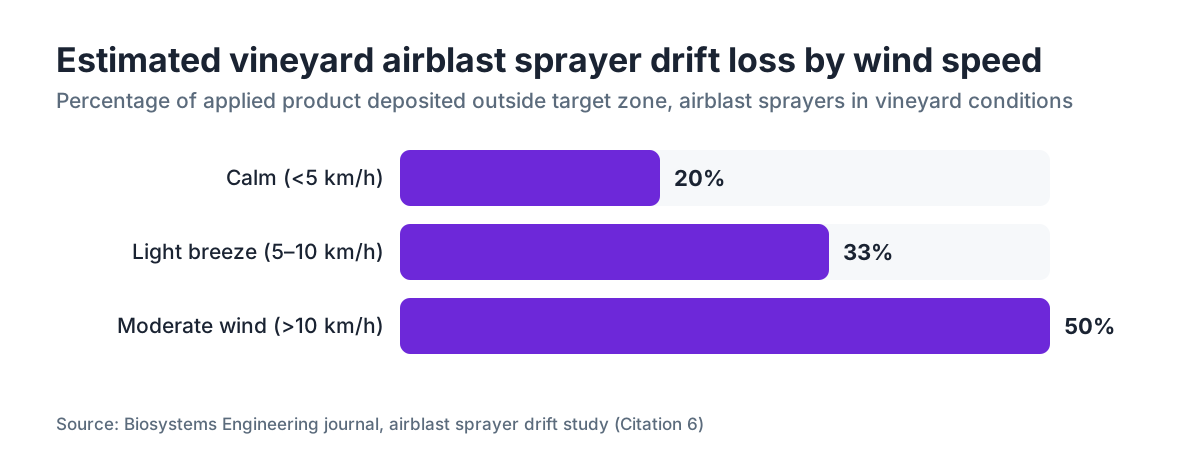
A study in the journal Biosystems Engineering found that vineyard airblast sprayers can deposit 20 to 50% of applied product outside the target zone under typical field conditions, and wind above 10 km/h makes it much worse. [6] That range is honest. Field conditions vary enough that any single-number drift claim is marketing.
Drift control on the Twist'Air comes down to four moves. Set tower angle only as high as the canopy needs. Close off deflector zones above the canopy. Use drift-reducing nozzles (AI flat fans, twin flat fans) when the label allows. Stop spraying when wind tops 10 mph (about 16 km/h). The EPA's Worker Protection Standard also bars applying pesticides when conditions could expose workers in nearby areas. [7]
Water-sensitive paper is the only way to know your real coverage. Place cards at three canopy depths (outside, mid, interior) and three heights (top, middle, bottom). Do it during the first spray of the season, before you lock in a nozzle-and-speed combination for the year. The adjustable deflectors give you more tuning room than a fixed tower. You just have to use the adjustment instead of leaving it set from last August.
How does the Twist'Air compare to other vineyard airblast sprayers?
The honest comparison field is other European vineyard airblasts in the professional tier (Gregoire, Bertoni, Nobili, Caffini) plus the American machines (Rears, Ag-Chem) and the Australian ones (Croplands, Silvan). Clean comparison is hard, because dealers rarely publish verified airflow or deposition data and independent university testing of specific commercial models is thin.
What the Twist'Air has over most rivals at its price is the tool-free tower rotation. A basic Nobili axial tower needs deflector adjustment with a wrench, which means operators mostly don't bother. The Twist'Air removes that friction, and that's real value when one sprayer covers several trellis systems.
Where it loses is automation. Top-tier machines from Caffini or the Berthoud Lider series offer GPS variable-rate control and automatic section shutoff. The Twist'Air's electronic models have basic rate control and nothing that reacts to vine gaps or headlands on its own. Spray 150+ acres with real variation and that gap costs you.
Price is genuinely hard to cite with confidence. U.S. dealer pricing swings by region and model year, and Berthoud doesn't publish MSRP lists. Import dealer figures reported in trade press put the Twist'Air 800 trailed roughly in the $18,000 to $28,000 range (2023 to 2024 model years), mid-tier for imported European vineyard sprayers. Domestic Rears units land at similar or slightly lower prices with better parts support. [1]
| Sprayer | Adjustable tower | Section control | Approx. price (800 L equiv.) | Parts availability (U.S.) |
|---|---|---|---|---|
| Berthoud Twist'Air | Tool-free rotation | Manual/basic electronic | $18,000 to $28,000 | Limited (AGCO network) |
| Nobili axial | Wrench adjustment | None/basic | $12,000 to $20,000 | Limited (import dealers) |
| Rears AirBlast+ | Adjustable | Section shutoff option | $15,000 to $25,000 | Good (domestic) |
| Caffini Pixel | Auto variable | Full GPS section | $45,000 to $70,000 | Specialist only |
What EPA Worker Protection Standard rules apply when using any vineyard sprayer?
The EPA Worker Protection Standard (WPS), 40 CFR Part 170, covers agricultural workers and pesticide handlers at farms, forests, nurseries, and greenhouses. Vineyard spray operators are pesticide handlers under WPS. The requirements are not optional. [7]
The 2015 revised WPS (in effect for most provisions since January 2017) added several rules that hit vineyard spray work directly. Handlers now train every year, not every five years like the old rule allowed. Handlers must have and use the personal protective equipment (PPE) each product label specifies. Minimum PPE for most vineyard fungicide and insecticide jobs is chemical-resistant gloves, protective eyewear, and long-sleeved clothing, with tougher requirements for restricted-use pesticides.
Application exclusion zones (AEZs) under the 2015 WPS require a minimum 100-foot zone around any outdoor application, and no workers or bystanders can be inside it during application. Some labels carry larger buffers that override the WPS minimum. [7] EPA puts it plainly: "The pesticide label is a legal document, and you must follow all of its directions and requirements." [4]
Post-application restricted-entry intervals (REIs) go on a central, visible notice board. Most vineyard fungicides run 4 to 48 hour REIs; organophosphate insecticides often carry 24 to 72 hour REIs. Spray records documenting product, rate, date, time, operator, REI, and weather at application are required under WPS, and also under organic certification and many state programs.
A spray record system like VitiScribe cuts the time to generate WPS-compliant records, especially with multiple applicators across multiple blocks. Federal WPS requires keeping the record for at least two years. [7]
How do you maintain the Twist'Air to keep it calibrated and legal?
Maintenance priorities on the Twist'Air run in a clear order: nozzles, filters, pump, fan. That order is deliberate.
Nozzles wear faster than anything and cost the least to replace. A nozzle running at 120% of rated flow sounds harmless, but it means you're over-applying at that position and your calibration is wrong across every foot of canopy that nozzle touches. WSU Extension's rule (replace any nozzle deviating more than 10% from rated output) is the right standard. [3] At $2 to $8 per nozzle by type, a full swap of a 12-nozzle tower once a season costs $24 to $96. That's not a real cost.
Filters: the Twist'Air has in-line filters at the pump inlet and at the boom. Clean them at the start of every spray day, inspect for damage weekly. A clogged filter drops pressure unevenly and wrecks output uniformity.
The diaphragm pump (standard on most Twist'Air builds) needs diaphragms replaced on the Berthoud service schedule, typically every 500 hours or annually, whichever comes first. A diaphragm that fails mid-season is a pressure loss and a possible product spill. Keep a spare diaphragm kit on hand.
Fan belt: eyeball it at every fill. A belt slipping 5% drops airflow and kills canopy penetration with no obvious symptom in the cab. Replace at the first sign of glazing or cracking.
Rinsate disposal: triple-rinse the tank at the end of every spray day, apply rinsate to a non-sensitive area at proper dilution, and follow your state rules. California's Department of Pesticide Regulation and most other state agencies have specific rinsate requirements. [8]
End of season: flush the whole system with clean water, then run a 50/50 water and propylene glycol antifreeze mix through pump, lines, and nozzles. Store with the pump primed. Berthoud's operator manual is the reference for model-specific steps.
What does canopy-matched spraying look like in practice across growth stages?
The adjustable tower makes canopy-matched spraying operationally possible. Here's how it plays out over a California growing season, though timing shifts elsewhere.
Budbreak through 4-inch shoot (March, April in most of California): canopy is minimal. Run the tower at its lowest angle, close off upper deflectors, drop application volume. You're targeting basal buds and young shoots. University of California IPM guidelines recommend starting powdery mildew programs at 0.5-inch shoot green, and early applications don't need midsummer-level penetration. [9] Slow the tractor if you're pushing chemistry into a thin canopy; otherwise the spray blows right through.
Bloom through fruit set (May, June): canopy builds fast. Step the tower angle up as shoots lengthen. This is the highest-pressure window for disease and the point where calibration accuracy matters most, because infection periods come thick and fast. Spray early morning, when wind is calm and temperatures are climbing so chemistry dries quickly on berries.
Veraison through harvest (July, September): full canopy, dense foliage, maximum leaf resistance to spray. Tower angle at or near maximum, all deflectors open, maybe drop to 2 to 3 mph to push per-acre volume up in dense blocks. Botrytis control here depends entirely on spray reaching the cluster interior. Check your water-sensitive cards.
Post-harvest (October, November): thinned canopy after leaf drop. Mirror your early-season settings. Copper or dormant materials go on fine at low volume and low angle.
Operations mixing varieties and trellis types (VSP next to GDC next to head-trained) get the most out of the Twist'Air's adjustability. The tradeoff: each block change means stopping to readjust, 2 to 4 minutes a pop. On big uniform blocks that flexibility earns nothing.
How do you keep vineyard spray records compliant and audit-ready?
Spray record requirements stack up fast. Federal WPS requires application records with handler information and REIs. [7] FIFRA requires certified applicators to keep restricted-use pesticide (RUP) records for two years. [4] California requires all commercial pesticide applications reported to the County Agricultural Commissioner within 7 days through the Pesticide Use Report (PUR) system. [8] Oregon, Washington, and other major wine states run their own reporting rules.
On top of all that, organic certification under USDA NOP requires detailed input records going back at least three years for the audit. [10] Wine grape contracts with major buyers increasingly carry residue audit clauses that tie documented applications to harvest lots.
A paper logbook works for a 10-acre estate. Past that, or with two or more applicators, paper turns into a liability. Records go missing, go illegible, or never get filled in. Cloud tools like VitiScribe let you log applications on a phone in the field, auto-generate the California PUR format, and store records with block-level traceability. Trial that kind of tool before your next audit, not the week after it.
Whatever system you run, every record should capture at minimum: date and time, product name and EPA registration number, rate per acre and total product used, acres treated and block identity, operator name and license number, equipment used, and weather (temperature, wind speed, wind direction). WPS requires records be available to workers and their representatives within 15 days of a request. [7]
What do WSU and Cornell extension programs say about airblast sprayer performance?
WSU Extension has published some of the most useful applied research on vineyard spray application in the U.S. Their guides push one idea hard: canopy density (measured by leaf area index or the simpler leaf wall area calculation) should set your target volume, not habit and not a label default. WSU's recommendation is to measure canopy volume in each block and target 10 to 15 gallons of water per 1000 cubic feet of canopy. [3]
WSU researchers also documented that pouring on excess volume in low-density canopies does nothing for efficacy but does raise runoff, soil loading, and cost. Their testing of several airblast types found forward speed had the single largest effect on deposition uniformity, with 2 to 3 mph producing much more uniform coverage than 4 to 5 mph in VSP canopies. [3]
Cornell Cooperative Extension's pest management program in New York publishes calibration resources built for humid-climate grape production, where higher disease pressure and tighter spray intervals make calibration errors expensive. Cornell's IPM guidance is blunt: "spray program success depends as much on application quality as on product selection." [5] Their trials found under-calibrated airblast applications (too little volume, or too fast) raised powdery mildew severity in Finger Lakes Riesling blocks.
UC Davis's viticulture and enology extension program documents pesticide use in wine grapes, including application timing by growth stage, pre-harvest intervals (PHIs), and how canopy management interacts with spray efficacy. UC Farm Advisors publish updated regional spray guides (North Coast, Central Valley, Sierra Foothills). [9]
On the Twist'Air specifically, none of these programs have published machine-specific trials as of mid-2026. Applying their general airblast guidance to the Twist'Air is fair. Airblast deposition physics don't change with the badge on the tank.
Frequently asked questions
What horsepower tractor does the Berthoud Twist'Air require?
It depends on the model. The 3-point mounted 400 L and 600 L versions need 60 to 70 HP minimum. The trailed 800 L needs at least 80 HP and the 1200 L needs 100 HP or more. PTO power matters as much as engine power. Confirm your tractor's PTO HP rating, more than engine HP, before pairing it with a Twist'Air.
How often should I replace nozzles on the Twist'Air?
WSU Extension recommends replacing any nozzle that deviates more than 10% from rated output. Check output every 25 hours of use by collecting timed flow into a graduated container. In practice most vineyards go through one full nozzle set per season if they spray weekly through a 12 to 16 week disease window. Ceramic or stainless nozzles outlast plastic under continuous use.
Can the Twist'Air spray both sides of the vine row simultaneously?
Yes. The standard build carries nozzles on both sides of the tower, treating both sides of the row in one pass. That's normal for vineyard airblast sprayers. Deflector adjustment on each side is independent, which matters when your row orientation means one side gets more sun and grows a denser canopy than the other.
What is the application exclusion zone (AEZ) requirement when spraying vineyards?
Under the 2015 EPA Worker Protection Standard, outdoor pesticide applications require a minimum 100-foot application exclusion zone, and no workers or bystanders may be inside it during the application. Some product labels specify larger buffers that override the WPS minimum. Always check both the WPS rule and the specific product label before you start.
How do I reduce spray drift with the Twist'Air?
Set the tower angle only as high as the canopy actually needs. Close off deflector zones above the canopy. Use drift-reducing nozzles (air-induction or twin-flat-fan types) where your label allows. Stop spraying above 10 mph wind. Spray in early morning when wind is usually calmer. Water-sensitive cards placed in adjacent areas show how much drift you're really making in your field conditions.
Does the Twist'Air work for organic grape production?
The sprayer itself is equipment-neutral for organic use. What matters is the chemistry you put in it. Organic-approved materials like copper, sulfur, and OMRI-listed biologicals all apply through the Twist'Air. Organic certification under USDA NOP requires detailed application records going back three years, so your recordkeeping has to be tight no matter which sprayer you own.
What's a realistic application rate and speed for VSP vineyards with the Twist'Air?
Most VSP applications run 2 to 4 mph forward speed, at 50 to 100 gallons per acre depending on canopy density and growth stage. UC Davis Cooperative Extension suggests lower volumes early season when the canopy is thin and higher volumes at full canopy. WSU research found 2 to 3 mph gave more uniform coverage than faster speeds in VSP blocks. Calibrate for your block before committing to a rate.
How long do I have to keep pesticide spray records under federal law?
Federal WPS requires records of pesticide applications involving handlers for at least two years. FIFRA requires certified applicators to keep restricted-use pesticide records for two years as well. Some state programs (California's PUR system, Oregon's reporting rules) set their own retention. Organic certification under USDA NOP effectively needs three years of clean input records to support the audit.
Is the Berthoud Twist'Air available in the United States?
Yes, through AGCO's dealer network and select specialty agricultural equipment importers. Parts availability in the U.S. is a real concern operators raise consistently. Before you buy, confirm your nearest dealer stocks common wear parts: fan belts, diaphragm kits, nozzle bodies, and pressure regulators. Waiting weeks for an overseas parts shipment during peak spray season is a genuine operational risk.
What is leaf wall area and why does it matter for calibration?
Leaf wall area (LWA) measures the canopy surface exposed to spray, calculated as vine height times row length divided by row spacing, in square feet per acre. WSU Extension uses LWA to set target volumes, recommending roughly 10 to 15 gallons of water per 1000 cubic feet of canopy. This gives more consistent disease control than a flat GPA rate applied regardless of canopy size, especially across blocks with different trellis systems.
What safety training does the EPA require for vineyard spray operators?
The 2015 EPA Worker Protection Standard requires annual pesticide handler training for everyone who handles pesticides at agricultural operations. Training covers pesticide hazards, reading labels, proper PPE use, emergency decontamination, and worker rights. It can be completed through an EPA-approved program or delivered by a certified applicator. Records of handler training must be kept and available for WPS inspections.
How does the Twist'Air handle headlands and row ends to minimize waste?
The manual and base electronic versions require the operator to shut the boom off manually at row ends, usually by cutting the pump or using a manual valve. Electronic models with rate controllers can ramp down faster but still need manual section control at headlands. This is a weak point next to GPS-controlled sprayers that shut off automatically. On short rows, headland over-application can add up to a meaningful share of total product.
What's the difference between the mounted and trailed Twist'Air configurations?
The 3-point mounted versions (400 and 600 L) attach directly to the tractor's rear hitch with no separate chassis. They're more maneuverable in short rows and tight access lanes. The trailed versions (800 and 1200 L) ride on their own axle and drawbar, which buys more tank capacity and easier tractor swaps, but adds a longer turning radius and more weight that can matter on sloped ground.
Can I use the Twist'Air for frost protection?
No. The Twist'Air is a pesticide application sprayer, not a frost protection machine. Vineyard frost protection uses dedicated wind machines, over-vine sprinklers, or helicopter services. Using an airblast sprayer for frost protection wastes the equipment's time, risks mechanical damage from running water through a pesticide system, and likely violates label compliance for any chemistry left in the tank.
Sources
- UC Davis Cooperative Extension, Grape Pest Management resources: Typical vineyard application volumes 50 to 100 GPA for VSP canopies; fan volume alone is a weak predictor of spray efficacy
- Washington State University Extension, Vineyard Spray Application Guide: Replace nozzles deviating more than 10% from rated output; target 10 to 15 gallons per 1000 cubic feet of canopy; 2 to 3 mph forward speed produces more uniform coverage in VSP
- U.S. EPA, Federal Insecticide Fungicide and Rodenticide Act (FIFRA) overview: The pesticide label is a legal document and must be followed; certified applicators must retain RUP records for two years
- Biosystems Engineering journal, airblast sprayer drift deposition study: Airblast sprayers in vineyards can deposit 20 to 50% of applied product outside the target zone under typical field conditions; wind above 10 km/h worsens drift significantly
- U.S. EPA, Worker Protection Standard (WPS), 40 CFR Part 170: Annual handler training required; 100-foot minimum application exclusion zone; records must be available to workers within 15 days; records retained at least two years
- California Department of Pesticide Regulation, Pesticide Use Reporting (PUR): California requires commercial pesticide applications to be reported to County Agricultural Commissioner within 7 days; rinsate disposal requirements
- UC Davis Statewide Integrated Pest Management Program, grape pest management: Starting powdery mildew programs at 0.5-inch shoot green; application timing by growth stage for California wine grapes
- USDA National Organic Program (NOP), record-keeping requirements: Organic certification requires detailed input records going back at least three years to support certification audit
Last updated 2026-07-09