A consistent trend toward earlier flowering, veraison, and harvest in wine grapes
TL;DR
- Long-term records from Europe, California, and Australia show grape harvest dates have moved roughly 2 to 3 weeks earlier since the 1980s, driven by rising growing-season temperatures.
- Flowering and veraison have shifted in lockstep.
- The trend is well-documented across Bordeaux, Napa, the Rheingau, and Barossa, and it has direct consequences for spray timing, water budgets, and ripeness management.
How much earlier are grapes flowering and ripening now compared to 30 to 40 years ago?
The short answer: roughly 2 to 3 weeks, depending on the region and variety. That number comes from some of the longest phenology datasets in agriculture.
A 2005 study by Duchêne and Schneider analyzing Alsatian records going back to 1972 found harvest dates advanced by about 2.5 weeks between 1972 and 2003 [1]. Work by Jones and Davis published in the American Journal of Enology and Viticulture in 2000 examined Bordeaux records and found a similar trend: average harvest dates moved roughly 13 days earlier per degree Celsius of warming [2]. For context, mean growing-season temperatures in Bordeaux increased about 1.5°C between 1950 and 2000, so the net shift was close to 19 to 20 days across that half-century.
Flowering (bloom) and veraison have tracked harvest almost perfectly. The three phenological stages stay about the same distance apart in calendar days, which means the whole growing season has compressed and shifted earlier, more than the tail end of it. If your bloom date has crept from late May to early May over two decades, expect veraison to arrive in mid-July instead of early August, and harvest several weeks ahead of where your grandfather's records show it.
These are regional averages. Site-level variation is enormous, and cool coastal California sites or high-elevation Willamette Valley vineyards have shifted less dramatically than warm inland regions. Almost no wine region in the Northern Hemisphere with records longer than 20 years shows a trend running the other way.
What is actually driving earlier phenology in wine grapes?
Temperature. Specifically, accumulated heat (degree days) during the growing season, roughly April through October in the Northern Hemisphere. Grapevines are among the most temperature-responsive perennial crops, and their phenological timing tracks growing degree days (GDD, base 10°C) with high fidelity [3].
The mechanism is not complicated. Budburst timing depends partly on winter chilling hours and partly on spring heat accumulation. Once budburst happens, flowering follows roughly 60 to 70 degree days (base 10°C) later. Veraison follows approximately 600 to 900 GDD after flowering, and harvest follows another 300 to 500 GDD after veraison. Each stage is heat-triggered. Warm the whole season and everything happens faster and earlier.
A secondary factor is earlier budburst itself. Some research suggests chilling requirements for dormancy release have been slightly better met in recent decades in certain regions because winters are milder, but the picture there is messier. What's cleaner in the data is that post-budburst heat accumulation has increased markedly.
There are also some non-climate contributors. Canopy management improvements, higher vine density in some regions, and rootstock selection have all influenced yield and berry size in ways that interact with ripening speed. These confounders explain only a fraction of the documented shift. The primary driver, consistently, is rising mean growing-season temperature [2].
Water stress can speed ripening, which matters for how you read your own site's trend. If you've been cutting irrigation over the same period your harvest has moved earlier, part of the shift in your records may be agronomic rather than purely climatic. Worth checking before you blame everything on temperature.
Which wine regions show the strongest evidence for this trend?
European regions with centuries of harvest records show the cleanest signal, partly because the dataset runs so long.
Burgundy has wine harvest date records going back to 1354. A 2004 study by Chuine et al. in Nature used those records to reconstruct summer temperatures and found that recent decades are anomalously warm by any historical measure, with harvest dates in the late 1990s and early 2000s among the earliest in 650 years [4]. The Rheingau in Germany has similar long records with the same direction of shift.
In the New World, the data is shorter but the trend is no less clear. A widely cited analysis by Jones et al. published in Climate Research in 2005 examined wine quality ratings and temperature data from 1950 to 1999 across 27 of the world's most recognized wine regions [5]. Growing-season temperatures increased in every single region studied, with an average increase of about 1.26°C over the 50-year period. Australia's Barossa Valley, McLaren Vale, and Clare Valley all show harvest date advances consistent with this warming. Napa Valley records from the same period showed comparable shifts.
Washington State's Walla Walla and Columbia Valley regions are younger in development, but WSU Viticulture Extension has documented warming trends there too [6]. The Pacific Northwest has warmed faster in some metrics than coastal California, which has implications for the region's traditional variety mix.
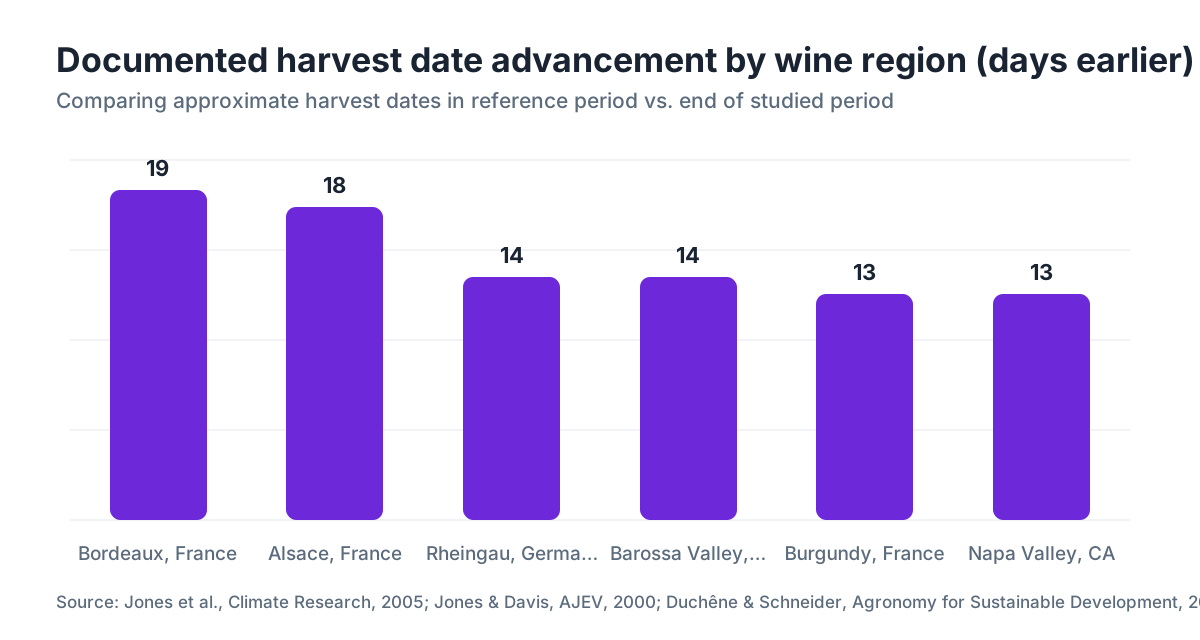
The table below summarizes documented harvest date shifts across several well-studied regions:
| Region | Approximate shift (days earlier) | Reference period |
|---|---|---|
| Bordeaux, France | ~19 days earlier | 1950 to 2000 [2] |
| Alsace, France | ~18 days earlier | 1972 to 2003 [1] |
| Burgundy, France | ~13 days earlier | 1960 to 2000 [4] |
| Rheingau, Germany | ~14 days earlier | 1950 to 2000 [5] |
| Napa Valley, CA | ~12 to 15 days earlier | 1950 to 1999 [5] |
| Barossa Valley, Australia | ~14 days earlier | 1950 to 1999 [5] |
How does earlier veraison affect berry ripeness and wine style?
This is where the trend gets practically consequential, and where growers often first feel the pressure.
Earlier veraison means sugar accumulation happens during the hottest part of summer. In California's inland valleys, veraison-to-harvest now often lands in August rather than September. Brix accumulates faster when temperatures are high, but phenolic and flavor maturity (sometimes called physiological maturity) can lag behind sugar maturity. You end up with grapes at 26 to 27 Brix before tannins are fully ripe, which pushes you toward picking underripe or picking overripe by one metric.
The flip side is that earlier harvest can mean cooler overnight temperatures at picking time in regions where fall cools fast. That helps with aromatic preservation in whites and reduces heat stress on freshly crushed fruit. It's not a uniformly bad story.
Acid levels have become a real management issue. Malic acid, the primary titratable acid in unripe grapes, degrades faster at higher temperatures. Across most of the warming wine regions, must pH at harvest has crept upward and titratable acidity down [2]. For winemakers, that means more acidification at crush and higher microbial risk in the cellar. For vineyard managers, it changes what Brix target you're actually chasing, because the traditional Brix-to-acid balance no longer holds the way it did 30 years ago.
Varietal response varies a lot. Chardonnay and Pinot Noir, both early-ripening, have felt these pressures harder in Burgundy and Champagne than Cabernet Sauvignon did initially, though Cabernet in Napa is now trending into difficult territory. Late-ripening varieties like Mourvèdre and some Iberian cultivars are arguably better positioned in warming regions, which is why you're seeing experiments with alternative varieties in places like southern Australia and Paso Robles [7].
What does earlier bloom and harvest mean for your spray program timing?
Your pest and disease calendar needs to shift with phenology, and this is a place where the trend has real operational teeth.
Powdery mildew risk is pegged to phenological stage, not calendar date. The 10-inch shoot growth threshold and pre-bloom application windows your integrated pest management (IPM) program specifies are still valid, but if bloom now happens 2 weeks earlier, those sprays go on 2 weeks earlier too. A spray schedule built on calendar dates from records kept in the 1990s runs chronically late.
Botrytis management is similarly stage-driven. The critical covers at bunch closure and veraison haven't changed, but if veraison arrives in mid-July on a site where it used to arrive in early August, your fungicide window shifts with it, and you need product on hand earlier. Re-entry intervals (REIs) and pre-harvest intervals (PHIs) don't change, but because harvest is earlier, the PHI math starts earlier too. Missing a late-season botrytis spray because you thought you had another two weeks is a real risk when your reference points are old records [8].
EPA Worker Protection Standard requirements for recording application dates, rates, and re-entry intervals stay constant regardless of phenological timing [9]. But an earlier season compresses field activity into a shorter window, and WPS recordkeeping errors tend to cluster under time pressure. Accurate, real-time spray logs are non-negotiable.
This is an area where tools that tie spray records to phenological stage rather than calendar date earn their keep. VitiScribe lets you anchor application events to growth stage, so your compliance records reflect the biological reality of when something went on in the vine's cycle, more than a wall-calendar date that means less every year.
One note on weed management: earlier bloom also brings earlier canopy closure in some cultivars, which can shade out cover crops and affect your weed suppression program. That's a second-order effect, but one worth tracking.
How should vineyard managers adjust irrigation scheduling for an earlier-ripening season?
If veraison arrives earlier, regulated deficit irrigation (RDI) protocols move earlier too. Most California and Pacific Northwest RDI programs aim to stress vines moderately between berry set and veraison to limit berry size, then shift to holding stem water potential in a narrow range through harvest. The timing of those phase transitions is keyed to phenology.
The practical problem is that an earlier veraison often coincides with peak summer heat, meaning ET demand is at its seasonal high exactly when you want to hold irrigation back. You're running a slight deficit during the hottest weeks, which demands closer monitoring of midday stem water potential. The target ranges themselves haven't changed much (roughly -1.1 to -1.4 MPa pre-veraison for moderate stress in most red varieties), but the margin for error shrinks when the vine is simultaneously fighting heat load.
UC Cooperative Extension has published irrigation scheduling guidelines that use degree-day accumulation alongside calendar date [10]. If your current program is primarily calendar-based, this is a good time to rebuild it around phenological triggers and evapotranspiration data rather than the month on the wall.
Earlier harvest also has implications for soil water status at dormancy. In summer-dry climates like California, growers sometimes rely on late-season rains to recharge the profile before vines shut down. Earlier harvest with a longer dry tail on the season can mean less natural recharge and more reliance on post-harvest irrigation to carry the profile into winter in good shape.
Water availability is becoming a constraint in the same regions seeing the strongest warming. That's not a coincidence. Managing earlier-season peak demand against potentially tighter water allocations is the central water challenge for the next decade across the western United States.
How should you update your phenology records to track this shift on your own vineyard?
Keep a phenology log. This sounds obvious, but a surprising number of small operations don't have written records of bloom date, veraison date, and harvest date going back more than 5 to 7 years, which isn't enough to detect a trend on a single site.
At minimum, record: the date when 50% of shoots reach 6-inch growth (budburst), the date of 50% bloom (when 50% of flower caps have dropped), the date of 50% veraison (when 50% of berries have changed color or gone soft), and harvest date by block and variety. These four dates, tracked consistently, tell you more about your site's trajectory than any regional average.
Brix at harvest alone doesn't capture the shift well, because your winemaker's target Brix may have changed over the same period. Calendar date is the cleaner metric for detecting trend.
Growing degree day accumulation by April 1 and by July 1 are useful supplemental metrics. NOAA's Climate Data Online tool provides daily temperature records that let you calculate GDD for your nearest weather station going back decades, which gives you context for your site records [11].
Cornell Cooperative Extension has published guidance on phenological monitoring methods for grape growers in the Northeast, including standardized definitions of the key stages worth using if you want your records comparable to published research [12].
Be consistent about where you make your observations. Moving the observation vine or block mid-series introduces noise that can swamp a real trend signal. Pick representative vines in a permanent location and always use those.
Are there varieties or rootstocks that perform better as harvest windows shift earlier?
Yes, and this is where long-term planning gets interesting for small vineyard operations.
The basic logic: if your site is warming and harvest dates are shifting earlier, late-ripening varieties become more reliably harvestable, and early-ripening varieties may overshoot their quality window before you can get them off the vine. Pinot Noir in a warming region that used to be cool is a good example. It ripens early, acid drops fast, and it wants to be picked in a narrow window that's getting harder to hit.
In practice, variety decisions are constrained by appellation regulations, existing infrastructure, market positioning, and the 7 to 10 year horizon on a replant. Nobody rips out a Pinot Noir vineyard just because harvest is 10 days earlier than it was in 1995. But at replant decisions, thinking about variety thermal adaptation is reasonable.
Rootstock selection interacts with this somewhat. Vigorous rootstocks like 110R promote later maturity than dwarfing stocks, which can be useful in warm regions where you need to slow the vine down. UC Davis has published rootstock trial data comparing relative maturity timing across several widely used rootstocks [10].
Some California growers in warmer inland regions have been adding Rhône varieties, Iberian cultivars (Tempranillo, Touriga Nacional), and southern Italian varieties (Nero d'Avola, Fiano) that evolved in warmer climates and hold acidity better under heat. The Paso Robles wine community has been at the front of this experimentation [7]. Whether it pencils out on your site is a different question, but the agronomic logic is real.
Clonal selection matters too. Within a variety, clones differ meaningfully in phenological timing and thermal response. If you're replanting Chardonnay, asking your nursery specifically about clonal differences in ripening timing is worth doing.
What do climate projections say about how much further this trend will go?
The honest answer: quite a bit further under most scenarios, but the range of outcomes is wide.
The IPCC AR6 report (2021) projects continued warming through 2100 under all emissions scenarios, with the range running roughly an additional 1.0°C to 4.4°C globally by end-of-century depending on the scenario [13]. For viticulture, that means growing-season temperatures in most current wine regions keep climbing. Using the Jones and Davis (2000) estimate of about 13 days of harvest advancement per degree Celsius [2], even the lower-end 1°C scenario implies another 10 to 13 days of harvest date advancement on top of what's already happened.
Some modeling work suggests that if temperatures rise 2°C or more, portions of today's premium wine regions may shift out of the optimal temperature band for their signature varieties entirely. Research published in PNAS in 2013 by Hannah et al. projected that suitable habitat for premium wine production could contract by up to 73% in some currently premium regions under high-warming scenarios, while opening up at higher latitudes and higher elevations [13].
That's a stark projection and should be held at arm's length for operational decisions on a 5-year planning horizon. What's more immediately actionable is the near-term probability: the trend documented over the past 40 years is very likely to continue for at least the next 20, regardless of what happens with global emissions, because of the warming already locked in.
For practical vineyard planning, assume another 5 to 10 days of harvest advancement over the next 15 to 20 years, with more uncertainty beyond that. Design your water infrastructure, variety mix, and harvest logistics around that working assumption.
How do you update compliance records and harvest logs to reflect a shifting season?
Regulatory compliance doesn't care about climate trends. It cares about accurate records with correct dates, rates, and registrations. But an earlier season creates specific recordkeeping risks worth thinking through.
Start with pre-harvest intervals. If a fungicide label specifies a 14-day PHI and you've always applied it in mid-August on the assumption harvest is in early October, and harvest is now in mid-September, that spray is now hitting 8 days before harvest rather than 14. PHI violations don't require intent. You have to rebuild your late-season spray cutoff dates against your actual harvest target, not your historical one [8].
Next, spray records tied to block and growth stage. California Department of Pesticide Regulation (CDPR) requires a pesticide use record for every application, including date, crop, location, amount, and EPA registration number of the product [14]. If your blocks harvest on rolling dates across a compressed window (which is more common as seasons get more variable), you need airtight records showing which blocks were at what stage when each product went on.
Variability is increasing alongside the earlier trend. It's more than that the average is earlier; year-to-year swings in bloom and harvest date are also wider than they were 50 years ago in most regions. That unpredictability is arguably harder to manage than the directional trend, because you can't just shift your calendar two weeks earlier and be done. You have to respond to the actual season.
This is exactly where VitiScribe is built to help: linking spray records to block-level phenological stage and harvest date tracking, so your compliance documentation reflects what actually happened in the field, not a schedule you drew up in January.
For growers in California, CDPR's guidance on restricted materials permits and pesticide use reporting is available directly from the state [14]. WSU Extension publishes similar compliance guidance tailored to Washington requirements [6].
Frequently asked questions
How many days earlier is harvest now compared to 40 years ago in major wine regions?
Most well-studied wine regions show harvest dates roughly 12 to 20 days earlier than in the 1950s and 1960s. Bordeaux data analyzed by Jones and Davis (2000) showed approximately 19 days of advancement between 1950 and 2000. Alsace data shows about 18 days over the period 1972 to 2003. Site-level results vary, but very few regions with long records show no trend.
Does earlier harvest always mean lower wine quality?
Not automatically. The Jones et al. 2005 study in Climate Research found that quality ratings for many regions actually improved alongside warming from the 1950s through the 1990s, as previously marginal sites became reliably warm enough to ripen fruit. The risk emerges when temperatures rise past the optimal range for a variety, compressing the window between physiological maturity and overripeness. Some regions are now entering that zone.
Is earlier veraison a reliable predictor of harvest date?
Yes, with some variation. The interval between veraison (50% color change) and harvest is relatively stable for a given variety on a given site, typically 40 to 55 days for most red varieties and 35 to 50 days for whites. Veraison date gives you a workable harvest projection roughly 6 weeks out. Heat accumulation after veraison and any water stress can compress or extend that window, so check actual Brix progression rather than relying purely on the date.
Which varieties are most vulnerable to the trend toward earlier, hotter ripening conditions?
Early-ripening, cool-climate varieties carry the most risk. Pinot Noir, Chardonnay, Pinot Gris, and Riesling are the clearest examples. These varieties evolved in climates where they barely ripened, so extra heat pushes them past their quality window fast. Malic acid loss accelerates, sugar overshoots phenolic maturity, and the picking window shrinks. Late-ripening, heat-adapted varieties like Grenache, Mourvèdre, Tempranillo, and Touriga Nacional are less stressed.
How do I calculate if my growing degree day accumulation has changed over the years?
NOAA's Climate Data Online provides daily maximum and minimum temperature records for most US weather stations going back decades. Calculate GDD base 10°C as ((Tmax + Tmin)/2) - 10 for each day the result is positive, then sum from April 1 through October 31. Comparing your April 1 to July 1 accumulation now versus 20 years ago at your nearest station gives you a locally relevant measure of the shift.
If harvest is earlier, do pre-harvest interval (PHI) requirements for pesticides change?
The PHI itself doesn't change; it's fixed by the label. What changes is when you must make your last application. If harvest is now in mid-September instead of early October, you count back your PHI from mid-September. Growers who use old calendar-based cutoff dates without recalculating against their actual harvest target risk PHI violations, which are detectable at residue testing. Always back-calculate your last application date from a realistic current harvest estimate.
Is the trend toward earlier harvests the same in all wine regions worldwide?
The direction is consistent: every wine region with records longer than 20 years shows earlier phenology on average. The magnitude varies. Southern Australian regions like Barossa and McLaren Vale have seen roughly 14-day advances since 1950. European regions show 12 to 20 days of advancement. Some Pacific Northwest regions have warmed faster in some metrics than coastal California. Higher-elevation and coastal sites have generally shifted less than warm inland regions.
Can cover crops or shade netting slow ripening and offset earlier harvest dates?
Cover crops create some competition for water and nutrients that can modestly slow vine vigor and ripening. Shade netting has been studied in Australia and parts of California and can reduce berry temperature by 2 to 4°C under the net, which measurably slows sugar accumulation and preserves acidity. Neither is a complete solution at the scale most vineyard managers work, but shade netting over high-value white variety blocks is a real and increasingly used tool in warm inland regions.
How do I build a phenology log for my vineyard blocks?
Pick 3 to 5 representative vines in each block and mark them permanently. Record the date each reaches: 50% budburst, 50% bloom (caps dropping), 50% veraison (color or softening), and harvest. Use the same definition each year. Store dates with block ID, variety, and clone. Even five years of consistent records starts to reveal block-level patterns. Cornell Cooperative Extension provides standardized stage definitions you can use to make your records comparable to published research.
Does earlier bloom increase frost risk or reduce it?
It increases frost risk. Earlier budburst and bloom mean tender shoot tissue is exposed during a period when late frosts are still possible. In most temperate wine regions, the last frost date hasn't advanced as fast as vine phenology, so the gap between bloom and the last hard frost has actually narrowed in some locations. This is one of the underappreciated risks of the early-season shift, particularly in Burgundy, Champagne, and parts of Oregon and Washington.
What is the relationship between growing degree days and harvest date advancement?
Jones and Davis (2000) estimated roughly 13 days of harvest advancement per 1°C increase in mean growing-season temperature in Bordeaux. Because growing degree days and mean temperature are closely correlated, this roughly translates to about 1 day of harvest advancement per 7 to 8 additional GDD accumulated over the season. The exact relationship varies by variety, site, and training system, but this gives a useful order-of-magnitude estimate for planning.
How do I adjust my botrytis management program if veraison is arriving 2 weeks earlier?
Key botrytis application windows are tied to phenological stage: pre-bloom, bunch closure, and veraison. If veraison now arrives 2 weeks earlier on your site, the veraison cover spray and any post-veraison applications go on 2 weeks earlier too. Also recalculate your PHI window from your revised harvest date. The product choices and rates don't change, but the calendar does. If you're running a calendar-based spray schedule from old records, you're probably running late in most recent seasons.
Is earlier harvest linked to higher alcohol wines?
Generally yes, though the relationship runs through sugar accumulation rather than calendar date directly. Earlier veraison coincides with peak summer heat, which drives rapid sugar accumulation. Growers targeting the same Brix as 20 years ago are harvesting fruit that was stressed into higher sugar by heat, often with lower acidity. Many winemakers report that average must Brix at harvest has risen 1 to 2 degrees in warm regions over the past 20 years, which adds roughly 0.5 to 1.0% potential alcohol.
What records do California growers need to maintain on spray applications under a shifting, compressed season?
California DPR requires a Pesticide Use Report for every application, including operator name, date, location, crop, acreage treated, product name, EPA registration number, and amount applied. There is no exception for compressed or unusual seasons. Records must be submitted to the county agricultural commissioner monthly. Growers using restricted materials also need a permit. CDPR's guidance is at cdpr.ca.gov. Accurate records get harder to maintain when the season is compressed and variable, which is exactly when you most need a reliable logging system.
Sources
- Duchêne E. and Schneider C., 2005, Agronomy for Sustainable Development, 'Grapevine and climatic changes: a glance at the situation in Alsace': Harvest dates in Alsace advanced approximately 2.5 weeks between 1972 and 2003.
- Jones G.V. and Davis R.E., 2000, American Journal of Enology and Viticulture, 'Climate Influences on Grapevine Phenology, Grape Composition, and Wine Production and Quality for Bordeaux, France': Bordeaux harvest dates advanced approximately 13 days per degree Celsius of warming; mean growing-season temperatures increased about 1.5°C between 1950 and 2000.
- Chuine I. et al., 2004, Nature, 'Grape ripening as a past climate indicator': Burgundy harvest dates in the late 1990s and early 2000s were among the earliest in 650 years of records.
- Paso Robles Wine Country Alliance, variety and climate information: Paso Robles growers have been experimenting with Rhône and Iberian cultivars suited to warmer ripening conditions.
- UC Agriculture and Natural Resources, UC IPM Grape Pest Management Guidelines: Botrytis and powdery mildew spray timing is keyed to phenological stage including pre-bloom, bunch closure, and veraison; pre-harvest intervals must be observed.
- US EPA, Worker Protection Standard for Agricultural Pesticides: EPA WPS requires recording application date, rate, location, and re-entry interval for all pesticide applications regardless of season timing.
- UC Cooperative Extension, Irrigation of Winegrapes in California: UC Davis Cooperative Extension irrigation scheduling guidelines use degree-day accumulation and evapotranspiration data as phenological triggers; rootstock trial data compares relative maturity timing.
- NOAA National Centers for Environmental Information, Climate Data Online: NOAA Climate Data Online provides daily temperature records for US weather stations going back decades, enabling GDD calculations.
- Cornell Cooperative Extension, Viticulture Program, grape phenology monitoring: Cornell Cooperative Extension publishes standardized phenological stage definitions for grape growers in the Northeast.
- Hannah L. et al., 2013, PNAS, 'Climate change, wine, and conservation': Under high-warming scenarios, suitable habitat for premium wine production could contract by up to 73% in some currently premium regions while opening at higher latitudes and elevations.
- California Department of Pesticide Regulation, Pesticide Use Reporting: California DPR requires a Pesticide Use Report for every application including operator name, date, location, crop, acreage, product name, EPA registration number, and amount applied, submitted to county agricultural commissioner monthly.
Last updated 2026-07-09