How long from veraison to harvest: timing by variety and climate
TL;DR
- Most wine grape varieties reach harvest 45 to 75 days after veraison, the stage when berries soften and start to color.
- Warm climates and early-ripening varieties compress that window to 40 to 50 days.
- Cool climates and late-ripening varieties can stretch it past 80.
- Tracking Brix, pH, titratable acidity, and berry texture together beats counting days.
What actually happens at veraison, and why does it matter for timing?
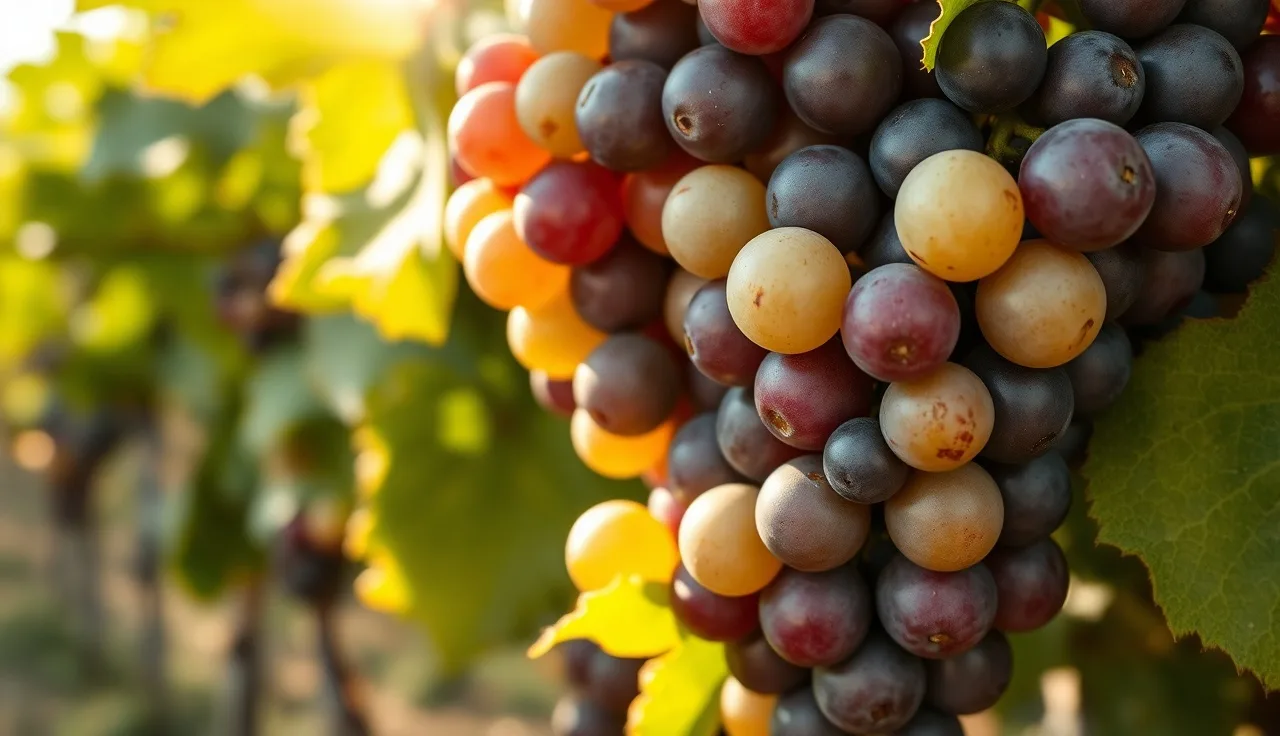
Veraison is the switch point when berries stop building seeds and start ripening. Cell division essentially stops. Sugar accumulation begins in earnest. In red varieties, anthocyanins flood the skin and you get the color change from hard green to translucent red or blue-black. In whites the change is subtler, a softening and a shift from opaque green to a more translucent, yellowish green, but the same physiology is running underneath [1].
The date of veraison is the starting gun for your harvest countdown. That's why recording it matters as much as anything else you do all season. A manager who knows the average veraison-to-harvest interval for each block, built over several years, has a real planning tool. A manager guessing off general knowledge stays perpetually surprised.
Veraison rarely happens uniformly. The earliest berries sit on sun-exposed clusters at the canopy exterior, while shaded interior clusters lag by a week or more. Standard practice is to call veraison when roughly 50 percent of berries on a representative sample have softened and colored [2]. Some extension programs use 80 percent instead. Pick one threshold and use it every year so your records line up.
Temperature during and right after veraison sets the pace of everything that follows. A heat spike at veraison can compress ripening by two weeks, giving you uneven flavor and a scramble to pick. A cool, foggy stretch afterward slows sugar accumulation and can push harvest well past what your historical averages predicted.
How many days from veraison to harvest for common wine grape varieties?
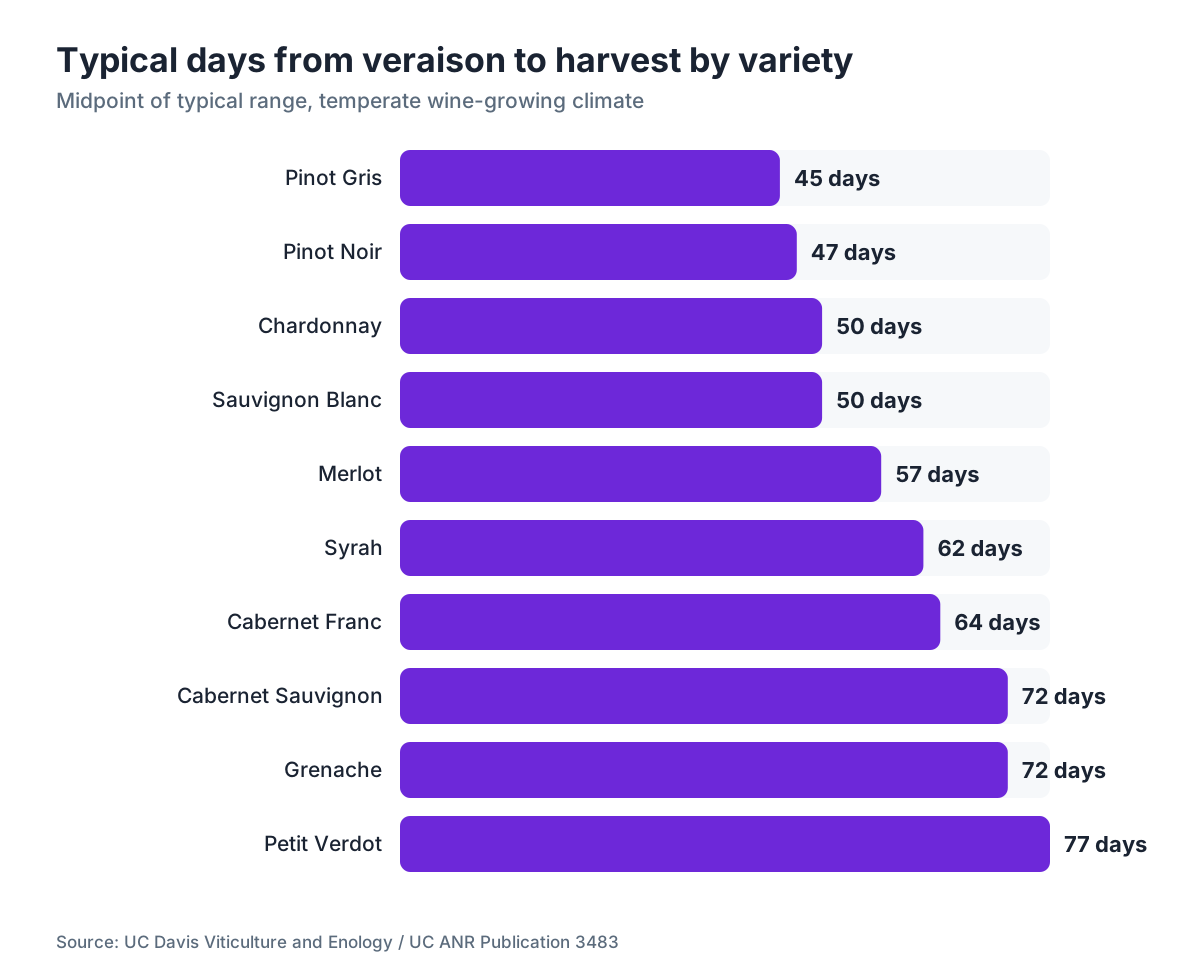
No single number is right, but 45 to 75 days covers most commercial wine grape varieties under normal conditions [3]. Early-ripening varieties land at the low end. Late-ripening varieties push toward or past the high end. Climate moves both ends.
Here is a practical reference table built from UC Davis and extension data [1][3]:
| Variety | Typical days from veraison to harvest | Ripening class |
|---|---|---|
| Pinot Gris / Grigio | 40 to 50 | Early |
| Pinot Noir | 42 to 52 | Early |
| Chardonnay | 45 to 55 | Early, mid |
| Sauvignon Blanc | 45 to 55 | Early, mid |
| Merlot | 50 to 65 | Mid |
| Syrah | 55 to 70 | Mid, late |
| Cabernet Franc | 58 to 70 | Mid, late |
| Cabernet Sauvignon | 65 to 80 | Late |
| Grenache | 65 to 80 | Late |
| Petit Verdot | 70 to 85 | Late |
| Nebbiolo | 75 to 90 | Very late |
These ranges assume a temperate growing climate with normal degree-day accumulation. Paso Robles and other warm interior California sites often run 5 to 10 days faster than Napa Valley's average for the same variety [3]. A vineyard in a cool coastal AVA like Sonoma Coast or the Finger Lakes can add another week or two to the upper bounds.
The table is a planning tool, not a harvest decision. You still sample berries. But knowing your Cab Sauv block has averaged 72 days post-veraison tells you when to start tasting seriously.
What temperature and degree-day accumulation drives the veraison-to-harvest window?
Grapevines accumulate heat in a way you can measure. The Winkler scale, developed at UC Davis, uses growing degree days (GDD): the average daily temperature minus 50°F, the base below which vines don't accumulate meaningful heat, summed from April 1 through October 31 in the Northern Hemisphere [1]. A Region I climate accumulates fewer than 2,500 GDD. Region V exceeds 4,000.
The timing consequence is direct. In Region I sites (Champagne, Germany's Mosel, Washington's Yakima Valley in some years), post-veraison heat is slow to build, and the interval to harvest stretches. In Region IV and V sites (San Joaquin Valley, much of interior Spain), the post-veraison sprint is fast.
WSU Extension research on Washington winegrape phenology found that warm years can shift veraison three weeks earlier than cool years for the same variety and site [4]. That early veraison doesn't automatically buy you an equally early harvest, because the ripening rate adjusts too, but the two events track together. Early veraison usually means early harvest.
Night temperatures matter for quality specifically. Cool nights after veraison preserve malic acid and aromatic precursors. Sites with big diurnal swings, the gap between daytime highs and nighttime lows, tend to make wines with more retained acidity and aromatics at a given sugar level. That's why coastal and high-elevation vineyards get prized for certain varieties.
You can calculate your own site's GDD from on-site weather data or from NOAA's Climate Data Online, which holds daily temperature records going back decades [5]. Tracking GDD from veraison to harvest over a few years builds a reliable local prediction model faster than any generic chart.
What ripeness markers should you actually measure instead of counting days?
Days elapsed is context. Ripeness markers are the decision. Four measurements matter most, and good growers use all four together.
Brix (soluble solids, mostly sugars) is where most people start. Wine grapes usually come in between 20 and 26 Brix, though sparkling base wine and some whites get picked at 18 to 20, and late-harvest styles run far past 26 [1]. Brix alone falls short: a berry can hit 24 Brix with excellent flavor or terrible flavor depending on what else is going on.
Titratable acidity (TA) and pH move in opposite directions through the season. Malic acid degrades with heat and time. Tartaric acid holds steadier. A white picked below 5.5 g/L TA often needs acidulation. Above 8.5 g/L it can taste harsh. pH above 3.6 at harvest creates microbial stability problems in the cellar and often signals overripeness in reds [6].
Brix-to-acid ratio is the single most useful combined index for many winemakers. UC Davis extension literature often references a target of 30:1 to 35:1 (Brix divided by TA in g/L per 100 mL) as a rough starting point for table wine reds, though it shifts with style [1].
Flavor and phenolic maturity are the fourth factor and the hardest to pin down. Seed color, seed crunch, skin texture, and berry flavor tell you things no refractometer can. Green, bitter seeds in a ripe-looking berry mean the phenolics aren't there yet. Brown, crunchy seeds that release cleanly from the pulp say you're at or past phenolic maturity. You build this skill by tasting hundreds of berries over several seasons. No shortcut exists.
If you track all of this across multiple blocks, a field record-keeping tool like VitiScribe makes it practical to log sampling dates, Brix, pH, and tasting notes in one place so patterns surface across vintages.
How does the veraison-to-harvest window differ by wine region and climate type?
Climate is the biggest modifier of the generic variety timelines. Here's how the major growing region types behave.
Cool coastal regions (Sonoma Coast, Willamette Valley, Finger Lakes, Champagne, Burgundy) build heat slowly after veraison. Chardonnay and Pinot Noir often reach harvest 55 to 65 days post-veraison here, and vintages swing hard. A warm September compresses that. A cool, wet September pushes it past 70 days or brings rot pressure that forces an early pick regardless of ripeness.
Moderate Mediterranean climates (Napa Valley, Marlborough, much of Tuscany) run more consistent timelines because summers are reliably warm and dry. Merlot at 55 to 60 days and Cabernet Sauvignon at 65 to 75 days are typical. Year-to-year variation is lower than in cool climates.
Warm interior regions (Paso Robles, San Joaquin Valley, Barossa Valley, much of Spain) compress the window. The Cabernet Sauvignon that needs 75 days in cool Napa might be ready in 60 in a hot-year Paso Robles block. Temecula in Southern California, warm with real marine influence, often runs a short, intense harvest, roughly a 3 to 4 week window across all varieties instead of the 6 to 8 weeks a cooler region gets.
High-elevation vineyards (Sierra Foothills, Mendoza, parts of Oregon's Walla Walla) are their own case. Daytime heat can be aggressive, but cool nights slow sugar accumulation below what the afternoon highs suggest. These sites often reach riper flavors at lower Brix than flatter, warmer ground.
Nobody has a clean global study on this. The closest systematic work comes from Jones et al. (2005) in the American Journal of Enology and Viticulture, which found grape harvest dates across major regions shifted an average of 6 to 13 days earlier over the preceding 50 years as temperatures rose, with more variation in cool-climate regions than warm ones [7].
How do you track veraison date reliably across multiple blocks?
Designate 10 to 20 representative vines per block as phenology sample vines before the season starts. Mark them. Visit weekly from mid-summer. When you spot the first color change, bump to twice-weekly visits and log the percentage of colored, softened berries on a 10-cluster sample per marked vine [2].
Record the date you hit 50 percent coloration and treat that as your official veraison date every year. If you also want to track completion (80 to 90 percent colored), log it separately. The spread between 50 percent and 80 percent tells you how uniform the ripening is in that block, which shapes harvest decisions later.
Blocks differ for reasons that are real and predictable. Rootstock, variety, row orientation, soil depth, irrigation, vine age, and canopy density all change how fast and how evenly veraison moves. A block with big variation at veraison will likely have variation at harvest, and you may end up planning selective picking rather than one pass.
Your veraison log should capture block ID, date, percentage colored, weather notes (flag any heat event in the prior week), and the name of the person doing the assessment. That last field matters for calibration across years. Different observers call 50 percent differently. Use one primary observer if you can.
What can push the veraison-to-harvest timeline earlier or later than normal?
Heat waves between veraison and harvest are the sharpest compressor. A sustained spell above 95°F in August or September can drive sugar accumulation up by a week or more, sometimes racing Brix past target before flavors develop. That's a real quality problem in hot vintages, and it's one reason picking at slightly lower Brix in a hot year can beat waiting for a 'normal' number.
Rain does the opposite. A significant rainfall can dilute sugars and drop Brix a degree or two within 48 hours. It also raises rot pressure. A cluster with any Botrytis or bunch rot at 70 percent ripeness can go downhill fast after rain. When rain is forecast, you often face a hard call: pick slightly underripe or gamble on a drying window afterward.
Irrigation shapes the timeline too. Withholding water after veraison concentrates flavors and holds a slight deficit that tends to improve phenolic development in reds, but too much stress shuts down ripening entirely. WSU Extension research suggests holding moderate deficit (stem water potential around -1.0 to -1.2 MPa) in reds post-veraison as a general target, though it varies by variety and rootstock [4].
Nitrogen status counts. Vines that hit veraison with excess vegetative growth push resources into shoots instead of fruit. Canopy work in the weeks around veraison, leafing, shoot positioning, hedging, directly changes how fast and evenly the fruit ripens. A dense, shaded canopy after veraison typically adds 5 to 10 days to the ripening timeline versus an open canopy on the same variety and site.
Mist and fog in coastal regions add their own dynamics. Morning fog that burns off by 10 or 11 a.m. tends to preserve acidity and stretch the ripening window in a useful way. Persistent afternoon marine clouds cut heat accumulation and can delay ripening past what you want, especially in a cool year.
What berry sampling method gives the most accurate picture of ripeness?
The industry standard in UC Davis extension guidance is a 100-berry sample pulled from across the block, with berries taken from multiple cluster positions (tip, shoulder, interior) and multiple vine positions (end post, middle of row, exterior canopy, interior canopy) for a representative cross-section [1][2].
Crush and strain the sample for juice. Read Brix with a refractometer or hydrometer (refractometers are faster in the field, and a temperature-corrected digital unit is plenty accurate). Bring the rest to the lab or winery for pH and TA. Larger operations sometimes read pH in-field with portable meters, which work fine if you calibrate them regularly.
Frequency matters. Once a week is the minimum once you enter the 40-days-post-veraison window. Twice a week is better for fast-ripening varieties or warm vintages. In the final 10 days before your target harvest, daily sampling earns its keep if you have the labor.
Taste the berries. Squeeze the pulp from the skin. Chew the seeds. Spit everything. Does the pulp taste like ripe fruit or still green and vegetal? Are the seeds brown and releasing cleanly? Is the skin soft and yielding or still firm? These calls can override a Brix number that looks ready when the flavors aren't.
Cornell Cooperative Extension's viticulture program suggests logging at least three sampling dates before harvest to establish the ripening trajectory rather than a single point-in-time number [6]. Trajectory tells the story. A block moving 19 to 21 to 23 Brix in consecutive weekly samples is on a clean curve. A block sitting at 22 Brix that was 21 two weeks ago is stalling, and it deserves a closer look at water status and canopy.
How does post-veraison management affect when you'll harvest?
The decisions you make in the six weeks after veraison have direct consequences for when you pick. Leafing the east- and west-facing sides of the cluster zone improves sun exposure and airflow, which tends to speed phenolic maturity and cut disease pressure. Pulling excess lateral growth does the same.
Green harvest, dropping crop after veraison, concentrates resources in the remaining clusters and often brings earlier, more uniform ripening. A 20 to 30 percent crop reduction early post-veraison can compress the harvest window meaningfully. Whether it's worth the yield loss is a business call, but the timing effect is real and documented [3].
Irrigation cutoff is one of the higher-stakes decisions. In most drip-irrigated western U.S. vineyards, growers taper hard after veraison and reach full cutoff 3 to 4 weeks before anticipated harvest, adjusted for soil water-holding capacity and vine size [11]. Cut too early in a hot, dry year and you risk shutting ripening down. Cut too late and you dilute sugars and flavors.
Bunch rots are the most common reason growers get forced into an early harvest. In a humid post-veraison region (Finger Lakes, Willamette Valley in a wet fall, or anywhere with heavy late-season rain), your spray program through the post-veraison window directly sets how much harvest flexibility you have. A clean, disease-free vineyard can wait for optimal ripeness. A vineyard with 15 percent bunch rot at day 55 post-veraison may need to come in now, whatever the Brix says.
For growers tracking all of this across blocks and vintages, consistent record-keeping starting at veraison makes harvest scheduling far more predictable. VitiScribe's block-level phenology and sampling logs are built for that season-over-season pattern building.
Are there differences between white and red varieties in the veraison-to-harvest window?
Yes, and the gap runs in both directions depending on the variety. Whites generally come in at lower Brix than reds (18 to 22 versus 22 to 26), so they get pulled earlier in the ripening curve. An early-ripening white like Pinot Gris, harvested at 20 to 21 Brix, might come off at day 45 post-veraison. A red at the same site, harvested at 24 Brix, might be day 60 to 65.
Phenolic maturity adds the complication. Reds need skin and seed tannin development that whites don't require the same way. A red might hit its target Brix 10 days before its seed and skin tannins arrive. So you wait. That gap, between 'the Brix looks ready' and 'the phenolics are actually ready,' tends to run larger for reds than whites, which is part of why red harvest windows are longer and less precise.
Sparkling wine grapes are a specific case. Grapes for méthode champenoise or other traditional sparkling production usually come in at 17 to 19 Brix with TA in the 9 to 11 g/L range. That pulls harvest much earlier, sometimes 30 to 40 days post-veraison depending on the vintage. In warm years, picking early enough to hold acidity for sparkling can be a genuine challenge.
Orange wines, where white grapes ferment on their skins, sit in the middle. Winemakers making this style often want more phenolic development in their white grapes and may push harvest 5 to 10 days past a conventional white from the same variety. That's a stylistic choice with a direct effect on the harvest window.
What records should you keep from veraison through harvest for compliance and future planning?
Regulatory compliance requires documentation that overlaps neatly with good agronomic record-keeping. Under the EPA Worker Protection Standard (WPS), restricted-entry intervals for pesticide applications must be tracked precisely through the post-veraison window, and pre-harvest intervals (the gap between the last permitted application of a product and harvest) are often the binding constraint on both harvest timing and spray decisions [8].
EPA guidance states that agricultural employers must maintain records of pesticide applications including the product name, EPA registration number, active ingredient, application date, and the restricted-entry interval, and these records must be available to workers and handlers [8]. If a pre-harvest interval limits your last two weeks of fungicide options, you need a good enough harvest estimate to plan your final spray date backward from it.
Beyond compliance, the highest-value planning records are: veraison date by block, berry sampling results (Brix, pH, TA) on a weekly or biweekly basis starting at veraison, weather observations (heat, rain, fog), disease observations (bunch rot percentage), and the actual harvest date with final Brix. Over three to five seasons, that dataset tells you more about your specific blocks than any textbook average.
For California growers, the Department of Pesticide Regulation requires pesticide application records with specific fields including the unit treated and the amount applied, subject to inspection [9]. California requires those records be kept for two years. Requirements vary by state, so check your state ag department.
A well-organized harvest log also supports wine labeling traceability (vintage dating, appellation claims, and variety labeling all depend on knowing exactly what came from where and when), grape purchase contracts, and crop insurance documentation.
Frequently asked questions
How do I figure out when veraison happened if I missed it?
Look back at your weather records for the first sustained warm period in mid-summer and check with neighboring vineyards. For same-variety, same-region vines, veraison dates rarely differ by more than 10 days between similar sites. You can also back-calculate from current Brix: if you're at 18 Brix and gaining about 0.3 to 0.5 Brix per day, count backward toward the veraison starting point of roughly 6 to 8 Brix. Imprecise, but workable for planning.
Can heat damage during summer push veraison earlier and change the harvest timing?
Yes. A sustained heat wave in July can accelerate veraison by one to three weeks compared to a cool year. Earlier veraison doesn't automatically mean earlier harvest by the same margin, since the post-veraison ripening rate also adjusts with temperature, but warm vintages typically produce earlier harvest dates. WSU Extension research found veraison in Washington can shift up to three weeks between cool and warm years for the same variety and site.
What Brix level should I be targeting at harvest for red wine grapes?
Most table wine reds come in between 23 and 26 Brix, with many winemakers targeting 24 to 25 for varieties like Cabernet Sauvignon and Syrah. Brix above 26 pushes potential alcohol past 15 percent, which many winemakers avoid. The right number depends on your yeast, your style, and your market. Taste the berries and assess phenolic maturity alongside the refractometer reading, not instead of it.
Does irrigation after veraison slow down ripening?
Yes. Continued full irrigation post-veraison dilutes sugar accumulation and can delay harvest by a week or more, depending on volume. Most drip-irrigated western U.S. programs taper sharply after veraison and aim for full cutoff three to four weeks before anticipated harvest. Mild deficit stress post-veraison generally goes with better phenolic and flavor development in reds. Push too dry, though, and ripening shuts down entirely.
How many days after veraison should I start berry sampling?
Start no later than 30 days post-veraison for early-ripening varieties (Pinot Noir, Chardonnay) and 35 to 40 days for mid- and late-ripening varieties. In warm vintages or warm climates, start sooner. The point is to establish the Brix and acid trajectory before you're in the harvest window, not to scramble for data when the fruit already sits at 22 Brix. Cornell Cooperative Extension recommends at least three sampling dates before harvest.
Why does the same variety ripen faster at some wineries than others?
Site climate (heat accumulation, diurnal swings), soil depth and water-holding capacity, rootstock, vine age, trellising, canopy management, and crop load all interact to set ripening speed. Warm interior sites like Paso Robles can ripen the same Cabernet Sauvignon 10 to 15 days faster than cool coastal sites. Even inside one appellation, a well-drained hillside block almost always ripens faster than a heavier-soil valley-floor block of the same variety.
How do bunch rots affect the veraison-to-harvest timeline?
Bunch rots, especially Botrytis cinerea in cool, wet conditions, can force early harvest regardless of ripeness. Botrytis spreads fast once established, and a block with 10 to 15 percent infected clusters can hit 30 to 40 percent within a week of rainy weather. If disease pressure is climbing, you may need to harvest underripe rather than lose the crop. A well-timed post-veraison fungicide program, respecting pre-harvest intervals, is your best tool for keeping the window open.
What is the pre-harvest interval (PHI) for common vineyard fungicides, and how does it affect harvest timing?
Pre-harvest intervals vary by product. Many common fungicides carry PHIs of 7 to 14 days. Some run 30 days. Mancozeb has a 66-day PHI in some formulations. Check the label of each specific product registered for use in your state. The EPA requires the PHI to appear on the label, and applying inside the PHI is a violation. Plan your last fungicide applications by working backward from your earliest anticipated harvest date.
Does thinning crop post-veraison actually speed up harvest?
A green harvest immediately post-veraison typically accelerates ripening and improves uniformity in the remaining clusters. Cutting crop load 20 to 30 percent can move harvest 5 to 10 days earlier and narrow the spread between first-ripe and last-ripe clusters. The trade-off is obvious: fewer tons per acre. The decision hinges on your contract price, the vintage, and your stylistic target. In a cool year with disease pressure, early thinning can be an easy call.
How should I log veraison and harvest dates for compliance and future planning?
Log the veraison date by block, using a consistent definition (50 percent of berries colored and softened on a 10-cluster sample is the standard). Record all berry sampling data with date, block ID, sampler name, Brix, pH, and TA. Log your harvest date, final Brix, and tons harvested. Keep pesticide application records with PHIs calculated against your harvest dates. California requires pesticide records for two years. Most other states require one to two years. Check your state department of agriculture.
Is the veraison-to-harvest window getting shorter as the climate warms?
Probably, in some regions. Jones et al. (2005) in the American Journal of Enology and Viticulture found harvest dates across major wine regions shifted 6 to 13 days earlier over 50 years, with more variability in cool-climate regions. Whether the veraison-to-harvest interval itself is shortening, versus just moving earlier on the calendar, is less clear and varies by region. In practice, growers in many warm regions report rising vintage-to-vintage volatility more than a clean shortening.
What happens if I harvest too early, before the post-veraison window is complete?
Harvesting too early means high acidity, low sugars, underripe flavors (vegetal, green pepper in reds, tart grapefruit in whites beyond what the variety intends), and green, astringent seeds in reds. The wine often turns out harsh and thin without heavy winemaking intervention. In warm years with disease pressure, that trade-off may be forced on you. When it isn't, waiting through the full interval produces meaningfully better fruit.
How do I estimate harvest date at the start of the season for logistics planning?
Use your historical veraison dates per block plus your average veraison-to-harvest interval (built from prior years' records) to generate an estimated harvest window for each block. Layer in the current season's degree-day pace against the historical average for the same date. That gives you a preliminary window for labor scheduling, crush pad booking, and equipment planning. Update the estimate when you hit veraison, and again at 30 days post-veraison with your first sampling data.
Sources
- UC Davis Viticulture and Enology, 'Winegrape Varieties and Ripening Characteristics': Wine grape harvest Brix targets, Winkler GDD scale, variety ripening classifications, and 100-berry sampling methodology
- UC Cooperative Extension, UC Agriculture and Natural Resources, 'Grape Phenology and Veraison Assessment': 50 percent berry coloration as the standard veraison date definition and 10-cluster sampling protocol
- University of California Division of Agriculture and Natural Resources, Publication 3483, 'Wine Grape Varieties in California': Variety-level ripening classifications, warm versus cool region days-from-veraison ranges, and crop thinning effects on ripening speed
- Washington State University Extension, 'Winegrape Phenology and Irrigation Management in Washington': Veraison can shift three weeks between warm and cool years for the same variety and site in Washington; post-veraison water deficit targets around -1.0 to -1.2 MPa stem water potential
- NOAA National Centers for Environmental Information, Climate Data Online: Daily temperature records for GDD accumulation calculation at vineyard sites
- Cornell Cooperative Extension, 'Fruit Quality Measurements for Grape Harvest Decisions': TA and pH targets for harvest, recommendation to collect at least three sampling dates before harvest to establish ripening trajectory
- Jones, G.V. et al. (2005), 'Climate Change and Global Wine Quality', American Journal of Enology and Viticulture 56(3): Grape harvest dates across major wine regions shifted an average of 6 to 13 days earlier over 50 years as temperatures rose, with higher variation in cool-climate regions
- U.S. EPA, Worker Protection Standard for Agricultural Pesticides: Agricultural employers must maintain pesticide application records including product name, EPA registration number, active ingredient, application date, and restricted-entry interval; records must be available to workers
- California Department of Pesticide Regulation, 'Pesticide Use Reporting': California requires pesticide application records with specific fields including unit treated and amount applied, subject to inspection and kept for two years
- WSU Extension, 'Irrigation Management of Wine Grapes': Post-veraison irrigation tapering recommendations and full cutoff 3 to 4 weeks before harvest in drip-irrigated Pacific Northwest vineyards
Last updated 2026-07-09