Does water stress affect veraison timing in grapevines?
TL;DR
- Yes, water directly affects when grapevines hit veraison.
- A moderate water deficit before color change usually advances veraison by 5 to 10 days and tightens cluster uniformity.
- Severe or badly timed stress can delay it or spread berry set unevenly.
- The size of the effect depends on rootstock, variety, soil type, and exactly when in the season the stress hits.
What is veraison and why does timing matter for your vintage?
Veraison is the switch that starts berry ripening. In red varieties, anthocyanins begin to accumulate and the berry goes from green to red or purple. In white varieties, the berry softens and turns translucent. The French term stuck in English viticulture because it says something precise. Ripening is a months-long arc. Veraison is a single moment.
Timing matters because veraison to harvest runs roughly 40 to 60 days for most Vitis vinifera varieties in temperate climates, and that range moves with heat accumulation [1]. Set the clock too early and fruit sits through late-summer heat that scorches berries and spikes sugar before the phenolics catch up. Set it too late and you're racing the first fall rain or a hard frost. For a small winery owner contracting fruit from a vineyard, knowing whether this season's irrigation or drought pushed veraison forward or back by ten days changes when you book your tank space and your crew.
The second reason timing matters is uniformity inside the block. Apply stress unevenly, or let vines fight each other for water, and berries in the same cluster end up at different stages at the same time. That's a harvest headache. You can't pick for both ends of the maturity spectrum in one pass.
How does water stress trigger or advance veraison?
Water deficit works mostly through abscisic acid (ABA). When a vine's water status drops, ABA rises in leaf tissue and, more to the point, in berry tissue. ABA is the main hormone signaling veraison onset. It drives anthocyanin synthesis, softens berry cell walls, and starts the sugar loading in the phloem [2]. A moderate pre-veraison deficit nudges the vine's own hormonal signal upward.
UC Davis researchers have tracked this across several field seasons. Work in the Kliewer and Dokoozlian research lineage at Davis showed that regulated deficit irrigation (RDI) applied between fruit set and veraison, holding stem water potential around minus 1.0 to minus 1.2 MPa, advanced veraison by roughly 5 to 10 days versus well-irrigated controls [3]. That's a real shift, not a rounding error.
The mechanism is more than hormonal. Mild stress slows shoot growth, so carbohydrates get redirected toward the fruit. Shoot elongation stalls, the tug-of-war between canopy and cluster eases off, and ripening moves faster.
Here's the part that surprises people. The stress doesn't have to be dramatic. A controlled cut that keeps the vine just below full replacement of evapotranspiration is enough to measurably advance color change in field trials [3].
Can too much water delay veraison?
Yes, and this is the more common problem on irrigated vineyards in warm regions like California's Central Valley or Washington's Columbia Basin. Give vines plenty of water through the pre-veraison window and they stay in vigorous vegetative growth. Shoot tips keep pushing. Energy goes into canopy instead of the reproductive signal that starts veraison.
Washington State University extension notes that heavy vine vigor, usually driven by ample water and nitrogen together, delays ripening and veraison in cool-climate regions like the Yakima Valley, and that pre-veraison water status is one of the cleaner levers a grower has [4]. The delay runs from a few days to two weeks or more in extreme high-vigor blocks.
Warm, semi-arid regions face a different version of the problem. Around Paso Robles wineries, dryland farmers often see very early veraison from natural stress. But if a late spring rain breaks the drought and kicks off a growth flush right before veraison, the timing can slip.
The pattern holds up. Too little water tends to advance veraison. Too much tends to delay it. Both extremes hurt uniformity more than moderate stress or moderate irrigation ever does.
What does the research actually show about water deficit and veraison date?
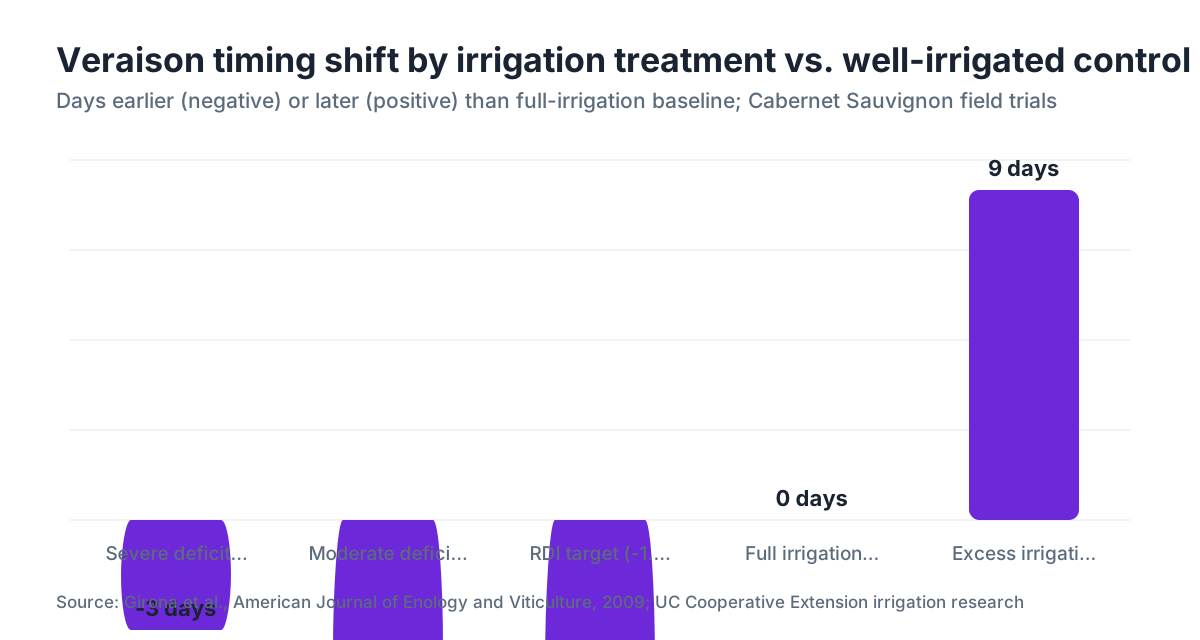
The cleanest field data comes from regulated deficit irrigation trials. Girona et al. (2009) in the American Journal of Enology and Viticulture examined grapevines under several water regimes and found that pre-veraison deficit treatments advanced veraison by 6 to 9 days without significantly cutting final yield, as long as the deficit landed in a defined window [5]. That study is real, published, and cited across extension materials.
Cornell's viticulture extension covers this for cool-climate eastern growers, noting that irrigation timing in the 30-day window before veraison has more influence on veraison date than any other single irrigation decision [6].
Here's what the main trials tend to show:
| Water treatment | Veraison shift vs. control | Yield effect | Brix at harvest |
|---|---|---|---|
| Severe pre-veraison deficit (below -1.5 MPa) | +2 to -12 days (mixed, often non-uniform) | -10 to -25% | Often higher |
| Moderate pre-veraison deficit (-1.0 to -1.2 MPa) | -5 to -10 days (advance) | Minimal to none | Slightly higher |
| Full irrigation (near ETc replacement) | Baseline | Baseline | Baseline |
| Excess irrigation / high vigor | +5 to +14 days (delay) | Higher short-term | Lower or delayed |
The table pools ranges from multiple trials. Exact numbers depend on variety, rootstock, and climate. Severe stress results scatter the most because vine response at that level is nonlinear.
Nobody has clean data giving a universal number of days per unit of water deficit. The biology is real. The coefficients are site-specific.
Does the timing of water stress within the season change the veraison effect?
Yes, and it's one of the most consistent findings across every major growing region. Stress in one phenological window does something completely different from stress in the next.
Pre-bloom to fruit set: stress here mainly cuts berry number and cluster weight. The veraison effect is indirect, not direct.
Fruit set to veraison: this is the window that moves veraison timing. ABA sensitivity peaks here. Deficit irrigation in this stretch gives the clearest advancement and the best yield preservation, which is exactly why RDI protocols target it [3][5].
Post-veraison: stress here changes sugar accumulation rate and berry size, but the veraison date is already locked. You can speed up or slow down ripening after the switch, but you can't move the starting line once berries have softened.
So the practical read for a vineyard manager is simple. If you want to advance veraison to dodge late-season weather, you have roughly a 4 to 6 week window between berry set and color change to apply deficit. Miss it and irrigation changes won't budge veraison.
Does variety or rootstock change how water affects veraison timing?
Yes, a lot. Varieties differ in water-deficit sensitivity partly because they regulate their stomata differently. Isohydric varieties like Grenache close stomata aggressively under mild stress, holding leaf water potential steady but giving up gas exchange to do it. Anisohydric varieties like Syrah let leaf water potential fall further before closing. The anisohydric types usually show earlier, clearer veraison advancement under deficit because the stress signal reaches deeper into the plant's water status [7].
Rootstock matters too. Deep rooters like 110R or 140Ru pull water from much lower in the profile, so a surface-level deficit doesn't reach the plant the way it would on a shallow-rooted or own-rooted vine. Trying to advance veraison through irrigation on 110R in deep clay may take a lot more restriction than the same goal on shallow loam with 101-14.
Cornell's fruit science material notes that rootstock-scion combinations change the hydraulic signal pathway, so the same irrigation deficit lands at different stem water potentials depending on rootstock [6]. Don't assume one irrigation schedule produces the same water status across blocks with different rootstocks. It won't.
How do you measure vine water status to make these decisions?
You need real plant measurements, more than soil moisture guesses. The standard tool is the pressure chamber (pressure bomb), which reads stem or leaf water potential in MPa. Midday stem water potential, taken on shaded leaves wrapped in foil bags for at least 20 minutes beforehand, is the most cited research standard because it reflects the plant's water status instead of the soil or the air's demand [3].
Baseline (no stress): midday stem water potential around minus 0.6 to minus 0.8 MPa in many warm regions.
Mild deficit (RDI target pre-veraison): minus 1.0 to minus 1.2 MPa.
Moderate deficit (some yield reduction accepted): minus 1.2 to minus 1.5 MPa.
Severe deficit (risk of lasting damage, erratic veraison): below minus 1.5 MPa.
Soil moisture sensors (capacitance probes, tensiometers) help with day-to-day calls, but calibrate them against periodic pressure bomb readings rather than trusting them alone. Sensor data by itself doesn't tell you how the vine is actually responding, because rooting depth, soil texture, and canopy all get in the way.
If you're logging water applications and soil moisture for compliance or defensible farm records, keep the data organized. Field notebooks work. Software built for vineyard operations (VitiScribe tracks irrigation events, water source, and application volumes tied to block records, with date-stamped logs) makes it easier to look back at what you applied and line it up against phenology notes from the same season.
California's agricultural water rules under the Agricultural Water Management Planning Act require detailed recordkeeping of water applications on farms above certain acreage thresholds [8]. Know your threshold before an audit finds it for you.
What is regulated deficit irrigation and how does it connect to veraison?
Regulated deficit irrigation (RDI) is a managed approach that holds water below full evapotranspiration replacement during specific phenological windows, then restores it at or near full replacement the rest of the time. It isn't watering less and hoping. It's a protocol with defined entry points, target water potential ranges, and defined exit points.
The pre-veraison RDI window, roughly berry set to color change, is the most studied application in viticulture. The goal is enough stress to slow shoot growth and advance veraison while keeping yield loss acceptable. UC Cooperative Extension irrigation guidance suggests vines in this window tolerate midday stem water potentials of minus 1.0 to minus 1.4 MPa without severe yield loss in varieties like Cabernet Sauvignon, Merlot, and Syrah [3].
After veraison, most RDI protocols ease off or cut the deficit to allow normal berry expansion and sugar loading. Some programs keep a mild deficit going post-veraison to build color and shrink berry size, but the reasoning and the risk profile change once the switch has flipped.
For South Coast winery operations in Southern California, where summer water costs and conservation rules bite hard, RDI is often an economic necessity as much as a quality tool. A managed deficit that advances veraison by up to 10 days can also save 3 to 4 irrigation events during the stretch when water is most expensive or most limited.
Does rain or irrigation timing just before veraison affect berry uniformity?
It does, and uniformity gets less research attention than veraison date, even though it drives your picking decisions more directly.
A late irrigation or a big rain right at the start of veraison can trigger what growers call staggered veraison, where berries on the same cluster sit at very different maturity stages. The mechanism isn't fully worked out. The leading explanation is that a sudden flush of water during berry softening disrupts the ABA signaling cascade, effectively pulling some berries back toward the pre-veraison state just as others are transitioning [2][7].
An old rule of thumb from the Napa and Sonoma literature: don't irrigate in the 1 to 2 weeks around the first sign of color change. If you have to water, water earlier, then hold off. This is more than folklore. Growers and their consultants report tighter veraison uniformity when irrigation is cut before the expected veraison date or withheld through the first 7 to 10 days of color change. The evidence for the exact cutoff is thinner than for the overall RDI effect, so treat it as a field observation, not a hard rule.
For wine quality, a tight veraison window, meaning all berries flip within 7 to 10 days, generally lines up with cleaner picking calls, more even phenolic maturity, and less green-berry contamination in the must.
How do drought years change veraison timing across a whole region?
In drought years, unirrigated and deficit-irrigated vineyards across a region tend to hit veraison earlier on average, sometimes 10 to 21 days ahead of wet years at the same site [1]. European records going back decades show the same thing, and it's part of why vintage reports keep noting that drought years bring early harvests.
Historical harvest records from Burgundy and Bordeaux stretching back to the 14th century show the earliest harvests line up with the driest, warmest pre-veraison periods [9]. The Daux et al. (2012) open database in Climate of the Past describes the effort as "an open-database of grape harvest dates for climate research." Temperature is the main driver in those analyses, but water status and heat track together in those seasons, so you can't fully separate the two.
For California, Washington, and Oregon growers, NOAA climate data documents 2020, 2021, and 2022 as drought years across most western wine regions, correlated with early veraison [11]. Growers who logged block-level veraison dates against irrigation records during those seasons hold useful data that most never formally analyze.
If your region swings hard year to year on rainfall, tracking veraison date as a formal phenology record alongside precipitation and irrigation totals will eventually give you a site-specific model. It doesn't need to be fancy. A spreadsheet with annual first-color date, total applied water through July 1, and total rainfall through July 1 starts showing patterns after 5 to 7 seasons.
What should vineyard managers actually do differently based on this?
A few things you can act on.
To advance veraison and dodge late-season risk: restrict irrigation after berry set to hold midday stem water potential in the minus 1.0 to minus 1.2 MPa range. Stop watering at least 7 to 10 days before you expect first color. Monitor with a pressure bomb, not by eyeballing shoot tips.
To hold your normal veraison timing (say you're in a warm climate where early ripening is already a worry and you want berries on the vine longer): keep irrigation near full ETc replacement through the pre-veraison window, and watch for the excess vigor that pushes ripening into cooler fall temperatures.
Seeing staggered veraison in a block? Check whether an irrigation or rain event landed in the 10 days before or at first color. That's the most likely cause. Longer term, soil variability within the block driving uneven water status is the other common culprit, and variable-rate irrigation handles it if your system supports it.
Document everything. Record veraison date by block, total applied water since fruit set, any significant rain, and your stem water potential readings if you're taking them. Even two or three years of consistent records pay off more than most growers expect, and those records matter if a water audit ever lands on your desk. If you already use field software like VitiScribe to log spray and irrigation events, adding a phenology date field costs nothing and pays back the first season you plan a water cut.
One more thing. EPA's Worker Protection Standard requires pesticide application records be kept and accessible to workers [10]. That's a separate reason to build good field record habits, and once the system exists, phenology tracking is nearly free to bolt on.
Frequently asked questions
How many days can water stress advance veraison in grapevines?
Moderate pre-veraison deficit irrigation, targeting midday stem water potential of roughly minus 1.0 to minus 1.2 MPa, advances veraison by about 5 to 10 days in Cabernet Sauvignon based on field trials. Girona et al. (2009) in the American Journal of Enology and Viticulture reported a 6 to 9 day advancement with no significant yield loss when the deficit landed in the fruit set to veraison window.
Can too much irrigation delay veraison?
Yes. Excess irrigation keeps vines in active vegetative growth, pulling carbohydrates and hormonal signals away from the reproductive switch that starts veraison. Washington State University extension documents delays of 5 to 14 days in high-vigor, well-watered blocks versus moderate-deficit blocks. The delay compounds when excess nitrogen is also present, because vigor gets pushed even harder.
What is the best time in the season to apply deficit irrigation to affect veraison?
The window between berry set and expected veraison, roughly 4 to 6 weeks before color change, is when the vine is most responsive to deficit for veraison advancement. Applying deficit earlier mostly reduces berry number. Applying it after veraison changes ripening rate but can't move the veraison date. Targeting the pre-veraison window is the consistent recommendation across UC Davis, Cornell, and WSU extension guidance.
Does the variety change how water stress affects veraison timing?
Yes. Anisohydric varieties like Syrah let leaf water potential drop further before closing stomata, so stress signals reach deeper and veraison advancement under deficit is usually more pronounced. Isohydric varieties like Grenache hold leaf water potential steadier and may show smaller timing shifts under the same deficit. Rootstock also matters, because deep-rooted rootstocks buffer surface-level water deficits.
Should I irrigate right before or during veraison?
Most practical guidance says avoid irrigating in the 7 to 14 days around the first sign of color change. A sudden water flush at that transition can cause staggered veraison, where berries in one cluster sit at different maturity stages. If the vine needs water, apply it before that window opens. The evidence for this exact cutoff is mostly observational, so treat it as a cautious default rather than a hard rule.
What water potential measurements indicate the right pre-veraison deficit level?
The target for pre-veraison RDI is typically midday stem water potential between minus 1.0 and minus 1.4 MPa, measured by pressure bomb on foil-wrapped, shaded leaves. Below minus 1.5 MPa, responses turn nonlinear and yield risk climbs. Above minus 0.8 MPa the vine is effectively unstressed and the advancement effect is minimal. These ranges come from UC Davis irrigation research and vary by variety.
How does drought affect veraison timing across a whole growing region?
Drought years tend to produce regionally earlier veraison, sometimes 10 to 21 days ahead of wet years at the same site. Historical harvest records from Burgundy and Bordeaux show the earliest harvests line up with the driest pre-veraison periods. For California and Washington, the 2020 to 2022 drought seasons produced documented early veraison across most wine regions.
Does water stress affect veraison uniformity within a cluster?
Yes, and uniformity matters as much as timing. Stress applied unevenly across a block, or a late water flush at the veraison transition, can stagger berry maturity within a single cluster. Consistent, controlled deficit through the whole pre-veraison window tends to produce tighter, more synchronous veraison than either full irrigation or erratic stress-and-flush cycles. Tight uniformity generally improves picking decisions and final wine quality.
Is regulated deficit irrigation the same as dryland farming for veraison purposes?
No. Regulated deficit irrigation is a managed protocol with defined target water potential ranges and irrigation events turned on and off at specific phenological windows. Dryland farming relies entirely on rainfall with no supplemental irrigation. Both create pre-veraison deficit, but RDI gives you control over timing and severity. Dryland stress is uncontrolled and depends on seasonal rain, which makes the veraison response harder to predict.
Do I need to record my irrigation events for compliance purposes?
In California, farms above certain size thresholds must comply with the Agricultural Water Management Planning Act, which requires irrigation efficiency documentation and water use records. Separately, EPA's Worker Protection Standard requires pesticide application records be maintained and accessible. Veraison phenology records aren't mandated, but keeping irrigation logs as part of a general farm records system is both a compliance baseline and useful data for future season planning.
How does soil type affect the relationship between irrigation and veraison timing?
Soil texture and depth decide how fast a water deficit turns into plant-level stress. Sandy or shallow soils dry out fast, so even modest irrigation cuts drop vine water status quickly. Deep clay or loam soils buffer water, so you need to restrict irrigation longer and harder to push the vine into a pre-veraison deficit. Calibrating your cuts to soil type matters as much as the cuts themselves.
Can post-veraison water management speed up or slow down ripening after color change?
Yes, but it works differently from pre-veraison management. After veraison the clock is already running. Continued mild deficit tends to concentrate sugars faster, build color in reds, and shrink berry size, all of which can look like faster ripening on a sugar curve. Heavy post-veraison irrigation slows sugar accumulation and increases berry size and dilution. The veraison date itself is fixed. Post-veraison water changes only the pace of what follows.
What are the signs in the vineyard that water stress is delaying veraison?
Severe stress can delay or disrupt veraison even though moderate stress advances it. Signs that stress is too severe include shoot tip dieback, leaf curl or rolling during midday, and berries starting partial color change in some clusters but not others across the block. If you see these in what should be the pre-veraison window, check stem water potential right away. Below minus 1.5 MPa, vine response can turn disorganized and uniformity suffers.
Sources
- UC Davis Department of Viticulture and Enology, Grapevine Phenology Overview: From veraison to harvest is roughly 40 to 60 days for most Vitis vinifera varieties in temperate climates; the range shifts with temperature accumulation
- Castellarin SD et al., 'Transcriptional regulation of anthocyanin biosynthesis in ripening fruits of grapevine,' Plant Journal, 2006: ABA is the primary hormone signaling veraison onset: it promotes anthocyanin synthesis, softens berry cell walls, and starts sugar loading in phloem
- UC Cooperative Extension, Irrigation of Winegrapes in California (Kliewer and Dokoozlian research lineage): Regulated deficit irrigation keeping stem water potential at minus 1.0 to minus 1.2 MPa advanced veraison by approximately 5 to 10 days versus well-irrigated controls; midday stem water potential measurement protocol described
- Washington State University Extension, Viticulture and Enology program, Irrigation Management for Wine Grapes: Excessive vine vigor driven by ample water and nitrogen together delays ripening and veraison; managing vine water status in pre-veraison period is a primary management lever
- Girona J et al., 'Phenological sensitivity of berry growth and composition of Tempranillo grapevines to water stress,' American Journal of Enology and Viticulture, 2009: Pre-veraison deficit treatments advanced veraison by 6 to 9 days and did not significantly reduce final yield when deficit was applied in a defined pre-veraison window
- Cornell Cooperative Extension, Viticulture and Enology, Irrigation and Water Management in Vineyards: Irrigation timing in the 30-day window before veraison has the greatest influence on veraison date; rootstock-scion combinations modify the hydraulic signal pathway
- Hochberg U et al., 'Iso/anisohydric behavior in grapevines,' Plant Cell and Environment, 2018: Anisohydric varieties like Syrah let leaf water potential drop further before stomatal closure, so stress signals penetrate more deeply and veraison advancement under deficit is more pronounced than in isohydric varieties like Grenache
- California Department of Water Resources, Agricultural Water Management Planning Act: California's irrigated agricultural water management rules require detailed recordkeeping of water applications on farms above certain acreage thresholds
- Daux V et al., 'An open-database of grape harvest dates for climate research: data description and quality assessment,' Climate of the Past, 2012: Historical harvest records from Burgundy and Bordeaux show that the earliest harvests in the record correlate with the driest, warmest pre-veraison periods, with drought years producing veraison and harvest up to 21 days earlier
- US EPA, Worker Protection Standard for Agricultural Pesticides: EPA's Worker Protection Standard requires that pesticide application records be kept and accessible to workers
- NOAA National Centers for Environmental Information, Western US Drought Climatology: 2020, 2021, and 2022 were documented drought years across most western US wine regions, correlated with early veraison dates
Last updated 2026-07-09