How many days from veraison to harvest by grape variety
TL;DR
- Most wine grapes reach harvest 45 to 70 days after veraison.
- Cool-climate and sparkling fruit gets picked toward the short end (40 to 50 days).
- Full-bodied reds often run 55 to 70 days or longer.
- The window shifts with heat accumulation, vine load, and your Brix target.
- Recording veraison date precisely is the single best anchor for harvest planning.
What is veraison and why does the day count matter?
Veraison is the point where ripening kicks into gear. Red berries turn from green to purple or red. White varieties shift from opaque green to a translucent yellow-green. Sugar climbs, acid drops, and the berry softens. The calendar date moves around year to year by site and variety, but once you have that anchor, you can project harvest with far more confidence than bud break ever gives you.
Here's why the day count matters in practical terms: it compresses your decision window. You get roughly six to ten weeks from first color change to pick. That's your runway to schedule labor, arrange tank space, line up fruit buyers if you're a grower, and order fermentation inputs. Do the math wrong, or miss veraison by a week because nobody wrote it down, and you're scrambling in September.
Veraison is also the moment the berry stops pulling water through the xylem and shifts almost entirely to phloem for sugar loading [1]. That physiological switch is what makes the date a real clock instead of a pretty photo.
Write the veraison date into your field records the same day you call it. If you're already logging spray applications and scouting notes, it costs you thirty seconds.
How many days from veraison to harvest for common varieties?
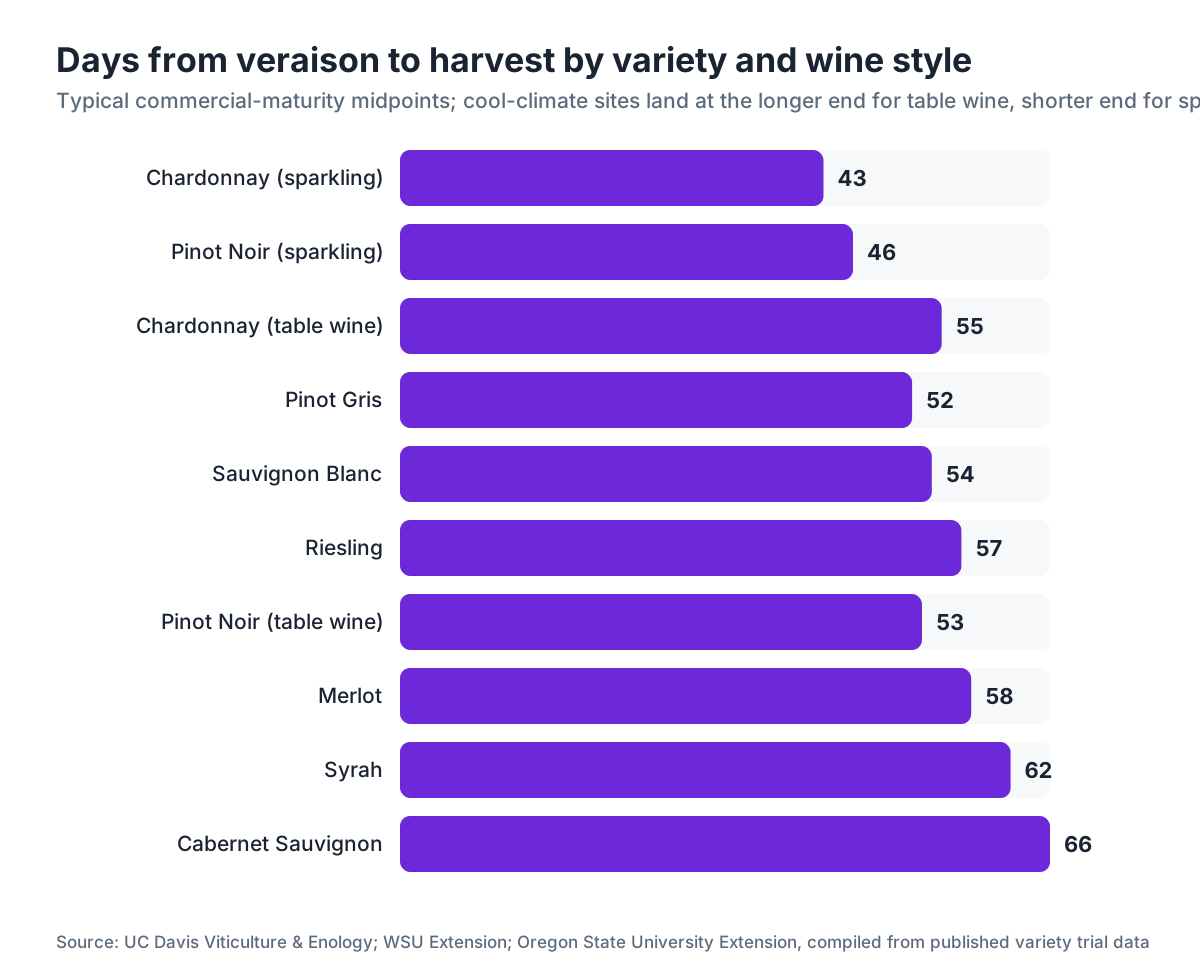
For most wine grapes, plan on 45 to 70 days from veraison to harvest, with sparkling fruit at the short end and late reds like Cabernet Sauvignon at the long end. The table below pulls research-supported ranges from UC Davis, Washington State University Extension, and Oregon State University trials. These reflect typical commercial-maturity targets, not extreme early or late picks.
| Variety | Days after veraison | Notes |
|---|---|---|
| Chardonnay (sparkling) | 38 to 48 | Picked at 17 to 19 Brix, high TA |
| Chardonnay (table wine) | 50 to 60 | Target 23 to 25 Brix |
| Pinot Gris | 45 to 58 | Wide range by style |
| Sauvignon Blanc | 48 to 60 | |
| Riesling | 50 to 65 | Late-harvest styles extend further |
| Pinot Noir | 45 to 60 | Climate-dependent; cool sites shorter |
| Merlot | 52 to 65 | |
| Cabernet Sauvignon | 60 to 72 | Latest major variety |
| Syrah | 55 to 68 | |
| Zinfandel | 55 to 70 | Uneven ripening complicates timing |
| Grenache | 58 to 72 |
These are ranges. Nobody should treat the midpoint as a deadline. A 2019 UC Davis study of Napa Valley Cabernet Sauvignon found harvest dates varied by up to 28 days between warm and cool years for the same clones on similar soils [2].
Cool-climate sites (Willamette Valley, Santa Barbara, parts of the Finger Lakes) consistently land at the short end of each range or below it. High-elevation sites with big diurnal swings stretch it out, because cold nights slow sugar accumulation even while warm afternoons pile on heat units.
One rule of thumb holds up reasonably well. For every 100 growing degree days (base 50°F) accumulated after veraison, add roughly 10 to 15 days to your count. That's not a peer-reviewed formula. It's the mental calibration experienced growers run when a heat spike hits in August.
How many days from veraison to harvest for sparkling wine?
Sparkling base wine programs pick 38 to 50 days after veraison, earlier and harder than still wine, at 17 to 19 Brix instead of the 23 to 25 Brix you'd want for a full-bodied Chardonnay. That lower sugar target is what pulls the pick date forward for most sparkling varieties in a typical warm-to-moderate season [3].
Pinot Noir and Pinot Meunier headed for sparkling programs in California often come in at 18 to 20 Brix, 50 to 55 days after veraison in a warm year, sometimes as few as 42 days in a cool, foggy year like 2011 in the Anderson Valley.
Acid drives this as much as sugar does. Titratable acidity for sparkling base wine gets targeted at 8 to 10 g/L, and pH ideally stays below 3.2. Both numbers move the wrong way fast once veraison passes and temperatures hold warm. So the sparkling window isn't just shorter. It's less forgiving. Miss your pick by five days in a warm September and you may be making still wine instead.
The practical move: if you're growing for sparkling, start weekly Brix sampling ten days earlier than you would for still wine. The juice acid titration tells you more than the Brix number does [3].
What factors push harvest earlier or later than the average?
Heat accumulation is the biggest lever. Growing degree days from veraison to harvest track closely with the day count. A site banking 900 GDD (base 50°F) between veraison and a projected harvest date almost always ripens fruit faster than a 650-GDD site, everything else equal [2].
Vine load matters more than most growers want to admit. Heavy crop slows ripening because the vine spreads fixed photosynthate across more berries. A cluster-thinned block can hit target Brix seven to ten days ahead of an adjacent unthinned block of the same variety and clone. That's not speculation. UC Davis viticulture work has documented the pattern in Central Valley trials [1].
Canopy management shifts things too. A dense, shaded canopy cuts the daily sugar accumulation rate, which stretches the window. A well-lit canopy on the same site can trim five to eight days off the count.
Mild water stress at the right level (deficit irrigation during Stage III ripening) firms berry skins and concentrates flavor without changing the sugar rate much. Severe water stress does something worse. It shrivels berries, inflates your Brix reading, and makes fruit look ready when the flavor is still green.
Wildfire smoke has become a real variable for West Coast growers, especially in Oregon and Northern California. Smoke taint can force a harvest decision regardless of Brix and acid, sometimes shrinking or wiping out the usable window entirely. UC Davis viticulture researchers have tracked it since 2017 [4].
Disease pressure changes the calculus last. A block turning up botrytis or powdery mildew may need to come off early, whatever the countdown says.
How do you accurately record and track veraison date?
The standard is 50% color change at the block level for red varieties, meaning half the berries in a representative sample have started to turn. Some viticulturists use a tighter 30% as an early marker and then call full veraison at 80 to 90%. Any of these works as long as you stay consistent year over year, because the value of the date is in comparing seasons.
Here's a scouting method that works. Walk the block every three to four days starting about 60 days after full bloom. Pull a random 100-berry sample from multiple vine positions across the block, more than the road rows. Count the berries showing any color change. Log the date you hit your threshold. Done.
The error most operations make is trusting one person's eyeball without writing it down. If your veraison date lives in a text thread or somebody's memory, it's worthless for year-over-year analysis. A field notebook, a spreadsheet, or a purpose-built record system all work. The habit matters more than the format.
For operations running multiple blocks and varieties, a tool like VitiScribe logs veraison dates next to spray records and GDD tallies, which makes the retrospective analysis much easier when you're trying to figure out why that Cabernet block ripened two weeks late in 2023.
WSU Extension recommends tying your veraison date to your degree-day accumulation log so you carry both the calendar date and the GDD context [5]. That pairing beats calendar date alone when you're comparing sites with different climates.
What ripeness metrics should you track in the weeks after veraison?
Track three numbers at every sampling: Brix, pH, and titratable acidity. Brix alone is incomplete. Together the three show you where the fruit actually sits versus where you need it.
A sensible sampling frequency after veraison:
- Days 1 to 20 post-veraison: every 7 to 10 days, unless you're in a heat spike
- Days 21 to 40: every 5 to 7 days
- Days 40+ or within 10 days of projected harvest: every 3 days, then daily if needed
For reds, seed color and taste matter. Green seeds mean phenolic immaturity no matter what the refractometer reads. Seeds turning brown and crunchy, with less bitterness when you chew them, signal tannin polymerization and physiological ripeness. Some growers track berry firmness with a penetrometer for a more objective read on skin integrity.
For whites, flavor assessment carries real weight. A Riesling at 22 Brix can taste herbaceous and sharp or honeyed and layered depending on phenolic ripeness. Same number, different wine.
Cornell's viticulture extension program has published field sampling protocols for Finger Lakes producers that carry across cool-climate regions [6]. Their recommended 50-berry sample per block, pulled from mid-cordon, sun-exposed clusters, is a reasonable minimum for a block under five acres.
How does growing region affect the veraison-to-harvest timeline?
Region beats variety in some cases. The same Pinot Noir clone can ripen in 48 days after veraison in a warm Carneros year and take 65 days in a cool Willamette Valley year.
California's Central Coast and warmer inland valleys hit harvest 55 to 65 days after veraison for full-bodied reds. The Sta. Rita Hills and Anderson Valley, being cooler, often run 60 to 75 days for the same styles. Washington's Columbia Valley, with its wild diurnal range, can push through ripening faster than its latitude suggests, often reaching harvest in 50 to 60 days after veraison for Cabernet Sauvignon in warm years [5]. Oregon State Extension trials put Willamette Valley Pinot Noir at 55 to 65 days in typical cool vintages [9].
New York's Finger Lakes and Hudson Valley run shorter, more compressed seasons. Varieties that ripen late in California may never reach acceptable maturity in a bad New York year. Cornell extension work has leaned heavily into variety selection and cold-hardy hybrids partly for that reason [6].
For a warm-region example, the Paso Robles wine country typically sees Cabernet Sauvignon through veraison in late July, then harvest from late September into mid-October, a 55 to 65 day window that fits the warm, arid climate. South Coast Winery and other Temecula operations run a similar schedule, warm afternoons moderated by marine influence.
Elevation shifts the clock too. High-altitude sites in the Sierra Foothills or around the Gervasi Vineyard region get cooler nights that slow sugar accumulation, often adding five to fifteen days to the timeline versus valley-floor sites at the same latitude. There's more background on vineyard site selection and phenology in our related coverage.
How do you use degree days to project harvest from veraison?
Growing degree days are the most field-practical way to project harvest from a known veraison date. The formula is simple: GDD per day = ((daily high + daily low) / 2) - 50°F. Sum those daily values from veraison forward.
Sources use different base temperatures. UC Davis uses base 50°F for wine grapes, the California standard [2]. Pacific Northwest researchers use base 50°F as well [5], though European literature often uses base 41°F (5°C). Keep your base consistent within your own records.
A rough calibration: most full-bodied reds need 550 to 750 accumulated GDD (base 50°F) from veraison to reach commercial maturity. Sparkling targets get reached at 350 to 500 GDD, because you're picking at lower Brix.
The practical workflow:
- Record veraison date
- Pull historical GDD accumulation for your site (NOAA weather station data, your own station, or a state ag weather network) [10]
- Average the GDD accumulated per day in August and September at your site
- Divide your target GDD from veraison by that daily average to get an estimated day count
- Flag the calendar date and start sampling ten days before it
Nobody has perfect data on the GDD-to-harvest relationship for every variety and clone at every site. The closest systematic work in the U.S. comes from UC Davis and USDA Agricultural Research Service studies, and even that literature admits the relationship shifts when water stress, disease, or extreme heat events show up [11].
What are the compliance and record-keeping requirements around harvest timing?
Harvest date is a required field on pesticide application records in most states. The EPA Worker Protection Standard (40 CFR Part 170) requires that restricted-entry intervals expire before workers enter a treated area, and harvest timing bears directly on how you manage that [7]. Spray a fungicide with a 14-day REI, then hit peak ripeness 12 days later, and you have a compliance problem.
The EPA WPS, revised in 2015 and effective in 2017, states that "agricultural employers must not allow or direct workers or handlers to enter or remain in a treated area until the REI has expired" [7]. That's a requirement with enforcement teeth, not a suggestion.
For Brix-based pricing contracts (common in grower-winery deals across California, Washington, and Oregon), harvest date also sets the quality tier. A contract specifying 24 to 26 Brix at delivery requires documented Brix at pick, and some require a winery-witnessed sample. Read your contract before harvest week.
Pre-harvest intervals for pesticides are separate from REIs and often run longer for late-season fungicides. Sulfur, one of the most common late-season sprays, carries a PHI of zero days in most registrations, but copper products run 0 to 7 days depending on the label. Read the current label every time. It's the law.
For certified organic fruit, harvest date ties into the inspection record proving the transition period was complete and no prohibited materials went on within the pre-harvest window. USDA National Organic Program rules require those records be kept for five years [8].
What mistakes do growers make in timing harvest from veraison?
The most common one is not recording veraison at all, then trying to back-calculate it from memory in October when the winemaker asks why the fruit came in underripe. Memory lies. Write the date down.
The second is treating veraison as a single block-level event when it's uneven across the block. In a big, variable block, the warmest corner or the most vigorous rows may color up a week ahead of the shaded areas. Pick the whole block on one schedule and you get a mix of ripeness levels. Some operations harvest in multiple passes. Others just accept the spread. Either way, knowing the block hit veraison across a 10-day window changes how you read your average day count.
Third is leaning on Brix and ignoring acid decline, especially for whites headed into high-acid styles. A Riesling at 23 Brix and pH 3.6 is a different wine than one at 23 Brix and pH 3.1. Track only Brix against a veraison date and you might pick them identically.
Fourth is waiting too long because "it always takes 65 days" in a year when September turns hot. Heat spikes after veraison can compress ripening by ten days or more. Your day count is a projection. The fruit decides when it's ready.
How should you log veraison and harvest data for year-over-year analysis?
The minimum useful data set per block per year is six numbers: veraison date (with your sampling method noted), harvest date, Brix at harvest, TA at harvest, pH at harvest, and GDD accumulated from veraison to harvest. Five minutes to record.
After three years you'll have something genuinely useful: the average days from veraison to harvest for each block, the variance, and the GDD totals that match your quality targets. You can start predicting harvest in real time by comparing seasonal GDD accumulation against your historical average.
After five years, you'll spot the difference between a fast season and a slow one by the time you're 20 days past veraison, just by reading your accumulated GDD against the historical mean. That's the kind of operational intelligence that catches scheduling problems before they get expensive.
For operations running multiple blocks, varieties, and clients, a record system that ties veraison dates to block maps and spray records makes the retrospective analysis much faster. VitiScribe is built for that workflow, keeping field phenology in the same place as your compliance records so you're not cross-referencing three spreadsheets during harvest week.
Even on paper, the data structure matters. Keep a separate row per block per year. Don't mix the Cabernet Sauvignon in block 3 with the Syrah in block 7, even if they sit next to each other and get the same management. Variety ripening differences show up in the data over time and help you place labor and equipment more precisely.
Frequently asked questions
How many days from veraison to harvest for Cabernet Sauvignon?
Cabernet Sauvignon typically runs 60 to 72 days from veraison to harvest for full table-wine targets of 24 to 26 Brix. Warm regions like Paso Robles or Napa Valley tend to land at 60 to 65 days. Cooler sites such as Washington's higher elevations or the Santa Ynez Valley can push 68 to 75 days in cool vintages. Heat accumulation (GDD base 50°F) from veraison predicts better than calendar days alone.
How many days from veraison to harvest for Pinot Noir?
Pinot Noir ranges from 45 to 62 days after veraison depending heavily on site and target style. Cool-climate sites in the Willamette Valley or Sonoma Coast often run 55 to 65 days. Warmer regions like parts of Carneros or the Sta. Rita Hills with fog influence can push toward 60 days. Sparkling-program Pinot Noir gets picked at 42 to 50 days after veraison at 18 to 20 Brix.
What is the veraison-to-harvest timeline for sparkling wine grapes?
Sparkling base wine programs target harvest 38 to 50 days after veraison, picking at 17 to 19 Brix and titratable acidity of 8 to 10 g/L. The window is tighter and less forgiving than still wine. In a warm September, five extra days post-veraison can drop TA below acceptable levels. Weekly Brix and acid sampling starting at day 25 after veraison is the minimum for sparkling programs.
How do I know when veraison has started in my vineyard?
Walk the block every three to four days starting about 60 days after full bloom. Pull a 100-berry random sample from multiple locations. Count berries showing any color change (red varieties) or translucency shift (whites). Record the date you hit your chosen threshold, typically 50% color change for the standard definition. Consistency in your threshold matters more than which exact percentage you pick.
Can heat spikes after veraison shorten the days to harvest?
Yes, significantly. A sustained heat event of five or more days above 100°F in August can compress the veraison-to-harvest timeline by 10 to 14 days by racing sugar accumulation and acid degradation. The risk is that flavor and phenolic ripeness lag behind sugar in those conditions, giving you high Brix but immature tannins or herbaceous character. Daily sampling during heat events is essential.
Does vine crop load affect how many days from veraison to harvest?
Heavily cropped vines ripen slower than cluster-thinned vines. UC Davis viticulture trials have documented delays of seven to ten days between thinned and unthinned blocks of the same variety on comparable sites. If your block is overcropped and you're calculating from a standard day count, build in an extra week of sampling flexibility. Thinning done after veraison has limited effect; the load needs to be set earlier.
How do I project harvest date using growing degree days from veraison?
Sum daily GDD (base 50°F) from your veraison date forward using: ((daily high + daily low) / 2) - 50. Most full-bodied reds need 550 to 750 accumulated GDD from veraison to reach commercial maturity. Sparkling programs reach their targets at 350 to 500 GDD. Divide your target GDD by your historical average daily GDD for August and September at your site to get an estimated day count.
What records do I need to keep connecting veraison and harvest dates for compliance?
At minimum, veraison date, harvest date, and pre-harvest interval documentation for any pesticide applied after veraison. The EPA Worker Protection Standard (40 CFR Part 170) requires restricted-entry intervals expire before workers enter treated areas. For organic operations, USDA NOP rules require five years of field records showing no prohibited materials were applied within the pre-harvest window. Keep block-level records, not farm-level averages.
How much do veraison dates vary from year to year at the same site?
More than most growers expect. A 2019 UC Davis study found veraison dates for Napa Valley Cabernet Sauvignon varied by up to 28 days between warm and cool years for the same clones on similar soils. Over ten years at a single site, veraison might arrive anywhere from mid-July to mid-August. That variance alone argues for tracking date-plus-GDD rather than treating any single year's timing as normal.
Should I pick all varieties at the same number of days post-veraison?
No. Each variety has its own ripening rate, and the day count is a starting point for sampling, not a harvest trigger. Cabernet Sauvignon takes 60 to 72 days; still Chardonnay, 50 to 60; sparkling Chardonnay, 38 to 48. Use variety-specific ranges to set your initial sampling schedule, then let Brix, pH, TA, and sensory assessment drive the pick. The day count tells you when to start looking closely.
How does irrigation management after veraison affect ripening speed?
Mild water deficit after veraison (around 50% ETc replacement) tends to concentrate flavors and firm berry skins without slowing sugar accumulation much. Severe stress can shrivel berries, inflating Brix artificially while flavor stalls. Over-irrigation after veraison dilutes sugars, extends your days-to-harvest window, and raises disease pressure. Most research supports a moderate deficit for quality red wine, roughly 50 to 60% ETc replacement through Stage III.
Do white and red varieties hit veraison at different times?
Generally yes, but it depends more on early-season temperature than on color. Early-ripening varieties like Pinot Gris, Gewurztraminer, and early Chardonnay clones typically hit veraison 10 to 20 days before late reds like Cabernet Sauvignon and Grenache in the same vineyard. Among reds, Pinot Noir usually enters veraison well ahead of Cabernet Sauvignon. Block-by-block scouting matters because microclimate can shift timing even among adjacent blocks of the same variety.
What Brix level should I target when sampling after veraison?
For full-bodied red table wines, most programs target 24 to 26 Brix at harvest. White table wines often target 22 to 24 Brix. Sparkling base wines get picked much earlier, at 17 to 19 Brix with titratable acidity of 8 to 10 g/L. Late-harvest and dessert styles extend beyond 26 Brix. Brix alone is insufficient: track pH and TA alongside it, and for reds, use seed color and taste to gauge phenolic maturity before calling the harvest.
Sources
- UC Davis Viticulture & Enology, Berry Development and Composition: At veraison, the berry stops importing water via xylem and becomes dependent on phloem for sugar loading; vine load affects ripening speed, with thinned vines ripening 7-10 days earlier in UC Davis Central Valley trials.
- UC Davis Department of Viticulture and Enology, Climate and Harvest Date Research: Harvest dates for Napa Valley Cabernet Sauvignon varied by up to 28 days between warm and cool years for the same clones on similar soils; GDD base 50°F from veraison correlates with harvest timing.
- UC Davis Viticulture & Enology, Sparkling Wine Production: Sparkling base wine programs target 17 to 19 Brix and 8 to 10 g/L TA at harvest, reached 38 to 50 days after veraison in typical growing seasons.
- UC Davis Department of Viticulture and Enology, Wildfire Smoke and Wine Grapes: UC Davis researchers have tracked smoke taint impact on West Coast wine grapes since 2017, including its effect on harvest timing decisions.
- Washington State University Extension, Viticulture and Enology Program: WSU Extension recommends tying veraison date to degree-day accumulation logs; Columbia Valley Cabernet Sauvignon reaches harvest in 50 to 60 days after veraison in warm years.
- Cornell Cooperative Extension, Viticulture Program (Finger Lakes and Hudson Valley): Cornell extension recommends a minimum 50-berry sample per block for Brix and maturity tracking; cool-climate variety selection is prioritized due to compressed growing seasons.
- U.S. EPA, Worker Protection Standard for Agricultural Pesticides (40 CFR Part 170): The EPA WPS states: 'agricultural employers must not allow or direct workers or handlers to enter or remain in a treated area until the REI has expired'; revised 2015, effective 2017.
- USDA Agricultural Marketing Service, National Organic Program: USDA NOP rules require organic operations to retain field records demonstrating no prohibited materials were applied within the pre-harvest window for five years.
- Oregon State University Extension Service, Viticulture Program: OSU extension viticulture trials document veraison-to-harvest timelines for Willamette Valley Pinot Noir ranging from 55 to 65 days in typical cool-climate years.
- NOAA National Centers for Environmental Information, Agricultural Weather Data: Historical growing degree day accumulation data by weather station for agricultural use, including base 50°F GDD sums used for vineyard heat accumulation calculations.
- USDA Agricultural Research Service, Grape Research Programs: USDA ARS research acknowledges that GDD-to-harvest relationships shift when water stress, disease pressure, or extreme heat events intervene.
Last updated 2026-07-09