Best soil in Texas for a vineyard: a regional evaluation guide
TL;DR
- The best vineyard soils in Texas are well-drained, calcareous loams and sandy loams with pH between 6.0 and 7.5, found most consistently in the Texas High Plains (Llano Estacado), the Hill Country, and the Trans-Pecos.
- These soils limit vine vigor, push roots deep, and match the state's heat and drought better than the heavy clays of East Texas or the Gulf Coast.
Why does soil matter so much for Texas vineyards?
Soil is a water regulator, more than an anchor. It controls how much water a vine can reach, how fast that water drains away, what nutrients show up in the leaf tissue, and how much stress the vine carries between rain events. In Texas, where summer afternoons routinely push past 100°F and rain can vanish for weeks, those four things decide whether you have a working vineyard or a graveyard by August.
The old wine-country line that stressed vines make better wine holds up here. Vines on shallow, rocky, or lean soils send roots deep, ration their own water, and set smaller berries with more skin per drop of juice. That means more tannin, more color, more concentrated flavor. Rich bottomland soils do the reverse. They push canopy, dilute the fruit, and trap humidity in dense foliage that invites rot.
Texas carries a vine-health layer most states shrug off: Pierce's Disease, a bacterial infection moved around by sharpshooter leafhoppers. Soils that hold standing water, or that sit in low creek bottoms where the vector insects breed, raise disease risk a lot. Drainage here is a plant-protection decision, not only a physiology one [1].
Texas A&M AgriLife Extension has mapped soil variability across the state's American Viticultural Areas (AVAs) in detail, and their guidance keeps pointing to three soil traits as the best predictors of vineyard success: drainage class (well-drained to excessively drained), calcium carbonate content (moderate amounts support the vine without triggering iron chlorosis), and depth to a restrictive layer (ideally more than 36 inches, so roots can chase water down) [2].
What are Texas's main wine regions and how does soil differ across them?
Texas has eight federally recognized AVAs, and their soils have almost nothing in common. Group them by soil type, not by map location, when you're sizing up a planting site. The difference between a good year and a dead block is often 40 miles and one soil series.
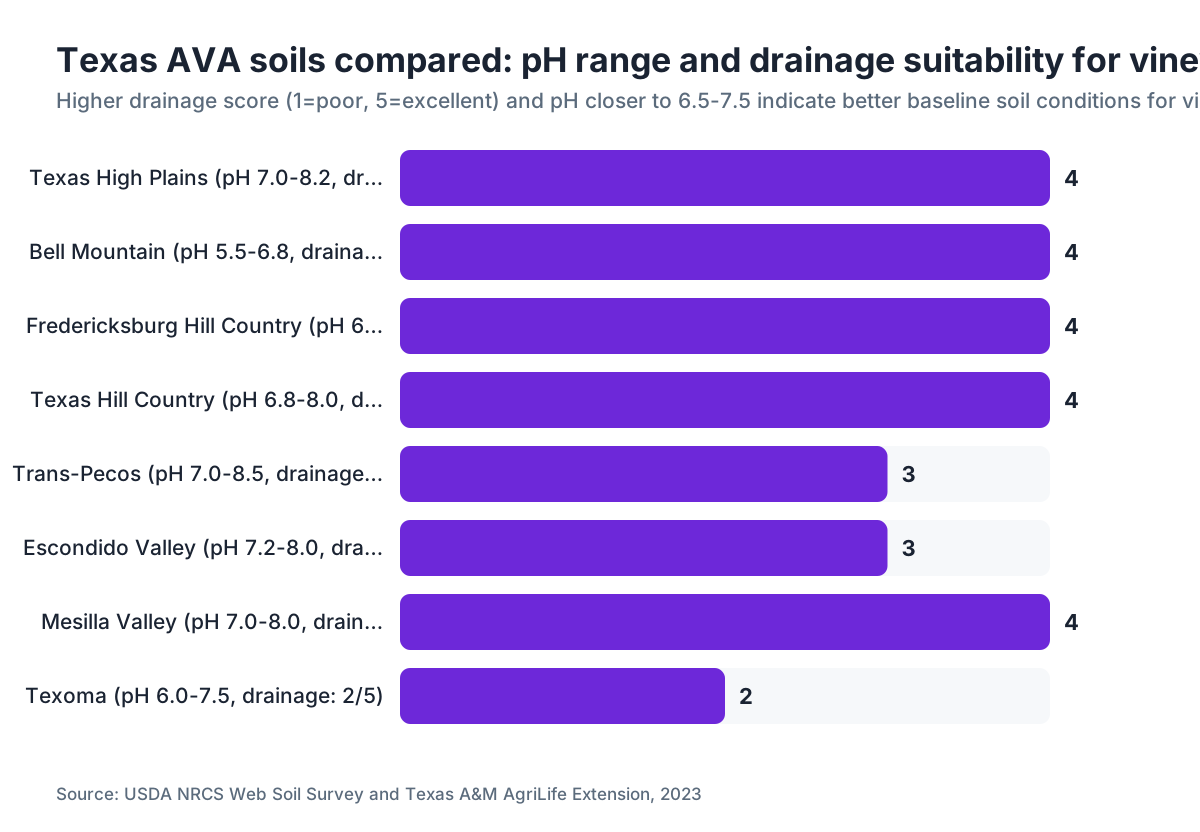
| AVA | Dominant soil type | pH range | Drainage | Key limitation |
|---|---|---|---|---|
| Texas High Plains | Sandy loam, fine sandy loam | 7.0 to 8.2 | Well to excessively drained | Caliche layers can limit rooting depth |
| Texas Hill Country | Shallow limestone, rocky loam | 6.8 to 8.0 | Well to excessively drained | Very thin A horizon, low organic matter |
| Trans-Pecos | Sandy loam, silty loam, some clay | 7.0 to 8.5 | Well-drained | High alkalinity can cause chlorosis |
| Escondido Valley | Calcareous clay loam | 7.2 to 8.0 | Moderate | Clay content slows drainage after rain |
| Bell Mountain | Granite-derived sandy loam | 5.5 to 6.8 | Well-drained | Lower pH, lower calcium buffering |
| Fredericksburg in the Texas Hill Country | Sandy loam over limestone | 6.5 to 7.8 | Well-drained | Caliche intrusions vary by site |
| Mesilla Valley (shared with NM) | Sandy loam, loamy sand | 7.0 to 8.0 | Well to excessively drained | Irrigation-dependent |
| Texoma | Silty clay loam, clay | 6.0 to 7.5 | Moderate to poorly drained | Heavy texture, disease risk higher |
The Texas High Plains sits at 3,000 to 4,000 feet in the Panhandle and produces about 80% of the state's grape crush [3]. Part of that is climate, since the elevation brings cool nights that hold acid. Part of it is soil. The Amarillo and Pullman fine sandy loams that cover the region drain fast, warm early in spring, and carry enough caliche at depth to force roots sideways without killing them outright.
Bell Mountain is the odd one out. Decomposed granite gives it a lower pH than almost anywhere else in Texas, which suits varieties that fight high-pH chlorosis, some Pinot-family grapes included, though the region runs warm enough that those grapes stay marginal at best.
Which specific soil series are considered best for Texas vineyards?
This is where the conversation gets exact. The USDA Web Soil Survey maps Texas down to the series level, and you can pull a site-specific report before you ever push a probe into the dirt [4].
The Amarillo series (fine sandy loam, USDA Hydrologic Group B) is probably the single most cited soil for Texas grape production. It drains well, holds enough moisture between irrigations to buffer stress, and carries moderate calcium carbonate that keeps surface pH from spiking above 8.0. Most High Plains commercial acreage sits on Amarillo or the related Pullman clay loam.
Hill Country sites keep turning up the Kerrville-Tarpley-Rock outcrop complex. These are shallow, stony soils over Edwards Plateau limestone. They drain fast, sometimes too fast, so irrigation has to be tighter, but they drive roots into fractured rock where vines find water and trace minerals the surface can't offer.
The Olmos-Tarrant-Rock outcrop complex is another Hill Country grouping worth knowing. Olmos soils have a strongly calcareous gravel layer that helps drainage but can starve sensitive rootstocks of iron and manganese. Pick a high-lime rootstock (1103 Paulsen, 110 Richter, Fercal) on these sites and the problem mostly disappears [5].
In the Trans-Pecos, the Verhalen clay loam shows up on some valley floors and is close to a worst case: slow drainage, high shrink-swell, and alkalinity that pushes pH past 8.0 at the surface. If your Web Soil Survey report lists Verhalen as a dominant series, treat it as a red flag and study elevation and drainage fixes before you commit to a planting plan.
What pH should vineyard soil be in Texas?
Grapevines grow acceptably from about pH 5.5 to 7.5, with the sweet spot for nutrient availability usually cited as 6.0 to 7.0 [6]. Texas complicates that, because most of the state's naturally good vineyard soils run higher, from 7.0 to 8.0, thanks to calcium carbonate in the parent rock. You plan around that number. You rarely beat it.
Above pH 7.5, iron, manganese, zinc, and boron all turn less soluble. Vines can throw interveinal chlorosis (yellow leaves with green veins) in their first season if the rootstock isn't lime-tolerant. The University of California Cooperative Extension, whose soils work covers high-pH regions much like Texas, tells growers on calcareous soils above pH 7.8 to pick rootstocks rated for lime tolerance, naming 1103 Paulsen, 110 Richter, and Fercal as options tested in alkaline Mediterranean ground [5].
You can nudge high pH down. Elemental sulfur, applied years ahead of planting, acidifies the root zone slowly as microbes oxidize it. Drip-applied acidified fertilizers (phosphoric acid, urea sulfuric acid) hold the zone near the emitter at a lower pH through the season. But you will not take a pH 8.2 soil down to 6.5 and keep it there across a vineyard without spending money every year forever. Picking a site with naturally moderate pH beats fighting chemistry at scale.
Get a soil test before you sign anything. Texas A&M's Soil, Water and Forage Testing Laboratory runs standard vineyard panels, and the report includes a lime requirement calculation [10].
How important is drainage, and what drainage class is ideal?
Drainage is the single most important physical trait of a Texas vineyard soil. More sites die from waterlogging than from anything else in the ground. Get this one wrong and the rest of your soil work doesn't matter.
The USDA sorts drainage into seven classes, from excessively drained to very poorly drained. For vines, you want well-drained or somewhat excessively drained. Well-drained soils move water through without a seasonal high water table sitting within three feet of the surface for long stretches. On a good site, a 2-inch rain should drain back to field capacity in 24 to 48 hours.
Poorly drained soils cause two problems that stack on each other. Saturated roots suffocate and open the door to Phytophthora crown rot and other soil-borne pathogens. And the standing water plus dense low vegetation that ride along with poor drainage build ideal habitat for the sharpshooter leafhoppers that carry Pierce's Disease [1].
If a site has drainage trouble, the fix depends on the cause. Shallow caliche that perches water can sometimes be ripped mechanically before planting to open drainage channels, though that runs $500 to $1,500 per acre depending on equipment and caliche depth. Raised beds or berms down the vine rows help on moderate cases. True clay hardpans below 36 inches are very hard to fix at a price that pencils.
Web Soil Survey drainage data is a starting point, not a verdict. Dig a pit by hand, ideally right after a heavy rain, and watch how water actually moves through the profile before you lock in a plan.
Does Texas soil depth affect grapevine rooting and fruit quality?
Yes, and it shows in the glass. Grapevine roots on own-rooted vines or vigorous rootstocks can reach 15 to 20 feet in deep, friable soil. In practice, Texas vineyards on Hill Country or High Plains ground often root down to 4 to 8 feet, enough to ride through dry spells without constant irrigation.
Shallow soils, meaning less than 18 inches to bedrock or a restrictive layer, cap total rooting volume. That splits into two outcomes depending on how you manage. Irrigate conservatively and the vine stress concentrates flavor and holds yields in the 2 to 4 tons per acre range that many premium Texas producers want. Irrigate hard on the same shallow soil and you get a vine hooked on surface water with no deep reserve to survive a pump failure or a blown irrigation line during a heat event.
Moderately deep soils, 24 to 48 inches to a restrictive layer, hit the best balance for most Texas AVAs. Enough rooting volume to buffer short droughts, not so much that the vine grows like a weed and dilutes the fruit.
When you need to nail down rooting depth before planting, a backhoe pit dug to 5 feet costs roughly $200 to $400 and tells you more than any remote-sensing tool. Describe the horizons, note texture changes, look for mottling (rust or gray blotches that flag seasonal saturation), and check for caliche or clay pans that roots simply will not cross.
What grape varieties match best with Texas soil types?
Soil and variety are one decision, not two. The best vineyard soil in Texas is defined partly by which grape you plan to put on it, so decide the pairing before you buy vines.
Tempranillo is the most reliable vinifera across the state's soils, especially on the calcareous loams of the Hill Country and the sandy loams of the High Plains. It shrugs off drought, heat, and moderate alkalinity. Several Fredericksburg-area producers now run Tempranillo as their lead red, and Texas A&M trial data has been steadier for Tempranillo than for Cabernet Sauvignon on the same soils [2].
Vermentino, Viognier, and Roussanne do well on the thinner, more calcareous Hill Country soils, where their Mediterranean roots translate reasonably. Roussanne in particular tolerates the high-pH soils common in Texas without the chlorosis that hammers Sauvignon Blanc on the same block.
Mourvèdre and Grenache take the Trans-Pecos and High Plains alkaline sandy loams better than most Bordeaux grapes. They evolved in similar soil chemistry, so they aren't surprised by it.
Muscat Blanc and other aromatics do well on Bell Mountain's lower-pH granite soils, where the slightly acid conditions favor floral compounds.
Hybrids like Black Spanish (Lenoir) and Blanc du Bois, bred for Pierce's Disease country, are the honest choice for East Texas and Texoma sites with heavier soils and higher disease risk. Nobody plants them for prestige. They pay the bills on ground where vinifera would just die.
For a wider view of how soil-variety matching plays out in other American regions, the calcareous Westside ground behind Paso Robles wineries in California is a useful comparison, since Paso's soil chemistry sits closer to the Texas Hill Country than most people guess.
What does the Texas High Plains soil specifically offer that other regions don't?
The High Plains AVA, centered on Lubbock and Plainview, produces roughly 80% of Texas's commercial grape tonnage on about 4,000 planted acres (Texas Department of Agriculture estimates move year to year) [3]. That lead comes from soil, climate, and infrastructure lining up in a way they don't anywhere else in the state.
The Amarillo fine sandy loam that covers much of the region does several jobs at once. It warms fast in spring, which pulls bud break forward and stretches the season. It drains heavy rain in hours instead of days, which cuts fungal pressure. It holds plant-available water at about 1.5 to 2.0 inches per foot of soil, which gives irrigators room between sets. And its calcium carbonate holds pH in the 7.5 to 8.0 range, higher than ideal but workable with lime-tolerant rootstocks like 1103 Paulsen.
Wind reads like a negative but works as free canopy management up here. The near-constant south-southwest wind dries leaf surfaces fast after rain or irrigation, cutting Botrytis and powdery mildew hard compared to the sheltered Hill Country canyons.
The real limit is water. The Ogallala Aquifer feeds most High Plains irrigation, and its decline has been on record for decades [7]. Any long-term planting here has to plan around falling well yields and the cost of deepening or replacing wells. Drip irrigation is basically mandatory, both for efficiency and to keep leaves dry.
How do you evaluate a specific Texas vineyard site before planting?
Start free at the USDA Web Soil Survey (websoilsurvey.nrcs.usda.gov). Enter your address or draw a polygon around the property and pull the map. You want the dominant soil series, drainage class, depth to a restrictive layer, and pH range. It costs nothing and takes about 20 minutes [4].
Next, get a grid soil sample. On a parcel up to 20 acres, a 2-acre grid gives enough resolution to see how pH and nutrients shift across the site. Texas A&M's Soil, Water and Forage Testing Laboratory charges roughly $10 to $25 per standard sample, and a vineyard panel (adding boron, iron, manganese, and zinc to the standard report) runs about $35 to $50 per sample [10]. A 10-acre site on a 2-acre grid runs $175 to $250 total. That's not optional. Do it.
Dig at least two backhoe pits per distinct soil map unit, ideally to 5 feet. Log horizon depth, texture, and color, and photograph everything. Note any mottling in the B or C horizon, which flags seasonal saturation even when the surface drains fine.
Check frost-pocket risk. Hill Country topography drains cold air into low spots, and a low site can sit 5 to 8°F colder on a still spring night than a slope 60 feet higher. That gap is the line between a wrecked crop and a clean bud break.
For the paperwork side of site evaluation, a field records tool like VitiScribe can hold soil test results, pit-log photos, and GPS-tagged site notes together, which pays off when you're comparing several parcels months apart.
Then call your nearest Texas A&M AgriLife Extension office. Viticulture specialists aren't spread evenly across the state, but county agents in Lubbock, Fredericksburg, and Uvalde counties carry decades of local knowledge no survey map holds.
What rootstock should you use on Texas calcareous soils?
Rootstock on high-pH Texas soil is one of the longest-lived decisions you'll make, because replanting a vineyard costs $15,000 to $30,000 per acre all in. Get it wrong and you spend the next decade fighting chlorosis on a stock that never fit the chemistry.
For soils above pH 7.5 with active calcium carbonate over 10%, the rootstock literature keeps landing on 1103 Paulsen and 110 Richter as first choices. Both came out of Mediterranean calcareous soils and carry documented lime tolerance. Cornell University's viticulture program notes that '1103 Paulsen imparts moderate to high vigor, good drought resistance, and good to very good lime tolerance,' which makes it a standard pick for arid alkaline sites [6].
Fercal, bred for high active calcium carbonate, is the most lime-tolerant rootstock on the market, but it comes with trade-offs: lower yield and some incompatibility with certain scions. It's the right call on extreme-pH Trans-Pecos ground where nothing else works, and overkill on a pH 7.6 High Plains loam.
SO4 and 3309C, both common in cooler humid regions, are poor picks for most Texas soils. They dislike drought and fade above pH 7.5. 3309C has thrown severe chlorosis in California and Texas trials on calcareous ground.
Rootstock also drives vigor, and vigor management is a live cost in Texas heat. On deep fertile soil, 1103 Paulsen can push so much growth that canopy work becomes a real labor line. On thin Hill Country soil, where shallow depth and low nutrients check vigor naturally, that same stock behaves.
Washington State University Extension publishes rootstock comparison tables for drought, lime, and nematode tolerance that apply directly to Texas even though WSU's own focus is the Pacific Northwest [8].
Are there soil tests or amendments you should make before planting?
Fixing soil before planting beats fixing it after, every time. Once vines are in, your reach into the root zone shrinks to whatever you can push through drip or spread on the surface. Deep tillage, lime, sulfur, and organic matter all have to go in beforehand, ideally one to two years ahead.
For pulling pH down (the usual Texas need), elemental sulfur is the standard amendment. The rate depends on texture and buffer pH, and the Texas A&M report includes a sulfur calculation. On a sandy loam at pH 7.8, dropping to pH 7.0 might take 500 to 1,000 lb of elemental sulfur per acre tilled into the top 12 inches, then irrigated so microbes can oxidize it. That runs 12 to 24 months. Do not apply sulfur and plant next week expecting a lower number.
For organic matter, Texas vineyard soils usually run 0.5 to 1.5%, below the 2 to 3% range that supports strong microbial life and water holding. Compost at 5 to 10 tons per acre before planting is money well spent on sites under 1%. It won't remake the soil, but it steadies the establishment years when young vines are most fragile.
For phosphorus, deep-band it before planting. Phosphorus barely moves in the profile, so surface-applied P stalls in the top two inches while roots grow to 4 feet. A pre-plant deep-band application (typically 100 to 200 lb P2O5 per acre in bands at 12 to 18 inches) feeds the vine through the first several years [2].
Boron runs short in a lot of Texas vineyard soil, and it drives fruit set. A pre-plant soil boron below 0.5 ppm (hot-water extractable) justifies borax at 5 to 10 lb per acre. Boron turns toxic at higher rates fast, so test first and apply light.
For tracking amendment history, a field log (paper or digital) lets you follow soil pH year over year and time applications right. Keeping it in VitiScribe's field records alongside spray records puts your soil and agrichemical data in one auditable place, which matters if you chase organic certification or need to document nutrient management. Any application of a pesticide or restricted amendment also falls under the EPA Worker Protection Standard, which requires training, notification, and records [12].
What soil problems most often kill Texas vineyards or reduce their quality?
Four soil problems account for most Texas vineyard failures and underperformance, in roughly this order of frequency based on extension case records.
First, impermeable caliche layers. Caliche (calcium carbonate hardpan) sits across much of Central and West Texas at depths from 18 inches to 5 feet. It stops roots cold and perches water above it after rain. Caliche above 24 inches is high-risk without mechanical work. Caliche at 36 to 48 inches is workable with careful drainage design.
Second, Pierce's Disease from badly sited plantings. That's technically a disease, not a soil trait, but poorly drained riparian soils in East Texas and the eastern Hill Country are the habitat that keeps the insect vectors alive. Choosing well-drained upland over creek bottom is partly a soil call. Texas A&M AgriLife Research at Fredericksburg has documented how site selection, meaning elevation and distance from creek corridors, tracks with Pierce's Disease incidence [1].
Third, iron chlorosis from active calcium carbonate. It surfaces within the first two or three leaf-out cycles on susceptible rootstocks. Chelated iron (EDDHA chelates work better than EDTA at high pH) treats it, but that's a yearly bill. Picking the right rootstock at planting erases most of it.
Fourth, compaction from heavy equipment during establishment. Texas clay loams (common in Texoma and parts of the Hill Country) compact badly under traffic, worst when wet. One pass with a loaded spray rig on saturated clay loam can cut macroporosity enough to halve rooting depth. Set a dedicated traffic-row system from day one and never run heavy gear on wet soil.
For a look at how climate and site push against soil in a different setting, a gervasi vineyard in a humid region with heavier ground shows the contrast with Texas's generally quicker drainage.
Frequently asked questions
What is the best county in Texas to plant a vineyard based on soil?
Gillespie County (Fredericksburg area) and Lubbock County (High Plains) draw the most attention for vineyard-friendly soils. Gillespie has well-drained shallow limestone loams that suit Tempranillo and Viognier. Lubbock's Amarillo fine sandy loam drains fast, warms early, and produces about 80% of the state's commercial crush. Your specific site inside a county matters more than the county line, so always run Web Soil Survey and pull soil samples first.
Can you grow wine grapes on heavy clay soil in Texas?
You can, but it takes real work and honest expectations. Heavy clay in Texoma or East Texas holds water too long, raises disease pressure, and compacts easily. If you're set on a clay site, plant on ridges or built berms, use Pierce's Disease-tolerant varieties like Blanc du Bois or Black Spanish, and install subsurface drainage. Costs run higher and vine life runs shorter than on a well-drained sandy loam.
How deep should vineyard soil be in Texas?
Aim for at least 24 to 36 inches of rootable soil before you hit caliche, bedrock, or clay hardpan. Deeper generally buffers drought better. Shallow sites (18 inches or less) can work if you irrigate precisely and manage vine stress actively, but they leave no cushion for equipment or pump failures during a heat wave. Dig backhoe pits to verify real depth before planting.
Does Texas Hill Country have good soil for vineyards?
Yes, with caveats. The Hill Country's shallow, rocky limestone soils over the Edwards Plateau drain fast and check vine vigor, which concentrates flavor. The challenges are pH (commonly 7.5 to 8.0), very low organic matter, and thin topsoil that makes establishment harder. Right rootstock (1103 Paulsen, Fercal on the most alkaline sites) and pre-plant organic matter make a real difference on these sites.
What soil pH is best for Texas vineyards?
Between 6.0 and 7.0 is ideal for nutrient availability, but most successful Texas vineyards run pH 7.0 to 8.0 because that's the state's natural calcareous chemistry. The key is matching rootstock to the real number. At pH 7.5 to 8.0, use 1103 Paulsen or 110 Richter. Above pH 8.0, look at Fercal. Pre-plant sulfur can drop pH modestly over one to two years on sandier soils.
Is the Texas High Plains the best region for vineyards in the state?
By commercial output, yes. The High Plains produces about 80% of Texas's grape crush on Amarillo and Pullman fine sandy loams that drain well and warm early. Elevation of 3,000 to 4,000 feet brings cool nights that hold acid. The main long-term risk is Ogallala Aquifer depletion, which makes water availability a strategic worry for any planting you expect to run 20 to 30 years.
What rootstock works best on calcareous Texas soils?
1103 Paulsen is the most widely used choice on alkaline Texas soils (pH 7.5 to 8.0). It gives good lime tolerance, drought resistance, and moderate to high vigor. 110 Richter is a solid alternative on slightly less alkaline sites. For extreme pH (above 8.0 with high active lime), Fercal is the most lime-tolerant option available, though it cuts yield and has scion compatibility limits. Avoid 3309C and SO4 on calcareous Texas soils.
How do I test my Texas vineyard soil before planting?
Start free with USDA Web Soil Survey (websoilsurvey.nrcs.usda.gov) for soil series, drainage class, and pH range. Then collect grid soil samples (one per 2 acres) and send them to Texas A&M's Soil, Water and Forage Testing Laboratory. A vineyard panel with boron, iron, manganese, and zinc costs roughly $35 to $50 per sample. Dig at least two backhoe pits per soil map unit to verify drainage and rooting depth in person.
What soil amendments are needed before planting a Texas vineyard?
The common pre-plant amendments on Texas sites are elemental sulfur (to lower pH on calcareous soils), compost at 5 to 10 tons per acre (to raise organic matter from the typical 0.5 to 1.5% range), deep-banded phosphorus at 12 to 18 inches, and borax if soil boron tests below 0.5 ppm. All work far better applied and incorporated before planting than after. Allow 12 to 24 months after sulfur before planting.
Can you grow Cabernet Sauvignon on Texas Hill Country soil?
It's possible but not easy. Cabernet Sauvignon dislikes the high pH and calcareous conditions common in the Hill Country, and it needs a long warm season to ripen fully. Late spring frosts hit Hill Country low spots often. Tempranillo and Roussanne perform more consistently on the same soils. Cabernet does better on the deeper, better-buffered sandy loams of the High Plains than on thin Hill Country limestone.
What does a caliche layer mean for my Texas vineyard site?
Caliche is a calcium carbonate hardpan that blocks roots and perches water above it after rain. Sites with caliche shallower than 18 to 24 inches are high-risk for vine failure. Between 24 and 36 inches, mechanical ripping before planting can break it enough for roots to push through, though that costs $500 to $1,500 per acre. Below 36 inches, most vines root fine in the soil above the layer without intervention.
How does soil affect Pierce's Disease risk in Texas vineyards?
Pierce's Disease comes from the bacterium Xylella fastidiosa, spread by sharpshooter leafhoppers that breed in riparian vegetation. Poorly drained soils in creek bottoms and low areas concentrate both the host plants and the insect vectors. Choosing well-drained upland over floodplain or creek-adjacent soils lowers disease pressure. Texas A&M AgriLife Research has documented that site elevation and distance from creek corridors track with lower Pierce's Disease incidence.
How much does it cost to prepare Texas soil for vineyard planting?
Soil prep costs vary widely by site. Basic soil testing runs $175 to $250 for a 10-acre site on a grid. Caliche ripping costs $500 to $1,500 per acre. Compost at 5 tons per acre runs $200 to $500 per acre depending on local pricing and hauling. Elemental sulfur for pH correction runs $50 to $150 per acre. Total pre-plant soil prep, excluding irrigation infrastructure, often lands between $1,000 and $3,500 per acre on sites needing moderate work.
Is East Texas soil suitable for a vineyard?
East Texas soils, generally sandy loam to silty clay loam with lower pH and higher organic matter than the rest of the state, face a different problem than western Texas: Pierce's Disease pressure from humid conditions and dense sharpshooter populations near creeks. Vinifera varieties are very hard to sustain here. Pierce's Disease-tolerant hybrids like Blanc du Bois, Black Spanish, and Champanel are the practical choices on East Texas sites.
Sources
- Texas A&M AgriLife Extension, Pierce's Disease of Grapevines: Pierce's Disease risk is elevated in low-lying riparian sites where sharpshooter leafhopper vectors concentrate; well-drained upland soils reduce exposure.
- Texas A&M AgriLife Extension, Viticulture and Enology Program: Texas A&M AgriLife Extension documents soil evaluation for Texas AVAs including pH range, drainage class, depth to restrictive layer, and variety-rootstock recommendations.
- Texas Department of Agriculture, Texas Wine Industry Statistics: The Texas High Plains AVA produces approximately 80% of Texas's total commercial grape crush.
- USDA NRCS, Web Soil Survey: The USDA Web Soil Survey maps Texas soils to the series level, reporting drainage class, depth to restrictive layer, and pH for a specific parcel.
- University of California Cooperative Extension, Rootstock Varieties for California Vineyards: UC Cooperative Extension recommends 1103 Paulsen, 110 Richter, and Fercal for calcareous soils with pH above 7.8 due to their documented lime tolerance.
- Cornell University Cooperative Extension, Viticulture and Enology, Grapevine Nutrition: Grapevines grow acceptably in soils from pH 5.5 to 7.5; Cornell notes that 1103 Paulsen 'imparts moderate to high vigor, good drought resistance, and good to very good lime tolerance' for arid alkaline sites.
- USGS, Ogallala Aquifer, High Plains Groundwater Availability: The Ogallala Aquifer, primary irrigation source for the Texas High Plains, has documented long-term depletion affecting long-range agricultural water planning.
- Washington State University Extension, Viticulture and Enology, Rootstock Selection: WSU Extension produces rootstock comparison tables covering drought, lime, and nematode tolerance applicable to arid wine regions including Texas.
- Texas A&M AgriLife Extension, Soil, Water and Forage Testing Laboratory: Texas A&M's Soil, Water and Forage Testing Laboratory processes standard vineyard soil panels including boron, iron, manganese, and zinc for approximately $35 to $50 per sample.
- EPA Worker Protection Standard for Agricultural Pesticides: EPA Worker Protection Standard applies to pesticide and soil amendment applications in vineyard operations and requires training, notification, and application records.
Last updated 2026-07-09