Can you plant a vineyard in Mexico? soil, climate, and legal guide
TL;DR
- Yes, you can plant a vineyard in Mexico.
- The country has over 40,000 hectares of wine-grape-suitable land, concentrated in Baja California, Sonora, Coahuila, Querétaro, and Zacatecas.
- Soils range from decomposed granite in Valle de Guadalupe to calcareous clay in Querétaro.
- Foreign nationals can own vineyard land through a fideicomiso trust or Mexican corporation, and SENASICA governs pesticide and phytosanitary compliance.
What makes Mexico's soil and climate good for grapes?
Mexico is a bigger wine country than most people outside the industry realize. The country stretches across 32 degrees of latitude and climbs from sea level to over 2,000 meters, which means its wine regions have almost nothing in common with each other except that they can all ripen Vitis vinifera.
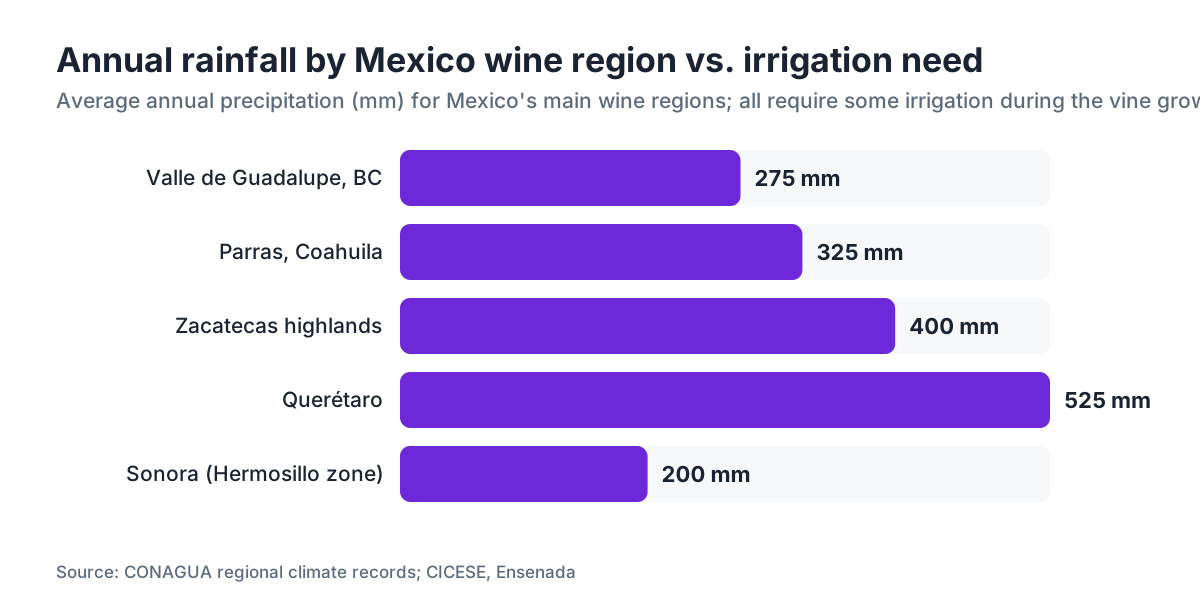
Baja California's Valle de Guadalupe sits on decomposed granite and sandy loam over granodiorite, which drains fast, stresses roots gently, and concentrates flavors [1]. Annual rainfall there is only about 250 to 300 mm, nearly all of it falling between November and March, so the growing season is essentially rain-free. That's a built-in advantage for disease pressure: you're not fighting downy mildew the way you would in humid climates.
Querétaro and Zacatecas sit at 1,800 to 2,000 meters elevation. The soils there are calcareous clay and volcanic loam, pH typically 7.0 to 8.0, and the altitude creates a diurnal temperature swing of 15 to 20°C on summer nights. That swing preserves acidity and aromatic compounds in varieties like Chenin Blanc and Tempranillo. Coahuila's Parras Valley, site of Casa Madero (North America's oldest winery, founded 1597), has deep alluvial soils over limestone [2].
Sonora is the hot outlier. The Altar Valley and Hermosillo zones are flat, irrigated desert farming. Soils are sandy desert loam and silt over hardpan caliche. Heat units run high enough that you're essentially in the same bracket as Coachella Valley in California. Table grapes and raisins dominate here, but wine grapes are planted, and a few serious producers have worked out elevation and night irrigation to manage sugar accumulation.
The short version: match variety to region correctly and Mexico's soil diversity works for you, not against you.
What are the main wine regions and how do their soils compare?
Here's a side-by-side of the five regions you'd seriously consider for commercial planting:
| Region | Elevation (m) | Avg rainfall (mm/yr) | Dominant soil type | Irrigation needed | Best-adapted varieties |
|---|---|---|---|---|---|
| Valle de Guadalupe, BC | 350 to 500 | 250 to 300 | Decomposed granite, sandy loam | Yes, drip | Nebbiolo, Syrah, Tempranillo, Chardonnay |
| Querétaro | 1,800 to 2,000 | 450 to 600 | Calcareous clay, volcanic loam | Supplemental | Chenin Blanc, Viognier, Malbec |
| Zacatecas | 2,100 to 2,200 | 350 to 450 | Volcanic loam, sandy clay | Supplemental | Tempranillo, Merlot, Cab Franc |
| Parras, Coahuila | 1,500 to 1,600 | 300 to 350 | Deep alluvial over limestone | Yes, drip | Cab Sauvignon, Merlot, Zinfandel |
| Sonora (altar/hermosillo) | 100 to 700 | 150 to 250 | Sandy desert loam over caliche | Heavy irrigation | Table grapes, some Muscat |
Valle de Guadalupe gets most of the press, and it deserves it. The Mediterranean climate analog is real: cool Pacific influence from the coast about 25 km west moderates summer maxima, and the granite-sand soils warm quickly in the morning and lose heat fast at night. UC Davis researchers studying the region have noted its similarity in heat summation to Paso Robles AVA, though with lower humidity [3]. If you've grown grapes in Paso Robles, your intuitions transfer reasonably well here.
Querétaro is the surprise. At 1,900 meters, you're growing grapes at an altitude most Napa or Sonoma growers never touch. UV radiation is higher, frosts are possible in December and January, and spring frost is occasionally a problem in April. But the calcareous soils give you natural pH buffering, and the tourist traffic around the city of Querétaro means an estate winery can pull real visitor numbers.
Zacatecas is earlier stage than Guadalupe or Querétaro but catching up fast. The volcanic soils are mineral-rich, the altitude is the highest of any major Mexican wine zone, and land prices sit well below what you'd pay in Baja. The trade-off is thinner supply-chain infrastructure for winery equipment and fewer experienced local viticulture consultants.
What soil tests should you run before planting in Mexico?
Don't skip the soils work. This is the single step most first-time foreign investors in Mexican vineyards cut short, and it's exactly where you'll regret the shortcut three years in when you're trying to figure out why your vines look chlorotic.
At minimum, run a full soil analysis that includes: pH (target 6.0 to 7.5 for most Vitis vinifera), electrical conductivity (EC, watch for saline conditions above 1.5 dS/m in Sonora and coastal areas), organic matter percentage, CEC (cation exchange capacity), and a macro and micronutrient panel covering N, P, K, Ca, Mg, S, Fe, Mn, Zn, B, and Cu. In limestone-heavy areas like Querétaro and Coahuila, check for free calcium carbonate because it directly affects iron and manganese availability.
Water analysis matters as much as soil analysis in Mexico's arid regions. Bicarbonate levels in many Mexican irrigation water sources run high, which means you may need acid injection to keep your drip system from clogging and to avoid raising soil pH over time [4]. Test for sodium adsorption ratio (SAR) if you're on well water in Baja or Sonora.
Send samples to a certified lab. UABC (Universidad Autónoma de Baja California) has an agricultural soil lab in Mexicali that understands regional conditions [5]. Some U.S.-based growers use A&L Western Laboratories in Oregon and just ship samples, which works fine for the chemistry even if the local context is limited.
Nematode assay. Baja California soils in areas previously farmed with tomatoes, peppers, or other solanaceous crops can carry Meloidogyne incognita and M. javanica. Run a nematode assay before rootstock selection. AXR1 (still used in older Baja blocks) is essentially worthless against these species, and you'd want to go to 1103P, 110R, or 140Ru depending on soil texture [3].
Soil depth and drainage. Hand-auger to 1.5 to 2 meters in multiple spots across your planting block. In Querétaro, you sometimes hit volcanic rock at 60 cm, which forces you into closer spacing or rootstocks with more compact root architecture. In Baja coastal areas near the Ensenada highway, watch for a shallow clay hardpan that perches water.
Can a foreign national legally own vineyard land in Mexico?
Yes, with the right legal structure. Foreign nationals cannot directly hold title to land within the restricted zone (100 km from any border, 50 km from any coastline), and Valle de Guadalupe sits within the coastal restricted zone under Article 27 of the Mexican Constitution [6]. That covers most of the Baja wine country foreigners want.
The two workable structures are the fideicomiso and the Mexican corporation. A fideicomiso is a bank trust where a Mexican bank (Banamex, BBVA Mexico, Santander Mexico, and others) holds legal title on your behalf. You, as the beneficiary, keep full economic rights: you can sell, lease, will it to your heirs, develop it as you choose. Fideicomisos renew every 50 years and cost roughly USD 500 to 800 annually in bank trust fees plus setup costs of USD 1,500 to 3,000. This is the standard structure for individual foreign buyers of Baja wine country land.
A Mexican S.A. de C.V. (sociedad anónima de capital variable) can hold land anywhere in the country, including in the coastal zone, as long as at least 51% of shares belong to Mexican nationals if the land is in the restricted zone. Some foreign investors form a corporation with a Mexican partner or use nominee structures, but get proper Mexican legal counsel before going that route. Laws around beneficial ownership and anti-money-laundering compliance (Ley Federal para la Prevención e Identificación de Operaciones con Recursos de Procedencia Ilícita) have tightened significantly since 2013 [7].
Outside the restricted zone (Querétaro, Zacatecas, Coahuila), foreign individuals and foreign corporations can hold direct title without a trust. That's one practical edge those regions have over Baja for foreign investors who want simpler ownership.
Ejido land is its own category. A large portion of rural Mexico is still held under the ejido communal land system. Ejido land went through a privatization reform under PROCEDE starting in 1992, and some ejido parcels have since been titled to individual members who can then sell. But some Valle de Guadalupe land still carries ejido status. Buying or leasing ejido land takes careful due diligence through a Mexican notary (notario público) because incomplete privatization can cloud title. Don't buy Baja vineyard land without a title search by a qualified notario.
What permits and government approvals do you need to start planting?
The regulatory stack in Mexico for vineyard planting is real but manageable. Here are the agencies and approvals you'll deal with:
SENASICA (Servicio Nacional de Sanidad, Inocuidad y Calidad Agroalimentaria) is the Mexican USDA-APHIS equivalent. It governs plant quarantine, phytosanitary certificates for imported planting material, and pesticide registration. Vine cuttings and rootstocks imported from the U.S. need a phytosanitary certificate from USDA-APHIS and must enter through an authorized port of entry with SENASICA inspection [8]. Do not try to bring cuttings across the Baja border in your truck bed. It ends badly.
Municipal land use (uso de suelo). You need a land use permit from the local municipio confirming the parcel is authorized for agricultural use. In Valle de Guadalupe, the municipio of Ensenada has specific land use rules under the Plan Municipal de Desarrollo Urbano. Vineyard and winery development in the valley went through a period of real controversy between 2012 and 2020 over rural/tourist mixed-use zoning. The rules have shifted, so verify current zoning with a local gestión (permit expediter) before signing a purchase contract.
Water rights (concesiones de agua). This is where things get genuinely complicated. Mexico's National Water Law (Ley de Aguas Nacionales) requires a concesión de agua from CONAGUA (Comisión Nacional del Agua) to extract groundwater from a well or divert surface water [9]. The Valle de Guadalupe aquifer is officially overexploited and classified as a veda zone, meaning new water rights are very hard to get. Most workable parcels come with existing water rights attached. Verify this before purchase. Querétaro and Zacatecas have less aquifer stress but still require the CONAGUA concesión process.
SAGARPA/SADER. Mexico's Secretaría de Agricultura (now called SADER) runs subsidy programs for agricultural development that can offset up to 50% of irrigation infrastructure or planting costs for qualifying projects under programs like PROAGRO and Programa de Apoyos a la Competitividad. Applications are annual, competitive, and require a registered agricultural producer number (CURP or RFC plus registro de productor). Worth pursuing, but plan a two-year timeline to actually receive disbursements.
Winery licensing is separate. An actual winery and label requires registration with COFEPRIS (Comisión Federal para la Protección contra Riesgos Sanitarios) for the production facility, and you'd meet the wine standard under NOM-142-SSA1-1995 as amended for production. That process sits beyond vineyard establishment, but plan for it early.
What varietals and rootstocks perform best in Mexican wine regions?
Variety selection is where most new planters in Mexico either get it right or spend a decade regrowing blocks. The good news is there's now 40-plus years of commercial planting data in Baja specifically, and the academic work from CICESE (Centro de Investigación Científica y de Educación Superior de Ensenada) and UABC has gotten useful.
In Valle de Guadalupe, the red varieties with the longest track record are Nebbiolo, Tempranillo, Syrah, and Petite Sirah. Nebbiolo in particular does surprisingly well here. The granite soils and Mediterranean climate echo Piedmont closely enough that the variety stays aromatic without turning jammy. Cabernet Sauvignon works but tends to overreach in warm years without careful thinning. Chardonnay is the leading white and holds acidity better than you'd expect given the heat. Sauvignon Blanc has struggled in Valle de Guadalupe's warmer inland sites but works at higher elevation near La Cacho.
Querétaro and Zacatecas should be in Chenin Blanc, Viognier, Malbec, and Tempranillo. Chenin is the variety that surprised everyone and became Querétaro's calling card. The altitude and calcareous soils produce a mineral, high-acid style with no equivalent anywhere else in Mexico.
Rootstocks: given the nematode risk in previously farmed Baja soils, 1103 Paulsen is the workhorse choice. It handles drought stress, resists nematodes well, and works in the sandy granite soils. 110 Richter is another solid option for dry, low-fertility sites. For the higher-pH calcareous soils of Querétaro, 41B or Fercal handles the lime tolerance better, similar to what you'd use in Champagne or southern France. UC Davis Foundation Plant Services publishes rootstock information that transfers well to the Mexican context even though the extension work is California-focused [3].
How does irrigation and water management work in Mexico's arid wine regions?
Almost every commercial vineyard in Mexico irrigates. Baja California is the clearest case: with 250 to 300 mm of annual rain falling mostly in winter, the vine's entire growing season from bud break in March through harvest in September runs on stored soil moisture plus whatever you add through drip. There is essentially no dry farming at commercial scale in Valle de Guadalupe, though a handful of old-vine blocks survive on natural moisture in exceptional years.
Drip irrigation is universal in modern Mexican vineyards. The typical Baja system is a single drip line at 60 to 90 cm offset from the vine with 2 to 4 liter-per-hour emitters spaced 50 to 75 cm apart. Total seasonal applied water in Baja runs roughly 300 to 500 mm depending on vine age, soil texture, and canopy size. In Querétaro, seasonal supplemental irrigation is lower, maybe 150 to 250 mm, because summer convective rainfall covers much of the vine's mid-season demand.
Water source options: most established Baja vineyards draw from private wells drilled into the granitic aquifer. Well depths range from 30 to over 100 meters and flow rates vary enormously. Before purchasing land, commission a hydrogeological assessment and test the existing well (if there is one) for conductivity, sodium, bicarbonate, and boron. Boron toxicity from groundwater is an occasional issue in parts of Baja and Sonora.
Fertigation through the drip system is standard practice. K and Ca are the most-applied nutrients through fertigation in Baja given the granitic soils' limited cation exchange capacity. Timing matters more than quantity: early-season N applications push vigor, and post-veraison K supports berry ripening and wood hardening.
Keep detailed irrigation records. If you're already tracking weather data, soil moisture sensors (capacitance probes or tensiometers), and applied water volumes in a field records system, you'll have the audit trail you need for both your own management decisions and any future regulatory reporting. Software like VitiScribe ties irrigation events, water source, and volume into the same record as spray events, which matters when you're also tracking CONAGUA concesión compliance on applied water totals.
What pesticide and worker safety rules apply to Mexican vineyard operations?
Mexico's pesticide regulation falls primarily under SENASICA and COFEPRIS. All pesticide products used in Mexico must be registered with COFEPRIS under the Reglamento en Materia de Registros, Autorizaciones de Importación y Exportación y Certificación de Plaguicidas, Nutrientes Vegetales y Sustancias y Materiales Tóxicos o Peligrosos [8]. Products legal in California or Washington are not automatically legal in Mexico. Check COFEPRIS registration before importing or using any pesticide product.
Spray records and MRL compliance. Mexico is a signatory to Codex Alimentarius standards, and its domestic maximum residue limits (LMRs, Límites Máximos de Residuos) for wine grapes generally align with Codex, though they differ from U.S. EPA tolerances in some cases. If you're producing for export to the U.S., EU, or Japan, you must also meet the destination country's MRL standards, which can be tighter than Mexican domestic limits.
Worker safety in Mexico's agricultural sector is governed by the Ley Federal del Trabajo and NOM-003-STPS (safety in agricultural workplaces). Mexico's system is not structured identically to the U.S. EPA Worker Protection Standard, but the practical requirements track close: restricted-entry intervals must be observed, personal protective equipment (PPE) appropriate to the pesticide must be provided, and worker training on pesticide hazards is required [10]. If you're a U.S. operator used to EPA WPS requirements, the mental model transfers reasonably well, but you'll need Mexican legal counsel to confirm current NOM compliance requirements.
If you eventually sell to U.S. buyers or export bulk wine into the U.S., your production practices come under scrutiny from importers who apply their own GAP (Good Agricultural Practices) audit standards. Keep clean spray records from day one. Mexico doesn't have a federal equivalent to California's Department of Pesticide Regulation mandatory spray reporting system, but keeping records as if you did will protect you in any export compliance situation.
Organic certification. SADER runs an organic certification program, and an equivalency arrangement with the USDA National Organic Program (NOP) means SADER-certified organic products can be labeled organic in the U.S. market [11]. If organic production is your goal, plan for it from planting: conversion periods, allowable inputs, and documentation requirements all start at year one.
What does it cost and how long does it take to establish a Mexican vineyard?
Real cost ranges are hard to pin down because land prices, labor rates, and infrastructure costs vary enormously by region. Here's what you can anchor to.
Land. Valle de Guadalupe agricultural parcels ranged from roughly USD 20,000 to 80,000 per hectare as of 2023 depending on whether the parcel had existing water rights, road access, and any infrastructure. Premium sites with water rights and views (for potential winery tourism) traded at the high end. Querétaro agricultural land outside the city ran USD 5,000 to 20,000 per hectare. These are informal market observations, not official data, because there's no MLS equivalent for Mexican agricultural land.
Vineyard establishment costs. A properly established drip-irrigated, trellised vineyard in Baja runs roughly USD 15,000 to 25,000 per hectare including land preparation, irrigation system installation, trellis posts and wire, planting material, labor through year two, and first-year inputs. The range is wide because drip system cost depends heavily on water source distance and pressure, and trellis material prices have swung with steel costs.
Labor. Mexican vineyard labor costs are significantly lower than California equivalents. Agricultural day wages in Baja ran approximately MXN 250 to 400 per day (roughly USD 14 to 22 at 2023-2024 exchange rates) for general vineyard labor, with pruning crews on piece-rate often earning more during peak season. Skilled tractor operators and irrigation technicians command higher rates. This cost differential is real and meaningful to the economics of establishment.
Timeline. Year 1: land preparation, irrigation installation, planting. Year 2 to 3: vine establishment, training, no commercial crop. Year 3 to 4: first small commercial harvest possible. Year 5 to 7: first full commercial crop. Total time from land purchase to a viable first full harvest in Mexico runs 4 to 6 years, similar to a greenfield planting in California.
The vineyard development process in Mexico mirrors California in broad strokes but has longer regulatory approval timelines (particularly for water rights and land use permits) that can add 6 to 18 months to the pre-planting phase if you're not already working with experienced local consultants.
How do you import vine cuttings and planting material into Mexico?
This is one area where getting it wrong costs you a year. Mexico's plant import rules are real and enforced.
Grape vine propagation material (cuttings, rooted vines, budwood) imported from the U.S. requires a USDA-APHIS phytosanitary certificate issued at origin and a SENASICA import permit obtained before the shipment moves [8]. The SENASICA permit application goes through the Dirección General de Inocuidad Agroalimentaria, Acuícola y Pesquera (DGIAP). Plan 60 to 90 days for permit processing.
Material must be accompanied by a clean bill of health for key pathogens: Xylella fastidiosa (Pierce's Disease), grapevine leafroll-associated viruses, Grapevine fanleaf virus, and phylloxera. If you're sourcing from a UC Davis Foundation Plant Services (FPS) registered nursery, the material already comes with clean stock documentation that satisfies most of these requirements [3].
Entry ports for agricultural plant material into Baja must be through authorized SENASICA inspection stations. The Otay Mesa commercial crossing near Tijuana handles the bulk of agricultural imports into Baja. The Tecate crossing also handles agricultural imports. Do not use the pedestrian or passenger vehicle crossings for commercial planting material shipments.
Alternatively, work with a Mexican nursery that already holds imported budwood and produces domestically certified plants. Several Baja-based nurseries now propagate from certified parent material and can sell you certified, virus-tested vines without the import complexity. For large plantings this is often the more practical path.
Ejido or communally farmed land sometimes carries legacy undocumented vine material that you might want to take cuttings from. Be careful. Material from unregistered vines cannot be certified and may carry virus load. Get any heritage material tested before propagating from it.
What are the realistic challenges and risks of a Mexican vineyard investment?
It would be dishonest to write a guide like this without being direct about the risks.
Water is the existential issue in Baja. The Valle de Guadalupe aquifer is classified as overexploited by CONAGUA [9]. Some hydrogeologists studying the region have found extraction rates exceeding natural recharge by a significant margin, and continued expansion of both vineyard and tourism infrastructure puts the aquifer under increasing stress. This is not a reason to avoid the region, but it means your water rights due diligence is the most important single step in the purchase. A beautiful parcel without verifiable water rights is not a viable vineyard.
Security and rule of law. Baja California Norte, where Valle de Guadalupe sits, has had elevated homicide rates in the broader state, particularly around border cities. The valley itself has generally been considered lower-risk than urban Tijuana or Ensenada, and the wine tourism industry has operated without major disruptions for decades. Still, any foreigner running a business in Mexico should keep good relationships with local community leaders and understand the informal rules of the region. Talk to other established foreign winery operators in the valley before committing. There's a real community of expat and binational winery owners there who will share honest perspective.
Title and ejido risk. Already mentioned, but worth repeating: incomplete ejido land privatization, competing claims, and unclear water rights have burned foreign investors in Baja. Spend USD 3,000 to 5,000 on a thorough title search and notarial due diligence. It's the cheapest insurance you can buy.
Exchange rate and cost exposure. Your establishment costs are in pesos (labor, local materials, local services) but you may be capitalizing the project in U.S. dollars. That exposure cuts both ways: MXN depreciation lowers your peso costs in dollar terms, but if you're paying debt service in dollars against peso revenue from domestic sales, a weak peso hurts. Think carefully about the currency structure of your revenue and costs.
Keeping detailed records across all of this (permits, spray records, water usage, worker training) is a management challenge on its own. A system that handles multi-language record-keeping and generates the audit-ready documentation you'd need for both Mexican and export compliance is worth evaluating early. VitiScribe handles spray records, water logs, and compliance documentation in a format that works for both domestic Mexican compliance and U.S. export audit standards.
None of these risks are disqualifying. Valle de Guadalupe is now producing wines that compete internationally, and second-generation family wineries like L.A. Cetto and Monte Xanic have shown long-term commercial viability. The point is to go in with clear eyes.
How does Mexican vineyard compliance compare to California and Washington State rules?
If you've operated a vineyard in California or worked through WSU extension recommendations for Washington, you already have most of the agronomic mental framework you need for Mexico. The viticultural practice is recognizably similar. The regulatory differences are where you have to adjust.
Pesticide regulation in California is arguably the strictest in North America. California's DPR requires licensed Pest Control Advisors (PCAs) for pesticide recommendation sign-offs, county agricultural commissioner spray reporting, and some of the tightest restricted-use material requirements in the world. Mexico's system is less granular at the county level. You don't need a Mexican equivalent of a PCA to buy or recommend pesticides, but COFEPRIS registration of the product itself is strictly required, and enforcement on unregistered products at the border is real.
Washington State's regulations under WSU Extension guidance emphasize integrated pest management for mildew and botrytis in the state's high-pressure environments [12]. That IPM framework applies directly to Mexico's mildew-risk regions (Querétaro during summer rains, any coastal Baja zone). The low-pressure environment of dry-season Baja actually reduces fungicide program complexity versus Washington, which is one of the operating cost advantages.
EPA Worker Protection Standard (WPS) does not apply in Mexico. The WPS is a U.S. federal regulation governing agricultural worker protections on U.S. farms [10]. Your Mexican operation falls under NOM-003-STPS and the Ley Federal del Trabajo. The substantive worker protection requirements (PPE, REI observance, training, emergency decontamination) are similar in intent but differ in specifics and enforcement. If your winery exports to the U.S. and faces a buyer-side social responsibility audit, you'll be held to WPS-equivalent standards regardless.
Cornell's viticulture extension work in New York is less directly applicable to Mexican conditions, but their rootstock and virus management resources are solid and region-agnostic [13].
Frequently asked questions
Is Valley de Guadalupe good for growing wine grapes?
Yes. Valle de Guadalupe has a Mediterranean climate with a rain-free growing season, decomposed granite and sandy loam soils, and Pacific cooling influence. It's the most established wine region in Mexico, with over 150 wineries operating there as of 2024. Nebbiolo, Syrah, Tempranillo, and Chardonnay perform particularly well. The main constraint is water: the underlying aquifer is officially overexploited, so verifying water rights before any land purchase is essential.
What grape varieties grow best in Mexico?
It depends on the region. In Baja's Valle de Guadalupe, Nebbiolo, Syrah, Tempranillo, and Chardonnay lead. In highland Querétaro (1,900 m elevation), Chenin Blanc has become a signature variety, along with Viognier and Malbec. Zacatecas suits Tempranillo and Cab Franc. Sonora is dominated by table grapes and some Muscat. Match variety to microclimate and soil type rather than planting what works in California without adjustment.
Can an American citizen own a vineyard in Mexico?
Yes. U.S. citizens can own vineyard land in Mexico through a fideicomiso (bank trust) in the coastal and border restricted zones, or through direct title outside those zones. Valle de Guadalupe falls within the coastal restricted zone, so most foreign buyers use a fideicomiso. Annual trust fees run roughly USD 500 to 800. Outside Baja, in Querétaro or Zacatecas, foreigners can hold direct title without a trust structure.
How much does it cost to establish a vineyard in Mexico per hectare?
A drip-irrigated, trellised Baja vineyard runs roughly USD 15,000 to 25,000 per hectare for establishment through year two, including irrigation system, trellis, planting material, and labor. This is substantially lower than comparable California costs, mostly due to lower labor rates. Land prices in Valle de Guadalupe ranged from USD 20,000 to 80,000 per hectare in 2023 depending on water rights and infrastructure.
What permits do I need to plant a commercial vineyard in Mexico?
You need: a land use permit (uso de suelo) from the local municipio, a CONAGUA water concesión for any groundwater extraction, a SENASICA import permit for vine planting material brought from the U.S., and registration as an agricultural producer with SADER if you want to access subsidy programs. Winery operations require separate COFEPRIS licensing. The water rights step is the most time-consuming and should start first.
How do I get a water rights concession for a Mexican vineyard?
You apply to CONAGUA (Comisión Nacional del Agua) for a concesión de agua. The Valle de Guadalupe aquifer is classified as overexploited and subject to a veda (moratorium on new extractions), making new rights very hard to get. Most viable Baja parcels must have existing water rights attached, which should be verified during title due diligence. In Querétaro and Zacatecas the process is less constrained but still requires CONAGUA approval.
What rootstocks work best in Mexican vineyard soils?
In Baja's sandy granite soils with nematode risk from prior vegetable farming, 1103 Paulsen and 110 Richter are the standard choices. Both have good drought tolerance and nematode resistance. For high-pH calcareous soils in Querétaro and Coahuila, 41B or Fercal handle lime tolerance better. Avoid AXR1 in any area with previous solanaceous crop history. Get a nematode assay before final rootstock selection.
Does Mexico have an organic wine certification program?
Yes. SADER (formerly SAGARPA) operates a national organic certification program, and Mexico has an equivalency arrangement with the USDA National Organic Program. Mexican-certified organic produce, including wine grapes, can be labeled organic in the U.S. market under this equivalency. Certification requires the standard three-year conversion period, documentation of all inputs, and annual inspection by an accredited certification body.
What are the main pest and disease pressures in Mexican wine regions?
In Baja's dry climate, the main pressures are powdery mildew (Erysiphe necator), grape leafhoppers, and mealybug in coastal fog zones. Downy mildew and botrytis are less of a problem than in humid wine regions. In Querétaro and Zacatecas, summer rains make downy mildew and botrytis real risks from July through September. Root-knot nematodes are a serious concern in Baja parcels with vegetable crop history. Pierce's Disease is present but manageable.
How does the altitude of Querétaro affect grape growing?
Querétaro vineyards sit at 1,800 to 2,000 meters above sea level, producing a diurnal temperature swing of 15 to 20°C in summer. That swing preserves natural acidity and aromatic compounds even in a warm climate, and it's why Querétaro Chenin Blanc has developed a distinct mineral-acid profile. The trade-off is frost risk in April and December-January, and higher UV radiation that can accelerate ripening and sunburn fruit without adequate canopy management.
What is the harvesting season for Mexican wine grapes?
Harvest timing varies by region and variety. In Valle de Guadalupe, white varieties typically harvest late July through August; reds from August through early October. In Querétaro and Zacatecas, the higher elevation pushes harvest about two to four weeks later than Baja for equivalent varieties, generally September and October. The rain-free Baja season means harvest timing is driven by sugar/acid balance rather than rain risk, unlike many European or East Coast U.S. regions.
Are there Mexican government subsidies for new vineyard planting?
Yes. SADER runs annual subsidy programs including PROAGRO and Programa de Apoyos a la Competitividad that can cover up to 50% of irrigation infrastructure or planting costs for qualifying projects. Applications are competitive and annual. Realistic timeline to receive disbursements is about two years from application. You need to be registered as an agricultural producer (with RFC and registro de productor) to be eligible.
Is it safe to invest in vineyard land in Mexico?
The main risks are water rights ambiguity, ejido title complications, and general business environment uncertainty, not physical security for most wine regions. Valle de Guadalupe has operated as an active wine tourism destination for decades without major disruptions to winery businesses. That said, conduct thorough notarial title searches, verify water concessions, and consult with existing binational winery operators in the region before committing capital. No investment in agricultural land anywhere is without risk.
How long does it take to get a first harvest from a new Mexican vineyard planting?
Expect three to four years from planting to a small first commercial harvest, and five to seven years for a full commercial crop. This is similar to California timelines. The main variable is vine training system and how aggressively you manage the young vine's energy allocation. Mediterranean climate conditions in Baja can accelerate early establishment relative to cooler climates, but rushing the first harvest at the expense of root system development is always a mistake.
Sources
- UC Davis Foundation Plant Services - Grapevine Certification Programs: UC Davis FPS provides certified, virus-tested grapevine propagation material and rootstock information applicable to arid wine regions including heat summation comparisons
- UC Agriculture and Natural Resources - Irrigation water quality for vineyards: High bicarbonate levels in irrigation water require acid injection to prevent drip emitter clogging and gradual soil pH elevation in arid vineyard regions
- UABC - Facultad de Ciencias Agrotecnológicas, Mexicali: UABC operates agricultural soil analysis laboratory services with expertise in Baja California regional conditions
- Cámara de Diputados - Constitución Política de los Estados Unidos Mexicanos, Artículo 27: Article 27 of the Mexican Constitution restricts direct foreign ownership of land within 100 km of borders and 50 km of coastlines, requiring fideicomiso or corporate structures for foreigners
- SAT Mexico - Ley Federal para la Prevención e Identificación de Operaciones con Recursos de Procedencia Ilícita: Mexico's anti-money-laundering law governs beneficial ownership disclosure requirements for corporate structures holding real property, tightened significantly since 2013
- SENASICA - Importación de material vegetal de propagación: Grape vine propagation material imported into Mexico requires a SENASICA import permit and USDA-APHIS phytosanitary certificate, with inspection at authorized border crossings
- CONAGUA - Acuíferos sobreexplotados, Valle de Guadalupe: CONAGUA classifies the Valle de Guadalupe aquifer as overexploited and subject to a veda (moratorium) on new water extraction concessions
- EPA - Worker Protection Standard for Agricultural Pesticides: The U.S. EPA Worker Protection Standard requires restricted-entry interval observance, PPE provision, and worker training on pesticide hazards on U.S. farms; forms the comparative baseline for Mexican NOM-003-STPS requirements
- USDA Agricultural Marketing Service - National Organic Program, International Trade: Mexico and the U.S. have an organic equivalency arrangement allowing SAGARPA/SADER-certified organic products to be labeled as organic in the U.S. market
- Washington State University Extension - Viticulture and Enology, Pest Management: WSU Extension IPM guidelines for mildew and botrytis management in vineyards are directly applicable to high-rainfall wine regions including Mexico's highland zones during summer convective rain season
- Cornell Cooperative Extension - Viticulture and Enology Program: Cornell's viticulture extension program provides rootstock selection and virus management resources applicable across wine regions regardless of geography
Last updated 2026-07-09