How to amend soil in an established vineyard

TL;DR
- Amending soil under mature vines is harder than pre-plant work because you can't till deep without shredding roots.
- Your real tools are surface-applied compost, lime, gypsum, and cover crops.
- Match every amendment to a deficiency shown by soil and petiole tests.
- Budget roughly $200 to $800 per acre depending on material and how you apply it.
Why amending an established vineyard is harder than pre-plant work
Before a vine goes in the ground you can rip to 36 inches, broadcast lime, and mix everything in one pass. Once the vines are established, that window is gone. Deep tillage now means severed feeder roots, compaction from tractor traffic at the wrong time, and years of yield you don't get back.
The constraint is real, but you can work around it. Grapevine roots are mostly active in the top 18 to 24 inches in most California and Pacific Northwest soils, though they run much deeper in sandy or fractured sites [1]. Surface applications of soluble or slow-release materials do reach the root zone eventually, just slower than you'd like. Your job is picking materials that move where you need them, applying them at the right time, and testing often enough to know whether they're working.
One more point worth making. Most established vineyards don't need a heroic amendment program. They need one or two targeted corrections and better management of what's already in the ground. Start with a soil test. Everything else follows from that number.
What soil tests should you run before amending anything?
Run a full agronomic soil panel before you spend a dollar on amendments. A standard panel from a lab like A&L Western Laboratories or Waypoint Analytical covers pH, organic matter, cation exchange capacity (CEC), the macronutrients (N, P, K, Ca, Mg, S), and the micronutrients (B, Fe, Mn, Zn, Cu). Most labs charge $30 to $60 per sample [2].
Sample at two depths, kept separate: 0 to 12 inches and 12 to 24 inches. The top layer tells you whether surface lime or compost is moving. The lower layer tells you what the roots actually see. Take 10 to 15 subsamples per management zone (a zone being a block with uniform soil type and vine performance), composite them into one sample per depth, and submit. UC Davis Cooperative Extension recommends re-sampling every 3 years for established vineyards, or annually if you're actively correcting a problem [1].
Petiole tissue tests matter just as much. Soil tests show what's available in the ground. Petiole tests show what the vine took up. Run petioles at bloom and again at veraison, sampling opposite the oldest cluster from 20 to 25 vines per block. WSU Extension publishes interpretation tables for both windows [3]. When soil and petiole numbers disagree, the cause is usually a pH problem locking up nutrients, not a real shortage in the soil.
| Test type | Cost per sample | Best timing | Key outputs |
|---|---|---|---|
| Standard soil panel | $30-60 | Fall or early spring | pH, OM, CEC, macro/micronutrients |
| Biological soil health | $80-150 | Spring, active growth | Respiration, active carbon, PLFA |
| Petiole tissue (bloom) | $20-40 | 50% bloom | N, P, K, Ca, Mg, B, Zn, Fe |
| Petiole tissue (veraison) | $20-40 | At veraison | Same, used for following season |
| Nematode assay | $35-70 | Fall | Species ID, population density |
How do you correct pH in an established vineyard?
Grapevines grow best in a soil pH of roughly 5.5 to 7.0, with most varieties happiest between 6.0 and 6.5 [1]. Step outside that range and nutrient uptake problems pile up fast, no matter what you apply.
If pH is too low (acidic), ground agricultural limestone (calcium carbonate) is the standard fix. Lime reacts slowly and moves less than an inch per year without incorporation, so surface applications to established vines are a multi-year project [4]. Apply finely ground lime (finer grind, faster reaction) to the undervine strip in fall so winter rain carries it down. Dolomitic lime (calcium and magnesium carbonate) makes sense if your magnesium is also low. Typical rates run 1 to 4 tons per acre depending on how far off you are and your soil's buffer capacity, and your lab report will include a lime recommendation.
If pH is too high (alkaline), elemental sulfur is the usual corrective. Soil bacteria oxidize sulfur into sulfuric acid, which drops pH. The reaction takes 3 to 6 months in warm, moist soil with active bacteria [4]. Rates come off your test again. A common range is 500 to 1,500 lbs of elemental sulfur per acre for moderately alkaline soils. High-pH calcareous soils (common in parts of the Central Valley and some Southwest AVAs) are notoriously stubborn, and you may need acidified water or other inputs alongside the sulfur.
Gypsum (calcium sulfate) helps on high-pH soils too. It doesn't lower pH directly, but it improves calcium availability and soil structure without raising pH further, which is why growers reach for it on alkaline Paso Robles ground. See the vineyard article for how soil management shifts across different growing regions.
What's the best way to add organic matter to vines already in the ground?
Compost is the workhorse. Surface-applied compost builds organic matter slowly but steadily, holds more water, feeds soil biology, and drips a broad set of nutrients into the ground in slow-release form. Research suggests 2 to 4 tons of finished compost per acre per year, spread on the undervine or interrow zone, raises organic matter by roughly 0.1 to 0.2 percentage points per year in mineral soils [5]. That sounds slow because it is. Compound it over a decade and the difference in tilth and microbial activity is real.
Wood chip mulch laid 2 to 4 inches deep in the undervine strip is another solid move. It knocks back weeds, evens out soil temperature, holds moisture, and breaks into organic matter over 2 to 3 years. Cornell Cooperative Extension research in New York found undervine mulches can hold 10 to 25% more soil moisture than bare ground, which matters in a dry season [6]. The catch is the cost of hauling and spreading chips, plus a short nitrogen tie-up as fresh chips decompose. Leave the chips on the surface. Don't work them in.
Cover crops in the row middles are the third leg. Cereal rye, oats, mustard, and legume mixes all add biomass you mow and return to the surface. Legumes fix nitrogen. Brassicas (mustard, radish) have been studied for nematode suppression and biofumigation, though the data on nematode control from cover crops alone is mixed at best [7]. Pick species around your irrigation setup, your termination date, and the pests or pathogens you're fighting.
Logging which amendment went where, at what rate, on what date, gets tedious fast across a multi-block vineyard. Tools like VitiScribe can log spray and amendment records block by block, so you keep a clean audit trail when you're in an organic program or when a lender or buyer wants your soil history.
How do you fix specific nutrient deficiencies without incorporating amendments?
Some deficiencies respond to soil-applied materials even without incorporation. Others need a foliar or fertigation route to reach the vine fast enough to matter this season.
Potassium deficiency is common in California Coastal and Sierra Foothills soils with low-CEC sands. Potassium sulfate (0-0-50) broadcast on the surface works over time. On drip blocks, fertigating potassium thiosulfate or potassium nitrate through the system is faster and more efficient. WSU Extension data suggests fertigated potassium can correct a mild deficiency inside one growing season on responsive soils [3].
Calcium and magnesium rarely need topping up in soils with decent pH and CEC, but soils below 10 meq/100g CEC (sandy or volcanic) can be genuinely calcium-short. Gypsum at 500 to 1,000 lbs per acre supplies calcium without raising pH. For magnesium, Epsom salt (magnesium sulfate) dissolves easily and goes through the drip or as a foliar at bloom. Foliar magnesium at 2 to 4 lbs of Epsom salt per 100 gallons of water is a common rescue when petioles show Mg deficiency at bloom [1].
Boron deficiency causes poor fruit set in some regions, especially on light soils or high-pH calcareous ground. One foliar shot of solubor at early bloom (0.2 to 0.3 lbs actual boron per acre) usually fixes it within the season. But boron turns toxic at only slightly elevated rates, so never go past label rates, and don't apply boron fertilizer to soil that already tests adequate [1].
Zinc and iron deficiency are almost always pH-driven. Above pH 7.5, no amount of soil-applied zinc or iron helps because both precipitate into unavailable forms. The real fix is pH correction. In the short term, chelated zinc or iron chelate (EDTA or DTPA) through the drip or foliar keeps vines functional while the pH work grinds along over several seasons.
Can you address compaction and drainage without deep tillage?
Compaction under mature vines is one of the hardest problems to fix without hurting roots. Deep ripping at 18 to 24 inches would solve it mechanically, but it also cuts a big share of feeder roots, worst of all in the interrow where tractor traffic is heaviest.
A sub-soiler or paraplow run in the interrow (not the undervine strip) in late fall after harvest, when soils are dry enough to shatter instead of smear, is the standard tool for moderate compaction. Keep the shanks at least 12 to 15 inches off the vine row to spare the roots. This works best as a one-time pass, backed up by a cover crop and less traffic on wet soil so it doesn't pack down again.
Biological fixes are slower but fit no-till management. Deep-rooted cover crops like tillage radish (Raphanus sativus) or crimson clover bore channels as their roots grow and die, which can lift infiltration rates over 2 to 3 seasons [7]. Nobody should pretend these replace mechanical work on severe compaction. On mild to moderate cases they genuinely help, and they build soil biology along the way.
Drainage problems often look like compaction but come from a hardpan layer, a high water table, or fine-textured subsoil instead. Dig a soil pit. Go down 4 feet in a problem area and look before you assume compaction is the culprit. If a hardpan sits at 18 inches and your water pools on top of it, no amendment fixes that without deep ripping or tile drainage.
What are the rules around applying pesticides and amendments under EPA Worker Protection Standard?
Apply a soil amendment that's also a registered pesticide (fumigants, some copper materials, sulfur used as a fungicide rather than a soil amendment) and you fall under the EPA Worker Protection Standard (WPS), 40 CFR Part 170 [8]. Even when the material is purely a fertilizer or compost, your tractor operator and anyone entering treated ground needs to know what went down and when.
WPS requires that pesticide application information (product name, EPA registration number, active ingredient, location and description of the treated area, date and time of application, and the Restricted Entry Interval) be posted on a central display at the establishment and kept available for 30 days after the REI expires [8]. Since the January 2017 WPS revision, a trained handler has to be present when applications happen, and every agricultural worker gets annual safety training.
For amendments that aren't pesticides (lime, compost, gypsum, many fertilizers), WPS doesn't technically apply, but your state may still regulate compost quality (pathogen and heavy metal limits) and fertilizer labeling. California's Department of Food and Agriculture regulates fertilizer materials under the California Food and Agriculture Code, and some composted materials need a certificate of compliance from a licensed compost producer [9].
Here's the practical takeaway. Keep records of everything applied to each block, including non-pesticide amendments, with date, rate, and product. You'll want them for organic certification, GAP audits, and any buyer's due diligence down the road.
How do you amend soil for nematode management in an established block?
Root-knot nematodes (Meloidogyne spp.) and dagger nematodes (Xiphinema index, which vectors grapevine fanleaf virus) do the most economic damage in California and Pacific Northwest vineyards [10]. Treating them after the vines are in the ground is genuinely hard.
Chemical nematicides registered for established vineyards in the U.S. are thin on the ground. Oxamyl (Vydate) has a California registration for certain uses, but it's expensive, needs a restricted materials permit in California, and only suppresses rather than eradicates. EPA re-registration decisions on older fumigants have narrowed the options further over the past decade [8].
Biological and organic routes include applying beneficial nematodes (Steinernema or Heterorhabditis species) and compost-based amendments. A 2019 study in the American Journal of Enology and Viticulture found compost at 4 tons per acre significantly raised populations of predatory soil fauna that suppress plant-parasitic nematodes compared to unamended control plots, but the effect took two to three seasons to build [5]. Nobody has good data on whether that turns into consistent yield protection.
Brassica cover crops release glucosinolate breakdown products that have shown biofumigation activity against some nematode species in field trials, but results swing hard depending on mustard variety, soil temperature at termination, and starting population [7]. Worth trying inside a broader soil health program. Not a standalone nematode fix.
The honest answer for a heavily infested block: chemical options are limited, biological options are slow, and the best long-term move is replanting on resistant rootstocks (5BB, 3309C, 1103P) after thorough field fumigation. Post-plant management is mostly about slowing the spread.
How much do soil amendments cost per acre in a vineyard?
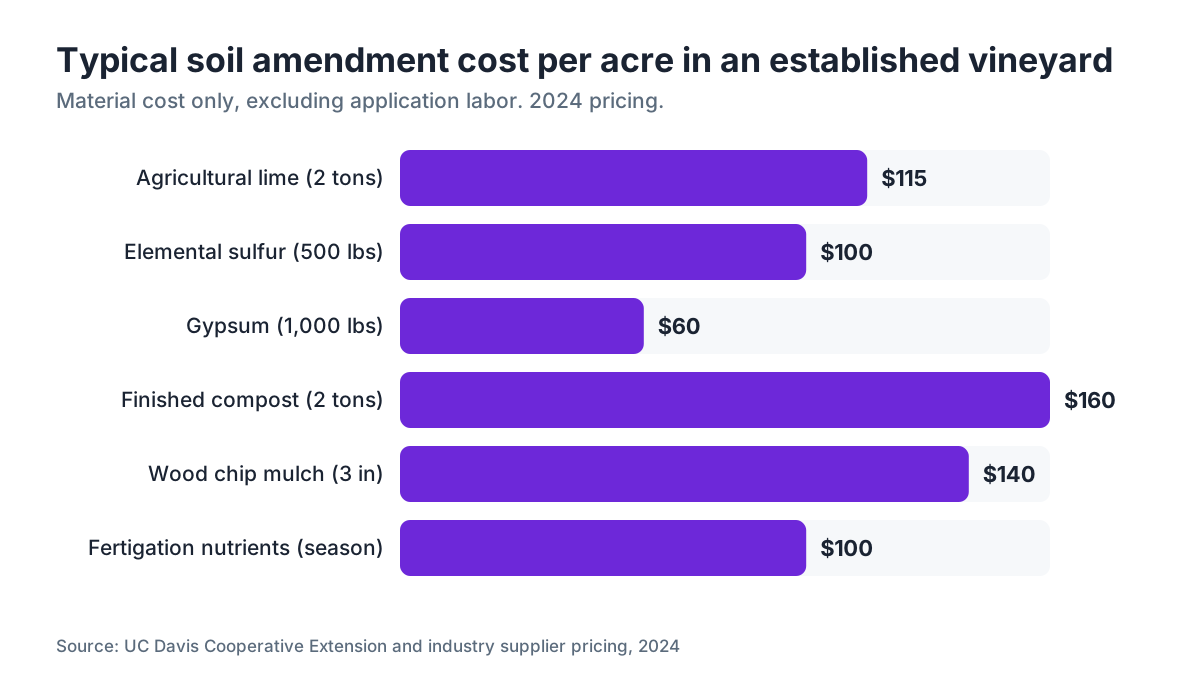
Costs swing enough by region, material, and application method that any single figure lies to you. Here's a realistic range on 2024 pricing.
Agricultural lime costs $30 to $60 per ton at the source, and hauling plus spreading adds $20 to $40 per ton depending on distance and spreader. At 2 tons per acre, figure $100 to $200 per acre for a lime correction. Elemental sulfur runs $300 to $500 per ton, so at 500 lbs per acre that's $75 to $125 in material before you apply it.
Finished compost from a certified producer costs $25 to $55 per cubic yard, and a cubic yard weighs roughly half a ton depending on moisture. Applying 2 tons per acre means about 4 cubic yards, or $100 to $220 in compost plus hauling and spreading. Spreading by tractor-mounted spreader or loader runs $30 to $80 per acre in most regions.
Fertigation inputs (potassium thiosulfate, magnesium sulfate, chelated micronutrients) are far lower in volume and cost. A season of targeted fertigation for potassium and magnesium on a deficient block might run $50 to $150 per acre in materials.
Professional soil sampling and analysis for a 10-block vineyard, two depths plus petioles at bloom, might total $600 to $1,200 for the whole vineyard per year. That's the best money you spend. It tells you which amendments to skip.
| Amendment | Typical rate | Material cost per acre | Application cost per acre |
|---|---|---|---|
| Agricultural lime | 1-3 tons | $50-180 | $30-80 |
| Elemental sulfur | 250-1,000 lbs | $40-250 | $25-60 |
| Gypsum | 500-1,500 lbs | $30-90 | $25-60 |
| Finished compost | 2-4 tons | $100-220 | $40-80 |
| Wood chip mulch | 2-4 in depth | $80-200 | $50-120 |
| Fertigation nutrients | varies | $50-150 | minimal (existing system) |
How do organic certification rules affect what amendments you can apply?
Go certified organic or start transitioning under the USDA National Organic Program (NOP), 7 CFR Part 205, and the list of allowed soil amendments gets a lot shorter [11]. Agricultural lime, gypsum, elemental sulfur, and finished compost made to NOP compost standards are all fine. Synthetic fertilizers (ammonium nitrate, urea, potassium chloride) are out.
The NOP compost standard requires any compost applied to a certified organic operation to come from approved feedstocks and either hit 131 to 170 degrees Fahrenheit for 15 days (static or windrow system) or run through a certified vermicomposting or other approved process. The USDA National Organic Program states that "materials used in organic crop production shall not contain synthetic substances unless the substances are included on the National List" [11]. Buying from a certified producer with documentation is far easier than making your own compost and keeping the temperature records.
The transition runs 3 years of documented organic management before your first certified harvest [11]. So your amendment records from that stretch have to be complete and auditable. One synthetic material applied during transition restarts the clock.
WSU Extension's organic viticulture resources are a good place to start for allowed input lists in the Pacific Northwest [3], and UC Davis Cooperative Extension has published organic winegrape guides that cover NOP-compliant fertility programs in detail [1].
How do you track and document all your amendment applications for compliance?
Amendment tracking usually falls apart not because managers don't care, but because the records live in paper logs, spreadsheets, and the memory of whoever ran the tractor that day. That's a problem for organic audits, GAP certification, and any time a buyer's technical team asks for your field history.
For each application, at minimum, capture: date, block ID, product name, manufacturer, analysis (NPK or other guarantees), rate per acre, total quantity used, application method, and the applicator's name. For pesticide-category materials (fumigants, registered nematicides, copper, sulfur as a fungicide) you also need the EPA registration number and the pre-harvest interval or REI under WPS [8].
Building this into one steady record system, whether that's a dedicated field ops platform like VitiScribe or a disciplined shared spreadsheet, matters more than which tool you land on. What counts: records are block-level (more than farm-level), entries go in within 24 hours of application, and the system can export a clean PDF for your certifier or auditor. California's County Agricultural Commissioner offices, which handle Pesticide Use Reports, accept digital records as long as they meet the required data fields under DPR Title 3 [9].
Check your state's Department of Agriculture requirements directly. California, Oregon, Washington, and New York differ in ways that bite a multi-state operation.
What's the realistic timeline to see results from soil amendments in a vineyard?
This is where growers get frustrated, because the timeline runs genuinely long for most amendment types.
pH correction with surface lime on established vines: figure 2 to 4 years to meaningfully shift pH in the 6 to 18 inch zone without incorporation [4]. You'll see some response in the surface layer (0 to 6 inches) within the first year, but the root zone takes longer. Test annually while you're correcting.
Organic matter from compost: moving from 1.5% to 2.5% in the top foot takes 5 to 10 years of steady annual applications at 2 to 4 tons per acre [5]. Biological markers (soil respiration, active carbon) move faster, often within 2 to 3 seasons, which is one reason biological soil health tests are worth running next to standard chemistry panels.
Fertigation corrections are the fastest, because you're delivering soluble nutrients straight to the root zone. Potassium or magnesium fertigated at correct rates can show up in petiole tissue at the next sampling window, inside the same growing season [3].
Compaction: one subsoiler pass in the interrow, plus a cover crop, can lift infiltration rates within 1 to 2 seasons if you also cut traffic on wet soil. Skip the traffic and tire-pressure changes that caused the problem and it packs down again within 3 to 5 years.
Nematode suppression through biological methods: 3 to 5 years of steady practice before you measure a population drop, if it works at all. Plan accordingly.
Frequently asked questions
Can you broadcast lime on an established vineyard without tilling it in?
Yes, and it's standard practice. Surface lime moves down slowly, roughly an inch per year in most mineral soils, so correcting pH at root depth is a 2 to 4 year project. Use finely ground ag lime for a faster reaction, apply in fall so rain carries it down, and test pH annually at two depths while you correct. You won't match pre-plant incorporation for speed, but it works.
How do I know if my vineyard soil needs organic matter or nutrients?
A standard soil panel plus petiole tissue tests at bloom will tell you. Organic matter below 1.5% in a mineral soil usually warrants a compost program. Petiole deficiencies that don't match your soil test levels typically point to a pH or compaction problem blocking uptake, not an actual shortage in the soil. Run both tests before spending money on amendments.
Is gypsum useful for established vineyards?
Gypsum (calcium sulfate) earns its keep in specific spots: alkaline soils where you need calcium but can't raise pH, sodic soils where excess sodium wrecks structure, or claypan soils where it improves infiltration. It doesn't touch pH, so it won't fix iron or zinc lock-up caused by high pH. At $30 to $90 per acre in materials, it's low-risk on problem soils and unnecessary on soils with adequate calcium and good structure.
Can cover crops replace compost applications for building organic matter?
Cover crops are excellent but slow. The biomass from one interrow cover crop season (mowed and left on the surface) adds maybe 1,000 to 3,000 lbs of dry matter per acre, far less than a 2-ton compost application. They build soil biology, cut erosion, and fix nitrogen if legume-based, but for fast organic matter gains in deficient soils, compost delivers a bigger initial push. Running both together is the most effective approach.
What's the safest way to fix potassium deficiency in drip-irrigated vines?
Fertigation with potassium thiosulfate (0-0-25 with sulfur) or potassium nitrate through the drip system is the most efficient method. Apply during active growth from budbreak through veraison. Avoid over-applying, since excess potassium interferes with calcium and magnesium uptake. WSU Extension and UC Davis Cooperative Extension both publish tissue test thresholds to guide your rates.
Do soil biology amendments like mycorrhizal inoculants work in established vineyards?
The research is mixed. Grapevines form natural associations with arbuscular mycorrhizal fungi, and inoculation has shown benefits in nursery and young vine trials. In established vineyards with intact native mycorrhizal populations, commercial inoculants rarely show a measurable yield or vigor response. Your money does more in compost and cover crops that feed the existing fungal community. Nobody has strong data showing consistent ROI from inoculants in mature blocks.
How do you amend soil pH in a vineyard without hurting the earthworms and soil biology?
Surface lime at agronomic rates (1 to 3 tons per acre, not one massive dose) is generally benign to earthworms and soil biology. Elemental sulfur at high rates can drop pH enough to stress some organisms during the oxidation phase, so apply it conservatively and retest before adding more. Compost and cover crops actively build the biological community, which partly offsets any chemistry-related stress.
What does the EPA Worker Protection Standard require when applying soil fumigants in a vineyard?
Soil fumigants (used for nematode management at replant) are Restricted Use Pesticides requiring a licensed applicator and a state permit in most states. Under EPA WPS 40 CFR Part 170, the applicator must post application information, observe the REI (which for fumigants can run 5 days or longer), provide emergency medical contact information, and keep workers out of the treated area until the REI expires. WPS training for all agricultural workers is mandatory annually.
Are wood chip mulches in the undervine strip a good idea for all vineyard soils?
Wood chip mulches work well on free-draining soils where you want moisture retention and weed suppression. On poorly drained soils or in high-rainfall regions, 3 to 4 inches of chips in the undervine strip can hold soils too wet and favor crown gall or Phytophthora root rot. They also give rodents cover in some regions. Check drainage and pest pressure first. Mulch isn't automatically a win everywhere.
How often should you retest soil in a vineyard that's actively being amended?
Annually while you're correcting a problem, especially pH work or organic matter building. Once soil chemistry sits in the target range and holds steady, every 2 to 3 years is enough. Always retest at the same time of year (fall post-harvest is common) and from the same sampling points so results are comparable. Petiole tests each season complement soil tests by confirming the vine is actually taking up what the soil shows as available.
Can you over-apply compost in a vineyard and cause problems?
Yes. Excess compost nitrogen pushes vines into heavy vegetative growth, which raises canopy density, disease pressure, and delays ripening. Very high applications (over 6 to 8 tons per acre, repeated) can lift soluble salt levels enough to stress roots. For most established vineyards on mineral soils, 2 to 4 tons per acre per year is the right range. If you're under organic program rules, your certifier may cap rates based on agronomic nitrogen need.
What's the difference between soil amendments and soil conditioners?
Soil amendments change the chemistry of the soil: pH, nutrient levels, organic matter content. Soil conditioners mostly change physical properties like structure, drainage, and water-holding capacity without big chemical effects. In practice many materials do both: compost amends chemistry and conditions structure, gypsum corrects calcium and flocculates clay particles. The legal line matters for labeling and state registration, but agronomically the overlap is large.
How do you address iron deficiency chlorosis in a high-pH vineyard?
Iron chlorosis on high-pH calcareous soils is almost always a pH-driven availability problem, not a true iron shortage in the soil. Soil iron is almost never actually low. Short-term, chelated iron (DTPA or EDDHA forms) through the drip or as a foliar gives the vine a functional season while you work on pH. EDDHA chelate stays stable above pH 7.5 where DTPA fails. Long-term, acidifying the root zone with elemental sulfur plus acidified irrigation water is the real solution.
Sources
- UC Davis Cooperative Extension, Soil and Water Management for Wine Grapes: Grapevines grow best in soil pH 5.5 to 7.0; petiole sampling protocols at bloom and veraison; magnesium foliar rate; boron toxicity caution
- A&L Western Laboratories, Soil Testing Services: Standard soil panel including pH, OM, CEC, macronutrients, and micronutrients costs $30 to $60 per sample
- Washington State University Extension, Viticulture and Enology Program: Petiole tissue test interpretation tables for both sampling windows; fertigated potassium can correct mild deficiency within one season
- Cornell Cooperative Extension, Nutrient Management for Grapes: Surface lime moves less than an inch per year without incorporation; elemental sulfur pH reaction takes 3 to 6 months
- American Journal of Enology and Viticulture, Compost amendments and soil fauna suppression of nematodes (2019): Compost at 4 tons/acre significantly increased predatory soil fauna vs unamended control, effect built over 2-3 seasons; organic matter increases 0.1 to 0.2 percentage points per year with 2-4 tons compost annually
- Cornell Cooperative Extension, Cover Crops and Mulches in Vineyards: Undervine mulches can increase soil moisture retention by 10 to 25% compared to bare ground
- UC Davis Cooperative Extension, Cover Cropping for Vineyards: Brassica biofumigation results against nematodes are highly variable; deep-rooted cover crops create biopores improving infiltration over 2-3 seasons
- U.S. EPA, Worker Protection Standard 40 CFR Part 170: WPS requires pesticide application information posted at central display for 30 days after REI expires; fumigants are restricted use requiring licensed applicator and state permit
- California Department of Food and Agriculture, Fertilizer Materials and Compost Regulations: California regulates fertilizer materials and composted materials under Food and Agriculture Code; County Agricultural Commissioner offices accept digital records meeting DPR Title 3 data fields
- UC Davis Cooperative Extension, Nematode Management in Vineyards: Root-knot nematodes and dagger nematodes (Xiphinema index, vector of grapevine fanleaf virus) cause the most economic nematode damage in California and Pacific Northwest vineyards
- USDA National Organic Program, 7 CFR Part 205: NOP requires 3-year transition period, allows lime, gypsum, sulfur, and NOP-compliant compost; prohibits synthetic fertilizers; NOP states materials shall not contain synthetic substances unless on National List
Last updated 2026-07-09