Calculating micronutrient additions to vineyard soil: a field guide

TL;DR
- Micronutrient additions to vineyard soil are calculated from soil test ppm levels, tissue analysis results, soil pH, and organic matter percentage.
- Typical correction rates run 1-5 lbs actual nutrient per acre for zinc and manganese, 0.5-2 lbs for boron, and 10-50 lbs for iron chelates.
- Always confirm deficiency with both soil and tissue data before applying anything.
Why you can't skip the soil and tissue test step
There is no universal micronutrient recipe for vineyards. A block at 6.8 pH on a sandy loam needs a completely different correction than a block at 7.4 pH on a heavy clay, even if both vines show the same faint interveinal chlorosis. Applying iron when you actually have a manganese problem, or blasting a boron-deficient block without knowing your soil's cation exchange capacity, wastes money at best and creates toxicity at worst.
Boron is the clearest example. The margin between deficiency and toxicity in grape tissue is narrow: WSU Extension puts deficient petiole boron below 25 ppm and potentially toxic above 100 ppm at bloom, and you can close that gap in a single over-application [1]. You genuinely need the numbers before you touch the spreader.
The standard workflow is simple. Pull soil cores in fall or early spring, submit for a complete micronutrient panel (minimum: zinc, boron, iron, manganese, copper), then take petiole samples at bloom and compare against established sufficiency ranges. Cornell's viticulture program recommends opposite-the-cluster petioles at full bloom as the most diagnostically reliable tissue sample timing [2]. If soil and tissue both flag the same element, you have a real deficiency. If only one does, dig into soil pH and organic matter before spending anything.
The vineyard block map you're working from should note soil series and pH by zone. Micronutrient availability is so pH-sensitive that a single field can have two completely different correction needs 100 feet apart.
What soil test thresholds actually mean for grape micronutrients
Soil test labs report micronutrients in parts per million (ppm) by weight, extracted with DTPA (diethylenetriaminepentaacetic acid) or Mehlich-3 depending on the lab. These extractants don't measure total soil nutrient content. They estimate the plant-available fraction. The interpretation ranges below come from UC Agriculture and Natural Resources and WSU Extension and are specific to DTPA extraction [3][4].
| Nutrient | Deficient (ppm) | Adequate (ppm) | High/Excess (ppm) |
|---|---|---|---|
| Zinc | < 0.5 | 0.5 to 2.0 | > 5.0 |
| Boron | < 0.5 | 0.5 to 1.0 | > 2.0 |
| Manganese | < 1.0 | 1.0 to 5.0 | > 10.0 |
| Iron | < 2.5 | 2.5 to 10.0 | > 20.0 |
| Copper | < 0.1 | 0.1 to 0.5 | > 1.0 |
These ranges assume a soil pH between 6.0 and 6.5. Every full unit increase in pH above 6.5 roughly halves the plant-available fraction for zinc, manganese, and iron, because these elements precipitate as hydroxides and carbonates at higher pH [3]. That's why a soil test reading of 1.2 ppm zinc is fine at pH 6.2 but borderline deficient at pH 7.2. The lab may not flag that automatically. You have to think it through.
Copper is a special case in wine country. Decades of Bordeaux mixture and copper-based fungicides have driven soil copper to phytotoxic levels in some old Cabernet and Merlot blocks in California and the Pacific Northwest [4]. If your copper reads above 50-100 ppm DTPA in a block with a history of copper sprays, that's a problem to manage down, not correct up.
Mehlich-3 and DTPA extractions don't produce identical numbers for the same soil. If you switch labs between years, rebaseline against the new lab's ranges rather than comparing raw ppm to your old results. Pick one lab and stay with it if you want trend data that means anything [3].
How do you convert soil test ppm to actual pounds per acre to apply?
This is where most vineyard managers either blank out or trust a number from the fertilizer rep without checking it. The math isn't hard, but it requires understanding what you're converting.
Soil test ppm is mg of nutrient per kg of soil. To turn that into a field application rate, you need the weight of soil in the incorporation depth you're working with. The standard assumption for a 6-inch depth is roughly 2,000,000 lbs of soil per acre (about 900,000 kg). This is an approximation. Sandy soils run lighter and heavy clays run heavier, but 2 million lbs/acre is the most common extension default [5].
From that: 1 ppm in a 6-inch acre furrow slice equals about 2 lbs of that element per acre.
So if your soil test shows 0.2 ppm DTPA zinc and you want to reach 0.8 ppm (the low end of adequate), you need to raise zinc by 0.6 ppm, which equals roughly 1.2 lbs actual zinc per acre in the top 6 inches.
But you never apply the exact elemental weight. You apply a product that contains a percentage of that element. Zinc sulfate monohydrate (ZnSO4·H2O) is 35% elemental zinc by weight. To deliver 1.2 lbs actual zinc, you'd apply:
1.2 lbs Zn ÷ 0.35 = 3.4 lbs zinc sulfate monohydrate per acre.
For boron, sodium tetraborate (Solubor, 20.5% B) or granular borate products (14-15% B) are the common carriers. To add 0.5 lbs actual boron per acre with Solubor: 0.5 ÷ 0.205 = 2.4 lbs product per acre. That's a small amount and easy to mis-calibrate, so some managers apply it as a foliar spray at bloom instead of a soil application, which sidesteps soil pH interference entirely [1].
Iron is different. Soil applications are rarely efficient because iron re-precipitates fast at pH above 6.5. Iron chelates (EDTA, DTPA, or EDDHA chelated iron) stay plant-available longer. EDDHA chelates remain stable up to pH 9, while DTPA chelates become less effective above pH 7.5 [6]. A typical corrective EDDHA iron chelate rate for a moderately deficient block is 2-5 lbs product per acre, applied to the drip zone or incorporated near the root zone. At 6% Fe chelated, that's 0.12-0.30 lbs actual Fe per acre, which is intentionally conservative because over-application of chelated iron can suppress manganese and zinc uptake.
Soil pH adjustment before micronutrient application: when does it make sense?
If your block sits at pH 7.5 or higher and you have zinc, manganese, and iron all reading low, the root cause is often pH, not true elemental deficiency. Applying zinc sulfate and moving on gives you maybe one season of marginal improvement before the zinc re-precipitates and you're back where you started.
Acidifying to pH 6.0-6.5 fixes availability for all three elements at once and spares you from buying and spreading multiple micronutrient products every season. Elemental sulfur is the standard amendment. At a soil buffering capacity typical for western US vineyard soils, lowering pH by one unit takes roughly 1,000-2,000 lbs elemental sulfur per acre in the top 12 inches, but this varies widely with carbonate content and soil texture [5]. Labs can run a sulfur requirement test that gives you a site-specific estimate.
The complication is time. Elemental sulfur needs soil bacteria (primarily Thiobacillus thiooxidans) to oxidize it to sulfuric acid, and that takes several months under warm, moist conditions. You won't see pH drop from a fall sulfur application until the following spring at the earliest. If vines show acute deficiency symptoms mid-season, foliar applications of chelated micronutrients are the faster fix while you work on the underlying pH problem.
Calcareous soils (free carbonates present) in regions like parts of Paso Robles or Washington's Horse Heaven Hills will keep buffering back toward higher pH even after acidification. In those blocks, annual micronutrient foliar programs are often more practical than chasing a pH the soil chemistry keeps resetting [4].
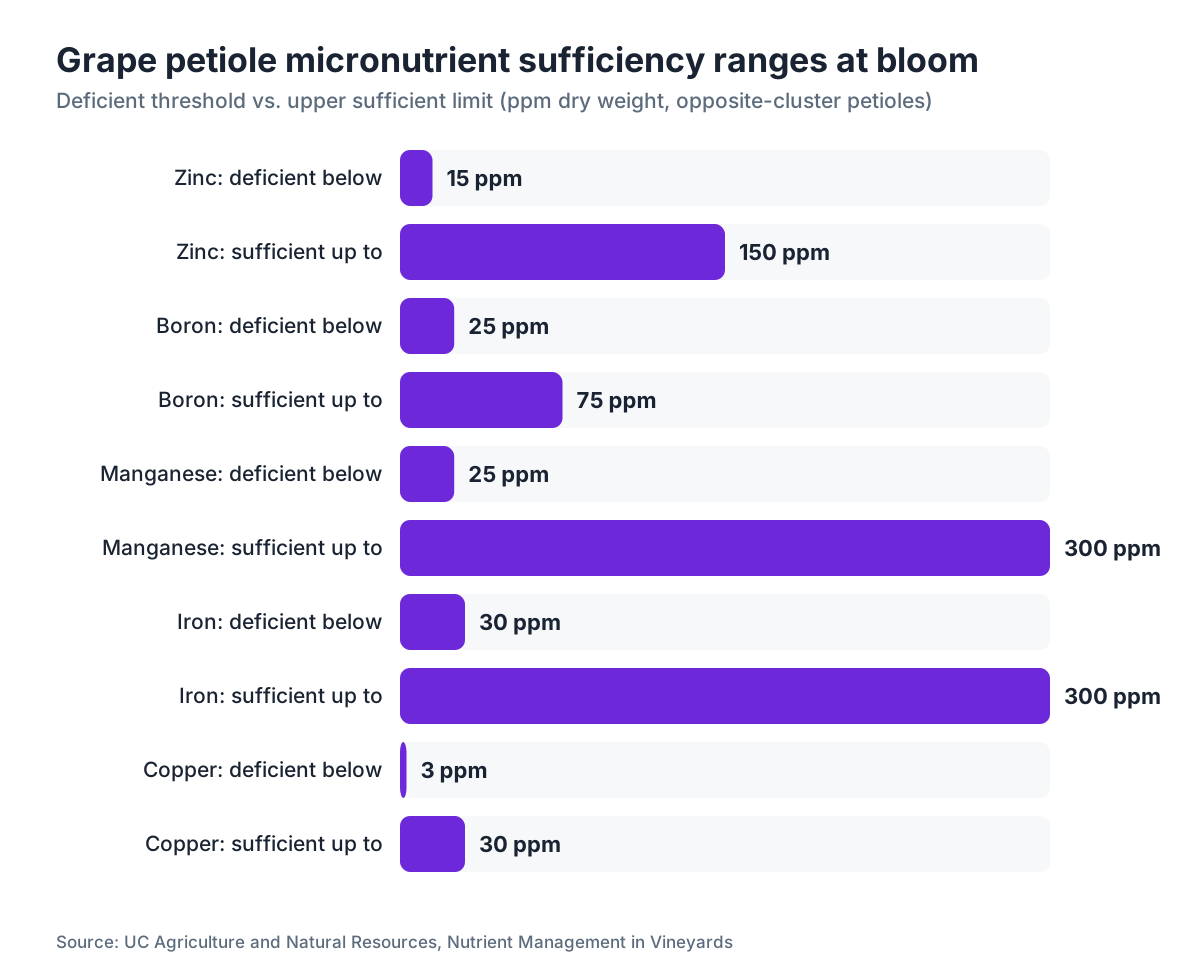
What are the correct petiole sufficiency ranges for wine grapes?
Tissue analysis gives you a real-time read on what the vine is actually absorbing, more than what's theoretically available in the soil. Petiole sampling at full bloom (opposite cluster petioles) is the benchmark timing. UC Agriculture and Natural Resources publishes sufficiency ranges for Vitis vinifera at bloom, and these are the numbers most California and Pacific Northwest labs calibrate against [3].
| Nutrient | Deficient (petiole, ppm dry wt) | Sufficient (petiole, ppm dry wt) | Excess/Toxic |
|---|---|---|---|
| Zinc | < 15 | 25 to 150 | > 500 |
| Boron | < 25 | 25 to 75 | > 100 |
| Manganese | < 25 | 30 to 300 | > 500 |
| Iron | < 30 | 30 to 300 | variable by form |
| Copper | < 3 | 5 to 30 | > 100 |
Iron tissue analysis is notoriously noisy because iron moves poorly in the phloem and can accumulate or deplete in tissue depending on plant demand signals rather than actual soil supply. A low iron petiole reading is more reliably diagnosed by looking at interveinal chlorosis on young leaves and confirming soil pH and chelate stability together [6].
Cornell's guidelines note that petiole zinc below 15 ppm at bloom consistently correlates with poor fruit set in Chardonnay and Pinot Gris, which is the economically painful symptom that usually triggers grower attention [2]. Zinc deficiency shows as small, mottled leaves (little leaf) and zigzag shoot growth. If you're seeing that, you're probably already multiple seasons into a problem.
Boron deficiency at bloom causes poor fruit set (shot berries, loose clusters), and the connection between bloom-time boron and fruit set is well documented in the literature. WSU recommends a single bloom foliar boron application at 0.1-0.2 lbs actual B per acre if tissue is below 25 ppm, rather than a soil application, specifically because soil pH typically limits boron uptake in the Pacific Northwest [1].
How to calculate a foliar micronutrient spray program
Foliar applications bypass soil pH problems entirely and get nutrients into the tissue within days. The tradeoff is that they're temporary. You're not building soil reserves. You're patching the plant's immediate need. For most micronutrients, a foliar program is a bridge, not a solution, unless the soil chemistry problem is genuinely unfixable (true calcareous soils, permanent high pH).
Foliar micronutrient products are labeled by percentage of elemental nutrient by weight. A zinc chelate foliar product at 10% Zn applied at 1 quart per acre delivers about 0.0625 lbs actual Zn per acre (assuming product weighs roughly 10 lbs/gallon, a common approximation for water-based chelates). That's a small amount, and it's intentional, because foliar application efficiency is high: vines can absorb 50-80% of the sprayed nutrient through leaves, versus the 10-30% soil application efficiency common for micronutrients in high-pH soils [6].
For boron, the standard WSU recommendation of 0.1-0.2 lbs actual boron per acre at early bloom (5-30% flowering) is usually met with about 0.5-1.0 lbs of Solubor (20.5% B) dissolved in 50-100 gallons of water per acre. Always dissolve Solubor in warm water first before adding to the tank. It clumps in cold water and plugs screens [1].
Zinc sulfate at 2-4 lbs per 100 gallons of water, applied at 50-100 gallons per acre, is a common PNW and California corrective foliar rate. That delivers 0.35-0.7 lbs actual zinc per acre per application at 35% elemental zinc. Two applications per season (pre-bloom and post-fruit set) is the typical recommendation for actively deficient blocks.
A note on phytotoxicity: boron and zinc both burn tissue if applied too concentrated or during heat stress. UC Agriculture and Natural Resources recommends applying micronutrient foliar sprays in the early morning or evening when temperatures are below 85°F and the canopy is not water-stressed [3]. Mixing multiple micronutrients in one tank is possible but requires a jar test first. Zinc sulfate and phosphate products, for example, can form precipitates that plug nozzles.
Every foliar application needs to be logged with product name, active ingredient percentage, application rate, gallons per acre, date, block, and operator. Tools like VitiScribe let you attach product labels and calculation worksheets directly to the spray record, which matters when you're reconstructing the season's nutrient history for compliance or a lease audit.
Drip fertigation of micronutrients: does it work better than broadcast?
Drip fertigation gets micronutrients directly into the active root zone and lets you split applications across the season, which reduces the risk of over-application and keeps nutrient availability more even. For blocks with established drip infrastructure, it's the most efficient delivery method for zinc and manganese when soil pH is in range.
The math changes slightly for fertigation because you're calculating in concentration rather than acres. Determine the total lbs of nutrient you want to apply across the season, divide by the number of irrigation sets you'll inject through, and calculate the concentration needed per set based on your total water volume.
Example: you want to deliver 1 lb actual zinc per acre over 10 irrigation events to a 5-acre block. Total zinc needed: 5 lbs. Per event: 0.5 lbs actual zinc. At 35% elemental zinc (zinc sulfate monohydrate), that's 1.43 lbs product per event. If your block receives 2,000 gallons per acre per event (10,000 gallons total), the injection concentration is 1.43 lbs per 10,000 gallons, or about 17 ppm in the irrigation water. That's well within the solubility of zinc sulfate.
Boron fertigated through drip needs particular care because it moves with water and can build up in the outer edges of the wetted zone if over-applied. WSU recommends not exceeding 0.5 lbs actual boron per acre per season through drip in most PNW soils, with annual soil monitoring to prevent accumulation [9].
Iron chelates fertigated through drip work well in moderately high pH soils (7.0-7.5) when using DTPA or EDDHA chelates. EDTA-chelated iron is not stable above pH 6.5 and will precipitate in the lines [6]. If you're running EDDHA chelate through drip, flush lines thoroughly after injection to prevent iron staining of emitters.
Compatibility with other fertilizers in the tank matters. Calcium-containing fertilizers (calcium nitrate) will precipitate with sulfate forms of zinc and manganese. Run separate injection sets or use chelated forms of the micronutrients when calcium is in the system.
What are the EPA and state pesticide rules for copper in vineyard micronutrient programs?
Copper sits at the intersection of plant nutrition and pesticide regulation, and it's the one micronutrient where you can run into serious compliance issues. In California, copper-containing fungicides and fertilizers applied to soil fall under the Department of Food and Agriculture's copper management guidance, and several counties have county agricultural commissioner (CAC) restrictions on cumulative copper loading because of soil toxicity concerns in organic operations [4].
EPA does not regulate most copper sulfate fertilizers as pesticides when they're used strictly as a soil amendment. But copper-based fungicides (copper hydroxide, copper octanoate, copper oxychloride) fall under FIFRA (Federal Insecticide, Fungicide, and Rodenticide Act) and require a pesticide application record under EPA's Worker Protection Standard [7]. That means trained applicators, re-entry intervals (REIs), and records kept for two years minimum.
The EPA Worker Protection Standard, revised in 2015, requires that all agricultural workers and handlers receive pesticide safety training and that records of pesticide applications, including restricted-entry intervals and the name of the certified applicator, be maintained and available for inspection [7]. Copper fungicides labeled as pesticides fall under this rule even if your motivation for applying them is as much nutritional as fungicidal.
For organic operations, the National Organic Program (NOP) allows copper-based materials as plant disease controls with restrictions: they must be used in a way that minimizes accumulation of copper in the soil. USDA's NOP guidance specifies that certifiers may require a soil management plan for copper if you're in a long-term organic system with documented copper accumulation [8].
The practical upshot: track cumulative copper applications in your spray records, keep product labels, and know your county's current CAC rules before adding copper-containing products to a micronutrient program.
How do organic matter and soil texture affect micronutrient calculations?
Organic matter and clay minerals both hold micronutrients on exchange sites, which affects how much you need to apply to see a tissue response and how long a correction persists. Higher organic matter soils have more chelating capacity. They form organo-metal complexes that keep zinc, copper, and manganese in plant-available forms at slightly higher pH than low-OM sandy soils.
A sandy soil with 0.8% organic matter at pH 6.8 will respond to a zinc application much faster than a clay loam at 2.5% organic matter at the same pH, because less zinc is tied up in organic chelates and clay lattice sites. The correction may also deplete faster. There are fewer sites to hold the added zinc between seasons, so annual applications may be needed on sandy ground while clay soils hold corrections for 2-3 years [5].
This matters for your rate calculation. Extension guidelines from UC Davis and WSU assume medium-texture soils at 1.5-2.5% organic matter as their baseline [3][4]. If your organic matter is below 1% (common in young vineyards on eroded hillsides), you may see adequate tissue response from 60-70% of the recommended soil rate. If OM is above 3%, budget for the higher end of the rate range and plan to retest in one year.
Manure and compost complicate micronutrient management in a specific way. They add organic matter (good) but also add copper, zinc, and manganese in variable and sometimes large amounts, depending on the source. Poultry manure is particularly high in copper and zinc: typical broiler litter runs 300-600 ppm copper and 400-800 ppm zinc on a dry weight basis [11]. Applying 5 tons per acre of that material adds meaningful amounts of both nutrients and should be counted against your planned micronutrient additions for the season. Ask for a nutrient analysis of any manure or compost before you apply it.
How often should you retest soil micronutrients after making corrections?
The minimum retest interval after a soil micronutrient correction is one full growing season. Apply in fall or early spring, take new soil samples the following fall (before any new application), and compare. That gives you a before-and-after picture in a consistent sampling season.
For boron especially, retest annually. Its behavior in the soil is more dynamic than zinc or manganese because it moves with water and can leach in high-rainfall or heavily irrigated sites. A boron reading of 0.9 ppm in fall can drop to 0.4 ppm by the following bloom in a wet, sandy block [1].
Zinc and manganese corrections from soil applications tend to persist for 2-4 years in medium-textured soils at appropriate pH. Once you've confirmed tissue sufficiency, retesting every 2-3 years for a stable block is reasonable. If you're in a high-pH block doing annual foliar applications, annual petiole testing is more useful than annual soil testing, because soil test numbers won't move much regardless of what you apply.
Sampling protocol consistency matters as much as frequency. Pull cores from the same GPS-marked locations each time, at the same depth (0-12 inches for most micronutrient work), at the same time of year. UC Agriculture and Natural Resources recommends at least 15-20 individual cores per sampling zone, composited into one sample, to average out spatial variability in micronutrient distribution [10]. If your blocks are smaller than 5 acres, one composite sample per block is fine. Larger blocks with variable soil types should be sampled by zone.
For ongoing field records and trend analysis across multiple seasons, you need a system that stores test results by block and year and flags when you're approaching the high end of a nutrient range. That's exactly the structured record that VitiScribe was built to manage, connecting soil test data to spray records and tissue results in one place.
Are there common calculation mistakes that lead to toxicity or wasted product?
Yes, several, and they're avoidable.
Mistake one: confusing product weight with elemental weight. This is the most frequent error. A 50-lb bag of zinc sulfate monohydrate (35% Zn) contains 17.5 lbs of actual zinc. If you budget 2 lbs of elemental zinc per acre and apply 2 lbs of product, you've applied 0.7 lbs actual zinc, less than half your target. Always check the guaranteed analysis on the label and do the elemental conversion before calibrating your spreader.
Mistake two: ignoring soil pH when interpreting soil test results. Applying corrective rates of zinc to a pH 7.8 block without addressing pH is spending money to precipitate zinc in the soil. The correction rate needs to account for the efficiency loss, or you shift to foliar.
Mistake three: applying boron to a full block based on a few symptomatic vines. Boron deficiency is often spatially patchy, tied to soil texture variability, irrigation distribution uniformity, or localized high pH spots. Applying a block-wide rate based on a zone-level deficiency can push parts of the block into excess range. Zone-specific soil testing before any boron application is worth the extra $20 per sample.
Mistake four: not accounting for prior manure or compost applications in the season's nutrient budget. Adding a standard zinc correction on top of a 5-ton poultry manure application is double-adding.
Mistake five: using extension rate recommendations from the wrong region. A WSU recommendation calibrated for Washington's calcareous, high-pH soils is not directly transferable to a low-pH, high-organic-matter Willamette Valley block. Use the extension publications from your own state or region as your primary source [1][3][4].
What does a complete micronutrient calculation worksheet look like for one block?
Here's a worked example for a real scenario: a 3-acre Cabernet Sauvignon block, sandy loam, pH 7.0, 1.2% organic matter, showing zinc deficiency symptoms at bloom.
Step 1, soil test results: DTPA zinc 0.3 ppm. Target: 1.0 ppm (mid-adequate). Deficit: 0.7 ppm.
Step 2, convert to lbs per acre: 0.7 ppm x 2 lbs/acre/ppm = 1.4 lbs actual zinc per acre. But at pH 7.0, apply an availability correction: assume 60% efficiency for soil-applied zinc sulfate (40% losses to precipitation). Adjusted application rate: 1.4 ÷ 0.60 = 2.3 lbs actual zinc per acre.
Step 3, product selection: zinc sulfate monohydrate, 35% Zn. Rate: 2.3 ÷ 0.35 = 6.6 lbs product per acre. For 3 acres: 19.8 lbs total product. Round to 20 lbs.
Step 4, timing: incorporate before bud break, broadcast and disk into top 6 inches, or apply to drip zone if drip-irrigated.
Step 5, tissue verification: pull bloom petioles in June. If petiole zinc is still below 25 ppm, add one foliar zinc sulfate application at 3 lbs per 100 gallons, applied at 50 gpa (1.5 lbs product per acre, 0.53 lbs actual Zn per acre) as a bridge.
Step 6, retest: pull soil cores at the same locations the following October to assess residual zinc and set the next season's correction.
This six-step structure (soil deficit, efficiency-adjusted rate, product conversion, timing, tissue verification, and retest scheduling) works for zinc, manganese, and boron with the efficiency factors and product analyses adjusted for each element. Iron is handled the same way but defaults to chelated products and usually targets the root zone rather than broadcast application [6].
Frequently asked questions
How do I know if my vineyard actually needs micronutrient additions or if pH is the problem?
The fastest check: if soil test ppm is in the adequate range but tissue is deficient, pH is almost certainly limiting uptake rather than true soil deficiency. If both soil and tissue read low, you have a real deficiency. For pH above 7.0 with multiple micronutrient deficiencies showing at once, acidification or chelated foliar products are more effective than broadcast soil applications of the nutrient itself.
What is the formula for converting soil test ppm to pounds per acre?
Multiply the soil test ppm deficit (target ppm minus actual ppm) by 2 to get approximate lbs of elemental nutrient per acre in the top 6 inches. This uses the standard assumption of 2,000,000 lbs of soil per acre-foot of the 6-inch tillage layer. Then divide by the elemental percentage in your product to get lbs of product per acre. Adjust for pH-related uptake efficiency losses when soil pH exceeds 7.0.
How much zinc sulfate per acre do wine grapes typically need?
Corrective rates for deficient blocks typically run 5-15 lbs of zinc sulfate monohydrate (35% Zn) per acre as a soil application, or 1-3 lbs of zinc sulfate per 100 gallons as a foliar spray applied at 50-100 gallons per acre. Maintenance rates once tissue sufficiency is confirmed drop to 2-5 lbs product per acre every 2-3 years. Use tissue analysis at bloom to confirm whether the correction is working.
Is foliar boron or soil boron application better for vineyards at bloom?
Foliar boron at bloom is generally more reliable for wine grapes, especially in high-pH or calcareous soils where soil boron availability is limited. WSU Extension recommends 0.1-0.2 lbs actual boron per acre as a foliar spray at 5-30% bloom using Solubor or similar water-soluble borate. Soil applications work on low-pH, well-buffered soils but take a full season to show up in tissue, so they don't fix an in-season deficiency.
Can I apply multiple micronutrients in the same foliar spray?
Sometimes, but test before you tank-mix. Zinc sulfate is incompatible with phosphate fertilizers (precipitates) and should not be mixed with calcium-containing products. Boron and zinc can usually be combined in the same spray solution. Always do a jar test: mix the products in your intended ratio in a clear jar and wait 15 minutes for signs of cloudiness or settling. When in doubt, apply separately and allow 48 hours between applications.
What petiole sampling protocol gives the most reliable micronutrient data?
Collect opposite-the-cluster petioles at full bloom, pulling 60-100 petioles per sample zone from across the block (more than symptomatic vines). Avoid petioles that are diseased, insect-damaged, or from water-stressed vines. Strip the leaf blade, bag the petioles in paper (not plastic), and ship to the lab within 24-48 hours. Cornell and UC Davis both recommend this protocol as the highest-diagnostic-value sampling event for most macronutrients and micronutrients.
How do manure and compost affect vineyard micronutrient programs?
Both add meaningful amounts of zinc, copper, and manganese. Poultry litter commonly contains 300-600 ppm copper and 400-800 ppm zinc on a dry weight basis. At a 5-ton-per-acre application, that's enough to count against or replace planned micronutrient corrections. Always run a complete nutrient analysis on any organic amendment before application and subtract those contributions from your calculated addition rates.
How does iron deficiency in grapes differ from zinc or manganese deficiency visually?
Iron deficiency causes interveinal chlorosis on young (apical) leaves first, with veins staying green and interveinal tissue turning bright yellow. Zinc deficiency causes small, mottled, asymmetrical leaves and stunted shoot internodes. Manganese deficiency looks similar to iron but appears on older leaves first and tends toward a paler, dull yellow rather than bright yellow. These distinctions help narrow the diagnosis before lab results arrive, but tissue and soil tests are needed to confirm.
What copper accumulation limits should organic vineyard operators be aware of?
USDA's National Organic Program allows copper-based materials for plant disease control but requires minimizing soil accumulation. In California, county agricultural commissioners may require soil monitoring or application limits in blocks where historical copper applications are high. Some EU organic certifiers cap cumulative copper at 28 kg/ha over 7 years. Track cumulative copper spray records and test soil copper every 3-5 years in blocks with long organic histories.
What records do I need to keep for micronutrient fertilizer and chelate applications?
For non-pesticide fertilizers (zinc sulfate, boron, iron chelate), record product name, application date, rate per acre, block, and operator. For any copper-based product registered as a pesticide, EPA's Worker Protection Standard requires records including the pesticide name, EPA registration number, active ingredient, application date, location, rate, and the name of the certified applicator, kept for a minimum of two years.
How do I calculate how much EDDHA iron chelate to apply per acre?
Corrective rates for moderately iron-deficient vineyard blocks typically run 2-5 lbs of EDDHA iron chelate product per acre, applied to the drip zone or incorporated near the root zone. At 6% Fe chelated, 5 lbs product delivers 0.3 lbs actual Fe per acre. EDDHA is the preferred chelate form above pH 7.5 because it stays stable where DTPA and EDTA chelates break down and re-precipitate.
How do I account for soil texture when calculating micronutrient correction rates?
Sandy soils (low CEC, low organic matter) respond faster but hold corrections for fewer seasons; consider applying 60-70% of the standard rate and retesting the following year. Clay soils with high CEC and organic matter buffer nutrient corrections longer and may need the full or higher end of the recommended rate to see a tissue response, but corrections persist for 2-4 years. UC Davis and WSU extension tables assume medium-texture soils as their baseline.
Do I need a certified pesticide applicator for micronutrient fertilizer applications in vineyards?
Standard micronutrient fertilizers (zinc sulfate, borax, iron chelates) are not regulated as pesticides under FIFRA and generally do not require a certified applicator license, though state rules vary. Copper-based products registered as pesticides do require a licensed applicator or direct supervision by one under EPA's Worker Protection Standard. Always check your state department of agriculture's pesticide registration database for the specific product you're using.
How does drip fertigation compare to broadcast soil application for vineyard micronutrients?
Drip fertigation concentrates micronutrients in the active root zone, allows split applications across the season, and reduces per-event risk of over-application. Broadcast applications are simpler logistically and reach the full soil volume, but micronutrient efficiency drops significantly above pH 7.0. For blocks with drip infrastructure and moderate to high pH, fertigation with chelated micronutrients is generally more efficient than broadcast non-chelated forms.
Sources
- Washington State University Extension, EB1893 Nutrient Management for Grapevines: WSU recommends foliar boron at 0.1-0.2 lbs actual B per acre at bloom for deficient petioles below 25 ppm, and identifies the deficient/toxic petiole boron range as below 25 ppm and above 100 ppm at bloom.
- Cornell University College of Agriculture and Life Sciences, Cornell Cooperative Extension, grape nutrient management guidelines: Cornell recommends opposite-cluster petioles at full bloom as the most diagnostically reliable sampling timing and notes petiole zinc below 15 ppm at bloom correlates with poor fruit set.
- University of California Agriculture and Natural Resources, Nutrient Management in Vineyards: UC ANR publishes DTPA-based soil test interpretation ranges and bloom petiole sufficiency ranges for Vitis vinifera, and recommends applying foliar micronutrients below 85°F.
- Washington State University Viticulture and Enology, soil management for wine grapes: WSU notes that decades of copper-based fungicide use have elevated soil copper to phytotoxic levels in some blocks, and that calcareous soils in Washington's Horse Heaven Hills continuously buffer back to high pH.
- University of California Agriculture and Natural Resources, Western Fertilizer Handbook and soil fertility guidance: The standard 6-inch furrow slice weight is 2,000,000 lbs soil per acre, and lowering pH by one unit in western US vineyard soils typically requires 1,000-2,000 lbs elemental sulfur per acre.
- University of California Agriculture and Natural Resources, iron deficiency and chelate stability in grapevines: EDDHA chelates remain stable up to pH 9; DTPA chelates become less effective above pH 7.5; EDTA chelates are not stable above pH 6.5.
- US EPA, Agricultural Worker Protection Standard: EPA's revised 2015 Worker Protection Standard requires pesticide application records including applicator name, product, REI, date, and location, retained for two years minimum.
- USDA Agricultural Marketing Service, National Organic Program: NOP allows copper-based materials for plant disease control in organic production but requires use in a manner that minimizes accumulation of copper in the soil, and certifiers may require a soil management plan.
- Washington State University Extension, micronutrient soil test interpretation for tree fruit and grapes: WSU recommends not exceeding 0.5 lbs actual boron per acre per season through drip irrigation in most Pacific Northwest soils to prevent accumulation.
- University of California Agriculture and Natural Resources, petiole and soil sampling for grapevines: UC ANR recommends 15-20 individual cores per sampling zone composited into one sample to account for spatial variability in micronutrient distribution.
Last updated 2026-07-09