Best soil texture for vineyards: what actually matters for grape quality
TL;DR
- The best vineyard soils are well-drained sandy loams, loamy sands, or gravelly loams with 10-25% clay.
- Vines want moderate water-holding capacity, good aeration, and enough structure to force roots deep.
- Heavy clays above 40% suffocate roots and delay ripening.
- Coarse sands drain too fast and stress vines in dry years.
- The sweet spot sits between those two failures.
What is the best soil texture for a vineyard?
Sandy loam is the texture UC Davis, Cornell, and Washington State University extension literature keep landing on for wine grapes. It holds enough water to carry vines through dry stretches, drains fast enough to avoid waterlogging, and lets roots reach down two to four meters, where they find minerals and temperature buffering that surface soil can't provide. [1]
But 'best' is relative. Terroir is real, and some of the world's famous wines come from soils that would horrify an agronomist on paper. Châteauneuf-du-Pape runs on rounded river stones over clay. Chablis sits on Kimmeridgian limestone with heavy silt. Mosel Riesling grows in fractured slate that barely qualifies as soil. What those sites share is drainage that never quits and roots forced to work hard. Texture matters less than what texture enables.
For a new planting in California, Oregon, Washington, or the eastern US, extension programs point at the same target range: 15-30% clay, 25-50% silt, and the rest sand. That puts you in sandy loam to loam territory on the USDA texture triangle. [2]
How does soil texture affect vine root depth and water uptake?
Texture controls pore size, and pore size controls how far water travels and how much air stays in the profile. Coarse-textured soils (sands, loamy sands) drain quickly and hold little plant-available water per foot of depth. Fine-textured soils (silty clays, clays) grip water tightly in micropores where roots can't always pull it out, and they choke off oxygen movement to the root zone.
Vines are unusually good at forcing roots deep when surface water runs short. A 2010 study from UC Davis found grapevine roots regularly reaching 3-4 meters in loamy sand profiles where topsoil moisture was restricted, against 1-1.5 meters in irrigated clay loam blocks on the same property. [1] Deeper roots reach subsoil moisture and mineral complexity that shows up in flavor. That's the honest reason growers say stressed vines make better wine. It's not mysticism. It's root architecture driven by soil physics.
Compacted fine-textured soils also throttle gas exchange. Carbon dioxide from root respiration can't leave, oxygen can't get in, and root function drops off. That's why a bulk density above 1.6 g/cm³ in a clay loam starts limiting vine performance, a threshold WSU extension flags as a management trigger. [3]
What percentage of clay is too much for grape growing?
Most extension guidelines treat 35-40% clay as the upper practical limit for wine grapes without heavy management. Above that line you start seeing waterlogging risk, root zone compaction, and delayed bud break in spring, because clay warms slowly. [2]
USDA Natural Resources Conservation Service (NRCS) soil survey data backs this up. Vineyards in Napa Valley, the Willamette Valley, and the Finger Lakes cluster hard in the loam, sandy loam, and silt loam classes. Clay loam shows up in some productive blocks. Pure clay almost never does. [4]
Too little clay causes its own headaches. Light sandy soils demand irrigation management that starts to look like precision hydroponics in a dry year. On some west-side Paso Robles sandy blocks, drip runs nearly weekly through August. You can see how those sites play out in finished wine at some paso robles wineries. The vines make concentrated fruit, but the management overhead is high and the margin for irrigation error is thin.
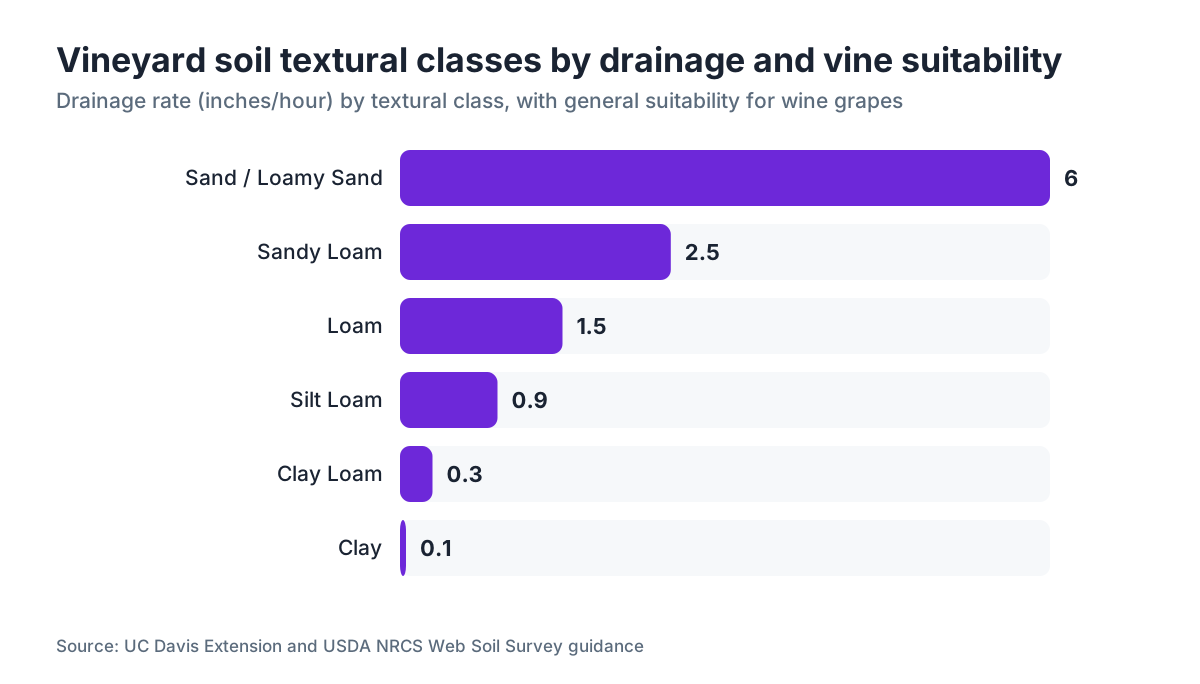
The table below maps textural class to viticultural outcome, built from aggregated extension guidance from UC Davis and Cornell.
| Textural Class | Clay % | Drainage | Vine Water Stress | Ripening Timing | General Rating |
|---|---|---|---|---|---|
| Sand / Loamy Sand | <15% | Very rapid | High (dry years) | Early | Marginal without irrigation |
| Sandy Loam | 10-20% | Rapid | Moderate | Early-mid | Excellent |
| Loam | 10-25% | Moderate | Low-moderate | Mid | Very good |
| Silt Loam | 15-25% | Moderate | Low | Mid-late | Good, watch compaction |
| Clay Loam | 28-40% | Slow | Very low | Late | Risky without tile drainage |
| Clay | >40% | Very slow | None (waterlogging) | Delayed | Generally unsuitable |
Does gravel or rock content change how you evaluate soil texture?
Yes, and it trips up a lot of first-time site evaluations. A soil that tests at 30% clay can behave like a sandy loam if it carries 40-50% coarse fragment content (gravel, cobbles, stones). The rocks take up space in the matrix, cut fine-particle contact, drain hard, and warm faster in spring. Rhone growers figured this out centuries before soil science had a name for it. [5]
When you pull a texture analysis from your lab, ask whether the clay percentage is on a whole-soil basis or a fine-earth basis (material passing a 2mm sieve). Most lab reports use fine-earth. A profile that reads clay loam on fine-earth but holds 60% rock fragments by volume is actually a fast-draining gravelly site that grapevines love.
So pair your texture data with a bulk density measurement and a visual coarse-fragment estimate from a soil pit. No single number tells the story. WSU extension recommends at minimum a two-foot pit inspection plus a standard 12-point composite for texture in new vineyard evaluations. [3]
How does soil texture interact with organic matter and nutrient availability?
Clay particles and organic matter both carry a negative charge, and they hang onto positively charged nutrients (calcium, magnesium, potassium, ammonium) through cation exchange. Sandy soils have low cation exchange capacity (CEC), so nutrients leach out faster and you apply smaller, more frequent inputs. Clay soils have high CEC but can lock up potassium in forms vines struggle to reach when pH swings.
For wine grapes, moderate organic matter (1.5-3%) in a sandy loam to loam profile is the target. Pile organic matter into a heavy clay and you drive runaway vegetative growth, shade the fruit zone, and turn canopy management into a season-long fight. Cornell's viticulture program has documented that blocks with organic matter above 4% in clay-rich Finger Lakes profiles ran higher-vigor vines with more disease pressure in tight clusters. [6]
This is where soil texture meets your spray program. Canopy density from high-vigor soils changes fungicide penetration and coverage. If you log spray applications, texture belongs in your site records, because it explains why one block needs a different program than another 200 yards away. VitiScribe lets you attach soil survey data and texture classifications directly to individual block records, so that context rides along with your spray records instead of sitting in a separate binder.
What soil drainage rate should you target for a new vineyard?
Target 1-3 inches per hour percolation in the top two feet of the profile. A test slower than 0.5 inches per hour signals a drainage problem that tile drainage, subsoil ripping, or cover crop management may or may not fix, depending on what's actually causing the restriction. [2]
The hardpan or claypan layer matters as much as the surface texture. You can have a sandy loam topsoil and a nearly impermeable clay horizon at 18 inches, and the roots effectively live in a bathtub. This is common in parts of the Salinas Valley and some Lodi blocks. A soil pit that goes down at least three feet is non-negotiable before you commit to a planting.
Cornell's viticulture program states plainly that 'poor internal drainage is the single most common site limitation encountered in new vineyard developments in the northeastern United States.' [6] Tile drainage fixes many of these sites, but it runs $3,000-$8,000 per acre depending on depth and spacing, and that number goes into your site economics before you sign a lease.
Excessive drainage cuts the other way. Coarse sands without supplemental irrigation make the vine uneconomical in most climates. You're chasing the middle: enough water retention to carry the vine through the growing season, fast enough drainage that the root zone never stays saturated longer than 24 to 48 hours after heavy rain.
Does soil pH connect to texture, and why does it matter for grapes?
Texture and pH aren't linked by definition, but they travel together in practice. Sandy soils in humid climates trend acidic because cations leach fast. Clay-rich soils in arid climates often run alkaline because calcium and magnesium pile up. Both extremes create nutrient availability problems for grapevines.
The accepted range for wine grapes is pH 5.5-7.0, with 6.0-6.5 considered optimal by most extension programs. [1] Outside that band, specific nutrients drop out of plant-available forms: manganese and iron turn toxic below pH 5.0, phosphorus and zinc lock up above pH 7.5.
Here's the texture connection. If your soil test shows a heavy clay profile with pH 7.8 and high sodium, you're looking at a sodic soil, and that changes structure entirely. Sodium disperses clay particles, wrecks aggregation, and turns a clay loam into something with the drainage of wet concrete. Gypsum (calcium sulfate) is the standard fix, but it takes years of steady application to shift sodic chemistry. NRCS soil health guidance covers this for irrigated wine regions. [4]
Always pair your texture read with a full chemistry panel (pH, CEC, base saturation, and sodium adsorption ratio if you're in an arid irrigated region). Texture is the structure. Chemistry is the operating environment. You need both.
How do California, Oregon, and Washington vineyard soils compare by texture?
These three states carry US wine production, and their soils are genuinely different, which explains a lot about their wine styles.
California's premium coastal valleys (Napa, Sonoma, Santa Barbara) run high textural diversity. Valley floors go silt loam to clay loam, laid down by alluvial deposition. Hillside sites lean loam and sandy loam over fractured volcanic or sedimentary parent material. Lodi, the Central Valley's big producing region, sits on sandy loam to loamy sand over deep alluvial fans. UC Davis soil data for Napa puts the dominant textural class for premium AVAs at loam and silt loam. [1]
Oregon's Willamette Valley is known for two soil series: Jory (a silty clay loam over volcanic basalt, the Pinot Noir benchmark soil) and Willakenzie (a loam to silt loam over sedimentary parent material). Jory's clay content runs 35-45% on fine-earth, which sounds alarming, but the profile drains well because the structure is stable and basalt fragments add macro-pore space. [7]
Washington's Columbia Valley runs the full range. The Wahluke Slope has coarse sandy loams and loamy sands over caliche, with low water-holding capacity that makes deficit irrigation non-negotiable. Walla Walla's older sites are silt loam over basalt, with famous Loess deposits giving excellent texture for Cabernet and Syrah. WSU extension soil maps for the Columbia Valley show silt loam as the dominant class across most established AVAs. [3]
For a real-world look at how these terroir differences show up in finished wines, mountain winery and south coast winery show how coastal California soil types play out at commercial scale.
What soil tests should you run before planting a vineyard?
At minimum, run these before you commit to a site: a standard texture analysis (hydrometer method), bulk density at 0-12 inches and 12-24 inches, organic matter, a full chemistry panel (pH, CEC, macro and micronutrients), and a percolation test at representative spots across the site. In an irrigated region, add sodium adsorption ratio and electrical conductivity for salinity. [4]
For texture, the hydrometer method (ASTM D7928) beats the feel method for anything past a quick field screen. Labs charge $15-35 per texture test. Run at least one sample per distinct soil mapping unit on your site. Don't pull everything from one corner of a 20-acre block.
The USDA Web Soil Survey is a free starting point. It gives you texture class, drainage class, and available water capacity for your parcel before you dig a single hole. It's not a substitute for real sampling, but it tells you where to prioritize pit locations. [4]
For EPA Worker Protection Standard purposes, if you apply restricted-use pesticides, your site data feeds into PHI and buffer zone calculations that belong in your spray records. [8] Good site documentation isn't only viticulture planning. It's the foundation of your compliance paperwork.
Can you improve poor soil texture before or after vineyard establishment?
Before planting, much more easily than after. Once the trellising is in and the vines are established, you're stuck with the soil below the vine row. Pre-plant options include deep ripping (subsoiling to 3-4 feet) to break up compacted layers, incorporating gypsum or lime to correct chemistry, and cover crop cycling to build organic matter. Some growers in clay-heavy blocks haul in coarse sand or fine gravel to mix into the planting row during site prep, though it takes real volume to matter. You have to move the textural class, not add a thin layer. [5]
After establishment, your options narrow to surface applications and management choices. Cover crops in the alley improve aggregate stability and drainage over time. Compost builds organic matter slowly. Mulching vine rows with straw or wood chips buffers surface compaction. None of these change the underlying clay percentage. They change how the clay behaves.
The honest answer is that a bad soil texture deep in the profile, like a clay pan below 18 inches, is close to permanent without tile drainage or blasting. A vineyard manager at gervasi vineyard working over glacial till subsoil faces structural limits that amendments can't fully overcome. Know what you're buying or leasing before you plant.
One practical tool: VitiScribe block records let you log pre-plant soil work, amendment applications, and tile drainage maps alongside your annual spray and scouting records. When you sell the vineyard or bring in a new manager, that history is in the record instead of in someone's head.
How do cover crops and tillage affect vineyard soil texture over time?
Texture itself (sand, silt, clay percentages) doesn't change meaningfully from cover crops or tillage on any human timescale. What changes is structure: how those particles arrange into aggregates, pores, and channels that decide how the soil actually behaves for roots and water.
Cover crops with deep taproots (tillage radishes, fescues, some clovers) mechanically open channels through compacted layers and improve effective drainage without touching clay percentage. UC Davis research on alley crop management in Napa found that a three-year perennial grass cover cut penetration resistance by 18-22% against tilled alleys in loam-textured soils. [10]
Tillage cuts both ways. Light cultivation breaks up surface crusts and improves short-term infiltration. Repeated tillage at the same depth builds a tillage pan (a compacted layer just below cultivation depth) that restricts drainage worse than the native texture ever would. If you till, vary your depth year to year and monitor bulk density below the cultivation zone.
The takeaway for texture management is simple. You can't change what the soil is made of in any practical sense, but you can change how it functions. Structure is manageable. Particle size distribution is not.
What do WSU, UC Davis, and Cornell say about ideal vineyard soil texture?
These three programs are the primary research and extension sources for US viticulture, and they mostly agree while emphasizing different regional contexts.
UC Davis, in its viticulture extension materials, identifies well-drained sandy loam to loam profiles with less than 35% clay as the target for California wine grapes. The program notes that Napa Valley's most productive blocks sit on 'well-drained alluvial fans and benchlands' where texture runs loam to silt loam with rapid to moderate permeability. [1]
Cornell's viticulture extension program for New York emphasizes drainage class over texture class, because the humid Northeast makes waterlogging the primary risk no matter the particle size. Their guidance is to target 'excessively drained to moderately well-drained' sites on the USDA drainage class scale, which practically means avoiding any soil series mapped as somewhat poorly drained or worse without tile drainage. [6]
WSU extension for eastern Washington focuses on windblown Loess silt loam deposits, noting that these soils (typically Walla Walla silt loam and Ritzville silt loam series) give excellent rootzone aeration and moderate water-holding capacity for long-hang-time varieties like Cabernet Sauvignon and Syrah. WSU also flags caliche layers (calcium carbonate accumulation common in Columbia Valley subsoils) as a drainage restriction that needs evaluation before planting. [3]
All three programs agree on the deal-breaker: drainage. Texture is where that evaluation starts, not where it ends.
Frequently asked questions
What USDA soil texture class is most common in top US wine regions?
Loam and silt loam dominate. USDA NRCS soil surveys of Napa Valley, Walla Walla, and the Willamette Valley all show loam-family soils on the most productive vineyard land. Sandy loam appears often on benchland sites. Clay loam shows up in lower valley floor blocks where drainage is managed with tile systems. Pure clay and pure sand are rare in premium wine production anywhere in the US.
Can you grow good wine grapes in sandy soil?
Yes, with irrigation management. Loamy sand and sandy soils force early root depth and produce concentrated fruit when water is managed carefully. Lodi, the southern Rhone, and parts of Portugal's Alentejo grow serious wine in sandy profiles. The risk is irrigation dependency and nutrient leaching. Without steady water, vines stress past the productive threshold fast. Sandy soils are a viable choice, but they demand more active management than sandy loam.
What is the minimum soil depth a vineyard needs?
Most extension programs recommend at least 24 inches of unrestricted rooting depth, with 36-48 inches preferred. Above a restrictive layer (hardpan, claypan, bedrock, caliche), you get shallow rooting, drought stress, and poor mineral uptake. UC Davis notes some California hillside sites produce excellent wine from 18-24 inch profiles over fractured rock, because the rock itself lets roots penetrate, so effective depth includes any fractures the vines can exploit.
How does soil texture affect irrigation scheduling in a vineyard?
Sandy soils need more frequent, smaller irrigation events because they hold less plant-available water per foot of depth. Clay loam soils hold more but deliver it slowly, so they need less frequent, deeper irrigations. In practice, a sandy loam might need 1-2 inch applications every 5-7 days at peak demand, while a clay loam might go 10-14 days between irrigations for the same vine size. Texture is the first input for any soil-based irrigation scheduling model.
Does clay soil cause more disease pressure in vineyards?
Indirectly, yes. Heavy clay slows drainage, keeps surface humidity high after rain, and pushes vigorous vegetative growth that thickens the canopy. A dense canopy traps moisture, raises bunch rot susceptibility, and cuts fungicide penetration. The texture doesn't cause disease directly, but it builds the canopy and microclimate where Botrytis, powdery mildew, and downy mildew thrive. Managing clay-driven vigor with deficit irrigation and aggressive hedging is the main response.
How many soil samples should I take before planting a 10-acre vineyard?
At minimum, one composite sample per distinct soil mapping unit visible on a Web Soil Survey map, plus targeted samples at any spot that looks different (different color, different surface texture, a lower-lying area). For a 10-acre block with two soil series, plan on 6-10 composites and at least 2-3 pit inspections to confirm the profile at depth. Lab texture analysis runs $15-35 per sample, a cheap investment against a failed planting.
What is a percolation test and how do I run one for a vineyard site?
A percolation test measures how fast water moves through a soil profile. Dig a hole 12-18 inches deep, soak it with water, let it drain, then refill it and time the drop in water level over 30-60 minutes. Express the result in inches per hour. For vineyards, target 1-3 inches per hour in the top two feet. Below 0.5 inches per hour signals a drainage problem. Run the test in winter or spring when soils are at field capacity for the worst-case result.
Can compost change my vineyard soil texture?
Not in any meaningful textural sense. Compost adds organic matter and improves aggregate stability, water retention in sandy soils, and aeration in clay soils, but it doesn't change the sand/silt/clay percentages. You'd need to add roughly 10-15% by volume of pure sand or clay to shift a textural class, an impractical amount once vines are in. Compost is worth applying for biological and structural reasons, but don't expect it to reclassify your soil.
Do grape variety rootstocks tolerate different soil textures differently?
Yes, substantially. SO4 and 5BB rootstocks handle clay soils and wet feet better than 110R or 140Ru, which prefer well-drained sandy loam profiles. 101-14 Mgt tolerates moderate clay and is widely used in the Willamette Valley's heavier Jory soils. 3309C works well in shallow, moderately well-drained sites. Cornell and UC Davis both publish rootstock-by-soil-texture matching guides that should be part of any pre-plant planning process.
How does soil texture affect wine flavor and style?
Texture affects flavor through root depth, water stress timing, and nutrient availability. Sandy soils produce wines with early ripening, lighter color, and often more aromatic expressiveness. Clay-dominant soils produce fuller-bodied wines with later ripening and higher tannin extraction potential, partly because the vine's slower water access concentrates sugar and phenolics. The correlation is real but not deterministic: irrigation, variety, clone, and winemaking choices all override textural signals if managed aggressively enough.
Is the USDA Web Soil Survey accurate enough to use for vineyard site selection?
As a first-pass screening tool, yes. Web Soil Survey uses NRCS-mapped soil series data and gives you texture class, drainage class, available water capacity, and depth to restrictive layers for any US parcel. Its mapping scale is 1:24,000, which means it can miss soil variability inside a 5-10 acre block. Always follow up with actual soil pits and lab texture analysis before planting. The survey tells you what questions to ask. It doesn't replace digging.
What's the difference between soil texture and soil structure, and which matters more for vines?
Texture is the permanent size distribution of soil particles: sand, silt, clay percentages. Structure is how those particles arrange into aggregates, pores, and channels, and it changes with management. For vines, both matter. Texture sets the baseline for water retention and drainage. Structure decides whether those theoretical properties translate to real root function. A clay loam with good granular structure can outperform a sandy loam with compaction damage. Manage both, but know texture is fixed and structure is not.
How does soil texture show up in vineyard compliance records and why does it matter?
Soil texture belongs in your vineyard block records because it justifies management decisions: irrigation scheduling, amendment applications, rootstock selection, and spray program design. Under EPA Worker Protection Standard rules, applicator training and record-keeping requirements tie to site conditions including soil type when restricted-use pesticides are involved. Auditors and crop insurance adjusters also ask for site characterization data. Keeping texture data in your block records alongside spray logs makes those audits straightforward.
Sources
- UC Davis Viticulture and Enology - Soils and Grapevine Nutrition: Sandy loam to loam profiles with less than 35% clay are identified as the target texture for California wine grapes; UC Davis data on Napa Valley dominant textural classes and root depth research in loamy sand profiles.
- UC Davis Extension - Vineyard Site Selection and Soil Evaluation: Target texture range of 15-30% clay, 1-3 inches per hour percolation rate, and 35-40% clay as the upper practical limit for wine grapes without drainage intervention.
- Washington State University Extension - Viticulture Program, Columbia Valley Soils: Bulk density above 1.6 g/cm3 in clay loam flagged as management trigger; WSU recommendation for two-foot pit inspection plus 12-point composite for new vineyard evaluations; Walla Walla silt loam and Ritzville silt loam series identified as dominant classes in established AVAs.
- USDA Natural Resources Conservation Service - Web Soil Survey: Vineyards in Napa Valley, Willamette Valley, and Finger Lakes cluster in loam, sandy loam, and silt loam textural classes per NRCS survey data; NRCS guidance on sodic soil chemistry and gypsum treatment.
- University of California Agriculture and Natural Resources - Soil Texture and Vineyard Performance: Coarse fragment content (gravel, cobbles) significantly modifies effective drainage behavior of clay-percentage soils; pre-plant sand incorporation requires meaningful volume to shift textural class.
- Cornell University Viticulture and Enology - New York Vineyard Site Selection: Poor internal drainage identified as the single most common site limitation in northeastern US vineyard development; organic matter above 4% in clay-rich Finger Lakes profiles linked to excessive vine vigor and disease pressure; tile drainage cost range $3,000-$8,000 per acre.
- Oregon State University Extension - Willamette Valley Soil Series and Viticulture: Jory series (silty clay loam over volcanic basalt) runs 35-45% clay on fine-earth basis but drains well due to stable structure and basalt fragment macro-pore space; Willakenzie series described as loam to silt loam over sedimentary parent material.
- EPA Worker Protection Standard - Agricultural Workers: Spray record-keeping requirements under EPA WPS tie to site conditions including soil type for restricted-use pesticide applications; applicator documentation requirements.
- UC Davis - Alley Crop Cover Management Research, Napa Valley: Three-year perennial grass cover reduced penetration resistance by 18-22% compared to tilled alleys in loam-textured Napa soils.
Last updated 2026-07-09