Grape vines weeping after pruning: what's normal and what isn't
TL;DR
- Grapevines weep sap from pruning cuts when root pressure builds as soil warms in late winter, usually once soil hits about 50°F (10°C).
- It's normal physiology and rarely hurts the vine.
- Heavy weeping can flag poor cut placement, disease pressure, or late pruning.
- Most healthy vines stop weeping on their own within days to a few weeks.
What is grapevine weeping and why does it happen?
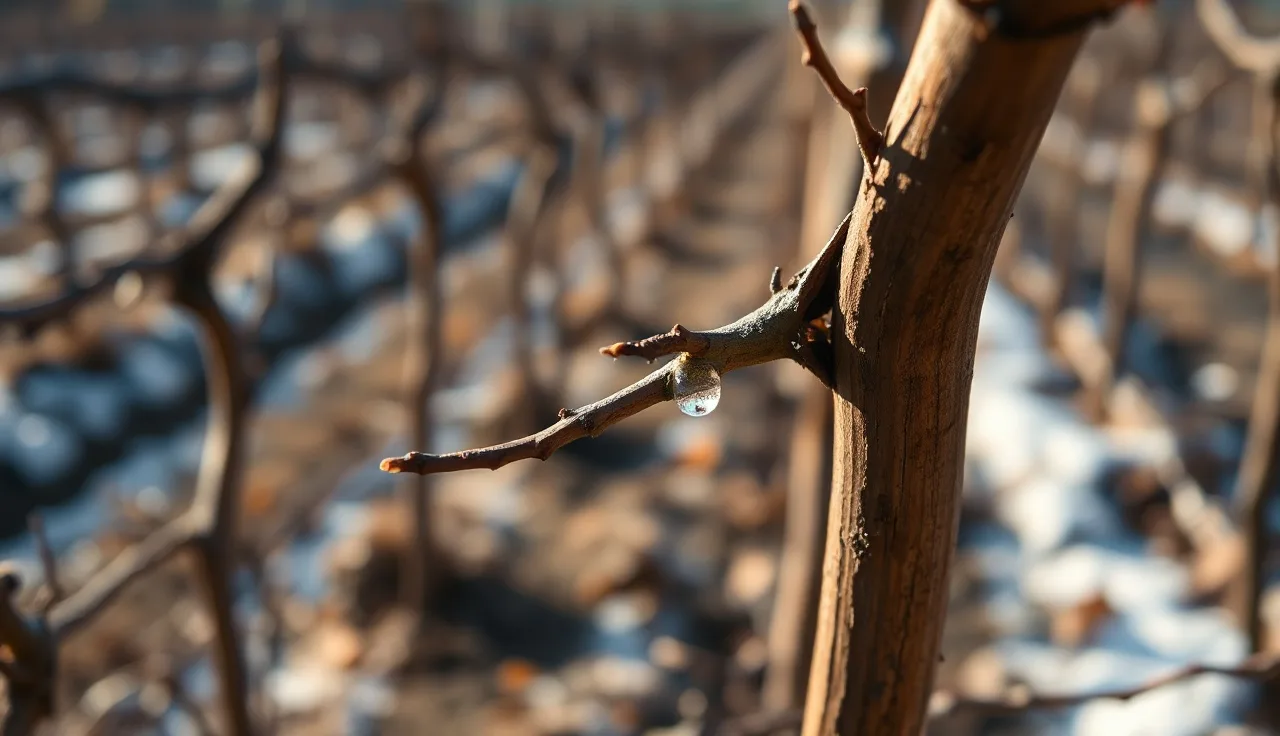
Weeping is exactly what it sounds like. Liquid drips or streams from fresh pruning cuts on a dormant or semi-dormant vine. The fluid is mostly water carrying a little dissolved sugar, minerals, and organic acids. It comes from root pressure, not the phloem. As soil temperature climbs above roughly 50°F (10°C) in late winter, roots start pulling water in before the shoots have broken and the leaves are ready to transpire it away. Pressure builds in the xylem. Cut a cane, and you open a door for that pressurized sap to exit. [1]
This happens in grapevines everywhere, Vitis vinifera and American hybrids alike, across every major wine region. Cornell University's viticulture extension program describes it as "a sign of active root function" rather than damage, and notes it usually begins days to a few weeks before bud swell. [2]
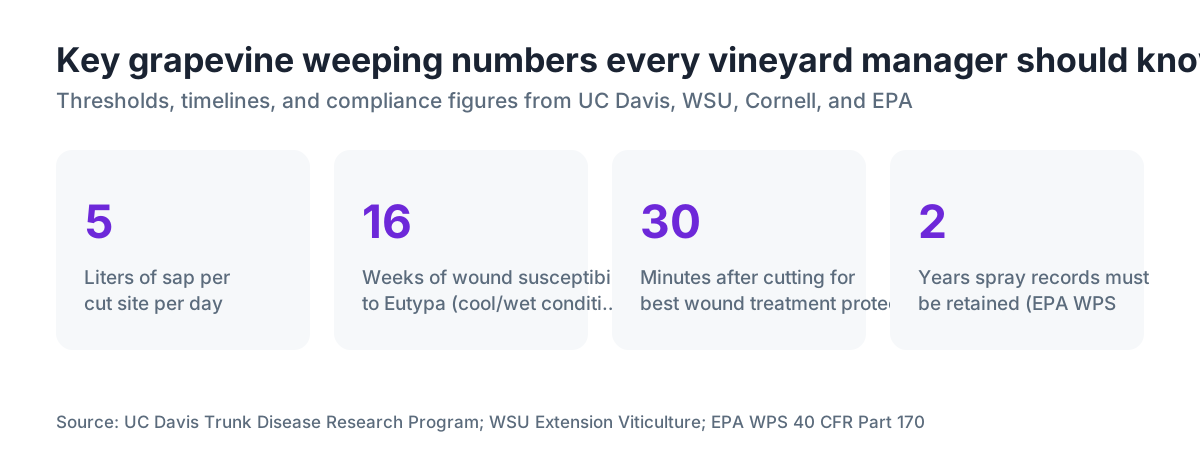
The volume can startle you. Research from UC Davis has shown individual cut sites on established vines can release anywhere from 1 to 5 liters of sap per day under high root pressure, with total loss over a full weeping period sometimes topping 5 to 10 liters. [3] That's enough to alarm a new vineyard manager who's never seen it. It shouldn't.
Weeping does not cauterize, seal, or trigger any lasting wound response on its own. The vine doesn't bleed out. What it does do is keep the wound wet, and that matters for disease management, as we'll get into.
When during the season do grapevines start weeping?
Soil temperature drives the timing, not the calendar. In most California wine regions, weeping starts between late January and early March. In the Pacific Northwest (Oregon, Washington), it's usually February through April. In the Northeast and Midwest it can wait until April. The trigger stays consistent: soil at 12-inch depth reaching about 10°C (50°F). [1]
The pruning-timing angle is real. Prune early in a warm winter and you may get more weeping because root pressure is already building. Prune during a cold snap and the vine may barely drip, then weep hard from older cuts once warmth returns. Neither one is bad.
Pruning grape vines after harvest is a timing tool some growers use. Fall pruning, done right after leaf drop, catches the vine while root activity winds down and soil temperatures fall. You'll see little to no weeping then. The catch is that fall-pruned vines hold less stored carbohydrate in the retained wood, because those reserves haven't fully translocated back from the foliage yet. Washington State University's extension service recommends waiting at least two to three weeks after leaf drop before fall pruning for exactly this reason. [4]
Conventional wisdom in California and the Pacific Northwest says delay pruning as late as practical in spring. Part of it is cutting frost risk to newly exposed buds. Part of it is that later pruning slows the weeping response, because the pressure difference between roots and atmosphere drops as the shoot system wakes up. WSU research found that "late pruning" done close to bud swell reduced weeping duration without significantly impacting yield. [4]
Is weeping harmful to the vine's health?
Usually not. The vine loses some water and a tiny amount of nutrients. Studies that tried to pin down nutrient loss from weeping keep landing in the same place: it's a lousy mechanism for moving minerals out of the vine. A 2012 study in the Australian Journal of Grape and Wine Research measured mineral concentrations in weeping sap and called the lost nutrients "nutritionally insignificant" against the vine's annual mineral budget. [5]
The real concern is disease entry. Eutypa lata, Botryosphaeria species, and Phomopsis viticola, the main players in the trunk disease complexes, all release spores during rain events in pruning season. Wet wounds stay open to them for a long time. Research at UC Davis found wound susceptibility to Eutypa lata persists for up to 16 weeks under cool, wet conditions. [3] Weeping keeps that wound surface moist longer than it would be otherwise.
Here's the practical version. Weeping itself isn't the problem. Weeping wounds sitting in air full of Eutypa or Botryosphaeria spores during wet weather is the problem. The sap doesn't cause disease. It stretches out the window of wound vulnerability by keeping the cut face from drying and forming a barrier.
Wounds that never dry out over several weeks can also mess with callusing. Callus tissue forms from the cambium at the wound margin, and it forms faster in drier conditions. If you farm in a region with late spring rains that keep wounds wet for months, that's where protective wound treatments earn their keep.
How much weeping is too much?
No universal threshold exists, but here's a working frame. A healthy vine dripping 1 to 3 liters a day from a few cut sites in the first week after pruning is nothing to worry about. Weeping that runs past four to six weeks, or that comes from wounds you made last season instead of fresh cuts, is worth a look.
A few signs weeping may point to a real problem:
- Sap is discolored, cloudy, or smells off. Clear to faintly yellow sap is normal. Brown, viscous, or foul-smelling sap can mean bacterial infection, most often crown gall (Agrobacterium vitis) or bacterial canker. [6]
- Weeping from old, sealed wounds. Sap seeping from cracks in two- or three-year-old wood, rather than fresh cuts, can flag wood disease weakening the tissue inside.
- Poor-condition vines that weep heavily. A vine with a sparse canopy last year, low yield, and delayed bud break may have a compromised vascular system that can't regulate pressure well.
Volume alone diagnoses nothing. Context does. A vigorous vine on deep, well-irrigated soil will always weep more than a stressed vine on shallow, droughty ground. That's normal physiology, not pathology.
For a side-by-side look at normal versus abnormal sap, see the table below.
What factors make weeping worse?
Several things drive heavier-than-normal weeping, and most of them are choices you control.
Soil moisture is the biggest lever. Vines in wet soils, whether from rain, over-irrigation in fall, or a high water table, have more water available for uptake and therefore higher xylem pressure. Irrigate hard late into the prior season and you should expect heavier weeping the next spring.
Rootstock matters too. Vigorous stocks like 1103 Paulsen and 110 Richter run more aggressive root systems that generate higher soil-to-shoot pressure than milder stocks like 3309 Couderc or Riparia Gloire. Nobody has published a clean comparison table of rootstock weeping rates that I know of, but the link between rootstock vigor and early-season sap flow shows up consistently across extension literature. [2]
Cut placement changes how much sap leaves any single wound. Cuts near the head of the vine or near large cordons open exit points with a bigger vascular column behind them. A spur cut three internodes back from the cordon will usually weep more per unit time than a cane cut farther from the base. Standard spur-pruning practice, leaving two-bud spurs, tends to hold this in check.
Temperature swings pour fuel on the fire. A cold night into a warm afternoon builds a larger pressure difference and faster sap flow than steady cool weather. That's why managers in places like the Columbia Valley or the Sierra Foothills, where spring days can run 40°F warmer than spring nights, sometimes see dramatic weeping from cuts made weeks earlier.
Should you apply wound sealants after pruning to stop weeping?
This is where grower habit and the research part ways, and the research has gotten more nuanced over the past decade.
The original case for wound sealants (products like Topsin-M paste, Benlate, or beeswax-based paints) was about blocking fungal entry at the wound face. The evidence against Eutypa lata is decent. UC Davis trials showed fungicide-based wound paints applied within 30 minutes of cutting cut Eutypa infection rates significantly in high-inoculum sites. [3] Stopping weeping was never the point, though wound paints do slow sap exit by covering the surface.
The catch: some sealants, especially film-forming ones, slow callusing if you lay them on too thick or too early in warm weather. The vine's own wound response needs oxygen exchange at the cut. A thick impermeable coat gets in the way.
My honest take. If you're pruning in a region or season with real Eutypa or Botryosphaeria pressure (rain during pruning, known disease history in the block), use a registered fungicide wound treatment. Topsin-M (thiophanate-methyl) paste has the strongest evidence behind it. [3] If you're pruning in dry weather with no disease history and you just want the cosmetic dripping to stop, sealants aren't worth the labor cost per vine.
One thing sealants won't do is meaningfully cut total water loss from weeping. The vine just redistributes that pressure and pushes sap out of adjacent tissue or smaller wounds. You can't patch a plumbing problem.
Does pruning timing affect weeping and vine performance?
Yes, and it's one of the more interesting applied-research areas in viticulture right now. The old "prune after leaf drop, before bud break" window is wide enough for real strategy.
Pruning early in dormancy (December or early January across most of the Northern Hemisphere) exposes the fresh wood to the full run of winter, frost and rain included. Weeping, when it starts, exits wounds that have had weeks or months to partly callus. Some growers like this because they get labor done when crews are around.
Pruning late, close to bud swell, is what WSU researchers call delayed pruning. It has a few documented effects. It cuts frost damage risk, because buds tolerate cold better in early swell than after they've pushed. It shortens the window of wound susceptibility to trunk pathogens, because the warmer, drying weather of late spring shows up sooner after the cut. And it tends to lower net weeping volume, because the shoot system is already gearing up to transpire and the pressure difference drops fast. [4]
The downside is obvious. You're pruning after the vine has committed resources to pushing buds, so you lose some early buds to the cut. This bites harder on some varieties than others. Chardonnay and Pinot Noir lean on basal bud fertility and handle delayed pruning fine. Varieties with weak basal bud fertility, like Thompson Seedless or some Italian ones, can lose yield if you prune too late.
Fall pruning is the third option. Weeping is almost nil. Disease risk is lower where inoculum pressure drops in fall (this varies by region). The tradeoff is the carbohydrate reserve question from earlier. Fall pruning works well in warmer, drier regions with mild winters where labor is the tight constraint. It's less common where winters are hard, because fall-pruned vines can show more tip dieback from cold.
How do trunk diseases interact with grapevine weeping wounds?
This is the most practically important part of the whole weeping story. Trunk diseases, mainly the Eutypa dieback and Botryosphaeria dieback complexes, are the leading cause of premature vine decline in established vineyards worldwide. UC Davis estimates trunk disease losses in California alone top $260 million a year. [3]
The infection path is depressingly simple. Fungal spores (ascospores for Eutypa, conidia or ascospores for Botryosphaeria species) release during rain. They land on fresh pruning wounds. If the wound is moist, and weeping wounds definitely are, germination and penetration can happen within hours. The fungi colonize the xylem and creep toward the trunk over years, eventually causing the wedge-shaped cankers, stunted shoots, and dead vines that trunk disease is known for.
Weeping doesn't cause this. Spores do. But weeping widens the window during which spores can infect, because it keeps the wound wet and blocks the dry, suberized barrier from forming quickly.
Management worth doing: prune in dry weather whenever scheduling allows, apply registered wound treatments right after cutting (within 30 minutes if you can), use double pruning where you leave a long sacrifice cane and re-prune to the final spur position in spring, and pull infected wood out of the vineyard and destroy it rather than leaving it around. Cornell's viticulture program has detailed guidance on double pruning as a trunk disease strategy. [2]
For record-keeping, if you apply fungicide wound treatments, those go in your spray records like any other pesticide application. EPA Worker Protection Standard requirements cover thiophanate-methyl products even when you brush them on by hand. [7] Tools like VitiScribe keep those application records, equipment calibration, and re-entry intervals in one place, instead of building a fresh spreadsheet for every block.
What do you actually do about weeping in the field right now?
You're standing in a block, watching sap drip off fresh cuts on a cold morning, wondering if you should do something. The honest answer: probably nothing urgent.
For most vines in most conditions, weeping stops on its own within one to three weeks. Shoot growth starts, transpiration creates a competing demand for the water the roots are pulling in, and the vine self-limits.
Actions worth taking, in order of real impact:
First, if it's raining or rain is forecast in the next 48 hours and you're in a block with known Eutypa or Botryosphaeria history, apply a wound treatment. This is the single highest-return action. Don't do the backwards thing I've watched more than once: painting wounds after they've dried in nice weather, then skipping it when rain is coming.
Second, if the weeping is extreme and you have drip, check whether your last irrigation set ran too close to pruning. Pulling irrigation back a few weeks before pruning, if you have stored soil moisture and your vine water status allows it, can lower root pressure and calm weeping in later years.
Third, if weeping keeps up past four to six weeks with no sign of slowing, or if sap is discolored or smells bad, cut into the weeping wood a few inches back and read the cross-section. Healthy wood shows a ring of green to creamy cambium around a pale xylem core. Brown or black discoloration in the xylem or vascular tissue points to disease.
Fourth, write it down. Date, block, vine IDs where weeping is severe or odd, any sap characteristics. If you end up chasing a disease problem later, that record earns its keep. A field notebook works. A vineyard operations app works better, because the data is still searchable years out.
How does grapevine weeping differ between Vitis vinifera and hybrid varieties?
American Vitis species and their hybrids, including labrusca, riparia, and varieties like Concord, Niagara, or Marquette, generally run root systems that are more cold-active than V. vinifera. They start absorbing water at slightly lower soil temperatures. Some growers in New York and Michigan report that hybrid vines seem to weep earlier, and sometimes harder, than vinifera in the same block under the same weather. [2]
That tracks. American species evolved in climates with wilder spring swings, and their root activity kicks in earlier as an adaptation to shorter growing seasons. Whether that earlier start means more wound vulnerability is less clear. Most trunk disease research has focused on V. vinifera, simply because that's where the money is at risk.
For hybrid growers, the advice doesn't change. Weeping is normal, it stops on its own, manage the disease risk during wet weather. Hybrids often resist some fungal pathogens better than vinifera, which may partly offset the longer weeping window. Cornell's research on cold-climate hybrid varieties in New York has useful variety-specific guidance. [2]
How should you record and track pruning wounds and weeping for compliance?
Apply any pesticide wound treatment and you pick up a federal record-keeping obligation under the EPA Worker Protection Standard, plus state pesticide use reporting rules in most states. [7] Thiophanate-methyl (Topsin-M), the most common fungicide wound treatment for Eutypa, is a restricted-use pesticide in some states and general-use in others. Check your state's classification before you apply.
Your spray record for a wound treatment needs at minimum: date, applicator name, product name and EPA registration number, rate, and the acreage or number of vines treated. Under the WPS, keep the record for two years. [7]
Beyond compliance, there's real agronomic value in tracking pruning dates, weeping severity notes, and any disease findings block by block. The vine you noted weeping from an old wound in 2024, and never followed up on, may be the vine with a dead cordon in 2026. The paper trail, or its digital version, connects those dots.
VitiScribe is built for this layered vineyard record. It links spray applications to block maps and calendar events, so a year-end compliance report or a CDFA audit doesn't turn into a memory exercise. That said, a well-kept paper log organized by block covers the legal minimum just fine.
In California, the county agricultural commissioner's pesticide use reporting (PUR) system requires a report for any pesticide application in a commercial vineyard, wound treatments included. Forms and deadlines vary by county, and the CDFA maintains the current framework. [8]
Key numbers and thresholds for grapevine weeping, summarized
Quick reference. Here are the figures that actually matter in managing weeping:
| Parameter | Typical normal range | Action threshold |
|---|---|---|
| Sap flow per cut site per day | 1 to 5 liters | >5 liters sustained past 3 weeks: investigate |
| Soil temp triggering weeping | ~50°F (10°C) at 12-inch depth | N/A (informational) |
| Wound susceptibility to Eutypa | Up to 16 weeks in cool/wet conditions | Apply wound treatment if rain forecast |
| Wound treatment timing | Within 30 minutes of cut for best protection | No later than same day |
| Spray record retention | 2 years minimum (EPA WPS) | Audit anytime |
| Fall pruning timing | 2 to 3 weeks after leaf drop minimum | Earlier reduces carbohydrate reserves |
| UC Davis estimated CA trunk disease losses | $260 million/year | N/A (scale reference) |
These numbers come from the UC Davis viticulture program, WSU extension, Cornell viticulture extension, and EPA WPS documentation. [2][3][4][7] Where the ranges run wide, the spread reflects differences in rootstock, soil, climate, and vine age. Treat them as calibration points, not rules.
Frequently asked questions
Is it normal for grapevines to drip sap after pruning?
Yes, completely normal. Weeping comes from root pressure building in late winter as soil warms above 50°F while shoots haven't leafed out yet. Sap exits fresh cut sites. A healthy vine can release 1 to 5 liters per cut per day during peak pressure. It slows and stops on its own within one to three weeks as budbreak and transpiration begin. Clear to pale yellow sap is the normal color.
Can weeping sap damage the vine or reduce yield?
The sap loss itself doesn't damage the vine or cut yield in any meaningful way. Research in the Australian Journal of Grape and Wine Research found nutrient loss from weeping sap is nutritionally insignificant against the vine's annual mineral budget. The real risk is indirect: wet pruning wounds are open to infection by Eutypa lata and Botryosphaeria species if spores are present during rain events.
How long do grapevines weep after pruning?
Typically one to three weeks for most healthy vines under normal spring conditions. Duration depends on soil moisture, rootstock vigor, and how fast the shoot system builds enough leaf area to create transpirational demand. Late pruning, close to bud swell, tends to shorten the weeping period because leaf development starts sooner after the cut. Weeping past six weeks is worth investigating.
Should I seal pruning cuts on grapevines to prevent weeping?
Not to stop weeping, since sealants don't meaningfully cut total sap volume. The reason to apply a wound treatment is disease protection against Eutypa lata and Botryosphaeria species. Fungicide-based wound paints like Topsin-M (thiophanate-methyl) have good evidence for reducing trunk disease infection if applied within 30 minutes of cutting, especially before rain events.
What soil temperature triggers grapevine weeping after pruning?
Root pressure high enough to cause visible weeping usually builds when soil temperature at 12-inch depth reaches about 50°F (10°C). This is a rough threshold, not a hard cutoff. Soil moisture, rootstock, and vine age all shift the exact timing. In most California wine regions it happens between late January and early March; in the Pacific Northwest it's generally February through April.
Does pruning timing affect how much grapevines weep?
Yes. Later pruning, close to bud swell, generally means shorter weeping because the shoot system develops fast and transpirational demand drops xylem pressure sooner. Pruning grape vines after harvest in fall produces almost no weeping, since root activity is slowing and soil temperatures are falling. Earlier dormant pruning can mean longer weeping periods, but it doesn't hurt vine health.
What does it mean if weeping sap is brown or smells bad?
Discolored, brown, viscous, or foul-smelling sap is not normal and warrants a closer look. It can indicate bacterial infection, most often crown gall from Agrobacterium vitis, or bacterial canker. Cut into the suspect wood a few inches from the wound and read the cross-section. Brown or black vascular discoloration confirms internal infection. Healthy wood shows pale to creamy xylem with a green cambium ring at the margins.
Is grapevine weeping worse with certain rootstocks?
Generally yes. Vigorous rootstocks like 1103 Paulsen and 110 Richter produce more aggressive root absorption and higher root pressure than milder stocks like 3309 Couderc or Riparia Gloire. A clean published comparison table on rootstock-specific weeping rates doesn't seem to exist yet, but the link between rootstock vigor class and early-season sap flow shows up consistently across extension literature from UC Davis and Cornell.
Do I need to record wound treatments for weeping on my spray records?
Yes, if you apply a registered pesticide wound treatment like thiophanate-methyl (Topsin-M). Under the EPA Worker Protection Standard, pesticide application records must be kept for at least two years. California additionally requires pesticide use reports submitted to the county agricultural commissioner. The record must include date, applicator name, product name, EPA registration number, application rate, and area treated.
Can pruning in wet weather cause trunk disease through weeping wounds?
Pruning in wet weather sharply raises trunk disease risk, because rain events release Eutypa lata and Botryosphaeria spores that land on fresh, moist wounds. UC Davis research found pruning wounds stay susceptible to Eutypa infection for up to 16 weeks in cool, wet conditions. Weeping keeps wounds moist and extends that window. Prune ahead of dry-weather windows when you can, and apply fungicide wound treatments if rain is forecast.
What's the difference between fall pruning and spring pruning for weeping management?
Fall pruning, done two to three weeks or more after leaf drop, produces minimal weeping because root activity is declining and soil temperatures are falling. Spring pruning, especially early in dormancy, produces more weeping as soil warms. Late spring pruning close to bud swell shortens weeping but can sacrifice some early buds. WSU recommends waiting at least two to three weeks after leaf drop for fall pruning to protect carbohydrate reserves.
Do hybrid grapevine varieties weep more than Vitis vinifera?
Anecdotally yes, though the difference is more about timing than volume. American Vitis species and their hybrids (Concord, Marquette, and the like) have root systems that turn active at slightly lower soil temperatures than V. vinifera, so they may start weeping earlier in spring. Cornell's cold-climate viticulture program in New York documents this pattern in hybrid trials. Whether earlier weeping raises disease vulnerability in hybrids is less studied than in vinifera.
Should I irrigate before or after pruning to affect weeping?
Skip irrigation in the weeks right before pruning if your soil moisture allows it. High soil moisture raises root pressure and amplifies weeping. Where fall irrigation is common to build soil reserves, finishing it at least three to four weeks before planned pruning gives the soil profile time to drain a little. This won't eliminate weeping, but it can ease its severity, especially in heavy-textured soils with slow drainage.
Sources
- UC Davis Cooperative Extension, Viticulture and Enology: Root pressure builds and grapevine weeping begins when soil temperatures reach approximately 10°C (50°F) at root depth, prior to budbreak.
- Cornell University, College of Agriculture and Life Sciences, Viticulture Extension: Weeping is described as a sign of active root function; double pruning and delayed pruning strategies for trunk disease management; hybrid variety early-season sap flow.
- UC Davis Department of Plant Pathology, Trunk Disease Research Program: Individual pruning wound sites can release 1 to 5 liters of sap per day; wound susceptibility to Eutypa lata persists up to 16 weeks in cool wet conditions; California trunk disease losses exceed $260 million annually; fungicide wound paints applied within 30 minutes of cutting significantly reduce Eutypa infection rates.
- Washington State University Extension, Viticulture: WSU recommends waiting at least two to three weeks after leaf drop before fall pruning to protect carbohydrate reserves; late pruning reduces weeping duration without significantly impacting yield.
- Australian Journal of Grape and Wine Research, Vol. 18 (2012), Mineral composition of grapevine weeping sap: Mineral concentrations in weeping sap were found to be 'nutritionally insignificant' relative to annual vine mineral budgets.
- UC Davis IPM Program, Grape Pest Management Guidelines: Crown gall (Agrobacterium vitis) and bacterial canker can produce discolored, abnormal sap from grapevine wounds; symptoms include brown or viscous sap and internal vascular discoloration.
- EPA Worker Protection Standard, 40 CFR Part 170: Pesticide application records including wound treatments must be retained for a minimum of two years; WPS requirements apply to thiophanate-methyl products applied in commercial vineyards.
- California Department of Food and Agriculture, Pesticide Use Reporting: California requires pesticide use reports submitted to county agricultural commissioners for all pesticide applications in commercial vineyards, including wound treatments.
- UC Davis Cooperative Extension, Eutypa Dieback of Grapevine: Eutypa lata spores are released during rain events and infect moist pruning wounds; fungicide wound treatments (thiophanate-methyl) are the primary chemical management tool.
- WSU Extension, Grapevine Pruning and Training Systems: Delayed pruning strategy (pruning close to bud swell) reduces frost damage risk and shortens wound exposure period; fall pruning timing recommendations relative to leaf drop.
Last updated 2026-07-09