Caring for grape vines: pruning methods, timing, and tools

TL;DR
- Grape vines need dormant-season pruning every year, usually between full leaf drop and bud swell (late November through early March in most U.S.
- regions).
- The two main systems are spur pruning and cane pruning.
- Done right, pruning controls crop load, manages vigor, and keeps your trellis working for decades.
- Skip it and yields collapse within two to three seasons.
Why does pruning matter so much for grape vines?
Grapes fruit on one-year-old wood. That single fact drives every pruning decision you'll ever make. Leave too much old wood and the vine pushes energy into vegetative growth instead of quality fruit. Remove too much and you stress the vine and lose yield. Every winter you're resetting the vine's balance: keep enough healthy one-year-old canes or spurs to meet your target crop load, remove everything else, and leave the permanent structure intact.
This is not optional maintenance. Cornell University's viticulture program is direct about it: untrained or unpruned vines rapidly become tangled masses of wood that harbor disease, shade fruit, and produce erratic crops [1]. The vine doesn't care about your production goals. Left alone, it spreads, over-crops, and exhausts itself.
Pruning also gives you your best annual look at vine health. Walking the rows in winter, you spot dead wood from cold injury, track the spread of crown gall, catch canes that grew unusually short or thin, and notice canopy problems before they compound. It's the most information-rich task of the year.
When is the right time to prune grape vines?
The window runs from after full leaf drop in fall through bud swell in spring. Most vineyard managers in the eastern U.S. aim for January through early March. In California's warmer regions, December through February is common. The Pacific Northwest, guided by Washington State University (WSU) extension, generally targets late January through March to dodge the worst cold snaps after cuts are made [2].
Timing matters for two reasons. Vines pruned too early (right after leaf drop) can be more vulnerable to winter injury, because the wounds haven't had time to desiccate and the vine hasn't fully hardened. Vines pruned too late, after buds start swelling, bleed sap heavily from cuts and waste carbohydrate reserves the vine stored all season.
The bleeding question comes up every year. Sap flow after late pruning looks alarming but rarely harms established vines. UC Davis viticulture extension notes that bleeding is more of an aesthetic concern than a physiological threat, though it does represent some carbohydrate loss [3]. For young vines in their first two years, minimize late pruning to protect those reserves.
If you farm where Eutypa dieback is a problem (most of California, parts of Oregon), there's a strong case for pruning as late as you can in the dormant window. Eutypa lata spore release peaks during winter rain events, and wounds made later in dormancy have less time to sit exposed before the vine's natural wound response kicks in at bud swell. UC Davis plant pathology extension recommends pruning after the last significant rain of the season where Eutypa is a known problem [8].
What are the two main pruning systems and which should you use?
Nearly every commercial training system falls into one of two categories: spur pruning or cane pruning. The difference is the foundation of all vine management.
Spur pruning means you keep short stubs (spurs) of two to three buds each, evenly spaced along a permanent cordon arm. Each spur pushes two to three shoots in the growing season, and the following winter you cut back to a new two-bud spur from the previous year's growth. Systems like VSP (vertical shoot positioning) with a bilateral cordon are almost always spur pruned. It's faster, easier to mechanize, and works well with varieties that have fruitful buds close to the base of the cane.
Cane pruning replaces the fruiting wood entirely each year. You pick one or two vigorous, well-positioned canes from last season's growth, tie them down to a fruiting wire, and remove everything else. The classic Guyot systems (single or double) are cane-pruned. Cane pruning works better for varieties where the basal buds (buds one and two from the base) tend to be poorly differentiated and unfruitful, including many Vitis labrusca varieties and crosses.
Here's how the two compare:
| Factor | Spur pruning | Cane pruning |
|---|---|---|
| Permanent structure | Bilateral cordon | Head or short trunk |
| Buds retained per vine | 20-40 (varies by vigor) | 8-20 per cane, 1-2 canes |
| Labor speed | Faster once learned | Slower, more judgment required |
| Mechanization potential | High | Low to moderate |
| Best for | Cabernet, Syrah, Grenache, etc. | Riesling, Pinot noir, Concord, Catawba |
| Eutypa risk over time | Higher (persistent cordon wounds) | Lower (fresh wood each year) |
Neither system wins on its own. Your variety, your labor situation, and your trellis infrastructure drive the choice. Cornell's viticulture resources recommend cane pruning for most labrusca-based varieties grown in the eastern U.S. specifically because their basal bud fruitfulness is low [1].
How do you prune a Catawba grape vine specifically?
Catawba is a Vitis labrusca hybrid, and like most American-type grapes, it has low fruitfulness in the first one or two buds from the cane base. Spur pruning to two buds, which works fine on Cabernet Sauvignon, leaves you with mostly vegetative shoots and almost no fruit on Catawba.
The right system for Catawba is cane pruning, usually a four-cane Kniffin or a two-cane Kniffin depending on vine spacing and trellis design. In the four-cane Kniffin, you keep four canes of roughly 8 to 10 buds each, tied to two wire levels, plus renewal spurs near the head to make next year's canes. Total bud count per vine typically runs 40 to 60, adjusted for vigor.
Pruning steps for Catawba:
- Start at the trunk and identify last year's canes, the smooth brown wood with visible nodes.
- Look for four canes that are pencil-diameter (roughly 6 to 10 mm), grew from near the head, and have evenly spaced nodes. Skip canes thinner than a pencil (weak, will produce poorly) or thicker than a thumb (too vigorous, will push vegetative growth).
- Tie your selected canes down to the fruiting wires before cutting, so you don't accidentally remove a good cane.
- Cut renewal spurs: find two or three short, well-positioned shoots near the head and cut them back to two buds each. These give you cane options next winter.
- Remove everything else. That's usually 80 to 90 percent of the total wood on the vine.
Catawba in the Finger Lakes region of New York is often managed this way, and Cornell Cooperative Extension's guidelines for the region specifically recommend cane pruning for labrusca types [1]. Timing follows the same late-dormancy window as other varieties: prune after the coldest nights have passed but before bud swell.
How much wood should you remove when pruning?
The standard guideline is balanced pruning, developed by Nelson Shaulis at Cornell in the 1950s and still used as a baseline across the industry [1]. The principle: weigh the cane prunings from each vine and use that weight to calculate how many buds to leave.
The formula is simple. For the first pound of cane prunings, leave 30 buds. For each additional pound, add 10 more. So a vine that produces two pounds of prunings gets 40 buds; a vine at three pounds gets 50. This ties retained bud count to actual vine productivity, which varies a lot within a block.
In practice, many managers use balanced pruning as a check rather than a strict rule. If your target is 40 buds and you keep finding that vigorous vines in one row want to be at 50, you adjust. The goal is matching retained bud count to the vine's capacity to ripen fruit, not hitting a uniform number across the block.
For most commercial vineyards, retained bud count after pruning runs between 20 and 60 per vine depending on variety, training system, vine age, and site vigor. WSU extension publishes variety-specific ranges in its pruning guides [2]. Young vines (years one through three) are a special case: you're building structure, not maximizing crop, so bud counts stay low and you cut harder than you might expect.
What pruning tools do you actually need?
Hand pruners are the core tool. A good pair of bypass pruners, Felco and Bahco are the brands most field crews actually use, costs $40 to $80 and lasts years with proper sharpening. Skip anvil-style pruners for vine work. They crush the wood slightly instead of making a clean cut, which opens the door to disease.
For larger cuts (removing thick arms or old cordon wood), loppers with 18 to 24 inch handles give you the reach and force to make clean cuts without destroying your wrists. A folding hand saw handles trunks or very old wood.
Pneumatic pruning systems, powered by a small compressor on a cart, are worth considering once your vineyard passes a few acres. They cut hand fatigue, which matters when a pruner is making 500 to 1,000 cuts per hour over an eight-hour day. Battery-powered electric pruners from Felco (the 801 and 820 series) have replaced pneumatic systems on many operations in recent years. They run roughly $350 to $600 per unit but reduce repetitive strain injuries and speed up pruning by 20 to 30 percent in crews that have adapted to them.
Sanitizing tools between vines matters when crown gall, leafroll virus, or other pathogens are present. A 10 percent bleach solution or 70 percent isopropyl alcohol works. Many growers skip this on routine pruning in clean blocks but sanitize hard when working around known disease hotspots.
How do you prune grape vines in the first three years after planting?
Young vine pruning differs from mature vine pruning in one key way: those first years are about building the permanent structure, not harvesting fruit. Cornell's establishment guidelines recommend giving up most or all fruit in years one and two to push energy into root development and trunk growth [1].
Year one: after planting, pick the single strongest shoot and tie it to a stake. Remove all other shoots from the base. At the end of the season, cut the trunk back to two to four buds above the graft union (for grafted vines) or just above the soil line for own-rooted vines. You're forcing a strong, straight trunk shoot the following spring.
Year two: train the strongest shoot straight up to your first wire. If the vine reaches the wire by midsummer, pinch the tip and let lateral shoots start forming your cordon or head. Remove all fruit clusters through the entire growing season.
Year three: now you're building your permanent cordon or training your first fruiting canes. For spur-pruned systems, tie the two strongest laterals along the cordon wire and cut back to four to six buds each. For cane-pruned systems, select your best canes and start forming a proper head. You can allow a partial crop this year, maybe 30 to 50 percent of a mature vine's load.
Rush this process and you pay for it later. Vines over-cropped early tend to have weaker root systems, smaller trunk diameters, and more variable productivity at maturity.
What are the most common pruning mistakes vineyard managers make?
Leaving too many buds is the most common error. It's counterintuitive: more buds should mean more fruit, right? But a vine with too many buds pushes too many shoots, which shades the canopy, drops fruit quality, raises disease pressure, and can actually reduce the total weight of ripe fruit at harvest. Balanced pruning exists to stop exactly this.
Cutting in the wrong spot is the second big problem. Cuts made far from the main cordon or trunk leave long stubs of dead wood that become infection courts for wood pathogens like Eutypa lata and Botryosphaeria species. Cut close to the base of the cane or spur you're removing, but leave a small heel (about a half-inch) rather than cutting flush, because flush cuts can damage the cambium of the parent arm.
Neglecting renewal spurs is a slow-motion disaster. If you're spur pruning, every spur position needs a renewal option. If you're cane pruning, your renewal spurs at the head are the whole game. Managers who skip renewal spur planning end up with cordons that walk away from the head over years, creating long, unproductive arms with dead zones at the base.
Pruning too early in fall or too late in spring throws off the vine's carbohydrate balance in ways that compound. Stick to the late dormancy window even when late-winter weather makes you itch to get into the vineyard.
How does pruning connect to spray records and compliance?
Pruning isn't a spray event, but it sets up conditions that drive your spray program for the whole season. The canopy you build at pruning directly affects how well your fungicide applications penetrate, how fast the canopy dries after rain, and what disease pressure you face from bud break through harvest.
In many states, any activity involving pesticide-treated vines falls under the EPA Worker Protection Standard (WPS), which requires that pruning crews have access to pesticide application records before entering treated areas [4]. If you sprayed a dormant oil or copper-based fungicide before pruning, your records need to be current and accessible. California's DPR, New York's DEC, and Washington's WSDA all enforce WPS at the vineyard level.
This is where record-keeping discipline starts to pay. Vineyard managers who track spray dates, restricted-entry intervals (REIs), and application rates in a system like VitiScribe can hand a foreman a quick summary before any field entry, which protects both the workers and the manager from compliance exposure. A WPS violation runs up to $11,645 per violation under the 2023 penalty schedule [4], far more than good record-keeping ever costs.
Pruning wounds are also your biggest disease management window of the year. If your spray program puts protectant fungicides on fresh wounds (a practice UC Davis supports for Eutypa control), those applications need to be logged with the same rigor as any other pesticide event [8].
How do you prune grape vines for home gardens versus commercial blocks?
The biology is identical. The logistics differ a lot.
For a backyard vine, you almost certainly have one to five plants on an arbor, fence, or simple post-and-wire setup. The most practical approach for most home growers is a simple cane system: pick the two or three best canes each winter, tie them down, cut renewal spurs, remove everything else. You don't need to weigh prunings or run balanced pruning math. Aim for 40 to 60 buds total per vine, adjust based on how the vine did last year, and you'll be fine.
Home growers tend to over-prune young vines and under-prune mature ones. The young vine error is wanting fruit fast, so they let the vine crop heavily in year two, the vine exhausts itself, and it takes an extra year or two to recover. The mature vine error is aesthetics: a heavily pruned vine looks stark and bare in winter, so homeowners leave extra wood to soften the look. That extra wood becomes next year's canopy chaos.
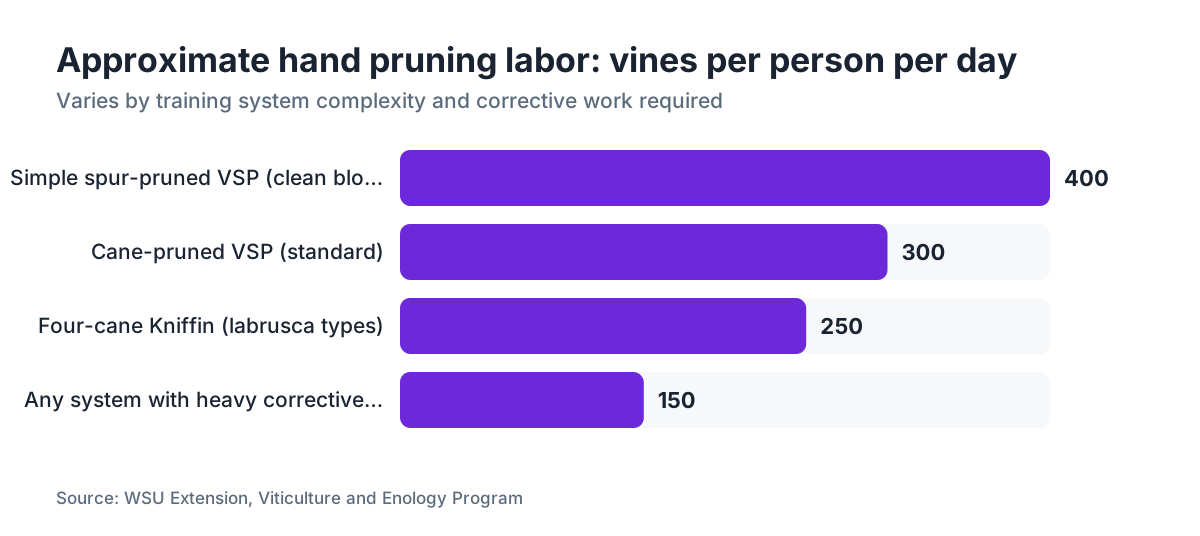
For a commercial block of several acres, you're thinking about labor efficiency. A skilled hand pruner works through roughly 200 to 400 vines per day depending on variety, system complexity, and how much corrective work the block needs [2]. A five-acre block at 800 vines per acre is 4,000 vines, so plan on 10 to 20 person-days of pruning labor minimum. Machine pre-pruning (running a hedger through the block first to strip bulk material) can cut hand labor by 30 to 40 percent, and it's standard practice in large California operations.
Small winery owners curious about how their peers run vineyard operations can look at working estate vineyards. Properties like Ponte Winery in Temecula and South Coast Winery run sizeable estate blocks where pruning logistics feed directly into production. The decisions made there are scaled-up versions of the same biology that applies to any vine.
What does research say about pruning effects on grape quality?
The link between pruning intensity and fruit quality is well-documented, even if site-specific variation makes universal numbers hard to pin down.
A foundational WSU study on Concord grapes found that over-cropped vines (too many buds retained) consistently produced fruit with lower soluble solids (Brix) and higher titratable acidity, which meant poorer flavor development [2]. The pattern holds across species: any vine asked to ripen more fruit than its canopy can photosynthesize sugars for produces diluted, underripe clusters.
For Vitis vinifera wine grapes, work published in the American Journal of Enology and Viticulture found that canopy management practices including pruning level had measurable effects on berry composition, especially anthocyanin content in red varieties and aromatic compound precursors in whites [5]. The mechanism is light exposure: properly pruned vines get more light into the fruiting zone, and clusters on the interior of a well-managed canopy build more flavor compounds than clusters buried in shade.
Nobody has perfect data on the exact yield-quality tradeoff for every variety and site. The closest practical guidance from UC Davis extension puts it this way: shoot for one pound of fruit per foot of canopy as a baseline, then adjust based on measured outcomes in your specific block over two to three seasons [3]. That's a rough rule of thumb, not a hard rule, but it gives you a starting point.
How do you handle winter injury when pruning?
Winter injury shows up in pruning as brown, dead cambium tissue where you'd expect green. Make a small diagonal cut across a bud or cane: healthy tissue is bright green, injured tissue is tan to dark brown. Severely injured canes are dead all the way through.
When you're finding significant injury across the block, delay final pruning until you can fully assess the damage. Buds that look dead can sometimes recover if the primary bud was killed but the secondary and tertiary buds survived. Secondary buds push later and produce less fruit, but they beat nothing.
For vines with partial trunk or cordon damage, the strategy shifts. If the trunk above the graft union is dead, you may need to select a sucker below the graft union, train it as a new trunk, and re-establish the vine. If one cordon is dead but the trunk and the other cordon are fine, remove the dead arm back to the head and start training a replacement from a well-positioned shoot in the current season.
In regions with serious winter injury risk (Minnesota, Wisconsin, upper Michigan, the Finger Lakes in bad years), some growers bury young vines in fall and uncover them before bud swell. The extra labor is real, but it can be the difference between losing and saving a block of young cold-sensitive varieties like Cabernet Franc, or even cold-hardy hybrids in the worst years.
Cornell's cold hardiness research program has published canopy management guidelines for cold-climate wine grape production in the northeastern U.S. that address how pruning intensity interacts with winter hardiness [7]. The short version: vines over-cropped going into fall carry less carbohydrate reserve and show more winter injury than well-balanced vines.
What records should you keep for vineyard pruning?
At minimum, track these for each block: pruning date, system used (spur or cane, with bud count range), labor hours, and any notes on vine health, winter injury, or corrective work done.
If you're applying any pesticides in connection with pruning (dormant sprays, wound protectants, copper fungicides), those need full pesticide application records: product name, EPA registration number, rate per acre, total product applied, water volume, applicator name, and the REI for each product. That's federal law under WPS [4].
For compliance, California DPR requires pesticide use reports (PURs) for any licensed pesticide application, filed monthly with your county agricultural commissioner [6]. Washington and New York have similar requirements through their state agriculture departments.
Keep pruning records digitally, not in paper notebooks that live in a truck. It matters when you're tracking vine health trends across seasons. A block that consistently needs heavy corrective work at pruning is telling you something about management or site that paper records tend to hide. VitiScribe's field operations tools let you log pruning notes and spray records in the same place, so a single block history shows both the canopy decisions and the spray history that followed. That pairing earns its keep when you're troubleshooting a disease problem or prepping for a compliance inspection.
Frequently asked questions
When should I prune grape vines in cold climates?
In cold-climate regions like the Finger Lakes, upper Midwest, and Pacific Northwest, prune after the coldest part of winter has passed but before bud swell, generally late February through late March. WSU extension recommends this window to minimize both cold injury to open wounds and carbohydrate loss from heavy spring bleeding. For vines with suspected winter injury, wait until bud break begins so you can assess actual damage before cutting.
Can you prune grape vines in fall after harvest?
Technically yes, but most extension programs advise against it. Fall pruning removes leaves before the vine has fully moved photosynthates back to the roots, which cuts carbohydrate storage going into winter. It also leaves wounds exposed for the longest possible time before natural wound closure begins at bud swell. Unless a vine has serious structural problems that need immediate correction, wait for true dormancy after leaf drop, then prune in late winter.
How many buds should I leave when pruning grape vines?
Use the balanced pruning formula as a starting point: leave 30 buds for the first pound of cane prunings removed, plus 10 buds per additional pound. In practice, most mature vines end up with 20 to 60 buds depending on variety and vigor. Spur-pruned varieties like Cabernet Sauvignon typically run 30 to 40 buds; cane-pruned labrusca types like Catawba or Concord often run 40 to 60 across all canes combined.
What is the best pruning system for Catawba grape vines?
Cane pruning, specifically a four-cane Kniffin system, is the standard recommendation for Catawba. Catawba is a Vitis labrusca hybrid with low fruitfulness in basal buds one and two, so spur pruning to two or three buds yields mostly vegetative shoots with little fruit. Retaining canes of 8 to 10 buds each, tied to two wire levels, puts the fruitful mid-cane buds in position to produce. Cornell extension recommends this approach for eastern American-type grape varieties.
How do you prune an old, overgrown grape vine?
Start with renovation pruning over two to three seasons rather than cutting everything at once. In year one, identify the best trunk and remove competing trunks or severely diseased arms. In year two, begin correcting cordon or cane structure. Trying to fully renovate in a single winter shocks the vine and often triggers excessive suckering and weak regrowth. For vines that are truly beyond renovation (dead trunk, severe crown gall, complete structural loss), replanting is usually faster than multi-year rehabilitation.
What diseases can spread during pruning and how do I prevent them?
Eutypa lata (Eutypa dieback) enters vines through fresh pruning wounds, especially during wet winter weather. Botryosphaeria species and Esca-complex pathogens also enter this way. UC Davis recommends pruning late in the dormant season to reduce wound exposure time, and applying registered wound protectants (Topsin-M or Rally) to cuts on high-value varieties in disease-prone regions. Sanitize tools with 10 percent bleach or 70 percent isopropyl between vines in blocks with known crown gall or virus presence.
How long does it take to prune an acre of grape vines?
A skilled hand pruner works through roughly 200 to 400 vines per day depending on variety, training system, and the amount of corrective work needed. At standard commercial spacing of 500 to 1,000 vines per acre, that's 1.5 to 5 person-days per acre for hand pruning alone. Machine pre-pruning (mechanical hedging to remove bulk wood before hand finishing) can reduce hand labor by 30 to 40 percent and is standard practice in larger California operations.
Do I need to sanitize pruning tools between vines?
In clean blocks with no known disease pressure, most commercial operations skip tool sanitization during routine pruning to keep work speed up. In blocks where crown gall (Agrobacterium vitis), leafroll virus, or Esca-complex wood diseases are confirmed, sanitizing between vines with 70 percent isopropyl alcohol or a 10 percent bleach solution meaningfully reduces pathogen spread. Base the decision on confirmed disease presence in the block, not routine precaution on every vine in every vineyard.
What is the difference between spur pruning and cane pruning?
Spur pruning keeps short two-to-three bud stubs along a permanent cordon. The cordon stays in place year after year; only the fruiting wood changes. Cane pruning removes all one-year-old wood and replaces it annually with selected canes of 8 to 15 buds. Spur pruning is faster and more mechanizable; cane pruning is better for varieties with low basal bud fruitfulness. Your variety's bud fruitfulness data, available from Cornell or WSU extension, should drive the choice.
Can I prune grape vines when it's freezing outside?
Avoid pruning when temperatures are at or below 0 degrees Fahrenheit (minus 18 Celsius) or right after a hard freeze. At very low temperatures, vine wood turns brittle and cuts are more likely to cause tissue damage beyond the wound itself. Fresh wounds in a hard freeze may take on extra cellular damage at the cut surface. Wait until temperatures are above 20 degrees Fahrenheit and rising before pruning, and avoid the day right after a severe cold event.
How does pruning affect vine disease pressure the following season?
Pruning level directly sets canopy density, the single biggest physical factor controlling Botrytis cinerea and powdery mildew pressure. Over-pruned vines with too many retained buds push dense, shaded canopies where humidity stays high and fungicide penetration is poor. Well-balanced canopies dry faster after rain and allow better spray coverage. Work published in the American Journal of Enology and Viticulture consistently links balanced pruning to lower disease severity scores through the season.
What records do I need to keep for vineyard pruning under EPA Worker Protection Standard?
WPS primarily governs pesticide use, not pruning itself. But if you applied any pesticide (dormant oil, copper fungicide, wound protectant) before a pruning crew enters the block, you must have current pesticide application records accessible to workers and their handlers before field entry. Records must include the product name, EPA registration number, application date, REI, and the specific block treated. Fines for WPS violations run up to $11,645 per violation under the 2023 penalty schedule.
How do I know if my grape vine pruning is working? What results should I see?
A well-pruned vine going into spring should push shoots evenly from all retained buds, with minimal blind buds. By veraison, clusters should be evenly distributed through the canopy with good light exposure to the fruit zone. At harvest, Brix should be at target with no large clusters of unripe berries. If you're consistently seeing uneven bud push, dense shaded canopies, or late-ripening interior clusters, your bud count is too high or your renewal spur placement needs correction.
Sources
- Cornell University Cooperative Extension, Viticulture and Enology Program: Cane pruning recommended for Vitis labrusca types due to low basal bud fruitfulness; untrained vines produce erratic crops; balanced pruning system developed by Shaulis at Cornell
- UC Davis Viticulture and Enology Department: Late-season pruning recommended to reduce Eutypa lata wound infection; sap bleeding after late pruning is cosmetic not physiological; one pound of fruit per foot of canopy as crop load heuristic
- U.S. EPA Worker Protection Standard for Agricultural Pesticides: WPS requires pesticide application records accessible before worker field entry; fines up to $11,645 per violation under 2023 penalty schedule
- American Journal of Enology and Viticulture: Canopy management practices including pruning level have measurable effects on berry anthocyanin content and aromatic compound precursors
- California Department of Pesticide Regulation, Pesticide Use Reporting: California requires monthly pesticide use reports (PURs) filed with county agricultural commissioner for all licensed pesticide applications
- Cornell University, Cold Climate Viticulture Program: Over-cropped vines have reduced carbohydrate reserves entering winter and show greater cold injury than balanced vines; canopy management guidelines for northeastern cold-climate production
- UC Statewide Integrated Pest Management Program, Eutypa Dieback: Eutypa lata spore release peaks during winter rainfall; registered wound protectants (Topsin-M, Rally) reduce infection at pruning wounds in susceptible varieties
- Washington State University Viticulture and Enology Program: Pacific Northwest pruning window late January through March; variety-specific bud count ranges; over-cropped Concord vines show lower Brix and higher acidity; hand pruning rates of 200-400 vines per day
Last updated 2026-07-09