Aggressive grape vine pruning: when hard cuts pay off
TL;DR
- Aggressive grape vine pruning removes a higher-than-normal share of last season's growth, sometimes 85-95% of shoot wood, to reset vine structure, cut out disease, or fix years of neglect.
- Timed right, on a vine with solid carbohydrate reserves, a hard prune improves fruit quality and buys you more productive years.
- Timed wrong, it stresses the vine or kills it outright.
What is aggressive grape vine pruning, exactly?
Aggressive pruning removes a large share of last season's cane and spur wood, well past a normal maintenance prune. Most practitioners define it as leaving a bud count far below the vine's balanced load, or cutting back into very old wood to force new basal shoots. In practice that can mean leaving 85-95% fewer buds than a normal year, or in extreme renewal cases, cutting the whole vine back to the trunk or a single cordon arm.
This is a different thing from severe spur or cane pruning done the same way season after season. Aggressive pruning is a deliberate intervention. You're fixing something. Maybe the vine has grown into a tangle of dead cordons. Maybe Eutypa dieback or Botryosphaeria has colonized a limb and the only move is amputation. Maybe the vine spent three years overcropped and has no vigor left. The hard cut is a reset.
The distinction matters because your reason changes your timing and your cuts. A grower pruning hard to manage disease uses different cut placement and wound protectant protocols than one retraining an overcrowded head-trained vine. Confuse the two and you turn a corrective prune into an open door for more infection.
What are the benefits of pruning grape vines hard?
Even at normal intensity, the payoffs of pruning are well documented: better light into the canopy, more air movement, less disease pressure, a crop load you can actually manage. Hard pruning pushes some of those further and adds a few of its own.
Resetting carbohydrate allocation is the big one. Grapevines stash starch in roots, trunk, and cordon wood over dormancy. Strip off excess shoot wood and all that root-stored carbohydrate pushes into fewer buds, which drives stronger, healthier new growth in spring [1]. Vines that have been chronically overcropped often rebuild fast after one or two hard seasons.
Removing diseased wood is the other major driver. Eutypa lata, the fungus behind Eutypa dieback, cannot be killed with chemicals once it's inside the wood. The only real fix is cutting well below the canker margin, which on an old cordon can mean losing the whole arm [2]. Same story with Botryosphaeria and Esca. Growers who keep putting off those cuts, watching yield bleed away year after year, usually wish they'd cut sooner.
There's a structural argument too. Vines trained for speed rather than the long haul, especially head-trained old vines with spurs that have crept out too far, tend to develop poor water and nutrient flow from the trunk. A hard renewal prune forces new wood from basal positions you can train into cleaner architecture. The yield hit in year one or two is real. The vine you have in year four can beat what you started with.
One benefit nobody talks about: crew speed. A vine with clean, simple structure takes less time to prune every year after. Say you have 10 acres of gnarly head-trained Zinfandel where crews burn three minutes per vine hunting for the right wood. One hard reset season can save real money across the life of the block.
How much wood should you remove? What does the research say?
Leave roughly 10 buds for the first pound of pruning weight, then 10 more for each additional pound. That's the balanced pruning formula, built on Nelson Shaulis's work at Cornell in the 1960s and refined since [3]. A vine that produces 1.5 pounds of shoot wood gets about 15 retained buds. The point is to hold the vine near balance between leafy growth and fruit.
Aggressive pruning breaks that formula on purpose, on the low side. You leave fewer buds than the vine can support. The vine answers by pushing those buds harder and pouring more reserves into each one. Research from UC Davis and WSU both find that under-budded vines in one season often produce heavier individual clusters and better berry set the next year, though total yield per acre drops [1][4].
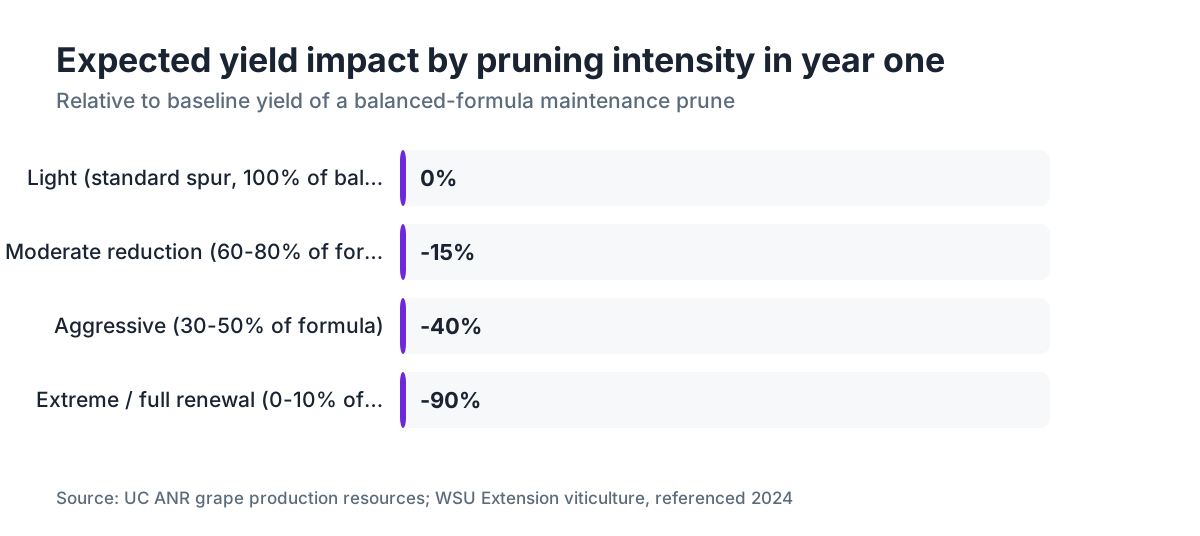
| Pruning intensity | Buds retained (relative to balanced formula) | Expected yield impact year 1 | Typical use case |
|---|---|---|---|
| Light (standard spur) | 100% of formula | Baseline | Mature, healthy vines |
| Moderate reduction | 60-80% of formula | -10 to -20% yield | Vigor correction |
| Aggressive | 30-50% of formula | -30 to -50% yield | Disease removal, renewal |
| Extreme/renewal | 0-10% of formula | Near-zero yield | Full vine reset, retraining |
Nobody has clean long-run data on the ROI of a renewal prune versus pulling the block. The closest honest comparison comes from UC Cooperative Extension cost studies for wine grape production, which put vine establishment at roughly $15,000-$22,000 per acre in California depending on training system and rootstock [5]. If a renewal prune on an existing block costs $800-$1,500 per acre in extra labor plus a year of lost yield, the math usually favors the prune, as long as the roots are sound.
WSU Extension guidance for Washington notes that vines with less than 30% of their trunk cross-section occupied by wood decay can usually recover well from aggressive retraining [4]. That's a field test worth carrying in your head.
When is the best time to do aggressive pruning on grapevines?
Timing is where growers get burned. Standard advice is to prune during dormancy, after the worst cold-damage risk has passed but before bud swell. For most of the western US that's January through early March. For the East Coast and Midwest, February into early April depending on the year.
For a hard prune specifically, late dormancy (right before bud break) is generally safer than early dormancy. The reason: grapevines are still moving carbohydrates into storage in early winter, and a very early hard cut can interrupt that. Wait until late January or February and the vine has finished most of that internal transfer, so you're cutting when reserves are fully stockpiled in roots and trunk. Those reserves matter enormously when the vine has almost no buds to fall back on.
Wounds also heal better in slightly warmer weather. Eutypa lata spore release peaks in wet winter weather, and infection risk through fresh pruning wounds runs highest October through February in California's North Coast, according to UC Davis Plant Pathology research [2]. For vines already carrying trunk disease, some advisors push pruning as late as practical to shrink that infection window, or apply wound protectants the moment cuts are made.
Double pruning is a timing trick worth knowing. Make a rough first cut in early winter leaving extra cane, then come back for the final precise cut in late winter. Fewer fresh wounds sit exposed through the wettest stretch. It costs labor but can meaningfully cut new Eutypa infection on blocks that already carry disease [2].
Freeze risk is the other factor in cold country. Aggressive pruning after a late freeze is sometimes forced on you, because the freeze damage itself demands a hard cut. Cornell Cooperative Extension has solid regional guides for reading freeze injury before you lock in a final bud count [3].
What are the risks of pruning grapevines too aggressively?
The main risk is overcorrection: pulling off so much wood that the vine can't hold enough leaf area to recharge root carbohydrate reserves for next year. A vine with almost no canopy is also more exposed, so trunk and cordon sunburn becomes a real threat in hot climates.
On very old vines, or vines already worn down by disease, drought, or rootstock failure, a hard prune can be the thing that finishes them. Root reserves are finite. If two or three hard years already drained them, there may not be enough fuel left to push new growth after a heavy cut. You can lose the vine. Before you commit to a renewal prune on a struggling plant, look at the roots if you can. A vine with serious Phylloxera damage or a failing graft union won't respond to a pruning correction, full stop.
Then there's infection risk. Every cut is a wound, and big cuts on thick cordon wood callus slowly. If you're taking off major limbs or cutting to the trunk, wound sealant (a thiophanate-methyl paste such as Topsin-M, or a wax-based protectant) goes on right away [2]. Don't leave those cuts sitting open overnight.
Labor and timing carry their own risk. Aggressive pruning means slower cuts and more decisions per vine. Run a crew through a block at full speed and the nuance disappears. Train your lead pruner on exactly what you're after before anyone starts. A miscommunication costs you a vine you can't un-cut.
How do you prune neglected or overgrown grapevines?
Neglected vines, meaning vines that went a season or more with little or no pruning, are their own puzzle. You'll usually find a mass of two and three-year-old canes woven through the trellis, some reaching 15 or 20 feet. The vine underneath the mess may still be strong.
Most advisors recommend a multi-year renovation, not one catastrophic cut. Year one: take out the worst structural problems, meaning crossing canes, dead wood, and any limb showing canker. Cut back to a workable framework, but don't try to reach your final architecture in a single season. Let the vine push from the buds you kept, see what grows, then make your retraining calls in year two when you can read what the root system actually wants.
For a vine neglected five years or more, sometimes the cleanest move is cutting everything back to the trunk, leaving a couple of low buds, and regrowing from scratch. You give up two or three years of production, but you end up with a properly built vine on an established root system, which reaches full production faster than a fresh planting. This goes by head renewal or trunk renewal.
The vineyard planning you do now about training system shapes every pruning decision for the next 30 years. Spend real time deciding what architecture you're retraining toward before the first cut lands on a neglected block.
Does aggressive pruning help with common grapevine diseases?
For fungal trunk diseases, yes, aggressive pruning is often the best tool you have. Eutypa dieback, Botryosphaeria canker, and Esca all live on wood-inhabiting fungi that foliar or soil fungicides can't reach once they're inside the vine [2]. UC Cooperative Extension has published extensively on trunk disease management, and the consistent conclusion is that cutting out the wood is the primary strategy [9].
UC Davis Plant Pathology research on Eutypa lata is direct: the fungus can only be managed by removing infected wood, and cuts should be made well below the margin of discolored wood (at least 10 cm) to reach clean tissue [2]. That one recommendation can mean taking an entire cordon arm, or the whole top of the vine, off a heavily infected plant.
Powdery mildew and Botrytis are different animals. They live on the vine surface, not inside the wood, so pruning won't wipe them out. But a hard prune that opens the canopy lowers the humidity and shade both pathogens love. You're managing microclimate, not killing the fungus. That's a real benefit, just a different mechanism.
For Phylloxera-hit blocks on own-rooted vines, aggressive pruning is generally the wrong first move. The roots are already under attack, and stripping shoot wood raises the demand on those damaged roots. Better to work out whether replanting on resistant rootstock pencils out [5].
What equipment and safety practices do you need for aggressive pruning?
Sharp tools are non-negotiable. Dull shears crush tissue instead of cutting it, which slows callus formation and raises infection risk. For large-diameter cordon removal you need loppers or a pruning saw on top of hand shears. Pneumatic or battery-powered shears earn their keep over a long pruning season, both for cut quality and for sparing your crew's wrists.
Sanitation matters more here than in routine pruning because you're cutting deeper and sometimes through diseased tissue. Disinfect equipment between vines if trunk disease is confirmed in a block, or at minimum between clearly infected vines and clean ones. A 10% bleach solution or 70% isopropyl alcohol both work. Bleach eats metal, so wipe and oil your tools often [2].
Worker protection is a genuine compliance issue. Under the EPA Worker Protection Standard, agricultural workers in vineyards must get safety training every year, and any pesticide-treated area carries a restricted-entry interval that governs when pruning crews can go in [6]. If you're applying wound protectants that contain registered pesticides (thiophanate-methyl, for one), those applications go into your pesticide records per your state department of agriculture. That part isn't optional.
In California, the DPR requires pesticide use records be kept for three years and be available for inspection [7]. A wound sealant with an active pesticide ingredient counts, same as a spray event. VitiScribe's pruning-linked application log lets you record a wound protectant at the same moment you log the pruning event, so everything sits in one place when an inspector shows up.
PPE for pruning crews means cut-resistant gloves, eye protection for overhead cuts, and decent footwear. Power equipment adds hearing protection. Requirements vary by state, but California's Cal/OSHA Title 8 agricultural safety standards are detailed and worth a read if you operate there [8].
How do you manage vine recovery after a hard prune?
A heavily pruned vine pushing hard in spring needs help. Watch shoot selection first, right after bud break. When you've left very few buds, every shoot that pushes counts. If more shoots emerge than you planned (from latent buds), thin them early to steer energy into the shoots you want as your new architecture.
Go light on nitrogen in the recovery year. A vine with limited canopy can't process a heavy nitrogen load, and forcing vegetative push into a handful of shoots isn't the goal. Petiole sampling at bloom tells you more than fertilizing on a guess. WSU Extension publishes petiole sampling standards for Pacific Northwest vineyards [4].
Irrigation gets more important after a hard prune, not less. The root system is sized for a bigger canopy than the one you left it. Early season, moderate water stress isn't a big deal because shoot demand is low. But mid-season, if the vine is trying to rebuild canopy on minimal leaf area, drought stress slows recovery hard. Keep watching soil moisture in a recovery year.
Harvest calls in the first recovery year can hurt. A full renewal prune may leave you near-zero crop. A partial aggressive prune might give a partial crop. The urge to ripen whatever sets is understandable, but on a recovering vine, dropping fruit early so the plant can pour resources into structure usually pays off in years two and three.
Is aggressive pruning different for different grapevine varieties or training systems?
Variety matters more than most growers expect. Zinfandel and Grenache, both often grown as old head-trained vines, take hard pruning well because they push vigorously from old wood and basal positions. Cabernet Sauvignon on VSP trellis handles aggressive spur renewal fine, since the training system itself makes clean spur replacement easy. Pinot Noir is trickier. It's slower to push latent buds from old wood, and those latent buds often sit in awkward positions, so a full trunk renewal on Pinot carries more uncertainty about where your new growth shows up.
Chardonnay and Sauvignon Blanc, usually cane-pruned, respond differently from spur-pruned varieties because cane pruning already selects all-new wood every year. An aggressive cane prune on Chardonnay might mean dropping from four canes to one or two. That's a big canopy cut but structurally less disruptive than cutting back to old spur positions on a cordon.
Training system sets your options. A bilateral cordon with structured spur positions gives you many points to intervene at any cordon segment without losing the whole vine's architecture. A head-trained vine cut below all its spurs is basically a trunk with stubs, and your new architecture becomes whatever pushes from basal latent buds, which means more follow-on training. That's no reason to skip the cut. It's a reason to plan the follow-up training before you prune.
In cold country like the Finger Lakes, Lake Erie, or the Midwest, winter injury can force aggressive pruning on varieties that wouldn't otherwise need it. Cornell Cooperative Extension resources cover freeze damage assessment and the pruning responses that fit cold-climate varieties, including hybrids like Marquette and Frontenac [3].
How do you document aggressive pruning for compliance and farm records?
Good pruning records do two jobs. Agronomic: you track vine response year over year. Compliance: you can show a certifier, insurer, or state inspector that your operations are documented.
At minimum, capture date, block or row ID, pruning method (spur, cane, renewal), approximate bud count or pruning weight if you track balance, any disease you spotted during pruning, wound treatments applied (product, rate, applicator), and the crew lead. In a certified organic or biodynamic program, your certifier will want proof that any wound treatment sits on the approved materials list, and that the record lives in your application logs.
Pruning weight data is worth the extra effort in blocks where you're actively managing balance. Weighing pruning samples from representative vines (usually 10 per block or sampling unit) takes about 30 minutes per block and gives you the numbers to set balanced pruning targets for next year. UC Cooperative Extension farm advisors in California have published sampling protocols for this [5].
For blocks under renovation, photograph representative vines before and after pruning. It sounds like busywork, but three years later, when you're deciding whether to keep renovating or pull the block, those photos earn their keep. Date-stamped field photos tied to block records make that call fast. VitiScribe's block record system attaches photos to pruning events straight from your phone, so you skip the step of moving images off a personal device into a shared record.
If you're tracking trunk disease for insurance or tax purposes, a disease map (infected vines marked on your block map) drawn during pruning is the most reliable way to follow spread over time.
Frequently asked questions
How much of a grapevine can you prune off without killing it?
A healthy vine with good root carbohydrate reserves can tolerate removal of 90-95% of its shoot wood during dormant pruning. Death risk climbs when the root system is already compromised by disease, drought, or Phylloxera, or when the vine was chronically overcropped and reserves are drained. Assess vine health before committing to an extreme cut.
When is the best time of year for aggressive grapevine pruning?
Late dormancy, roughly January through early March in most of the western US and February through early April in the East, is the preferred window. Late pruning reduces wound exposure during peak Eutypa spore release, which runs October through February on California's North Coast. Avoid very early dormancy cuts for hard pruning, since carbohydrate translocation to storage may not be finished yet.
Will aggressive pruning reduce grape yield permanently?
No, the yield loss is usually temporary. A full renewal prune gives near-zero yield in year one, a reduced crop in year two, and progressive recovery through years three and four. A partial aggressive prune (50% bud reduction) usually drops year-one yield 30-50% with strong recovery the next season, assuming vine health and canopy management support carbohydrate replenishment.
Does aggressive pruning help with Eutypa dieback or other trunk diseases?
Yes. Eutypa lata and Botryosphaeria species can only be managed by removing infected wood, according to UC Davis Plant Pathology research. Cuts should go at least 10 cm below the visible margin of discolored wood. Chemical treatments can't eliminate established fungal infections inside wood. Apply wound protectants (thiophanate-methyl or wax-based sealants) right after any major cut.
What is the balanced pruning formula and how does aggressive pruning relate to it?
The balanced pruning formula, developed at Cornell, retains roughly 10 buds per pound of pruning wood removed. Aggressive pruning deliberately leaves fewer buds than the formula calls for, usually 30-50% of the target. That forces reserves into fewer growing points, which typically produces stronger individual shoots and better berry set in the recovery year.
Can I aggressively prune old vines or does age make it riskier?
Old vines often have deeper, larger root systems with proportionally bigger carbohydrate reserves, which can make them better candidates for hard pruning than younger vines. The risk on very old vines is trunk disease, which is more common and more extensive in older wood. Check the percentage of trunk cross-section occupied by decay before cutting hard. WSU Extension suggests vines under 30% trunk decay usually tolerate aggressive retraining.
What should I apply to pruning wounds after aggressive cuts?
Thiophanate-methyl paste (sold as Topsin-M) formulations registered for wound treatment are the most commonly recommended option where Eutypa or Botryosphaeria are concerns. Wax-based sealants provide a physical barrier. Some growers use Trichoderma-based biocontrols instead. Whatever you use, apply it immediately: UC Davis research shows infection risk is highest in the hours right after cutting, especially in wet weather.
How do I prune a grapevine that was never trained properly?
Start with a multi-year approach, not one catastrophic cut. Year one: remove dead wood, crossing limbs, and any canker-affected tissue, then cut back to a workable framework even if it looks messy. Let the vine push, identify the strongest shoots in the right positions, and train those toward your target architecture in year two. Full renewal to the trunk fits only when the existing structure is unsalvageable or badly diseased.
Do I need to record wound treatments applied during pruning?
Yes, if the wound protectant contains a registered pesticide active ingredient (like thiophanate-methyl), it must go into your pesticide application records under both state regulations and the EPA Worker Protection Standard. In California, the DPR requires application records be kept for three years and made available for inspection. Record product name, rate, date, block, and applicator, same as any spray event.
How does aggressive pruning differ between spur-pruned and cane-pruned varieties?
On spur-pruned varieties (Cabernet, Syrah, Zinfandel), aggressive pruning means cutting spur count or going back to basal renewal positions on the cordon. On cane-pruned varieties (Pinot Noir, Chardonnay, Riesling), which already select all-new wood each year, it means reducing the number of retained canes and buds per cane. Cane pruning gives more flexibility since you're not cutting into permanent cordon wood, which lowers infection risk from big cuts.
How long does it take a vine to recover after aggressive pruning?
For a partial aggressive prune (50% bud reduction), most vines show meaningful recovery in year two and near-normal yield by year three, given adequate health and management. A full renewal or trunk prune usually needs two to three years before a well-trained new cordon reaches productive capacity. Root age and health are the biggest variables: established roots on a 20-year-old vine push new growth faster than a recently planted block.
Is there a risk of frost damage after aggressive pruning?
Hard pruning doesn't directly raise frost susceptibility at a given temperature. But a very early dormant-season hard cut can slightly advance bud break by reducing bud load, which could expose tender shoots to late frosts. This risk matters most in cold-climate regions. Cornell and WSU both recommend checking regional frost probability data before finalizing pruning timing on frost-prone sites.
What nutrient management should follow an aggressive prune?
Go conservative on nitrogen in the recovery year. A vine with limited canopy can't process a heavy nitrogen load, and forcing vegetative growth into a few retained shoots isn't productive. Petiole tissue sampling at bloom gives the most accurate read on what the vine needs. WSU Extension publishes sufficiency ranges by nutrient, variety, and region. Don't fertilize on a guess in a recovery year.
Can aggressive pruning help improve fruit quality or wine quality?
Yes, indirectly. By cutting bud load and redistributing carbohydrate reserves to fewer growing points, aggressive pruning often increases individual cluster weight, improves berry set, and concentrates flavor by reducing competition among clusters. The biggest quality gains come in recovery years two and three, when the vine has both restored reserves and a cleaner, better-managed structure than before the intervention.
Sources
- University of California Agriculture and Natural Resources (UC ANR), grape production and pruning resources: Carbohydrates stored in roots and trunk push into fewer retained buds after aggressive pruning, driving more vigorous spring growth; under-budded vines often produce higher individual cluster weights
- UC Davis Department of Plant Pathology, Eutypa Dieback of Grapevine: Eutypa lata can only be managed by removing infected wood, cuts should be at least 10 cm below discolored wood margin, and spore release peaks October through February on California's North Coast
- Cornell Cooperative Extension, viticulture and grape pruning resources: The balanced pruning formula retains approximately 10 buds per pound of pruning weight removed; Cornell resources cover freeze damage assessment and pruning responses for cold-climate varieties
- Washington State University Extension, viticulture and grapevine pruning resources: WSU guidance states vines with less than 30% trunk cross-sectional area occupied by wood decay can typically recover well from aggressive retraining; petiole sampling standards provided for Pacific Northwest vineyards
- UC Cooperative Extension, Sample Costs to Establish a Vineyard and Produce Wine Grapes cost studies: Vine establishment costs run $15,000-$22,000 per acre in California depending on training system and rootstock; UC advisors publish sampling protocols for pruning weight data collection
- US EPA, Agricultural Worker Protection Standard (WPS): Under the EPA Worker Protection Standard, agricultural workers in vineyards must receive annual safety training and restricted-entry intervals apply to pesticide-treated areas
- California Department of Pesticide Regulation, Pesticide Use Reporting: California DPR requires pesticide use records be kept for three years and made available for inspection, including wound protectant applications containing registered active ingredients
- UC Cooperative Extension / UC ANR, trunk disease management in vineyards: Surgical wood removal is the primary management strategy for Eutypa, Botryosphaeria, and Esca; foliar or soil-applied fungicides cannot reach established infections inside wood
- Cornell Cooperative Extension, freeze injury assessment in vineyards: Cornell provides regional guides for assessing freeze injury before committing to final bud count decisions in cold-climate regions
Last updated 2026-07-10