Grape vine maintenance pruning: the complete field guide
TL;DR
- Grapevine maintenance pruning removes last season's wood to control crop load, shape the canopy, and keep vines productive for decades.
- Most regions prune during dormancy, roughly December through March.
- Spur pruning fits Cabernet and Syrah; cane pruning fits Pinot Noir and Riesling.
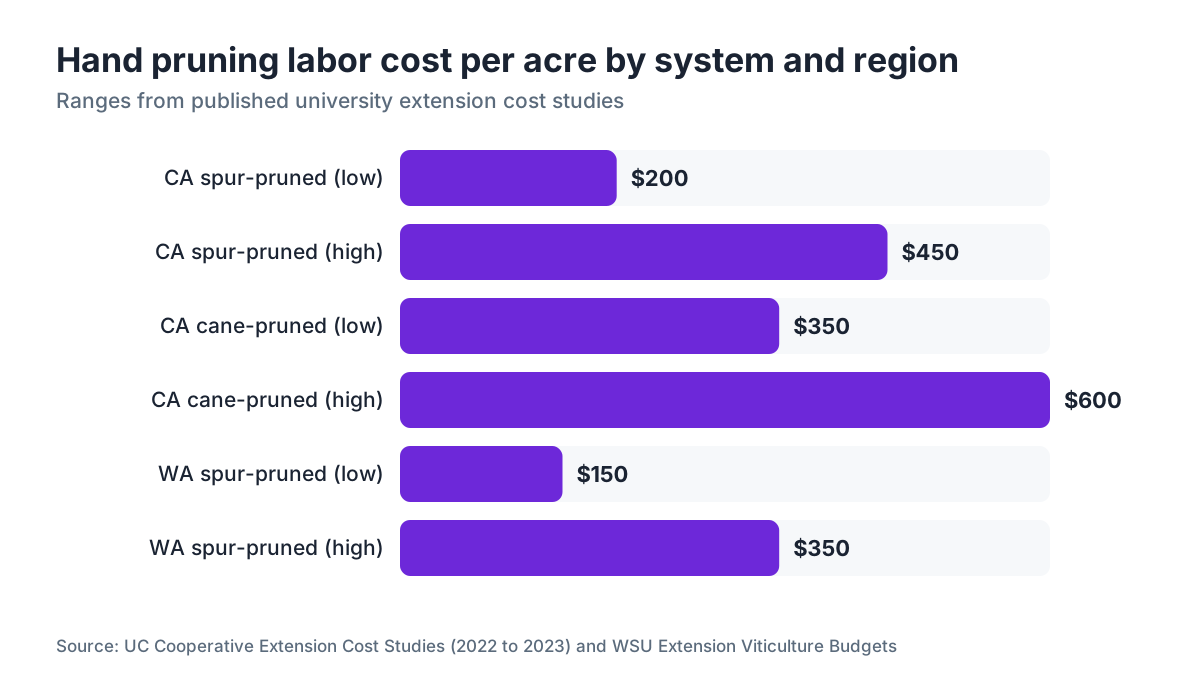
- Hand-pruning labor runs $200 to $600 per acre depending on system and region.
Why do grapevines need annual pruning?
Grapevines fruit on one-year-old wood. That single fact drives every pruning decision you'll make. Skip a season and the vine buries its new buds deeper in a thicket of old shoots, crop load goes sideways, and inside two or three years you've got a canopy so dense that spray coverage fails and powdery mildew wins.
The vine also wants to over-produce. Left alone, it sets far more clusters than the root system can ripen, and you get watery, thin fruit with high pH. Pruning is the main tool for balancing vine vigor against fruit quality [1].
There's a second reason that gets shortchanged in most guides: disease. Dead wood is the front door for Esca, Botryosphaeria, and Eutypa dieback, three trunk diseases that can hollow out a block over fifteen to twenty years. Clean, well-timed cuts drop inoculum levels hard [2].
Pruning sets the vine's shape too. Vertical shoot positioning, Geneva Double Curtain, or a head-trained gobelet, the annual cut keeps trunks and cordons clean and holds the fruiting zone where you want it.
When is the right time to prune grapevines?
Prune after the vine goes fully dormant in winter and before bud swell in spring. In most North American wine regions that window runs mid-December through early March, though it shifts with climate [3].
Cold-climate regions like New York's Finger Lakes or the Willamette Valley push pruning toward late February and March, because late pruning delays bud break by a few days and cuts spring frost risk. Cornell's viticulture team has documented this delayed-pruning approach and found that pruning three to four weeks after initial bud swell can push phenology back five to ten days in some seasons [4]. Five to ten days of frost buffer is a big deal in April.
Warm regions like California's Central Valley or Paso Robles run the opposite problem. An early bud break catches pruners flat-footed, so most operations try to finish by late February before the vine wakes up.
One timing rule holds almost everywhere: don't prune in wet, cold weather if you can help it. Wet wood is slow to callus and gives Botrytis and trunk-disease fungi a longer window into fresh cuts. UC IPM guidelines recommend wound protectants (Topsin-M or a Trichoderma-based biological like Vinevax) on cuts larger than a pencil, especially on cordons and trunks [2].
| Region | Typical window | Notes |
|---|---|---|
| Finger Lakes / Lake Erie | Mid-Feb to late March | Delay to reduce frost risk |
| Willamette Valley | Jan to mid-March | Watch for wet-weather Botrytis |
| Napa / Sonoma | Dec to mid-Feb | Earlier to finish before bud swell |
| Central Valley (CA) | Dec to Jan | Fast growing season, tight window |
| Texas Hill Country | Jan to early March | Variable; watch late freezes |
| Pacific Northwest (WA) | Jan to mid-March | Freeze injury assessment first |
Spur pruning vs. cane pruning: which method fits your vineyard?
This is the biggest pruning-method decision you'll make, and it's mostly locked in by your trellis and your variety. Switching from cane to spur on an established vine is a two-to-three-year reset. Plan for that before you change anything.
Spur pruning leaves two-to-three-bud stubs spaced six to eight inches apart along a permanent cordon arm. It's faster, easier to mechanize, and suited to varieties with fruitful basal buds, meaning bud 1 and bud 2 on each shoot set clusters reliably. Cabernet Sauvignon, Merlot, Syrah, Grenache, Zinfandel, and most Rhone varieties live here. WSU Extension puts average hand-pruning time for spur systems at roughly 12 to 18 hours per acre, depending on spacing and cordon complexity [5].
Cane pruning replaces the whole fruiting unit every year. You pick two to four new canes from last season's growth, each carrying eight to sixteen nodes, and tie them to the fruiting wire. Last year's canes come off entirely. This fits varieties where basal buds are unfruitful and clusters form on buds three through eight or beyond: Pinot Noir, Chardonnay, Riesling, Gewurztraminer. Hand-pruning cane systems runs 20 to 30 hours per acre, because each vine takes more judgment and more tie-down labor [5].
Mechanical pre-pruning with hedgers or robotic heads cuts labor 30 to 60% in spur blocks, but you still need a hand pass to clean the spurs and pull mummy clusters [6]. Cane systems fight mechanization, because the new cane has to be selected, more than shortened.
A word on minimal pruning. Some growers in hot, high-vigor sites run severe skirting and hedging with no spur selection at all. Australian research shows it works for high-volume commodity fruit but consistently drops phenolic complexity in premium varieties. I wouldn't touch it for anything you're trying to sell with a sense of place.
How do you assess vine balance before you make a cut?
The standard metric is the Ravaz Index, the ratio of fruit weight to pruning weight [7]. A balanced vine sits between 5 and 10. Above 10 means the vine is overcropped relative to its vegetative capacity. Below 5 means it's over-vigorous and under-cropped.
You collect the data twice: cluster weight per vine at harvest, and total cuttings weight per vine at pruning. It sounds tedious. It isn't. A sample of 10 to 15 representative vines per block gives you a usable number. If a block runs a Ravaz Index of 12 two years running, you're leaving too many nodes, and the vine is telling you so [7].
Eyes matter too. The classic field rule, going back to Nelson Shaulis at Cornell in the 1960s, is 30-plus-10: keep 30 nodes for the first pound of pruning weight, then add 10 nodes for each additional pound. A vine that weighs in at 1.5 pounds of cuttings carries roughly 35 retained nodes [4]. It's a starting point, not scripture, and every variety and rootstock combo shifts it.
Shoot diameter at the base should sit at 6 to 10 mm, pencil to thumb thickness. Thinner than 6 mm and the vine ran short on resources last season. Thicker than 12 to 14 mm in most varieties signals excess vigor, which is usually a rootstock or irrigation issue, not a pruning one.
What are the steps to prune a grapevine correctly?
Walk the row before you cut anything. Find where last year's growth came from, spot the clean straight canes, and read the trunk and cordon for disease: black streaking in cross-section, dead wood, cankers.
For a spur-pruned cordon vine, the sequence goes like this. Remove all of last year's cane growth from each spur position down to a clean base. Select the spur you'll keep, ideally a shoot that grew from near the base of last year's spur, with a clean node pointing up or out. Cut to two buds, counting from the base node (often hidden by the bud union) and cutting just above the second bud, angled slightly away from the bud so water runs off. Pull every sucker off the trunk and any shoot below the cordon.
For cane pruning: strip last year's fruiting canes entirely. Pick replacement canes from wood near the head or from pre-selected renewal spurs. The ideal cane is about pencil diameter, has internodes 3 to 4 inches long (short internodes usually mean last year overcropped), and shows no disease. Tie down with biodegradable ties or reusable wire clips, never staples.
Tool hygiene is not optional. Shears carry Xylella, crown gall bacteria, and some trunk-disease fungi vine to vine. A 10% bleach solution or 70% isopropyl alcohol between vines is the floor; some crews use an LPG torch. The EPA Worker Protection Standard at 40 CFR Part 170 governs restricted-entry intervals but doesn't require tool sanitation itself; that sits under general good practice and your state's pest management guidelines [8].
Deal with the cuttings. Shred and incorporate, or haul them out entirely if trunk-disease pressure is high. Brush piles rotting slowly in the row are the worst outcome. They stay wet, stay near the vine base, and keep spore counts up all spring.
How many buds should you leave per vine?
Bud count, or retained node count, is your main crop-load lever. The number swings hard by variety, site, trellis, and target yield, but there are honest benchmarks.
A VSP-trained, spur-pruned Cabernet Sauvignon block targeting 3 to 4 tons per acre lands most growers at 24 to 40 nodes per vine, depending on spacing. At 6x4 foot spacing (1,815 vines per acre) that's roughly 6 to 8 spurs with 2 buds each. At 10x6 foot spacing (726 vines per acre) you carry more nodes per vine to hit the same per-acre target.
Cane-pruned Pinot Noir targeting 2.5 to 3.5 tons per acre often starts at two canes of 10 to 12 nodes each (20 to 24 total), then you adjust off the previous year's Ravaz Index [1].
Here's what gets missed: not every bud breaks. Depending on winter, variety, and vine health, you'll see 60 to 85% bud break from retained nodes. Build that in. If you need 20 productive shoots and expect 75% break, leave at least 27 nodes. Varieties with weak basal bud break, Pinot and some Chardonnay clones, need more generous counts or you undersell the vine.
WSU Extension publishes variety-specific node-count guidelines for Pacific Northwest conditions, and they're worth downloading if you farm out there [12].
What tools do you actually need for vineyard pruning?
The short list: a good pair of bypass shears, loppers for canes over an inch, a pruning saw for trunk surgery, and a sanitizer. That covers hand pruning.
Felco (Swiss) and Bahco (Swedish) are the two brands in nearly every serious operation. The Felco 2 and Felco 7 are the most common models in North American vineyards. They cost $60 to $100 a pair, which isn't cheap, but they're rebuildable and a good pair lasts a decade with maintenance. Cheap shears dull fast, crush instead of cut, and leave torn wood that calluses poorly and invites disease. Don't save $30 here.
Pneumatic and battery-powered cordless shears are now common at larger operations. Felco, Infaco, and Pellenc all make well-regarded electric models. They cut hand fatigue a lot and speed pruning 20 to 30% in labor studies, though at $400 to $900 per unit they only pencil out at scale [6].
For trunk surgery, cutting dead wood out of Esca or Eutypa infections, you need a narrow-blade pruning saw and sometimes a chisel to dig out necrotic tissue. This isn't cosmetic. You cut back to clean, healthy wood, then treat the wound face.
Some crews use an angle grinder with a wood-rasp disc to hollow out infected trunk sections while keeping the vine alive on healthy vasculature. It's more common in older European vineyards, but it's spreading in California as trunk disease climbs in blocks planted in the 1990s.
What does vineyard pruning labor actually cost?
Honest answer: it moves more than any single published figure suggests, because it rides on vine system, variety, vintage vigor, wage rates, and whether you run H-2A or local crews.
The most-cited numbers come from UC Cooperative Extension cost studies, updated for North Coast and San Joaquin Valley in 2022 to 2023. They put hand pruning at $200 to $450 per acre for spur-pruned wine grape blocks and $350 to $600 per acre for cane-pruned blocks [9]. Those assume piece-rate or crew labor at California minimum wage levels. In Washington, WSU Extension budgets run $150 to $350 per acre for spur systems, reflecting lower wage rates in some markets [5].
Mechanical pre-pruning (one hedging pass) adds $15 to $40 per acre in equipment cost but can cut total pruning labor 30 to 50% in spur systems, so the math usually works on blocks over 20 acres.
H-2A visa labor, which many Western operations lean on for pruning crews, adds $500 to $1,500 per worker in administrative and housing costs over a season. In return you get a skilled crew that comes back each year. Those costs belong in your per-acre budget even when they never show up in a simple hourly rate.
For a small estate with 10 to 15 acres, a custom pruning crew usually beats year-round labor. At 50 acres and up, most operators find a trained full-time crew that returns annually gives better precision than seasonal custom work.
Accurate pruning records, hours per acre by block, bud counts, disease notes, are where a field platform like VitiScribe pays off. If you keep this in spreadsheets or paper logs, you lose the year-over-year comparisons that make next year's pruning better.
How does pruning affect vine disease and trunk health?
Trunk disease is the long fuse that most pruning guides play down. Esca, Eutypa dieback, and Botryosphaeria canker together cut yields an estimated 10 to 20% in affected California blocks, and older vineyards past 15 years show infection rates as high as 80% in some surveys [2].
All three enter mainly through pruning wounds. Eutypa lata spores, the cause of Eutypa dieback, ride rain splash up to 30 feet from infected wood and infect fresh cuts within hours [11]. UC Davis plant pathology work backs the double-pruning strategy: make a rough cut leaving a 6 to 8 inch stub in November or December, then come back in late January or February for the final cut at your spur position. The stub soaks up the early-season spore load and leaves with the second cut [2].
Wound protectants matter. Topsin-M (thiophanate-methyl) paste is registered and labeled in California. Biological options using Trichoderma atroviride (Vinevax, RootShield) have shown efficacy in UC trials, though the results are more variable than the fungicide. In practice many operations run a biological on young vines and a chemical protectant on older, higher-value blocks.
The EPA Worker Protection Standard kicks in the moment any pesticide-based wound protectant goes on in the vineyard. Workers need WPS training, and the application gets recorded: pesticide name, EPA registration number, rate, date, applicator [8]. Brushing Topsin-M paste on by hand still needs a record. Inspectors check it.
One more thing. Don't yank pruning canes out of the trellis wires. It wrecks the wire and, worse, tears the base of the spur stub into jagged entry wounds. Cut the cane free first, then pull.
How do you prune young vines in the first three years?
Young vine pruning is training, not production pruning. The two share almost nothing beyond the shears.
Year one after planting: pick a single strong shoot and tie it vertically to a stake. Take everything else off. The point is to drive energy into roots and trunk. Some growers leave a leaf or two on secondary shoots briefly to add photosynthesis, but anything competing with the main shoot comes off. Do not let the vine fruit in year one under almost any circumstances.
Year two: if the trunk reached the cordon wire, start cordon or head formation. On a VSP cordon system you tie the shoot along the wire and encourage laterals to become future spurs. On head-trained gobelet you pick two or three shoots from the head and cut them to two buds each. The vine may carry a token cluster or two, but real cropping waits for year three at the earliest.
Year three: the vine supports modest production. A first-crop target of 1 to 2 tons per acre is common, with full potential reached in year four or five depending on rootstock and soil.
Training quality in years one through three has a 30-year consequence. Weak trunks, crooked cordons, and badly placed first spurs are brutal to fix once the wood matures. Most of the ugly old vineyards I've walked came from rushing training to chase first-crop revenue, not from disease or weather.
Do pruning records matter for compliance and certification?
Yes, and more than most small operators realize until an auditor is standing in the office.
For USDA Organic certification, pruning records are part of your Organic System Plan. You need records showing that anything applied to pruning wounds (sealants, protectants) sits on the National Organic Program's approved materials list. Run a synthetic fungicide as a wound protectant on an organic block and that's a straight compliance failure [10].
For California's Department of Pesticide Regulation and its equivalents in other states, any restricted-use pesticide applied around pruning (including some wound protectants and fungicides applied right after) needs a Pest Control Adviser recommendation and a Pesticide Use Report. General-use products skip the PUR but still fall under WPS record-keeping when employees do the application [8].
For wine grape contracts with larger wineries, block-level records of pruning dates, bud counts, and disease found are increasingly required for premium tiers. Some wineries audit field records as part of quality assurance.
Hand records are fine for a very small operation, but you need a system that pulls a block-level pruning summary fast. Paper binders fail audits not because the data is missing, but because nobody can find it while someone waits in your office. Dedicated platform or well-built spreadsheet, the structure matters as much as the data.
For producers selling into regulated appellations, American Viticultural Area rules don't dictate pruning directly, but yield thresholds in some estate or reserve programs effectively cap your node counts. Know your contract specs before pruning season starts.
If you run multiple blocks and want all of this in one place, VitiScribe was built for vineyard field records and compliance tracking, with spray records and crop logs sitting right next to pruning data.
What does university extension research say about best pruning practices?
Three programs most vineyard managers lean on are UC Davis, Cornell, and Washington State University, and each carries a regional focus worth matching to your situation.
UC Davis Cooperative Extension has the deepest body of work on trunk disease and its tie to pruning timing. Its Viticulture and Enology department has published widely on double pruning, wound protectants, and the epidemiology of Eutypa lata and Botryosphaeria [2]. Its cost study series is also the standard reference for California pruning labor [9].
Cornell's viticulture program, based in Geneva, New York, focuses on cold-climate adaptation: delayed pruning to cut frost risk, training systems for hybrid varieties, and management of Vitis labrusca and interspecific hybrid vineyards that make up a big share of East Coast production [4]. The Appellation Cornell series has good practitioner guides.
WSU's viticulture extension, centered in Prosser, Washington at the Irrigated Agriculture Research and Extension Center, covers high-elevation, semi-arid conditions common to eastern Washington. It has done solid work on pruning level and canopy management for Riesling, Syrah, and Cabernet Franc in cold desert climates [5].
None of these programs claims one right answer for bud count or timing. The message across all three is consistent: measure your vines, track the Ravaz Index across seasons, adjust in small steps, and don't swing pruning level hard in a single year. A 30% jump in retained nodes from one vintage to the next overloads the vine's ability to ripen all that wood and can set a block back two seasons.
Frequently asked questions
When should I start pruning grapevines in my region?
Prune after the vine is fully dormant following the first hard frost, and finish before bud swell. In most North American wine regions that means December through early March. Cold-climate regions like New York and Oregon push pruning toward late February to delay bud break and cut spring frost exposure, a strategy documented by Cornell Extension that can shift phenology five to ten days.
What is the difference between spur pruning and cane pruning for grapevines?
Spur pruning leaves short two-to-three-bud stubs on a permanent cordon. It's faster and easier to mechanize. Cane pruning replaces the whole fruiting unit each year with new long canes tied to a fruiting wire. Spur pruning fits varieties with fruitful basal buds like Cabernet and Syrah. Cane pruning fits varieties with weak basal bud fruitfulness like Pinot Noir, Chardonnay, and Riesling.
How many buds do you leave when pruning grapevines?
It depends on vine size and your yield target. A common starting point is 24 to 40 nodes per vine for spur-pruned Cabernet Sauvignon at typical spacings, or 20 to 24 nodes across two canes for cane-pruned Pinot Noir. Use the Ravaz Index (fruit weight to pruning weight ratio) to calibrate over multiple seasons. Cornell's 30-plus-10 rule gives a starting framework based on pruning weight.
Does pruning time affect spring frost risk in grapevines?
Yes. Delayed pruning, waiting until a few weeks after initial bud swell begins, can push final bud break back five to ten days compared to pruning in deep dormancy. Cornell Extension has documented this for cold-climate regions. The tradeoff is tighter crew scheduling and faster work once you start, since the window before full bud swell shrinks when you delay.
How do I prevent trunk disease when pruning grapevines?
Prune in dry weather, apply wound protectants to cuts larger than a pencil, and consider double pruning: a rough cut in early winter leaving a stub, then a final clean cut in late winter. UC Davis recommends Topsin-M paste or a Trichoderma-based biological like Vinevax. Remove or shred cuttings rather than leaving brush piles in the row, which keep fungal spore loads high through spring.
What tools do professional viticulturists use for grapevine pruning?
Bypass pruning shears (Felco 2 or 7 are the industry standard), loppers for thick canes, a pruning saw for trunk work, and a sanitizer (10% bleach or 70% isopropyl alcohol) between vines. Battery-powered electric shears from Felco, Infaco, or Pellenc cut hand fatigue and speed pruning 20 to 30% in labor studies but cost $400 to $900 per unit, which makes them practical mainly at larger scale.
How much does it cost to prune grapevines per acre?
UC Cooperative Extension cost studies put hand pruning at $200 to $450 per acre for spur-pruned blocks and $350 to $600 per acre for cane-pruned blocks in California (2022 to 2023 data). Washington runs lower at $150 to $350 per acre for spur systems per WSU Extension budgets. Mechanical pre-pruning adds $15 to $40 per acre but can cut total hand-labor costs 30 to 50% in spur-pruned blocks.
What is the Ravaz Index and how do I use it for pruning decisions?
The Ravaz Index is the ratio of fruit weight harvested to pruning weight removed from the same vine. A balanced vine sits between 5 and 10. Above 10 signals over-cropping; below 5 signals over-vigor. Collect fruit weights at harvest and cane weights at pruning on a 10 to 15 vine sample per block, then adjust retained node counts the following winter to bring the ratio back into range.
Can you prune grapevines in summer or fall?
Summer pruning, usually called shoot thinning or green pruning, is a separate canopy management practice from dormant pruning. It removes excess shoots, laterals, or leaves to improve air circulation and light. Fall pruning of mature wood after harvest but before full dormancy is generally discouraged, because the vine is still moving carbohydrates back to the roots and cutting now reduces the carbohydrate reserve going into winter.
What pruning records do I need to keep for organic certification?
Your Organic System Plan must document any materials applied to pruning wounds. Synthetic fungicide wound protectants are not allowed on certified organic blocks; you must use materials on the USDA National Organic Program's approved list. Records should include product name, rate, date, and block. The certifying agency reviews these during your annual inspection, and missing records are one of the most common compliance gaps found in audits.
How do you prune a grapevine that was neglected for several years?
Renovation pruning on a neglected vine takes two to three seasons. In year one, remove the most crowded and diseased wood, re-establish the permanent trunk and cordon, and accept reduced yield. In year two, begin setting spur positions. By year three you're near a normal production structure. Trying to fix everything in one cut usually shocks the vine into excess vigor the next season, making the canopy problem worse.
Does the EPA Worker Protection Standard apply to grapevine pruning activities?
The WPS (40 CFR Part 170) applies when workers enter treated areas or handle pesticides, not to the physical cutting itself. If any pesticide-based wound protectant goes on during pruning, WPS training, posting, and record-keeping requirements apply to the applicator and nearby workers. Pruning in an area still under an active restricted-entry interval from a previous spray also triggers WPS re-entry requirements.
How do you train a young grapevine in its first three years of pruning?
Year one: select one strong shoot for the trunk and remove all others; no fruit. Year two: begin cordon or head formation at the trellis wire; allow minimal fruiting if the vine is vigorous. Year three: set spur positions and target 1 to 2 tons per acre maximum. Poor training in years one through three creates structural problems that last the life of the vine, so prioritizing trunk quality over early crop revenue pays off consistently.
What sanitation steps should I take between vines when pruning?
Dip or spray shear blades with a 10% bleach solution or 70% isopropyl alcohol between vines, especially around Xylella-risk areas, crown gall symptoms, or obvious trunk cankers. Some crews use an LPG torch for a quick flame pass on blades. Bleach works but corrodes blades faster; alcohol is gentler on tools. Either way, the few seconds per vine beats spreading a systemic pathogen down the row.
Sources
- UC Davis Department of Viticulture and Enology, Vine Balance and Pruning Overview: Grapevines fruit on one-year-old wood; pruning controls crop load and balances vine vigor against fruit quality
- UC Statewide Integrated Pest Management Program, Grape Trunk Diseases and Pruning Guidelines: Trunk disease pathogens enter primarily through pruning wounds; double pruning and wound protectants significantly reduce infection rates
- UC Statewide Integrated Pest Management Program, Grape Pest Management guidelines: Dormant pruning window in California typically runs mid-December through early March depending on region
- Cornell College of Agriculture and Life Sciences, Appellation Cornell Viticulture Program: Delayed pruning in cold climates can push bud break back five to ten days; the 30-plus-10 node retention rule originates from Cornell's Nelson Shaulis research
- Washington State University Extension, Viticulture Publications, Irrigated Agriculture Research and Extension Center: Hand pruning for spur-pruned systems takes 12 to 18 hours per acre; cane systems 20 to 30 hours; WSU budgets show $150 to $350 per acre for spur pruning in Washington State
- American Journal of Enology and Viticulture, Mechanical pruning and canopy management studies: Mechanical pre-pruning can reduce total pruning labor by 30 to 60% in spur-pruned systems; battery-powered shears increase individual speed 20 to 30%
- UC Davis Viticulture and Enology, Vine Balance: The Ravaz Index: A balanced Ravaz Index (fruit weight to pruning weight) falls between 5 and 10; values above 10 indicate overcropping
- U.S. Environmental Protection Agency, Worker Protection Standard, 40 CFR Part 170: EPA Worker Protection Standard requires training, posting, and record-keeping for workers applying pesticides or re-entering treated areas; applies to wound protectant applications during pruning
- UC Davis Agricultural and Resource Economics, Sample Costs to Establish a Vineyard and Produce Wine Grapes cost study series: Hand pruning costs in California: $200 to $450 per acre for spur-pruned blocks, $350 to $600 per acre for cane-pruned blocks (2022 to 2023 data)
- USDA Agricultural Marketing Service, National Organic Program, Organic Regulations (7 CFR Part 205): Organic certification requires wound protectants applied during pruning to appear on the NOP approved materials list; synthetic fungicides are prohibited on certified organic blocks
- UC Davis Department of Plant Pathology, Eutypa Dieback of Grapevines research: Eutypa lata spores can travel up to 30 feet on rain splash and infect fresh pruning cuts within hours of exposure
- WSU Extension, Canopy Management and Pruning for Pacific Northwest Viticulture: Variety-specific node count guidelines for Pacific Northwest conditions published by WSU viticulture extension
Last updated 2026-07-09