Grape vine pruning machines: what they cost and whether they're worth it
TL;DR
- Mechanical grape vine pruning machines range from $400 power hand pruners to $180,000+ robotic units, with tractor-mounted boom pre-pruners at $20,000-$60,000 in the middle.
- They cut pruning labor 50-70% on average.
- No current machine replaces a skilled hand for shoot selection on mature vines.
- Most operations over 20 acres see a net benefit; smaller vineyards rent.
What does a grape vine pruning machine actually do?
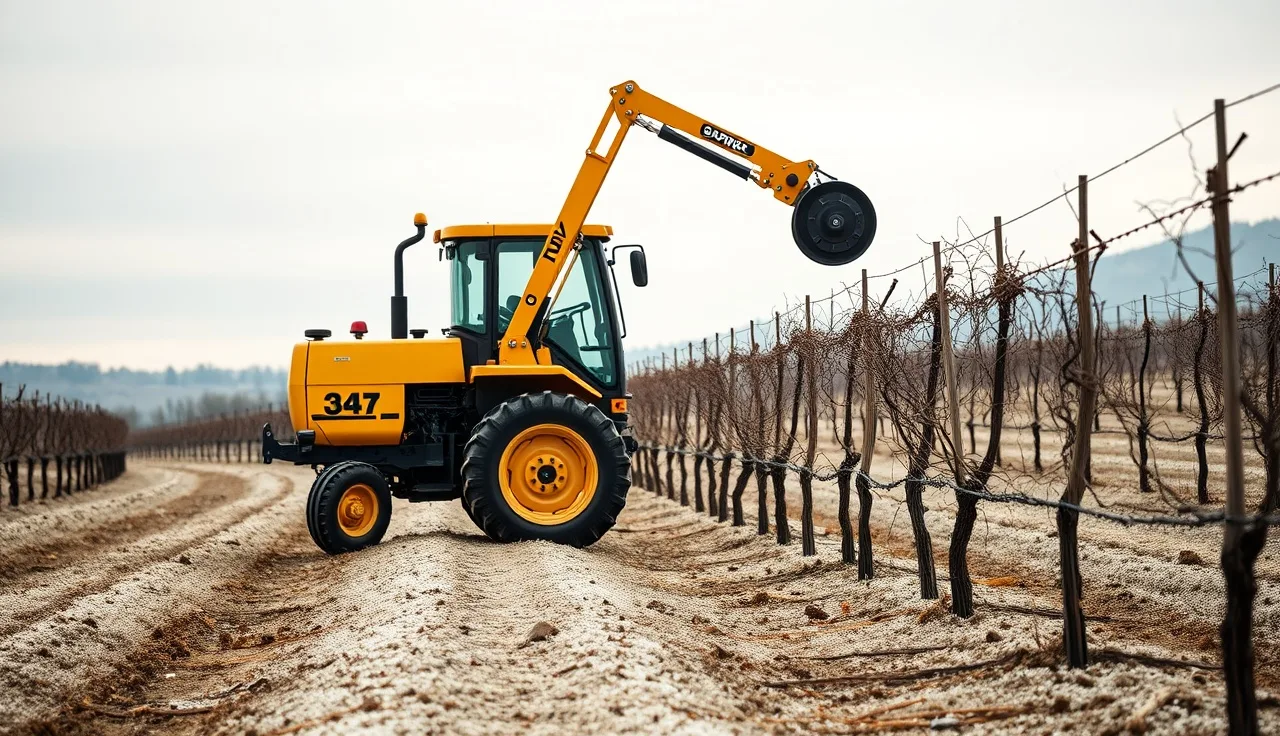
A grape vine pruning machine strips off the bulk of last season's cane growth mechanically, using spinning circular saws, reciprocating blades, or oscillating shears mounted on a tractor frame that straddles or reaches into the row. The machine rides down the row and cuts everything above and beside the cordon or head back to a preset height or width. What comes out the other end is a rough-pruned vine that still needs a human for the final shoot and spur selections.
This two-pass system, sometimes called "mechanical pre-pruning followed by hand finishing," is the dominant real-world method in large commercial operations. The machine removes 70-80% of the wood in a fraction of the time. Then a crew walks behind it and makes the judgment calls: which spurs to keep, how many nodes to leave, whether that cane sits right for next year's fruit zone.
Fully autonomous pruning, where the machine selects and cuts with no human follow-up, exists in research settings. It is not commercially standard for wine grapes yet. UC Cooperative Extension notes that even the best commercial units still need hand finishing to hold vine architecture and fruit quality over time [1].
So when growers say "pruning machine," they almost always mean the pre-pruner. And the labor savings math has to count the finish crew, more than the machine pass. Skip that step and the numbers lie to you.
What types of grape vine pruning machines are on the market?
There are four broad categories. They differ in cost, throughput, and how much finishing work they leave behind.
Power-assisted hand pruners (pneumatic and electric)
These are handheld tools, not self-propelled machines, but they belong in this conversation because they're the entry point for mechanization. Pneumatic bypass pruners like the Felco 801 or the Infaco Electrocoup F3010 cut hand fatigue hard and let a pruner work faster and longer. They run roughly $400-$1,200 per unit [2]. A crew on pneumatic or electric shears cuts labor hours 20-30% versus conventional bypass pruners, and the work is full hand quality because a human is still making every cut.
Tractor-mounted mechanical pre-pruners
This is the workhorse category. A boom-mounted cutter head, usually hydraulic, hangs off the front or side of a tractor and runs reciprocating or circular blades through the canopy as the tractor creeps down the row. Speed is typically 2-4 mph. One operator can pre-prune 10-20 acres per day depending on vine spacing and row conditions [3]. These units run roughly $20,000-$60,000 new. Used machines from dealers in Napa, Lodi, or the Riverland in Australia go for a good deal less.
Over-row straddling pre-pruners
These larger rigs straddle the row like a harvester. They're more common in high-density European plantings and Australian bulk wine regions. They cut both sides of the canopy in a single pass, which is faster, but they cost $60,000-$120,000 new and they need consistent row width and trellis height to work cleanly.
Robotic and vision-guided pruning systems
Companies including Trimble (through its VineRobot research), Naïo Technologies, and university prototypes have been building systems that use cameras and machine learning to identify and cut individual spurs without a human [4]. As of 2024, none run in wide commercial deployment for wine grapes. They're the future. But the cost (often over $200,000 per unit in pilot programs) and the mess of variable vine architecture mean most growers are watching, not buying.
| Machine type | Approx. cost (new) | Labor reduction | Finishing needed? |
|---|---|---|---|
| Power hand pruner | $400-$1,200 | 20-30% | No (human operation) |
| Tractor boom pre-pruner | $20,000-$60,000 | 50-70% | Yes |
| Over-row straddler | $60,000-$120,000 | 60-75% | Yes |
| Robotic autonomous | $150,000-$200,000+ | Potentially 80%+ | Minimal (not yet commercial) |
Sources: UC Cooperative Extension, industry supplier catalogs [1][3].
How much labor and money do mechanical pruners actually save?
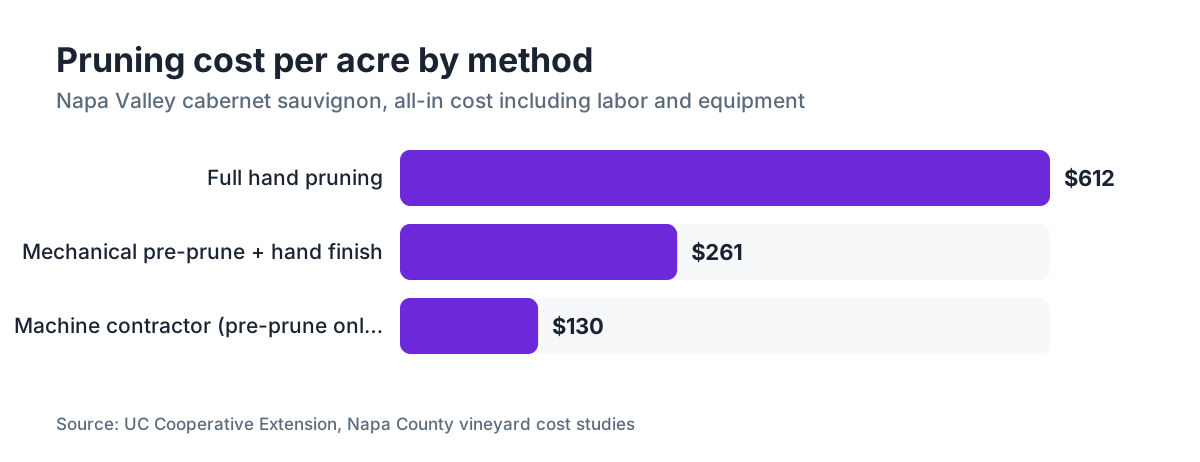
Here's where the numbers get honest and a little messy. Hand pruning in California wine grapes runs $400-$700 per acre for the full operation, depending on vine age, training system, and local labor rates [1]. In high-wage regions or tight labor markets, that climbs past $800. Pre-pruning with a machine plus hand finishing runs closer to $200-$350 per acre in most California studies.
A UC Cooperative Extension cost study for Napa Valley cabernet sauvignon put total pruning cost (mechanical pre-prune plus hand finish) at $261 per acre, against $612 per acre for full hand pruning in that same sample [1]. That's roughly $350 per acre saved. On 100 acres, that's $35,000 a season.
Now the ownership math. A $40,000 tractor-boom pre-pruner amortized over 10 years, with annual maintenance of roughly $1,500-$3,000, adds up to $5,500-$7,000 a year in fixed cost. At $350 per acre saved, you break even at 16-20 acres a year. Most vineyards over 30 acres find the case easy.
Smaller operations, say under 15 acres, usually do better renting from a custom operation or ag contractor at roughly $80-$150 per acre for the machine pass [11]. Contractors in every major wine region offer this. It skips the capital cost entirely.
Labor availability matters here too, maybe more than cost per acre. In a lot of regions, finding enough skilled pruners is harder than paying them. A machine that halves your crew size is worth something beyond the dollar math, especially heading into a season with a thin labor pool.
Which training systems work best with mechanical pruning?
Not every vine can be pre-pruned by machine efficiently, and some training systems are close to impossible to machine prune without wrecking the structure. The systems that work best are bilateral cordon setups (VSP, Scott Henry, Smart-Dyson derivatives) where the fruiting zone sits in a consistent, flat plane at a predictable height.
On those, the machine cuts to a defined height and width and leaves a clean bead of stubs on the cordon arms. That's why most new California plantings built for mechanization use bilateral cordon on VSP.
Head-trained, own-rooted gobelet vines, common in old Zinfandel and Grenache blocks, are much harder. The head sits at variable heights, the canes radiate in every direction, and you can't set a clean cutting plane without risking cordon damage. Some operators run a loose pass just to cut wood volume, but most old head-trained vines stay hand-pruned.
Guyot canes (single or double) present a different problem. The machine can strip the old canes off the wire, but the cuts for the replacement canes and renewal spurs still need eyes and hands. Pre-pruning Guyot mostly means clearing bulk cane mass before the finish crew shows up.
WSU Extension's viticulture program notes that trellis consistency, meaning uniform post height and tight, even wire tension, is a prerequisite for good mechanical pre-pruning [5]. If your trellis sags or the posts aren't uniform, the machine either misses cuts or gouges the cordon wood. Fix the trellis first.
What does mechanical pruning do to vine health and fruit quality?
This gets debated seriously, and the honest answer is that it depends on how well you manage the follow-up. Machine pre-pruning alone, without enough hand finishing, leaves too many nodes on the vine.
Too many nodes means a crowded canopy, worse air circulation, and conditions that favor powdery mildew and botrytis. Overcropped vines also throw fruit with lower Brix and less phenolic development. So machine pruning isn't the problem. Cutting corners on the finish crew is.
The second concern is trunk disease. Cutting blades can carry Eutypa lata (the fungus behind Eutypa dieback) and Botryosphaeria species from vine to vine if you don't disinfect them. Hand pruners have the same problem, but because a machine cuts so many more vines per hour, the transmission risk scales right up with it. The UC Statewide Integrated Pest Management Program recommends disinfecting blades with a sodium hypochlorite solution (10% bleach) or a commercial product between rows, or at minimum between blocks of different ages and varieties [6].
Long-term vine health data comparing machine-plus-finish against full hand pruning in matched blocks is thin. The closest work, multi-year trials run through UC Cooperative Extension in commercial Napa and Lodi blocks, found no significant difference in vine mortality or trunk disease when mechanical pre-pruning was paired with proper finishing and trunk disease management [1]. It did find higher canopy density in machine-pruned blocks that got skimpy finish labor, which just confirms the obvious.
Fruit quality follows the same rule. Well-finished machine-pruned vines make fruit comparable to hand-pruned vines at the same crop load. The danger is the economic pull to thin the finish crew. That's exactly where quality starts to slip.
How do grape vine pruning machines affect spray records and worker safety compliance?
Here's where a lot of growers miss something. The pruning machine itself isn't a pesticide application, so it doesn't generate a spray record entry. But pruning activity touches your pesticide records in two ways that matter for compliance.
First, many crews apply wound sealants or Bordeaux paste to pruning cuts to slow trunk disease infection. If you're using a registered pesticide product as a wound protectant (some operations use materials with Bacillus subtilis or copper), that application needs a pesticide application record under the EPA Worker Protection Standard and your state's equivalent rules [7].
Second, if workers re-enter a block treated with a restricted-entry interval (REI) pesticide before dormancy ended, the WPS REI controls when the pruning crew can go in. This bites operations that apply copper, sulfur, or dormant oil late in the season. The EPA WPS under 40 CFR Part 170 requires handlers and early-entry workers to have specific training, personal protective equipment, and access to decontamination supplies. EPA states the rule is meant "to reduce the risk of pesticide poisonings and injuries among agricultural workers and pesticide handlers" [7].
For machine operators, tractor-mounted pruner work in an enclosed cab generally falls outside the WPS field worker definition. Open-station operators and any hand-finish crew working in treated areas are subject to WPS. Your county agricultural commissioner is the authoritative source for your state's specific requirements.
Keep clean records of pruning timing, any wound sealant applications, and crew entry dates relative to pesticide REIs. Good record-keeping software makes this simple. VitiScribe's field operations module logs machine and crew entries alongside application records, so REI compliance is visible without cross-referencing three spreadsheets. That integration earns its keep the day your PCA or an auditor asks for records.
The USDA National Agricultural Statistics Service tracks vineyard mechanization, but pruning-specific adoption data is sparse. The nearest figure comes from USDA survey work showing roughly 35% of California wine grape acreage used some form of mechanical pruning by 2020, up from about 20% in 2010 [8].
How do you prune ornamental grape vines differently from wine or table grapes?
Ornamental grape vine pruning follows the same biology but chases completely different goals, and whether you'd ever use a machine comes down to scale and setting. The short answer: on an arbor, never.
Ornamental grape vines (most often Vitis vinifera cultivars grown for foliage, or Parthenocissus species sometimes called Virginia creeper or ornamental grape) grow on arbors, pergolas, walls, or fences in landscape settings. The pruning objective is to control size, shape the structure, and cover the frame with leaves, not to manage crop load and fruit zone.
No one runs a tractor-mounted pre-pruner on ornamental vines. The tools are hand bypass pruners, loppers, and occasionally pneumatic hand pruners for large commercial installations like estate arbors, resort grounds, or tasting room pergolas. Pruning happens in late winter while the vine is fully dormant, same as production grapes, cutting back to two or three buds per spur to hold the structure and keep the vine from getting too heavy for its support.
The key difference from production pruning is that you can be more aggressive with ornamentals without worrying about crop load balance. Most ornamental grape vines tolerate a hard cut back to the main framework every few years if they've gone unruly. On a pergola at a resort or hospitality property (see properties like Allegretto Vineyard Resort or Gervasi Vineyard where decorative vines are part of the guest experience), regular maintenance pruning keeps the structure clean and presentable without any specialized equipment.
Ornamental pruning in a commercial landscape follows the same worker safety rules as any other outdoor pruning: appropriate personal protective equipment, ladder safety, and if any pesticide wound treatments go on, the applicable pesticide handler requirements.
What should you look for when buying or renting a grape vine pruning machine?
A few specifications matter far more than the name on the paint. Get these right and the machine earns out; get them wrong and you'll gouge cordons all winter.
Cutting head width and adjustment range. Your cordon or cane zone has a specific width, and the machine needs to match it. Most adjustable boom heads offer a cutting width range of 18-36 inches. Confirm that range covers your narrowest and widest rows before you buy or rent.
Blade type and replacement cost. Circular saw heads are faster through heavy wood but dull quicker and cost more per replacement. Reciprocating blade heads handle mixed wood diameters well and are easier to service in the field. Ask other users for annual blade cost estimates, not the dealer.
Hydraulic demand. Tractor-mounted pre-pruners pull real hydraulic flow, typically 15-30 gallons per minute. Verify your tractor's hydraulic output matches the machine's requirement. Underpowering a hydraulic head is a common cause of poor cut quality and overheating.
Debris management. Some machines blow cuttings into the row middle (mulch-in-place), others side-discharge. In blocks with high disease pressure, pulling cuttings off the vineyard floor lowers the inoculum load for next season. Know your disease program before you pick a machine that buries debris.
Trellis clearance and sensor guidance. Better machines have mechanical or electronic feelers that help the head track the cordon wire even on uneven terrain. On rolling ground or inconsistent trellising, this matters a lot for cut quality and for keeping the head off the cordon.
For used equipment, check the blade mounts and hydraulic hose condition carefully. Used machines in California and Washington show up regularly on Machinery Pete, farm equipment classifieds, and through the Vineyard Team and regional grower associations. Functional used boom pruners typically run $10,000-$25,000 [11].
What do Cornell and WSU extension say about mechanical pruning adoption?
Cornell's viticulture extension program has studied mechanical pruning mostly under Finger Lakes and Hudson Valley conditions, where the constraint differs from California: shorter labor windows in a colder climate, and vine damage risk if you machine prune when wood is frozen and brittle [9].
Cornell's position, consistent across several extension publications, is that mechanical pre-pruning followed by hand finishing works for bilateral cordon systems in eastern conditions, with one caution. Wood shouldn't be mechanically cut when temperatures drop below roughly 23 degrees Fahrenheit (-5 Celsius), because frozen wood shatters instead of cutting cleanly and leaves ragged wounds that open the door to disease [9].
WSU Extension's viticulture program, covering Washington's Columbia Valley and beyond, has looked at mechanical pruning in large-scale operations. Washington's wine grape industry adopted mechanical pre-pruning broadly, partly because the scale of individual blocks (some operations run thousands of acres) makes full hand pruning both uneconomic and logistically impossible [5]. In high-volume Washington operations, mechanical pre-pruning is no longer an option to weigh. It's the baseline.
Both programs stress that mechanical pruning is a management tool, not a substitute for viticultural knowledge. The person setting the machine parameters and running the finish crew still has to understand vine physiology, training system goals, and how this year's cuts set up next year's crop. Buying a machine doesn't lower the knowledge requirement. It moves the requirement from the pruner's hands to the farm manager's planning.
Operators running vineyards tied to a tasting room or hospitality business, like you'd see at Ponte Winery or South Coast Winery in Temecula, often balance mechanical efficiency against the look of the blocks guests walk through. In those cases, the rows nearest the tasting room usually stay hand-pruned for presentation, while back blocks get mechanically pre-pruned.
How do you track pruning machine operations for compliance and audit purposes?
Pruning records aren't required under federal pesticide law the way spray applications are. But they matter for several other reasons: traceability in sustainability certification programs, crop insurance documentation, labor law compliance (particularly around piece-rate and hourly wage rules for pruning crews), and internal agronomic records that tell you how the vine responds over time.
At minimum, a pruning log should capture the date, block or vineyard ID, operator name, machine or method, acreage covered, and any wound treatment products applied. If your operation is certified under California Sustainable Winegrowing, LIVE, or SIP, you may need to show that pruning timing and methods line up with your vineyard management plan.
Digital record-keeping makes this simple. VitiScribe is built for exactly this kind of field operations documentation, tying pruning records to block maps, variety data, and later spray records so you see the full seasonal picture without spreadsheet archaeology. It's not the only tool for the job, but it's built around the workflows vineyards actually run rather than generic farm management.
For piece-rate labor compliance (California AB 1513, which sets requirements for how piece-rate pruning crews get paid for non-productive time), accurate time records tied to acreage records are essential. A machine operation log showing tractor hours by block, paired with crew time records for the finish work, gives you the documentation you need if a wage claim comes up [10].
Labor and pesticide records tied to specific blocks are also what your crop insurance adjuster wants after a frost or hail event. Clean documentation of what was done and when has real dollar value. Nobody enjoys building it in January. Everybody's glad they did when the adjuster shows up.
What are realistic timelines for mechanical pruning by operation size?
Planning the pruning window is one of the harder parts of vineyard scheduling. The biology gives you roughly 10-14 weeks of safe pruning window in most northern hemisphere wine regions, from late December through early March. The exact window depends on your climate and how you manage late pruning to delay budbreak and frost risk.
A single tractor with a boom pre-pruner running at 3 mph on 6-foot row spacing covers roughly 15-20 acres per 8-hour day. A finish crew of four experienced pruners follows behind and finishes 4-6 acres per day. That ratio, about one machine pass per three to four finish crew days, is your planning baseline.
For a 100-acre vineyard:
- Machine passes: 5-7 days
- Finish crew (4 people): roughly 17-25 working days
- Total calendar time: 4-5 weeks assuming no weather delays
For a 500-acre vineyard:
- You're running multiple rigs and crews, contracting out machine passes, or both
- Operations this size typically run two to three tractor rigs at once and keep a finish crew of 15-20 or more
Weather is the wildcard. Rain closes the vineyard, frozen ground blocks tractor access, and a late frost forecast often pushes you to hold the final blocks to delay budbreak. Build a 20-30% time buffer into your pruning calendar or you'll be scrambling every February.
Operations that use the vineyard as both a production unit and a guest-facing asset, as many hospitality-integrated wineries do, sometimes stagger mechanical pruning to keep at least some blocks looking neat during early-season visits. That's a real scheduling constraint the pure efficiency math never captures.
Frequently asked questions
How much does a grape vine pruning machine cost?
Power hand pruners (pneumatic or electric) run $400-$1,200 per unit. Tractor-mounted boom pre-pruners cost $20,000-$60,000 new, or $10,000-$25,000 used. Over-row straddling machines run $60,000-$120,000. Experimental robotic systems sit above $150,000. For operations under 15 acres, renting from an ag contractor at $80-$150 per acre per pass usually beats ownership math.
Does mechanical pruning reduce fruit quality in wine grapes?
Not by itself. The risk is in how the finish crew gets managed afterward. Machine-only pruning with no hand finishing leaves too many nodes, which crowds the canopy and drops fruit quality. Trials run through UC Cooperative Extension found no significant quality difference between mechanical pre-pruning plus hand finishing and full hand pruning when finish labor was adequate. Cut corners on finishing and quality drops.
Can you mechanically prune head-trained old vines?
Generally no, at least not with a standard boom pre-pruner. Head-trained gobelet vines have variable head heights and canes radiating in every direction, so there's no consistent cutting plane to set the machine to. Some operators run a light pass to cut wood volume before the hand crew arrives, but most old head-trained blocks stay fully hand-pruned. That's one reason old-vine Zinfandel and Grenache blocks are expensive to maintain.
What training system works best for mechanical pruning?
Bilateral cordon on vertical shoot positioning (VSP) is the system best suited to mechanical pre-pruning. It presents a consistent, predictable fruit zone height and width that a boom cutter can be calibrated to. Scott Henry and Smart-Dyson work reasonably well too. Guyot canes can be partially machine-stripped for bulk removal, but the renewal cane selections still need hands. Gobelet and fan-trained systems are very hard to machine prune.
Do I need to record grape vine pruning machine operations for compliance?
Machine pruning itself isn't a pesticide application, so it doesn't require a spray record. But if you apply wound sealants or protectant pesticides during pruning, those need a pesticide application record under EPA WPS requirements (40 CFR Part 170). California AB 1513 also requires accurate time and piece-rate records for pruning crews. Sustainability certifications including CSWA and SIP may require pruning records in your vineyard management documentation.
Can mechanical pruning spread trunk diseases like Eutypa?
Yes. Eutypa lata and Botryosphaeria species spread through cutting tools, and a machine making thousands of cuts per hour scales that risk. The UC Statewide IPM Program recommends disinfecting blades with 10% sodium hypochlorite solution (bleach) or approved commercial disinfectants between rows or at least between blocks. The same protocol applies to hand pruners, but it matters more with machines because of cut volume and speed.
How do I prune ornamental grape vines, and would I ever use a machine?
Ornamental grape vines on arbors, pergolas, or walls get pruned in late winter while dormant, cutting back to two or three buds per spur to control size and hold structure. No one uses a tractor-mounted pruner for ornamental work. Bypass hand pruners or loppers are standard. For large commercial installations, pneumatic hand pruners cut fatigue. You can be more aggressive with ornamentals than production vines since crop load isn't a concern.
How many acres can a mechanical grape vine pruner cover per day?
A single tractor-mounted boom pre-pruner running at 2-4 mph covers roughly 15-20 acres per 8-hour day at typical wine grape row spacings. Over-row straddling machines cutting both sides at once may reach 25-30 acres per day. Variables that slow throughput include tight row widths, inconsistent trellis height, heavy cane load from a vigorous previous season, and rough terrain.
Is it worth buying a grape vine pruning machine or should I rent?
For operations over 30 acres, owning a tractor-mounted boom pre-pruner typically pencils out in two to four seasons, based on UC Cooperative Extension cost data showing savings of $250-$350 per acre per year against full hand pruning. Under 15-20 acres, renting from an ag contractor at $80-$150 per acre per pass is usually the better economic choice and skips the capital outlay, maintenance, and storage.
What does WSU Extension say about mechanical pruning in Washington State?
WSU Extension's viticulture program notes that mechanical pre-pruning is effectively standard practice in large Columbia Valley operations because the scale makes full hand pruning impractical. WSU research stresses trellis consistency as a prerequisite for good results and cautions against cutting frozen wood below about 23 degrees Fahrenheit, because frozen canes shatter rather than cut cleanly and leave rough wounds that raise disease risk.
How does mechanical pruning interact with EPA Worker Protection Standard requirements?
The machine itself doesn't trigger WPS, but pruning crews entering blocks with active pesticide restricted-entry intervals (REIs) are covered by EPA WPS under 40 CFR Part 170. Workers need training, appropriate PPE, and decontamination access. If wound protectant pesticides go on during pruning, those applications require standard pesticide records. Tractor operators in enclosed cabs are treated differently from hand workers in open fields; check with your county ag commissioner for state-specific rules.
What are the main mistakes growers make with mechanical pruning?
The most common mistake is under-resourcing the finish crew to save money, which produces crowded canopies and fruit quality problems. Second is skipping blade disinfection, which spreads trunk disease. Third is running a machine on a training system it wasn't designed for, particularly head-trained or inconsistent trellising. Fourth is leaving finish labor out of the cost-benefit math, which makes the machine look more profitable than it really is.
When should I prune to delay budbreak and reduce frost risk?
Leaving your highest-risk frost blocks for last in the pruning schedule delays budbreak by one to three weeks in most studies, because unpruned dormant vines hold budbreak back. Cornell and UC Cooperative Extension both document this strategy. The tradeoff is a compressed pruning window, which is exactly why having a machine (or contracting machine work) matters: you can pre-prune all blocks early and delay hand-finishing only the frost-prone blocks without a labor bottleneck.
Sources
- UC Cooperative Extension, Sample Costs to Establish a Vineyard and Produce Wine Grapes, Napa County (UC Davis Cost Studies): Mechanical pre-pruning plus hand finishing costs roughly $261 per acre vs. $612 per acre for full hand pruning in Napa Valley cabernet sauvignon cost studies; also supports the note that machine units benefit from hand finishing to maintain vine architecture.
- Infaco, Electrocoup F3010 electric pruner specifications: Pneumatic and electric hand pruner units in the $400-$1,200 range; Electrocoup F3010 is a commercially available electric bypass pruner.
- UC Agriculture and Natural Resources (UC ANR), viticulture and vineyard mechanization resources: Tractor-mounted mechanical pre-pruners can cover 10-20 acres per day; labor reduction of 50-70% with mechanical pre-pruning.
- Naïo Technologies and Trimble VineRobot research overviews on autonomous vineyard robotics: Robotic and vision-guided pruning systems are in research/pilot stage and not yet commercially standard for wine grapes as of 2024.
- Washington State University, Viticulture and Enology program: WSU notes trellis consistency is a prerequisite for mechanical pre-pruning and that mechanical pruning is baseline practice in large Columbia Valley operations; frozen wood below ~23°F should not be mechanically cut.
- UC Statewide Integrated Pest Management Program (UC IPM), Grape trunk diseases: Blade disinfection with 10% sodium hypochlorite or commercial disinfectants recommended between vine rows or blocks to reduce Eutypa and Botryosphaeria transmission during pruning.
- US EPA, Agricultural Worker Protection Standard, 40 CFR Part 170: EPA WPS requires training, PPE, and decontamination access for workers entering fields with active REIs; EPA states the rule is meant to reduce the risk of pesticide poisonings and injuries among agricultural workers and pesticide handlers.
- USDA National Agricultural Statistics Service, Census of Agriculture and California vineyard surveys: Approximately 35% of California wine grape acreage used some form of mechanical pruning as of 2020, up from about 20% in 2010.
- Cornell University, College of Agriculture and Life Sciences, viticulture and enology extension: Cornell research states wood should not be mechanically cut when temperatures are below approximately 23°F because frozen wood shatters rather than cuts cleanly; mechanical pre-pruning viable for bilateral cordon systems in eastern conditions.
- California Labor Code Section 226.2 (AB 1513), Piece-Rate Compensation: California AB 1513 requires specific compensation for non-productive time in piece-rate work including vineyard pruning; accurate time and acreage records are required for compliance.
- UC Agriculture and Natural Resources (UC ANR), vineyard mechanization and custom operator resources: Used tractor boom pre-pruners available for $10,000-$25,000; custom machine contractors in major wine regions offer pre-pruning services at approximately $80-$150 per acre.
Last updated 2026-07-09