How to translate spray safety signage for non-English workers
TL;DR
- Under EPA's Worker Protection Standard (40 CFR Part 170), agricultural employers must provide pesticide safety information in a language workers understand.
- For vineyards with Spanish-speaking crews, that means translated posted notices, oral warnings in Spanish, and pictogram signs at field entry points.
- WPS violations carry civil penalties up to $19,162 each under FIFRA section 14.
What does federal law actually require for non-English spray signage?
If your workers don't read English, your English-only signs don't satisfy the law. That's the whole thing in one sentence. EPA's Worker Protection Standard (WPS), codified at 40 CFR Part 170 and last revised in 2015, is explicit. Safety information has to be communicated in a way the worker can actually understand, which in practice means oral warnings in the worker's own language plus posted pesticide safety information translated to match your crew.
The WPS says the central-location safety posting must be 'in a language that the workers and handlers can understand.' [1] That phrasing is in the 2015 regulatory text itself. So if your crew is mostly Spanish-speaking, the central posting goes up in Spanish. If some workers speak Mixtec or another indigenous language as their first tongue, Spanish alone may not clear the bar.
The standard also requires that handlers and early-entry workers get oral warnings before they enter a treated area during a restricted-entry interval (REI). Those warnings have to be in a language the worker understands. A laminated English-only sign at a field road junction is not a spoken warning, and it does not substitute for one.
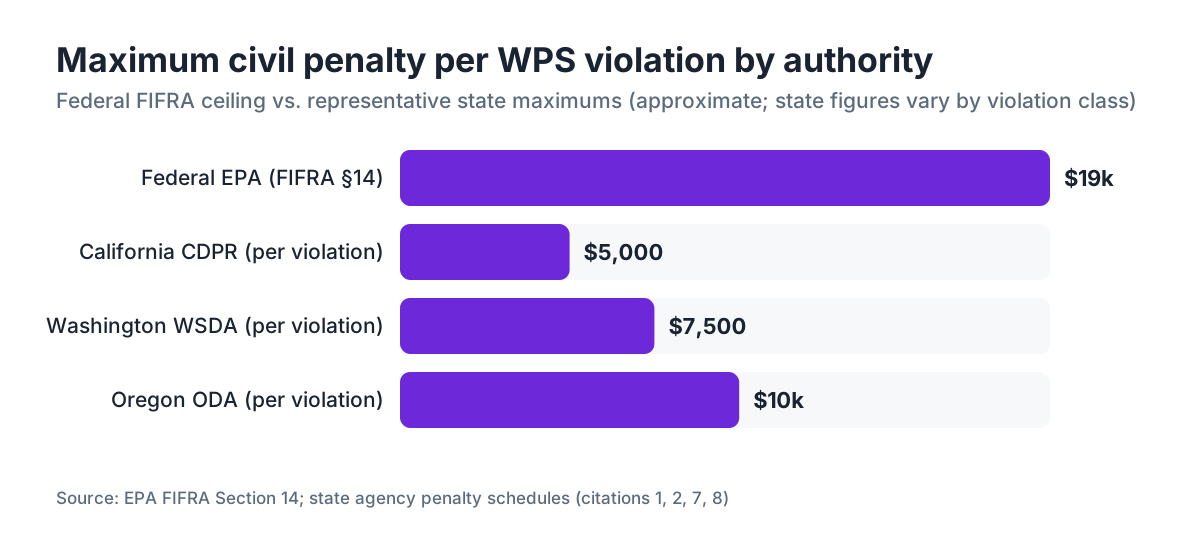
WPS violations run up to $19,162 per violation under FIFRA section 14(b)(2). [2] EPA inspects vineyard operations, and state lead agencies in California, Washington, and Oregon often set tighter timelines and audit more often than federal inspectors do.
Which specific signs and notices must be translated?
Three separate WPS communication requirements touch on language. Keep them straight and the compliance picture gets a lot simpler.
First, the Application Exclusion Zone (AEZ) warning. During any pesticide application, everyone has to stay out of the AEZ. Nearby workers must be warned orally, in a language they understand, before the application starts. It's a real-time spoken requirement. No sign covers it.
Second, the central posting. Within 24 hours of a pesticide application that triggers an REI, you post pesticide safety information where workers gather (a toolshed, a lunch area, a vehicle staging point). EPA gives you a bilingual English/Spanish 'Pesticide Safety Information' template. If your crew includes other languages, you add those translations. The posting has to carry the product name, EPA registration number, REI, location treated, and date and time of application. [1]
Third, treated area warning signs at field entry points. These go up before an application starts and come down only after the REI expires (and after ventilation, if the label calls for it). EPA's WPS requires these signs to include the words 'PESTICIDES' and 'DANGER' and meet a minimum size of 11 inches by 8.5 inches, with a minimum 1-inch letter height for the warning words. [1] The standard allows pictogram-based signs in place of text-heavy ones, and EPA has approved standardized pictogram formats for exactly this.
California stacks another layer through the Department of Pesticide Regulation (CDPR). Cal/OSHA's Hazard Communication standard (Title 8, Section 5194) and CDPR rules require that safety data sheets and pesticide hazard information be available in a language workers understand. California runs its own pesticide illness reporting system and inspects independently of EPA. [3]
What languages do vineyard workers actually speak, and where do you get translations?
Spanish is the most common language among vineyard field workers in California, Washington, Oregon, and New York. It is not the only one. In the Salinas Valley, the Central Valley, and parts of Washington's Yakima Valley, a real share of workers speak Mixtec, Triqui, Zapotec, or other Oaxacan indigenous languages as their first language, with Spanish coming second or third. That gap is exactly why a Spanish-only posting can fail to communicate the hazard.
The University of California Agriculture and Natural Resources (UC ANR) program has produced translated pesticide safety materials in Spanish, and some materials in Mixtec variants. [4] Cornell Cooperative Extension and Washington State University Extension have done similar work for their regions. These are free, backed by university translation review, and a much safer starting point than running your own text through a general-purpose translation app.
For languages with fewer resources, Farmworker Justice and the California Rural Legal Assistance Foundation (CRLA) have materials. Some CDPR materials come in multiple languages through the CDPR website. [3]
If you run a vineyard in a region like Paso Robles wineries or South Coast Winery territory where indigenous-language speakers are well represented, call your county agricultural commissioner's office. They often know which community organizations have done professional-grade translations for local dialects.
For genuinely rare languages, EPA's guidance points you toward a qualified interpreter who speaks the language and delivers the oral safety training in person. Then document it: who translated, what date, what materials you covered.
How do pictogram signs satisfy the language requirement?
Pictograms are not a loophole. They're a compliance pathway EPA specifically endorses for treated area warning signs. The logic holds up: a clear image of a person being warned away from a spray application communicates danger no matter the worker's literacy level or spoken language.
EPA's WPS lets treated area warning signs use the standardized pesticide warning pictogram (a person with an X or a stop-hand near a spray nozzle) instead of text-based warnings, as long as the sign meets the size minimums. The pictogram format EPA recognizes comes from EPA's own WPS materials and mirrors the format on pesticide labels under the Globally Harmonized System (GHS). [1]
Pictograms don't cover everything, though. The central posting still needs readable text, because you can't reasonably convey a product name, EPA registration number, REI, and application location through pictures. For the central posting, you need actual translated text. Pictograms handle the field boundary. They do not satisfy the informational posting requirement.
Here's the practical setup. Use EPA-approved bilingual English/Spanish text for your central posting, add any other language versions your crew needs, and use pictogram signs at field entry points as your first-line visual warning. Stack the two. Don't treat them as either-or.
WSU Extension's Pesticide Safety Education Program has produced pictogram-based training materials reviewed for agricultural use in the Pacific Northwest. [5] Download them and keep them in your spray records binder.
What does a compliant bilingual central posting actually look like?
EPA hands you the template. You can download the official WPS Pesticide Safety Information poster straight from EPA's website. The current version is bilingual English/Spanish and covers every required element. [6] Print it at a minimum of 8.5 by 11 inches, laminate it, and post it where workers congregate within 24 hours of any application.
The application-specific details (product name, REI, treated area, date and time) you fill in each time. Plenty of operations keep a dry-erase board next to the posted template, or a printed insert in a sleeve. Either one works as long as it's legible and in the required languages.
Here's what the posting must include, per 40 CFR 170.311(b):
| Required Element | Notes |
|---|---|
| Product name and EPA Reg. No. | From the label |
| REI (in hours) | Must match label REI |
| Date and time of application | Within 24 hrs after application |
| Location treated | Field block or description |
| Hazard warnings | Language workers understand |
| Contact info for emergency | Poison control or similar |
If you record applications digitally, tools like VitiScribe can auto-populate some of this for each spray event and flag when a posting update is due, which shrinks the odds of a gap between the application and the required posting window.
Keep a log showing the posting went up. Inspectors ask for that. A timestamped phone photo isn't a bad idea, but a written log entry with the date, the person who posted it, and the field block is the cleaner record.
What oral warnings are required, and how do you document them?
Oral warnings come up in two situations. First, when a worker is nearby during an application and needs to stay out of the AEZ. Second, when early-entry workers (people who enter a treated area during the REI) get their pre-entry safety briefing.
Both warnings have to be in a language the worker understands. If your applicator speaks only English and your crew speaks Spanish, you have a real problem. Either the applicator can give the warning in Spanish, or a bilingual crew supervisor is present to relay it right then.
Early-entry workers (those pruning, scouting, or doing other tasks during an REI under the early-entry exception) must get specific safety information before they go in: the product name and EPA registration number, the REI, instructions for using required PPE, and where emergency medical care is available. [1] That's delivered orally, in the worker's language.
Documenting oral training is genuinely awkward. EPA doesn't require a signed acknowledgment for every oral warning, but it does require employers to keep records of annual pesticide safety training for workers and handlers. That annual training record has to show the date, the topics, the language used, and who delivered it. [1] Hold those records for two years.
For the daily or event-specific warnings (the AEZ warning, the pre-entry briefing), good practice is a quick note in your spray log: 'Verbal warning given in Spanish to crew of 8 before entry on 7/9/2026, Block 4, Block 5.' Twenty seconds to write. It's the difference between a correctable observation and a willful violation when an inspector shows up.
How are California's requirements different from federal WPS?
California runs its own pesticide safety program through the Department of Pesticide Regulation (CDPR) and county agricultural commissioners, and the state rules are stricter than federal WPS in several places.
CDPR requires pesticide safety information in a language the handler or worker understands, which mirrors federal WPS. But California requires that safety training be completed before a worker handles or contacts pesticides, not merely before early entry. [3] Federal WPS gives you 5 days after a worker starts. California wants it done before exposure begins.
California also has the Healthy Schools Act and separate rules under the Safe Drinking Water and Toxic Enforcement Act (Prop 65), which affect how you post around riparian areas and water sources. Those are separate from WPS but overlap with spray signage.
County agricultural commissioners in Napa, Sonoma, San Joaquin, and Kern counties have historically been more active on WPS inspections than EPA Region 9 directly. Napa County's Agricultural Commissioner's office, for one, has published local guidance on multilingual posting. Call your local CAC office and ask for their current checklist. They'll usually share it.
For vineyard operations in California, the mix of CDPR, Cal/OSHA, and federal WPS means at least three overlapping authorities carry language requirements. The most conservative reading is almost always the right one. If any of the three requires a translated notice, post it.
What are the requirements in Washington and Oregon?
Washington runs its WPS program through the Washington State Department of Agriculture (WSDA), which adopted federal WPS with some state-specific additions. [7] WSDA requires pesticide safety training in a language the worker understands and requires training records to document the language used. Washington also licenses pesticide applicators, and licensed applicators are expected to know the language rules.
WSU Extension's Pesticide Safety Education Program (PSEP) has produced some of the best multilingual training materials in any state. Their Spanish-language WPS training video and companion pictogram materials are free to download and have been reviewed by agricultural safety specialists. [5] If you manage vineyards in the Yakima Valley or Columbia Valley, start there.
Oregon runs its program through the Oregon Department of Agriculture (ODA). Oregon adopted the 2015 federal WPS revisions and added a state requirement that employers conduct pesticide safety training in a language the worker understands before the worker first handles pesticides. [8] Oregon also has a farmworker protection law (ORS Chapter 658 and agricultural labor rules) that interacts with the WPS language requirements.
In both states, wage-and-hour enforcement agencies sometimes run joint inspections with the pesticide regulator, so language access for safety materials can surface in a labor inspection even when it's nominally a pesticide compliance issue.
How do you train a crew supervisor to deliver translated safety information correctly?
This is where most small vineyard operations fall short. You can have perfect bilingual postings and still fail if your bilingual crew supervisor doesn't actually know what the REI means or how to explain PPE requirements in plain Spanish.
Train the trainer. Get one or two bilingual crew leaders through a formal WPS train-the-trainer program. UC Cooperative Extension and Cornell Cooperative Extension both offer train-the-trainer curricula. [4][9] These run roughly four hours and cover how to explain REIs, how to read a label's signal words, what PPE fits which exposure scenario, and how to handle a pesticide emergency.
For crew supervisors whose first language is indigenous, find a community organization that offers pesticide safety training in that language. The Lideres Campesinas network and the Mixteco/Indigena Community Organizing Project (MICOP) in California have delivered agricultural safety training in Mixtec variants. These groups are hard to find through a plain web search. Your county farm bureau or UC Cooperative Extension farm advisor is usually the best referral.
Practice matters too. Run a 15-minute mock briefing at the start of each spray season, where the supervisor walks through the oral warning script in Spanish (or the relevant language) with you watching. Correct anything vague or technically wrong. It's free, it takes one morning, and it sharply cuts the chance that a worker gets a garbled safety message at the worst possible moment.
What records do you need to keep, and for how long?
Federal WPS requires you to keep certain records for two years after the date of application or training. [1] Those records include:
- Pesticide application records: product name, EPA registration number, date and time, location, REI, applicator name
- Central posting records: when it went up and came down, and that it was in the required language(s)
- Worker safety training records: date, topics, language, who trained, and the workers present (names or a count, depending on whether you can identify them)
- Handler safety training records: same as above, retained per handler
California's retention timelines differ slightly. Under California Food and Agricultural Code Section 12981, pesticide use reports go to the county agricultural commissioner monthly and are retained for three years. [10]
For the language piece specifically, the record you most want is something showing you assessed what languages your workers speak and acted on it. A short written note in your season-opening file does the job: 'Crew of 12; 11 Spanish-speaking, 1 Mixtec/Spanish bilingual; all safety materials provided in Spanish; oral briefings delivered in Spanish by crew lead.' That's the kind of documentation that turns a potential violation into a non-issue during an inspection.
Digital record-keeping keeps this consistent. VitiScribe's spray log module lets you attach language-of-training notes directly to each event record and generates a printable application log that meets federal WPS format requirements, which trims the paperwork without thinning the documentation trail.
Where can you get free translated materials right now?
Bookmark these. All free.
EPA's WPS resources page has the official bilingual English/Spanish Pesticide Safety Information poster, the central posting template, and Spanish fact sheets on REIs and PPE. [6]
UC Agriculture and Natural Resources (UC ANR) runs a Pesticide Safety Education program with Spanish-language training materials, videos, and worker rights fact sheets. [4] The materials are reviewed for agricultural accuracy and widely used in California vineyards.
WSU Extension's PSEP has Spanish-language and pictogram-based materials, including a video series on WPS requirements for workers and handlers. [5] Good fit for Pacific Northwest operations.
Cornell Cooperative Extension has WPS compliance guides for New York and the Northeast, including materials for the state's Spanish-speaking workforce. [9]
CDPR's website has California-specific pesticide safety materials in Spanish and links to county-level resources. [3]
The National Center for Farmworker Health (NCFH) keeps a resources library with health and safety materials in Spanish and some indigenous languages. [11]
For Mixtec-specific materials, MICOP (micop.org) and UC Davis's California Institute for Rural Studies have produced some, though availability is limited and not everything is professionally vetted for pesticide-specific accuracy. When in doubt, pair a bilingual staff member with the Spanish written materials and document the process.
None of these cover every language or every situation. But using them as a starting point, instead of translating materials yourself or skipping the requirement, is better compliance and genuinely better for your workers.
Frequently asked questions
Does the EPA Worker Protection Standard require signs in Spanish specifically, or just any non-English language?
WPS requires warnings and postings in 'a language workers and handlers can understand,' per 40 CFR Part 170. It doesn't name Spanish. If your workforce speaks Mixtec, Hmong, or any other language, the requirement follows the workers' actual language, not a default. Spanish materials are widely available because Spanish is the most common language in U.S. field agriculture, but the legal obligation tracks who is actually in your crew.
Can I use Google Translate to create my Spanish safety postings?
No rule bans it, but it's a bad idea. Machine translation of technical safety content (pesticide signal words, REI instructions, PPE requirements) often produces errors that could mislead a worker about when it's safe to enter a field. Use the official EPA bilingual template or UC ANR and WSU Extension materials, which have been professionally reviewed. Reserve translation tools for quick informal communication, not posted safety information.
What is the fine for not having translated spray signs?
FIFRA section 14(b)(2) allows civil penalties up to $19,162 per violation for WPS infractions. Each missing or non-compliant notice can count as a separate violation. State agencies in California, Washington, and Oregon can add state-level penalties on top of the federal amount. The bigger risk for most small operations is repeated violations across multiple inspections, which can escalate to stop-use orders and license review.
Do the language requirements apply to owners or family members who work on the farm?
WPS generally exempts immediate family members of the agricultural employer from worker protections. But 'immediate family' is narrowly defined: spouse, children, stepchildren, foster children, parents, stepparents, foster parents, brothers, sisters, or grandparents. Everyone else, including cousins, in-laws, and non-family labor contractors, is covered by WPS and must receive safety information in their language.
How long does a treated area warning sign need to stay posted?
Under federal WPS, treated area signs go up before the application begins and stay in place until the REI expires. After the REI, you remove the signs within 3 days. State rules can differ: California requires signs be removed within 24 hours after REI expiration in some situations. Check with your county agricultural commissioner for California-specific timing, which can be stricter than the federal minimum.
What happens if a worker speaks Mixtec but not Spanish? Does Spanish signage comply?
No, not fully. If a worker's primary language is Mixtec and their Spanish comprehension is limited, Spanish-only signage doesn't meet WPS's 'language workers can understand' requirement. You need translated materials in the specific Mixtec variant, an interpreter who can deliver the oral warning and briefing in Mixtec, or both. MICOP and UC Cooperative Extension are the best resources for Mixtec-language agricultural safety materials in California.
Is there a difference between what handlers and regular field workers need to receive in their language?
Yes. Handlers (people who mix, load, or apply pesticides) get more detailed safety information than workers who only re-enter after an REI. Handler training covers product-specific hazards, PPE requirements, emergency procedures, and environmental protection steps. Worker training covers what pesticides are, how to recognize exposure symptoms, rights under WPS, and basic re-entry safety. Both must be delivered in the worker's language, but handler training runs more technical.
Do I need translated Safety Data Sheets (SDS) for pesticides my crew might encounter?
Under OSHA's Hazard Communication Standard (29 CFR 1910.1200), SDS must be 'readily accessible' to workers during their shift. OSHA guidance says employees need access to SDS in a language they understand, though it doesn't require translated SDS in every case if an interpreter is available. California's Cal/OSHA requirements lean toward providing SDS in the worker's language when feasible. EPA's WPS pesticide safety posting, not the SDS, is the primary posted document for field spray events.
How do I document that I gave oral warnings in Spanish if the worker doesn't sign anything?
A signed acknowledgment is best practice but not strictly required for every oral warning under WPS. What is required is a record of annual safety training that includes the language used. For event-specific warnings, make a brief written entry in your spray log the same day: the date, block number, the language used, who gave the warning, and an approximate count of workers warned. That's enough to show good-faith compliance if an inspector asks.
Are pictogram-only signs legally sufficient, or do I still need text?
For treated area warning signs at field entry points, pictogram-only signs meeting EPA's size and format standards are legally sufficient under WPS. For the central posting (which must carry product name, EPA registration number, REI, location, and date), text is required, because that information can't be conveyed through pictures. Use pictograms at field boundaries and bilingual text for the informational central posting.
Where can I find the official EPA bilingual WPS poster template?
EPA's official WPS resources are at epa.gov/pesticide-worker-safety. The Pesticide Safety Information poster is available as a free English/Spanish bilingual download. UC ANR and WSU Extension also host copies of this template alongside their own supplementary training materials. Print it at a minimum of 8.5 by 11 inches and laminate it; it needs to stay legible and weather-resistant for outdoor posting.
Does my spray contractor have language compliance obligations, or is that all on me as the vineyard owner?
Both parties can carry obligations. The agricultural employer (the vineyard owner or manager who hires workers) is responsible for worker safety training and postings for agricultural workers. The pesticide handler employer (which may be the contractor) is responsible for handler training. If you hire a labor contractor whose workers enter treated areas, spell out in the contract who owns WPS compliance and the language requirements. An inspection won't accept 'the contractor handles that' as a full defense.
How often do EPA or state agencies actually inspect vineyards for WPS language compliance?
Inspection frequency varies widely by state and county. California's county agricultural commissioners run routine WPS inspections, and language compliance is a standard checklist item. A CDPR report covering 2019 data found WPS-related violations among the top five most common findings in agricultural inspections. Federal EPA inspections are less frequent. Washington WSDA and Oregon ODA inspect at lower frequency than California's county system. Your odds rise if you've had a pesticide incident or a worker complaint.
Sources
- EPA, Agricultural Worker Protection Standard (40 CFR Part 170): WPS requires pesticide safety information be posted in a language workers and handlers can understand, and oral warnings be given in the worker's language; records must be kept two years.
- EPA, FIFRA Section 14 Civil Penalty Policy: Civil penalties for WPS violations can reach $19,162 per violation under FIFRA section 14(b)(2).
- California Department of Pesticide Regulation (CDPR), Worker Safety: CDPR requires pesticide safety training before workers are exposed to pesticides, and safety information must be in a language workers understand; California also has its own pesticide illness reporting system.
- UC Agriculture and Natural Resources, Pesticide Safety Education Program: UC ANR has produced Spanish-language WPS training materials and worker rights fact sheets for California agricultural workers.
- EPA, WPS Pesticide Safety Information Poster (bilingual English/Spanish): EPA provides an official bilingual English/Spanish Pesticide Safety Information poster template satisfying the WPS central posting requirement.
- Washington State Department of Agriculture, Pesticide Management Division: WSDA administers Washington's WPS program and requires that pesticide safety training be conducted in a language the worker understands, with language documented in training records.
- Oregon Department of Agriculture, Pesticide Division: Oregon adopted the 2015 federal WPS revisions and added a state requirement that employers complete pesticide safety training in a language the worker understands before the worker first handles pesticides.
- Cornell Cooperative Extension, Agricultural Safety and Health: Cornell Cooperative Extension has produced WPS compliance guides and Spanish-language safety materials for Northeast vineyard and farm operations.
- California Food and Agricultural Code Section 12981, Pesticide Use Reporting: California requires pesticide use reports be submitted to the county agricultural commissioner monthly and retained for three years.
- National Center for Farmworker Health, Resources Library: NCFH maintains a library of health and safety materials in Spanish and some indigenous languages relevant to agricultural worker safety.
- OSHA, Hazard Communication Standard (29 CFR 1910.1200): OSHA's HazCom standard requires Safety Data Sheets be readily accessible to workers during their shift, with OSHA guidance indicating access in a language employees understand.
Last updated 2026-07-10