FSMA produce safety rule applicability for wine grape growers

TL;DR
- Wine grapes are technically a raw agricultural commodity covered by the FDA's Produce Safety Rule, but most commercial wine grape growers qualify for the 'rarely consumed raw' (RAC) exclusion and are fully exempt.
- Growers who also sell table grapes, or who have mixed operations, need to verify their status carefully.
- Annual food sales below $25,000 trigger a separate exemption.
- Here's how to work through the analysis.
Does the FSMA Produce Safety Rule apply to wine grapes at all?
Yes, technically. The FDA's Produce Safety Rule (21 CFR Part 112), which came out of the Food Safety Modernization Act of 2011, covers 'produce,' defined broadly as fruits and vegetables.[1] Wine grapes are fruits. So the rule applies to wine grapes by default unless a specific exemption removes them from coverage.
The critical word there is 'unless.' There are several exemptions that pull most wine grape operations out from under the rule entirely, and the most important one is the 'rarely consumed raw' exclusion. Understanding why that exclusion exists, whether you qualify, and what your remaining obligations are is the entire job here.
One thing worth saying plainly: this is an area where a lot of growers have received conflicting information. Some were told they're completely exempt, full stop, no records needed. Others were told they have to comply with the full rule. Neither blanket answer is always right. The correct answer depends on your sales figures, what else you grow, and how your fruit moves to the buyer.
What is the 'rarely consumed raw' exemption and do wine grapes qualify?
This is the big one. Under 21 CFR Part 112, the FDA explicitly lists produce that is 'rarely consumed raw,' and commodities on that list are excluded from the rule's coverage entirely.[2] The FDA's reasoning is straightforward: if people essentially never eat something raw, the food safety risk pathway that the rule is designed to address (pathogens on fresh produce reaching a consumer without a kill step) doesn't exist.
Wine grapes made the list. The FDA's final rule published in November 2015 identifies wine grapes as a commodity rarely consumed raw, which means they are categorically excluded from the Produce Safety Rule's requirements regardless of your farm size or revenue.[2]
Table grapes are not on that list. This distinction matters enormously if you grow both. If your ranch has Thomcord or Muscat Hamburg vines you're selling to a farmers market alongside your Cabernet Sauvignon, your table grape rows are covered by the rule even if your wine grape rows aren't. You can't treat the whole operation as exempt just because wine grapes dominate acreage.
The FDA published a commodity list alongside the final rule. UC Cooperative Extension has also summarized it for California growers in their food safety materials.[3] If you want to see the statutory language, the relevant section reads: 'Produce that is rarely consumed raw is not covered by this part.' [2]
Here's the short version. A dedicated wine grape operation, selling exclusively to crush facilities, wineries, or the bulk market, is excluded from the Produce Safety Rule under the RAC exemption. You don't need water testing, worker training documentation, or the other Part 112 requirements for those acres.
Are there other exemptions that could apply even if the RAC exclusion didn't?
Yes, and knowing them matters for mixed operations or unusual farm structures.
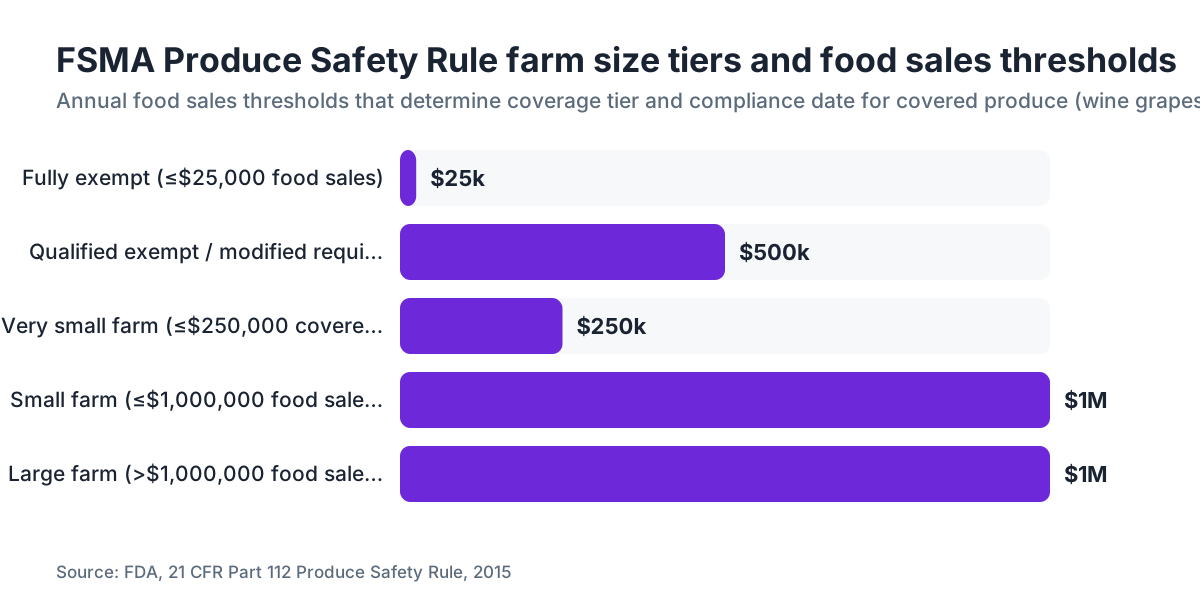
The $25,000 sales threshold. Farms with average annual food sales of $25,000 or less (measured over a three-year rolling average) are fully exempt from the Produce Safety Rule.[1] This is a gross sales figure for all food, more than produce. For a very small vineyard selling a few tons per year, this might apply, but most commercial wine grape operations exceed it quickly at typical $/ton prices.
Qualified Exempt status. Farms with total food sales under $500,000 per year (three-year average) and where more than half of those sales go directly to 'qualified end-users' (the consumer, or a restaurant or retailer in the same state or within 275 miles) qualify for modified requirements rather than full exemption.[1] They still have to post or provide certain disclosure information. This category is more relevant to small direct-to-consumer farm wineries than to growers selling to commercial crush facilities.
On-farm winery operations. If your operation moves grapes through your own winery under a beverage alcohol license and the wine is the product being sold rather than fresh grapes, the FDA's analysis shifts. Alcohol beverages are regulated by the TTB and generally fall outside FDA produce safety jurisdiction once the manufacturing process is the primary activity. That said, the boundary gets blurry for farm wineries that also sell fresh grapes.
For most straightforward commercial wine grape growers, the RAC exclusion resolves the question before any of these secondary exemptions become relevant. But it's worth knowing the full landscape, especially as farm operations grow more diverse.
How does farm size affect FSMA compliance for wine grape operations?
The Produce Safety Rule uses a tiered size structure for its compliance dates and modified requirements, based on average annual food sales.[1] The three categories are: large farms (over $1 million in food sales), small farms ($250,001 to $1 million), and very small farms ($25,001 to $250,000).
For wine grape growers who are excluded under the RAC exemption, these tiers are essentially moot. The exemption applies regardless of farm size. A 500-acre premium Napa Cabernet operation and a 5-acre hobby Pinot Noir block both sit outside the rule if they're selling exclusively wine grapes destined for processing.
Where size becomes relevant again is in mixed-produce operations. If you grow table grapes, stone fruits, vegetables, or any non-RAC produce alongside wine grapes, the covered portion of your operation falls into whichever size tier matches your total food sales. Your compliance obligations, record-keeping requirements, and the specific standards that apply (water quality testing, soil amendment restrictions, worker hygiene training) are then determined by that tier.
WSU Extension has published guidance specifically for Pacific Northwest growers with these mixed-operation questions.[4] If your situation is genuinely complicated, that's worth reading alongside the FDA's actual regulatory text.
What records do wine grape growers actually need to keep under FSMA?
If you qualify for the RAC exclusion and grow nothing but wine grapes, the honest answer is: none, under Part 112 specifically. The rule's record-keeping requirements don't apply to excluded commodities.
This surprises a lot of growers who've been told to keep food safety records as a blanket best practice. That advice isn't wrong, exactly, it just conflates two different things. Many wineries and crush facilities now require growers to carry Good Agricultural Practices (GAP) certification or complete a food safety audit as a condition of their purchase contract. That's a private contractual requirement, not an FDA mandate. The buyer is managing their own supply chain risk.
So in practice, you may well end up keeping records, but they're being kept because your customer requires it, not because FSMA compels it. The distinction matters when you're deciding how much to invest in a formal food safety program.
For growers who do have covered produce in their operation, Part 112 records include: water testing results, training records for workers and supervisors, inspection records for equipment and buildings, and documentation of corrective actions taken when problems were found.[1] Records generally must be retained for two years.
For compliance tracking across multiple blocks and commodities, a system like VitiScribe can keep water test results, training records, and spray logs organized in one place, which helps when a buyer auditor shows up wanting documentation on short notice.
One more thing. Even if you're exempt from Part 112, the EPA Worker Protection Standard (WPS) under FIFRA still applies if you use pesticides and have workers or handlers.[5] WPS record-keeping is separate from FSMA and is enforced by state lead agencies, not the FDA. Don't let the FSMA exemption fool you into thinking you're done with compliance paperwork entirely.
How do direct-to-consumer wine grape sales affect your FSMA status?
Selling at a farmers market or through a U-pick operation where customers are literally eating grapes off the vine changes the analysis. Once you're selling grapes as a fresh product for raw consumption, the core assumption of the RAC exclusion breaks down.
The FDA's reasoning for the RAC exclusion rests on the idea that these commodities go through a processing step (crush, fermentation, pasteurization in the case of juice) before reaching a consumer. If you're selling wine grapes directly as eating grapes, even in small amounts, you're no longer operating purely under that assumption.
The safe approach: if you sell any wine grape variety directly to consumers for fresh consumption, treat those sales as covered produce and apply the appropriate standards to the acreage supplying that market. If the total food sales for those covered products stay under $25,000, the low-volume exemption may still apply.
For farm wineries and estate tasting rooms that pick grapes for educational crush experiences where visitors handle fresh fruit, consult your state department of agriculture. A few states have addressed this specifically in their FSMA implementation guidance. California's CDFA, for example, has been fairly active in publishing interpretive guidance for multi-activity farm operations.[6]
Does the FDA's Produce Safety Rule cover imported wine grapes?
The RAC exclusion applies regardless of where the grapes are grown. If imported wine grapes are destined for processing into wine, juice, or another beverage, they carry the same excluded status as domestic wine grapes.
However, importers of food face a separate set of requirements under FSMA's Foreign Supplier Verification Program (FSVP), which is a distinct regulation from the Produce Safety Rule.[11] FSVP requires U.S. importers to verify that their foreign suppliers are producing food in a manner that meets the same safety standards as would apply if the food were produced domestically. For wine grapes excluded under the RAC exemption, this creates an interesting practical question: if the underlying commodity is exempt from the Produce Safety Rule, what verification is the importer required to perform under FSVP?
The FDA's position is that FSVP still applies to importers of produce, but the verification activities can be scaled to reflect the actual risk. This is an area where getting specific legal or regulatory affairs advice is worth the cost. The FDA's FSVP page and Cornell Cooperative Extension's food safety resources are good starting points for the general framework.[7]
How do state-level food safety programs interact with federal FSMA rules?
FSMA authorized the FDA to partner with state agencies to implement the Produce Safety Rule at the farm level. Under these partnerships, states can have their own produce safety regulations that may differ from or add to the federal rule, as long as they're at least as protective.[1]
In practice, California, Washington, Oregon, and New York have all entered into cooperative agreements with FDA to run their own produce safety programs. California's program is administered by CDFA.[6] Washington's is run by the Washington State Department of Agriculture (WSDA).[8]
For wine grape growers, the relevant question is whether your state's program tracks the federal RAC exclusion or applies its own commodity classifications. In all of the major wine grape producing states I'm aware of, state programs have adopted the same RAC exclusion as the federal rule. But you should verify this with your state's lead agency rather than assume it.
State programs also handle the on-farm inspections that FDA would otherwise conduct. If your state has a cooperative agreement, expect that state inspectors, not FDA agents, are the ones who would show up for a compliance check on your covered produce acres.
What should you do if you're unsure about your FSMA status?
Start with the FDA's self-assessment tools. The FDA publishes a 'Produce Safety Rule Key Requirements' page and an interactive decision tree for determining coverage.[1] These are free, accurate, and walk through the exemptions in order.
After that, your state's lead agency is the most practical resource. They know local variations, can give you written confirmation of your status, and are often the ones who would conduct any inspection. In California, that's CDFA's Produce Safety Program. In Washington, it's WSDA. In New York, it's the NYSDAM, with Cornell Cooperative Extension providing a lot of the grower-facing educational support.[7]
If you have a genuinely complex situation, a farm food safety consultant or an agriculture attorney who specializes in FSMA compliance is worth the fee. An hour of their time to confirm you're properly categorized is much cheaper than a compliance failure or, just as common, a needless investment in training and infrastructure you're not required to have.
For the vast majority of commercial wine grape growers reading this, the analysis is short. Wine grapes are on the RAC list. You sell them for processing. You're excluded from Part 112. Write that down, note where you confirmed it, and move on to the compliance obligations you actually have, like WPS, pesticide record-keeping under your state program, and whatever your buyers' GAP audit requires.
How does FSMA interact with pesticide records and the EPA Worker Protection Standard?
These are parallel regulatory frameworks, not the same thing. FSMA's Produce Safety Rule is an FDA program focused on pathogen risk in fresh produce. The EPA Worker Protection Standard (WPS) is an EPA program focused on protecting agricultural workers and handlers from pesticide exposure.[5] Your state pesticide use reporting requirements come from yet another framework, enforced by your state department of pesticide regulation or agriculture.
For wine grape growers who are excluded from the Produce Safety Rule, the practical compliance burden is still real. It just comes from WPS and state pesticide law rather than FSMA.
WPS requires, among other things: pesticide safety training for workers before their first day working in treated fields, access to labeling and safety data at the central display location, a designated pesticide safety contact, and decontamination supplies.[5] Handlers (those applying pesticides) have additional training and personal protective equipment requirements.
California's WPS requirements are administered by the California Department of Pesticide Regulation (CDPR) and are actually stricter than federal minimums in several areas.[9] Washington's requirements are enforced by the Washington State Department of Agriculture Pesticide Management Division.[8]
Keeping WPS training records, pesticide application records, and restricted entry interval (REI) documentation organized is something growers often underestimate. These records need to be available for inspection and retained for specific time periods, usually two years for training records and two years for application records under state programs. A vineyard operations platform like VitiScribe that links spray records to block maps and tracks REI expiration dates can prevent the kind of simple documentation gaps that make audits painful.
What are the compliance dates and enforcement history for wine grape growers?
The Produce Safety Rule's compliance dates have passed for all farm size categories. Large farms were required to comply by January 2018, small farms by January 2019, and very small farms by January 2020.[1]
For wine grape growers excluded under the RAC exemption, there was no compliance date to meet. The exclusion is immediate and doesn't phase in.
As for enforcement: FDA has been criticized in some quarters for slow Produce Safety Rule enforcement generally. A 2023 HHS Office of Inspector General report found that FDA's inspection numbers were far below its own targets for covered produce farms.[10] The practical implication for a wine grape grower is that the risk of an erroneous FSMA inspection is low, but not zero, especially if you have mixed operations where an inspector might not immediately understand your commodity mix.
Having a one-page document on file that explains your operation, identifies your acreage as wine grapes, notes the RAC exclusion under 21 CFR Part 112, and lists your buyer contracts (showing the grapes go to processing) is a genuinely good idea. It costs you an hour to prepare and it answers the question before an inspector has to ask it.
Frequently asked questions
Are wine grapes on the FDA's 'rarely consumed raw' list?
Yes. The FDA explicitly lists wine grapes as a commodity rarely consumed raw in the Produce Safety Rule (21 CFR Part 112), published in the Federal Register in November 2015. This means wine grapes are categorically excluded from the rule's requirements. Table grapes are not on the list and are covered by the rule.
Do I need to register with FDA as a wine grape grower?
Probably not for FSMA purposes. Farms that are excluded from the Produce Safety Rule under the RAC exemption don't need to register under that program. However, if your operation includes a winery or food processing facility, you may need a separate FDA food facility registration. Pure farm operations generally don't require registration. Check with your state's lead agency to confirm.
What happens if I grow both wine grapes and table grapes on the same farm?
Your wine grape acres remain excluded under the RAC exemption, but your table grape acres are covered by the Produce Safety Rule. You'll need to implement Part 112 requirements (water testing, worker training records, etc.) for the covered portion of your operation. The covered acres fall into a compliance tier based on your total farm food sales.
Does FSMA apply to a farm winery that grows its own grapes?
For the grape-growing portion of the operation, the RAC exclusion still applies. Once grapes are crushed and fermented into wine, the beverage alcohol manufacturing side is regulated by the TTB, not FDA's produce safety program. Mixed operations that also sell fresh table grapes or other produce need to assess those activities separately under Part 112.
How small does my operation need to be to qualify for the $25,000 food sales exemption?
Your average annual food sales (measured over three rolling years) must be $25,000 or less to qualify for the lowest-level exemption under 21 CFR Part 112. At typical wine grape prices of $800 to $3,000 per ton, this means fewer than 10 to 30 tons annually. Most commercial wine grape operations exceed this threshold, though the RAC exclusion usually applies first.
Do buyers or wineries require food safety certifications even if FSMA doesn't apply?
Yes, and this is very common. Many wineries and crush facilities require GAP (Good Agricultural Practices) certification or a third-party food safety audit as a condition of purchase contracts. These are private contractual requirements, not FSMA mandates. You may need to maintain records and pass audits even though the federal rule doesn't technically require it.
Is the FSMA Produce Safety Rule enforced at the state level for wine grape growers?
In states with FDA cooperative agreements (California, Washington, Oregon, New York, and others), state agencies handle on-farm inspections rather than FDA agents. California's program is run by CDFA, Washington's by WSDA. State programs must be at least as protective as the federal rule and generally adopt the same RAC exclusion for wine grapes.
What pesticide records do wine grape growers need to keep if they're exempt from FSMA?
FSMA exemption doesn't affect pesticide record requirements. Under the EPA Worker Protection Standard and state pesticide programs, you still need to keep pesticide application records, worker training records, and documentation of restricted entry intervals. California requires records be kept for two years; Washington requirements are similar. These are enforced by state agriculture or pesticide departments.
Does the rarely consumed raw exclusion apply to wine grape juice or must?
The RAC exclusion applies to the raw agricultural commodity, meaning the fresh grapes before processing. Once grapes are crushed into must or pressed into juice, the product enters a different regulatory category. Juice products that are not further processed (like fresh grape juice sold at retail) may fall under FDA's juice HACCP regulation (21 CFR Part 120) rather than the Produce Safety Rule.
Can a wine grape grower lose the RAC exclusion if they start selling grapes at a farmers market?
Potentially, yes. If you're selling wine grape varieties for fresh consumption at a farmers market or through direct channels where customers eat them raw, the justification for the RAC exclusion weakens. The FDA's analysis is based on typical consumption patterns. Selling for raw consumption would be a material change in how the commodity is used. Consult your state lead agency if you start selling through direct fresh channels.
Where can I find the official FDA guidance on which commodities are rarely consumed raw?
The FDA's Produce Safety Rule final rule (80 FR 74354, November 27, 2015) lists the rarely consumed raw commodities. The FDA also maintains a Produce Safety Rule overview page at FDA.gov. UC Cooperative Extension and Cornell Cooperative Extension have both published grower-facing summaries of the RAC list and its implications for specific farm types.
Are organic wine grape operations subject to different FSMA rules?
No. Certification as organic (under the USDA's National Organic Program) doesn't change your FSMA status. Organic wine grapes are covered by the same RAC exclusion as conventional wine grapes. The two programs run on separate tracks: USDA NOP governs input restrictions and certification, while FDA's Produce Safety Rule governs food safety practices for fresh produce.
Do I need a food safety plan for my wine grape operation under FSMA?
Not under the Produce Safety Rule if you qualify for the RAC exclusion. The Preventive Controls rule (21 CFR Part 117), which requires written food safety plans, applies to facilities that manufacture, process, pack, or hold food, not to farms growing excluded commodities. A winery that processes grapes might need to assess Preventive Controls separately, but growing wine grapes alone doesn't trigger that requirement.
What resources exist for wine grape growers trying to determine their FSMA compliance status?
The FDA's produce safety resources page and interactive decision tools are the starting point. UC Cooperative Extension (UC Davis), Cornell Cooperative Extension, and WSU Extension all publish grower-facing FSMA guidance. Your state lead agency (CDFA in California, WSDA in Washington) can confirm your specific status in writing. For complex mixed operations, an agriculture attorney or farm food safety consultant is worth the investment.
Sources
- FDA, Standards for the Growing, Harvesting, Packing, and Holding of Produce for Human Consumption (21 CFR Part 112): The Produce Safety Rule covers produce as a default, with exemptions for farms with food sales at or below $25,000, qualified exempt farms under $500,000, and commodities rarely consumed raw; compliance dates ran from January 2018 (large farms) to January 2020 (very small farms); records must generally be retained for two years.
- FDA, Produce Safety Rule: Rarely Consumed Raw Commodities (21 CFR 112.2(a)(1)): Wine grapes are listed among commodities rarely consumed raw and are excluded from the Produce Safety Rule under 21 CFR 112.2(a)(1); the rule text states 'Produce that is rarely consumed raw is not covered by this part.'
- UC Agriculture and Natural Resources, FSMA Produce Safety Resources for California Growers: UC Cooperative Extension summarizes the FDA's RAC commodity list and its implications for California produce growers, including wine grape operations.
- Washington State University Extension, FSMA and the Produce Safety Rule for Pacific Northwest Growers: WSU Extension has published guidance for Pacific Northwest growers on mixed-produce operation questions under FSMA, including commodity-specific exemption analysis.
- EPA, Worker Protection Standard (WPS) for Agricultural Pesticides: The EPA Worker Protection Standard requires pesticide safety training before workers first enter treated fields, access to labeling at a central display location, and decontamination supplies; it applies independently of FSMA exemptions.
- California Department of Food and Agriculture, Produce Safety Program: CDFA administers California's FDA-cooperative produce safety program and has published interpretive guidance for multi-activity farm operations including farm wineries.
- Cornell Cooperative Extension, Food Safety for Farms and Markets: Cornell Cooperative Extension provides FSMA grower education including FSVP framework summaries and commodity-level exemption guidance relevant to New York and Northeast growers.
- Washington State Department of Agriculture, Produce Safety and Pesticide Management Programs: WSDA administers Washington's FDA-cooperative produce safety program and enforces state pesticide use requirements for agricultural operations including wine grape vineyards.
- California Department of Pesticide Regulation, Worker Protection Standard Requirements: California's WPS requirements, enforced by CDPR, are stricter than federal minimums in several areas including training frequency and hazard communication.
- HHS Office of Inspector General, FDA's Implementation of the Produce Safety Rule (OEI-01-20-00430): A 2023 HHS OIG report found FDA's Produce Safety Rule inspection numbers were substantially below the agency's own targets for covered produce farms.
- FDA, Foreign Supplier Verification Programs (FSVP) for Importers of Food for Humans and Animals: FSVP is a separate FSMA regulation that applies to U.S. importers of food, including produce, and requires verification that foreign suppliers meet equivalent safety standards; it is distinct from the Produce Safety Rule.
- USDA Agricultural Marketing Service, National Organic Program: USDA NOP organic certification governs input restrictions and certification for organic growers but operates on a separate regulatory track from FDA's FSMA Produce Safety Rule.
Last updated 2026-07-10