Hand harvest crew documentation requirements under worker protection standards

TL;DR
- The EPA's revised Worker Protection Standard (40 CFR Part 170) requires hand harvest operations to keep at least six kinds of records: pesticide application logs, worker safety training records, handler certifications, decontamination supply logs, posted emergency medical contacts, and re-entry interval documentation.
- Keep most records two years.
- Produce them within 24 hours when an inspector asks.
What is the Worker Protection Standard and who does it cover for hand harvest?
The Worker Protection Standard (WPS) is the federal rule that sets minimum safety requirements for farm workers and pesticide handlers. It lives at 40 CFR Part 170. EPA rewrote it in 2015, and the new requirements phased in starting January 2017. [1]
For a vineyard running a picking crew, this is not paperwork you can ignore. Every person hand-picking grapes counts as an "agricultural worker" under WPS the moment they touch a crop on a farm that uses pesticides. Seasonal H-2A workers. Day-labor contractors. Family members pitching in for the harvest weekend. If your vineyard has applied any pesticide at any point during the season, WPS covers everyone on the crew.
Coverage runs at the farm level, not the application level. You don't dodge WPS by skipping the spray rig on harvest day. The obligation starts with your first application of the season and runs through harvest, then keeps going for records retention.
Small farms often assume they're off the hook. They usually aren't.
Two exemptions actually apply to vineyards with any regularity: farms where the only workers are the owner and the owner's immediate family, and operations that use only minimum-risk pesticides exempt under 40 CFR 152.25(f). Most production vineyards fit neither. If you spray sulfur, copper, or anything with an EPA registration number, and you hire anyone outside your immediate family, WPS applies to you. [1]
What are the six core documentation categories every hand harvest operation needs?
Think of WPS paperwork in six buckets. Miss one and you're exposed at inspection.
1. Pesticide application records
For every product applied during the season, record the product name, EPA registration number, active ingredient(s), date and time of application, location of the treated area (block name or identifier), application method, and the name and address of the certified applicator. The 2015 revision also has you record the start of any re-entry interval. Hold these two years. [1]
2. Safety training records
Every worker and handler needs WPS safety training before they first enter a treated area. Each record documents the trainee's name, the training date, the trainer's name and credentials, and the method used (in-person, video, or EPA-approved materials). Two-year retention here too. [1]
3. Handler pesticide safety training and certification
Anyone who mixes, loads, or applies pesticides is a "handler" and needs documentation beyond basic worker training. Keep proof of handler-specific training, and if they apply restricted-use products, a copy of the certified applicator's license. [1]
4. Decontamination supply records
WPS says you provide soap, water (at least one gallon per worker for routine decontamination, three gallons for handlers), and single-use towels at each decontamination station in or next to treated areas. The documentation here is looser, but good practice, and some state programs require you to log station location, supplies stocked, and setup date. [2]
5. Emergency medical contact information
You must post, or make sure workers can access, the name, phone number, and address of the nearest emergency medical facility. That posting goes at the central display alongside pesticide safety information and application and hazard details. [1]
6. Field posting and re-entry interval (REI) records
For any treated area with an REI over 48 hours, post a warning sign at the field entrance. Document when signs go up and when they come down (after the REI expires). For REIs of 48 hours or less, verbal or written notice to workers is enough, but you still keep a record of that notice. [1]
That's the baseline. Several states pile on more. California's Department of Pesticide Regulation, for one, requires a supervisor to hold a valid Qualified Applicator License or Certificate and adds recordkeeping tied to pesticide use reports filed with the county agricultural commissioner. [3]
How long do you have to keep WPS records, and what format do they need to be in?
Two years. That's the standard retention period for WPS records under 40 CFR 170.311, and the clock starts on the date of the activity, not the end of the calendar year. [1]
Format is wide open by design. Paper works. Spreadsheets work. Purpose-built software works. What fails is a record nobody can find. The rule says records must be "accessible" to the agricultural employer and available to authorized EPA or state representatives, or to workers and their designated representatives, "within 24 hours of a request for the records." [1] If your spray logs sit in a binder in the back of the equipment barn and the county ag commissioner shows up, you have 24 hours, not 24 minutes. But if you genuinely can't find them, that's a violation no matter the format.
Digital records are fine and more common every year. Keep a backup. Make sure someone besides the vineyard manager can open the files in a pinch. An inspection doesn't wait for a password reset.
WSU Extension's pesticide safety materials suggest keeping paper spray records in a weather-resistant binder at the farm office rather than in the cab of the spray rig, so they're on hand even when the rig isn't. [4]
What training documentation do you need before harvest crews enter the field?
This is the requirement small operations blow most often, especially when they hire through a labor contractor.
Under WPS, every agricultural worker gets safety training before entering a treated area for the first time. The 2015 revision tightened the content hard. Training now covers all content areas in 40 CFR 170.401, including understanding pesticide hazards, recognizing signs of pesticide poisoning, using personal protective equipment, and handling a pesticide emergency. [1]
For each worker, the record shows:
- Full name of the worker
- Date training was completed
- Name and credentials of the trainer (a certified applicator, a WPS-trained handler, or someone who finished an EPA-approved train-the-trainer program)
- The training method used (EPA's online modules, a state-approved video, or in-person instruction with EPA-approved materials)
The common failure for hand harvest crews is timing. Training happens before first entry into a treated area, full stop. If your day laborers show up at 6 a.m., walk the block to check fruit, and sign a form at 7 a.m., that's a violation. The paperwork proves you trained them. It doesn't undo the fact that entry came first.
Cornell's Agricultural Workforce Development program points out that labor contractors who supply crews aren't automatically on the hook for WPS training, and the agricultural employer (the vineyard owner or lessee) holds ultimate responsibility even when a contractor brought the crew. [5] Get the training records from any contractor before harvest starts. Then verify them.
H-2A guest workers need the same documentation as any domestic hire. Their visa paperwork does nothing for WPS.
What WPS records does a labor contractor need to provide, and who's responsible?
This trips up a lot of growers, and it's the source of real compliance gaps.
WPS recognizes two employer roles: the agricultural employer who runs the establishment (usually the vineyard owner) and the employer who supplies the workers. When a labor contractor brings a crew onto your vineyard, both parties can carry WPS obligations. The establishment owner is always answerable for what happens on their land. [1]
What that means in practice: if a contractor trained the crew and holds the records, you still verify those records exist and are complete. EPA's position is that the establishment owner can't hand off WPS responsibility to a contractor and walk away. If the contractor's training records come up short and an inspector arrives, the vineyard owner is the one exposed.
Before harvest, get written confirmation from any labor contractor that:
- Every worker in the crew got WPS training in the last 12 months (training is good for one year from the training date)
- Training records are retained and producible within 24 hours
- The contractor gave workers the application and hazard information for the areas they'll enter
File that confirmation in your own records. A signed letter does the job. You're building a paper trail that shows you did your due diligence.
UC Cooperative Extension and its farm advisor network have published guidance on WPS compliance when using farm labor contractors for wine grape harvest. [6] Read it before you sign a harvest labor contract.
What information has to be posted at the central display location during harvest?
WPS requires every agricultural establishment to keep a "central display location," and it has to be up and accessible to workers whenever they're on the establishment. This isn't optional, and a folder in the office doesn't cut it. [1]
For hand harvest operations, the central display holds:
- The current EPA WPS safety poster ("Protect Yourself from Pesticides: Guide for Agricultural Workers"), or an equivalent state-approved poster, in a spot where workers gather.
- Pesticide application and hazard information for any product used in the 30 days before the current date. That means product name, EPA registration number, active ingredient(s), the REI, any specific instructions for workers, and the location of the treated area.
- The name, address, and phone number of the nearest emergency medical facility.
For a picking crew, "where workers gather" usually means the staging area, the equipment shed, or wherever crews check in and out. A laminated poster zip-tied to a fence post in a far block fails the requirement if workers can't reach it at the start of their work period.
The 30-day lookback catches growers off guard. This is more than active spray programs. If you sprayed a fungicide 25 days ago, that application still belongs on the central display during harvest. Keep a running log and update the display as you go.
State rules add on. Washington's Department of Agriculture requires the WPS poster in the primary language of the majority of workers when that language isn't English. [7]
How do re-entry interval records work for hand harvest timing?
The re-entry interval is the window after an application when entry into the treated area is restricted. REIs run from 4 hours (some insecticides) to several days (certain fumigants), and every pesticide label spells out its own. The label is the law.
For hand harvest, REI management matters in a way it doesn't for mechanical work. A crew picking a block with staggered ripening moves through subblocks sprayed on different days with different products, so different REIs. You need a record for each application, and you have to show nobody entered a restricted area before its REI expired. [1]
Your REI documentation shows:
- Application date and time
- Product name and EPA registration number
- REI duration (from the label)
- Calculated REI expiration date and time
- Method of notifying workers (posting, verbal, or written)
- For REIs over 48 hours: date and time the warning sign went up, and when it came down
The "early entry" provision is where growers get sloppy. WPS lets workers enter a treated area before the REI expires for narrow tasks like crop thinning or irrigation, but only with specific PPE, specific training, and hard exposure limits. Hand harvesting during an active REI is not an allowed early-entry task. It's prohibited entry. Line up your harvest dates against your spray log and confirm no overlap.
The pre-harvest interval (PHI) is a separate animal from the REI. The PHI comes from the pesticide registration, not WPS, and both have to be satisfied. If your fungicide carries a 7-day PHI and a 4-hour REI, workers can re-enter in 4 hours but you can't pick for 7 days. Your records prove both.
What does a WPS inspection actually look for in a hand harvest operation?
State lead agencies run WPS inspections under cooperative agreements with EPA. On the ground, that's your county agricultural commissioner or state department of agriculture showing up with a checklist. For hand harvest operations, the findings cluster in a few predictable spots.
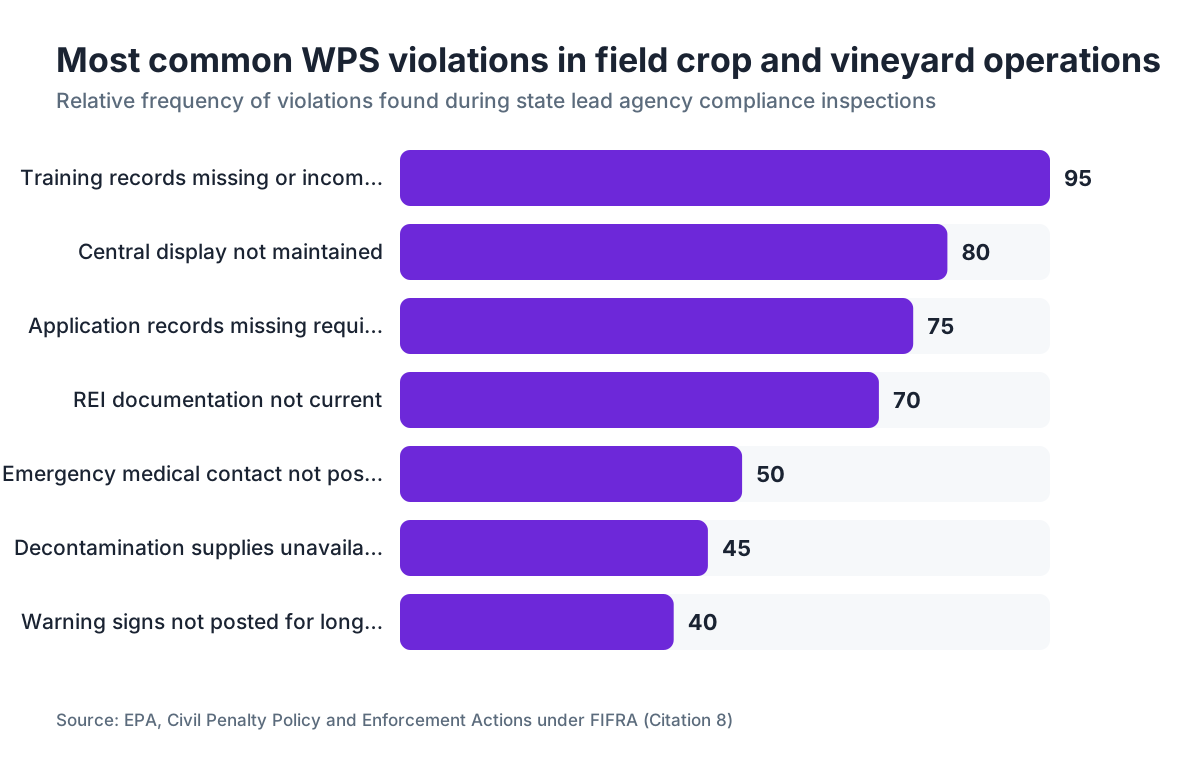
EPA's compliance monitoring work and enforcement guidance point to a familiar set of the most-cited WPS violations in field crop and vineyard settings [1][8]:
| Violation Category | Relative Frequency |
|---|---|
| Training records missing or incomplete | Very high |
| Central display location not maintained | High |
| Application records missing required data fields | High |
| REI documentation not current | High |
| Emergency medical contact not posted | Moderate |
| Decontamination supplies not available in treated area | Moderate |
| Warning signs not posted for long-REI applications | Moderate |
An inspector arriving mid-harvest usually asks to see four things: your pesticide application records for the season, training records for the workers currently in the field, the central display, and proof of decontamination stations in or near the picking blocks.
They can also interview workers directly, without you present. That's their right under WPS. Workers can say whether they got training, whether they heard about applications in the area, and whether decontamination supplies were on hand. Paperwork that contradicts what workers report is a serious problem.
Fines are set by state programs and vary a lot. Federal referrals can bring civil penalties up to $19,636 per violation under current EPA penalty authority. [8] Most states start with a warning for first-time, good-faith slips. Repeat or willful violations climb fast.
To tighten your records before harvest, tools like VitiScribe handle vineyard spray log management and WPS record organization, keeping application data, REI calculations, and training logs in one place.
Do WPS requirements change if you're certified organic?
Mostly no. That surprises a lot of organic growers.
WPS applies to any establishment that uses pesticides, and for WPS purposes a "pesticide" includes plenty of substances common in organic production: copper fungicides, sulfur, spinosad, and other OMRI-listed materials registered with EPA. If the product has an EPA registration number and an REI on the label, WPS applies to its use. [1]
The narrow exception: an operation that uses only pesticides qualifying for the minimum-risk exemption under 40 CFR 152.25(f) is exempt from WPS for those applications. But most organic vineyard programs run at least some EPA-registered products, so full WPS compliance still holds.
What organic certification changes is how this meshes with your organic system plan. Your OSP already has you record every material applied, plus timing and rates. Those records overlap heavily with WPS application documentation. Line up your record format once, and one document satisfies both instead of running two parallel systems.
UC's organic viticulture resources and USDA's National Organic Program compliance guidance both point growers toward merging OSP recordkeeping with WPS records to cut the double work. [6][9]
What language requirements apply to WPS documents and training for harvest crews?
The 2015 revision added language access requirements that hit multilingual harvest crews directly.
The WPS safety poster at the central display must be in English plus any other language spoken by a significant portion of the workers at the establishment. EPA doesn't pin "significant portion" to a set percentage, but its training materials make clear that workers who aren't literate in English need information in a language they understand. [1]
Training has to be delivered so workers can understand it. If your crew is mostly Spanish-speaking, English-only training doesn't satisfy the rule. EPA has approved Spanish-language WPS training materials, and other language versions come through the National Pesticide Safety Education Center and state extension programs. [10]
Here's the documentation angle: your training records should note the language training was delivered in. Train 20 workers in Spanish with an approved Spanish video, and write "training conducted in Spanish" on each record. If an inspector asks how a crew with no English got meaningful WPS training from an English-only session, your records need to answer.
WSU Extension's Pesticide Safety Education Program publishes Spanish WPS materials for Pacific Northwest crews, and UC Cooperative Extension has similar resources for California wine grape operations. [4][6]
One practical note: oral notice of pesticide applications has to be in a language the worker understands too. An English-only posting doesn't count as notice for workers who can't read English.
What's the fastest way to get your WPS documentation in order before harvest starts?
If you're reading this in July or August with harvest six weeks out, here's a realistic sequence.
Week 1: Pull your pesticide application records for the whole season. Check each one against the WPS data fields (product name, EPA registration number, active ingredients, date and time, location, application method, certified applicator name and address, REI start). Fill the gaps now. Print or export a clean copy.
Week 2: Audit your training records. Using a labor contractor? Contact them this week and get their training documentation in writing. Training your own crew? Schedule the sessions and confirm you have an EPA-approved training method ready. Check that your trainer meets WPS credentialing.
Week 3: Set up or verify your central display. Confirm the current WPS poster is up (EPA revised the poster in 2017; older versions are technically out of compliance). Pre-populate the application information section with this season's spray data.
Week 4: Verify decontamination stations are stocked and identified at each picking block. Confirm the emergency medical contact is correct and current. Check that your warning sign inventory covers any late-season applications with REIs over 48 hours.
For an ongoing season, building these records into your weekly spray program beats reconstructing them six weeks before harvest. A log that captures all the WPS fields at the time of application takes about 10 minutes per application. Rebuilding three months of applications from memory and phone photos takes far longer and always leaves holes.
VitiScribe was built for exactly this kind of record assembly, with WPS-required fields baked into every spray entry so nothing slips at application time.
Where can you find official WPS training materials and compliance resources?
A handful of free, reliable sources cover WPS compliance for vineyard and wine grape operations.
EPA's pesticide worker safety page at epa.gov is the authoritative source for the full regulatory text, the official safety poster (in multiple languages), and the agency's plain-language compliance guide for agricultural employers. [1]
The National Pesticide Safety Education Center coordinates EPA-approved WPS training materials and keeps a list of state pesticide safety education programs. [10]
WSU Extension's Pesticide Safety Education Program has published harvest crew WPS guidance for Washington, including bilingual materials and a farm-specific recordkeeping guide. [4]
UC Cooperative Extension and UC's agricultural safety programs have resources built for California wine grape operations, including guidance on dealing with county agricultural commissioners during inspections. [6]
Cornell's Agricultural Workforce Development initiative covers WPS through the lens of labor contractor relationships, which maps directly onto harvest crew management in New York wine regions. [5]
For a concise reference, CDFA and California's county agricultural commissioners publish the pesticide use reporting requirements that run parallel to WPS documentation, and those county offices will often answer specific compliance questions for free. [3]
One honest note: extension publications get updated more often than growers expect, and an old printout may not match the current rule. Check the publication date on any extension document you lean on, and verify against the current EPA regulation when anything's unclear.
Frequently asked questions
How long do I have to keep WPS records for my hand harvest crew?
Two years from the date of the activity being recorded. That covers pesticide application records, worker training records, and handler certification documentation. The clock starts at the activity date, not the end of the season or calendar year. Records must be producible within 24 hours of a request by EPA, a state lead agency, or a worker's authorized representative under 40 CFR 170.311.
Do I need WPS records if I hire a labor contractor to run my hand harvest?
Yes. The vineyard owner or operator keeps WPS responsibility as the agricultural employer, even when a contractor supplies and supervises the crew. Verify that the contractor's training records are complete, confirm all workers were trained before entering treated areas, and keep your own documentation showing you exercised oversight. Get written confirmation of training compliance from any contractor before harvest starts.
What happens if a worker enters a field during an REI?
Entry during a re-entry interval is a WPS violation and a possible pesticide exposure incident. If you learn of an early entry, document it right away: who entered, which block, which product was applied, when it went on, and when the REI expires. Report any exposure symptoms to the nearest emergency medical facility. Some states require reporting REI violations to the state lead agency. EPA can assess civil penalties up to $19,636 per violation for willful or repeat offenses.
Does WPS training need to be repeated every year?
Yes. WPS safety training is valid for one year from the training date. Workers and handlers trained more than 12 months ago need retraining before entering treated areas. This applies to returning seasonal employees, more than just new hires. Keep dated training records so you can quickly tell whether returning crew members need a refresher before harvest.
Can WPS training be done online or by video?
Yes. EPA-approved video and online materials satisfy the WPS training requirement. The trainer still needs to be present to answer questions and sign the training record. EPA keeps a list of approved training materials. For multilingual crews, use the approved materials in the language workers understand, and note that language on each training record.
What information has to be in a pesticide application record under WPS?
Required fields: product name, EPA registration number, active ingredient(s), date and time of application, location of the treated area, application method, name and address of the certified applicator or commercial handler, and the start of any re-entry interval. California adds fields for state pesticide use reporting. Record all of this at the time of application, not afterward, to avoid gaps.
Does WPS apply to organic wine grape operations?
Usually yes. WPS applies to any farm using EPA-registered pesticides. Most organic vineyards use at least some registered materials (copper fungicides, sulfur, spinosad) that carry EPA registration numbers and REIs on their labels. Only operations using exclusively minimum-risk pesticides under 40 CFR 152.25(f) are exempt. If your organic program uses any EPA-registered inputs, full WPS documentation applies.
What's the difference between a re-entry interval and a pre-harvest interval?
They're separate, and both must be met. The re-entry interval (REI) is a WPS rule about when workers can safely enter a treated area after application, set for worker safety. The pre-harvest interval (PHI) is a pesticide registration rule about how many days must pass before harvesting, set to control residue on the fruit. A product might have a 4-hour REI but a 7-day PHI: workers can enter in 4 hours but can't pick for 7 days.
What languages do WPS posters and training need to be in for my crew?
The WPS safety poster must be in English plus any other language spoken by a significant portion of your workers. Training has to be delivered in a language workers understand. For Spanish-speaking crews, EPA has approved Spanish-language posters and training materials. Document the language used for training on each worker's record. Posting English-only materials for a crew that can't read English does not satisfy WPS.
Do I need to post warning signs for every pesticide application?
Only for applications with REIs over 48 hours. For REIs of 48 hours or less, written or verbal notice to workers before they enter is enough, but you keep a record of that notice. For REIs over 48 hours, post warning signs at all entry points to the treated area right after application. Document when signs went up and when they came down after the REI expired.
What decontamination supplies are required under WPS and where do they need to be?
WPS requires soap, water, and single-use towels for decontamination. Routine stations need at least one gallon of water per worker expected to use the station; handler decontamination needs at least three gallons per handler. Stations go in or next to treated areas where workers are working, more than at a central farm location. For crews spread across multiple blocks, plan a station at each harvest area.
What information must be at the central display location during harvest?
The central display must include the current EPA WPS safety poster, pesticide application and hazard information for applications made in the last 30 days (product name, active ingredients, REI, treated area location, and specific worker instructions), and the name, address, and phone number of the nearest emergency medical facility. The display must be accessible to workers during their work period and maintained throughout harvest.
Can I be cited for WPS violations if my labor contractor was responsible for training?
Yes. The agricultural employer, meaning the vineyard owner or operator, is ultimately responsible for WPS compliance on the establishment. If a contractor failed to train workers properly or keep records, the vineyard can still be cited. Protect yourself: get written confirmation of training compliance from contractors before harvest, keep copies of their training records on file, and document your own oversight steps.
How do I handle WPS records for workers who split time across multiple vineyard blocks?
Each worker's training record is tied to the person, not the block, so one training record covers all blocks. Application records, though, are block-specific. Make sure your application records name each treated block clearly and that your notification records for each block are complete. Workers should hear the application and hazard information for every area they enter, more than a single season-level briefing.
Sources
- EPA, Worker Protection Standard (40 CFR Part 170): Core WPS requirements including training, application records, REI documentation, central display, and two-year record retention period
- EPA, WPS Decontamination Requirements Guidance: WPS requires at least one gallon of water per worker for routine decontamination and three gallons per handler at handler decontamination stations
- California Department of Pesticide Regulation, Pesticide Use Reporting: California requires pesticide use reports be submitted to county agricultural commissioners and that supervisors hold a Qualified Applicator License or Certificate
- Washington State University Extension, Pesticide Safety Education Program: WSU Extension recommends paper spray records be kept in a weather-resistant binder at the farm office and publishes bilingual WPS training materials for harvest crews
- Cornell University, Agricultural Workforce Development Program: The agricultural employer retains WPS responsibility even when a labor contractor supplies harvest crews; contractor training records must be verified
- UC Cooperative Extension, Agricultural Safety and Pesticide Compliance Resources: UC Cooperative Extension guidance recommends integrating organic system plan records with WPS documentation to reduce administrative duplication and covers WPS compliance with farm labor contractors in wine grape harvest
- Washington State Department of Agriculture, Worker Protection Standard Requirements: Washington State requires the WPS safety poster to be displayed in the primary language of the majority of workers when that language is not English
- EPA, Civil Penalty Policy and Enforcement Actions under FIFRA: Federal civil penalties for WPS violations can reach up to $19,636 per violation under current EPA penalty authority
- USDA Agricultural Marketing Service, National Organic Program Compliance: National Organic Program compliance guidance recommends aligning organic system plan recordkeeping with WPS records to reduce administrative duplication
- National Pesticide Safety Education Center, WPS Training Materials: NPSEC coordinates EPA-approved WPS training materials in multiple languages and maintains a list of state pesticide safety education programs
Last updated 2026-07-10