Precision viticulture market: size, tools, and what actually pays off
TL;DR
- The global precision viticulture market was valued at roughly $1.4 to 1.7 billion in 2023 and is projected to grow 10 to 14% a year through 2030, driven by remote sensing, variable-rate application, and vineyard software.
- Adoption is highest in large commercial operations.
- Small growers are catching up fast as sensor costs drop and shared services spread.
How big is the precision viticulture market right now?
Market sizing here is messy, and anyone who hands you one clean number is smoothing over real differences in how research firms count. The ballpark holds up, though. Estimates from MarketsandMarkets, Grand View Research, and similar firms put the global precision viticulture market between $1.4 billion and $1.7 billion as of 2022 to 2023, with compound annual growth rates projected between 10% and 14% through 2030. [1]
That growth rate is roughly double the broader agricultural technology average. The driver isn't hype. It's water scarcity rules, rising labor costs, and the yield and quality gains that remote sensing and variable-rate technology have produced in replicated trials.
North America and Europe together spend most of the money. California, France, Spain, Australia, and Italy generate the bulk of commercial activity. China grows fast from a small base, but the data coming out of that region is unreliable.
Growers under 50 acres are a tiny slice of current revenue. That's shifting. A basic NDVI drone survey cost roughly $15 to 25 per acre in 2018. In 2024 it runs $5 to 12 per acre depending on vendor and region. Entry-level soil sensor packages have followed the same curve. [2]
What tools and technologies make up precision viticulture?
"Precision viticulture" covers a lot of ground. In practice it splits into five categories with different cost structures, learning curves, and payoff timelines.
Remote sensing and imagery. Satellite NDVI subscriptions (Planet, Maxar), fixed-wing aircraft surveys, and drone multispectral imaging. Satellite subscriptions for a single block run $200 to 800 per year. Drone services run $5 to 25 per acre per flight depending on the sensor payload. These tools are the most mature and have the clearest ROI evidence. [3]
Soil sensors and EM mapping. Electromagnetic induction mapping (Veris, DUALEM) creates a soil variability map that drives zone decisions. A one-time EM survey typically costs $8 to 20 per acre done professionally. Continuous soil moisture sensors (Sentek, Campbell Scientific, Irrometer) run $300 to 1,200 per station installed. Most valuable in irrigated vineyards.
Variable-rate application (VRA) equipment. Sprayers, spreaders, and irrigation controllers with prescription-based variable-rate capability are the highest capital cost. A variable-rate sprayer retrofit runs $15,000 to 50,000. Most small operations lease access or hire contractors rather than own the gear.
Weather stations and microclimate networks. On-site stations from Davis Instruments, Onset, or Pessl cost $500 to 3,500 installed. Networked systems with disease model integration can reach $5,000 to 15,000 for a full block deployment.
Vineyard management software. This category ties everything else together. It pulls sensor data, spray records, scouting notes, and compliance documents into one place. Prices range from free basic apps to $500 to 2,000-plus per year for operations-grade platforms. This is also where EPA Worker Protection Standard (WPS) compliance and restricted-use pesticide records live. [4]
What does the research actually say about precision viticulture ROI?
Here's where honest reporting matters most, because the marketing claims and the peer-reviewed evidence don't always agree.
The clearest ROI evidence comes from irrigation. UC Davis deficit irrigation research in wine grapes found that soil moisture sensor-guided irrigation cut water use by 15 to 30% while holding or improving berry quality against calendar-based scheduling. [5] That saving turns straight into dollars in drought-restricted regions like California's Central Coast, where water costs $500 to 1,500 per acre-foot in some districts.
On variable-rate nitrogen, a Washington State University trial in the Yakima Valley found NDVI-guided variable-rate fertilizer cut nitrogen inputs by an average of 22% across blocks while yield held steady. [6] In blocks where uniform applications were pushing over-vigorous zones, fruit quality improved. It's not a one-off. Similar patterns show up in South Australian and Spanish trial data.
Drone and satellite NDVI mapping shows its most consistent benefit in flagging under-performing zones early enough to intervene. A Cornell study of New York Finger Lakes vineyards found NDVI mapping identified soil-driven yield variability at rates matching actual harvest yield maps, though the relationship was stronger in unirrigated blocks. [7]
What lacks strong evidence? Automated canopy management robots are still mostly in demonstration trials. The economics on full robotic thinning or shoot positioning don't close for most operations at current machine costs of $200,000 to 500,000-plus per unit. Nobody has good long-term data here. The closest studies are single-season trials.
The honest summary: remote sensing, soil moisture sensing, and prescription irrigation have solid multi-year evidence. Everything else runs from promising to speculative, depending on your scale and labor costs.
How does vineyard size affect whether precision viticulture makes sense?
Scale matters enormously. The math changes fast below about 100 acres.
For a 500-acre operation in the San Joaquin Valley, a $25,000 variable-rate irrigation investment that saves 20% of water across the block can pay back in 2 to 4 seasons. For a 20-acre Napa estate, the same investment may never pay back on water savings alone. The quality argument (more uniform ripeness, cleaner lot separation) might still justify it.
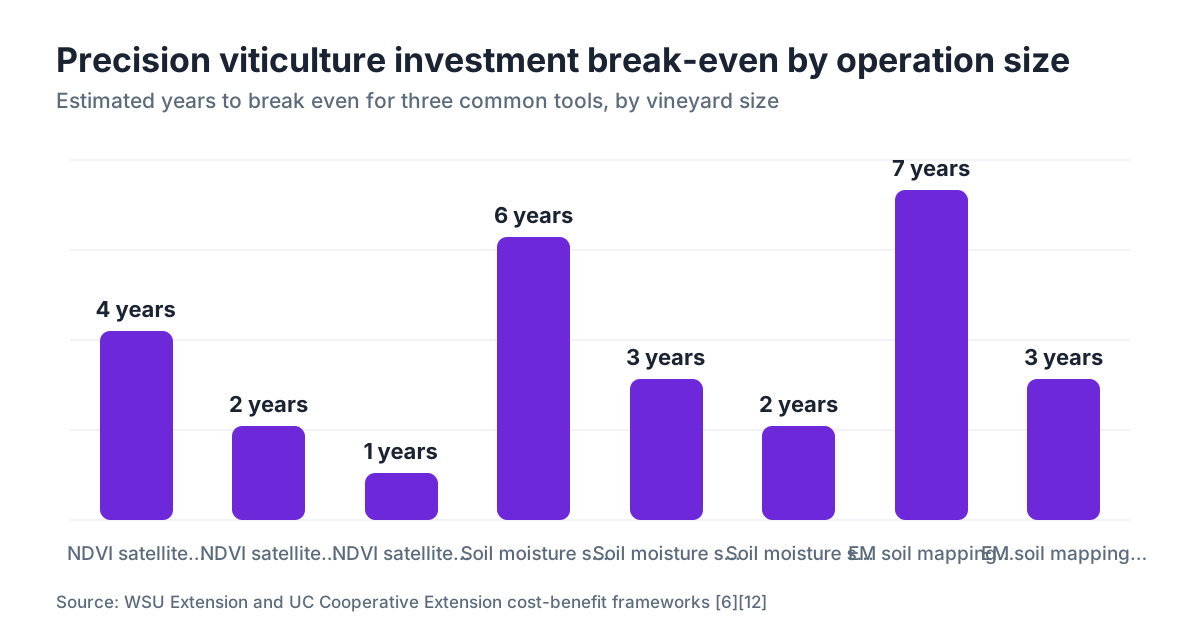
The table below shows approximate break-even timelines by operation size for three common investments, drawn from extension cost-benefit frameworks at UC Cooperative Extension and WSU. These are ranges, not promises, and they assume professional installation plus actual use of the data.
| Investment | 20-acre block | 100-acre operation | 500-acre operation |
|---|---|---|---|
| NDVI satellite subscription | 3 to 6 years | 1 to 3 years | <1 year |
| Soil moisture sensor network | 4 to 8 years | 2 to 4 years | 1 to 2 years |
| EM soil mapping (one-time) | 5 to 10 years | 2 to 5 years | 1 to 3 years |
| VR sprayer (leased/contracted) | ROI unclear | 3 to 6 years | 1 to 3 years |
Growers in the 5 to 30 acre range usually get the best economics from shared services. County farm bureaus, viticulture consultants, and some regional grower associations now run shared drone scouting programs where per-flight costs drop to $3 to 7 per acre because several growers split one flight path.
For owners of small vineyard operations, the entry point that makes sense at almost any scale is weather station data plus record-keeping software. The pair costs under $1,500 per year for most operations and gives you both agronomic value and compliance coverage.
What role do drones and satellite imagery play in modern vineyard management?
Remote sensing is probably the single most-adopted precision viticulture tool in commercial wine grape production right now. The reason is simple. It answers the question every vineyard manager asks in July: where in this block is something wrong that I can still fix?
NDVI (Normalized Difference Vegetation Index) is the workhorse. It's sensitive to canopy density and chlorophyll content, which track reasonably well with vine stress, disease pressure, and yield potential. Everyone in the field knows the limit: NDVI saturates in dense, vigorous canopies, which is often exactly where you're trying to tell "good vigor" from "excessive vigor." Newer indices like NDRE (Red Edge) and CWSI (Crop Water Stress Index) handle that better, but they need pricier sensors.
Satellite services like Planet Labs and Maxar now offer 3-meter multispectral imagery with 5 to 7 day revisit times at prices mid-size operations can afford. Sentinel-2 from ESA is free at 10-meter resolution, which is fine for block-level decisions but not row-level precision. [3]
Drones give you resolution satellite can't touch. Most commercial systems flying at 80 to 120 meters above ground deliver 5 to 10 cm per pixel, enough to see individual vines. The trade-off is coverage rate. A DJI Matrice with a Micasense sensor covers 50 to 80 acres per flight hour in good conditions. A 300-acre block takes a full day once you count setup and battery swaps.
The real question for most growers isn't drone versus satellite. It's buy a drone, hire a service, or subscribe to satellite? Unless you run multiple vineyards past 500 acres and have staff to process imagery, hiring a service or subscribing to a satellite analytics platform almost always beats ownership. The analytics layer is where most of the operational value lives, and a service contract usually bundles it in.
How is precision viticulture connected to pesticide compliance and WPS?
Most precision viticulture coverage skips this connection. It's real and it's practical.
The EPA Worker Protection Standard (40 CFR Part 170) requires vineyard operations to keep records of pesticide applications including product name, EPA registration number, application date, location, rate, and the restricted-entry interval (REI) for each product. [4] Precision viticulture records, especially block maps and variable-rate application logs, can support WPS compliance or create new headaches if your zone-based records don't line up with the block designations in your compliance files.
If you're applying variable-rate across management zones, your spray records need to show actual rates per zone rather than one field-average number. This matters in California, where the Department of Pesticide Regulation (CDPR) audit standards for restricted-use pesticide records require site-specific data that matches your applications. [8]
The good news: most modern platforms and vineyard management software generate records structured correctly for WPS if you set them up right. The bad news: the default outputs from drone analytics platforms and VRA controllers often don't map cleanly to the block and sub-block structure your county ag commissioner expects. Closing that gap takes deliberate setup work.
This is where vineyard compliance software earns its keep. A platform like VitiScribe is built around the block-level record structure WPS and CDPR require, so when you pull drone imagery or VRA logs in, they attach to the right compliance record instead of floating around as loose files.
What are the leading companies and platforms in the precision viticulture market?
The market has three tiers. Which tier you buy from matters for both cost and long-term data ownership.
Integrated hardware and analytics platforms. These companies sell the sensor hardware and own the analytics layer. Trimble with its Ag Software suite, Topcon, and AgLeader are the largest. They're built for broadacre grain agriculture and have adapted to viticulture with mixed results. Their strength is hardware integration. Their weakness is that viticulture-specific features tend to be bolted on rather than native.
Viticulture-specific software and imagery analytics. Companies built specifically for wine grape production: Fruition Sciences (sap flow and water stress monitoring), DigifarmZ, Pessl Instruments (weather and disease modeling), and several regional players. Better viticulture logic baked in, smaller development teams behind it.
Data and imagery services. Planet Labs, Maxar, EarthDaily Analytics, and regional drone service providers. They sell data, not decisions. You still need an analytics layer to turn raw imagery into workable management zones.
University extension programs belong here too as non-commercial resources. UC Davis's Viticulture and Enology department publishes irrigation decision tools and has run some of the most credible field trials. Cornell's Lake Erie Grape Program and the Cornell Cooperative Extension network publish precision viticulture adoption guides for cool-climate varieties. WSU Extension's viticulture team in Prosser covers tools relevant to Washington and Oregon. [5][6][7] These are free, and most growers underuse them.
How is AI and machine learning changing precision viticulture?
The honest answer: it's real but early, and a lot of what's marketed as AI is just slightly better statistics.
The genuinely new capability machine learning brings is pattern recognition in imagery at a scale humans can't match. A convolutional neural network trained on thousands of labeled vine images can flag early Botrytis infection, leafroll virus symptoms, or grapevine trunk disease in multispectral images before a human scout would spot them. Studies from INRAE in France and from UC Davis report detection accuracies of 80 to 90% for some diseases under controlled conditions. [9] Field performance across diverse vineyard conditions runs lower, somewhere in the 65 to 80% range depending on disease and growth stage.
Yield forecasting models that combine NDVI time-series with weather inputs and historical yield records now produce pre-harvest estimates within 10 to 15% of actual harvest weight in well-characterized vineyards. That accuracy helps winery planning and grape sale talks, but it needs 3 to 5 years of calibration data from your own blocks before the model is worth trusting.
Fraud detection and geographic indication integrity is a growing use. Spectroscopic analysis of grape and wine samples paired with machine learning classifiers can identify geographic origin with reasonable accuracy, which is commercially interesting in protected designation markets. Most of this is still in research and regulatory trials.
The practical advice: don't buy "AI-powered" as a feature. Ask what the model was trained on, what the validation accuracy was in conditions like yours, and who owns the data your operation generates while using the platform. Data ownership is going to matter a lot in this market over the next decade.
What's the projected market growth through 2030, and what's driving it?
The growth story has three real drivers and one that gets oversold.
Real driver one: water. California's Sustainable Groundwater Management Act (SGMA), enacted in 2014 and now entering enforcement-phase allocations in many basins, is pushing irrigated agriculture including vineyards into documented, monitored water use. [10] Precision irrigation tools that generate water use records aren't optional anymore in regulated groundwater basins. That demand isn't sensitive to ROI math because compliance isn't optional.
Real driver two: labor cost and availability. Hand-thinning, hand-harvesting, and hand-scouting are all under pressure from rising labor costs and workforce shortages in California, Washington, and Oregon. Every task precision sensing can reduce or automate carries a direct labor offset. USDA data show California farm labor costs rose roughly 35% between 2018 and 2023. [11]
Real driver three: premium wine quality demands. Buyers of $30-plus wine increasingly want lot-level traceability and block-specific quality documentation. Precision viticulture records provide it. That's a marketing and contract compliance benefit more than a farming efficiency one.
The oversold driver: pure technology enthusiasm. Precision agriculture investment runs in cycles of hype and correction, and viticulture isn't immune. The 2020 to 2022 stretch saw venture capital pour into agtech at rates that can't hold, and some precision viticulture startups have folded or pivoted. The 10 to 14% CAGR projections are credible if water regulation and labor economics stay on their current path. If either softens, growth slows.
How do I evaluate whether a precision viticulture investment is right for my operation?
Start with your biggest pain point, not the newest tool.
If irrigation scheduling uncertainty is your worst problem, start with soil moisture sensors and a weather station. If it's spray efficacy and resistance management, start with scouting data and disease model integration. If it's compliance paperwork and WPS record burden, start with vineyard management software. Buying expensive remote sensing gear while your spray records are a mess is the wrong order.
A practical framework from WSU Extension suggests three questions before any precision agriculture purchase: [6]
- Can I put a dollars-per-acre-per-year figure on the problem this solves?
- Does the data this tool generates connect to a decision I'll actually make differently?
- Who will process and interpret this data, and do I have that capacity on staff?
Question three is the one most growers get wrong. A drone that spits out beautiful NDVI maps is worthless if nobody has time to analyze them between flights. Budget beyond the hardware or subscription. Budget for the 2 to 4 hours a month of analytical time that turns data into management actions.
For operations running record-keeping and compliance software like VitiScribe, the integration question matters. Will the precision tool you're weighing push data into your compliance records automatically, or will you be retyping from one system into another? Manual transcription is where record accuracy degrades and where compliance risk piles up.
The single best first investment for most operations under 100 acres: a calibrated weather station feeding a disease model (powdery mildew, Botrytis) paired with good record-keeping software. Total annual cost under $2,000. ROI is often visible within one season from reduced spray costs alone.
What does a precision viticulture adoption look like for Paso Robles or other warm-climate regions?
Region matters. Tools that pay off in Washington's Yakima Valley don't necessarily deliver the same ROI in Temecula or the Sierra Foothills.
Warm, dry regions like Paso Robles face a specific mix: high summer evapotranspiration that stresses vines, variable soil depth and water-holding capacity (especially in the east side's calcareous soils), and rising regulatory pressure on groundwater. Here, soil moisture sensing and precision deficit irrigation scheduling carry among the highest documented ROIs of any precision viticulture technology.
A UC Cooperative Extension study on the Central Coast found sensor-guided deficit irrigation in Cabernet Sauvignon blocks cut water use by an average of 18% while raising berry anthocyanin concentration against calendar-based scheduling. [12] That's a double payoff: lower water cost and higher-value fruit.
Disease modeling for powdery mildew is less critical in the arid Central Coast than in coastal Sonoma or the Finger Lakes, where humidity drives infection pressure. Spray interval tools and wetting-period models built for humid regions offer less in Paso Robles. You're spraying on different risk logic there.
The lesson: before buying any precision viticulture tool, look at what your nearest university extension program actually recommends for your region. UC Cooperative Extension's Central Coast advisors, WSU's Prosser team, and Cornell's Lake Erie program all publish region-specific guidance reflecting local disease pressure, irrigation need, and soil variability.
Frequently asked questions
What is the current size of the precision viticulture market?
The global precision viticulture market was valued at approximately $1.4 to 1.7 billion in 2022 to 2023, depending on which research firm's methodology you use. It's projected to grow at a compound annual rate of 10 to 14% through 2030. North America and Europe account for most current spending. These estimates come from MarketsandMarkets and Grand View Research, though independent verification of their exact figures is difficult.
Is precision viticulture worth it for small vineyards under 20 acres?
For most operations under 20 acres, expensive hardware like variable-rate sprayers or full drone ownership doesn't pay back on efficiency alone. The tools that consistently earn their cost at small scale: a calibrated on-site weather station ($500 to 1,500), disease model subscriptions, and vineyard management software for compliance and spray records. Shared drone scouting through a consultant or grower cooperative adds NDVI mapping for $3 to 7 per acre without ownership costs.
What NDVI indices should I use for vineyard canopy assessment?
Standard NDVI works well for moderate-vigor canopies and is the most widely supported index across platforms. In high-vigor vineyards, NDVI saturates and loses discrimination; NDRE (Red Edge NDVI) performs better there. For water stress specifically, CWSI (Crop Water Stress Index) using thermal imagery is more direct than reflectance-based indices, though it needs a thermal sensor. WSU and UC Davis extension materials cover index selection in more detail.
How do precision viticulture records connect to EPA Worker Protection Standard compliance?
Under EPA's Worker Protection Standard (40 CFR Part 170), every pesticide application must be documented with product name, EPA registration number, application date, treated location, rate, and restricted-entry interval. Variable-rate application logs from precision equipment need to match the block-level structure in your WPS files. If your spray records use different zone or block identifiers than your WPS records, auditors can spot the discrepancies. Set up your management software with consistent block names from the start to prevent this.
What companies offer satellite imagery for vineyard management?
Planet Labs offers commercial multispectral satellite imagery at 3-meter resolution with frequent revisit times; pricing varies by acreage. Maxar (formerly DigitalGlobe) offers higher resolution at higher cost. Sentinel-2 from ESA is free at 10-meter resolution, good for block-level analysis. Analytics companies like EarthDaily, Ceres Imaging, and Fruition Sciences layer processing and decision-support tools on top of raw satellite data. Free Sentinel-2 data through Copernicus is a sensible starting point for growers testing the technology.
How accurate are AI-based vine disease detection tools?
In controlled research, machine learning models for detecting powdery mildew, leafroll virus, and Botrytis in multispectral imagery have reported accuracies of 80 to 90%. Field performance across diverse commercial vineyards is typically lower, in the 65 to 80% range depending on disease, vine variety, and growth stage. Studies from INRAE and UC Davis have published the strongest validation data. No commercially deployed tool has published long-term accuracy data across multiple seasons in diverse geographies.
What is the break-even timeline for a soil moisture sensor network in a vineyard?
Break-even depends on water cost and how much over-irrigation you're doing now. In California districts where water costs $500 to 1,500 per acre-foot, a soil moisture sensor network costing $5,000 to 10,000 installed (for a 20 to 40 acre block) typically breaks even in 2 to 5 seasons if it drives a 15 to 25% cut in applied water. UC Davis deficit irrigation research supports that reduction range for sensor-guided scheduling versus calendar-based approaches in wine grapes.
How does California's SGMA affect vineyard precision irrigation requirements?
California's Sustainable Groundwater Management Act (SGMA) requires groundwater sustainability agencies in critically over-drafted basins to develop and implement plans that bring basins into balance, typically by 2040 for high-priority basins. For vineyards in covered basins, that means documented extraction reporting and, in many districts, allocation limits. Precision irrigation tools that generate verified water use records provide the documentation these programs require. The State Water Resources Control Board oversees SGMA implementation.
Does drone scouting replace traditional vine scouting for pest and disease?
No, and anyone selling it as a replacement is overpromising. Drone NDVI and multispectral imagery flags zones of stress or anomaly, but it doesn't diagnose the cause. A human scout still needs to walk those flagged zones and make the pest or disease call. The value of drone scouting is that it prioritizes where your scout spends time, which in a 200-acre block is genuinely useful. UC Davis and Cornell both describe drone scouting as a triage tool, not a replacement for ground observation.
What extension resources are available for precision viticulture decision-making?
UC Davis's Department of Viticulture and Enology publishes irrigation scheduling tools, disease modeling guides, and cost-of-production studies for California wine grapes. Cornell Cooperative Extension's Lake Erie Grape Program and the Finger Lakes advisors publish cool-climate-specific guidance. Washington State University Extension in Prosser covers irrigation, variable-rate nitrogen, and canopy management for Pacific Northwest conditions. All three publish freely online, and all have farm advisors reachable by phone or email for site-specific questions.
How does precision viticulture data affect grape contract pricing or negotiations?
Block-level data creates two advantages in grape contract talks. First, yield forecasts with 10 to 15% accuracy help both parties plan logistics and pricing earlier. Second, quality documentation (berry chemistry by block, irrigation history, spray records) supports arguments for differential pricing between lots. Premium wine buyers above the $30 bottle tier increasingly request this documentation. Its value depends heavily on your buyer relationships and whether your contracts carry quality incentive structures.
What is the typical cost of a professional EM soil survey for a vineyard block?
Professional electromagnetic induction (EM) soil mapping using equipment like Veris or DUALEM typically costs $8 to 20 per acre for a contractor-performed survey, with most quotes closer to $10 to 15 per acre for blocks over 20 acres. It's a one-time cost that produces a soil variability map used for years. The map drives management zone delineation for variable-rate applications and irrigation. For vineyards with high soil variability, the investment frequently pays back within 2 to 3 seasons through more targeted inputs.
Are there any precision viticulture grants or cost-share programs available?
USDA's EQIP (Environmental Quality Incentives Program), administered through NRCS, offers cost-share for precision irrigation systems, soil moisture monitoring, and related conservation practices. Eligible practices and payment rates vary by state and fiscal year. California's State Water Efficiency and Enhancement Program (SWEEP), administered by CDFA, has funded precision irrigation upgrades in past cycles. Both require applications during specific enrollment windows. Contact your local NRCS office or county CDFA office for current availability.
Sources
- Grand View Research, Precision Viticulture Market Size & Share Report: Global precision viticulture market valued at approximately $1.4 to 1.7 billion in 2022 to 2023, CAGR projected at 10 to 14% through 2030
- American Journal of Enology and Viticulture (American Society for Enology and Viticulture): Declining per-acre costs of drone-based NDVI surveying over 2018 to 2024 period
- ESA Copernicus, Sentinel-2 Mission Overview: Sentinel-2 satellite provides free 10-meter resolution multispectral imagery with approximately 5-day revisit time
- U.S. EPA, Worker Protection Standard 40 CFR Part 170: EPA WPS requires records of pesticide applications including product, EPA registration number, date, location, rate, and REI
- UC Davis Department of Viticulture and Enology, Deficit Irrigation Research: Soil moisture sensor-guided irrigation reduced water use by 15 to 30% while maintaining or improving berry quality compared to calendar-based scheduling in UC Davis trials
- Washington State University Extension, Viticulture and Enology Program: NDVI-guided variable-rate fertilizer application reduced nitrogen inputs by an average of 22% across Yakima Valley blocks in WSU trial while holding yield steady
- Cornell University College of Agriculture and Life Sciences, Lake Erie Grape Program: Cornell study found NDVI mapping identified soil-driven yield variability consistent with actual harvest yield maps in New York Finger Lakes vineyards
- California Department of Pesticide Regulation, Pesticide Use Reporting: CDPR audit standards for restricted-use pesticide records require site-specific application data matching the field location of applications
- Computers and Electronics in Agriculture (Elsevier), Machine Learning Disease Detection Review: Machine learning models for vineyard disease detection in multispectral imagery have reported controlled-condition accuracies of 80 to 90%, with field performance typically 65 to 80%
- California State Water Resources Control Board, SGMA Implementation: California SGMA requires groundwater sustainability agencies in critically over-drafted basins to bring basins into balance, creating documented water use reporting requirements for agricultural operations
- USDA National Agricultural Statistics Service, Farm Labor Report: California farm labor costs rose approximately 35% between 2018 and 2023
- UC Agriculture and Natural Resources, Central Coast Viticulture, Deficit Irrigation Studies: Sensor-guided deficit irrigation in Central Coast Cabernet Sauvignon blocks reduced water use by average 18% while improving berry anthocyanin concentration compared to calendar-based scheduling
Last updated 2026-07-09