Healthy soils for healthy vines: soil management for productive vineyards
TL;DR
- Vineyard soil health drives root depth, water retention, nutrient cycling, and fruit quality.
- The levers that matter: organic matter (target 2-4%), pH (6.0-7.0 for most varieties), cover crops, less tillage, and soil testing every three to five years.
- A small shift in any of these moves yield and wine character more than almost any input you can buy.
Why does soil health matter more than fertilizer for vines?
Soil health decides whether a vine can even reach the nutrients you paid for. Fertilizer treats a symptom. The soil itself decides root depth, water access, and how much slow-release nitrogen the biology hands the vine across a season. Most managers reach for the fertilizer bag first, and that's backwards.
Vines are perennial. Their roots don't reset every season the way a vegetable crop's do. A root system channeled into compacted, low-organic-matter soil for five years doesn't heal itself when you add nitrogen. The vine just cycles through the same constrained architecture, year after year.
Soil health is shorthand for a set of measurable properties: organic matter content, microbial biomass, aggregate stability, pore structure, pH, cation exchange capacity (CEC), and the diversity of organisms breaking down organic material into available nutrients. When those are in good shape, the root system explores a large soil volume, pulls water between rain events, and draws on a nutrient supply the microbes generate continuously.
The USDA Natural Resources Conservation Service defines healthy soil as soil that "functions as a living ecosystem that sustains plants, animals, and humans." [1] That word "living" carries the whole idea. A cubic foot of healthy vineyard soil can hold billions of bacteria, tens of millions of fungi, thousands of nematodes, and hundreds of earthworms. Strip away the conditions those organisms need and you're running the vine on inert growing media with expensive inputs standing in for biology.
Nobody has clean data on the exact organic matter percentage that maximizes wine quality. Here's what the research does show. Soils below 1% organic matter have markedly lower water-holding capacity and nutrient availability, while soils at 2-4% tend to support stable vine nutrition across seasons, per UC Cooperative Extension guidance. [2]
What are the key soil properties a vineyard manager should measure?
The properties worth tracking are pH, organic matter, CEC, phosphorus, potassium, texture, and bulk density, most of them on a three to five year cycle. You can't manage what you haven't measured. That sounds obvious, and yet plenty of operations sample once at planting and then never again.
Soils change, especially under perennial crops with canopy shading, organic matter inputs, and repeated equipment passes over the same tracks.
Here's what to look for and how often to check:
| Property | Why it matters | Target range (most wine grapes) | Test frequency |
|---|---|---|---|
| pH | Controls nutrient availability, microbial activity | 6.0 to 7.0 | Every 3-5 years |
| Organic matter (%) | Water retention, nutrient cycling, soil structure | 2-4% | Every 3-5 years |
| CEC (meq/100g) | Capacity to hold cations (Ca, Mg, K, NH4) | Varies by soil type; >10 preferred | Every 3-5 years |
| Phosphorus (ppm) | Vine energy metabolism, root health | 20-50 ppm Mehlich-3 | Every 3-5 years |
| Potassium (ppm) | Osmotic regulation, fruit set | 100-200 ppm | Every 3-5 years |
| Soil texture (% sand/silt/clay) | Drainage, water retention, tillage response | Site-specific | Once at planting |
| Bulk density (g/cm³) | Compaction indicator, root penetration | <1.4 for loam | Every 3-5 years or if compaction suspected |
| Active carbon (mg/kg) | Leading indicator of biological activity | Higher is better; >500 improving | Optional, annually if tracking cover crop effects |
Soil pH controls more than most people realize. Below pH 5.5, aluminum and manganese turn soluble at levels toxic to fine roots. [3] Above pH 7.5, iron, zinc, and boron lock up. Most nutrient deficiencies in well-fertilized vineyards are pH problems in disguise.
Bulk density above 1.6 g/cm³ in loamy soils is a practical ceiling for root growth. Roots can't push through it. You find it most in the wheel tracks between rows where equipment passes dozens of times a year.
UC Cooperative Extension recommends composite samples from the vine row and the inter-row separately, at 0-12 inch and 12-24 inch depths. [2] One blended average sample mixes very different conditions and usually misleads you.
What is the right soil pH for wine grapes, and how do you adjust it?
The right target is pH 6.0 to 7.0 for Vitis vinifera, with 6.5 a solid middle ground for most sites. That's the standard from WSU Extension. [3] American varieties and hybrids handle somewhat lower pH, but vinifera roots are genuinely sensitive to the aluminum toxicity that shows up below 5.5.
Too acidic? The fix is agricultural lime. How much depends on your soil's buffering capacity, which follows texture and organic matter. A sandy soil with low organic matter might need only 1-2 tons per acre to move pH a full unit. A heavy clay loam can need 4-6 tons. Get a lime requirement test done alongside the basic panel. Guessing here wastes money and can overshoot.
Lime works slowly. Apply it at least six months before you need the effect. Incorporation helps but isn't always possible in an established vineyard with shallow feeder roots. Surface application still works, just on a slower clock.
Too alkaline, which is common in arid western regions with calcareous parent material? Elemental sulfur is the standard acidifying amendment. Soil bacteria convert it to sulfuric acid over time. That conversion depends on temperature and moisture, so it drags in dry conditions. Granular sulfur at 200-500 lbs per acre can lower pH by about 0.5 units in well-buffered soils over a season or two. Iron sulfate works faster and costs more.
In high-pH ground, rootstock choice matters almost as much as the amendment. Rootstocks like 1103P and 140Ru tolerate lime-induced chlorosis well, while SO4 and 3309C are more sensitive. [4]
How do cover crops improve vineyard soil health?
Cover crops are the highest-return soil investment most vineyards can make, and they're still underused. A well-managed cover crop does several jobs at once. It adds organic matter when terminated or mowed, its roots break compaction and open macropores, it feeds soil biology, it fixes nitrogen if you plant legumes, it holds soil against erosion, and it crowds out weeds.
Cornell's Integrated Pest Management program has documented that inter-row cover crops in New York vineyards cut soil compaction and raised earthworm populations compared to clean-cultivated controls. [5] Earthworms earn their keep. Their castings are nutritional hotspots and their burrows are the most efficient macropores in the soil.
For the inter-row, perennial cover crops like creeping red fescue, hard fescue, or a clover-grass mix are common picks. They need less reseeding and compete less with vines than annual mixes. In drier climates like central Washington or Paso Robles, you may have to mow or roll to manage water competition, or hold cover crops to the wetter winter and spring window using annuals.
The vine row itself usually stays cleaner to cut direct competition for water and nutrients during the establishment years. In mature, irrigated vineyards, a resident vegetation strip under the vine can work if it's mowed low and managed for competition. Some Rhône-style producers in warm climates stress vines this way on purpose for concentration.
Legume cover crops (bell beans, field peas, vetch) can fix 50-150 lbs of nitrogen per acre per year under good conditions. [6] That's real money if you're buying nitrogen. The catch: you have to terminate them before they set seed and start competing hard. Roll crimping or mowing just before or at early flowering gives you the best carbon-to-nitrogen ratio for decomposition.
One thing worth saying plainly. Cover crop programs demand more management attention than bare soil or herbicide strips. If you don't have time to monitor and mow on schedule, start simple. A single perennial grass in the inter-row beats an ambitious mix you can't keep up with.
How does compaction form in vineyards and what actually fixes it?
Compaction forms from heavy equipment on the same wheel tracks, especially when the soil is wet, and the only real fix is to break the layer mechanically or with deep-rooted cover crops, then rebuild biology on top. A loaded tractor with a spray tank can top 10,000 lbs. Repeated passes compress aggregates, collapse macropores, and raise bulk density to where roots physically can't get through.
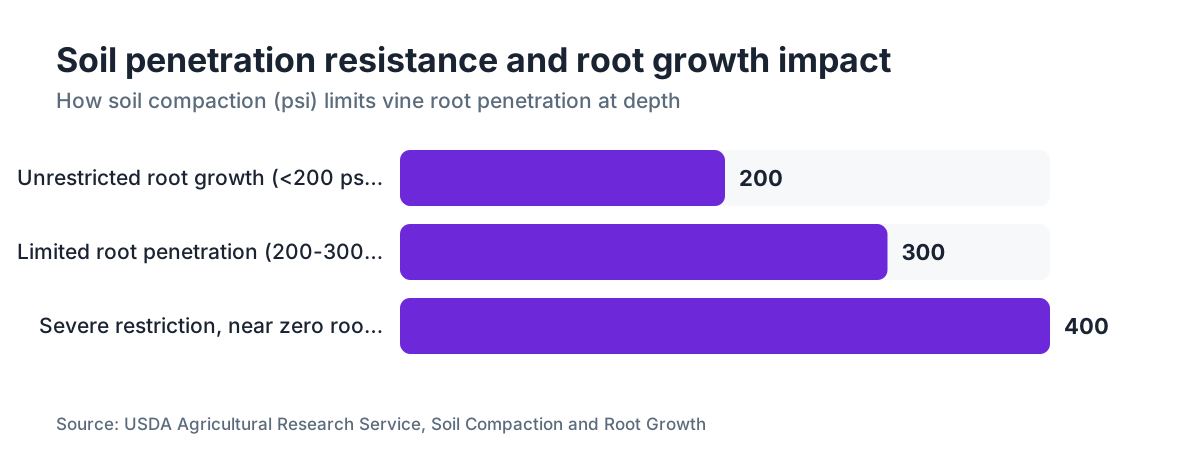
Compaction shows up in two zones. Surface compaction sits in the top 4-8 inches from repeated traffic. A tillage pan forms at 8-16 inches if the operation has run discs or cultivators at the same depth for years. You find the tillage pan with a penetrometer, not by looking. Push it in every 2 inches and note where resistance passes 300 psi. Roots generally can't penetrate above 300 psi and struggle between 200 and 300 psi. [7]
For surface compaction in the traffic zone, cover crops with fibrous grass roots help over multiple seasons, but the fastest mechanical fix is a subsoiler or ripper set to break the compacted layer. Do it in fall on dry soil, in the inter-row only, at angles that don't sever main root axes.
A deep-rooted cover crop like tillage radish is worth trying where you can't subsoil safely. The taproots drive to 12-18 inches, then rot over winter, leaving channels that last.
What doesn't fix compaction: compost on the surface. It helps the top inch or two and does nothing for a pan below it. Break the layer first, then build biology on top.
Prevention is cheaper than remediation. Permanent traffic lanes plus keeping equipment off wet soil prevents most compaction. If your spray schedule forces you into soft ground after rain, the compaction cost may be worth paying for pest control, but go in knowing you're making a trade.
What organic matter inputs work best in a vineyard context?
Compost, composted pomace, mulch, and (with caveats) biochar are the practical inputs, and they differ in how fast they build organic matter and what they contribute. Compost is the workhorse. Well-aged compost from grape pomace, green waste, or manure runs 1-3% nitrogen and adds stable humus that persists in the soil.
UC Cooperative Extension suggests 2-5 tons per acre per year as a maintenance input for established vineyards, applied to the surface in fall or early spring. [2] Fresh manure works but risks pathogens and weed seeds, and its high soluble nitrogen can push excessive vine vigor.
Pomace from your own crush is a logical input at an estate winery. It's high in carbon, low in nitrogen, and needs composting before use to avoid nitrogen tie-up and pathogen problems. A compost pile that reaches 131°F for three days (or 150°F for one day) meets USDA National Organic Program pathogen reduction standards, even if you never certify. [8]
Biochar keeps drawing attention. It resists decomposition, so it builds stable carbon, and its pore structure houses microbes and holds water. The vineyard-specific research base is still thin. Nobody has good long-term data on yield or quality effects here. The closest evidence comes from general horticultural trials showing better water retention in sandy soils.
Mulching the vine row with wood chips, straw, or grape cane chips suppresses weeds, holds moisture, and adds organic matter slowly as it breaks down. A 2-4 inch organic mulch layer can cut vine row irrigation demand by 20-30% in warm climates. The trade: thick mulch can shelter slugs and rodents.
Tracking your organic matter trend over time is where a digital record system pays off. Log soil test results, amendment applications, and cover crop mowing dates in one place and you can see whether your inputs are actually moving the number. VitiScribe's field records module lets you attach soil test PDFs to blocks and flag when retesting is due, which sounds small but prevents the common trap of testing once and forgetting for a decade.
How does soil biology actually feed vines, and should you buy microbial inoculants?
Soil biology feeds vines by holding nitrogen in microbial bodies and releasing it slowly as organisms die and get eaten, which matches vine phenology far better than a single fertilizer hit. Buying inoculants, on the other hand, rarely earns its keep in an established vineyard with decent biology. Urea or ammonium sulfate is plant-available right away. The nitrogen cycling through the soil food web isn't, at first, but it's more persistent and doesn't leach. Bacteria and fungi immobilize nitrogen in their biomass. When they die or get grazed by nematodes and protozoa, that nitrogen releases in forms the vine can take up.
Mycorrhizal fungi deserve a specific note. Most vinifera vines, in natural conditions, form partnerships with arbuscular mycorrhizal fungi (AMF). The fungal hyphae stretch the vine's effective root surface area dramatically and matter most for phosphorus uptake. AMF populations crash under high phosphorus fertilization, tillage, and fumigation. Kill them off and the vine leans harder on soluble fertilizer, which is a cycle that's hard to break.
So should you buy mycorrhizal inoculant? Fair question. The honest answer: inoculants work best in soils that already lack native AMF, meaning fumigated ground or soils with no history of host plants. In an established vineyard with reasonable organic matter and limited tillage, native populations usually rebound on their own once conditions improve. Spending $50-150 per acre on inoculant in that setting probably does little. At planting on fumigated ground, it's worth trying.
Bacterial inoculants (Rhizobium, Bacillus, Trichoderma) perform all over the map. The research is genuinely mixed. A 2022 meta-analysis in Frontiers in Plant Science found microbial inoculant effects on yield were significant in about half of field trials and negligible in the other half, with soil type and existing microbial diversity as the main predictors. [9] Build the habitat first. Add inoculants second, if at all.
How do you manage soil water to support vine root health without over-irrigating?
Manage soil water to sensor readings, not the calendar, and let the rootzone dry down some between irrigations so roots chase moisture deeper. Vine roots follow water and oxygen. In a well-aerated, non-compacted soil with good structure, roots go deep hunting for moisture and anchor the vine through drought. In waterlogged or compacted soil, they stay shallow, and shallow-rooted vines are vulnerable to both drought stress and wind.
Over-irrigation hurts root depth as much as under-irrigation does. Constant shallow watering trains roots to camp in the top 12 inches. Cut off surface water during a dry stretch and those shallow roots have nowhere to go. UC research on regulated deficit irrigation (RDI) found mild mid-season stress of 10-15% below ETc (crop evapotranspiration) can improve berry composition without a real yield hit, while pushing deeper rooting. [2]
Drip placed at 12-18 inch depth pulls roots deeper than surface drip. Subsurface drip also cuts evaporation from the surface and shrinks the saturated zone up top that promotes shallow rooting and certain root pathogens.
Soil water sensors (capacitance probes, tensiometers) at multiple depths tell you when the rootzone is actually dry versus when the surface just looks dry. Managing to sensor data instead of visual guesses or a fixed schedule cuts over-irrigation in most vineyards. WSU has documented that sensor-managed programs use 20-40% less water than calendar programs in Washington vineyards with no yield loss. [10]
Where drainage is poor, standing water for more than 48-72 hours after a heavy rain kills roots from oxygen starvation. Phytophthora root rot moves in fast under waterlogged conditions. If your soil drains slowly, subsurface tile drainage or mole drains are a long-term fix that does more for root health than any amendment.
What soil management practices support organic or sustainable vineyard certification?
Cover cropping, composting, reduced tillage, approved organic fertilizer sources, and documented records are the soil practices that carry you toward organic and sustainable certification. Organic certification bans synthetic fertilizers and most synthetic pesticides, which pushes you into soil health practices by default. The National Organic Program (NOP) under USDA requires certified operations to build soil organic matter, manage nutrients, and prevent erosion through biological and cultural practices. [8] That's more than a restriction. It's a framework that tends to produce better soil over time.
For operations chasing CCOF, Oregon Tilth, or USDA organic certification, the soil-side requirements come down to approved fertilizer sources (composted manure, feather meal, blood meal, bone meal, kelp), documented field practices, and a system plan updated every year. The record-keeping load is real. You have to show what you applied, when, at what rate, and from what source.
Sustainable programs like LIVE (Low Input Viticulture and Enology) in the Pacific Northwest, Fish Friendly Farming in California, and the Lodi Rules in the Central Valley run soil health scorecards that reward cover cropping, reduced tillage, composting, and monitoring. [11] These don't require going fully organic, but they nudge soil management the right way and carry market credibility.
The EPA Worker Protection Standard (WPS) sits separate from soil health but shapes how you handle applications that touch soil (pre-emergent herbicides, fumigants, nematicides). [12] WPS requires that workers and handlers get training, access to safety information, and proper PPE, and those rules apply whether you farm conventional or organic.
For day-to-day compliance across organic inputs, restricted-use pesticide applications, and soil amendment records, one field log keeps you out of trouble. VitiScribe was built for this: spray records, soil test results, and amendment applications all live in block-level records that answer an audit request without a filing cabinet hunt.
How often should you run soil tests and how do you read results?
Run soil tests every three to five years in an established vineyard, annually for the first five years after planting, and read them by comparing vine row to inter-row rather than managing to a blended average. Early on you're still learning the soil's baseline and reacting to fast vine development. After that, a three to five year cycle catches trends before they become problems.
Where to pull samples: collect at the vine row midpoint (avoiding the drip emitter wet zone) and at the inter-row center separately. Pull at least 15-20 cores per block to 12-inch depth for the basic panel, plus 6-10 cores to 24 inches for a subsoil check. Mix, air dry, and send within 48 hours. Skip sampling within 30 days of fertilizer application.
Most labs return a basic panel (pH, organic matter, phosphorus, potassium, calcium, magnesium, CEC, micronutrients) for $30-80 per sample. A complete panel adding boron, zinc, manganese, copper, iron, and sulfur runs $60-120. That's cheap against what you'd waste on misapplied inputs. West Coast vineyards commonly use A&L Western Laboratories, Waypoint Analytical, and UC Division of Agriculture and Natural Resources cooperating labs.
Reading results: don't manage to averages. Study the inter-row versus vine row comparison. If potassium reads high in the inter-row from cover crop uptake and decomposition but low at the vine row, the vine isn't getting it. Distribution matters as much as totals.
Sufficiency ranges for vinifera from the Western Plant Disease Management Manual and UC Cooperative Extension guides give the calibration targets most useful for California, Oregon, and Washington. [2] Cornell Cooperative Extension publishes parallel guidance for eastern varieties and hybrids. [5] The numbers shift by region, so use the guide calibrated for your climate and soil.
How do you build a long-term soil health plan for a vineyard block?
Start a long-term soil health plan with baseline data, then set three to five year targets and work them in order: fix pH first, add cover crops, cut tillage, then build organic matter and address compaction. Pull the baseline: soil texture (once), pH, organic matter, bulk density at two depths, and a biological indicator (active carbon, PLFA, or earthworm count). Targets flow from where you actually start.
Organic matter builds slowly. Moving a block from 1% to 2% can take 5-10 years of steady cover cropping and composting. That's not discouraging, it's just true. Cover crops add roughly 0.5-1.5 tons of dry matter per acre per year in the inter-row. At a decomposition rate of 60-80% per year, net stable carbon accumulates slowly. Patience is part of the job.
For a framework, the USDA NRCS soil health assessment uses four indicator groups: biological (active carbon, microbial activity), chemical (pH, nutrients), physical (aggregate stability, bulk density, water infiltration), and erosion potential. [1] Scoring your blocks against all four gives a fuller picture than any single test.
Year one, typically: fix pH if it's off (everything builds on this), establish an inter-row cover crop, stop unnecessary tillage. Years two and three: add organic inputs, schedule irrigation off sensors, address compaction mechanically. Years four and five: retest and adjust based on what moved.
Block-level records make this tractable. Look back at what you applied in year one against your year-three soil test and you're doing real adaptive management. Without records, you're guessing. Spreadsheets work for small operations. A purpose-built system matters more as you scale.
The vineyard management decisions you make in the first five years after planting set the soil trajectory for the life of the block. That's 20 to 40 years of vine performance riding on early calls about cover crops, equipment traffic, irrigation depth, and organic inputs. Get the baseline right early.
What are the biggest soil management mistakes vineyard managers make?
The big ones are over-tillage, ignoring low pH, fertilizing to tissue targets without checking the soil, neglecting the subsoil, and leaning too hard on fumigation at planting. Over-tillage tops the list. Repeated discing wrecks soil aggregates, kills fungi, buries residue too fast for stable humus to form, and can build a hardpan. Many vineyards would do better with permanent sod inter-rows and targeted weed management under the vine than with annual cultivation.
Ignoring pH is second. Low pH is fixable. It just takes time and planning. Operations that fertilize and amend for years on soil at pH 5.2 are pouring money into chemistry the vine can't reach.
Fertilizing to tissue test targets without a soil test is another common miss. If petiole analysis shows low potassium, the cause might be a low-CEC soil that can't hold it, or high soil magnesium blocking potassium uptake, or a pH problem. Throwing potassium at it without knowing why it's low usually doesn't fix it.
Neglecting the subsoil is underrated. Most sampling stops at 12 inches. But vines in a well-managed system have roots at 3-4 feet. If the subsoil is calcareous, compacted, or waterlogged, no surface amendment fixes what the roots hit below 18 inches.
Over-reliance on fumigation at planting deserves a mention. Methyl bromide alternatives (1,3-D, metam sodium) do knock back soilborne pathogens and nematodes, but they also flatten native AMF and bacterial communities. Washington research suggests well-chosen rootstocks on non-fumigated ground can match fumigated performance within a few seasons while keeping better long-term soil biology. [10] If you can manage replant disease risk through rootstock and organic amendments instead of fumigation, the biology payoff over time is meaningful.
Frequently asked questions
What is the ideal soil pH for wine grapes?
Most Vitis vinifera varieties grow best at pH 6.0 to 7.0, with 6.5 as a practical target for the broadest nutrient availability. Below 5.5, aluminum toxicity can damage fine roots. Above 7.5, iron, manganese, and zinc become unavailable. WSU and UC extension both recommend this range. Test every three to five years and amend with lime or sulfur as needed.
How much organic matter should vineyard soil have?
Target 2 to 4% organic matter in the top 12 inches. Below 1%, water retention and nutrient cycling suffer badly. Most vineyard soils in the western US start at 0.5 to 1.5%, so building organic matter is an active, multi-year project of consistent cover cropping and compost inputs. Retest every three to five years to see whether your inputs are actually raising the number.
How do I know if my vineyard soil is compacted?
Use a soil penetrometer. Push it in at 2-inch intervals and record psi resistance. Root penetration is severely restricted above 300 psi and limited between 200 and 300 psi. Also check bulk density: above 1.4 g/cm³ in loam indicates compaction. Visual clues include water ponding on the surface after rain and shallow, horizontal roots visible in trench excavations.
What cover crops work best in a vineyard inter-row?
In cooler, wetter climates (Pacific Northwest, New York), perennial grasses like creeping red fescue or hard fescue plus clovers are standard. In drier climates (California, southern Oregon), annual mixes of cereals and legumes seeded in fall and mowed or rolled in spring avoid season-long water competition. Tillage radish works for breaking compaction. Match the mix to your water balance and management capacity.
How often should I take soil samples in a vineyard?
Every three to five years in an established vineyard. Annually in the first five years after planting. Take separate samples from the vine row and inter-row, at both 0 to 12 and 12 to 24 inch depths. Sample the same time each year for consistency. Most extension programs recommend late summer or fall, well after the last fertilizer application.
Is composted grape pomace good for vineyard soil?
Yes, once it's properly composted. Fresh pomace has a very high carbon-to-nitrogen ratio, which ties up nitrogen as it decomposes. Composted pomace adds stable organic matter, some potassium, and feeds soil biology. The pile needs to reach 131°F for three days minimum to reduce pathogens and weed seeds. Apply at 2 to 5 tons per acre to the soil surface in fall.
Should I fumigate the soil before replanting a vineyard block?
Fumigation reduces replant disease and nematode pressure but kills native mycorrhizal and bacterial communities that take years to recover. If you can manage replant risk through rootstock selection and organic matter building, that's worth considering first. Fumigation makes sense when soilborne pathogen pressure is documented and severe. WSU research suggests rootstock-matched planting on non-fumigated ground can perform comparably within a few seasons.
What is the best way to add nitrogen to vineyard soil organically?
Legume cover crops (bell beans, field peas, hairy vetch) fix 50 to 150 lbs of nitrogen per acre per year when well managed. Terminate them at early flowering for the best release timing. Composted manure, feather meal, and blood meal are approved organic sources that release nitrogen more slowly than synthetic forms. Match nitrogen inputs to vine tissue test data; excess nitrogen drives vigor over fruit quality.
How does soil texture affect water management in a vineyard?
Sandy soils drain fast and hold little water, needing more frequent irrigation but offering good aeration for roots. Clay soils hold more water but drain slowly and compact easily. Loam balances both. Knowing your texture (test it at planting) lets you calibrate irrigation frequency, compaction risk under equipment, and how much organic matter you need to add for water retention.
Do mycorrhizal inoculants actually help established vineyards?
Probably not much in most established vineyards. Native arbuscular mycorrhizal fungi (AMF) recover on their own when conditions improve (less tillage, lower phosphorus inputs, organic matter added). Inoculants show the most benefit in fumigated soils or soils with no prior host plant history. In an established vineyard with decent biology, spend the money on organic matter inputs instead.
What soil records do I need to keep for organic or sustainable certification?
For USDA organic certification, you need a system plan plus records of all inputs: what was applied, when, at what rate, and the approved source. Soil test results and cover crop practices are typically documented annually. Sustainable programs like Lodi Rules or LIVE require soil health scorecards updated each year. Keep amendment invoices tied to block-level application records.
How do I reduce soil erosion in a hillside vineyard?
Permanent cover crops in inter-rows are the primary tool. Even a sparse perennial grass cover cuts erosion sharply versus bare soil on slopes above 5%. Contour planting (vine rows following the slope contour) slows runoff velocity. Mulching the vine row adds surface protection. NRCS EQIP cost-share programs exist specifically for erosion control practices in vineyards; check your local NRCS office.
Can I use wood chip mulch under vineyard vines, and does it help soil health?
Yes. A 2 to 4 inch layer of wood chip or grape cane mulch under the vine row suppresses weeds, retains soil moisture, moderates soil temperature, and feeds soil biology as it decomposes. It can cut vine row irrigation demand by 20 to 30% in warm climates. Watch for slug habitat under thick layers in wet climates, and keep mulch pulled back from the trunk base to avoid crown rot.
Sources
- UC Cooperative Extension, Soil and Water Management in Vineyards: Soil organic matter targets (2-4%), composite soil sampling guidance (vine row vs. inter-row, two depths), compost application rates (2-5 tons/acre), regulated deficit irrigation research for wine grapes
- Washington State University Extension, Viticulture and Enology Program: Recommended soil pH range of 6.0 to 7.0 for Vitis vinifera; aluminum toxicity below pH 5.5
- UC Agriculture and Natural Resources, Viticulture Rootstock Guidance: Rootstock tolerance differences for lime-induced chlorosis: 1103P and 140Ru more tolerant, SO4 and 3309C more sensitive in high-pH calcareous soils
- Cornell Cooperative Extension, Integrated Pest Management and Viticulture: Inter-row cover crops in New York vineyards reduced compaction and increased earthworm populations versus clean cultivation; sufficiency guidance for eastern varieties and hybrids
- USDA Agricultural Research Service, Soil Compaction and Root Growth: Root penetration is severely restricted above 300 psi soil resistance; limited between 200 and 300 psi; bulk density above 1.6 g/cm³ in loam is a practical ceiling for root growth
- USDA National Organic Program, Compost and Pathogen Reduction Standards: NOP pathogen reduction standard: compost pile must reach 131°F for three days (or 150°F for one day); NOP requires certified organic operations to build soil organic matter and manage nutrients through biological and cultural practices
- Frontiers in Plant Science, Meta-analysis of Microbial Inoculant Effects on Crop Yield (2022): Microbial inoculant effects on yield were significant in about half of field trials and negligible in the other half; soil type and existing microbial diversity were the main predictors of response
- Washington State University Extension, Wine Grape Irrigation and Fumigation Research: Sensor-managed irrigation in Washington vineyards uses 20-40% less water than calendar programs without yield loss; rootstock performance on non-fumigated ground can match fumigated ground within a few seasons
- Lodi Winegrape Commission, Lodi Rules Sustainable Winegrowing Program: Lodi Rules sustainable certification has soil health scorecards rewarding cover cropping, reduced tillage, composting, and monitoring
- EPA, Agricultural Worker Protection Standard (WPS): Worker Protection Standard requires training, safety data access, and proper PPE for workers and handlers applying pesticides including soil-applied pre-emergents, fumigants, and nematicides
Last updated 2026-07-10