Viticulture and enology: what the science actually covers
TL;DR
- Viticulture is the science of growing grapes; enology is the science of making wine.
- The two fields overlap at harvest, where berry composition drives every winemaking decision downstream.
- UC Davis runs the most cited research program in North America.
- Understanding both disciplines helps vineyard managers make better canopy, irrigation, and picking decisions, more than hand off fruit and hope.
What is viticulture and how is it different from enology?
Viticulture covers everything that happens in the vineyard: vine physiology, soil science, canopy management, irrigation scheduling, pest and disease control, and the timing of harvest. Enology picks up at the crush pad and carries through fermentation, aging, blending, and bottling. They're distinct disciplines, each with its own credentialing track and body of literature, but they're inseparable in practice.
The clearest way to see the difference is to trace a single decision. Say you're deciding when to pick Cabernet Sauvignon. Viticultural data tells you where sugar accumulation is, what the leaf-to-fruit ratio has been all season, and whether the seeds have lignified. That raw data then runs straight into the enologist's calculations: projected alcohol, expected pH and titratable acidity, whether the juice chemistry will support the style the winemaker is chasing. One discipline ends, the other begins, but they're talking to each other constantly through harvest.
For small winery owners managing their own blocks, the practical reality is that you're doing both jobs. You're watching Brix in the field and you're thinking about what that number means inside the tank. That dual role is why programs at places like UC Davis teach viticulture and enology together as an integrated curriculum rather than siloing them [1].
What does the UC Davis viticulture and enology program actually teach?
UC Davis runs the department of Viticulture and Enology out of the College of Agricultural and Environmental Sciences. It's the oldest and most research-intensive program of its kind in the United States, founded in 1935. The undergraduate degree covers vine biology, sensory evaluation, wine chemistry, winery operations, and vineyard establishment. Graduate students pursue original research in areas like yeast genetics, rootstock physiology, and climate adaptation [1].
The department publishes research that vineyard managers actually use. Work coming out of UC Davis on deficit irrigation, specifically regulated deficit irrigation (RDI) and partial rootzone drying, shaped how most California growers handle water stress today. Their rootstock trials have been running for decades and are among the few datasets large enough to give statistically reliable guidance on phylloxera resistance and vigor control.
Extension is where the practical payoff shows up. UC Cooperative Extension farm advisors translate that research into region-specific guidance for Napa, Sonoma, the Central Coast, the Central Valley, and the Sierra Foothills. If you're looking at a Botrytis problem in Paso Robles or a leafroll virus situation on the North Coast, there's almost certainly a UC Davis-connected resource with local calibration [2].
WSU (Washington State University) runs the other major North American program, with particular strength in cold-climate viticulture and Riesling-focused enology research [3]. Cornell's Geneva station covers the Northeast, including hybrid varieties and high-humidity disease pressure [4]. Between the three programs, most serious agronomic and winemaking questions have at least a starting-point answer in the peer-reviewed literature.
What are the core viticultural concepts every vineyard manager needs to understand?
Vine physiology starts with the annual growth cycle: budbreak, shoot growth, flowering, fruit set, veraison, and ripening. Each stage has specific temperature and water requirements, and stress at the wrong moment leaves a mark that no amount of cellar work can erase. Coulure (poor fruit set from cold or wet weather at flowering) and millerandage (uneven berry sizing) are both viticultural problems with permanent enological consequences.
Canopy management is probably where most small growers can get the fastest improvement. The Ravaz Index, which is fruit weight divided by pruning weight, gives you a rough ratio of crop load to vine balance. A ratio between 5 and 10 is generally considered balanced for Vitis vinifera, though the ideal shifts with variety, site, and target style [5]. Vines outside that range are either overcropped or overly vegetative, and both show up in the wine.
Soil and water management feed vine vigor, which then drives canopy density, disease pressure, and fruit composition. High-vigor sites need different trellis systems and hedging schedules than low-vigor sites. Getting this wrong early in an establishment plan is expensive to fix later because you're fighting the vine's genetic tendency on that soil for the life of the planting.
Pest and disease pressure rounds out the core viticultural skillset. Powdery mildew (Erysiphe necator) is the most economically significant fungal disease in most California regions. Grape leafroll-associated viruses have become a major concern across the Pacific Northwest and California, where infected vineyards can lose 30 to 50 percent of yield and show significant sugar accumulation delay [6]. Phylloxera management, through rootstock selection, remains the foundational disease-resistance decision for any new planting.
How does berry chemistry connect the vineyard to the winery?
The grape berry is where viticulture and enology physically meet. Sugar content, measured in Brix (degrees Brix = grams of sucrose per 100 grams of juice), determines potential alcohol. Acid levels, measured as titratable acidity (TA) in grams per liter and as pH, determine wine stability, microbial safety, and palate structure. Phenolic ripeness, which includes seed tannin lignification and skin anthocyanin accumulation, determines color and mouthfeel in red wines.
The challenge is that these components don't always ripen in sync. In warm years or warm regions, Brix often races ahead of phenolic maturity, leaving growers with a choice: pick at lower sugar for freshness and live with underripe tannins, or wait for phenolic ripeness and accept higher alcohol. This is the central tension of warm-climate viticulture, and it's purely a vineyard-management problem that can't be solved after the fact.
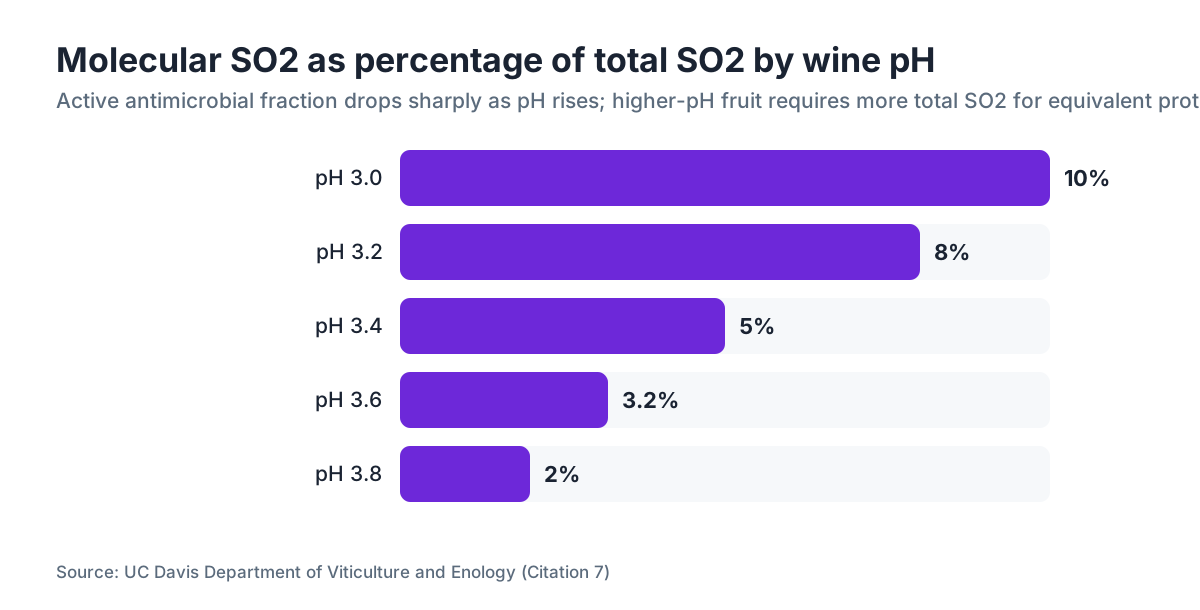
pH is worth paying particular attention to because it affects almost everything in the winery. At pH above 3.6, you need more free SO2 to provide effective protection against oxidation and spoilage organisms. The ratio of molecular SO2 to total SO2 is pH-dependent: at pH 3.2, roughly 8 percent of your total SO2 is in the active molecular form; at pH 3.8, that drops to about 2 percent [7]. A grower who consistently delivers high-pH fruit is handing the winemaker a preservation problem.
Sampling protocol matters enormously here. A single cluster from the road side of the vine at eye level is not representative of the block. UC Davis extension recommends sampling at least 100 to 200 berries per block, randomized across rows and vine positions, to get a Brix reading within about 0.5 degrees of the true mean [2].
What pesticide records and worker protection rules apply in the vineyard?
Pesticide record-keeping in the vineyard is federally required under the EPA Worker Protection Standard (WPS) and, in California, under the California Department of Pesticide Regulation (CDPR) regulations that go further than federal minimums [8][9]. Federal WPS requires agricultural employers to keep records of all pesticide applications for at least two years, covering the product name, EPA registration number, application date, location, rate, total amount applied, and the name of the certified applicator.
California growers must submit pesticide use reports (PURs) to their county agricultural commissioner within seven days of each application month. The state compiles these into one of the most complete pesticide use databases anywhere in the country. If you miss a reporting window, the fines are real: CDPR can assess civil penalties up to $5,000 per violation per day.
Re-entry intervals (REIs) on the product label are legally binding. Under WPS, workers cannot enter treated areas during the REI without specific personal protective equipment (PPE). The label is the law; if the label says 24-hour REI, that's what you enforce, regardless of what the dealer tells you.
For operations managing multiple blocks across different ownership entities or grower contracts, keeping spray records organized and instantly retrievable becomes genuinely difficult. That's one of the places where digital record-keeping earns its keep. VitiScribe, for example, is built specifically around spray log compliance and field operations, letting you generate the application record formats county ag commissioners actually ask for without rebuilding a spreadsheet every season.
Trained handler and early-entry worker requirements under WPS also require documented training. The EPA published revised WPS regulations in 2015 that expanded training requirements, including an obligation to provide safety information at a central location and to provide decontamination supplies within a quarter mile or at the closest point of vehicle access to each field [8].
What are the main enological processes and why do they matter to growers?
Alcoholic fermentation is the conversion of sugars to ethanol and CO2 by yeast, primarily Saccharomyces cerevisiae in commercial wine production. Malolactic fermentation (MLF), which converts sharp malic acid to softer lactic acid, is nearly universal in red wines and common in barrel-fermented Chardonnay. Understanding these processes matters to growers because fruit composition determines how easily they proceed.
High-Brix fruit produces high-alcohol wines. At Brix above 27 or 28, fermentation can stall because ethanol toxicity inhibits yeast activity. The winemaker can add water in some states (but not in California for estate-designated wines without a variance) or can chapitalize in some jurisdictions (adding sugar to boost alcohol, allowed in Burgundy and Germany, not in California or Washington). Knowing your region's rules before you let Brix run too high is basic grower due diligence.
Sulfite management, which is foundational to enological practice, also starts with the vineyard. Grapes with heavy Botrytis pressure contain laccase, a fungal enzyme that oxidizes sulfite rapidly. A winemaker receiving Botrytis-affected fruit needs higher SO2 doses to compensate, which can push finished wine above the federal labeling threshold of 10 ppm (at which point "contains sulfites" is required on the label) [10].
Tannin extraction in red wines depends on skin contact time, temperature, and the physical breakdown of berry tissue. Skins with good phenolic ripeness extract differently than underripe skins: tannins from underripe skins tend to be harsh and astringent rather than polymerized and integrated. Growers who push for full phenolic ripeness are directly improving the cellar team's options.
How do climate and site selection shape viticulture decisions?
Grapevines are perennial crops, which means a site selection decision made today lives with you for 20 to 40 years. The foundational framework for characterizing wine regions by heat accumulation is the Winkler scale, developed at UC Davis in 1944, which classifies sites into five regions based on growing degree days (GDD) above 50°F from April through October [1]. Region I is the coolest (below 2,500 GDD) and Region V is the warmest (above 4,000 GDD).
The Winkler scale has real limitations. It treats all heat equally, ignoring diurnal temperature variation, fog influence, and the timing of that heat within the season. Coastal California sites and inland desert sites can accumulate similar GDD totals with radically different wine styles from the same variety. That's why more recent climate research from UC Davis and others uses metrics like mean temperature of the warmest month, growing season precipitation, and heat spike frequency to characterize sites more precisely [1].
Soil drainage is arguably more important than soil chemistry for vine performance. Vines stressed by waterlogged soils grow poorly, set fruit poorly, and are more susceptible to root diseases including crown gall (Agrobacterium vitis) and Phytophthora root rot. Slope, aspect, and proximity to water bodies all affect frost risk, which is the single most acute short-term climate hazard for most North American vineyards.
For new plantings, a site evaluation should include at minimum: soil profile pits to at least 4 feet, soil texture and water-holding capacity testing, a multi-year temperature record if possible, and an assessment of phylloxera and nematode populations before rootstock selection. Skipping any of these is a false economy.
The vineyard landscape along California's Central Coast, where many of the state's newer plantings are happening, shows how much site variation can exist within a short distance. Paso Robles wineries on the east side of Highway 101 farm in significantly warmer, more continental conditions than those on the west side, and variety selection and canopy management strategies diverge accordingly.
What career paths exist in viticulture and enology, and what credentials matter?
The formal credential landscape in viticulture and enology is less structured than many agricultural fields. In California, a licensed pest control advisor (PCA) designation is required to make commercial pesticide recommendations, and a qualified applicator license (QAL) or certificate (QAC) is required to apply restricted-use pesticides. These are state-administered exams through CDPR [9]. They're not optional if you're running spray programs.
Beyond those regulatory minimums, the most recognized academic credentials are the BS, MS, and PhD from programs like UC Davis, WSU, Cornell, and a handful of international programs (Montpellier SupAgro in France, the University of Adelaide in Australia). The American Society for Enology and Viticulture (ASEV) doesn't itself administer professional certification but is the primary peer-reviewed publication venue and professional society for the field in North America [11].
The Court of Master Sommeliers and the Wine & Spirit Education Trust (WSET) are consumer and trade credentials focused on sensory evaluation and wine knowledge, not on production science. They're relevant for sales and hospitality roles but don't substitute for production training.
For working vineyard managers who didn't come up through a formal program, UC Cooperative Extension workshops, online courses through UC Davis Extension, and WSU's online viticulture certificate are practical ways to fill specific knowledge gaps. The UC Davis Division of Continuing and Professional Education offers non-degree courses in viticulture fundamentals, wine chemistry, and sensory evaluation [1].
How do vineyard record-keeping systems support compliance and agronomic decisions?
Good record-keeping in the vineyard is both a regulatory requirement and a decision-support tool. Spray records, as noted above, are legally mandated. But irrigation logs, scouting records, phenology notes (budbreak dates, bloom dates, veraison dates), tissue test results, and harvest data are all inputs that make next year's decisions better.
The problem most small operations face isn't motivation to keep records, it's friction. Paper logs get rained on, misplaced, or left in the truck. Spreadsheets work but require someone to actually enter data, and the formats for reporting to county ag commissioners don't match the formats that are convenient for daily use. The gap between what growers observe in the field and what ends up in a retrievable record is where compliance risk lives.
Digital field-logging tools, designed specifically for vineyard operations (including VitiScribe), address this by letting crews log applications on mobile devices at the point of application, auto-populating the mandatory fields from product labels, and generating county-compliant reports on demand. This is genuinely useful, more than a sales pitch: CDPR has documented that most record-keeping violations are not intentional falsification but missing or incomplete entries from operations that simply didn't have a reliable capture workflow.
Tissue testing is an underused agronomic tool. Petiole analysis at bloom and veraison gives you a direct read on nitrogen, potassium, boron, zinc, and other nutrients that visual symptoms often miss until deficiency is severe. UC Davis and WSU both publish interpretation tables for petiole nutrient levels by variety and sampling timing [2][3]. Building tissue test results into your records over multiple years lets you see trends before they become problems.
What does current research say about climate adaptation in viticulture?
Climate adaptation is the most active research area in viticulture right now, and the honest answer is that the science is still catching up to the rate of change. A 2013 study in the Proceedings of the National Academy of Sciences projected that by 2050, suitable winegrape growing area in the US could decline by 49 to 70 percent under a high-emissions scenario due to increased heat extremes [12]. More recent modeling using finer-grained data has partially revised those projections, finding that some marginal cool-climate regions gain suitability while some traditional warm regions face real challenges.
Rootstock selection is getting renewed attention as a climate tool, more than a phylloxera tool. Rootstocks that impose moderate water stress on the scion (like 101-14 or SO4 under certain soil conditions) may help slow excessive sugar accumulation in warming climates by reducing vine vigor. The UC Davis rootstock trials are the longest-running dataset in the US on this question [1].
Variety diversification is a strategy some forward-thinking growers are already testing. There's growing interest in late-ripening varieties that can use the longer warm seasons rather than struggling against them, and in heat-tolerant Italian and Iberian varieties in California's warmer regions. This is genuinely early-stage work, and nobody has good long-term commercial data on most of these alternatives yet.
Cover crop management is another adaptation lever. Cover crops in Mediterranean-climate vineyards can either compete with vines for water (useful in high-vigor situations) or be managed to reduce evapotranspiration and soil temperature. Research from UC Davis and USDA Agricultural Research Service has shown measurable soil temperature reductions of 2 to 5°F in vineyards with straw mulch or permanent cover compared to bare cultivated soil [2].
For growers who want to see how top-performing wineries handle site-specific challenges in practice, visits to established mountain winery operations or south coast winery properties in California's coastal zones offer a real-world look at how aspect, elevation, and marine influence get translated into management decisions.
What are the federal and state regulations every vineyard manager should know?
Federal law governs pesticide registration (FIFRA, the Federal Insecticide, Fungicide, and Rodenticide Act), worker protection (WPS under FIFRA), and the labeling requirements for wine (TTB, the Alcohol and Tobacco Tax and Trade Bureau, administers the Federal Alcohol Administration Act) [10][8]. State law layers on top and often adds requirements.
In California, the key regulatory touch points for a vineyard manager are: CDPR for pesticide use reporting and applicator licensing; the State Water Resources Control Board for irrigation water rights and wastewater discharge; the county agricultural commissioner for pesticide application reporting and organic certification inspection; and the California Department of Food and Agriculture for nursery stock and plant health quarantine regulations.
Orders of quarantine and hold under the CDFA have real consequences. If a county is under a quarantine for a pest like the light brown apple moth, glassy-winged sharpshooter, or spotted lanternfly, moving plant material out of a quarantine zone requires a compliance agreement and inspection. Violating a federal or state plant quarantine order can result in civil penalties and seizure of materials.
TTB labeling rules matter to any winery selling wine commercially. The "contains sulfites" declaration is required when total SO2 exceeds 10 ppm in the finished wine. Organic wine certification under the USDA National Organic Program (NOP) prohibits added sulfites entirely, while "made with organic grapes" allows up to 100 ppm total SO2 [10]. These distinctions start with vineyard management choices, more than cellar choices.
Table: Key regulatory thresholds for vineyard and winery operations
| Regulation | Threshold / Requirement | Authority |
|---|---|---|
| Pesticide use reporting (CA) | Within 7 days of end of application month | CDPR |
| Pesticide records retention | Minimum 2 years | EPA WPS |
| "Contains sulfites" label | Total SO2 > 10 ppm in finished wine | TTB / FAA |
| Organic wine (NOP) | No added sulfites | USDA NOP |
| "Made with organic grapes" | Up to 100 ppm total SO2 | USDA NOP |
| WPS worker training | Annual, documented | EPA WPS |
| Re-entry interval (REI) | Per product label, legally binding | EPA FIFRA |
How do you read and use a tissue test or soil test in vineyard management?
Soil testing tells you what nutrients are present and at what pH they're available; tissue testing tells you what the vine is actually taking up. You need both because soil test results don't perfectly predict plant uptake, especially for micronutrients whose availability shifts sharply with pH and organic matter.
For petiole analysis, timing is standardized to make results comparable. The UC Davis interpretation tables are calibrated to petioles collected at bloom (when the first flowers are open) and again at veraison (when berries first change color) [2]. Collecting at other times gives you data that can't be compared to the published sufficiency ranges.
Nitrogen sufficiency at bloom, for example, is typically 0.8 to 1.2 percent N in petiole dry weight for most Vitis vinifera varieties on the UC Davis scale. Below 0.8 percent suggests deficiency; above 1.4 percent raises concerns about excessive vigor. But these thresholds shift with rootstock, variety, and soil type, so they're starting points, not hard rules.
Boron deficiency causes poor fruit set and is more common in sandy, low-pH soils. Zinc deficiency causes little leaf (zinc deficiency syndrome) and is common on calcareous soils. Both are correctable with foliar sprays applied at budbreak or early shoot growth, but the timing window is narrow and missing it means waiting until next year.
Soil pH below 5.5 is worth addressing before replanting because it affects rootstock performance and nutrient availability more than almost any other single factor. Liming an established vineyard is possible but slow-acting; correcting pH before planting is far more effective.
Frequently asked questions
What is the difference between viticulture and enology?
Viticulture is the science of growing grapes in the vineyard, covering vine physiology, canopy management, irrigation, and pest control. Enology is the science of making wine, covering fermentation, chemistry, aging, and sensory evaluation. The two overlap at harvest, where the composition of the berry directly determines what options the winemaker has. In small winery operations, one person often handles both roles.
Is UC Davis the best program for viticulture and enology?
UC Davis is the most research-intensive program in North America and has the longest track record, founded in 1935. For California-specific viticulture, rootstock research, and wine chemistry, it's hard to beat. WSU is stronger for cool-climate and Pacific Northwest viticulture. Cornell's Geneva station leads on cold-hardy hybrids and high-humidity disease management. The best program depends on where you're growing and what problems you're trying to solve.
What records does a vineyard manager legally need to keep?
Federal EPA Worker Protection Standard requires pesticide application records kept for at least two years, including product name, EPA registration number, date, location, rate, total amount, and certified applicator name. California adds mandatory pesticide use reports to the county agricultural commissioner within seven days of each application month. Violations can result in civil penalties up to $5,000 per violation per day in California.
What is the Winkler scale and how is it used?
The Winkler scale classifies winegrape regions by heat accumulation using growing degree days (GDD) above 50°F from April through October, developed at UC Davis in 1944. Region I is coolest (below 2,500 GDD), Region V is warmest (above 4,000 GDD). Variety selection for new plantings often starts with Winkler region as a rough filter, though diurnal variation and marine influence limit the scale's precision for site-level decisions.
How do you calculate Ravaz Index and what does it mean?
Ravaz Index is fruit weight divided by pruning weight, both measured per vine. A ratio between 5 and 10 is generally considered balanced for Vitis vinifera, meaning the vine is neither overcropped nor too vegetative. Below 5, the vine is likely undercropped or overly vigorous. Above 10, the vine may be stressed by excessive crop load, which often shows up as poor color development and slow sugar accumulation in red varieties.
What does pH have to do with sulfite effectiveness in wine?
The antimicrobial protection from SO2 comes from its molecular form, and the proportion of molecular SO2 decreases sharply as pH rises. At pH 3.2, roughly 8 percent of total SO2 is in the active molecular form; at pH 3.8, that drops to about 2 percent. This means high-pH fruit requires significantly higher total SO2 additions to achieve the same protective level, which can push finished wine above the 10 ppm threshold requiring a sulfite declaration on the label.
What is the EPA Worker Protection Standard and what does it require for vineyards?
The EPA Worker Protection Standard (WPS) is a federal regulation under FIFRA that protects agricultural workers from pesticide exposure. It requires employers to provide annual safety training, post pesticide application information at a central location, provide decontamination supplies within a quarter mile of treated fields, and enforce re-entry intervals listed on product labels. Revised in 2015, WPS also expanded early-entry worker protection requirements. Records of training and applications must be kept for at least two years.
What is leafroll virus and how serious is it for vineyards?
Grape leafroll-associated viruses (GLRaV) are a complex of vectored viruses causing delayed ripening, reduced sugar accumulation, and significant yield loss. Infected vineyards can lose 30 to 50 percent of yield and show Brix reductions of 2 to 4 degrees at harvest compared to healthy vines. The viruses spread through mealybugs and soft scales. There is no cure; management relies on removing infected vines, controlling vectors, and planting certified clean stock.
Can a vineyard manager take UC Davis viticulture courses without being a degree student?
Yes. UC Davis Division of Continuing and Professional Education offers non-degree courses in viticulture fundamentals, wine chemistry, and sensory evaluation, accessible to working professionals. WSU also offers an online viticulture certificate program. UC Cooperative Extension runs regional workshops through farm advisors in most California counties. These are practical options for growers filling specific knowledge gaps without committing to a full degree program.
What are the sulfite rules for organic wine versus wine made with organic grapes?
Under USDA National Organic Program rules, wine labeled as organic wine cannot contain any added sulfites. Wine labeled as made with organic grapes may contain up to 100 ppm total SO2. TTB requires any wine with total SO2 above 10 ppm to carry a contains sulfites declaration on the label. These distinctions affect vineyard management choices because Botrytis-affected fruit increases laccase activity, which consumes sulfite rapidly and complicates both rules.
How often should petiole samples be taken for vineyard nutrient management?
Most UC Davis and WSU extension guidance recommends petiole sampling at two standardized timing windows: at bloom (when first flowers open) and at veraison (when berries begin to change color). The published sufficiency ranges are calibrated to these windows specifically. Sampling outside these windows gives results that can't be reliably compared to reference tables, making the data hard to interpret. Annual sampling builds a multi-year trend picture that's more useful than any single result.
What climate change projections exist for US wine regions?
A 2013 study in the Proceedings of the National Academy of Sciences projected that under a high-emissions scenario, suitable winegrape area in the US could decline by 49 to 70 percent by 2050, primarily due to increased heat extremes rather than average warming. More recent modeling has partially revised those figures, identifying some cool-climate regions that gain suitability while some traditional warm regions face greater risk. Nobody has good long-term commercial data on variety substitution as an adaptation strategy yet.
What is the difference between titratable acidity and pH in grape juice?
Titratable acidity (TA) measures the total concentration of acids in the juice, expressed in grams per liter, typically as tartaric acid equivalents. pH measures hydrogen ion activity, which reflects acid strength rather than quantity. A juice can have high TA and moderate pH, or lower TA with higher pH depending on the ratio of tartaric to malic acid and buffering capacity. Both matter: TA affects palate perception of sourness, while pH drives microbial stability and SO2 efficacy.
What is chapitalization and is it allowed in California?
Chapitalization is the addition of sugar to grape must before or during fermentation to increase potential alcohol. It's a standard practice in cooler European regions like Burgundy and Germany where grapes may not reach full ripeness. California and Washington prohibit chapitalization for varietal wines under state regulations. In California, water addition to reduce Brix is allowed in certain circumstances under the California Code of Regulations, but adding sugar to boost alcohol is not.
Sources
- UC Davis Department of Viticulture and Enology: UC Davis Viticulture and Enology department founded in 1935; Winkler scale developed at UC Davis in 1944; ongoing rootstock trials and climate research
- UC Cooperative Extension, Division of Agriculture and Natural Resources: UC Cooperative Extension provides region-specific vineyard management guidance, petiole sampling protocols, and cover crop research for California vineyards
- Washington State University Extension, Wine and Viticulture: WSU Extension publishes petiole interpretation tables by variety and timing for Pacific Northwest vineyards; offers online viticulture certificate program
- Cornell University College of Agriculture and Life Sciences, Horticulture Section: Cornell Geneva station leads research on cold-hardy hybrid varieties and high-humidity disease management for northeastern US viticulture
- American Journal of Enology and Viticulture, Ravaz Index reference: Ravaz Index of 5 to 10 is the generally cited balanced range for Vitis vinifera; published in AJEV literature on vine balance and crop load
- UC Davis Plant Pathology, Grape Leafroll Disease: Grape leafroll-associated viruses can cause 30 to 50 percent yield loss and significant sugar accumulation delay in infected vineyards
- UC Davis Department of Viticulture and Enology, Sulfur Dioxide and Wine: Molecular SO2 as a fraction of total SO2 drops from roughly 8 percent at pH 3.2 to approximately 2 percent at pH 3.8
- US EPA Worker Protection Standard for Agricultural Pesticides: WPS requires pesticide application records kept at least two years; annual worker training; decontamination supplies within quarter mile of treated fields; 2015 revisions expanded requirements
- California Department of Pesticide Regulation: California requires pesticide use reports to county agricultural commissioner within 7 days of application month end; civil penalties up to $5,000 per violation per day; PCA and QAL licensing requirements
- American Society for Enology and Viticulture (ASEV): ASEV is the primary professional society and peer-reviewed publication venue for viticulture and enology in North America
- Proceedings of the National Academy of Sciences, Climate change and wine (Diffenbaugh et al., 2013): 2013 PNAS study projected suitable US winegrape area could decline 49 to 70 percent by 2050 under high-emissions scenario due to increased heat extremes
Last updated 2026-07-09