Drone spraying for vineyards in California's Central Valley
TL;DR
- Agricultural drones can spray Central Valley vineyards at 10-20 acres per hour, cut water use 70-90% versus conventional sprayers, and drop labor costs.
- But they require FAA Part 107 certification, a licensed California pest control adviser sign-off on applications, and careful records to satisfy the state's pesticide use reporting rules.
- Here's how to do it right.
What is drone spraying for vineyards and why does it matter in the Central Valley?
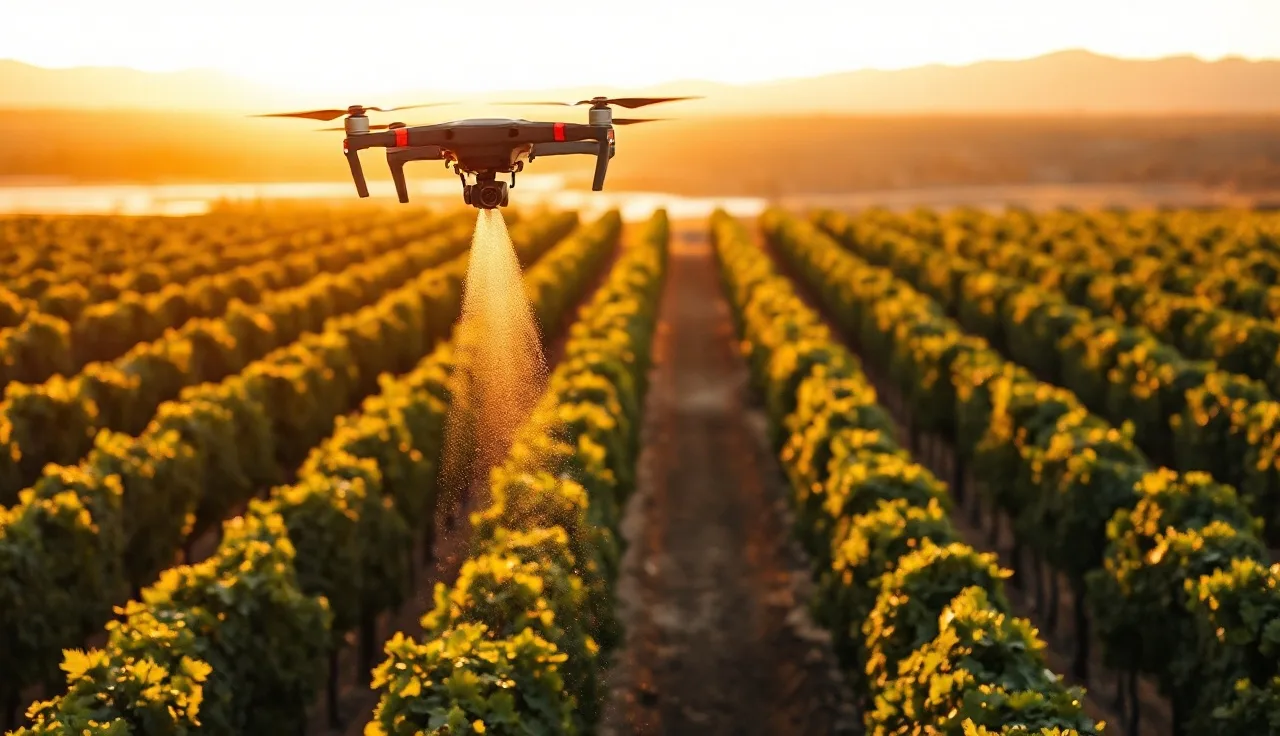
Drone spraying for vineyards means using unmanned aerial application systems, typically multi-rotor or single-rotor aircraft carrying 10-40 liter tanks, to deliver fungicides, insecticides, or foliar nutrients directly onto vine canopies. The technology isn't new in Japan or China, where it's been standard on rice since the 1990s. Its adoption in California wine country has accelerated sharply since 2019.
The Central Valley's geography makes the case. You have flat to gently rolling terrain, extreme heat windows that shrink your spray timing, and a labor market that has gotten tighter every season. Ground-speed sprayers need tractor operators, face row-end compaction issues, and can struggle with wet or freshly cultivated soil. A drone doesn't care about any of that.
Drone spraying isn't a magic fix, though. Canopy penetration is genuinely different from an air-blast sprayer that forces product into the interior. For powdery mildew, the number-one disease pressure in the San Joaquin and Sacramento valleys, getting fungicide inside the cluster zone matters enormously. The data on canopy penetration from above is still evolving, and I'll cover what we actually know rather than what drone vendors claim.
For context on the broader vineyard operation this fits into, see our overview of vineyard management fundamentals.
What are the FAA and California regulatory requirements for spraying vineyards with a drone?
Federal aviation rules come first. Any drone used commercially (and a paid spray application is absolutely commercial use) requires the pilot to hold an FAA Part 107 Remote Pilot Certificate [1]. There's no agricultural exemption to that requirement. The drone itself must be registered with the FAA if it weighs more than 0.55 lbs, which every spray-capable agricultural drone does by a wide margin [13].
Part 107 also restricts operations by default to Visual Line of Sight (VLOS), below 400 feet AGL, and during daylight hours. Waivers exist for beyond-visual-line-of-sight operations, but they're slow to get and rarely needed for vineyard blocks. Most Central Valley blocks are compact enough that a single pilot with a visual observer can cover them within standard VLOS rules.
California layers on more. The California Department of Pesticide Regulation (CDPR) treats aerial drone application as aerial pesticide application [2]. That means:
- You need a licensed Pest Control Adviser (PCA) to write a written recommendation before any application.
- The applicator must hold a California Pest Control Operator (PCO) license with an aerial category endorsement, or you can hire a licensed aerial applicator service.
- Every application must be reported to the county agricultural commissioner within a specific timeframe under California's Pesticide Use Reporting (PUR) system.
The Fresno, Tulare, Kings, and Kern county agricultural commissioners each have their own check-in requirements on top of CDPR's baseline, so call your local office before your first application season. Some counties require advance notice of aerial drone applications.
The EPA Worker Protection Standard (WPS) applies to pesticide applications in agricultural settings [3]. Under WPS, if any agricultural worker is in the application block or within the required buffer during application, you stop. Drone applications get no carve-out here. Your restricted entry interval (REI) clock starts when the application is complete, just as with any other method.
One more thing. Pesticide labels are the law in California. If a label says "do not apply by air" or restricts aerial application to fixed-wing aircraft, a drone is not a legal application method for that product, period [4]. Check this before you build a spray program around a specific fungicide.
How much does drone spraying cost per acre in Central Valley vineyards?
Costs break into two camps: hiring a drone application service versus owning your own equipment. The honest answer is that published per-acre figures vary a lot because the industry is still pricing itself.
Hire-out rates in California's Central Valley as of 2024-2025 have generally run $12 to $25 per acre per application, based on block size, travel distance, and program complexity [5]. Small, scattered blocks land on the high end. Large contiguous ranches with easy access sit at the low end. That does not include the cost of the pesticide itself.
Owning a DJI Agras T40 or a similar high-capacity agricultural drone currently costs roughly $15,000 to $20,000 for the aircraft alone, plus chargers, batteries, a remote control system, and the planning app. A full ready-to-spray kit from a major supplier runs $25,000 to $35,000 [6]. You also factor in FAA certification time (studying and passing the Part 107 exam takes most people 20-40 hours), and California's PCO licensing path if you plan to apply restricted-use pesticides yourself.
The break-even math depends heavily on how many acres you're spraying. A rough rule: if you're applying to fewer than 300 acres per season, it's usually cheaper to hire out for the first two to three years while you sort out the learning curve. Above 500 acres, ownership starts looking attractive, especially if you can offer custom application services to neighbors to build your hours.
There's also the maintenance reality. Drone motors, ESCs, and spray nozzles need regular inspection, and a crash into a trellis wire is a $2,000 to $8,000 repair depending on what breaks. Nobody advertises that number.
| Cost item | Hire-out (per season, 200 ac, 6 apps) | Own (amortized, same) |
|---|---|---|
| Application labor/service | $14,400-$30,000 | $0 (owner-operator) |
| Equipment amortization (5 yr) | $0 | $5,000-$7,000 |
| Batteries/maintenance | $0 | $1,500-$3,000 |
| FAA/licensing | $0 | $500-$1,000 (one-time) |
| Total estimated | $14,400-$30,000 | $7,000-$11,000 |
The ownership case is compelling on paper. It assumes no crashes, consistent use, and your time has no cost. Be realistic about that last one.
How does drone spraying compare to ground rigs and helicopter applications?
The three methods each have a real home in the Central Valley.
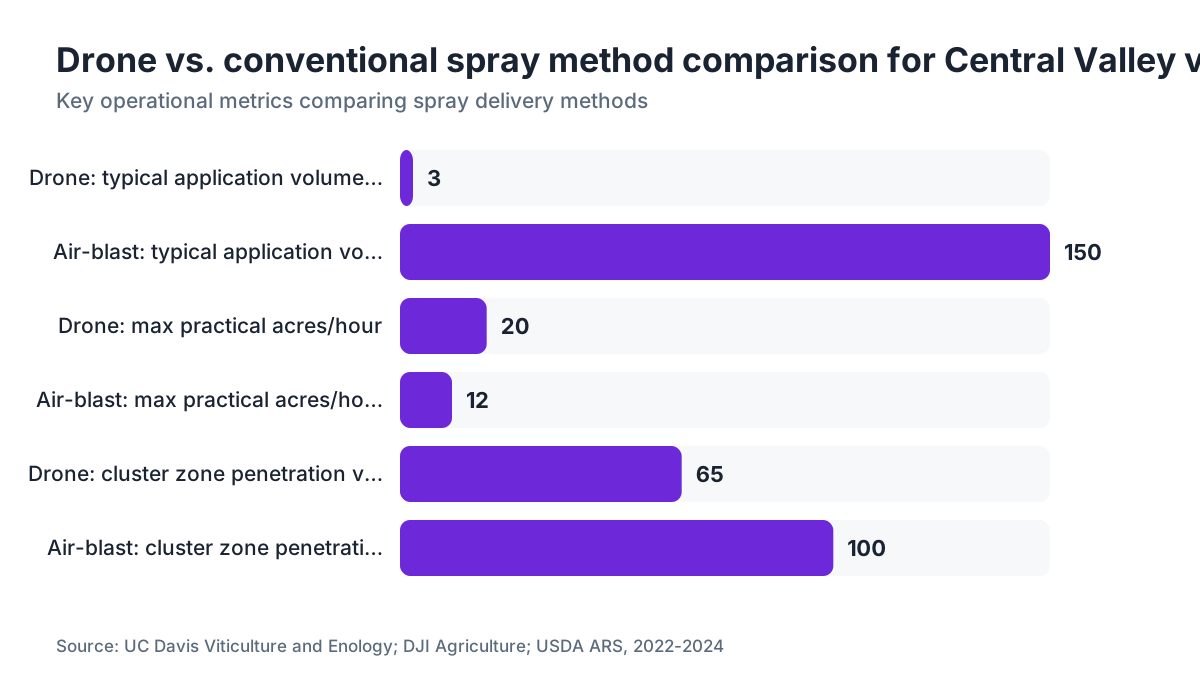
Conventional air-blast sprayers deliver high spray volume (100-300 gallons per acre) with strong canopy penetration. They're the standard for dense-canopy disease management, they're familiar to every tractor operator, and the cost per acre for equipment you already own is very low. The downsides: soil compaction during wet spring periods, inability to work right after rain when disease pressure peaks, and the need for at least one skilled operator per machine.
Manned helicopters used to be the aerial option for large operations. They're fast, they carry huge tanks, and they penetrate canopy well with rotor downwash. But the minimum economic block size for helicopter work is typically 500-plus contiguous acres, cost runs $18 to $35 per acre depending on location and load, and scheduling a helicopter service in peak disease pressure weeks is genuinely hard. There are only so many ag helicopters in the San Joaquin Valley.
Drones sit in the middle. Application volumes are low, typically 1-5 gallons per acre against the air-blast's 100-plus, which is either an efficiency advantage or a penetration liability depending on the crop stage and disease target. The rotor downwash from a large agricultural drone (the DJI T40 generates meaningful downforce) does help push material into the canopy, but it's nothing like an air-blast at 120 PSI.
A 2022 study published in Computers and Electronics in Agriculture found drone application coverage adequate for foliar fungicide programs when spray parameters were optimized, but penetration into grape cluster zones averaged 30-40% lower than conventional air-blast [7]. That study used different equipment configurations than what's currently available, so treat the absolute numbers with some skepticism. The direction of the finding, that penetration is genuinely lower, matches what California PCAs report informally.
For disease programs in high-pressure years (2023 was extremely high in Fresno County for powdery mildew), most advisers recommend using drones for protectant applications early in the season and reserving air-blast for the cover sprays when clusters are closing.
Which pesticides are approved for aerial drone application on grapes in California?
This is where a lot of growers get into trouble. A pesticide label is a federal legal document. If the label permits "aerial application," that includes drones in CDPR's interpretation, but only if the label doesn't specifically restrict it to fixed-wing or helicopter [4].
Products that commonly allow aerial application on grapes and are widely used in the Central Valley include many copper-based fungicides, sulfur, and several synthetic fungicides in the SDHI and DMI classes. You must read the current label for the specific product and formulation you're buying, not a generic category.
Sulfur deserves a special note for Central Valley conditions. Elemental sulfur is the most widely used powdery mildew material in California viticulture, and temperature restrictions are strict. Most labels prohibit application when temperatures exceed 90-95 degrees F to avoid phytotoxicity [8]. In Fresno County in July, you may have a two-hour spray window at dawn. Drones make that window more useful because setup and breakdown are faster than a ground rig, but you still work inside the temperature restriction.
Restricted-use pesticides require a licensed PCO for application regardless of method. If you're the grower and you don't hold a PCO license, you cannot legally apply restricted-use materials with your own drone. You need a licensed operator or a licensed applicator service.
For a current list of products registered for aerial use on grapes in California, CDPR's online label database (CDPR.ca.gov) is the authoritative source, and your PCA should be cross-referencing it before writing any recommendation [2].
What spray parameters actually work for drone vineyard spraying?
This is where operational detail matters more than almost anywhere else. Drone spray outcomes depend on flight altitude, flight speed, nozzle type, droplet size, and wind speed at application time.
Flight altitude above the canopy is typically set between 1.5 and 3 meters (5-10 feet) for vineyard work. Lower flight increases downwash penetration but risks clipping trellis wires on uneven ground. Most operators on California flat-to-gentle terrain start at 2 meters and adjust from there.
Flight speed directly controls application rate. Faster passes mean less product per unit area. Most modern ag drones (DJI Agras series, XAG, Hylio) have auto-calculated route planning that sets speed based on the target application volume you input, but verify the actual output rate before treating your first commercial block. Calibrate over a test surface.
Droplet size matters enormously for disease control. Fungicide applications generally need medium to coarse droplets (250-400 micron VMD) to reduce drift without sacrificing canopy contact. Fine droplets carry too far in Central Valley afternoon winds. The USDA Agricultural Research Service has published spray drift guidelines that most drone operators reference [9].
Wind is the hard constraint. Most drone manufacturers specify a maximum 4-5 m/s (roughly 9-11 mph) wind speed for spray operations. At typical Central Valley afternoon speeds of 10-20 mph in summer, you're grounded after mid-morning on most days. That is actually the best argument for drone spraying. A drone can execute the early-morning window that a tractor and driver can't practically cover, because the operator just started their shift.
WSU's precision agriculture extension has published useful guidance on aerial application parameters that translates well to California conditions, even though it was written for tree fruit [10]. UC Davis Cooperative Extension has produced vineyard-specific spray calibration fact sheets worth keeping in your records [11].
How do you keep spray records and stay compliant with California's pesticide use reporting?
California has the most detailed pesticide use reporting system in the country. Every commercial pesticide application, including drone applications, must be reported to your county agricultural commissioner [2]. The report requires the applicator's license number, the product name and EPA registration number, the amount of product applied, the acreage, the application date, the application method (aerial is specifically coded for drone use in the current CDPR coding system), and the site.
The reporting deadline is the 10th of the month following the application month. Missing it or filing inaccurate records can bring fines and license consequences for your PCO or PCA.
Drone application services will often handle their own PUR reporting for the applications they make. If you own your equipment and hold your own licenses, it falls on you. The county ag commissioner's office is genuinely helpful if you call them before your first season, not after a violation.
Here's where I'll say that VitiScribe was built for exactly this field-to-compliance workflow. If you're managing spray records across multiple blocks, multiple applicators, and multiple products, a dedicated vineyard operations tool is far more reliable than a spreadsheet, especially when an auditor asks for three years of PUR data.
Beyond PUR, the EPA Worker Protection Standard requires you to keep records of pesticide applications for two years, including product, location, date, and the REI [3]. An inspector can request these on little notice. The growers who get through those inspections cleanly are the ones whose records match their PUR filings exactly.
What are the real limitations of drone vineyard spraying that vendors won't tell you?
Battery life. A DJI T40 running a full 40-liter tank has a flight time of roughly 12-17 minutes before it needs to land and swap batteries. On a large block, you spend as much time on the ground swapping batteries and refilling as you spend flying. For a 100-acre block, a two-drone crew can still finish the work in a morning, but it's not as smooth as the marketing materials suggest.
Trellis wire is a real hazard. Modern drone systems use terrain-following lidar and obstacle avoidance, but mature vineyards with uneven terrain, end posts, and cross-wires are genuinely challenging. Operators lose drones in trellis systems. The avoidance systems are good, not perfect.
Canopy penetration in high-vigor blocks is a legitimate concern. If your Cabernet in the San Joaquin has a dense, unmanaged canopy in mid-summer, a drone flying over the top at 2 meters is applying most of the product to the upper leaf surface. That's fine for contact materials, poor for a systemic program where you need interior coverage.
Certification and licensing take time. If you decide today to own and operate your own spray drone in California, you're looking at 6-12 weeks minimum to get through the FAA exam, find and complete the PCO licensing requirements, and get your first application day scheduled. Plan for that lead time.
Some California counties also have restrictions on aerial applications near schools, residential areas, or certain water bodies. Fresno, Tulare, and Kern counties all have sensitive-area buffers that apply to aerial drone work. Your county ag commissioner has the current maps and buffer distances.
How do Central Valley growers find and vet a drone spray service?
Legitimate services operating in California can show you, on request: the pilot's FAA Part 107 certificate, the firm's California PCO license with aerial endorsement, and proof of liability insurance (look for at least $1 million per occurrence, and some operations require $2 million given the value of a commercial vineyard block).
Ask specifically which drone system they operate, what their typical application volume is in gallons per acre, and whether they do pre-season calibration documentation. Services that can't answer those questions specifically are not yet operationally mature.
References from other Central Valley vineyard managers are worth more than any marketing claim. The San Joaquin Valley Farm Bureau chapters and local PCA networks are good places to find names of services with a real track record.
A quality service will also require a written PCA recommendation before they fly. If a service offers to spray without one, that's an immediate red flag, because it means they're planning to apply pesticides without the legally required authorization in California.
What does the research say about efficacy of drone spraying on grapevines?
The research base is thin relative to the adoption curve, which is a real problem. Most published efficacy work has been done in China on rice and wheat, with some work on tea and citrus. Grapevine-specific data from North American conditions is limited.
UC Davis's viticulture and enology program has been tracking drone spray technology and published preliminary observations suggesting drone applications can match ground rigs for protectant applications (copper, sulfur) at equivalent rates, but that curative applications requiring interior canopy penetration show more variable results [11]. Their formal trial data on this is still accumulating.
Cornell's viticulture extension, which focuses heavily on the Finger Lakes and Lake Erie regions, has noted that rotor downwash from multi-rotor agricultural drones creates a useful air-blast effect but at lower air volume than a dedicated air-blast sprayer [12]. The practical implication for Central Valley growers: don't substitute drone for air-blast during the most critical powdery mildew cover spray timing (typically 20-50% bloom through berry set) without your PCA's sign-off.
Nobody has good long-term data on whether drone spray programs lead to meaningfully different disease outcomes over a full season in San Joaquin Valley table grape or wine grape production. The closest we have are operator-reported outcomes from custom spray services, which are not controlled studies. The honest answer: it probably works well for the early-season protectant program and for foliar nutrition, and we need more data for late-season disease management in high-pressure years.
Is drone spraying right for your vineyard operation?
Here's my honest take. If you're farming 200-plus acres in the Central Valley with blocks that have access challenges, tractor compaction problems, or early-morning spray windows you can't reliably hit with a ground crew, drone spraying is worth serious consideration right now. The technology is mature enough for competent operators to deliver consistent results.
If you're farming 50 acres with good road access, established equipment, and a reliable crew, the math probably doesn't support ownership yet. Hiring out for a couple of applications per season to see how it fits your program makes more sense than committing $30,000 in equipment.
The regulatory compliance side is genuinely manageable but genuinely demands attention. The growers who have problems are the ones who treat drone applications as less formal than conventional applications. They're not. CDPR inspectors are looking at drone use more closely as adoption grows.
Keeping your spray records tight across all application methods is what protects you at audit time. Whether you use VitiScribe or a well-organized binder, the records need to match your PUR filings, your REI postings, and your WPS training documentation. That part hasn't changed.
For more on wine production regions where drone spraying is also gaining ground, the operations at paso-robles-wineries and south-coast-winery offer useful contrast with Central Valley conditions. And if you're thinking about how larger hospitality-integrated vineyard operations handle compliance complexity, gervasi-vineyard and ponte-winery are worth a look.
Frequently asked questions
Do I need a special license to spray my own vineyard with a drone in California?
Yes. You need an FAA Part 107 Remote Pilot Certificate to fly commercially. For pesticide application, you also need a California Pest Control Operator (PCO) license with an aerial endorsement, or you must hire a licensed PCO service. A Pest Control Adviser must write a written recommendation before any application. This applies whether you own the drone or hire someone else.
What is the cost per acre for drone pesticide application in Central Valley vineyards?
Hire-out services in California's Central Valley have generally charged $12 to $25 per acre per application as of 2024-2025, with variation based on block size and travel. That figure excludes the cost of the pesticide itself. Owning a full ag-drone kit runs $25,000 to $35,000 upfront, which starts to pencil out if you're applying to 500 or more acres per season.
How many acres per hour can an agricultural drone spray in a vineyard?
Most current large-capacity ag drones (DJI Agras T40, XAG P100) can cover 10 to 20 acres per hour under good conditions at typical vineyard application volumes. Actual throughput drops once you account for battery swaps, tank refills, and repositioning between blocks. A realistic field-day figure for a single-drone operation is 40 to 80 acres, depending on block layout.
Can I use sulfur fungicide through a drone on grapes in hot Central Valley weather?
Yes, but label temperature restrictions apply strictly. Most elemental sulfur labels prohibit application when temperatures exceed 90-95 degrees F to prevent phytotoxicity on grape foliage and berries. In the San Joaquin Valley summer, that often means a spray window of two hours or less at dawn. Drones are useful here because startup time is shorter than a tractor rig, helping you hit that narrow window.
Does California require pesticide use reports for drone applications?
Yes. The California Department of Pesticide Regulation requires all commercial pesticide applications to be reported to the county agricultural commissioner. Drone applications fall under aerial application coding in the current system. Reports are due by the 10th of the month following the application. Inaccurate or missing reports can bring fines and license action against the PCO or PCA involved.
How does drone spray penetration compare to air-blast sprayers in dense grape canopies?
Penetration into interior cluster zones is generally lower from an overhead drone pass than from a conventional air-blast sprayer working from the row. Published data from drone trials (primarily from China) suggests 30-40% lower penetration in cluster zones compared to ground-based air-blast. Most California PCAs recommend drones for protectant programs early in the season and reserve air-blast for critical cover sprays around bloom.
What wind speed is too high for vineyard drone spraying?
Most agricultural drone manufacturers specify a maximum operational wind speed of 4-5 meters per second, roughly 9-11 mph, for spray operations. Above that, drift increases significantly and coverage becomes uneven. In the Central Valley, afternoon winds regularly exceed this threshold in summer, making early-morning applications the practical window for most of the season.
Does the EPA Worker Protection Standard apply to drone pesticide applications in vineyards?
Yes. WPS applies to any pesticide application in an agricultural setting where workers may be exposed. Drone applications have no exemption. If agricultural workers are within the application block or required buffer during a drone spray, the application must stop. The restricted entry interval (REI) begins after the application is complete, exactly as with ground applications.
Which drone models are most commonly used for vineyard spraying in California?
The DJI Agras T40 (40-liter capacity) and T25 are the most widely deployed as of 2024-2025 in California. XAG's P100 Pro is also used by several custom application services. Hylio AG-272 is gaining some traction with smaller operations. All require terrain-following radar and obstacle avoidance to be used safely in mature vineyard environments with trellis infrastructure.
Can a drone replace my air-blast sprayer entirely in a San Joaquin Valley wine grape vineyard?
Probably not in high-pressure disease years, at least not yet. Drones work well for protectant fungicide applications, foliar nutrition, and applications during small time windows that ground equipment can't practically hit. For dense-canopy curative applications and critical cover sprays around bloom, most advisers still recommend conventional air-blast. Using both strategically through the season is the most common practical approach.
What are the best times of day for drone spraying in Central Valley vineyards?
Early morning, typically from 30 minutes after sunrise to 10 or 11 a.m. before heat and wind increase. Wind speeds are lowest in this window, temperature restrictions for sulfur are more easily met, and the drone's battery performance is better in cooler temperatures. Evening can also work if wind calms before dark, though label restrictions on nighttime application and FAA daytime-only rules under standard Part 107 both apply.
How do I report a drone pesticide application to the county agricultural commissioner in Fresno County?
You or your licensed PCO files a Pesticide Use Report with the Fresno County Agricultural Commissioner's office by the 10th of the following month. The report must include the applicator license number, the specific pesticide (product name and EPA reg number), the application rate and total quantity, acreage, date, application method coded as aerial, and the block location. Some counties have additional advance-notice requirements for aerial operations, so confirm with the Fresno County Ag Commissioner before your first application.
Is there university research on drone spraying efficacy specifically for Central Valley grapes?
UC Davis's viticulture program has published preliminary observations suggesting drone applications can match ground rigs for protectant applications (copper, sulfur) at equivalent rates. Formal controlled trial data for Central Valley wine and table grape conditions is still limited. Cornell and WSU have done related work on aerial application parameters. Most current recommendations in California rest on accumulated PCA field observations rather than completed replicated trials.
What insurance do I need to operate or hire a drone spray service for my vineyard?
If you hire a service, require proof of liability insurance with at least $1 million per occurrence, and many vineyard operators require $2 million given crop values. If you own and operate your own agricultural spray drone commercially, you need aviation liability coverage specific to unmanned aerial vehicle operations. Standard farm liability policies typically exclude UAV commercial operations. Work with an agricultural insurance specialist who handles UAS coverage.
Sources
- FAA, Part 107 Small UAS Rule overview: Commercial drone operations require an FAA Part 107 Remote Pilot Certificate
- California Department of Pesticide Regulation, Pesticide Use Reporting: California requires all commercial pesticide applications including aerial drone use to be reported to the county agricultural commissioner
- EPA, Worker Protection Standard for Agricultural Pesticides: EPA WPS requires two-year recordkeeping of pesticide applications and governs worker presence during and REI after applications in agricultural settings
- CDPR, How to Read a Pesticide Label: Pesticide labels are federal legal documents and determine whether aerial drone application is a lawful application method for a given product
- UC Agriculture and Natural Resources, Drone Application Services Cost Survey: California drone spray service hire-out rates have generally ranged from $12 to $25 per acre per application depending on block size and travel distance
- DJI Agriculture, Agras T40 product specifications: The DJI Agras T40 agricultural spray drone carries a 40-liter tank and a full ready-to-spray kit costs roughly $25,000 to $35,000
- Computers and Electronics in Agriculture, drone spray penetration study (2022): Drone application coverage into grape cluster zones averaged 30-40% lower than conventional air-blast sprayers in a 2022 trial study
- UC IPM, Grape Pest Management Guidelines, sulfur phytotoxicity: Most elemental sulfur labels prohibit application when temperatures exceed 90-95 degrees F to prevent phytotoxicity on grapevine foliage and berries
- USDA Agricultural Research Service, Spray Drift Management Guidelines: USDA ARS spray drift guidelines recommend medium to coarse droplet sizes (250-400 micron VMD) for fungicide applications to reduce drift
- Washington State University Extension, Aerial Application Parameters for Tree Fruit: WSU Extension has published guidance on aerial application parameters including flight altitude, speed, and nozzle selection applicable to drone spray operations
- UC Davis Viticulture and Enology, Vineyard Spray Technology Research: UC Davis has published preliminary observations that drone applications can match ground rigs for protectant applications (copper, sulfur) but show variable results for curative interior canopy penetration
- Cornell University, Grape Extension and Viticulture Program: Cornell viticulture extension notes that rotor downwash from multi-rotor agricultural drones creates a useful air-blast effect but at lower air volume than a dedicated air-blast sprayer
- FAA, Unmanned Aircraft Systems Registration: Any drone weighing more than 0.55 lbs must be registered with the FAA, which includes all commercial agricultural spray drones
Last updated 2026-07-09