Spraying roundup in vineyards: what actually works and what goes wrong
TL;DR
- Glyphosate (Roundup) is the most-used herbicide for under-vine weed control in established vineyards, but grapevines are highly sensitive to its drift and vapor.
- Safe use means hooded or shielded sprayers, application below 85°F, label rates near 0.75 to 1.5 lbs acid equivalent per acre, and full EPA Worker Protection Standard compliance including a 4-hour re-entry interval and two-year records.
Why do vineyard managers use glyphosate under the vines?
Under-vine weed control is one of the harder jobs in a vineyard. You can't run a tractor-mounted cultivator tight to the trunk without risking bark damage, and hand-hoeing a 10-acre block every three weeks costs real money. Glyphosate, sold under the Roundup brand and dozens of generics, kills a broad range of annual and perennial weeds in a single pass when conditions are right. That's why it became the default tool on millions of vineyard acres starting in the 1980s.
The chemistry is simple. Glyphosate blocks the EPSPS enzyme in the shikimate pathway, which plants use to make aromatic amino acids. Mammals don't have that pathway, so acute toxicity to humans is low compared to older herbicides. Grapevines share the pathway. Hit green tissue, even the base of the trunk, and symptoms show in days.
For weed management in vineyards, glyphosate works best as a post-emergent burndown of actively growing weeds, not a soil sterilant. It has no meaningful residual activity in most vineyard soils, so you're not stopping germination. You're killing what's already up. That distinction drives your spray timing and your whole approach to integrated weed management.
How sensitive are grapevines to glyphosate drift and vapor?
Very. More than most growers expect until they watch it happen the first time.
Grapevines get hit two ways. Direct contact with green tissue, any part of the shoot system, produces the classic look: strap-like narrow leaves, shortened internodes, and twisted shoot tips that mimic virus. The vine doesn't always die, but it can lose a season of growth on affected canes and sometimes throw abnormal clusters. The second route is vapor. Glyphosate has low vapor pressure at normal temperatures, but above roughly 85°F (29°C) volatilization climbs enough to carry herbicide onto foliage several rows away [1]. This is the injury nobody can diagnose easily, because no spray ever touched the damaged vines.
University of California Cooperative Extension has documented glyphosate injury in commercial vineyards as one of the leading causes of herbicide-related insurance claims in California wine regions [2]. Cornell and Washington State University extension both flag vapor movement as the main reason they tell growers not to spray glyphosate from budbreak through bloom in most climates [3][14].
Young vines and sucker growth at the trunk base are the highest-risk targets. Green bark on trunks under two inches in diameter absorbs glyphosate readily. Once the bark browns and corks over, the risk drops hard. That's why the standard advice is to keep glyphosate off vines in their first two or three years entirely, and to use shielded equipment on every established vine.
What are the legal label rates and use restrictions for glyphosate in vineyards?
The EPA-registered label is the law. Under FIFRA, using a pesticide in a way inconsistent with its labeling is a federal violation [5]. So step one is reading the specific product label in your hand, because formulations differ.
For the common Roundup agricultural formulations registered for vineyard use, rates run 0.75 to 1.5 pounds of acid equivalent (a.e.) per acre per application, with annual maximums generally around 6 to 8 lbs a.e. per acre depending on the product. Generic glyphosate 41% SL products often carry the same use rate, but confirm on each label. The label also spells out surfactant requirements. Most agricultural formulations already include surfactant. Adding more can cause runoff and raise drift risk without improving kill.
Key label restrictions for vineyard use usually include:
| Restriction | Common label language |
|---|---|
| Drift to green tissue | "Do not allow spray to contact green tissue of vines" |
| Temperature | Some labels specify "do not apply when temperatures exceed 85°F" |
| Equipment | "Use hooded or shielded equipment to prevent contact with vines" |
| Pre-harvest interval | Typically 14 days for wine grapes (confirm on your label) |
| Re-entry interval (REI) | 4 hours for most glyphosate products under EPA WPS [6] |
| Buffer near water | Setbacks vary; check state requirements |
California adds a layer. The California Department of Pesticide Regulation (CDPR) requires all pesticide applications be recorded and submitted in the monthly report to the county agricultural commissioner [7]. Other states set their own reporting thresholds and timing. If you're in a Prop 65 state, the glyphosate OEHHA listing comes into play, though its practical effect on spray records themselves is limited.
EPA's Worker Protection Standard (40 CFR Part 170) requires that before workers enter a treated area within 30 days of application, they get pesticide safety training, access to labeling and safety data, and decontamination supplies. The REI has to be posted at the treated area or communicated clearly to every worker [6].
What sprayer setup actually prevents vine injury?
Equipment choice matters more than almost anything else here. A standard flat-fan nozzle on an open boom has no place under established vines. The plume goes everywhere.
Three setups actually work:
- Hooded sprayers (also called shielded sprayers). A physical hood surrounds the nozzle and blocks spray from escaping upward. This is the most reliable mechanical drift control you can buy, and it's the setup UC Davis and WSU extension recommend most consistently for under-vine glyphosate [1][3]. Hood attachments fit ATV-mounted or tractor-mounted booms, and purpose-built under-vine sprayers in the $3,000 to $8,000 range are common in commercial vineyards.
- Rope-wick or wiper applicators. These wipe herbicide onto weed stems instead of spraying. Zero drift. The catch is that weeds have to stand taller than the vine foliage, or at least taller than the wiper height, which rules them out for low weeds flush to the soil. They shine on tall escaped perennials like johnsongrass or bindweed in the row.
- Recirculating sprayers. These spray from one side, catch overspray on the far side, and return it to the tank. Expensive upfront ($15,000+) but near-zero herbicide loss to drift and much lower per-acre product cost over time.
Nozzle choice still counts inside a hood. Flat-fan nozzles at 15 psi throw fine droplets that ride air currents. A low-drift nozzle (TTI or similar) at the same output makes larger droplets and cuts the airborne fraction sharply. Since the hood already stops most upward escape, the nozzle upgrade mainly protects adjacent rows through any gap in the shield.
Then there's wind. Whatever equipment you run, spraying glyphosate above 5 mph invites off-target movement. Plenty of experienced applicators set a hard cutoff at 3 mph in vineyards, especially during the growing season.
When is the right time of year to spray glyphosate in a vineyard?
Timing controls injury risk more than almost any single decision you make.
The lowest-risk window is dormancy to early budbreak, when vines carry no green tissue to absorb drift. In most California and Pacific Northwest wine regions, that runs roughly December through the first week of March, though it moves with climate and variety. In this window, even a sloppy spray job rarely injures the vine.
Once budbreak starts, the risk climbs fast. Emerging shoots are the most susceptible tissue on the plant. WSU extension research found that glyphosate reaching test vines at very low exposure rates during budbreak, from drift rather than direct application, produced measurable growth abnormalities [4]. The rule from extension services is plain: no glyphosate from visible budbreak through bloom. That's a 6 to 10 week blackout depending on your region.
Post-bloom through veraison is a reduced-risk window for shielded applications, as long as temperatures stay below 85°F and wind is calm. That's when most commercial operators run their mid-season pass if they need one.
Pre-harvest timing follows the label's pre-harvest interval (PHI), commonly 14 days for wine grapes on major glyphosate labels. Read your specific label, because it varies.
Post-harvest is another strong window. Vines are still moving photosynthate, so perennial weeds are actively growing and take up herbicide well. You get good control of deep-rooted perennials like field bindweed and nutsedge without risking shoot injury.
Time of day matters too. Early morning, when temperatures sit lowest and wind is calmest, is the standard best practice. Never spray in the afternoon on a hot summer day.
How do you avoid glyphosate injury to young vines?
Young vines need a different approach entirely.
In years one and two, most experienced viticulturists keep glyphosate out of the vine row completely. The trunks are thin, the bark is green and permeable, and the root zone is shallow and still developing. Losing a vine to herbicide injury costs far more than hand-weeding or an alternative method.
If you have to use glyphosate near young vines, rigid plastic grow tubes or waxed cardboard trunk guards give real protection. They aren't foolproof, especially against vapor, but they cut direct-contact risk a lot. UC Davis extension recommends grow tube protection plus hooded equipment as the minimum standard for any glyphosate near vines in years one through three [2].
For new blocks, in the first season or two before the trunk sets up, think about other under-vine strategies: pre-emergent herbicides without glyphosate's contact risk, cultivation, or organic mulch. Each has tradeoffs (pre-emergents leave residual soil activity that can mess with cover crop establishment; cultivation moves soil and can nick drip lines), but the injury math usually favors them near new plantings.
Graft unions are a specific weak point on grafted vines. The union often sits at or just above ground level, and glyphosate contact there can disrupt callus and kill the graft. Keep spray at least 4 to 6 inches below the union.
What does EPA Worker Protection Standard compliance require for glyphosate in vineyards?
The EPA's Worker Protection Standard (WPS), codified at 40 CFR Part 170, covers all agricultural pesticide applications on farms with agricultural workers or pesticide handlers [6]. Most vineyards have both, so full WPS compliance is required.
The core requirements that touch glyphosate applications directly:
Re-entry interval (REI): The REI for most glyphosate products in vineyards is 4 hours. During that window, workers can't enter the treated area unless they wear handler-level PPE. The REI has to be communicated verbally and in writing before application.
Posting: Post the treated area with WPS-compliant warning signs at every entry point during the REI. Signs show the product name, REI end date and time, and emergency contact.
Training: All agricultural workers who might contact treated surfaces need WPS safety training every year. All pesticide handlers need handler training before they handle pesticides.
Application exclusion zone (AEZ): The 2015 revised WPS set AEZs around handlers during applications. For ground-based outdoor equipment, the AEZ is 100 feet in all directions. Workers and bystanders not involved in the application can't be inside it during spraying. This is often the toughest part to manage for crews doing other field work at the same time.
Access to information: You have to give workers access to the specific product label and Safety Data Sheet at a central location they know about, before they enter a treated area within 30 days of application.
Record-keeping: WPS requires application records kept for two years. Each record needs product name, EPA registration number, active ingredient, location treated, date and time, and handler information.
One practical note: EPA enforcement of WPS in vineyards has grown since the 2015 revisions. California's CDPR runs WPS compliance inspections, and the fines are real. Clean records are your first defense in an inspection.
How do you keep spray records for glyphosate applications that pass a compliance audit?
A spray record isn't just a log entry. In most states with mandatory pesticide use reporting, it's a legal document, and gaps or contradictions are what get growers cited.
A complete glyphosate application record for a vineyard should carry:
- Date and time of application
- Block ID or legal description of treated acreage
- Crop (wine grapes, table grapes, etc.) and crop growth stage
- Product name, EPA registration number, and formulation
- Active ingredient (glyphosate, expressed as acid equivalent)
- Rate applied (oz or lbs per acre, and total volume)
- Total acres treated
- Equipment used and calibration date
- Applicator name and license number (if a licensed PCA or CCA is required in your state)
- Weather at application: temperature, wind speed and direction, relative humidity
- Re-entry interval and expected REI end time
- Name of the person who posted the treated area
California requires this on monthly Pesticide Use Reports submitted to the county ag commissioner by the 10th of the following month [7]. Washington state has similar requirements through the Washington State Department of Agriculture's pesticide reporting system.
The weather entry is the one growers skip most and regret most in an audit. Apply at 88°F, watch injury appear later, and with no record of temperature your defense gets much weaker.
For operations with multiple blocks and a crew running several applications a week at peak season, paper logs fail. The records pile up, they get rained on, they go illegible. That's exactly where digital record-keeping earns its keep. VitiScribe was built for this workflow: you log the application in the field on a phone, weather data populates automatically, and the record comes out formatted for your state's reporting requirement before you're back at the shop. The REI posting reminder fires on its own too.
Whatever system you run, keep backups. California requires two-year retention. Many other states require three.
Does glyphosate resistance in vineyard weeds require changing your program?
Yes, and it's already a real problem in some regions.
Glyphosate-resistant weeds are confirmed in vineyard production areas. Horseweed (Conyza canadensis, also called marestail) with confirmed glyphosate resistance sits across California's Central Valley, including ground that overlaps wine grape production [9]. Rigid ryegrass (Lolium rigidum) resistance is documented in some Australian vineyards and has turned up in limited form in California. Hairy fleabane resistance is widespread in California tree crops and is moving into vineyard ground.
Resistance management isn't complicated, but it takes actual rotation of modes of action. Glyphosate is Group 9 (EPSP synthase inhibitor). Rotating to a pre-emergent with a different mode, or a contact herbicide with a different site of action (pelargonic acid gives you a non-selective burndown), breaks the selection pressure.
Practical resistance management in a vineyard program:
| Practice | Why it helps |
|---|---|
| Rotate herbicide modes of action | Prevents selection for resistance alleles |
| Don't spray escapes and call it done | Escapes that set seed feed next-generation resistance |
| Use pre-emergents to reduce weed pressure | Fewer weeds treated means slower resistance selection |
| Scout after applications | A patch that didn't die may be the start of a resistant population |
| Use cover crops in midrows | Competition cuts weed germination |
The Weed Science Society of America maintains the International Survey of Herbicide-Resistant Weeds database [9], updated continuously. Check it for confirmed resistance cases in your county before you build a program.
What are the alternatives to glyphosate for under-vine weed control?
Glyphosate isn't the only tool, and in some situations it isn't even the right one.
Pre-emergent herbicides (residual): Products with pendimethalin, oryzalin, oxyfluorfen, or flumioxazin are registered for vineyards in most states. They don't kill established weeds, they stop germination. Applied in late winter before weeds come up, they can cut the need for post-emergent passes way down. The tradeoff is soil residue that can limit when you seed cover crops.
Contact herbicides: Pelargonic acid (Scythe, others) is a non-selective contact herbicide made from fatty acids. It burns down weeds fast, leaves no soil residual, and is OMRI listed for organic use. It doesn't translocate, so it won't control perennials, but it's a solid choice for young-vine situations where glyphosate risk is too high.
Cultivation: Under-vine cultivators (Clemens, Braun, others) use sensors to retract the blade around the trunk. They work well in well-drained soils and can nearly replace herbicides in some operations. Downsides are equipment cost ($8,000 to $25,000), soil disturbance, and poor performance when it's wet.
Mulch: Organic mulch (wood chips, straw) at 4 to 6 inches suppresses annual weeds well. It holds soil moisture and builds organic matter. The labor to apply and replenish it is real, and voles love the cover in some regions.
Flame weeding: Propane flamers handle pre-emergent and early post-emergent control under vines. They work on small-seeded annuals. Not safe near dry organic mulch or in fire-risk conditions.
None of these are free. The honest comparison is total cost per acre with labor, equipment, and product folded in. For most commercial vineyards over 10 acres, some glyphosate stays in the program because the economics favor it when it's used correctly. The goal is a system, not a single product.
How does glyphosate affect vineyard soil health and mycorrhizal fungi?
This is an area where the science is genuinely unsettled, so it's worth being straight about what we know and don't.
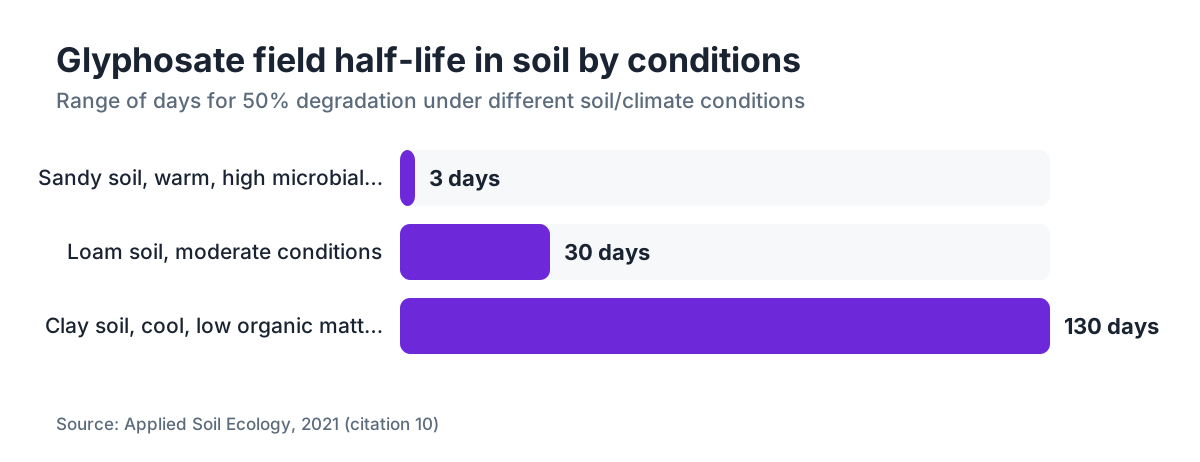
Glyphosate binds hard to soil particles, especially clay and organic matter. In most vineyard soils it breaks down fairly quickly through microbial action, with field half-lives running 3 to 130 days depending on soil type, temperature, and moisture [10]. Sandy, low-organic-matter soils degrade it faster. Heavy clay soils hold it longer.
The mycorrhizal question is the one growers ask most. Arbuscular mycorrhizal fungi (AMF) form partnerships with grapevine roots and help with phosphorus uptake and stress tolerance. Several lab studies show reduced AMF colonization in soils with high glyphosate concentrations. The problem is that lab concentrations in many of those studies run far higher than what you'd see in field soils at typical rates. A 2021 review in Applied Soil Ecology found mixed results: some field studies showed AMF suppression under long-term glyphosate use, others didn't [10].
The practical read isn't "never use glyphosate." It's simpler. Don't use more than you need, rotate herbicide programs to give soil biology recovery time, and build soil organic matter with cover crops and compost, which buffer against any single input's effect on the microbial community.
For vineyards going for organic certification, glyphosate is prohibited under the USDA National Organic Program. Transition requires three years with no prohibited-substance applications before certification, so the timeline shapes your planning [11].
What does the glyphosate cancer controversy mean for vineyard operators?
Straight answer: more documentation, more litigation awareness, and possibly more regulatory scrutiny. It doesn't change the current federal registration.
The International Agency for Research on Cancer (IARC) classified glyphosate as "probably carcinogenic to humans" (Group 2A) in 2015 [12]. EPA ran its own evaluation and in 2020 reaffirmed that glyphosate is "not likely to be carcinogenic to humans" at typical exposure levels [5]. Two conclusions, two methodologies, and a lot of litigation against Bayer (which bought Monsanto) as a result.
For vineyard operators, the practical takeaways:
Wear PPE. The WPS requires it anyway, but the litigation climate makes written evidence of PPE use more important. Log what PPE was worn on each application.
Minimize worker exposure. The re-entry interval, the AEZ, the training requirements all exist partly to hold worker exposure down. Following them is legal compliance and the practical response to a product with contested safety data.
Watch state-level action. California's Office of Environmental Health Hazard Assessment (OEHHA) listed glyphosate as a known carcinogen under Proposition 65 in 2017 [13], though a court challenge blocked enforcement of warning requirements for a stretch. The California regulatory picture isn't static.
The federal label still holds. You can legally use glyphosate in California vineyards under current federal and state registration. What may shift is the downstream liability, and thorough application records protect you there as much as they do for regulators.
How do you build a complete glyphosate spray program for a small vineyard?
Put this together for a 15-acre estate vineyard and it looks like this.
Dormant season (December to early March): One to two passes with glyphosate at 1 lb a.e./acre using a hooded sprayer on the tractor. Target actively growing winter weeds (chickweed, annual ryegrass, brassicas). Apply a pre-emergent right after, or in the same pass if your rig runs a second product. Cold conditions mean near-zero vapor risk, so temperature works for you here.
Pre-budbreak window: Scout the block in late February. If pressure is low after the dormant pass, you may reach budbreak without another application. If annuals germinated since the first pass, one more glyphosate application before visible bud swell is reasonable.
Budbreak to bloom (6 to 10 week blackout): No glyphosate. Use cultivation, hand-hoeing, or a contact herbicide like pelargonic acid if you need post-emergent control. The injury risk isn't worth it.
Post-bloom to veraison: Shielded applications on calm mornings below 80°F if weed pressure warrants. This is the window for perennial escapes. One application usually does it if the dormant program was solid.
Post-harvest (September to November): A strong window for perennials. Bindweed, johnsongrass, and nutsedge are packing carbohydrate into their roots and respond well to glyphosate now. Use the full label rate for perennials.
Record every application the same day. Log the block, product, rate, acres, equipment, weather, and REI. File the WPS posting records with them. In California, roll them into your monthly pesticide use report. Keep digital backups.
Total glyphosate applications in a typical commercial program: 2 to 4 a year, rarely more. Spray more than that and the program has a weed-pressure problem more glyphosate won't fix. Look at your pre-emergent timing, your cover crop management, or your cultivation options.
VitiScribe's spray record module lets you build this whole program as a template, with every required field pre-mapped to California's CAC report format and EPA WPS requirements, so the record is complete before you leave the block.
Frequently asked questions
Can you spray glyphosate around grapevines without killing them?
Yes, but equipment matters. A hooded or shielded sprayer is required to physically block spray from reaching green vine tissue. Keep applications below 85°F to prevent vapor drift. Avoid spraying from budbreak through bloom. On established vines with corked bark, trunk injury risk is low. On vines under three years old with green bark, injury risk is much higher, and most extension advisors recommend keeping glyphosate away from young vines.
What is the re-entry interval for Roundup in vineyards?
Most glyphosate products registered for vineyard use carry a 4-hour re-entry interval (REI) under the EPA Worker Protection Standard. Workers cannot enter the treated area during the REI without handler-level PPE. The treated area must be posted with WPS-compliant warning signs showing the REI end date and time. Check your specific product label, since some formulations differ.
What temperature is too hot to spray Roundup in a vineyard?
Most extension guidance puts the practical upper limit at 85°F (29°C). Above that, glyphosate volatilizes enough to move off-target as vapor. Some California vineyard advisors use 80°F to build in a margin. UC Davis and WSU extension both recommend early-morning applications, when temperatures are lowest and wind is calmest.
How long does glyphosate stay in vineyard soil?
Field half-lives range from roughly 3 to 130 days depending on soil type, temperature, and microbial activity. Sandy soils with high microbial activity degrade it fastest. Clay-heavy soils with low organic matter hold it longer. It binds tightly to soil particles and has little to no residual weed control, so it isn't acting as a pre-emergent during that degradation period.
Is glyphosate allowed in organic vineyards?
No. Glyphosate is prohibited under the USDA National Organic Program. Any vineyard using glyphosate cannot be certified organic. The transition to organic certification requires three years with no prohibited-substance applications. Alternatives for organic under-vine weed control include cultivation, pelargonic acid, flaming, and organic mulch.
What are signs of glyphosate injury in grapevines?
The most recognizable symptoms are strap-like, abnormally narrow leaves on new shoots, shortened internodes that give a compressed or stunted look, and twisted shoot tips. Cluster abnormalities like small berries and poor set can appear if injury hit near bloom. Symptoms usually show one to three weeks after exposure and can be confused with virus or nutrient deficiency, so timing relative to any nearby application is the key diagnostic clue.
Do I need a pesticide applicator license to spray Roundup in my own vineyard?
In most states, vineyard owners can apply pesticides on land they own or lease without a commercial applicator license. If you hire someone else to apply, that person usually needs a licensed pesticide applicator credential. Some states require a Pest Control Adviser (PCA) recommendation for certain restricted-use pesticides. Glyphosate is a general-use pesticide federally, but check your state's requirements, since they vary a lot.
How do I report glyphosate applications in California?
California requires monthly Pesticide Use Reports (PURs) filed with the county agricultural commissioner by the 10th of the following month. Reports must include product name, EPA registration number, active ingredient, rate, total acres treated, field location, and date. The California Department of Pesticide Regulation publishes PUR data publicly. Non-compliance can bring fines and license actions.
Can glyphosate drift from a neighboring vineyard or farm injure my vines?
Yes, and it happens. Vapor drift from nearby applications in high temperatures is a documented injury mechanism. If you suspect off-site drift, photograph symptoms with timestamps, document wind direction and temperature from that date using weather station records, and request application records from the neighboring operation. In California, you can file a pesticide complaint with the county agricultural commissioner, who is required to investigate.
What weeds are hardest to control with glyphosate in vineyards?
Field bindweed (Convolvulus arvensis) and nutsedge (Cyperus spp.) are notoriously tough. Bindweed's deep root system means a single glyphosate pass rarely gives adequate control, so multiple applications targeting regrowth are standard. Yellow and purple nutsedge need high label rates and repeat passes. Confirmed glyphosate-resistant horseweed and hairy fleabane are also challenging and require rotating to a different mode of action.
How does the 2015 EPA Worker Protection Standard revision affect vineyard operators?
The 2015 revision added the Application Exclusion Zone (AEZ), a 100-foot buffer where no workers can be present during ground-based applications. It also raised training requirements to annual WPS safety training (previously every five years), required worker access to pesticide application records, and strengthened anti-retaliation protections. Records must be kept for two years. EPA and CDPR have both increased compliance inspections since the revisions took effect.
What PPE is required when spraying glyphosate in a vineyard?
The label is the legal standard. Most glyphosate labels for vineyard use require a long-sleeved shirt, long pants, chemical-resistant gloves, shoes plus socks, and protective eyewear. If you're mixing or loading concentrate, a face shield or goggles and a chemical-resistant apron are typically required. A closed-cab tractor with HEPA filtration can substitute for some body-protection requirements on some labels, but only if the label specifically says so.
How much does a hooded under-vine sprayer cost?
Purpose-built under-vine hooded sprayer units run roughly $3,000 to $8,000 for ATV or tractor-mounted configurations, based on equipment listed by major agricultural suppliers as of 2024. Full recirculating under-vine systems start around $15,000. Hood attachments for existing booms cost less but need more careful setup. The cost pays back in reduced product use from recirculation and in avoided vine-injury losses.
Sources
- UC Davis UC ANR, Glyphosate Use in Vineyards: Glyphosate volatilization increases above 85°F and hooded sprayer equipment is recommended for under-vine applications
- UC Cooperative Extension, Herbicide Injury in Vineyards: Glyphosate injury is one of the leading herbicide-related issues documented in California commercial vineyards
- Washington State University Extension, Weed Management in Vineyards: WSU extension recommends avoiding glyphosate during budbreak through bloom due to vapor drift risk and recommends shielded equipment
- WSU Extension, Glyphosate and Grapevine Sensitivity Research: WSU research found measurable growth abnormalities in test vines exposed to glyphosate drift during budbreak
- EPA, Glyphosate: Response to Comments, Weight-of-Evidence Determination and Updated Exposure Analysis, 2020: EPA 2020 evaluation concluded glyphosate is 'not likely to be carcinogenic to humans' at typical exposure levels; FIFRA requires use consistent with labeling
- EPA, Worker Protection Standard (40 CFR Part 170): WPS requires 4-hour REI for most glyphosate products, Application Exclusion Zone of 100 feet, annual training, and two-year record retention
- California Department of Pesticide Regulation, Pesticide Use Reporting: California requires monthly Pesticide Use Reports filed with the county agricultural commissioner by the 10th of the following month
- International Survey of Herbicide-Resistant Weeds, Weed Science Society of America: Glyphosate-resistant horseweed (Conyza canadensis) is confirmed in California's Central Valley including areas overlapping wine grape production
- Applied Soil Ecology, Review of glyphosate effects on soil microbial communities and mycorrhizal fungi, 2021: Field half-lives of glyphosate range from 3 to 130 days; mixed results on AMF suppression under field conditions at typical application rates
- USDA Agricultural Marketing Service, National Organic Program: Glyphosate is prohibited under the USDA National Organic Program; three-year transition period required before certification
- IARC Monographs Volume 112, Glyphosate, 2015: IARC classified glyphosate as 'probably carcinogenic to humans' (Group 2A) in 2015
- California OEHHA, Proposition 65 Chemical Listings, Glyphosate: California OEHHA listed glyphosate as a known carcinogen under Proposition 65 in 2017
- Cornell University Cooperative Extension, Vineyard Weed Management: Cornell extension flags vapor movement of glyphosate as primary reason to avoid applications during budbreak through bloom
Last updated 2026-07-09