Portal XLO spraying for GBM in vineyards: what actually works
TL;DR
- Portal XLO (fenpyroximate 0.4 SC) controls grape berry moth by hitting larvae and adults through contact and residual action.
- Apply 5 to 6 fl oz per acre, respect the 7-day pre-harvest interval, and stop at 3 applications a season.
- Timing to a degree-day model is what separates real control from a wasted tank.
What is Portal XLO and why do vineyard managers use it for GBM?
Portal XLO is a miticide and insecticide built on fenpyroximate at 0.4 lb active ingredient per gallon, sold as a suspension concentrate. It sits in IRAC Group 21A, meaning it shuts down mitochondrial complex I and cuts off the pest's energy production. That mode of action has nothing in common with organophosphates or pyrethroids, which is why Portal XLO earns a spot as a rotation partner in programs that have leaned on those older chemistries for years.
Grape berry moth (Paralobesia viteana) is the worst insect pest in eastern North American vineyards [1]. Larvae bore into berries, cause direct crop loss, and crack the door open for secondary Botrytis that can wreck a whole block. In high-pressure country like the Lake Erie district, the Finger Lakes, and western Pennsylvania, GBM is the single reason growers run three or four spray passes a year.
Portal XLO shows up in GBM programs mostly for its contact activity on larvae and its knockdown of adult feeding and egg-laying. It is not a true ovicide. But cutting adult activity during egg lay suppresses the next generation anyway. Penn State Extension has folded fenpyroximate-class products into integrated spray schedules as a rotation tool when carbamate and pyrethroid activity looks like it is slipping [1].
One caveat, and it matters. Portal XLO is labeled first as a miticide, and GBM use rides on the supplemental label plus whatever state registrations allow it. Check the current label for your state before you buy. Labels change, and state registrations change with them.
How do degree-day models drive the timing of Portal XLO applications?
Timing is the whole game with GBM. Spray on the wrong day and you burned money. Spray on the right day and you can knock a generation back hard enough to lighten the load on the next pass.
The standard GBM degree-day (DD) model runs off a base temperature of 50 degrees F (10 C). Biofix is set when adult moths first show up consistently in traps, usually late April to early May across most eastern regions. From biofix, the thresholds you care about are:
- First generation egg hatch: about 100 to 180 DD50 after biofix [1]
- Second generation: about 810 to 1,000 DD50 after biofix
- Third generation: about 1,440 to 1,620 DD50 after biofix
Portal XLO fits best at the shift from early larvae to mobile late-instar larvae, and at adult flight peaks where contact suppression cuts egg-laying. Its residual window runs roughly 7 to 10 days in the field, which lines up with putting it down just before or at peak egg hatch. Not after. Once larvae bore into berries, they are protected and contact activity can't touch them.
Cornell runs the Network for Environment and Weather Applications (NEWA), a free platform with a GBM degree-day model that pulls in trap data [2]. Washington State University keeps similar phenology models for Pacific Northwest pests. Skip the weather-station-linked calculator and you are guessing. Guessing usually costs a grower one extra application per season.
One field note worth keeping. In drought years or a hot spring, degree-day accumulation can run 2 to 3 weeks ahead of the historical average. Read your station data weekly through May and June, not monthly.
What are the label rates and restrictions for Portal XLO in vineyards?
The Portal XLO supplemental label for grapes sets the numbers below. Always check the current printed label, because these shift between registration cycles.
| Parameter | Rate or Restriction |
|---|---|
| Application rate per acre | 5 to 6 fl oz Portal XLO per acre |
| Maximum applications per season | 3 |
| Minimum interval between applications | 7 days |
| Pre-harvest interval (PHI) | 7 days |
| Re-entry interval (REI) | 12 hours |
| Water volume (ground) | 50 to 150 gallons per acre |
| Water volume (air-assisted/airblast) | 50 to 100 gallons per acre |
| Maximum seasonal AI rate | Check current label; GBM use stacks against mite-use totals |
The 12-hour REI keeps workers out of treated areas for that window unless they have the right PPE [3]. Under the EPA Worker Protection Standard (WPS), you have to post the treated area and get handlers the safety data sheet before application starts. The WPS also requires you to keep the label copy and application records for at least 2 years [3].
Fenpyroximate has a water solubility of about 0.023 mg/L at 20 C and a soil half-life (DT50) somewhere between 20 and 100 days depending on soil type and moisture. So runoff into surface water is a real concern during and after application. Buffer zone compliance is not optional. The current Portal XLO label sets a minimum 25-foot buffer from water bodies for ground applications. Check your state label for anything layered on top of the federal one.
Tracking PHI, REI, application dates, rates, and field IDs in paper logbooks sets you up for a compliance gap. A tool like VitiScribe stores spray records digitally with the label requirements pinned to each entry. That matters here because the multi-pass, multi-generation shape of GBM programs makes record-keeping errors compound fast.
How do you mix and apply Portal XLO for best coverage in a vine canopy?
Fenpyroximate works by contact. If the spray doesn't reach the cluster zone, you get no meaningful GBM suppression, and it doesn't matter how perfectly you timed the pass.
For airblast, university extension programs agree on one thing: calibrate for full cluster-zone penetration, more than outer leaf coverage. That usually means 50 to 100 gallons per acre for a typical trellis, adjusted for canopy density. Dense double-curtain or sprawl canopy with no shoot positioning? Add water volume and slow down. Penn State's airblast calibration resources walk through the catch-frame method step by step [1].
Mixing order matters. Fill the tank half full with clean water. Add any label-required adjuvants (Portal XLO generally doesn't need a sticker-spreader, though some growers add a non-ionic surfactant at 0.05 to 0.1% v/v). Add Portal XLO, then top off. Agitate through mixing and application. The suspension concentrate settles if the sprayer sits idle more than 15 to 20 minutes.
Portal XLO tank-mixes with several fungicides common in GBM timing windows, including mancozeb and some DMI fungicides. Run a physical jar test first, every time. Some adjuvant systems cause precipitation or separation with SC formulations. The label lists known incompatibilities. Read it before you assume any mix is fine.
Wind matters more than most growers admit. Spray when wind is under 10 mph to hold down drift. Early morning applications, calm and cooler, also cut volatilization of the active ingredient. Where bees are active, aim for early morning or evening when foragers are quiet, because fenpyroximate carries some bee-contact toxicity.
What does resistance management look like when Portal XLO is in the rotation?
IRAC Group 21A has a cleaner resistance history in GBM than pyrethroids (Group 3) and some organophosphates. That is not permission to ignore rotation. GBM has documented resistance to organophosphates and pyrethroid classes in parts of the eastern U.S. [4]. The lesson from those failures is simple: lean on one mode of action across several straight generations and you speed up selection.
A workable three-pass rotation might look like this:
- First generation: Altacor or Delegate (IRAC Group 28 or 5, diamides/spinosyns)
- Second generation: Portal XLO (IRAC Group 21A)
- Third generation: back to Group 28, or an IGR like Intrepid (Group 18) if a fourth generation is possible in your region
That pattern gives you chemical diversity across all three generations and holds any single mode of action to one application per season. Cornell's New York and Pennsylvania Pest Management Guidelines for grapes lay out the full rotation matrix with resistance notes [12].
Using Portal XLO once does not buy you permanent protection from resistance. If your degree-day timing is sloppy and larvae keep surviving applications, look at timing and coverage before you blame the chemistry. Resistance gets confirmed by bioassay, not by a bad field result alone.
What records do you legally need to keep after applying Portal XLO?
Federal law makes commercial applicators and producers keep certain application records. Under the WPS [3] and FIFRA Section 8(a) [5], the minimum for a restricted-use pesticide application includes: applicator name and certification number, product name, EPA registration number, date and time of application, location (field ID or legal description), rate applied, total product used, and crop treated.
Portal XLO's EPA registration number is 67690-43. Keep that number in your spray log. Some state agriculture departments want extra fields too, including weather at application, application method, and target pest. California's Department of Pesticide Regulation requires county-reported use data for all restricted materials, filed monthly [6].
The 2-year retention minimum under WPS [3] is a floor, not a ceiling. If a GAP (Good Agricultural Practices) audit is in your future, most certification bodies want 3 years. Sell to a major winery with an audit program and their vendor rules may push it to 5.
Paper logbooks work until audit day, when you're hunting through binders for one spray event on one block. If you run multiple vineyard blocks across separate properties, a digital spray record system pays for the subscription almost immediately. The alternative is hours of audit prep you could spend anywhere else.
Write each spray log entry before the next spray, not at season's end. Reconstructing records from memory is error-prone, and if an auditor catches it, it puts a question mark over everything else in your file.
What is the pre-harvest interval for Portal XLO, and why does it matter?
The PHI for Portal XLO on grapes is 7 days. Your last application has to land at least 7 days before harvest.
That's tighter than a lot of growers expect for a Group 21A product, and it forces a real decision. The third-generation GBM flight often overlaps the 4-to-6-week pre-harvest window in early-ripening varieties. If your Pinot Noir or Chardonnay comes in at 100 to 105 days from bud break, your third-generation spray window can run right up against harvest.
Most experienced managers schedule the third application with a 10-day margin instead of cutting it to exactly 7. Harvest dates move fast. A week of surprise heat or a winery schedule change can crush your window. A 3-day buffer costs you almost nothing in pest terms.
On the resistance side, skipping the third application when harvest is close, and using a different tool instead (pulling infested clusters, removing mummy berries post-harvest), is legitimate for low-to-moderate pressure blocks. The question is honest: how much damage is third-generation GBM actually doing here, and does it clear the economic threshold? If berry moth pressure reads low at second-generation assessment, a third application may not pay regardless of PHI timing.
How does Portal XLO fit into a full GBM IPM program?
No single product beats GBM. The growers who keep berry moth damage under 2 to 3% injury at harvest run a stacked system: monitoring, degree-day timing, cultural practices, and well-rotated chemistry.
Monitoring means pheromone traps at a density of at least one per 5 acres, checked weekly from April through September [1]. Trap catch sets your biofix, and biofix resets your degree-day model. Without accurate biofix, your spray timing drifts by a margin that can easily beat the residual window of any product, Portal XLO included.
Cultural practices that lower GBM pressure include cluster-zone leaf removal (better spray penetration, less humidity favoring larval survival), cane or spur pruning to cut mummy clusters where adults overwinter, and early harvest of damaged blocks to break the third generation. Unglamorous, labor-heavy work. But WSU tree-fruit entomology guidance is consistent: IPM programs with strong cultural components beat chemistry-only programs on long-run pest pressure [7].
Mating disruption with pheromone dispensers (Isomate GBM or similar) has solid trial data showing 60 to 80% trap catch reduction in treated blocks [4]. For vineyards with steady multi-year GBM pressure, mating disruption plus one or two well-timed insecticide passes beats three untimed chemical passes. The upfront cost runs roughly $100 to $200 per acre for full deployment, which is real money, but the resistance benefit and the labor you save on spray passes can justify it across a 3-to-5-year horizon.
Biological control with Bacillus thuringiensis var. kurstaki (Btk) products like DiPel hits early-instar larvae and fits the first-generation slot when pressure is moderate. Btk holds no residual past a few days of UV exposure, so it demands even tighter degree-day precision than Portal XLO. The tradeoff: no REI, no PHI, no resistance risk.
What are the worker safety requirements when applying Portal XLO?
Portal XLO is a Restricted Use Pesticide (RUP) in most states thanks to its acute toxicity profile. Application takes a licensed applicator, or someone working directly under a licensed applicator's supervision.
Under the EPA Worker Protection Standard [3], the handler PPE on the current Portal XLO label includes long-sleeved shirt and long pants, chemical-resistant gloves (Category A), protective eyewear, and shoes plus socks. Some label versions also call for chemical-resistant footwear. Read your specific version, because PPE gets updated between registration cycles.
The 12-hour REI means no agricultural workers or handlers enter the treated area without full PPE until 12 hours have passed from the end of application. Post the block with WPS-compliant signs at every entry point, and leave them up until the REI ends.
Decontamination facilities have to be within 1/4 mile of handler work sites. Running an airblast rig means your truck carries water, soap, and single-use towels, accessible within a quarter mile of the block you're treating [3].
For employees who work treated blocks after the REI clears, WPS requires access to the pesticide safety information (label and SDS) and pesticide safety training within the last year. That training rule covers all agricultural workers, not only handlers. It's a common gap on smaller operations where the owner does the spraying and seasonal crews get a thin WPS briefing.
USDA National Agricultural Statistics Service surveys point to pesticide-related injuries in viticulture being underreported but real [8]. Handler training is more than a checkbox. It's what stops an employee from rinsing spray residue off their hands in the vineyard water line.
How do you document Portal XLO use to pass a winery or GAP audit?
Winery audits and third-party GAP certifications (PrimusGFS, SCS, GlobalG.A.P.) have settled on a fairly consistent spray record format. Here is what auditors pull for when they open your pesticide records:
- Product name, EPA Reg No., and AI name
- Application date, block ID, acreage treated
- Rate per acre and total product used
- Target pest and crop
- Applicator name and (for RUPs) license number
- PHI and REI logged against harvest date
- Weather conditions at time of application (required by many state labels, standard in audit programs)
- Signature of responsible party
The most common audit finding is not a missing record. It's an incomplete one. A log entry with date and product but no rate, or a rate with no block acreage, fails the audit as cleanly as a blank line.
Run more than two or three blocks and the complexity climbs fast. A manager handling five varieties across three properties, each with its own rotation schedule and harvest window, can generate 40 to 60 spray records in a season. Keeping those organized and cross-referenced to harvest dates and PHIs is where digital record-keeping earns its cost. VitiScribe was built for this exact problem, and its PHI/REI flag catches the harvest timing conflicts that surface in audits and, worse, in winery residue testing.
For growers selling to wineries with their own residue testing (a growing habit among larger production wineries), fenpyroximate sits on most panel assays. Knowing your last application date and confirming PHI compliance gives you the paperwork to back up a clean test result.
How does Portal XLO compare to other GBM insecticides on key parameters?
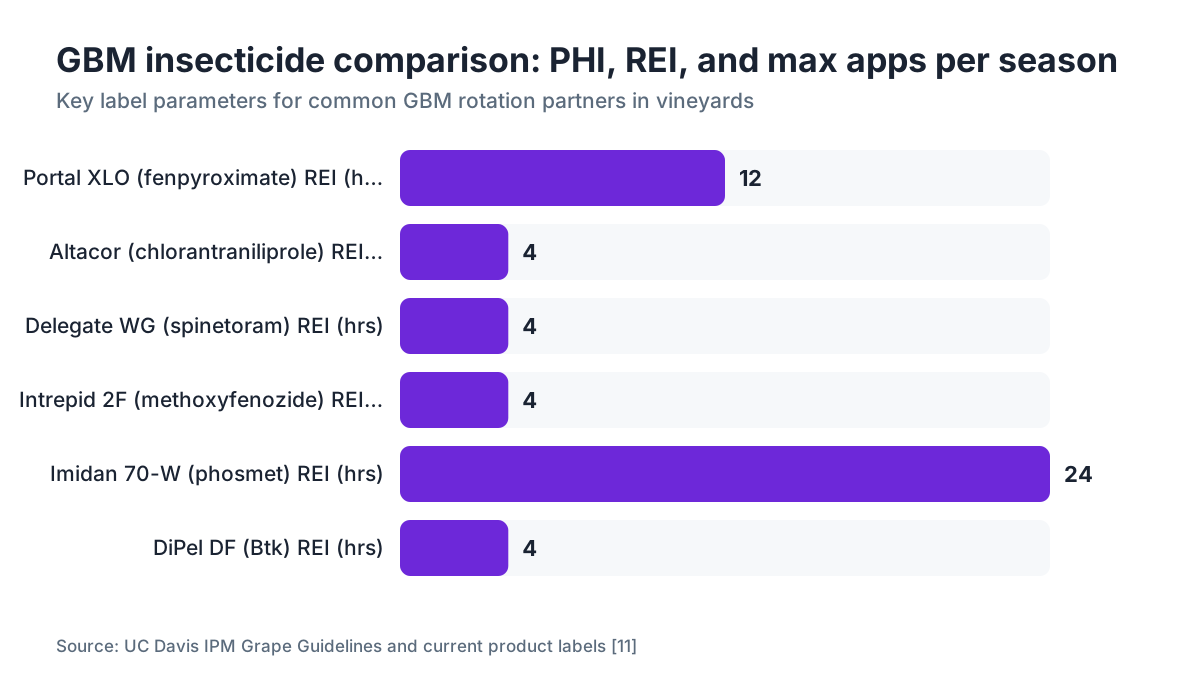
Here's a straight comparison of the products that show up most in GBM rotations. Numbers come from current labels and university extension spray guides [1][7][11].
| Product (AI) | IRAC Group | Rate/Acre | PHI (days) | REI (hours) | Max Apps/Season | RUP? |
|---|---|---|---|---|---|---|
| Portal XLO (fenpyroximate) | 21A | 5 to 6 fl oz | 7 | 12 | 3 | Yes |
| Altacor (chlorantraniliprole) | 28 | 3.0 to 4.5 oz | 7 | 4 | No stated max, see label | No |
| Delegate WG (spinetoram) | 5 | 3 to 6 oz | 7 | 4 | 3 | No |
| Intrepid 2F (methoxyfenozide) | 18 | 4 to 16 fl oz | 7 | 4 | 6 | No |
| Imidan 70-W (phosmet) | 1B | 2.125 lb | 7 | 24 | Check label | Yes |
| DiPel DF (Btk) | 11 | 0.5 to 2 lb | 0 | 4 | No limit | No |
Portal XLO's real edge in this table is the Group 21A classification, which hands you genuine mode-of-action diversity when the rest of your rotation runs heavy on Groups 28 and 5. Its real drawback is the longer REI, 12 hours against 4 for Altacor and Delegate, which piles scheduling pressure on operations with workers in the vineyard on tight timelines.
On cost, Portal XLO at the upper 6 fl oz rate burns roughly 1.5 pints per acre. Retail runs somewhere in the $400 to $600 per gallon range (varies by supplier and year, so get a current quote from your ag chem rep). At 6 fl oz per acre, product cost lands around $19 to $28 per acre per application. Mid-range for this class of insecticide.
Are there any environmental or water quality concerns with Portal XLO near vineyards?
Fenpyroximate is highly toxic to fish and aquatic invertebrates. The LC50 for rainbow trout is around 0.2 mg/L, which puts it in EPA Aquatic Toxicity Category I, the most restrictive tier [9]. This is not the product to round up on rate near a pond. The no-spray buffer zones on the label exist because this compound does real ecological damage at low concentrations.
The 25-foot buffer from water for ground applications on the federal label is the minimum. Several states, California [6] and New York among them, layer additional label restrictions or mitigation on top. If your vineyard borders a drainage channel, stream, or pond, you need to know exactly what your state label says about buffer distances and spray direction.
Fenpyroximate is also moderately toxic to birds, with dietary LC50 values that warrant caution where ground-feeding species forage during application. Early-morning applications, when bird activity near the spray zone is lower, cut exposure.
On soil and water: fenpyroximate binds tightly to organic matter (log Kow around 5.0), so it tends to stay in the top few centimeters of soil rather than leaching toward groundwater. The main risk is surface runoff during rain in the first 24 to 48 hours after application. Don't apply with rain forecast inside 24 hours. On sloped ground with compacted soil or thin between-row cover crop, that runoff risk climbs.
The UC Davis Integrated Pest Management program publishes pesticide ecotoxicology data with fenpyroximate risk rankings by site type [10]. Pull that data for your own site conditions, especially if you sit in a groundwater protection area or next to sensitive aquatic habitat.
Frequently asked questions
What pest does Portal XLO control in vineyards?
Portal XLO (fenpyroximate 0.4 SC) controls grape berry moth (Paralobesia viteana) in vineyards, along with various mite species. Its contact and residual activity targets larvae and reduces adult feeding and egg-laying. It sits in IRAC Group 21A, which makes it a useful rotation partner when pyrethroids or organophosphates form the backbone of an existing program.
What is the correct rate for Portal XLO in a vineyard spray program?
The labeled rate for Portal XLO on grapes is 5 to 6 fluid ounces per acre per application. Use the higher end for dense canopies, high GBM pressure, or second and third generation timing when larvae are more mobile. Don't exceed 3 applications per season or go below a 7-day interval between passes.
What is the pre-harvest interval for Portal XLO on grapes?
Portal XLO has a 7-day pre-harvest interval (PHI) on grapes. Most experienced managers build in a 10-day buffer to absorb winery scheduling shifts and unexpected heat that compresses harvest timing. For early-ripening varieties with tight harvest windows, plan your third-generation GBM spray backwards from your estimated harvest date.
Does Portal XLO require a restricted use pesticide license to apply?
Yes. Portal XLO is a Restricted Use Pesticide in most states. Application requires a licensed commercial pesticide applicator or someone working under direct supervision of one. Keep the applicator's license number in your spray log for every application. It's a standard requirement during WPS and GAP audits.
How many times can you apply Portal XLO per season in vineyards?
The label allows a maximum of 3 applications per season in vineyards, spaced at least 7 days apart. In a typical three-generation GBM program, one application per generation is the standard approach, with mode-of-action rotation across the season to hold down resistance pressure.
What is the re-entry interval (REI) for Portal XLO?
The REI for Portal XLO is 12 hours. No agricultural workers or handlers may enter the treated block without full label-specified PPE until 12 hours have passed from application completion. Under the EPA Worker Protection Standard, you must post treated-area signs at all entry points for the full duration of the REI.
When should you apply Portal XLO to hit grape berry moth effectively?
The best timing is at or just before peak egg hatch for each GBM generation, calculated with a degree-day model using a 50 degrees F base temperature after biofix. NEWA (Cornell) and your state extension model give real-time degree-day tracking. Target the 100 to 180 DD50 post-biofix window for first generation. Spraying after larvae bore into berries gives little benefit, since contact activity can't reach protected larvae.
Can Portal XLO be tank-mixed with fungicides used in vineyards?
Portal XLO tank-mixes with some common vineyard fungicides including mancozeb and certain DMIs, but always run a physical jar test before committing to a full tank. SC formulations can react with adjuvant systems unpredictably. Check the Portal XLO label for listed incompatibilities, and never assume a mix is safe just because it looks homogeneous right after mixing.
What spray records do I need to keep after a Portal XLO application?
Required records under FIFRA and WPS include product name, EPA registration number (67690-43 for Portal XLO), application date, field ID and acreage, rate applied, total product used, target pest, crop, applicator name and license number, REI and PHI, and weather at application. Retain records at least 2 years under WPS; GAP and winery audit programs typically want 3 to 5 years.
Is Portal XLO safe to use near water or streams bordering a vineyard?
No. Fenpyroximate is highly toxic to fish and aquatic invertebrates, rated EPA Aquatic Toxicity Category I. The federal label requires a minimum 25-foot no-spray buffer from water bodies for ground applications. Some state labels require wider buffers. Never apply with rain forecast within 24 hours. Check your specific state label for additional restrictions before applying near any surface water.
How does Portal XLO fit into a resistance management rotation for GBM?
Portal XLO (IRAC Group 21A) gives you genuine mode-of-action diversity in a GBM program dominated by Group 28 (diamides like Altacor) and Group 5 (spinosyns like Delegate). Use it for one generation per season, not back-to-back. GBM has documented resistance to organophosphates and pyrethroids in eastern U.S. vineyards, the historical warning for what happens when rotation discipline breaks down.
What PPE is required when handling or applying Portal XLO?
The Portal XLO label requires long-sleeved shirt and pants, chemical-resistant gloves (Category A), protective eyewear, and shoes with socks for handlers. Some label versions require chemical-resistant footwear. Decontamination facilities (water, soap, single-use towels) must be within 1/4 mile of the work site. Verify current PPE requirements on the most recent printed label, since these get updated between registration cycles.
What does a degree-day model for GBM look like and where can I access one?
GBM degree-day models use a 50 degrees F base temperature. You set biofix when adult moths first show up consistently in pheromone traps. Cornell's NEWA platform (newa.cornell.edu) runs a free, weather-station-integrated GBM DD model that tracks generations in real time. Penn State Extension also provides regional GBM models. Without trap-based biofix, your model inputs are guesses and your spray timing will drift.
How much does it cost to apply Portal XLO per acre?
At the upper labeled rate of 6 fl oz per acre and typical retail pricing of $400 to $600 per gallon, product cost runs roughly $19 to $28 per acre per application. That's mid-range among GBM insecticides. Application cost (custom applicator or own equipment) adds $15 to $40 per acre depending on region and operation size. Three-pass programs run $100 to $200 per acre in direct spray inputs for GBM control alone.
Sources
- Penn State Extension, Grape Berry Moth Management: GBM is the most economically damaging insect pest of eastern North American vineyards; degree-day thresholds, trap monitoring density, and resistance management rotation guidance.
- Cornell University, Network for Environment and Weather Applications (NEWA), GBM Degree-Day Model: NEWA hosts a free GBM phenology model using trap-based biofix and weather station degree-day accumulation for spray timing.
- EPA, Worker Protection Standard for Agricultural Pesticides: WPS requires 2-year minimum record retention, REI posting, decontamination facilities within 1/4 mile, and annual worker safety training.
- Isaacs R. et al., Documented pyrethroid and organophosphate resistance in grape berry moth populations, Journal of Economic Entomology: GBM populations in eastern U.S. have documented resistance to organophosphates and pyrethroids, supporting the need for mode-of-action rotation.
- EPA, FIFRA Section 8 Record-keeping Requirements: FIFRA Section 8(a) requires commercial applicators to maintain pesticide application records including product, rate, location, and applicator identity.
- California Department of Pesticide Regulation, Pesticide Use Reporting: California requires monthly county-reported pesticide use data for all restricted materials applications, with additional buffer zone requirements on some labels.
- Washington State University Extension, Grape Berry Moth and Integrated Pest Management: IPM programs combining cultural practices with well-timed chemistry consistently outperform chemistry-only programs on long-run pest pressure.
- USDA National Agricultural Statistics Service, Farm Labor and Pesticide Injury Data: Pesticide-related injuries in viticulture are underreported; NASS survey data provides baseline estimates for agricultural worker exposure incidents.
- EPA, Pesticide Ecotoxicology and Assessing Pesticide Risks, Fenpyroximate Aquatic Toxicity: Fenpyroximate LC50 for rainbow trout is approximately 0.2 mg/L, classifying it as EPA Aquatic Toxicity Category I, highly toxic to fish.
- UC Davis Integrated Pest Management Program, Pesticide Active Ingredient Database: UC IPM publishes fenpyroximate ecotoxicology risk rankings by site type, including aquatic and groundwater protection area assessments.
- UC Davis, Grape Pest Management Guidelines, GBM and Insecticide Options: UC Davis IPM grape guidelines include insecticide comparison tables with IRAC group, PHI, REI, and resistance management ratings for GBM control products.
- Cornell Cooperative Extension, New York and Pennsylvania Pest Management Guidelines for Grapes: Cornell's grape IPM guidelines provide the full recommended GBM rotation matrix with resistance management notes and generation-by-generation product recommendations.
Last updated 2026-07-09