Cotton over-spraying into vineyards: what growers need to know

TL;DR
- Cotton sprayed with synthetic auxin herbicides (2,4-D, dicamba, clopyralid) can drift onto neighboring vineyards and cause severe injury or vine death.
- Grapevines are among the most sensitive crops to these chemicals, showing symptoms at exposures below 1 part per billion.
- Fast documentation, a complaint filed with your state ag department, and clean spray records are your main legal and insurance tools.
Why are vineyards so vulnerable to cotton herbicide drift?
Grapevines are one of the most sensitive crops on earth to synthetic auxin herbicides. That category includes 2,4-D, dicamba, and clopyralid, all used heavily in cotton across the southern San Joaquin Valley, the Texas High Plains, and the Mid-South cotton belt. University of California Cooperative Extension research found grapevines show visual injury from dicamba at air concentrations as low as 0.1 to 1 part per billion (ppb) [1]. Put another way: a single badly timed application on a field a half-mile off can volatilize enough herbicide on a warm afternoon to damage a whole block.
The biology explains the sensitivity. Auxin herbicides mimic the plant's own growth hormones. The vine responds with fast, uncontrolled cell division. Leaves curl into tight fists, petioles twist, shoot tips bend into a distinctive shepherd's crook. Cluster stems distort and abort. In bad cases the vascular cambium is damaged and the vine dies back to the trunk. None of that reverses after the fact.
Cotton and wine grapes sit closest together in the San Joaquin Valley, where fields and blocks can be a few hundred yards apart. The same layout shows up near Lubbock in West Texas, where irrigated vineyards border big cotton acres. Those overlap zones produce nearly every documented damage case.
Which herbicides used on cotton cause the most damage to grapevines?
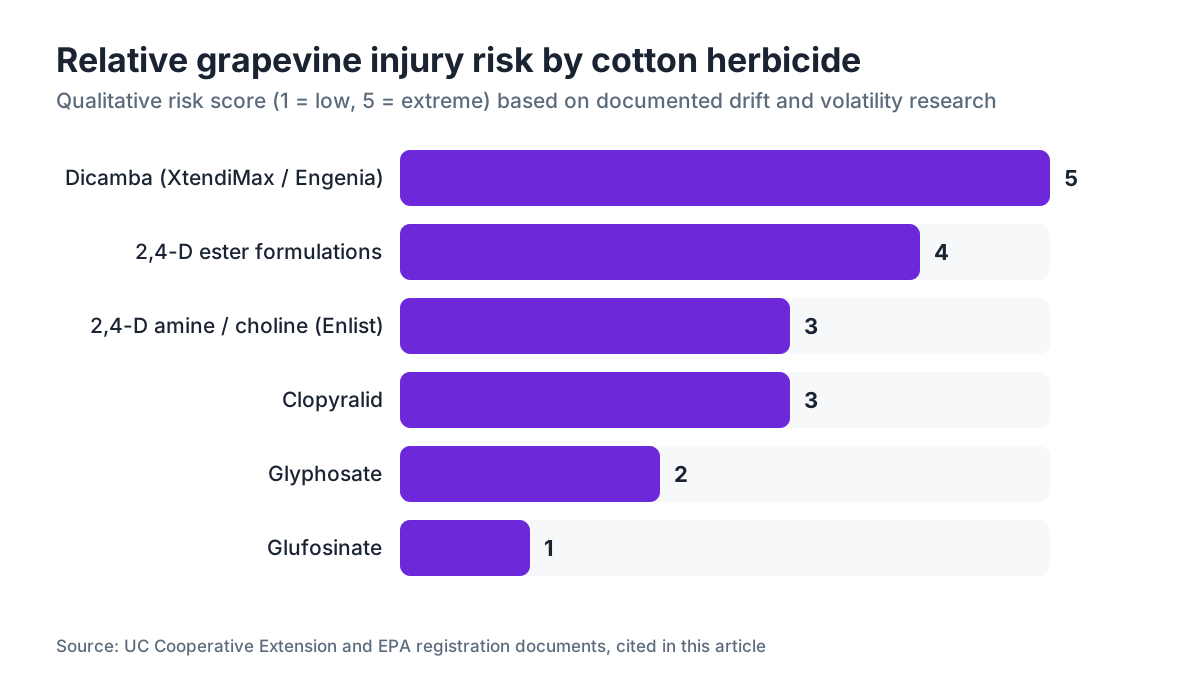
Not every cotton herbicide carries the same risk. The synthetic auxins are the real problem. Here's how the main ones compare.
| Herbicide | Use in cotton | Vine sensitivity | Key drift mechanism |
|---|---|---|---|
| 2,4-D amine | Preplant, burndown | Very high | Spray particle drift and vapor drift |
| 2,4-D choline (Enlist) | In-crop, Enlist cotton | Very high | Reduced volatility vs. ester, but still drift risk |
| Dicamba (XtendiMax, Engenia, Tavium) | In-crop, XtendFlex cotton | Extremely high | Volatilization hours after application |
| Clopyralid | Broadleaf weeds, some cotton programs | High | Spray drift, soil residue in compost |
| Glufosinate | In-crop contact herbicide | Low | Minimal drift injury to vines |
| Glyphosate | Burndown | Moderate at high rates | Primarily spray drift, not vapor |
Dicamba is the worst offender today. It volatilizes after application, so even a correct, on-label spray can throw off vapor that moves off-target for 24 to 48 hours, worst when temperatures climb [2]. The EPA's 2020 registration cancellation order for three dicamba products (XtendiMax, Engenia, Tavium) was later modified after legal challenges, but the science on off-target movement didn't change. California's CDFA has issued county-level restrictions on dicamba use near vineyards [3].
2,4-D esters volatilize more readily than amine formulations, which is why most state ag departments restrict ester use in warm months. The Enlist Duo label (2,4-D choline plus glyphosate) carries specific geographic restrictions and wind speed limits. Those are legally binding parts of the federal registration, not suggestions [4].
How does herbicide drift actually reach a vineyard?
Three separate pathways move herbicide off a cotton field, and each one calls for a different response from you.
Spray particle drift happens during application. Droplets smaller than roughly 150 microns stay airborne long enough to travel hundreds of yards on a moderate breeze. Aerial work is the highest risk because the aircraft operates at altitude with more wind exposure. Most state pesticide rules require ground rigs to shut down above 10 mph wind, but enforcement is uneven.
Vapor drift is the slow, quiet one. Dicamba can volatilize off treated soil and leaf surfaces for hours or days after the spray dries. Warm afternoons above 85 degrees Fahrenheit speed it up. A manager who saw no spray activity next door can still catch a damaging dose of volatilized dicamba that came off an application made two days earlier a quarter mile away.
The third pathway is contaminated water or irrigation runoff. It's rare with synthetic auxins but documented with clopyralid, which moves freely in water and survives composting. UC Davis extension has flagged clopyralid-contaminated municipal compost as a vine injury source in California [5].
Temperature inversions at dawn and dusk pin herbicide vapor near the ground and funnel it into low-lying blocks. Anyone who's watched morning fog pool in a valley-bottom row already knows how this plays out.
What does herbicide drift damage look like on grapevines?
Symptoms come on fast, usually within 3 to 10 days of exposure depending on dose and growth stage. The pattern is distinctive enough that an experienced viticulturist can make a confident field call before any lab result comes back.
Leaf symptoms: epinasty (downward cupping and twisting), fan-shaped distortion, and a mottled yellow-green color. New growth reads worse than old leaves because dividing cells are more sensitive. In dicamba injury the veins run nearly parallel instead of in the normal net pattern, sometimes called leaf strapping.
Shoot and tendril symptoms: shepherd's crook curling at the tip, twisted tendrils, shortened internodes. The whole shoot can look like it froze and contorted in place.
Cluster symptoms: rachis distortion, berry set failure, cluster stem necrosis in bad cases. If bloom lines up with the exposure, crop loss can hit near 100 percent in affected blocks even when the vines live.
Root and trunk: high or repeated doses can damage cambium. Vines that seem to bounce back above ground may grow poorly the next season and die back over winter. Washington State University extension notes that young vines under 5 years carry far less carbohydrate reserve to recover from sublethal auxin injury and are more likely to die than established vines [6].
One practical warning. Auxin symptoms mimic grape leafroll virus and some nutrient deficiencies. If you're unsure, tissue analysis for herbicide residue (covered below) is the only way to prove a chemical cause.
How do I confirm that herbicide drift caused the damage I'm seeing?
Visual diagnosis gives you a working theory. A complaint or a claim needs lab evidence, and you need that evidence in hand before you argue with anyone.
Tissue sampling: collect actively growing shoot tips and young leaves from symptomatic vines, plus a matched set from visually normal vines in a block away from the exposure direction. Seal them in plastic bags on ice. Ship overnight to an agricultural lab that runs herbicide residue panels. Eurofins Agroscience Services and Pacific Agricultural Laboratories both run these panels in California. Your county farm advisor can name labs in your state.
Air sampling: some county ag commissioners will deploy passive air samplers if you call fast enough during an active exposure event. This matters most for dicamba, where the vapor window is short.
Spray drift modeling: state and county investigators sometimes run drift models (AGDISP is a common one) to test whether a neighboring application could plausibly have reached you given wind, temperature, and equipment. You won't run this yourself, but knowing it exists helps when you're working with an attorney.
Your own field documentation: photograph symptoms the day you notice them. Use a GPS-enabled phone so each photo carries coordinates. Note date, time, wind direction, and any neighboring spray activity you saw. VitiScribe or any field record tool that stamps entries with time and location beats reconstructing paper notes a month later [7]. Keep records of your own spray work too, because the first thing a cotton grower's attorney raises is that your own herbicide caused the symptoms.
Here's what nobody tells you. Symptoms often peak 7 to 14 days after exposure, not right away. Don't wait for them to settle before you document. Start the day you first see anything off.
What are your legal options and how do you file a complaint?
Most states make you file a pesticide drift complaint with the county agricultural commissioner (in California) or the equivalent state ag office inside a set window. California allows filing within 30 days of the incident, though sooner is always better because investigators need to grab evidence before it degrades [3].
The process runs like this. You call the county ag commissioner, describe the incident in as much detail as you have, and an investigator gets assigned. That investigator may collect tissue samples, interview both parties, and pull application records from the neighboring operator. Under the California Food and Agricultural Code, licensed applicators must keep application records for at least 3 years and hand them to the commissioner on request [3].
Civil litigation is the other track, usually run alongside or after the administrative complaint. To win in court you have to establish four things: the defendant applied a pesticide, it moved off-target, it reached your vineyard, and it caused measurable damage. Lab evidence ties the first three together. An economic damage assessment from a certified crop adviser (CCA) or independent viticulturist covers the fourth.
The EPA's Worker Protection Standard (WPS) kicks in if any of your workers were exposed during the event, separate from the crop damage. Under WPS you must provide decontamination, emergency help if needed, and pesticide safety information when workers may have been exposed [8]. That obligation stands on its own, and skipping it creates fresh liability.
Set your expectations. Most of these cases settle before a verdict. The evidentiary bar is high, the timeline runs years, and both sides usually have more to lose from a long fight than from a negotiated payment. A well-documented complaint backed by lab data reaches settlement faster than one built on photos alone.
What spray records should you be keeping in your own vineyard?
Your own spray records protect you two ways. They prove you weren't the source of the herbicide that hit your vines, and they document your own label compliance if regulators come knocking.
At minimum, a compliant application record in California lists the operator's name, the property description (APN or legal description), the application date, the product name and EPA registration number, the amount applied, the method, the target pest, and the applicator's license number [3]. Washington and Oregon set similar requirements under their state pesticide acts.
Go past the legal floor. A record that actually helps you in a drift dispute also captures wind speed and direction at application, temperature, relative humidity, any adjacent crops or sensitive sites you noted before spraying, and your calibration check result. Those entries take maybe two extra minutes per application. They're the difference between a record that shows professional diligence and one that just clears the statutory bar.
Paper logbooks work, and plenty of growers still use them. The trouble is that paper lives in a truck or a desk drawer, and when a legal dispute forces you to pull application dates for a block from three seasons back, reconstructing from handwriting hurts. Digital systems that sync field entries to GPS block maps make retrieval fast and defensible. If you're shopping tools, pick one that exports to the format your county ag commissioner expects.
Cornell University's viticulture extension group has published guidance on minimum record-keeping for New York. It mirrors many other state requirements and is worth reading even if you farm somewhere else [9].
Can you protect your vineyard from drift before it happens?
Complete prevention isn't realistic if you border active cotton ground. Several practices still cut both the odds and the severity of a hit.
Tall windbreaks or tree rows on the windward edge reduce spray particle drift by a real margin. UC Cooperative Extension work in the San Joaquin Valley documented 50 to 90 percent reductions in particle drift behind 8-meter windbreaks, though windbreaks do nothing to stop vapor drift from volatilizing compounds like dicamba [1].
Build a relationship with the cotton grower next door before anything goes wrong. Know their spray calendar. Plenty of growers will give you a heads-up before a herbicide application if you ask. That conversation is awkward if you've never spoken and tense if you're already fighting. It's easy if you make it routine.
Register your vineyard on your state's pesticide-sensitive area notification program if one exists. California's Department of Pesticide Regulation runs a system where landowners register sites so nearby licensed applicators trigger notification requirements. Several other states run similar programs [3].
Keep the canopy healthy. Vines under water or nutrient stress take auxin injury harder than well-managed vines. That's not a substitute for drift prevention, but it's real.
Document baseline vine health at the start of each season with dated photos of representative vines across each block. That baseline is exactly what investigators need to show the damage you're reporting is new and comes from an outside cause.
What do extension services say about managing these incidents?
UC Davis Cooperative Extension holds the deepest published body of work on this in the country, largely because the San Joaquin Valley concentrates the problem in one place. Their guidance puts three actions at the top after a suspected event: document early, call the county ag commissioner fast, and pull plant tissue samples [1].
Washington State University extension covers drift injury from a Pacific Northwest angle, weighted toward orchard crops, but the symptom guidance carries straight over to vineyards. Their pesticide drift injury publication states that "the probability of plant injury is a function of herbicide concentration, plant growth stage, and environmental conditions at the time of exposure" [6]. Young shoot tissue during fast spring growth is the highest-risk window.
Cornell's viticulture program has addressed 2,4-D and dicamba drift from soybeans and corn in the Northeast, where row crops border wine country in the Finger Lakes and the Hudson Valley. Their practical order matches UC Davis: photograph, sample, call the ag commissioner, then call your crop insurance agent [9].
The National Pesticide Information Center (NPIC), run by Oregon State University under a cooperative agreement with the EPA, staffs a pesticide incident hotline at 1-800-858-7378. They walk you through documentation and connect you to your state regulatory contact if you don't know who to call [10].
Here's an honest gap in the literature. Nobody has rigorous data on the long-term productivity hit from sublethal dicamba exposure on perennial grapevines across multiple vintages. The closest published work uses annual crops and shorter exposure windows. For perennial vines, the real economic cost is probably larger than the single-season crop loss numbers that damage assessments lean on.
How are cotton growers and applicators held responsible?
Licensed applicators carry the duty to keep applications on-target under both federal and state law. The Federal Insecticide, Fungicide, and Rodenticide Act (FIFRA) requires pesticides be used in line with their label, and the label is legally a federal document. Applying a herbicide in conditions that cause off-target movement can be a FIFRA label violation even if every other step went right [4].
At the state level, California's Department of Pesticide Regulation can impose fines, order retraining, or suspend or revoke a license for drift violations. Civil penalties reach $5,000 per violation per day under California Food and Agricultural Code Section 12999 [3]. In practice, first-time incidents with documented economic harm settle far more often than they end in revocation, but the regulatory tool is there.
Crop insurance under USDA's Risk Management Agency may cover some drift losses, but coverage turns on your policy type and whether you bought the relevant endorsements. The standard Multi-Peril Crop Insurance (MPCI) policy covers certain causes of loss such as failure of the irrigation water supply and plant disease, but herbicide drift coverage isn't standard across all policies. Ask your crop insurance agent directly how drift is categorized under your current coverage [11].
For aerial applicators, both the FAA and EPA have jurisdiction. An aerial drift complaint can go to the state department of agriculture and to the relevant FAA Flight Standards District Office if the pilot's operating practices fed the drift.
What's the real economic impact of a drift event on a vineyard?
The honest answer: it depends on vine age, growth stage at exposure, dose received, and whether the vine lives.
Take an established 15-year-old block hit during bloom with enough dicamba for moderate symptoms. Expect 30 to 60 percent crop loss that vintage from rachis distortion and berry set failure, plus a follow-on cost as reduced photosynthetic capacity through the rest of the season cuts next year's bud count. Multiply by your yield per acre and your contract or market price per ton.
A young block hit in the same scenario is worse. A 2-year-old vine that dies from a severe dose costs you more than the planting itself (typically $8,000 to $18,000 per acre in California including land prep, vines, trellis, and establishment labor). It also costs you the multi-year income stream you lose while a replacement block grows into production [12].
Permanent vine loss is the tail risk that makes these cases serious. Vines that seem to recover in year one but fade in years two and three are common after high-dose auxin exposure. That deferred loss is harder to document and harder to recover in a settlement.
A realistic damage report for litigation or insurance should carry single-season crop value lost, remediation or replant cost, estimated yield reduction in later seasons, and interest on capital tied up in the damaged block. A certified crop adviser with viticulture experience is the right person to write it.
How should spray records and incident documentation be organized for compliance?
Treat your documentation as two layers: the ongoing spray record layer that exists before any incident, and the incident-specific layer you build if drift hits.
The ongoing layer holds all application records at your state's statutory minimum, block maps with GPS boundaries for each block, dated photos of vine health at the start of each season, any written contact with neighboring growers or applicators about spray plans, and your own weather records (temperature, wind speed, direction) at application time.
The incident layer adds a written narrative of when you first saw symptoms and what you observed, dated GPS-tagged photos from the day of first observation and every 3 to 5 days after as symptoms develop, tissue samples shipped to an accredited lab with a chain-of-custody form, any application notifications or use reports from neighboring operations your county ag commissioner can obtain, and correspondence with the commissioner, your insurance agent, and legal counsel.
Keeping this in a shared digital system instead of paper files matters for one plain reason. If drift hits in mid-May, you don't want to be digging through paper from March to establish baseline. A system that pulls a full block history in two minutes, sorted by date, showing GPS-tagged field photos next to spray log entries, makes your response faster and your evidence package more credible.
VitiScribe is built around that geotagged, timestamped field record structure. If you run compliance on paper today, a trial during a slow stretch (winter or post-harvest) lets you migrate existing records and get comfortable with the format before you ever need it under pressure [7].
Frequently asked questions
How quickly do grapevines show symptoms after cotton herbicide drift?
Symptoms usually appear within 3 to 10 days of exposure. Actively growing shoot tips show first: curling, twisting, and the shepherd's crook. Leaf symptoms like epinasty and strapping follow. The delay means the spray event often happened before you noticed anything, which is why documenting neighboring field activity as it happens, not after, is the right habit.
What is the minimum detectable dose of dicamba that injures grapevines?
University of California Cooperative Extension research found grapevines show visible symptoms from dicamba at air concentrations of 0.1 to 1 part per billion. That threshold is extreme compared to most crops. It means even correctly applied dicamba on a neighboring field can cause measurable vine injury when a temperature inversion or wind carries vapor toward your blocks.
Do I have to file a complaint with the county ag commissioner or can I go straight to a lawyer?
You can run both tracks at once, but the county ag commissioner investigation generates official evidence, including application records you can't subpoena yourself as a private party. Filing the administrative complaint first, or alongside retaining an attorney, gives you investigative resources that strengthen any civil case. In California, filing within 30 days preserves your options.
Will my crop insurance cover herbicide drift damage from a neighboring cotton field?
Standard USDA Multi-Peril Crop Insurance policies don't automatically cover herbicide drift. Coverage depends on your specific endorsements and how your insurer categorizes the cause of loss. Contact your crop insurance agent immediately after a suspected event and ask directly whether your current policy covers off-target pesticide injury. Document every insurer communication in writing.
Is there a way to test whether the damage was caused by drift versus a virus or nutrient deficiency?
Yes. Plant tissue testing at an accredited agricultural lab detects herbicide residue in symptomatic tissue. Collect young shoot tips and leaves from symptomatic vines and from healthy vines in an unaffected block for comparison. Ship overnight on ice to a lab that runs herbicide residue panels. A confirmed detection separates drift injury from leafroll virus or nutrient problems that look similar in the field.
What wind speed is too high for legal cotton herbicide application near vineyards?
Most pesticide labels stop application above 10 mph wind to limit drift. Some dicamba labels are stricter. California's CDFA has issued county-level restrictions near vineyards that can be tighter than the federal label. The legal standard is whatever the product label states, since the label is a federal legal document under FIFRA. Applying during excess wind is a documentable label violation.
Can young vines recover from auxin herbicide drift exposure?
It depends on dose and vine age. Established vines with good carbohydrate reserves can recover from sublethal exposure over one or two seasons, though crop loss that vintage is likely. Young vines under 5 years carry less reserve and are far more likely to die from the same dose an established vine survives. WSU extension viticulture guidance notes this age difference explicitly.
Are aerial cotton spray applications more dangerous to neighboring vineyards than ground applications?
Generally yes. Aerial rigs operate at greater height, where wind speed runs higher and droplets tend finer, both of which push drift farther. Aerial work also covers larger areas fast, so more herbicide is airborne during a single event. Many states set additional buffer requirements and wind speed limits for aerial application near sensitive crops.
Does the EPA's Worker Protection Standard apply when my workers are potentially exposed to drift from a neighboring field?
Yes. Under the EPA's Worker Protection Standard, agricultural employers must act when there's reason to believe workers may have been exposed to pesticides, including drift from a neighboring operation. You must provide decontamination supplies, emergency assistance if needed, and pesticide safety information. The WPS obligation stands regardless of who made the application.
How long do I need to keep pesticide application records for my own vineyard?
California requires licensed application records for at least 3 years, open to county ag commissioner inspection on request. Federal law under FIFRA requires certified applicators to keep records for 2 years. Most attorneys in drift cases recommend holding records at least 5 years given typical litigation timelines. Digital records with automatic backup make long-term retention effortless next to paper logs.
Can clopyralid drift from cotton fields damage grapevines the same way dicamba does?
Clopyralid is also a synthetic auxin and causes similar symptoms: leaf distortion, shoot curling, cluster damage. Its drift risk differs slightly from dicamba because it moves more readily in water and contaminated compost than through vapor. Clopyralid is also notably persistent in soil and plant material. UC Davis has flagged clopyralid-contaminated municipal compost as a vine injury source independent of spray drift.
Is there a national registry or notification system I can join to get warned before nearby cotton fields are sprayed?
California's Department of Pesticide Regulation runs a pesticide-sensitive site registry that triggers notification requirements for licensed applicators. Several other states run similar programs. There's no single federal registry covering all states. Your county farm advisor or county ag commissioner can tell you what notification systems exist in your state and how to register your blocks.
How much does it cost to replant a vineyard block that was killed by herbicide drift?
Replant costs in California typically run $8,000 to $18,000 per acre covering site prep, vines, trellis, and establishment labor. That excludes the 4 to 7 years before a new planting reaches full bearing, during which the block earns nothing. Total economic loss per acre over that stretch, including foregone revenue, usually runs far larger than the installation cost alone.
Sources
- UC Cooperative Extension, San Joaquin Valley - Herbicide Drift and Vineyard Injury: Grapevines show visual symptoms from dicamba at air concentrations of 0.1 to 1 ppb; windbreaks can reduce particle drift by 50-90 percent
- EPA - Dicamba Registration and Volatility Research Summary: Dicamba volatilizes from treated surfaces for 24-48 hours after application, especially at temperatures above 85 degrees Fahrenheit
- California Department of Food and Agriculture - Pesticide Use Enforcement and Application Records: California requires pesticide application records for 3 years; civil penalties can reach $5,000 per violation per day under Food and Agricultural Code Section 12999; county ag commissioner complaint filing recommended within 30 days
- EPA - Enlist Duo Pesticide Registration and Label Requirements: The Enlist Duo label contains geographic restrictions and wind speed requirements that are legally binding under FIFRA; applying a pesticide in off-label conditions constitutes a FIFRA violation
- UC Davis Cooperative Extension - Clopyralid in Compost and Grapevine Injury: Clopyralid-contaminated municipal compost has been documented as a vine injury source in California independent of spray drift
- Washington State University Extension - Pesticide Drift Injury to Crops: Young vines under 5 years have significantly less carbohydrate reserve to recover from auxin herbicide injury; the probability of plant injury is a function of herbicide concentration, plant growth stage, and environmental conditions at the time of exposure
- VitiScribe - Vineyard Field Record and Compliance Platform: GPS-tagged, timestamped digital spray records improve evidence quality for drift incident documentation
- EPA - Worker Protection Standard for Agricultural Pesticides: Under WPS, agricultural employers must provide decontamination, emergency assistance, and pesticide safety information when workers may have been exposed to pesticides, including from neighboring operations
- Cornell University Cooperative Extension - Pesticide Record Keeping and Drift Incident Response: Cornell extension guidance recommends photographing, tissue sampling, calling the ag commissioner, and calling the crop insurance agent in sequence after a suspected drift event
- National Pesticide Information Center (Oregon State University / EPA) - Pesticide Incident Reporting: NPIC operates a pesticide incident reporting hotline at 1-800-858-7378 and can connect callers with state regulatory contacts
- USDA Risk Management Agency - Multi-Peril Crop Insurance Policy Provisions: Standard MPCI policies do not automatically cover herbicide drift losses; coverage depends on policy type and endorsements
- UC Cooperative Extension - Cost and Return Studies for Wine Grape Establishment in California: Vineyard establishment costs in California typically range from $8,000 to $18,000 per acre covering site prep, vines, trellis, and establishment labor
Last updated 2026-07-09